Touch the Sun: A NASA Braille Book (2005)
Chapter: 12. Coronal Mass Ejections Over Time
Visit
NAP.edu/10766
to get more information about this book, to buy it in print, or to
download it as a free PDF.
Previous Chapter:
11. Coronal Mass Ejection
Next Chapter: 13. Ultraviolet View of the Sun's Disk
Suggested Citation:
"12. Coronal Mass Ejections Over Time." Noreen Grice. 2005. Touch the Sun: A NASA Braille Book. Washington, DC: Joseph Henry Press.
doi: 10.17226/11219.
Suggested Citation:
"12. Coronal Mass Ejections Over Time." Noreen Grice. 2005. Touch the Sun: A NASA Braille Book. Washington, DC: Joseph Henry Press.
doi: 10.17226/11219.
You will need to rotate the book clockwise to view the next image; the spine of the book should be facing up.
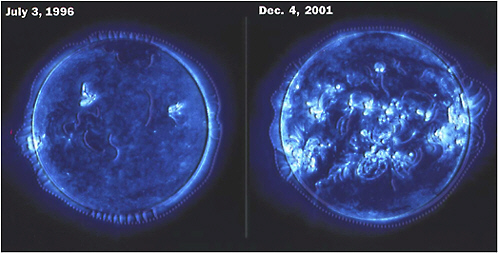
This is the Sun at two different times, on July 3, 1996 (on the left) and Dec. 4, 2001 (on the right). A solid line separates the two images.
Scan each image for brighter, raised areas of solar activity. Lower curved lines help outline areas of magnetic activity. Notice how active the Sun was during a solar maximum in 2001.
Credit: SOHO/EIT, NASA/ESA
Suggested Citation:
"12. Coronal Mass Ejections Over Time." Noreen Grice. 2005. Touch the Sun: A NASA Braille Book. Washington, DC: Joseph Henry Press.
doi: 10.17226/11219.
Subscribe to Emails from the National Academies
Stay up to date on activities, publications, and events by subscribing to email updates.