From Neutrinos to Narratives: An Interview with Katrina Miller
Feature Story
By Olivia Hamilton
Last update October 2, 2025
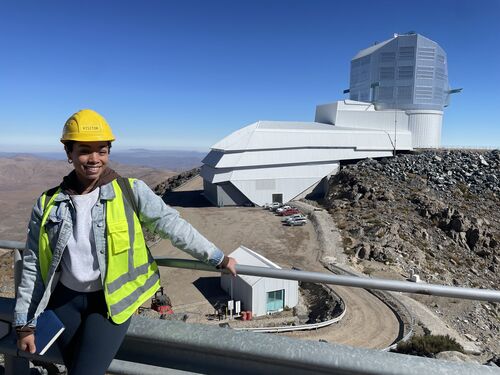
Katrina Miller at the Vera C. Rubin Observatory in Chile
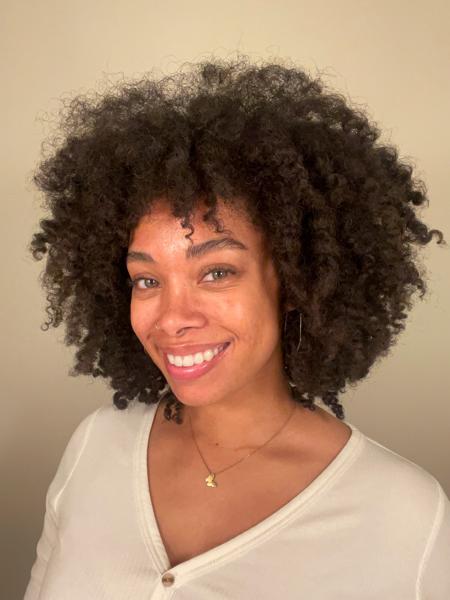
Katrina Miller is a science reporter for the New York Times. Based in Chicago, she writes about the universe and how the pursuit of understanding it impacts society. Miller joined the Times after earning a Ph.D. in physics from the University of Chicago, where she studied what tiny, subatomic particles known as neutrinos can reveal about the universe.
She was also a 2023 award winner of the National Academies’ Eric and Wendy Schmidt Awards for Excellence in Science Communications.
We asked Miller about covering astronomy and physics, shifting from research to journalism, and some of her recent stories.
What sparked your initial fascination with the universe?
Miller: My first grade teacher taught an astronomy unit. Every day we learned a new part of the solar system, then used the knowledge to make a newspaper about space. On the last day, we crawled into an inflatable planetarium and learned the constellations. The universe has been magical ever since.
What motivated your shift from conducting research on neutrinos to reporting on science?
Miller: I realized I loved learning physics more than I loved doing physics. Academia can also be very isolated from the rest of society, and I wanted to find a way to bridge that gap. I have always been a writer, so science journalism felt like a natural fit.
In your view, what makes a good science story, and how do you decide what to cover?
Miller: There is never a shortage of intriguing scientific phenomena to cover. But my favorite stories exist at the intersection of science and society — some new finding that impacts the public in a unique way, or an event or incident with some scientific angle.
You recently wrote about the Vera Rubin Observatory and its initial images, which were released in June. In one article, you noted that “for the first time, the number of observed celestial objects will be greater than the number of people living on Earth.” What was your personal reaction upon seeing these images for the first time?
Miller: Absolutely breathtaking. The Rubin images are so full of light it is difficult to believe that space is mostly empty. It was a reminder, in the best way, of how minor we are with respect to the universe.
In your reporting, you often highlight the human elements of scientific endeavors. How do you balance the technical aspects of astronomy and physics with the societal and human stories behind these discoveries?
Miller: Science is fundamentally a human endeavor, so to me, the emotions and experiences behind a discovery are just as important as the technical details. Sharing those more human elements also helps readers with less scientific expertise find something to connect with.
What kinds of science stories excite you the most right now? Are there emerging areas you’re particularly eager to cover or that you’re personally excited about?
Miller: The next few years will be an exciting time for cosmologists! They seem to be on the verge of discovering something very important about the nature of dark energy. I’m excited to play a role in breaking that news to the world.
Related Resources
The National Academies’ Eric and Wendy Schmidt Awards for Excellence in Science Communications