Civic Science Media: Reimagining How We Communicate Science
Feature Story
By Olivia Hamilton
Last update January 29, 2026
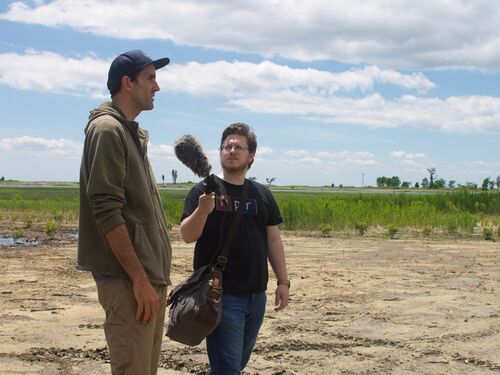
J.D. Allen in the field with NPR (photo by Sabrina Garone/WSHU Public Radio)
J.D. Allen has reported for public radio stations across the Northeast, investigating the climate crisis, health care, and small businesses, and real estate and land use for community newspapers on Long Island.
Allen is a journalism and science communication lecturer at Stony Brook University and co-host of “Higher Ground,” a climate podcast from WSHU Public Radio, with Sabrina Garone. As an accredited trainer with the Solutions Journalism Network, he helps newsrooms and classrooms cover responses to social problems.
Allen was a 2022 award winner of the National Academies’ Eric and Wendy Schmidt Awards for Excellence in Science Communications, which honor exceptional science communicators, journalists, and research scientists who have developed creative, original work to communicate issues and advances in science, engineering, or medicine for the general public.
We asked J.D. about the civic science media framework he uses to guide his work, his nuclear energy broadcast initiative, and how incorporating community engagement and solutions-focused journalism improves science storytelling.
You work at the intersection of journalism, climate communication, and higher education. How has your career path shaped the way you approach science communication today?
Allen: I spent most of the past decade in public media — producing stories for NPR and APM, while managing the local station, WSHU — reporting science stories the traditional way: Experts explain a problem with research, I report it, and the audience consumes it. One direction.
At some point, everything shifted. It might have been the attention given to the service that local community journalism provides to audiences, especially during the COVID-19 pandemic. Also, I learned around the same time how an engaged audience fosters and demands scientifically accessible, solutions-oriented reporting. Eventually, through many workshops, I established a set up principles for reporting on climate change and became certified to train others through the Solutions Journalism Network.
Now, teaching journalism and science communication at the State University of New York at Stony Brook, I am piecing together the lessons learned. The result is what I now call civic science media.
You’ve worked in both local and national media contexts. What have you learned about how scale — local versus national — changes the way science stories need to be told?
Allen: Local science reporting taught me that abstraction kills engagement. When I covered sea-level rise on Long Island, I didn’t start with global climate models — I started with flooded basements in specific neighborhoods. National audiences need that same specificity, just multiplied across geographies.
Scale also changes what “community voice” means. For our recent broadcast special, we couldn’t be in every affected community. But we could center the questions those communities are actually asking: Who bears the cost economically? What are the real risks? Why now?
The framework stays the same. The application adapts.
You recently outlined three pillars that guide your work: science communication, community engagement, and solutions journalism. Can you explain this framework and what led you to create it?
Allen: I didn’t set out to create a framework — I was trying to solve a problem. Honestly, it was to prevent my own burnout, give my work purpose, and share ideas.
Traditional science reporting wasn’t working. Audiences felt informed but helpless. Communities felt talked about, not talked with. On the flip side, important research was gathering dust in journals while real people made decisions without it.
So, I started combining three practices I’d seen work individually:
Making research accessible without dumbing it down
Documenting responses to problems, measuring what works, sharing insights/limitations
Involving communities in the storytelling process, when possible — not just extracting from them
When these three work together, you get something different. WSHU’s podcast “Higher Ground” used this approach and aired specials on 100+ stations for three years running, and was recognized with the National Academies’ Eric and Wendy Schmidt Awards for Excellence in Science Communications. Not because the science was simpler, but because communities saw themselves in the story and understood their agency. That’s civic science media.
You emphasize that science communication is “making research accessible without dumbing it down.” How does that idea shape the way you approach your stories?
Allen: It means I respect both the science and the audience.
For the nuclear energy special, we didn’t avoid technical concepts like radioactive isotopes or energy market economics. But we also didn’t assume everyone knows what a small modular reactor is. We explained clearly, used concrete examples, and trusted audiences to handle complexity.
The shift is this: Instead of asking, “how do I make this simpler?” I ask, “what context do people need to make this meaningful?” Those are very different questions with very different answers.
Community engagement is a core part of your work. What does it look like when communities are collaborators rather than subjects or audience members?
Allen: For “Higher Ground” Season 2, I trained middle school students to produce audio, not just be interview subjects. We gave them equipment, taught them journalism basics, and sent them into their Connecticut community to investigate climate impacts.
Their questions were sharper than most press conferences I’ve covered. They demanded evidence. They called out when adults were being evasive. They shaped the entire editorial direction.
That’s collaboration. When you center community voices, you don’t dilute the journalism. You strengthen it.
For the nuclear energy special, we hosted a 100-person forum on Governors Island before production. Scientists, policymakers, community members, students — two hours of genuine debate. Just wrestling with trade-offs together. The questions from that forum, our nation’s history of going nuclear, and renewed interest in policy reform became our reporting road map.
Have there been moments when community perspectives challenged your initial assumptions about a science story?
Allen: Constantly. And those are the most important moments.
When working on environmental justice stories in suburban Long Island, which has towns bigger than most cities in America, I assumed residents wanted stricter regulations on waste facilities. The trouble is, what happens when nobody wants a landfill or incinerator in their backyard?
That tension — environmental health versus a functioning society — completely reframed the story. I had to report on which policy interventions addressed both concerns, not just one. The community’s complexity made the journalism better.
Solutions journalism asks not just what’s happening, but what’s being done. Why is that framing especially important for climate and energy?
Allen: Because informed helplessness is worse than ignorance.
If I tell you sea levels are rising and stop there, I’ve increased your anxiety without increasing your agency. But if I also document how three coastal communities are responding — living shorelines, managed retreat, adaptive infrastructure — and examine the evidence of what’s working, now you’re equipped to be informed, to adapt, to act.
For nuclear energy, the stakes are even higher. We’re making 50- to 100-year infrastructure decisions right now. “Should we or shouldn’t we?” isn’t the only question. “If we do, what’s working — and what’s the process to implement? If we don’t, what are the alternatives? What can we learn from both paths?”
Solutions journalism doesn’t ignore problems. It completes the story.
How do you think about evidence and impact when covering responses to scientific challenges?
Allen: I’m looking for evidence of effectiveness, not just evidence of intentions. Lots of responses have good intentions. Fewer have evidence they’re actually working.
Rigorous evidence looks like:
Quantitative data. Has flooding decreased by measurable amounts? Has energy consumption changed? What do the numbers show?
Qualitative outcomes. Do community members report feeling more secure? Have behaviors changed?
Comparative context. How does this compare to other approaches or to doing nothing?
Time scale. Over what period has this been tested? Is it too early to tell?
Impact is about how communities feel more equipped to engage with the decision in front of them. This insight is about transferability. What worked in this specific context? What were the enabling conditions? What barriers had to be overcome? What might not transfer to other contexts?
What drew you to nuclear energy at this moment?
Allen: Three things converged. First, tech giants are making billion-dollar bets on nuclear — Microsoft restarting Three Mile Island, Google and Amazon investing in new nuclear. AI’s energy demand and changes in federal policy are forcing the conversation.
Second, it’s the most divisive topic in climate policy. Environmental scientists who agree on 99% of climate science are split on nuclear. That tension matters.
Third, and most importantly, my students are asking about it. In my environmental communication courses at Stony Brook, nuclear energy comes up constantly. Students see the climate crisis as existential — many will live with its impacts for their entire lives. They’re desperate for answers about viable paths forward. And they’re encountering wildly, seemingly contradictory information about nuclear.
This debate was the focus of Stony Brook’s Collaborative for the Earth (a campuswide climate initiative) last year. I use the production of its podcast “C4E Presents” as a teaching tool for students.
During this debate at the New York Climate Exchange on Governors Island last April, we heard arguments that nuclear [power] is dangerous, expensive, and unnecessary. We also heard that nuclear is essential for decarbonization. Students want help navigating that contradiction.
When the next generation is asking hard questions about energy futures, those of us in science communication have a responsibility to help them think through it rigorously, not dogmatically. So, when Heather Lynch, director of the Collaborative for the Earth, proposed we tackle this topic, it felt like the right moment and the right partnership.
How did cross-disciplinary collaboration shape the story?
Allen: As I learned years ago, climate journalism works best as collaboration among scientists, communicators, media, and communities.
For this nuclear special, having Heather Lynch — a quantitative ecologist — as co-producer meant scientific expertise was embedded from day one. There were no shortcuts taken to say small modular reactors are “safer because they’re smaller.” Heather pressed, “They have less radioactive material, which reduces certain risks, but different safety profiles. Let’s be precise.” That real-time fact-checking elevated every script.
And the team extended beyond us. Yes, scientists provided data and context. Stony Brook’s Collaborative for the Earth hosted its 100+ person forum, connecting us with Georgia Tech, NYU, and the New York Climate Exchange. We interviewed dozens of experts from the U.S. Nuclear Regulatory Commission to Moody’s and the Union of Concerned Scientists.
We examined both promise and limitations. We centered community concerns about safety, economics, and timelines. We sought to build diverse expertise into the production process, not just as a source list.
Yes, it took a lot more time. But the journalism is stronger.
What does success look like for this broadcast?
Allen: Not consensus. Conversation.
Success is someone listening and thinking, “I need to learn more about this.” Or, “I understand the trade-offs better now.” Or even, “I still disagree, but I see why others think differently.”
Also, I know everyone is attracted to the numbers and reach. Previous specials that I have produced were aired by more than 100 stations in 20+ states, so estimated millions of listeners.
If this special moves people from reflexive positions to informed engagement, we’ve succeeded.
What do you hope audiences take away from stories that combine science, community voices, and solutions?
Allen: That they’re capable of engaging with complexity. That their questions and concerns matter in scientific debates. That there are people responding to these challenges, and we can learn from what’s working and what’s not.
Most importantly, that science communication should empower, not just inform.
What lessons would you want other science communicators to take forward?
Allen: Three things:
First, stop defaulting to doom. Document responses alongside problems. Audiences need agency, not just anxiety.
Second, communities aren’t just sources or audiences — they’re collaborators. Center their voices and, when possible, participation. Their questions will make your journalism better.
Third, complexity isn’t the enemy. Condescension is. Trust your audience. Give them context, evidence, and respect. They’ll engage.
This is what civic science media looks like in practice. And it works.