Evaluating Crashworthiness of Sign Supports and Breakaway Luminaire Poles: Appendices (2024)
Chapter: Appendix L: Detailed Simulation Results PSST Sign Support System
APPENDIX L
Detailed Simulation Results
PSST Sign Support System
Summary results from the PSST sign support system simulations are shown in the following tables. A matrix of simulations on a family of PSST systems with a post size of 2¼-in. x 2¼-in. x 12 gauge was carried out. The matrix included simulations with different panel sizes (1 ft x 1.5 ft, 2 ft x 2 ft, 2.5 ft x 2.5 ft, 3 ft x 3 ft, 3 ft x 4 ft, and 4 ft x 5 ft), different impact conditions (MASH test no. 3-60 with gold colored Yaris, MASH test no. 3-61 with red colored Yaris, and MASH test no. 3-62 with blue colored Silverado), different impact locations (center, driver-side offset, and passenger-side offset), and different impact angles (0, +25, and −25 degrees).
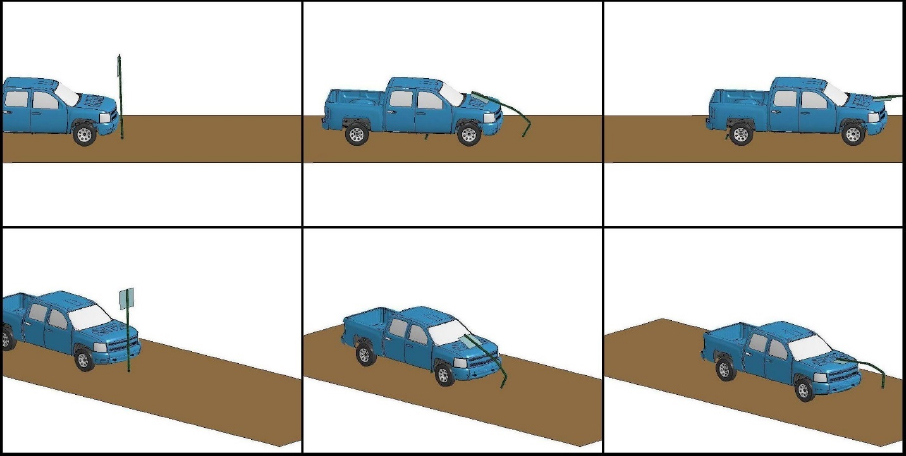
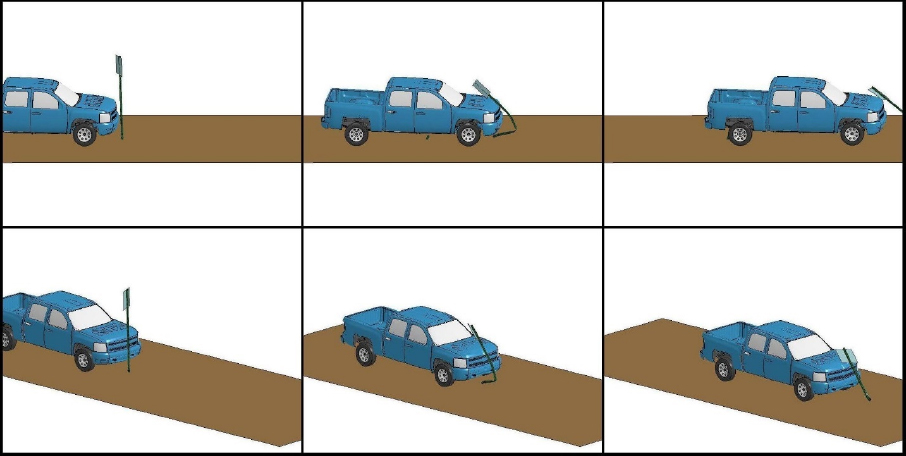
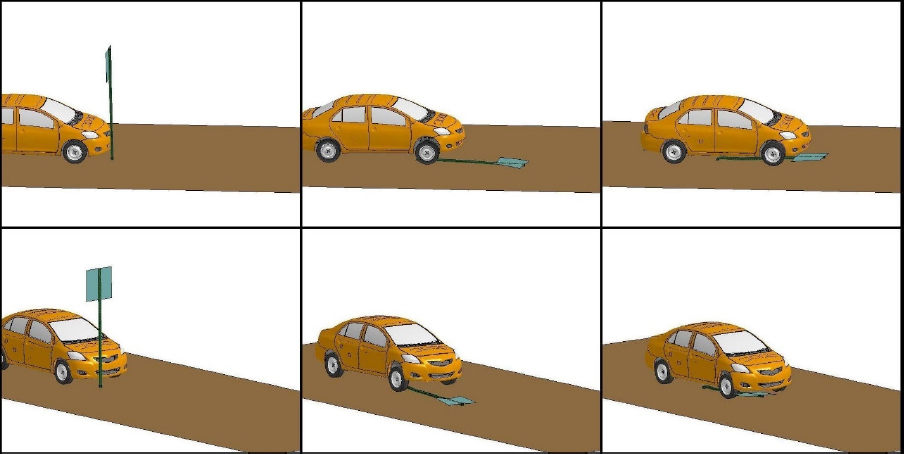
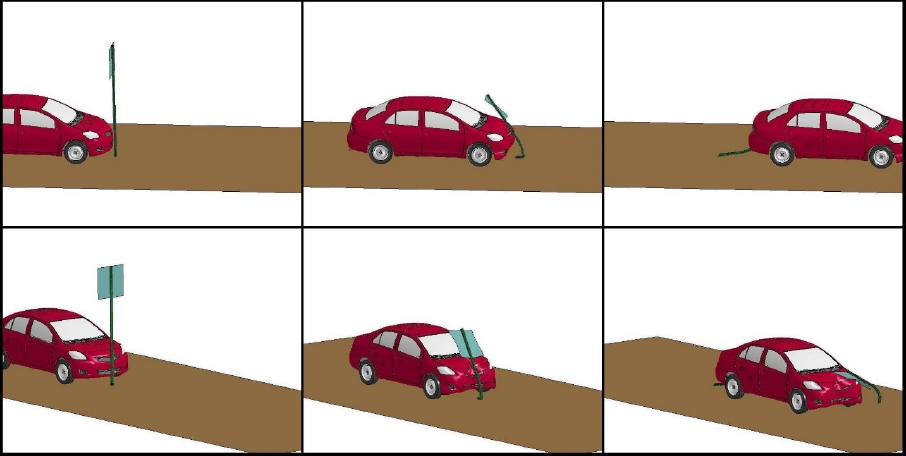
Results from each simulation are included in a summary table. Each table shows the predicted behavior of the PSST sign support system, the vehicle, and all the pertinent MASH metrics and evaluations. The basic system features and impact conditions are indicated in upper part of the table. The pictures below the heading show “snapshots” of the vehicle and sign positions at three points in time from two different views. The visual snapshots provide a convenient means to assess the performance of the sign support system. The lower part of the table provides a summary of the MASH crashworthiness evaluation metrics for the condition simulated and indicate whether they are met (pass/fail).
Summary of Results for Cases

| Single PSST Post Sign Support System Mounting-Height: 7 ft; A1011 Gr.50 Post; Aluminum Panel; Anchor Embedment depth: 36 in | ||||||||||
| Post Size | Anchor Size | Panel Size | MASH Impact | Impact Location | Impact Angle | Wind Beam | ||||
| 2¼” x 2¼” 12 gauge | 2½” x 2½” 12 gauge | 1’ x 1.5’ 0.08” thick | 3-60 | Center | 0 deg | No | ||||
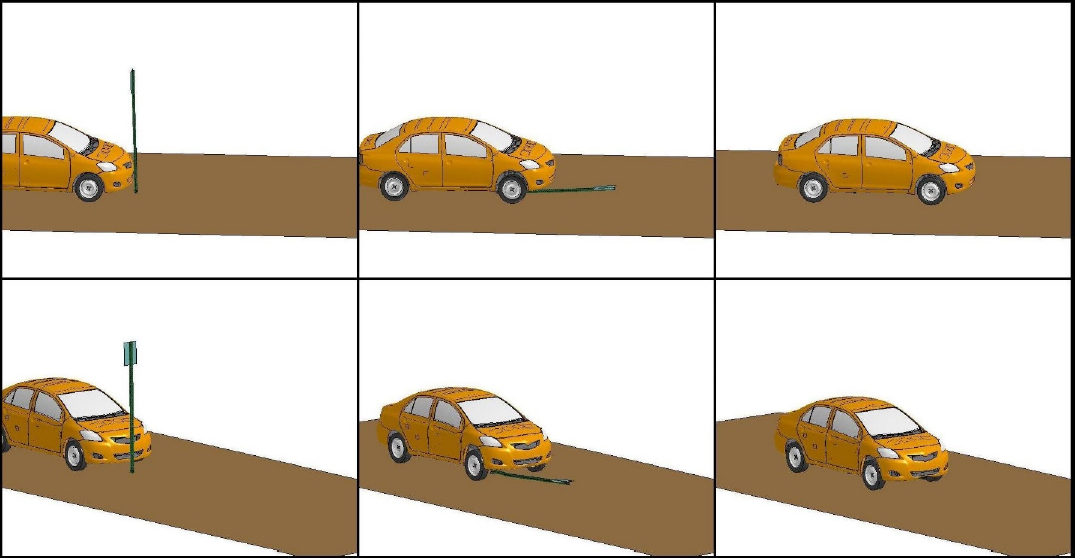 | ||||||||||
| Evaluation Criteria | ||||||||||
| B | The test article should readily activate in a predictable manner by breaking away, fracturing, or yielding. | Pass | ||||||||
| D | Detached elements, fragments, or other debris from the test article should not penetrate or show potential for penetrating the occupant compartment, or present undue hazard to other traffic, pedestrians, or personnel in a work zone. | Pass | ||||||||
| All Deformations of, or intrusions into, the occupant compartment should not exceed limits set forth in Section 5.3 and Appendix E of MASH. [Roof less than 4.0 in (101.6 mm). Windshield-no tear of plastic liner and maximum deformation of 3 in (76.2 mm)] | Roof ≤ 101.6 mm | 0 | Pass | |||||||
| Windshield ≤ 76.2 mm | 0 | |||||||||
| F | The vehicle should remain upright during and after the collision. The maximum pitch & roll angles are not to exceed 75 degrees. | Max Roll (Deg) | 0 | Pass | ||||||
| Max Pitch (Deg) | 1 | |||||||||
| H | Longitudinal & lateral occupant impact velocities (OIV) should fall below the preferred value of 10 ft/s (3.0 m/s), or at least below the maximum allowed value of 16 ft/s (4.9 m/s) | Vx (m/s) | 1.6 | Pass | ||||||
| Vy (m/s) | 0.0 | |||||||||
| I | Longitudinal & lateral occupant ridedown accelerations (ORA) should fall below the preferred value of 15.0 g, or at least below the maximum allowed value of 20.49 g | Ax (g) | 0.2 | Pass | ||||||
| Ay (g) | 0.2 | |||||||||
| N | Vehicle trajectory behind the test article is acceptable | Pass | ||||||||
| Single PSST Post Sign Support System Mounting-Height: 7 ft; A1011 Gr.50 Post; Aluminum Panel; Anchor Embedment depth: 36 in | ||||||||||
| Post Size | Anchor Size | Panel Size | MASH Impact | Impact Location | Impact Angle | Wind Beam | ||||
| 2¼” x 2¼” 12 gauge | 2½” x 2½” 12 gauge | 1’ x 1.5’ 0.08” thick | 3-60 | Offset Driver | 0 deg | No | ||||
 | ||||||||||
| Evaluation Criteria | ||||||||||
| B | The test article should readily activate in a predictable manner by breaking away, fracturing, or yielding. | Pass | ||||||||
| D | Detached elements, fragments, or other debris from the test article should not penetrate or show potential for penetrating the occupant compartment, or present undue hazard to other traffic, pedestrians, or personnel in a work zone. | Pass | ||||||||
| All Deformations of, or intrusions into, the occupant compartment should not exceed limits set forth in Section 5.3 and Appendix E of MASH. [Roof less than 4.0 in (101.6 mm). Windshield-no tear of plastic liner and maximum deformation of 3 in (76.2 mm)] | Roof ≤ 101.6 mm | 0 | Pass | |||||||
| Windshield ≤ 76.2 mm | 0 | |||||||||
| F | The vehicle should remain upright during and after the collision. The maximum pitch & roll angles are not to exceed 75 degrees. | Max Roll (Deg) | 1 | Pass | ||||||
| Max Pitch (Deg) | 1 | |||||||||
| H | Longitudinal & lateral occupant impact velocities (OIV) should fall below the preferred value of 10 ft/s (3.0 m/s), or at least below the maximum allowed value of 16 ft/s (4.9 m/s) | Vx (m/s) | 1.8 | Pass | ||||||
| Vy (m/s) | 0.0 | |||||||||
| I | Longitudinal & lateral occupant ridedown accelerations (ORA) should fall below the preferred value of 15.0 g, or at least below the maximum allowed value of 20.49 g | Ax (g) | 0.4 | Pass | ||||||
| Ay (g) | 0.4 | |||||||||
| N | Vehicle trajectory behind the test article is acceptable | Pass | ||||||||
| Single PSST Post Sign Support System Mounting-Height: 7 ft; A1011 Gr.50 Post; Aluminum Panel; Anchor Embedment depth: 36 in | ||||||||||
| Post Size | Anchor Size | Panel Size | MASH Impact | Impact Location | Impact Angle | Wind Beam | ||||
| 2¼” x 2¼” 12 gauge | 2½” x 2½” 12 gauge | 1’ x 1.5’ 0.08” thick | 3-60 | Offset Passenger | 0 deg | No | ||||
 | ||||||||||
| Evaluation Criteria | ||||||||||
| B | The test article should readily activate in a predictable manner by breaking away, fracturing, or yielding. | Pass | ||||||||
| D | Detached elements, fragments, or other debris from the test article should not penetrate or show potential for penetrating the occupant compartment, or present undue hazard to other traffic, pedestrians, or personnel in a work zone. | Pass | ||||||||
| All Deformations of, or intrusions into, the occupant compartment should not exceed limits set forth in Section 5.3 and Appendix E of MASH. [Roof less than 4.0 in (101.6 mm). Windshield-no tear of plastic liner and maximum deformation of 3 in (76.2 mm)] | Roof ≤ 101.6 mm | 0 | Pass | |||||||
| Windshield ≤ 76.2 mm | 0 | |||||||||
| F | The vehicle should remain upright during and after the collision. The maximum pitch & roll angles are not to exceed 75 degrees. | Max Roll (Deg) | 1 | Pass | ||||||
| Max Pitch (Deg) | 1 | |||||||||
| H | Longitudinal & lateral occupant impact velocities (OIV) should fall below the preferred value of 10 ft/s (3.0 m/s), or at least below the maximum allowed value of 16 ft/s (4.9 m/s) | Vx (m/s) | 1.8 | Pass | ||||||
| Vy (m/s) | 0.0 | |||||||||
| I | Longitudinal & lateral occupant ridedown accelerations (ORA) should fall below the preferred value of 15.0 g, or at least below the maximum allowed value of 20.49 g | Ax (g) | 0.4 | Pass | ||||||
| Ay (g) | 0.5 | |||||||||
| N | Vehicle trajectory behind the test article is acceptable | Pass | ||||||||
| Single PSST Post Sign Support System Mounting-Height: 7 ft; A1011 Gr.50 Post; Aluminum Panel; Anchor Embedment depth: 36 in | ||||||||||
| Post Size | Anchor Size | Panel Size | MASH Impact | Impact Location | Impact Angle | Wind Beam | ||||
| 2¼” x 2¼” 12 gauge | 2½” x 2½” 12 gauge | 1’ x 1.5’ 0.08” thick | 3-61 | Center | 0 deg | No | ||||
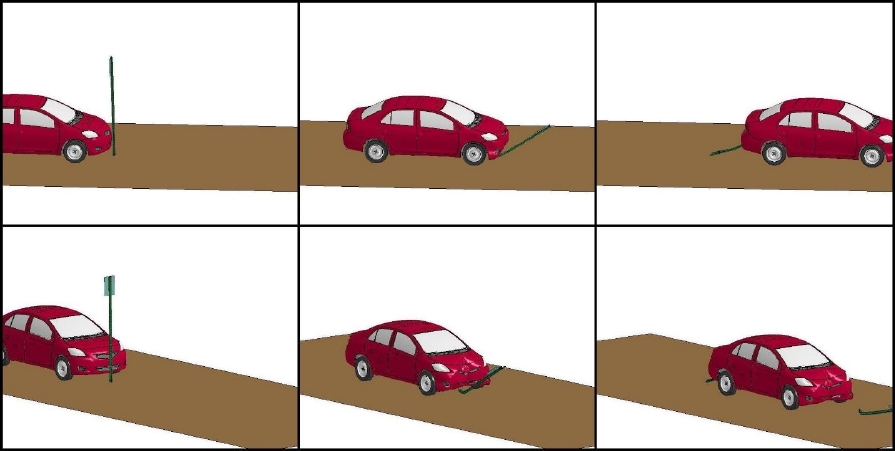 | ||||||||||
| Evaluation Criteria | ||||||||||
| B | The test article should readily activate in a predictable manner by breaking away, fracturing, or yielding. | Pass | ||||||||
| D | Detached elements, fragments, or other debris from the test article should not penetrate or show potential for penetrating the occupant compartment, or present undue hazard to other traffic, pedestrians, or personnel in a work zone. | Pass | ||||||||
| All Deformations of, or intrusions into, the occupant compartment should not exceed limits set forth in Section 5.3 and Appendix E of MASH. [Roof less than 4.0 in (101.6 mm). Windshield-no tear of plastic liner and maximum deformation of 3 in (76.2 mm)] | Roof ≤ 101.6 mm | 0 | Pass | |||||||
| Windshield ≤ 76.2 mm | 0 | |||||||||
| F | The vehicle should remain upright during and after the collision. The maximum pitch & roll angles are not to exceed 75 degrees. | Max Roll (Deg) | 1 | Pass | ||||||
| Max Pitch (Deg) | 1 | |||||||||
| H | Longitudinal & lateral occupant impact velocities (OIV) should fall below the preferred value of 10 ft/s (3.0 m/s), or at least below the maximum allowed value of 16 ft/s (4.9 m/s) | Vx (m/s) | 1.0 | Pass | ||||||
| Vy (m/s) | 0.0 | |||||||||
| I | Longitudinal & lateral occupant ridedown accelerations (ORA) should fall below the preferred value of 15.0 g, or at least below the maximum allowed value of 20.49 g | Ax (g) | 0.0 | Pass | ||||||
| Ay (g) | 0.0 | |||||||||
| N | Vehicle trajectory behind the test article is acceptable | Pass | ||||||||
| Single PSST Post Sign Support System Mounting-Height: 7 ft; A1011 Gr.50 Post; Aluminum Panel; Anchor Embedment depth: 36 in | ||||||||||
| Post Size | Anchor Size | Panel Size | MASH Impact | Impact Location | Impact Angle | Wind Beam | ||||
| 2¼” x 2¼” 12 gauge | 2½” x 2½” 12 gauge | 1’ x 1.5’ 0.08” thick | 3-61 | Center | -25 deg | No | ||||
 | ||||||||||
| Evaluation Criteria | ||||||||||
| B | The test article should readily activate in a predictable manner by breaking away, fracturing, or yielding. | Pass | ||||||||
| D | Detached elements, fragments, or other debris from the test article should not penetrate or show potential for penetrating the occupant compartment, or present undue hazard to other traffic, pedestrians, or personnel in a work zone. | Pass | ||||||||
| All Deformations of, or intrusions into, the occupant compartment should not exceed limits set forth in Section 5.3 and Appendix E of MASH. [Roof less than 4.0 in (101.6 mm). Windshield-no tear of plastic liner and maximum deformation of 3 in (76.2 mm)] | Roof ≤ 101.6 mm | 0 | Pass | |||||||
| Windshield ≤ 76.2 mm | 0 | |||||||||
| F | The vehicle should remain upright during and after the collision. The maximum pitch & roll angles are not to exceed 75 degrees. | Max Roll (Deg) | 0 | Pass | ||||||
| Max Pitch (Deg) | 1 | |||||||||
| H | Longitudinal & lateral occupant impact velocities (OIV) should fall below the preferred value of 10 ft/s (3.0 m/s), or at least below the maximum allowed value of 16 ft/s (4.9 m/s) | Vx (m/s) | 1.8 | Pass | ||||||
| Vy (m/s) | 0.0 | |||||||||
| I | Longitudinal & lateral occupant ridedown accelerations (ORA) should fall below the preferred value of 15.0 g, or at least below the maximum allowed value of 20.49 g | Ax (g) | 0.0 | Pass | ||||||
| Ay (g) | 0.0 | |||||||||
| N | Vehicle trajectory behind the test article is acceptable | Pass | ||||||||
| Single PSST Post Sign Support System Mounting-Height: 7 ft; A1011 Gr.50 Steel Post; Aluminum Panel; Anchor Embedment depth: 36 in | ||||||||||
| Post Size | Anchor Size | Panel Size | MASH Impact | Impact Location | Impact Angle | Wind Beam | ||||
| 2¼” x 2¼” 12 gauge | 2½” x 2½” 12 gauge | 1’ x 1.5’ 0.08” thick | 3-61 | Center | +25 deg | No | ||||
 | ||||||||||
| Evaluation Criteria | ||||||||||
| B | The test article should readily activate in a predictable manner by breaking away, fracturing, or yielding. | Pass | ||||||||
| D | Detached elements, fragments, or other debris from the test article should not penetrate or show potential for penetrating the occupant compartment, or present undue hazard to other traffic, pedestrians, or personnel in a work zone. | Pass | ||||||||
| All Deformations of, or intrusions into, the occupant compartment should not exceed limits set forth in Section 5.3 and Appendix E of MASH. [Roof less than 4.0 in (101.6 mm). Windshield-no tear of plastic liner and maximum deformation of 3 in (76.2 mm)] | Roof ≤ 101.6 mm | 0 | Pass | |||||||
| Windshield ≤ 76.2 mm | 0 | |||||||||
| F | The vehicle should remain upright during and after the collision. The maximum pitch & roll angles are not to exceed 75 degrees. | Max Roll (Deg) | 0 | Pass | ||||||
| Max Pitch (Deg) | 1 | |||||||||
| H | Longitudinal & lateral occupant impact velocities (OIV) should fall below the preferred value of 10 ft/s (3.0 m/s), or at least below the maximum allowed value of 16 ft/s (4.9 m/s) | Vx (m/s) | 1.5 | Pass | ||||||
| Vy (m/s) | 0.0 | |||||||||
| I | Longitudinal & lateral occupant ridedown accelerations (ORA) should fall below the preferred value of 15.0 g, or at least below the maximum allowed value of 20.49 g | Ax (g) | 0.0 | Pass | ||||||
| Ay (g) | 0.0 | |||||||||
| N | Vehicle trajectory behind the test article is acceptable | Pass | ||||||||
| Single PSST Post Sign Support System Mounting-Height: 7 ft; A1011 Gr.50 Post; Aluminum Panel; Anchor Embedment depth: 36 in | ||||||||||
| Post Size | Anchor Size | Panel Size | MASH Impact | Impact Location | Impact Angle | Wind Beam | ||||
| 2¼” x 2¼” 12 gauge | 2½” x 2½” 12 gauge | 1’ x 1.5’ 0.08” thick | 3-61 | Offset Driver | 0 deg | No | ||||
 | ||||||||||
| Evaluation Criteria | ||||||||||
| B | The test article should readily activate in a predictable manner by breaking away, fracturing, or yielding. | Pass | ||||||||
| D | Detached elements, fragments, or other debris from the test article should not penetrate or show potential for penetrating the occupant compartment, or present undue hazard to other traffic, pedestrians, or personnel in a work zone. | Pass | ||||||||
| All Deformations of, or intrusions into, the occupant compartment should not exceed limits set forth in Section 5.3 and Appendix E of MASH. [Roof less than 4.0 in (101.6 mm). Windshield-no tear of plastic liner and maximum deformation of 3 in (76.2 mm)] | Roof ≤ 101.6 mm | 0 | Fail | |||||||
| Windshield ≤ 76.2 mm | 30 (tear) | |||||||||
| F | The vehicle should remain upright during and after the collision. The maximum pitch & roll angles are not to exceed 75 degrees. | Max Roll (Deg) | 1 | Pass | ||||||
| Max Pitch (Deg) | 2 | |||||||||
| H | Longitudinal & lateral occupant impact velocities (OIV) should fall below the preferred value of 10 ft/s (3.0 m/s), or at least below the maximum allowed value of 16 ft/s (4.9 m/s) | Vx (m/s) | 1.0 | Pass | ||||||
| Vy (m/s) | 0.3 | |||||||||
| I | Longitudinal & lateral occupant ridedown accelerations (ORA) should fall below the preferred value of 15.0 g, or at least below the maximum allowed value of 20.49 g | Ax (g) | 0.0 | Pass | ||||||
| Ay (g) | 0.0 | |||||||||
| N | Vehicle trajectory behind the test article is acceptable | Pass | ||||||||
| Single PSST Post Sign Support System Mounting-Height: 7 ft; A1011 Gr.50 Post; Aluminum Panel; Anchor Embedment depth: 36 in | ||||||||||
| Post Size | Anchor Size | Panel Size | MASH Impact | Impact Location | Impact Angle | Wind Beam | ||||
| 2¼” x 2¼” 12 gauge | 2½” x 2½” 12 gauge | 1’ x 1.5’ 0.08” thick | 3-62 | Center | 0 deg | No | ||||
 | ||||||||||
| Evaluation Criteria | ||||||||||
| B | The test article should readily activate in a predictable manner by breaking away, fracturing, or yielding. | Pass | ||||||||
| D | Detached elements, fragments, or other debris from the test article should not penetrate or show potential for penetrating the occupant compartment, or present undue hazard to other traffic, pedestrians, or personnel in a work zone. | Pass | ||||||||
| All Deformations of, or intrusions into, the occupant compartment should not exceed limits set forth in Section 5.3 and Appendix E of MASH. [Roof less than 4.0 in (101.6 mm). Windshield-no tear of plastic liner and maximum deformation of 3 in (76.2 mm)] | Roof ≤ 101.6 mm | 0 | Pass | |||||||
| Windshield ≤ 76.2 mm | 0 | |||||||||
| F | The vehicle should remain upright during and after the collision. The maximum pitch & roll angles are not to exceed 75 degrees. | Max Roll (Deg) | 0 | Pass | ||||||
| Max Pitch (Deg) | 0 | |||||||||
| H | Longitudinal & lateral occupant impact velocities (OIV) should fall below the preferred value of 10 ft/s (3.0 m/s), or at least below the maximum allowed value of 16 ft/s (4.9 m/s) | Vx (m/s) | 0.6 | Pass | ||||||
| Vy (m/s) | 0.0 | |||||||||
| I | Longitudinal & lateral occupant ridedown accelerations (ORA) should fall below the preferred value of 15.0 g, or at least below the maximum allowed value of 20.49 g | Ax (g) | 0.0 | Pass | ||||||
| Ay (g) | 0.0 | |||||||||
| N | Vehicle trajectory behind the test article is acceptable | Pass | ||||||||
| Single PSST Post Sign Support System Mounting-Height: 7 ft; A1011 Gr.50 Post; Aluminum Panel; Anchor Embedment depth: 36 in | ||||||||||
| Post Size | Anchor Size | Panel Size | MASH Impact | Impact Location | Impact Angle | Wind Beam | ||||
| 2¼” x 2¼” 12 gauge | 2½” x 2½” 12 gauge | 1’ x 1.5’ 0.08” thick | 3-62 | Center | +25 | No | ||||
 | ||||||||||
| Evaluation Criteria | ||||||||||
| B | The test article should readily activate in a predictable manner by breaking away, fracturing, or yielding. | Pass | ||||||||
| D | Detached elements, fragments, or other debris from the test article should not penetrate or show potential for penetrating the occupant compartment, or present undue hazard to other traffic, pedestrians, or personnel in a work zone. | Pass | ||||||||
| All Deformations of, or intrusions into, the occupant compartment should not exceed limits set forth in Section 5.3 and Appendix E of MASH. [Roof less than 4.0 in (101.6 mm). Windshield-no tear of plastic liner and maximum deformation of 3 in (76.2 mm)] | Roof ≤ 101.6 mm | 0 | Pass | |||||||
| Windshield ≤ 76.2 mm | 0 | |||||||||
| F | The vehicle should remain upright during and after the collision. The maximum pitch & roll angles are not to exceed 75 degrees. | Max Roll (Deg) | 0 | Pass | ||||||
| Max Pitch (Deg) | 0 | |||||||||
| H | Longitudinal & lateral occupant impact velocities (OIV) should fall below the preferred value of 10 ft/s (3.0 m/s), or at least below the maximum allowed value of 16 ft/s (4.9 m/s) | Vx (m/s) | 0.5 | Pass | ||||||
| Vy (m/s) | 0.0 | |||||||||
| I | Longitudinal & lateral occupant ridedown accelerations (ORA) should fall below the preferred value of 15.0 g, or at least below the maximum allowed value of 20.49 g | Ax (g) | 0.0 | Pass | ||||||
| Ay (g) | 0.0 | |||||||||
| N | Vehicle trajectory behind the test article is acceptable | Pass | ||||||||
| Single PSST Post Sign Support System Mounting-Height: 7 ft; A1011 Gr.50 Post; Aluminum Panel; Anchor Embedment depth: 36 in | ||||||||||
| Post Size | Anchor Size | Panel Size | MASH Impact | Impact Location | Impact Angle | Wind Beam | ||||
| 2¼” x 2¼” 12 gauge | 2½” x 2½” 12 gauge | 1’ x 1.5’ 0.12” thick | 3-60 | Center | 0 deg | No | ||||
 | ||||||||||
| Evaluation Criteria | ||||||||||
| B | The test article should readily activate in a predictable manner by breaking away, fracturing, or yielding. | Pass | ||||||||
| D | Detached elements, fragments, or other debris from the test article should not penetrate or show potential for penetrating the occupant compartment, or present undue hazard to other traffic, pedestrians, or personnel in a work zone. | Pass | ||||||||
| All Deformations of, or intrusions into, the occupant compartment should not exceed limits set forth in Section 5.3 and Appendix E of MASH. [Roof less than 4.0 in (101.6 mm). Windshield-no tear of plastic liner and maximum deformation of 3 in (76.2 mm)] | Roof ≤ 101.6 mm | 0 | Pass | |||||||
| Windshield ≤ 76.2 mm | 0 | |||||||||
| F | The vehicle should remain upright during and after the collision. The maximum pitch & roll angles are not to exceed 75 degrees. | Max Roll (Deg) | 0 | Pass | ||||||
| Max Pitch (Deg) | 2 | |||||||||
| H | Longitudinal & lateral occupant impact velocities (OIV) should fall below the preferred value of 10 ft/s (3.0 m/s), or at least below the maximum allowed value of 16 ft/s (4.9 m/s) | Vx (m/s) | 1.7 | Pass | ||||||
| Vy (m/s) | 0.0 | |||||||||
| I | Longitudinal & lateral occupant ridedown accelerations (ORA) should fall below the preferred value of 15.0 g, or at least below the maximum allowed value of 20.49 g | Ax (g) | 0.2 | Pass | ||||||
| Ay (g) | 0.2 | |||||||||
| N | Vehicle trajectory behind the test article is acceptable | Pass | ||||||||
| Single PSST Post Sign Support System Mounting-Height: 7 ft; A1011 Gr.50 Post; Aluminum Panel; Anchor Embedment depth: 36 in | ||||||||||
| Post Size | Anchor Size | Panel Size | MASH Impact | Impact Location | Impact Angle | Wind Beam | ||||
| 2¼” x 2¼” 12 gauge | 2½” x 2½” 12 gauge | 1’ x 1.5’ 0.12” thick | 3-60 | Offset Driver | 0 deg | No | ||||
 | ||||||||||
| Evaluation Criteria | ||||||||||
| B | The test article should readily activate in a predictable manner by breaking away, fracturing, or yielding. | Pass | ||||||||
| D | Detached elements, fragments, or other debris from the test article should not penetrate or show potential for penetrating the occupant compartment, or present undue hazard to other traffic, pedestrians, or personnel in a work zone. | Pass | ||||||||
| All Deformations of, or intrusions into, the occupant compartment should not exceed limits set forth in Section 5.3 and Appendix E of MASH. [Roof less than 4.0 in (101.6 mm). Windshield-no tear of plastic liner and maximum deformation of 3 in (76.2 mm)] | Roof ≤ 101.6 mm | 0 | Pass | |||||||
| Windshield ≤ 76.2 mm | 0 | |||||||||
| F | The vehicle should remain upright during and after the collision. The maximum pitch & roll angles are not to exceed 75 degrees. | Max Roll (Deg) | 1 | Pass | ||||||
| Max Pitch (Deg) | 2 | |||||||||
| H | Longitudinal & lateral occupant impact velocities (OIV) should fall below the preferred value of 10 ft/s (3.0 m/s), or at least below the maximum allowed value of 16 ft/s (4.9 m/s) | Vx (m/s) | 1.9 | Pass | ||||||
| Vy (m/s) | 0.0 | |||||||||
| I | Longitudinal & lateral occupant ridedown accelerations (ORA) should fall below the preferred value of 15.0 g, or at least below the maximum allowed value of 20.49 g | Ax (g) | 0.4 | Pass | ||||||
| Ay (g) | 0.7 | |||||||||
| N | Vehicle trajectory behind the test article is acceptable | Pass | ||||||||
| Single PSST Post Sign Support System Mounting-Height: 7 ft; A1011 Gr.50 Post; Aluminum Panel; Anchor Embedment depth: 36 in | ||||||||||
| Post Size | Anchor Size | Panel Size | MASH Impact | Impact Location | Impact Angle | Wind Beam | ||||
| 2¼” x 2¼” 12 gauge | 2½” x 2½” 12 gauge | 1’ x 1.5’ 0.12” thick | 3-60 | Offset Passenger | 0 deg | No | ||||
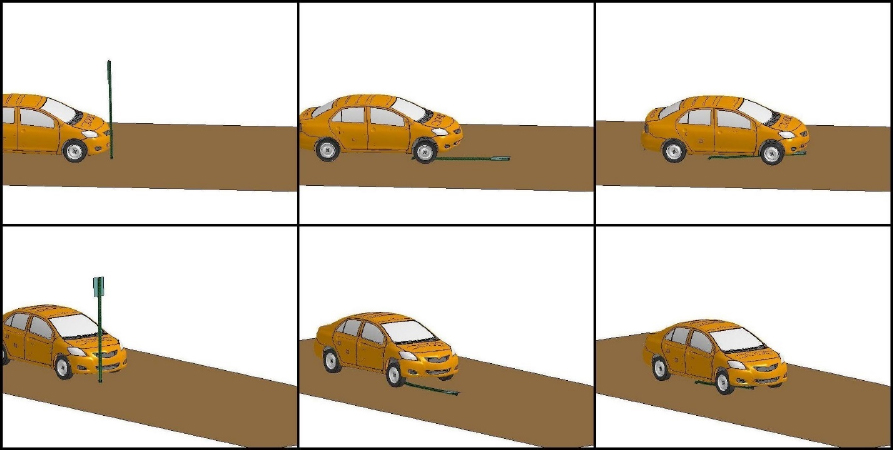 | ||||||||||
| Evaluation Criteria | ||||||||||
| B | The test article should readily activate in a predictable manner by breaking away, fracturing, or yielding. | Pass | ||||||||
| D | Detached elements, fragments, or other debris from the test article should not penetrate or show potential for penetrating the occupant compartment, or present undue hazard to other traffic, pedestrians, or personnel in a work zone. | Pass | ||||||||
| All Deformations of, or intrusions into, the occupant compartment should not exceed limits set forth in Section 5.3 and Appendix E of MASH. [Roof less than 4.0 in (101.6 mm). Windshield-no tear of plastic liner and maximum deformation of 3 in (76.2 mm)] | Roof ≤ 101.6 mm | 0 | Pass | |||||||
| Windshield ≤ 76.2 mm | 0 | |||||||||
| F | The vehicle should remain upright during and after the collision. The maximum pitch & roll angles are not to exceed 75 degrees. | Max Roll (Deg) | 1 | Pass | ||||||
| Max Pitch (Deg) | 1 | |||||||||
| H | Longitudinal & lateral occupant impact velocities (OIV) should fall below the preferred value of 10 ft/s (3.0 m/s), or at least below the maximum allowed value of 16 ft/s (4.9 m/s) | Vx (m/s) | 1.8 | Pass | ||||||
| Vy (m/s) | 0.1 | |||||||||
| I | Longitudinal & lateral occupant ridedown accelerations (ORA) should fall below the preferred value of 15.0 g, or at least below the maximum allowed value of 20.49 g | Ax (g) | 0.5 | Pass | ||||||
| Ay (g) | 0.6 | |||||||||
| N | Vehicle trajectory behind the test article is acceptable | Pass | ||||||||
| Single PSST Post Sign Support System Mounting-Height: 7 ft; A1011 Gr.50 Post; Aluminum Panel; Anchor Embedment depth: 36 in | ||||||||||
| Post Size | Anchor Size | Panel Size | MASH Impact | Impact Location | Impact Angle | Wind Beam | ||||
| 2¼” x 2¼” 12 gauge | 2½” x 2½” 12 gauge | 1’ x 1.5’ 0.12” thick | 3-61 | Center | 0 deg | No | ||||
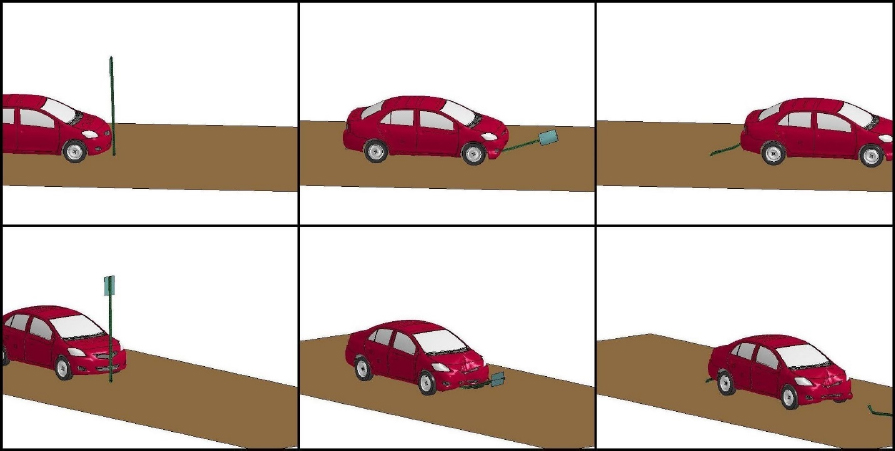 | ||||||||||
| Evaluation Criteria | ||||||||||
| B | The test article should readily activate in a predictable manner by breaking away, fracturing, or yielding. | Pass | ||||||||
| D | Detached elements, fragments, or other debris from the test article should not penetrate or show potential for penetrating the occupant compartment, or present undue hazard to other traffic, pedestrians, or personnel in a work zone. | Pass | ||||||||
| All Deformations of, or intrusions into, the occupant compartment should not exceed limits set forth in Section 5.3 and Appendix E of MASH. [Roof less than 4.0 in (101.6 mm). Windshield-no tear of plastic liner and maximum deformation of 3 in (76.2 mm)] | Roof ≤ 101.6 mm | 0 | Pass | |||||||
| Windshield ≤ 76.2 mm | 0 | |||||||||
| F | The vehicle should remain upright during and after the collision. The maximum pitch & roll angles are not to exceed 75 degrees. | Max Roll (Deg) | 0 | Pass | ||||||
| Max Pitch (Deg) | 1 | |||||||||
| H | Longitudinal & lateral occupant impact velocities (OIV) should fall below the preferred value of 10 ft/s (3.0 m/s), or at least below the maximum allowed value of 16 ft/s (4.9 m/s) | Vx (m/s) | 1.9 | Pass | ||||||
| Vy (m/s) | 0.0 | |||||||||
| I | Longitudinal & lateral occupant ridedown accelerations (ORA) should fall below the preferred value of 15.0 g, or at least below the maximum allowed value of 20.49 g | Ax (g) | 0.0 | Pass | ||||||
| Ay (g) | 0.0 | |||||||||
| N | Vehicle trajectory behind the test article is acceptable | Pass | ||||||||
| Single PSST Post Sign Support System Mounting-Height: 7 ft; A1011 Gr.50 Post; Aluminum Panel; Anchor Embedment depth: 36 in | ||||||||||
| Post Size | Anchor Size | Panel Size | MASH Impact | Impact Location | Impact Angle | Wind Beam | ||||
| 2¼” x 2¼” 12 gauge | 2½” x 2½” 12 gauge | 1’ x 1.5’ 0.12” thick | 3-61 | Center | -25 deg | No | ||||
 | ||||||||||
| Evaluation Criteria | ||||||||||
| B | The test article should readily activate in a predictable manner by breaking away, fracturing, or yielding. | Pass | ||||||||
| D | Detached elements, fragments, or other debris from the test article should not penetrate or show potential for penetrating the occupant compartment, or present undue hazard to other traffic, pedestrians, or personnel in a work zone. | Pass | ||||||||
| All Deformations of, or intrusions into, the occupant compartment should not exceed limits set forth in Section 5.3 and Appendix E of MASH. [Roof less than 4.0 in (101.6 mm). Windshield-no tear of plastic liner and maximum deformation of 3 in (76.2 mm)] | Roof ≤ 101.6 mm | 0 | Pass | |||||||
| Windshield ≤ 76.2 mm | 0 | |||||||||
| F | The vehicle should remain upright during and after the collision. The maximum pitch & roll angles are not to exceed 75 degrees. | Max Roll (Deg) | 0 | Pass | ||||||
| Max Pitch (Deg) | 1 | |||||||||
| H | Longitudinal & lateral occupant impact velocities (OIV) should fall below the preferred value of 10 ft/s (3.0 m/s), or at least below the maximum allowed value of 16 ft/s (4.9 m/s) | Vx (m/s) | 1.7 | Pass | ||||||
| Vy (m/s) | 0.0 | |||||||||
| I | Longitudinal & lateral occupant ridedown accelerations (ORA) should fall below the preferred value of 15.0 g, or at least below the maximum allowed value of 20.49 g | Ax (g) | 0.0 | Pass | ||||||
| Ay (g) | 0.0 | |||||||||
| N | Vehicle trajectory behind the test article is acceptable | Pass | ||||||||
| Single PSST Post Sign Support System Mounting-Height: 7 ft; A1011 Gr.50 Steel Post; Aluminum Panel; Anchor Embedment depth: 36 in | ||||||||||
| Post Size | Anchor Size | Panel Size | MASH Impact | Impact Location | Impact Angle | Wind Beam | ||||
| 2¼” x 2¼” 12 gauge | 2½” x 2½” 12 gauge | 1’ x 1.5’ 0.12” thick | 3-61 | Center | +25 deg | No | ||||
 | ||||||||||
| Evaluation Criteria | ||||||||||
| B | The test article should readily activate in a predictable manner by breaking away, fracturing, or yielding. | Pass | ||||||||
| D | Detached elements, fragments, or other debris from the test article should not penetrate or show potential for penetrating the occupant compartment, or present undue hazard to other traffic, pedestrians, or personnel in a work zone. | Pass | ||||||||
| All Deformations of, or intrusions into, the occupant compartment should not exceed limits set forth in Section 5.3 and Appendix E of MASH. [Roof less than 4.0 in (101.6 mm). Windshield-no tear of plastic liner and maximum deformation of 3 in (76.2 mm)] | Roof ≤ 101.6 mm | 0 | Pass | |||||||
| Windshield ≤ 76.2 mm | 0 | |||||||||
| F | The vehicle should remain upright during and after the collision. The maximum pitch & roll angles are not to exceed 75 degrees. | Max Roll (Deg) | 0 | Pass | ||||||
| Max Pitch (Deg) | 1 | |||||||||
| H | Longitudinal & lateral occupant impact velocities (OIV) should fall below the preferred value of 10 ft/s (3.0 m/s), or at least below the maximum allowed value of 16 ft/s (4.9 m/s) | Vx (m/s) | 1.8 | Pass | ||||||
| Vy (m/s) | 0.0 | |||||||||
| I | Longitudinal & lateral occupant ridedown accelerations (ORA) should fall below the preferred value of 15.0 g, or at least below the maximum allowed value of 20.49 g | Ax (g) | 0.0 | Pass | ||||||
| Ay (g) | 0.0 | |||||||||
| N | Vehicle trajectory behind the test article is acceptable | Pass | ||||||||
| Single PSST Post Sign Support System Mounting-Height: 7 ft; A1011 Gr.50 Post; Aluminum Panel; Anchor Embedment depth: 36 in | ||||||||||
| Post Size | Anchor Size | Panel Size | MASH Impact | Impact Location | Impact Angle | Wind Beam | ||||
| 2¼” x 2¼” 12 gauge | 2½” x 2½” 12 gauge | 1’ x 1.5’ 0.12” thick | 3-61 | Offset Driver | 0 deg | No | ||||
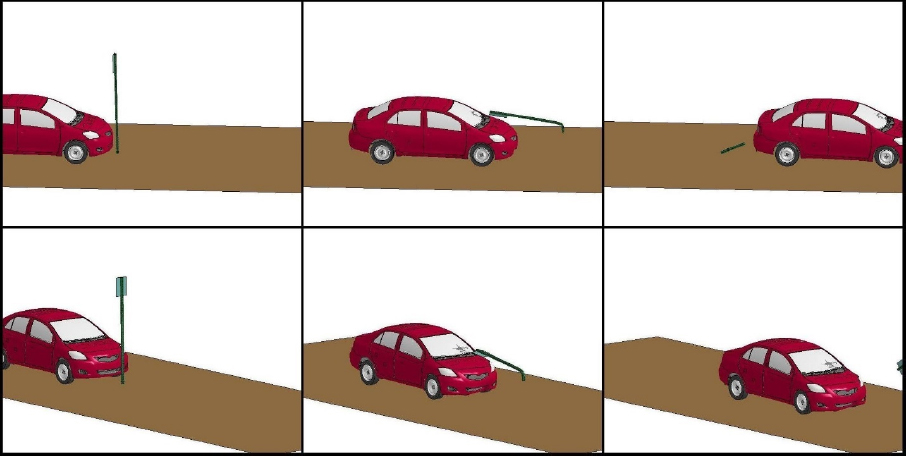 | ||||||||||
| Evaluation Criteria | ||||||||||
| B | The test article should readily activate in a predictable manner by breaking away, fracturing, or yielding. | Pass | ||||||||
| D | Detached elements, fragments, or other debris from the test article should not penetrate or show potential for penetrating the occupant compartment, or present undue hazard to other traffic, pedestrians, or personnel in a work zone. | Pass | ||||||||
| All Deformations of, or intrusions into, the occupant compartment should not exceed limits set forth in Section 5.3 and Appendix E of MASH. [Roof less than 4.0 in (101.6 mm). Windshield-no tear of plastic liner and maximum deformation of 3 in (76.2 mm)] | Roof ≤ 101.6 mm | 0 | Fail | |||||||
| Windshield ≤ 76.2 mm | 40 (tear) | |||||||||
| F | The vehicle should remain upright during and after the collision. The maximum pitch & roll angles are not to exceed 75 degrees. | Max Roll (Deg) | 1 | Pass | ||||||
| Max Pitch (Deg) | 1 | |||||||||
| H | Longitudinal & lateral occupant impact velocities (OIV) should fall below the preferred value of 10 ft/s (3.0 m/s), or at least below the maximum allowed value of 16 ft/s (4.9 m/s) | Vx (m/s) | 1.1 | Pass | ||||||
| Vy (m/s) | 0.0 | |||||||||
| I | Longitudinal & lateral occupant ridedown accelerations (ORA) should fall below the preferred value of 15.0 g, or at least below the maximum allowed value of 20.49 g | Ax (g) | 0.0 | Pass | ||||||
| Ay (g) | 0.0 | |||||||||
| N | Vehicle trajectory behind the test article is acceptable | Pass | ||||||||
| Single PSST Post Sign Support System Mounting-Height: 7 ft; A1011 Gr.50 Post; Aluminum Panel; Anchor Embedment depth: 36 in | ||||||||||
| Post Size | Anchor Size | Panel Size | MASH Impact | Impact Location | Impact Angle | Wind Beam | ||||
| 2¼” x 2¼” 12 gauge | 2½” x 2½” 12 gauge | 1’ x 1.5’ 0.12” thick | 3-62 | Center | 0 deg | No | ||||
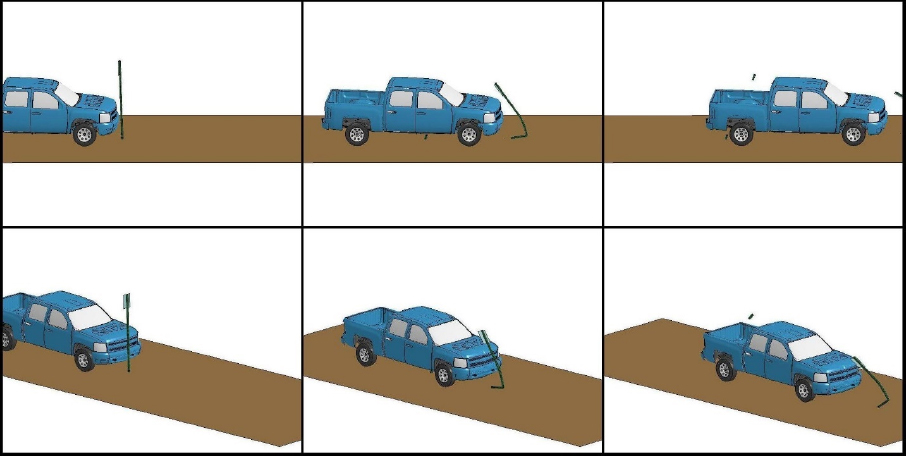 | ||||||||||
| Evaluation Criteria | ||||||||||
| B | The test article should readily activate in a predictable manner by breaking away, fracturing, or yielding. | Pass | ||||||||
| D | Detached elements, fragments, or other debris from the test article should not penetrate or show potential for penetrating the occupant compartment, or present undue hazard to other traffic, pedestrians, or personnel in a work zone. | Pass | ||||||||
| All Deformations of, or intrusions into, the occupant compartment should not exceed limits set forth in Section 5.3 and Appendix E of MASH. [Roof less than 4.0 in (101.6 mm). Windshield-no tear of plastic liner and maximum deformation of 3 in (76.2 mm)] | Roof ≤ 101.6 mm | 0 | Pass | |||||||
| Windshield ≤ 76.2 mm | 0 | |||||||||
| F | The vehicle should remain upright during and after the collision. The maximum pitch & roll angles are not to exceed 75 degrees. | Max Roll (Deg) | 0 | Pass | ||||||
| Max Pitch (Deg) | 0 | |||||||||
| H | Longitudinal & lateral occupant impact velocities (OIV) should fall below the preferred value of 10 ft/s (3.0 m/s), or at least below the maximum allowed value of 16 ft/s (4.9 m/s) | Vx (m/s) | 0.6 | Pass | ||||||
| Vy (m/s) | 0.0 | |||||||||
| I | Longitudinal & lateral occupant ridedown accelerations (ORA) should fall below the preferred value of 15.0 g, or at least below the maximum allowed value of 20.49 g | Ax (g) | 0.0 | Pass | ||||||
| Ay (g) | 0.0 | |||||||||
| N | Vehicle trajectory behind the test article is acceptable | Pass | ||||||||
| Single PSST Post Sign Support System Mounting-Height: 7 ft; A1011 Gr.50 Post; Aluminum Panel; Anchor Embedment depth: 36 in | ||||||||||
| Post Size | Anchor Size | Panel Size | MASH Impact | Impact Location | Impact Angle | Wind Beam | ||||
| 2¼” x 2¼” 12 gauge | 2½” x 2½” 12 gauge | 1’ x 1.5’ 0.12” thick | 3-62 | Center | +25 | No | ||||
 | ||||||||||
| Evaluation Criteria | ||||||||||
| B | The test article should readily activate in a predictable manner by breaking away, fracturing, or yielding. | Pass | ||||||||
| D | Detached elements, fragments, or other debris from the test article should not penetrate or show potential for penetrating the occupant compartment, or present undue hazard to other traffic, pedestrians, or personnel in a work zone. | Pass | ||||||||
| All Deformations of, or intrusions into, the occupant compartment should not exceed limits set forth in Section 5.3 and Appendix E of MASH. [Roof less than 4.0 in (101.6 mm). Windshield-no tear of plastic liner and maximum deformation of 3 in (76.2 mm)] | Roof ≤ 101.6 mm | 0 | Pass | |||||||
| Windshield ≤ 76.2 mm | 0 | |||||||||
| F | The vehicle should remain upright during and after the collision. The maximum pitch & roll angles are not to exceed 75 degrees. | Max Roll (Deg) | 0 | Pass | ||||||
| Max Pitch (Deg) | 0 | |||||||||
| H | Longitudinal & lateral occupant impact velocities (OIV) should fall below the preferred value of 10 ft/s (3.0 m/s), or at least below the maximum allowed value of 16 ft/s (4.9 m/s) | Vx (m/s) | 0.6 | Pass | ||||||
| Vy (m/s) | 0.0 | |||||||||
| I | Longitudinal & lateral occupant ridedown accelerations (ORA) should fall below the preferred value of 15.0 g, or at least below the maximum allowed value of 20.49 g | Ax (g) | 0.0 | Pass | ||||||
| Ay (g) | 0.0 | |||||||||
| N | Vehicle trajectory behind the test article is acceptable | Pass | ||||||||
| Single PSST Post Sign Support System Mounting-Height: 7 ft; A1011 Gr.50 Post; Aluminum Panel; Anchor Embedment depth: 36 in | ||||||||||
| Post Size | Anchor Size | Panel Size | MASH Impact | Impact Location | Impact Angle | Wind Beam | ||||
| 2¼” x 2¼” 12 gauge | 2½” x 2½” 12 gauge | 2’ x 2’ 0.08” thick | 3-60 | Center | 0 deg | No | ||||
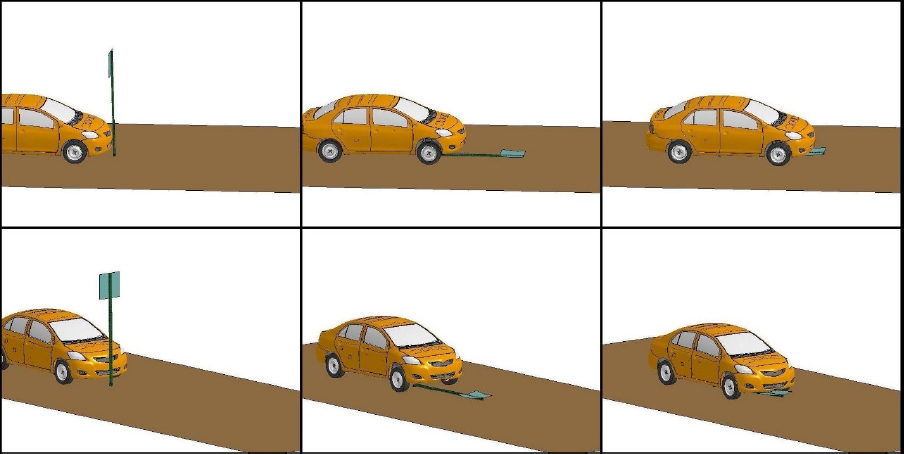 | ||||||||||
| Evaluation Criteria | ||||||||||
| B | The test article should readily activate in a predictable manner by breaking away, fracturing, or yielding. | Pass | ||||||||
| D | Detached elements, fragments, or other debris from the test article should not penetrate or show potential for penetrating the occupant compartment, or present undue hazard to other traffic, pedestrians, or personnel in a work zone. | Pass | ||||||||
| All Deformations of, or intrusions into, the occupant compartment should not exceed limits set forth in Section 5.3 and Appendix E of MASH. [Roof less than 4.0 in (101.6 mm). Windshield-no tear of plastic liner and maximum deformation of 3 in (76.2 mm)] | Roof ≤ 101.6 mm | 0 | Pass | |||||||
| Windshield ≤ 76.2 mm | 0 | |||||||||
| F | The vehicle should remain upright during and after the collision. The maximum pitch & roll angles are not to exceed 75 degrees. | Max Roll (Deg) | 0 | Pass | ||||||
| Max Pitch (Deg) | 2 | |||||||||
| H | Longitudinal & lateral occupant impact velocities (OIV) should fall below the preferred value of 10 ft/s (3.0 m/s), or at least below the maximum allowed value of 16 ft/s (4.9 m/s) | Vx (m/s) | 2.0 | Pass | ||||||
| Vy (m/s) | 0.1 | |||||||||
| I | Longitudinal & lateral occupant ridedown accelerations (ORA) should fall below the preferred value of 15.0 g, or at least below the maximum allowed value of 20.49 g | Ax (g) | 0.1 | Pass | ||||||
| Ay (g) | 0.2 | |||||||||
| N | Vehicle trajectory behind the test article is acceptable | Pass | ||||||||
| Single PSST Post Sign Support System Mounting-Height: 7 ft; A1011 Gr.50 Post; Aluminum Panel; Anchor Embedment depth: 36 in | ||||||||||
| Post Size | Anchor Size | Panel Size | MASH Impact | Impact Location | Impact Angle | Wind Beam | ||||
| 2¼” x 2¼” 12 gauge | 2½” x 2½” 12 gauge | 2’ x 2’ 0.08” thick | 3-60 | Offset Driver | 0 deg | No | ||||
| Evaluation Criteria | ||||||||||
| B | The test article should readily activate in a predictable manner by breaking away, fracturing, or yielding. | Pass | ||||||||
| D | Detached elements, fragments, or other debris from the test article should not penetrate or show potential for penetrating the occupant compartment, or present undue hazard to other traffic, pedestrians, or personnel in a work zone. | Pass | ||||||||
| All Deformations of, or intrusions into, the occupant compartment should not exceed limits set forth in Section 5.3 and Appendix E of MASH. [Roof less than 4.0 in (101.6 mm). Windshield-no tear of plastic liner and maximum deformation of 3 in (76.2 mm)] | Roof ≤ 101.6 mm | 0 | Pass | |||||||
| Windshield ≤ 76.2 mm | 0 | |||||||||
| F | The vehicle should remain upright during and after the collision. The maximum pitch & roll angles are not to exceed 75 degrees. | Max Roll (Deg) | 1 | Pass | ||||||
| Max Pitch (Deg) | 2 | |||||||||
| H | Longitudinal & lateral occupant impact velocities (OIV) should fall below the preferred value of 10 ft/s (3.0 m/s), or at least below the maximum allowed value of 16 ft/s (4.9 m/s) | Vx (m/s) | 2.2 | Pass | ||||||
| Vy (m/s) | 0.1 | |||||||||
| I | Longitudinal & lateral occupant ridedown accelerations (ORA) should fall below the preferred value of 15.0 g, or at least below the maximum allowed value of 20.49 g | Ax (g) | 0.2 | Pass | ||||||
| Ay (g) | 0.3 | |||||||||
| N | Vehicle trajectory behind the test article is acceptable | Pass | ||||||||
| Single PSST Post Sign Support System Mounting-Height: 7 ft; A1011 Gr.50 Post; Aluminum Panel; Anchor Embedment depth: 36 in | ||||||||||
| Post Size | Anchor Size | Panel Size | MASH Impact | Impact Location | Impact Angle | Wind Beam | ||||
| 2¼” x 2¼” 12 gauge | 2½” x 2½” 12 gauge | 2’ x 2’ 0.08” thick | 3-60 | Offset Passenger | 0 deg | No | ||||
 | ||||||||||
| Evaluation Criteria | ||||||||||
| B | The test article should readily activate in a predictable manner by breaking away, fracturing, or yielding. | Pass | ||||||||
| D | Detached elements, fragments, or other debris from the test article should not penetrate or show potential for penetrating the occupant compartment, or present undue hazard to other traffic, pedestrians, or personnel in a work zone. | Pass | ||||||||
| All Deformations of, or intrusions into, the occupant compartment should not exceed limits set forth in Section 5.3 and Appendix E of MASH. [Roof less than 4.0 in (101.6 mm). Windshield-no tear of plastic liner and maximum deformation of 3 in (76.2 mm)] | Roof ≤ 101.6 mm | 0 | Pass | |||||||
| Windshield ≤ 76.2 mm | 0 | |||||||||
| F | The vehicle should remain upright during and after the collision. The maximum pitch & roll angles are not to exceed 75 degrees. | Max Roll (Deg) | 2 | Pass | ||||||
| Max Pitch (Deg) | 2 | |||||||||
| H | Longitudinal & lateral occupant impact velocities (OIV) should fall below the preferred value of 10 ft/s (3.0 m/s), or at least below the maximum allowed value of 16 ft/s (4.9 m/s) | Vx (m/s) | 2.2 | Pass | ||||||
| Vy (m/s) | 0.0 | |||||||||
| I | Longitudinal & lateral occupant ridedown accelerations (ORA) should fall below the preferred value of 15.0 g, or at least below the maximum allowed value of 20.49 g | Ax (g) | 0.2 | Pass | ||||||
| Ay (g) | 0.2 | |||||||||
| N | Vehicle trajectory behind the test article is acceptable | Pass | ||||||||
| Single PSST Post Sign Support System Mounting-Height: 7 ft; A1011 Gr.50 Post; Aluminum Panel; Anchor Embedment depth: 36 in | ||||||||||
| Post Size | Anchor Size | Panel Size | MASH Impact | Impact Location | Impact Angle | Wind Beam | ||||
| 2¼” x 2¼” 12 gauge | 2½” x 2½” 12 gauge | 2’ x 2’ 0.08” thick | 3-61 | Center | 0 deg | No | ||||
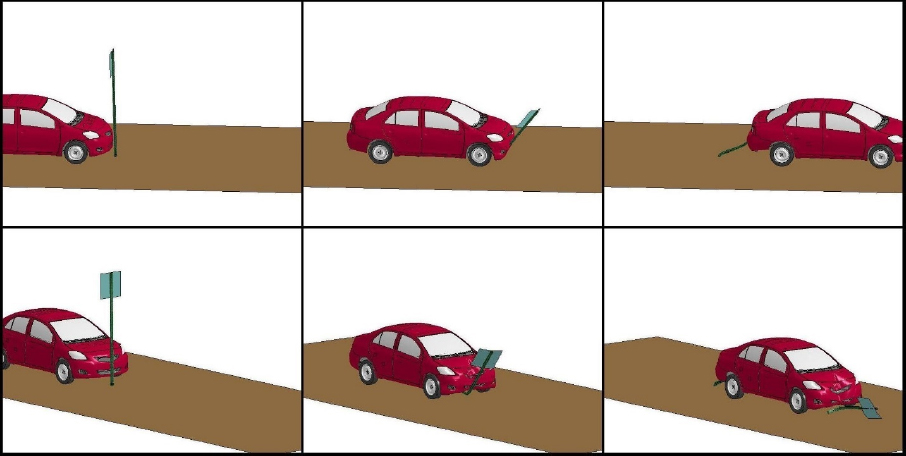 | ||||||||||
| Evaluation Criteria | ||||||||||
| B | The test article should readily activate in a predictable manner by breaking away, fracturing, or yielding. | Pass | ||||||||
| D | Detached elements, fragments, or other debris from the test article should not penetrate or show potential for penetrating the occupant compartment, or present undue hazard to other traffic, pedestrians, or personnel in a work zone. | Pass | ||||||||
| All Deformations of, or intrusions into, the occupant compartment should not exceed limits set forth in Section 5.3 and Appendix E of MASH. [Roof less than 4.0 in (101.6 mm). Windshield-no tear of plastic liner and maximum deformation of 3 in (76.2 mm)] | Roof ≤ 101.6 mm | 0 | Pass | |||||||
| Windshield ≤ 76.2 mm | 0 | |||||||||
| F | The vehicle should remain upright during and after the collision. The maximum pitch & roll angles are not to exceed 75 degrees. | Max Roll (Deg) | 0 | Pass | ||||||
| Max Pitch (Deg) | 1 | |||||||||
| H | Longitudinal & lateral occupant impact velocities (OIV) should fall below the preferred value of 10 ft/s (3.0 m/s), or at least below the maximum allowed value of 16 ft/s (4.9 m/s) | Vx (m/s) | 2.0 | Pass | ||||||
| Vy (m/s) | 0.0 | |||||||||
| I | Longitudinal & lateral occupant ridedown accelerations (ORA) should fall below the preferred value of 15.0 g, or at least below the maximum allowed value of 20.49 g | Ax (g) | 0.0 | Pass | ||||||
| Ay (g) | 0.0 | |||||||||
| N | Vehicle trajectory behind the test article is acceptable | Pass | ||||||||
| Single PSST Post Sign Support System Mounting-Height: 7 ft; A1011 Gr.50 Post; Aluminum Panel; Anchor Embedment depth: 36 in | ||||||||||
| Post Size | Anchor Size | Panel Size | MASH Impact | Impact Location | Impact Angle | Wind Beam | ||||
| 2¼” x 2¼” 12 gauge | 2½” x 2½” 12 gauge | 2’ x 2’ 0.08” thick | 3-61 | Center | -25 deg | No | ||||
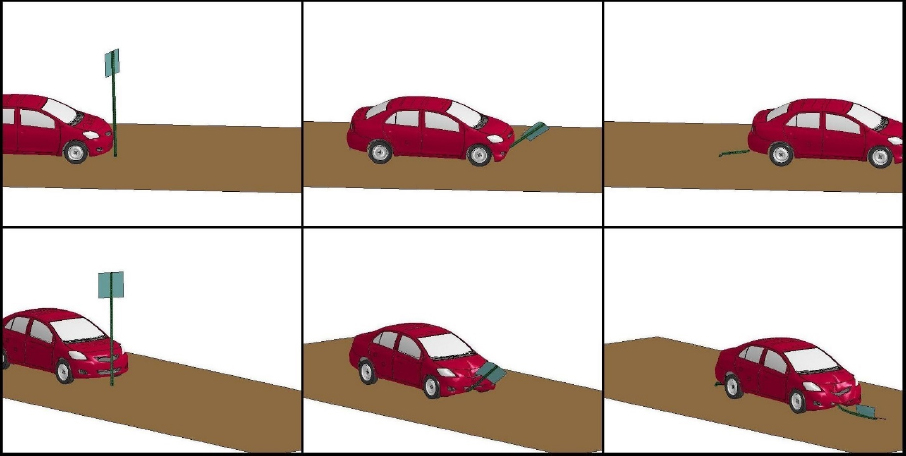 | ||||||||||
| Evaluation Criteria | ||||||||||
| B | The test article should readily activate in a predictable manner by breaking away, fracturing, or yielding. | Pass | ||||||||
| D | Detached elements, fragments, or other debris from the test article should not penetrate or show potential for penetrating the occupant compartment, or present undue hazard to other traffic, pedestrians, or personnel in a work zone. | Pass | ||||||||
| All Deformations of, or intrusions into, the occupant compartment should not exceed limits set forth in Section 5.3 and Appendix E of MASH. [Roof less than 4.0 in (101.6 mm). Windshield-no tear of plastic liner and maximum deformation of 3 in (76.2 mm)] | Roof ≤ 101.6 mm | 0 | Pass | |||||||
| Windshield ≤ 76.2 mm | 0 | |||||||||
| F | The vehicle should remain upright during and after the collision. The maximum pitch & roll angles are not to exceed 75 degrees. | Max Roll (Deg) | 0 | Pass | ||||||
| Max Pitch (Deg) | 1 | |||||||||
| H | Longitudinal & lateral occupant impact velocities (OIV) should fall below the preferred value of 10 ft/s (3.0 m/s), or at least below the maximum allowed value of 16 ft/s (4.9 m/s) | Vx (m/s) | 1.9 | Pass | ||||||
| Vy (m/s) | 0.0 | |||||||||
| I | Longitudinal & lateral occupant ridedown accelerations (ORA) should fall below the preferred value of 15.0 g, or at least below the maximum allowed value of 20.49 g | Ax (g) | 0.0 | Pass | ||||||
| Ay (g) | 0.0 | |||||||||
| N | Vehicle trajectory behind the test article is acceptable | Pass | ||||||||
| Single PSST Post Sign Support System Mounting-Height: 7 ft; A1011 Gr.50 Steel Post; Aluminum Panel; Anchor Embedment depth: 36 in | ||||||||||
| Post Size | Anchor Size | Panel Size | MASH Impact | Impact Location | Impact Angle | Wind Beam | ||||
| 2¼” x 2¼” 12 gauge | 2½” x 2½” 12 gauge | 2’ x 2’ 0.08” thick | 3-61 | Center | +25 deg | No | ||||
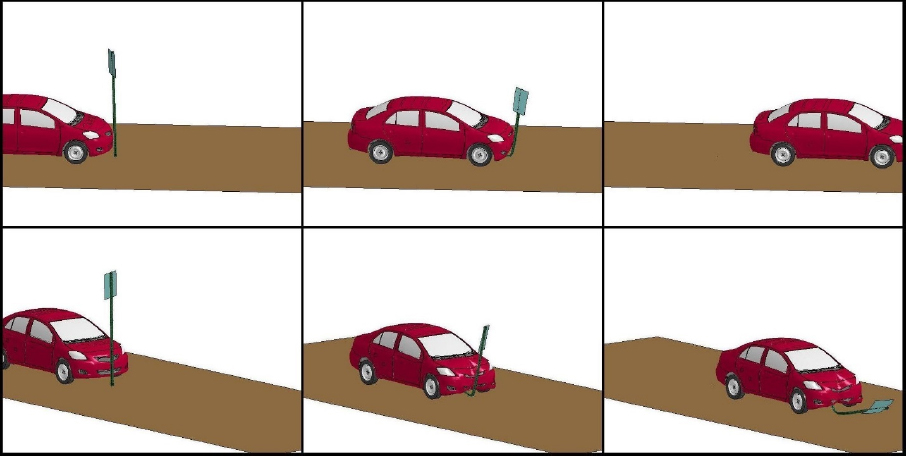 | ||||||||||
| Evaluation Criteria | ||||||||||
| B | The test article should readily activate in a predictable manner by breaking away, fracturing, or yielding. | Pass | ||||||||
| D | Detached elements, fragments, or other debris from the test article should not penetrate or show potential for penetrating the occupant compartment, or present undue hazard to other traffic, pedestrians, or personnel in a work zone. | Pass | ||||||||
| All Deformations of, or intrusions into, the occupant compartment should not exceed limits set forth in Section 5.3 and Appendix E of MASH. [Roof less than 4.0 in (101.6 mm). Windshield-no tear of plastic liner and maximum deformation of 3 in (76.2 mm)] | Roof ≤ 101.6 mm | 0 | Pass | |||||||
| Windshield ≤ 76.2 mm | 0 | |||||||||
| F | The vehicle should remain upright during and after the collision. The maximum pitch & roll angles are not to exceed 75 degrees. | Max Roll (Deg) | 0 | Pass | ||||||
| Max Pitch (Deg) | 2 | |||||||||
| H | Longitudinal & lateral occupant impact velocities (OIV) should fall below the preferred value of 10 ft/s (3.0 m/s), or at least below the maximum allowed value of 16 ft/s (4.9 m/s) | Vx (m/s) | 1.6 | Pass | ||||||
| Vy (m/s) | 0.0 | |||||||||
| I | Longitudinal & lateral occupant ridedown accelerations (ORA) should fall below the preferred value of 15.0 g, or at least below the maximum allowed value of 20.49 g | Ax (g) | 0.0 | Pass | ||||||
| Ay (g) | 0.0 | |||||||||
| N | Vehicle trajectory behind the test article is acceptable | Pass | ||||||||
| Single PSST Post Sign Support System Mounting-Height: 7 ft; A1011 Gr.50 Post; Aluminum Panel; Anchor Embedment depth: 36 in | ||||||||||
| Post Size | Anchor Size | Panel Size | MASH Impact | Impact Location | Impact Angle | Wind Beam | ||||
| 2¼” x 2¼” 12 gauge | 2½” x 2½” 12 gauge | 2’ x 2’ 0.08” thick | 3-61 | Offset Driver | 0 deg | No | ||||
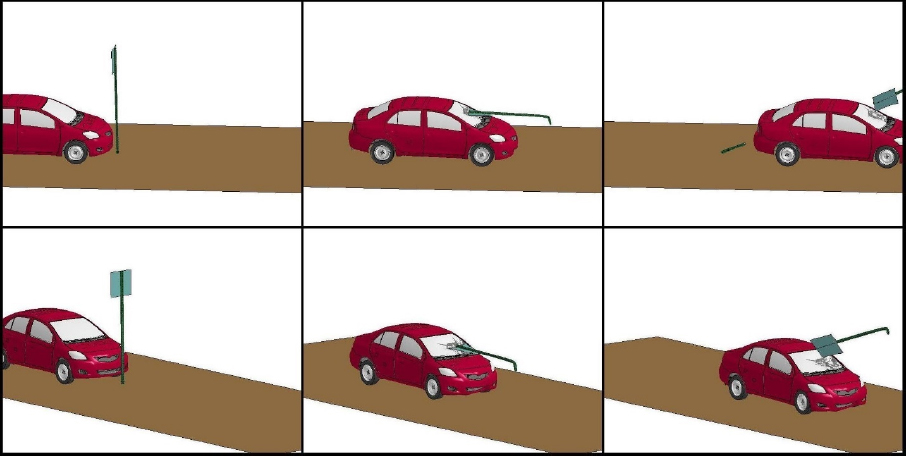 | ||||||||||
| Evaluation Criteria | ||||||||||
| B | The test article should readily activate in a predictable manner by breaking away, fracturing, or yielding. | Pass | ||||||||
| D | Detached elements, fragments, or other debris from the test article should not penetrate or show potential for penetrating the occupant compartment, or present undue hazard to other traffic, pedestrians, or personnel in a work zone. | Pass | ||||||||
| All Deformations of, or intrusions into, the occupant compartment should not exceed limits set forth in Section 5.3 and Appendix E of MASH. [Roof less than 4.0 in (101.6 mm). Windshield-no tear of plastic liner and maximum deformation of 3 in (76.2 mm)] | Roof ≤ 101.6 mm | 4 | Fail | |||||||
| Windshield ≤ 76.2 mm | 107 (tear) | |||||||||
| F | The vehicle should remain upright during and after the collision. The maximum pitch & roll angles are not to exceed 75 degrees. | Max Roll (Deg) | 1 | Pass | ||||||
| Max Pitch (Deg) | 1 | |||||||||
| H | Longitudinal & lateral occupant impact velocities (OIV) should fall below the preferred value of 10 ft/s (3.0 m/s), or at least below the maximum allowed value of 16 ft/s (4.9 m/s) | Vx (m/s) | 1.0 | Pass | ||||||
| Vy (m/s) | 0.3 | |||||||||
| I | Longitudinal & lateral occupant ridedown accelerations (ORA) should fall below the preferred value of 15.0 g, or at least below the maximum allowed value of 20.49 g | Ax (g) | 0.0 | Pass | ||||||
| Ay (g) | 0.0 | |||||||||
| N | Vehicle trajectory behind the test article is acceptable | Pass | ||||||||
| Single PSST Post Sign Support System Mounting-Height: 7 ft; A1011 Gr.50 Post; Aluminum Panel; Anchor Embedment depth: 36 in | ||||||||||
| Post Size | Anchor Size | Panel Size | MASH Impact | Impact Location | Impact Angle | Wind Beam | ||||
| 2¼” x 2¼” 12 gauge | 2½” x 2½” 12 gauge | 2’ x 2’ 0.08” thick | 3-62 | Center | 0 deg | No | ||||
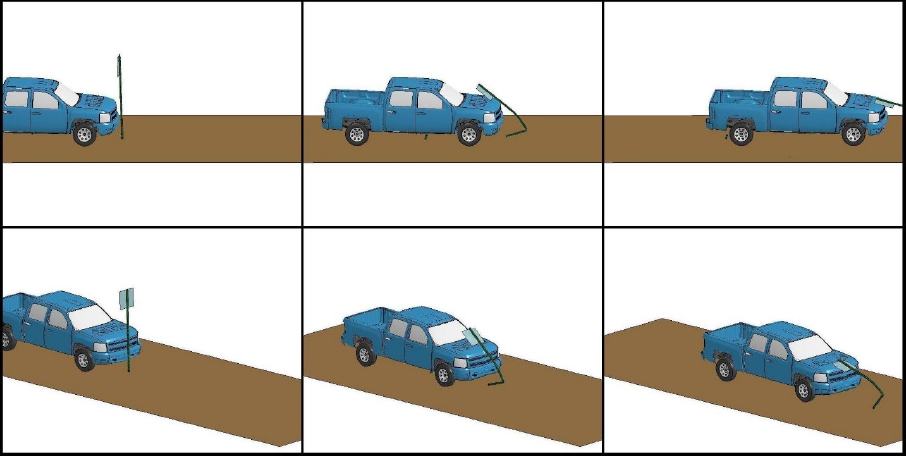 | ||||||||||
| Evaluation Criteria | ||||||||||
| B | The test article should readily activate in a predictable manner by breaking away, fracturing, or yielding. | Pass | ||||||||
| D | Detached elements, fragments, or other debris from the test article should not penetrate or show potential for penetrating the occupant compartment, or present undue hazard to other traffic, pedestrians, or personnel in a work zone. | Pass | ||||||||
| All Deformations of, or intrusions into, the occupant compartment should not exceed limits set forth in Section 5.3 and Appendix E of MASH. [Roof less than 4.0 in (101.6 mm). Windshield-no tear of plastic liner and maximum deformation of 3 in (76.2 mm)] | Roof ≤ 101.6 mm | 0 | Pass | |||||||
| Windshield ≤ 76.2 mm | 0 | |||||||||
| F | The vehicle should remain upright during and after the collision. The maximum pitch & roll angles are not to exceed 75 degrees. | Max Roll (Deg) | 0 | Pass | ||||||
| Max Pitch (Deg) | 0 | |||||||||
| H | Longitudinal & lateral occupant impact velocities (OIV) should fall below the preferred value of 10 ft/s (3.0 m/s), or at least below the maximum allowed value of 16 ft/s (4.9 m/s) | Vx (m/s) | 0.7 | Pass | ||||||
| Vy (m/s) | 0.0 | |||||||||
| I | Longitudinal & lateral occupant ridedown accelerations (ORA) should fall below the preferred value of 15.0 g, or at least below the maximum allowed value of 20.49 g | Ax (g) | 0.0 | Pass | ||||||
| Ay (g) | 0.0 | |||||||||
| N | Vehicle trajectory behind the test article is acceptable | Pass | ||||||||
| Single PSST Post Sign Support System Mounting-Height: 7 ft; A1011 Gr.50 Post; Aluminum Panel; Anchor Embedment depth: 36 in | ||||||||||
| Post Size | Anchor Size | Panel Size | MASH Impact | Impact Location | Impact Angle | Wind Beam | ||||
| 2¼” x 2¼” 12 gauge | 2½” x 2½” 12 gauge | 2’ x 2’ 0.08” thick | 3-62 | Center | +25 | No | ||||
 | ||||||||||
| Evaluation Criteria | ||||||||||
| B | The test article should readily activate in a predictable manner by breaking away, fracturing, or yielding. | Pass | ||||||||
| D | Detached elements, fragments, or other debris from the test article should not penetrate or show potential for penetrating the occupant compartment, or present undue hazard to other traffic, pedestrians, or personnel in a work zone. | Pass | ||||||||
| All Deformations of, or intrusions into, the occupant compartment should not exceed limits set forth in Section 5.3 and Appendix E of MASH. [Roof less than 4.0 in (101.6 mm). Windshield-no tear of plastic liner and maximum deformation of 3 in (76.2 mm)] | Roof ≤ 101.6 mm | 0 | Pass | |||||||
| Windshield ≤ 76.2 mm | 0 | |||||||||
| F | The vehicle should remain upright during and after the collision. The maximum pitch & roll angles are not to exceed 75 degrees. | Max Roll (Deg) | 0 | Pass | ||||||
| Max Pitch (Deg) | 1 | |||||||||
| H | Longitudinal & lateral occupant impact velocities (OIV) should fall below the preferred value of 10 ft/s (3.0 m/s), or at least below the maximum allowed value of 16 ft/s (4.9 m/s) | Vx (m/s) | 0.6 | Pass | ||||||
| Vy (m/s) | 0.0 | |||||||||
| I | Longitudinal & lateral occupant ridedown accelerations (ORA) should fall below the preferred value of 15.0 g, or at least below the maximum allowed value of 20.49 g | Ax (g) | 0.0 | Pass | ||||||
| Ay (g) | 0.0 | |||||||||
| N | Vehicle trajectory behind the test article is acceptable | Pass | ||||||||
| Single PSST Post Sign Support System Mounting-Height: 7 ft; A1011 Gr.50 Post; Aluminum Panel; Anchor Embedment depth: 36 in | ||||||||||
| Post Size | Anchor Size | Panel Size | MASH Impact | Impact Location | Impact Angle | Wind Beam | ||||
| 2¼” x 2¼” 12 gauge | 2½” x 2½” 12 gauge | 2’ x 2’ 0.12” thick | 3-60 | Center | 0 deg | No | ||||
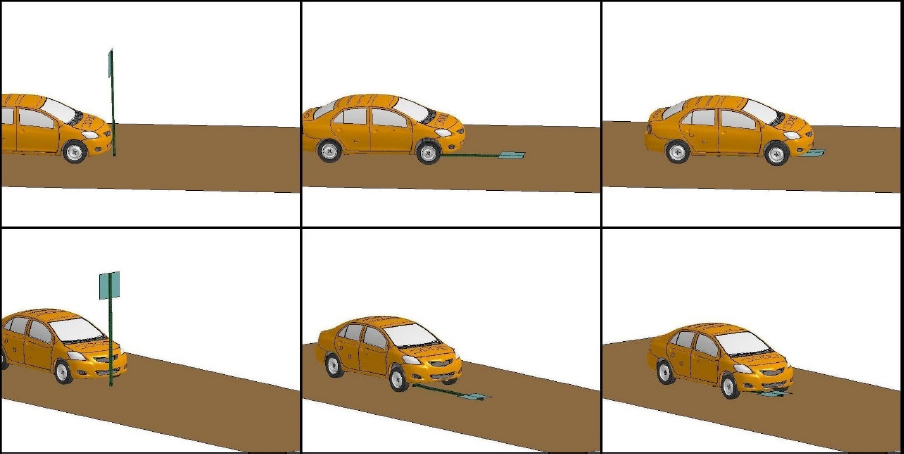 | ||||||||||
| Evaluation Criteria | ||||||||||
| B | The test article should readily activate in a predictable manner by breaking away, fracturing, or yielding. | Pass | ||||||||
| D | Detached elements, fragments, or other debris from the test article should not penetrate or show potential for penetrating the occupant compartment, or present undue hazard to other traffic, pedestrians, or personnel in a work zone. | Pass | ||||||||
| All Deformations of, or intrusions into, the occupant compartment should not exceed limits set forth in Section 5.3 and Appendix E of MASH. [Roof less than 4.0 in (101.6 mm). Windshield-no tear of plastic liner and maximum deformation of 3 in (76.2 mm)] | Roof ≤ 101.6 mm | 0 | Pass | |||||||
| Windshield ≤ 76.2 mm | 0 | |||||||||
| F | The vehicle should remain upright during and after the collision. The maximum pitch & roll angles are not to exceed 75 degrees. | Max Roll (Deg) | 0 | Pass | ||||||
| Max Pitch (Deg) | 2 | |||||||||
| H | Longitudinal & lateral occupant impact velocities (OIV) should fall below the preferred value of 10 ft/s (3.0 m/s), or at least below the maximum allowed value of 16 ft/s (4.9 m/s) | Vx (m/s) | 2.2 | Pass | ||||||
| Vy (m/s) | 0.0 | |||||||||
| I | Longitudinal & lateral occupant ridedown accelerations (ORA) should fall below the preferred value of 15.0 g, or at least below the maximum allowed value of 20.49 g | Ax (g) | 0.3 | Pass | ||||||
| Ay (g) | 0.3 | |||||||||
| N | Vehicle trajectory behind the test article is acceptable | Pass | ||||||||
| Single PSST Post Sign Support System Mounting-Height: 7 ft; A1011 Gr.50 Post; Aluminum Panel; Anchor Embedment depth: 36 in | ||||||||||
| Post Size | Anchor Size | Panel Size | MASH Impact | Impact Location | Impact Angle | Wind Beam | ||||
| 2¼” x 2¼” 12 gauge | 2½” x 2½” 12 gauge | 2’ x 2’ 0.12” thick | 3-60 | Offset Driver | 0 deg | No | ||||
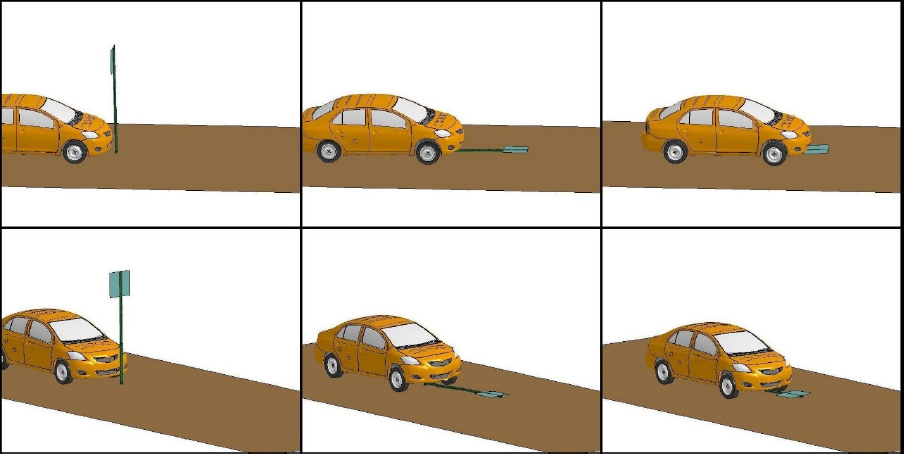 | ||||||||||
| Evaluation Criteria | ||||||||||
| B | The test article should readily activate in a predictable manner by breaking away, fracturing, or yielding. | Pass | ||||||||
| D | Detached elements, fragments, or other debris from the test article should not penetrate or show potential for penetrating the occupant compartment, or present undue hazard to other traffic, pedestrians, or personnel in a work zone. | Pass | ||||||||
| All Deformations of, or intrusions into, the occupant compartment should not exceed limits set forth in Section 5.3 and Appendix E of MASH. [Roof less than 4.0 in (101.6 mm). Windshield-no tear of plastic liner and maximum deformation of 3 in (76.2 mm)] | Roof ≤ 101.6 mm | 0 | Pass | |||||||
| Windshield ≤ 76.2 mm | 0 | |||||||||
| F | The vehicle should remain upright during and after the collision. The maximum pitch & roll angles are not to exceed 75 degrees. | Max Roll (Deg) | 2 | Pass | ||||||
| Max Pitch (Deg) | 2 | |||||||||
| H | Longitudinal & lateral occupant impact velocities (OIV) should fall below the preferred value of 10 ft/s (3.0 m/s), or at least below the maximum allowed value of 16 ft/s (4.9 m/s) | Vx (m/s) | 2.4 | Pass | ||||||
| Vy (m/s) | 0.0 | |||||||||
| I | Longitudinal & lateral occupant ridedown accelerations (ORA) should fall below the preferred value of 15.0 g, or at least below the maximum allowed value of 20.49 g | Ax (g) | 0.2 | Pass | ||||||
| Ay (g) | 0.4 | |||||||||
| N | Vehicle trajectory behind the test article is acceptable | Pass | ||||||||
| Single PSST Post Sign Support System Mounting-Height: 7 ft; A1011 Gr.50 Post; Aluminum Panel; Anchor Embedment depth: 36 in | ||||||||||
| Post Size | Anchor Size | Panel Size | MASH Impact | Impact Location | Impact Angle | Wind Beam | ||||
| 2¼” x 2¼” 12 gauge | 2½” x 2½” 12 gauge | 2’ x 2’ 0.12” thick | 3-60 | Offset Passenger | 0 deg | No | ||||
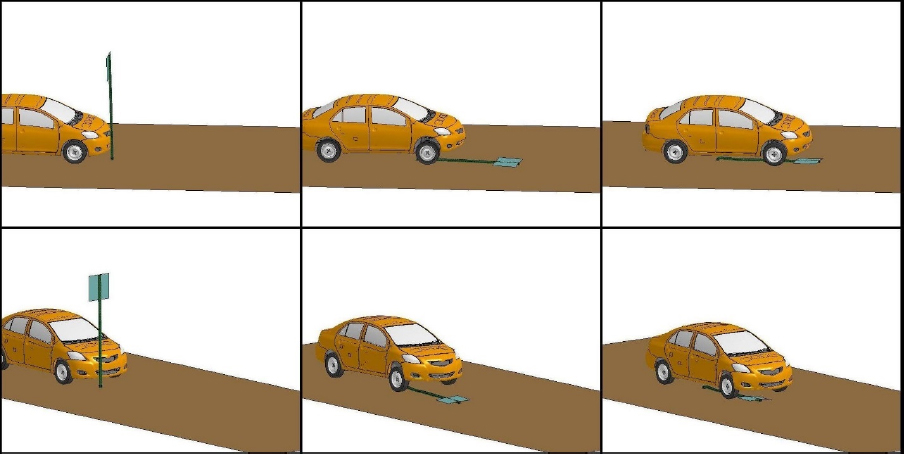 | ||||||||||
| Evaluation Criteria | ||||||||||
| B | The test article should readily activate in a predictable manner by breaking away, fracturing, or yielding. | Pass | ||||||||
| D | Detached elements, fragments, or other debris from the test article should not penetrate or show potential for penetrating the occupant compartment, or present undue hazard to other traffic, pedestrians, or personnel in a work zone. | Pass | ||||||||
| All Deformations of, or intrusions into, the occupant compartment should not exceed limits set forth in Section 5.3 and Appendix E of MASH. [Roof less than 4.0 in (101.6 mm). Windshield-no tear of plastic liner and maximum deformation of 3 in (76.2 mm)] | Roof ≤ 101.6 mm | 0 | Pass | |||||||
| Windshield ≤ 76.2 mm | 0 | |||||||||
| F | The vehicle should remain upright during and after the collision. The maximum pitch & roll angles are not to exceed 75 degrees. | Max Roll (Deg) | 2 | Pass | ||||||
| Max Pitch (Deg) | 2 | |||||||||
| H | Longitudinal & lateral occupant impact velocities (OIV) should fall below the preferred value of 10 ft/s (3.0 m/s), or at least below the maximum allowed value of 16 ft/s (4.9 m/s) | Vx (m/s) | 2.4 | Pass | ||||||
| Vy (m/s) | 0.1 | |||||||||
| I | Longitudinal & lateral occupant ridedown accelerations (ORA) should fall below the preferred value of 15.0 g, or at least below the maximum allowed value of 20.49 g | Ax (g) | 0.3 | Pass | ||||||
| Ay (g) | 0.6 | |||||||||
| N | Vehicle trajectory behind the test article is acceptable | Pass | ||||||||
| Single PSST Post Sign Support System Mounting-Height: 7 ft; A1011 Gr.50 Post; Aluminum Panel; Anchor Embedment depth: 36 in | ||||||||||
| Post Size | Anchor Size | Panel Size | MASH Impact | Impact Location | Impact Angle | Wind Beam | ||||
| 2¼” x 2¼” 12 gauge | 2½” x 2½” 12 gauge | 2’ x 2’ 0.12” thick | 3-61 | Center | 0 deg | No | ||||
 | ||||||||||
| Evaluation Criteria | ||||||||||
| B | The test article should readily activate in a predictable manner by breaking away, fracturing, or yielding. | Pass | ||||||||
| D | Detached elements, fragments, or other debris from the test article should not penetrate or show potential for penetrating the occupant compartment, or present undue hazard to other traffic, pedestrians, or personnel in a work zone. | Pass | ||||||||
| All Deformations of, or intrusions into, the occupant compartment should not exceed limits set forth in Section 5.3 and Appendix E of MASH. [Roof less than 4.0 in (101.6 mm). Windshield-no tear of plastic liner and maximum deformation of 3 in (76.2 mm)] | Roof ≤ 101.6 mm | 0 | Pass | |||||||
| Windshield ≤ 76.2 mm | 0 | |||||||||
| F | The vehicle should remain upright during and after the collision. The maximum pitch & roll angles are not to exceed 75 degrees. | Max Roll (Deg) | 0 | Pass | ||||||
| Max Pitch (Deg) | 1 | |||||||||
| H | Longitudinal & lateral occupant impact velocities (OIV) should fall below the preferred value of 10 ft/s (3.0 m/s), or at least below the maximum allowed value of 16 ft/s (4.9 m/s) | Vx (m/s) | 1.9 | Pass | ||||||
| Vy (m/s) | 0.0 | |||||||||
| I | Longitudinal & lateral occupant ridedown accelerations (ORA) should fall below the preferred value of 15.0 g, or at least below the maximum allowed value of 20.49 g | Ax (g) | 0.0 | Pass | ||||||
| Ay (g) | 0.0 | |||||||||
| N | Vehicle trajectory behind the test article is acceptable | Pass | ||||||||
| Single PSST Post Sign Support System Mounting-Height: 7 ft; A1011 Gr.50 Post; Aluminum Panel; Anchor Embedment depth: 36 in | ||||||||||
| Post Size | Anchor Size | Panel Size | MASH Impact | Impact Location | Impact Angle | Wind Beam | ||||
| 2¼” x 2¼” 12 gauge | 2½” x 2½” 12 gauge | 2’ x 2’ 0.12” thick | 3-61 | Center | -25 deg | No | ||||
 | ||||||||||
| Evaluation Criteria | ||||||||||
| B | The test article should readily activate in a predictable manner by breaking away, fracturing, or yielding. | Pass | ||||||||
| D | Detached elements, fragments, or other debris from the test article should not penetrate or show potential for penetrating the occupant compartment, or present undue hazard to other traffic, pedestrians, or personnel in a work zone. | Pass | ||||||||
| All Deformations of, or intrusions into, the occupant compartment should not exceed limits set forth in Section 5.3 and Appendix E of MASH. [Roof less than 4.0 in (101.6 mm). Windshield-no tear of plastic liner and maximum deformation of 3 in (76.2 mm)] | Roof ≤ 101.6 mm | 0 | Pass | |||||||
| Windshield ≤ 76.2 mm | 0 | |||||||||
| F | The vehicle should remain upright during and after the collision. The maximum pitch & roll angles are not to exceed 75 degrees. | Max Roll (Deg) | 0 | Pass | ||||||
| Max Pitch (Deg) | 1 | |||||||||
| H | Longitudinal & lateral occupant impact velocities (OIV) should fall below the preferred value of 10 ft/s (3.0 m/s), or at least below the maximum allowed value of 16 ft/s (4.9 m/s) | Vx (m/s) | 2.0 | Pass | ||||||
| Vy (m/s) | 0.0 | |||||||||
| I | Longitudinal & lateral occupant ridedown accelerations (ORA) should fall below the preferred value of 15.0 g, or at least below the maximum allowed value of 20.49 g | Ax (g) | 0.0 | |||||||
| Ay (g) | 0.0 | ass | ||||||||
| N | Vehicle trajectory behind the test article is acceptable | Pass | ||||||||
| Single PSST Post Sign Support System Mounting-Height: 7 ft; A1011 Gr.50 Steel Post; Aluminum Panel; Anchor Embedment depth: 36 in | ||||||||||
| Post Size | Anchor Size | Panel Size | MASH Impact | Impact Location | Impact Angle | Wind Beam | ||||
| 2¼” x 2¼” 12 gauge | 2½” x 2½” 12 gauge | 2’ x 2’ 0.12” thick | 3-61 | Center | +25 deg | No | ||||
 | ||||||||||
| Evaluation Criteria | ||||||||||
| B | The test article should readily activate in a predictable manner by breaking away, fracturing, or yielding. | Pass | ||||||||
| D | Detached elements, fragments, or other debris from the test article should not penetrate or show potential for penetrating the occupant compartment, or present undue hazard to other traffic, pedestrians, or personnel in a work zone. | Pass | ||||||||
| All Deformations of, or intrusions into, the occupant compartment should not exceed limits set forth in Section 5.3 and Appendix E of MASH. [Roof less than 4.0 in (101.6 mm). Windshield-no tear of plastic liner and maximum deformation of 3 in (76.2 mm)] | Roof ≤ 101.6 mm | 0 | Pass | |||||||
| Windshield ≤ 76.2 mm | 0 | |||||||||
| F | The vehicle should remain upright during and after the collision. The maximum pitch & roll angles are not to exceed 75 degrees. | Max Roll (Deg) | 0 | Pass | ||||||
| Max Pitch (Deg) | 2 | |||||||||
| H | Longitudinal & lateral occupant impact velocities (OIV) should fall below the preferred value of 10 ft/s (3.0 m/s), or at least below the maximum allowed value of 16 ft/s (4.9 m/s) | Vx (m/s) | 1.7 | Pass | ||||||
| Vy (m/s) | 0.0 | |||||||||
| I | Longitudinal & lateral occupant ridedown accelerations (ORA) should fall below the preferred value of 15.0 g, or at least below the maximum allowed value of 20.49 g | Ax (g) | 0.0 | Pass | ||||||
| Ay (g) | 0.0 | |||||||||
| N | Vehicle trajectory behind the test article is acceptable | Pass | ||||||||
| Single PSST Post Sign Support System Mounting-Height: 7 ft; A1011 Gr.50 Post; Aluminum Panel; Anchor Embedment depth: 36 in | ||||||||||
| Post Size | Anchor Size | Panel Size | MASH Impact | Impact Location | Impact Angle | Wind Beam | ||||
| 2¼” x 2¼” 12 gauge | 2½” x 2½” 12 gauge | 2’ x 2’ 0.12” thick | 3-61 | Offset Driver | 0 deg | No | ||||
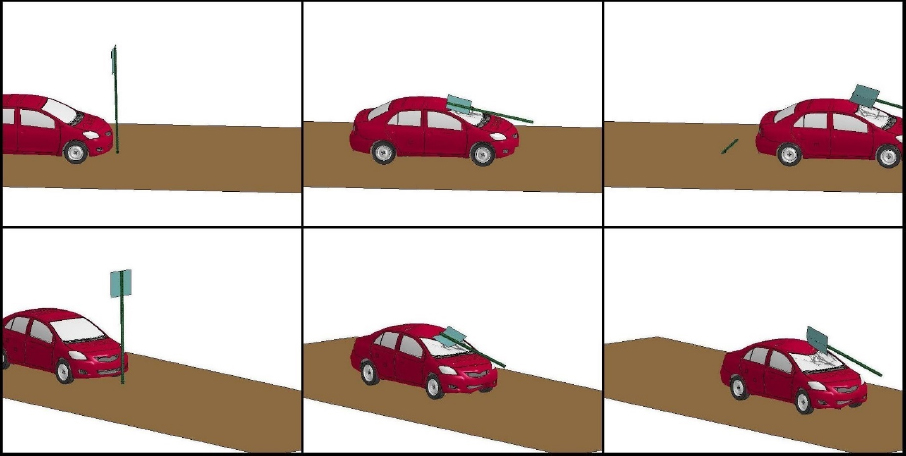 | ||||||||||
| Evaluation Criteria | ||||||||||
| B | The test article should readily activate in a predictable manner by breaking away, fracturing, or yielding. | Pass | ||||||||
| D | Detached elements, fragments, or other debris from the test article should not penetrate or show potential for penetrating the occupant compartment, or present undue hazard to other traffic, pedestrians, or personnel in a work zone. | Pass | ||||||||
| All Deformations of, or intrusions into, the occupant compartment should not exceed limits set forth in Section 5.3 and Appendix E of MASH. [Roof less than 4.0 in (101.6 mm). Windshield-no tear of plastic liner and maximum deformation of 3 in (76.2 mm)] | Roof ≤ 101.6 mm | 100 | Fail | |||||||
| Windshield ≤ 76.2 mm | 315 (tear) | |||||||||
| F | The vehicle should remain upright during and after the collision. The maximum pitch & roll angles are not to exceed 75 degrees. | Max Roll (Deg) | 1 | Pass | ||||||
| Max Pitch (Deg) | 1 | |||||||||
| H | Longitudinal & lateral occupant impact velocities (OIV) should fall below the preferred value of 10 ft/s (3.0 m/s), or at least below the maximum allowed value of 16 ft/s (4.9 m/s) | Vx (m/s) | 0.8 | Pass | ||||||
| Vy (m/s) | 0.3 | |||||||||
| I | Longitudinal & lateral occupant ridedown accelerations (ORA) should fall below the preferred value of 15.0 g, or at least below the maximum allowed value of 20.49 g | Ax (g) | 0.0 | Pass | ||||||
| Ay (g) | 0.0 | |||||||||
| N | Vehicle trajectory behind the test article is acceptable | Pass | ||||||||
| Single PSST Post Sign Support System Mounting-Height: 7 ft; A1011 Gr.50 Post; Aluminum Panel; Anchor Embedment depth: 36 in | ||||||||||
| Post Size | Anchor Size | Panel Size | MASH Impact | Impact Location | Impact Angle | Wind Beam | ||||
| 2¼” x 2¼” 12 gauge | 2½” x 2½” 12 gauge | 2’ x 2’ 0.12” thick | 3-62 | Center | 0 deg | No | ||||
 | ||||||||||
| Evaluation Criteria | ||||||||||
| B | The test article should readily activate in a predictable manner by breaking away, fracturing, or yielding. | Pass | ||||||||
| D | Detached elements, fragments, or other debris from the test article should not penetrate or show potential for penetrating the occupant compartment, or present undue hazard to other traffic, pedestrians, or personnel in a work zone. | Pass | ||||||||
| All Deformations of, or intrusions into, the occupant compartment should not exceed limits set forth in Section 5.3 and Appendix E of MASH. [Roof less than 4.0 in (101.6 mm). Windshield-no tear of plastic liner and maximum deformation of 3 in (76.2 mm)] | Roof ≤ 101.6 mm | 0 | Pass | |||||||
| Windshield ≤ 76.2 mm | 0 | |||||||||
| F | The vehicle should remain upright during and after the collision. The maximum pitch & roll angles are not to exceed 75 degrees. | Max Roll (Deg) | 0 | Pass | ||||||
| Max Pitch (Deg) | 0 | |||||||||
| H | Longitudinal & lateral occupant impact velocities (OIV) should fall below the preferred value of 10 ft/s (3.0 m/s), or at least below the maximum allowed value of 16 ft/s (4.9 m/s) | Vx (m/s) | 0.7 | Pass | ||||||
| Vy (m/s) | 0.0 | |||||||||
| I | Longitudinal & lateral occupant ridedown accelerations (ORA) should fall below the preferred value of 15.0 g, or at least below the maximum allowed value of 20.49 g | Ax (g) | 0.0 | Pass | ||||||
| Ay (g) | 0.0 | |||||||||
| N | Vehicle trajectory behind the test article is acceptable | Pass | ||||||||
| Single PSST Post Sign Support System Mounting-Height: 7 ft; A1011 Gr.50 Post; Aluminum Panel; Anchor Embedment depth: 36 in | ||||||||||
| Post Size | Anchor Size | Panel Size | MASH Impact | Impact Location | Impact Angle | Wind Beam | ||||
| 2¼” x 2¼” 12 gauge | 2½” x 2½” 12 gauge | 2’ x 2’ 0.12” thick | 3-62 | Center | +25 | No | ||||
 | ||||||||||
| Evaluation Criteria | ||||||||||
| B | The test article should readily activate in a predictable manner by breaking away, fracturing, or yielding. | Pass | ||||||||
| D | Detached elements, fragments, or other debris from the test article should not penetrate or show potential for penetrating the occupant compartment, or present undue hazard to other traffic, pedestrians, or personnel in a work zone. | Pass | ||||||||
| All Deformations of, or intrusions into, the occupant compartment should not exceed limits set forth in Section 5.3 and Appendix E of MASH. [Roof less than 4.0 in (101.6 mm). Windshield-no tear of plastic liner and maximum deformation of 3 in (76.2 mm)] | Roof ≤ 101.6 mm | 0 | Pass | |||||||
| Windshield ≤ 76.2 mm | 0 | |||||||||
| F | The vehicle should remain upright during and after the collision. The maximum pitch & roll angles are not to exceed 75 degrees. | Max Roll (Deg) | 0 | Pass | ||||||
| Max Pitch (Deg) | 0 | |||||||||
| H | Longitudinal & lateral occupant impact velocities (OIV) should fall below the preferred value of 10 ft/s (3.0 m/s), or at least below the maximum allowed value of 16 ft/s (4.9 m/s) | Vx (m/s) | 0.9 | Pass | ||||||
| Vy (m/s) | 0.0 | |||||||||
| I | Longitudinal & lateral occupant ridedown accelerations (ORA) should fall below the preferred value of 15.0 g, or at least below the maximum allowed value of 20.49 g | Ax (g) | 0.0 | Pass | ||||||
| Ay (g) | 0.0 | |||||||||
| N | Vehicle trajectory behind the test article is acceptable | Pass | ||||||||
| Single PSST Post Sign Support System Mounting-Height: 7 ft; A1011 Gr.50 Post; Aluminum Panel; Anchor Embedment depth: 36 in | ||||||||||
| Post Size | Anchor Size | Panel Size | MASH Impact | Impact Location | Impact Angle | Wind Beam | ||||
| 2¼” x 2¼” 12 gauge | 2½” x 2½” 12 gauge | 2.5’ x 2.5’ 0.08” thick | 3-60 | Center | 0 deg | No | ||||
 | ||||||||||
| Evaluation Criteria | ||||||||||
| B | The test article should readily activate in a predictable manner by breaking away, fracturing, or yielding. | Pass | ||||||||
| D | Detached elements, fragments, or other debris from the test article should not penetrate or show potential for penetrating the occupant compartment, or present undue hazard to other traffic, pedestrians, or personnel in a work zone. | Pass | ||||||||
| All Deformations of, or intrusions into, the occupant compartment should not exceed limits set forth in Section 5.3 and Appendix E of MASH. [Roof less than 4.0 in (101.6 mm). Windshield-no tear of plastic liner and maximum deformation of 3 in (76.2 mm)] | Roof ≤ 101.6 mm | 0 | Pass | |||||||
| Windshield ≤ 76.2 mm | 0 | |||||||||
| F | The vehicle should remain upright during and after the collision. The maximum pitch & roll angles are not to exceed 75 degrees. | Max Roll (Deg) | 0 | Pass | ||||||
| Max Pitch (Deg) | 2 | |||||||||
| H | Longitudinal & lateral occupant impact velocities (OIV) should fall below the preferred value of 10 ft/s (3.0 m/s), or at least below the maximum allowed value of 16 ft/s (4.9 m/s) | Vx (m/s) | 2.4 | Pass | ||||||
| Vy (m/s) | 0.0 | |||||||||
| I | Longitudinal & lateral occupant ridedown accelerations (ORA) should fall below the preferred value of 15.0 g, or at least below the maximum allowed value of 20.49 g | Ax (g) | 0.2 | Pass | ||||||
| Ay (g) | 0.2 | |||||||||
| N | Vehicle trajectory behind the test article is acceptable | Pass | ||||||||
| Single PSST Post Sign Support System Mounting-Height: 7 ft; A1011 Gr.50 Post; Aluminum Panel; Anchor Embedment depth: 36 in | ||||||||||
| Post Size | Anchor Size | Panel Size | MASH Impact | Impact Location | Impact Angle | Wind Beam | ||||
| 2¼” x 2¼” 12 gauge | 2½” x 2½” 12 gauge | 2.5’ x 2.5’ 0.08” thick | 3-60 | Offset Driver | 0 deg | No | ||||
 | ||||||||||
| Evaluation Criteria | ||||||||||
| B | The test article should readily activate in a predictable manner by breaking away, fracturing, or yielding. | Pass | ||||||||
| D | Detached elements, fragments, or other debris from the test article should not penetrate or show potential for penetrating the occupant compartment, or present undue hazard to other traffic, pedestrians, or personnel in a work zone. | Pass | ||||||||
| All Deformations of, or intrusions into, the occupant compartment should not exceed limits set forth in Section 5.3 and Appendix E of MASH. [Roof less than 4.0 in (101.6 mm). Windshield-no tear of plastic liner and maximum deformation of 3 in (76.2 mm)] | Roof ≤ 101.6 mm | 0 | Pass | |||||||
| Windshield ≤ 76.2 mm | 0 | |||||||||
| F | The vehicle should remain upright during and after the collision. The maximum pitch & roll angles are not to exceed 75 degrees. | Max Roll (Deg) | 1 | Pass | ||||||
| Max Pitch (Deg) | 2 | |||||||||
| H | Longitudinal & lateral occupant impact velocities (OIV) should fall below the preferred value of 10 ft/s (3.0 m/s), or at least below the maximum allowed value of 16 ft/s (4.9 m/s) | Vx (m/s) | 2.4 | Pass | ||||||
| Vy (m/s) | 0.0 | |||||||||
| I | Longitudinal & lateral occupant ridedown accelerations (ORA) should fall below the preferred value of 15.0 g, or at least below the maximum allowed value of 20.49 g | Ax (g) | 0.2 | Pass | ||||||
| Ay (g) | 0.5 | |||||||||
| N | Vehicle trajectory behind the test article is acceptable | Pass | ||||||||
| Single PSST Post Sign Support System Mounting-Height: 7 ft; A1011 Gr.50 Post; Aluminum Panel; Anchor Embedment depth: 36 in | ||||||||||
| Post Size | Anchor Size | Panel Size | MASH Impact | Impact Location | Impact Angle | Wind Beam | ||||
| 2¼” x 2¼” 12 gauge | 2½” x 2½” 12 gauge | 2.5’ x 2.5’ 0.08” thick | 3-60 | Offset Passenger | 0 deg | No | ||||
 | ||||||||||
| Evaluation Criteria | ||||||||||
| B | The test article should readily activate in a predictable manner by breaking away, fracturing, or yielding. | Pass | ||||||||
| D | Detached elements, fragments, or other debris from the test article should not penetrate or show potential for penetrating the occupant compartment, or present undue hazard to other traffic, pedestrians, or personnel in a work zone. | Pass | ||||||||
| All Deformations of, or intrusions into, the occupant compartment should not exceed limits set forth in Section 5.3 and Appendix E of MASH. [Roof less than 4.0 in (101.6 mm). Windshield-no tear of plastic liner and maximum deformation of 3 in (76.2 mm)] | Roof ≤ 101.6 mm | 0 | Pass | |||||||
| Windshield ≤ 76.2 mm | 0 | |||||||||
| F | The vehicle should remain upright during and after the collision. The maximum pitch & roll angles are not to exceed 75 degrees. | Max Roll (Deg) | 2 | Pass | ||||||
| Max Pitch (Deg) | 2 | |||||||||
| H | Longitudinal & lateral occupant impact velocities (OIV) should fall below the preferred value of 10 ft/s (3.0 m/s), or at least below the maximum allowed value of 16 ft/s (4.9 m/s) | Vx (m/s) | 2.5 | Pass | ||||||
| Vy (m/s) | 0.1 | |||||||||
| I | Longitudinal & lateral occupant ridedown accelerations (ORA) should fall below the preferred value of 15.0 g, or at least below the maximum allowed value of 20.49 g | Ax (g) | 0.2 | Pass | ||||||
| Ay (g) | 0.6 | |||||||||
| N | Vehicle trajectory behind the test article is acceptable | Pass | ||||||||
| Single PSST Post Sign Support System Mounting-Height: 7 ft; A1011 Gr.50 Post; Aluminum Panel; Anchor Embedment depth: 36 in | ||||||||||
| Post Size | Anchor Size | Panel Size | MASH Impact | Impact Location | Impact Angle | Wind Beam | ||||
| 2¼” x 2¼” 12 gauge | 2½” x 2½” 12 gauge | 2.5’ x 2.5’ 0.08” thick | 3-61 | Center | 0 deg | No | ||||
 | ||||||||||
| Evaluation Criteria | ||||||||||
| B | The test article should readily activate in a predictable manner by breaking away, fracturing, or yielding. | Pass | ||||||||
| D | Detached elements, fragments, or other debris from the test article should not penetrate or show potential for penetrating the occupant compartment, or present undue hazard to other traffic, pedestrians, or personnel in a work zone. | Pass | ||||||||
| All Deformations of, or intrusions into, the occupant compartment should not exceed limits set forth in Section 5.3 and Appendix E of MASH. [Roof less than 4.0 in (101.6 mm). Windshield-no tear of plastic liner and maximum deformation of 3 in (76.2 mm)] | Roof ≤ 101.6 mm | 0 | Pass | |||||||
| Windshield ≤ 76.2 mm | 0 | |||||||||
| F | The vehicle should remain upright during and after the collision. The maximum pitch & roll angles are not to exceed 75 degrees. | Max Roll (Deg) | 0 | Pass | ||||||
| Max Pitch (Deg) | 1 | |||||||||
| H | Longitudinal & lateral occupant impact velocities (OIV) should fall below the preferred value of 10 ft/s (3.0 m/s), or at least below the maximum allowed value of 16 ft/s (4.9 m/s) | Vx (m/s) | 1.9 | Pass | ||||||
| Vy (m/s) | 0.0 | |||||||||
| I | Longitudinal & lateral occupant ridedown accelerations (ORA) should fall below the preferred value of 15.0 g, or at least below the maximum allowed value of 20.49 g | Ax (g) | 0.0 | Pass | ||||||
| Ay (g) | 0.0 | |||||||||
| N | Vehicle trajectory behind the test article is acceptable | Pass | ||||||||
| Single PSST Post Sign Support System Mounting-Height: 7 ft; A1011 Gr.50 Post; Aluminum Panel; Anchor Embedment depth: 36 in | ||||||||||
| Post Size | Anchor Size | Panel Size | MASH Impact | Impact Locatio | Impact Angle | Wind Beam | ||||
| 2¼” x 2¼” 12 gauge | 2½” x 2½” 12 gauge | 2.5’ x 2.5’ 0.08” thick | 3-61 | Center | -25 deg | No | ||||
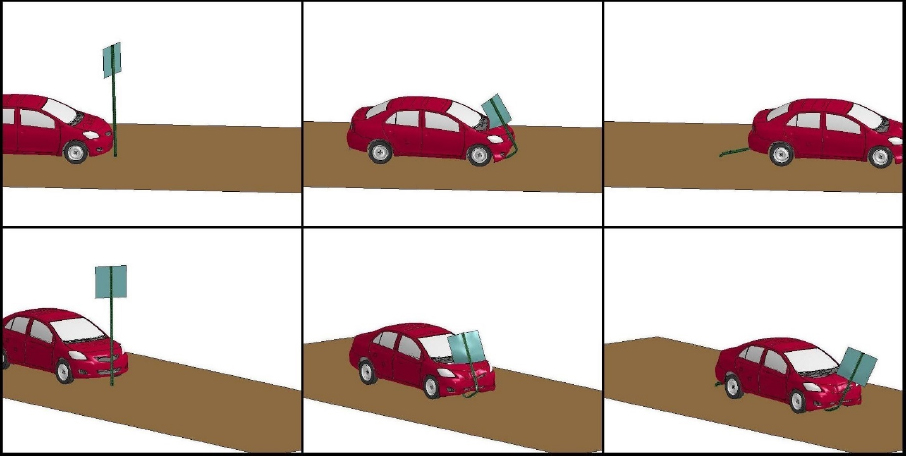 | ||||||||||
| Evaluation Criteria | ||||||||||
| B | The test article should readily activate in a predictable manner by breaking away, fracturing, or yielding. | Pass | ||||||||
| D | Detached elements, fragments, or other debris from the test article should not penetrate or show potential for penetrating the occupant compartment, or present undue hazard to other traffic, pedestrians, or personnel in a work zone. | Pass | ||||||||
| All Deformations of, or intrusions into, the occupant compartment should not exceed limits set forth in Section 5.3 and Appendix E of MASH. [Roof less than 4.0 in (101.6 mm). Windshield-no tear of plastic liner and maximum deformation of 3 in (76.2 mm)] | Roof ≤ 101.6 mm | 0 | Pass | |||||||
| Windshield ≤ 76.2 mm | 0 | |||||||||
| F | The vehicle should remain upright during and after the collision. The maximum pitch & roll angles are not to exceed 75 degrees. | Max Roll (Deg) | 0 | Pass | ||||||
| Max Pitch (Deg) | 1 | |||||||||
| H | Longitudinal & lateral occupant impact velocities (OIV) should fall below the preferred value of 10 ft/s (3.0 m/s), or at least below the maximum allowed value of 16 ft/s (4.9 m/s) | Vx (m/s) | 1.9 | Pass | ||||||
| Vy (m/s) | 0.1 | |||||||||
| I | Longitudinal & lateral occupant ridedown accelerations (ORA) should fall below the preferred value of 15.0 g, or at least below the maximum allowed value of 20.49 g | Ax (g) | 0.0 | Pass | ||||||
| Ay (g) | 0.0 | |||||||||
| N | Vehicle trajectory behind the test article is acceptable | Pass | ||||||||
| Single PSST Post Sign Support System Mounting-Height: 7 ft; A1011 Gr.50 Steel Post; Aluminum Panel; Anchor Embedment depth: 36 in | ||||||||||
| Post Size | Anchor Size | Panel Size | MASH Impact | Impact Location | Impact Angle | Wind Beam | ||||
| 2¼” x 2¼” 12 gauge | 2½” x 2½” 12 gauge | 2.5’ x 2.5’ 0.08” thick | 3-61 | Center | +25 deg | No | ||||
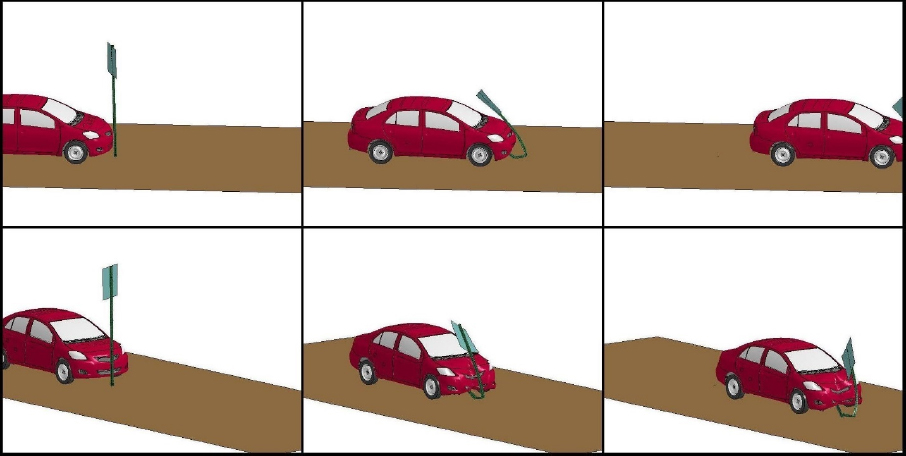 | ||||||||||
| Evaluation Criteria | ||||||||||
| B | The test article should readily activate in a predictable manner by breaking away, fracturing, or yielding. | Pass | ||||||||
| D | Detached elements, fragments, or other debris from the test article should not penetrate or show potential for penetrating the occupant compartment, or present undue hazard to other traffic, pedestrians, or personnel in a work zone. | Pass | ||||||||
| All Deformations of, or intrusions into, the occupant compartment should not exceed limits set forth in Section 5.3 and Appendix E of MASH. [Roof less than 4.0 in (101.6 mm). Windshield-no tear of plastic liner and maximum deformation of 3 in (76.2 mm)] | Roof ≤ 101.6 mm | 0 | Pass | |||||||
| Windshield ≤ 76.2 mm | 0 | |||||||||
| F | The vehicle should remain upright during and after the collision. The maximum pitch & roll angles are not to exceed 75 degrees. | Max Roll (Deg) | 0 | Pass | ||||||
| Max Pitch (Deg) | 1 | |||||||||
| H | Longitudinal & lateral occupant impact velocities (OIV) should fall below the preferred value of 10 ft/s (3.0 m/s), or at least below the maximum allowed value of 16 ft/s (4.9 m/s) | Vx (m/s) | 1.7 | Pass | ||||||
| Vy (m/s) | 0.0 | |||||||||
| I | Longitudinal & lateral occupant ridedown accelerations (ORA) should fall below the preferred value of 15.0 g, or at least below the maximum allowed value of 20.49 g | Ax (g) | 0.0 | Pass | ||||||
| Ay (g) | 0.0 | |||||||||
| N | Vehicle trajectory behind the test article is acceptable | Pass | ||||||||
| Single PSST Post Sign Support System Mounting-Height: 7 ft; A1011 Gr.50 Post; Aluminum Panel; Anchor Embedment depth: 36 in | ||||||||||
| Post Size | Anchor Size | Panel Size | MASH Impact | Impact Location | Impact Angle | Wind Beam | ||||
| 2¼” x 2¼” 12 gauge | 2½” x 2½” 12 gauge | 2.5’ x 2.5’ 0.08” thick | 3-61 | Offset Driver | 0 deg | No | ||||
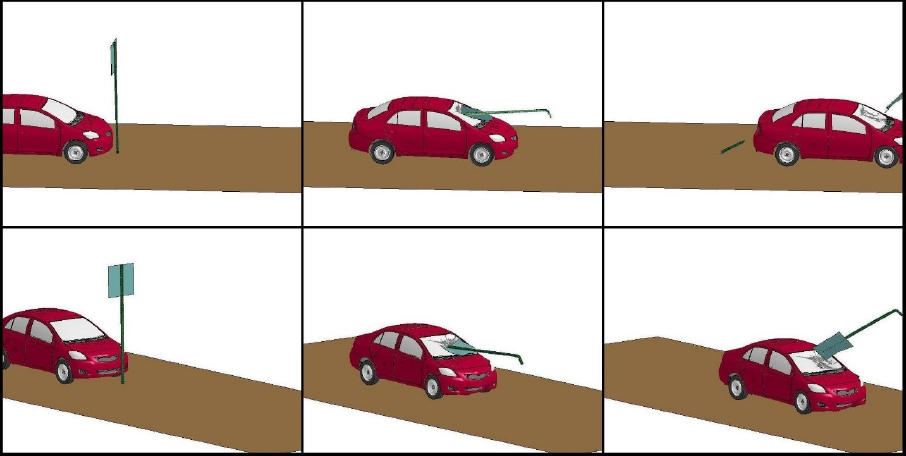 | ||||||||||
| Evaluation Criteria | ||||||||||
| B | The test article should readily activate in a predictable manner by breaking away, fracturing, or yielding. | Pass | ||||||||
| D | Detached elements, fragments, or other debris from the test article should not penetrate or show potential for penetrating the occupant compartment, or present undue hazard to other traffic, pedestrians, or personnel in a work zone. | Pass | ||||||||
| All Deformations of, or intrusions into, the occupant compartment should not exceed limits set forth in Section 5.3 and Appendix E of MASH. [Roof less than 4.0 in (101.6 mm). Windshield-no tear of plastic liner and maximum deformation of 3 in (76.2 mm)] | Roof ≤ 101.6 mm | 6 | Fail | |||||||
| Windshield ≤ 76.2 mm | 173 (tear) | |||||||||
| F | The vehicle should remain upright during and after the collision. The maximum pitch & roll angles are not to exceed 75 degrees. | Max Roll (Deg) | 1 | Pass | ||||||
| Max Pitch (Deg) | 1 | |||||||||
| H | Longitudinal & lateral occupant impact velocities (OIV) should fall below the preferred value of 10 ft/s (3.0 m/s), or at least below the maximum allowed value of 16 ft/s (4.9 m/s) | Vx (m/s) | 0.8 | Pass | ||||||
| Vy (m/s) | 0.2 | |||||||||
| I | Longitudinal & lateral occupant ridedown accelerations (ORA) should fall below the preferred value of 15.0 g, or at least below the maximum allowed value of 20.49 g | Ax (g) | 0.0 | Pass | ||||||
| Ay (g) | 0.0 | |||||||||
| N | Vehicle trajectory behind the test article is acceptable | Pass | ||||||||
| Single PSST Post Sign Support System Mounting-Height: 7 ft; A1011 Gr.50 Post; Aluminum Panel; Anchor Embedment depth: 36 in | ||||||||||
| Post Size | Anchor Size | Panel Size | MASH Impact | Impact Location | Impact Angle | Wind Beam | ||||
| 2¼” x 2¼” 12 gauge | 2½” x 2½” 12 gauge | 2.5’ x 2.5’ 0.08” thick | 3-62 | Center | 0 deg | No | ||||
 | ||||||||||
| Evaluation Criteria | ||||||||||
| B | The test article should readily activate in a predictable manner by breaking away, fracturing, or yielding. | Pass | ||||||||
| D | Detached elements, fragments, or other debris from the test article should not penetrate or show potential for penetrating the occupant compartment, or present undue hazard to other traffic, pedestrians, or personnel in a work zone. | Pass | ||||||||
| All Deformations of, or intrusions into, the occupant compartment should not exceed limits set forth in Section 5.3 and Appendix E of MASH. [Roof less than 4.0 in (101.6 mm). Windshield-no tear of plastic liner and maximum deformation of 3 in (76.2 mm)] | Roof ≤ 101.6 mm | 0 | Pass | |||||||
| Windshield ≤ 76.2 mm | 0 | |||||||||
| F | The vehicle should remain upright during and after the collision. The maximum pitch & roll angles are not to exceed 75 degrees. | Max Roll (Deg) | 0 | Pass | ||||||
| Max Pitch (Deg) | 0 | |||||||||
| H | Longitudinal & lateral occupant impact velocities (OIV) should fall below the preferred value of 10 ft/s (3.0 m/s), or at least below the maximum allowed value of 16 ft/s (4.9 m/s) | Vx (m/s) | 0.8 | Pass | ||||||
| Vy (m/s) | 0.0 | |||||||||
| I | Longitudinal & lateral occupant ridedown accelerations (ORA) should fall below the preferred value of 15.0 g, or at least below the maximum allowed value of 20.49 g | Ax (g) | 0.0 | Pass | ||||||
| Ay (g) | 0.0 | |||||||||
| N | Vehicle trajectory behind the test article is acceptable | Pass | ||||||||
| Single PSST Post Sign Support System Mounting-Height: 7 ft; A1011 Gr.50 Post; Aluminum Panel; Anchor Embedment depth: 36 in | ||||||||||
| Post Size | Anchor Size | Panel Size | MASH Impact | Impact Location | Impact Angle | Wind Beam | ||||
| 2¼” x 2¼” 12 gauge | 2½” x 2½” 12 gauge | 2.5’ x 2.5’ 0.08” thick | 3-62 | Center | +25 | No | ||||
 | ||||||||||
| Evaluation Criteria | ||||||||||
| B | The test article should readily activate in a predictable manner by breaking away, fracturing, or yielding. | Pass | ||||||||
| D | Detached elements, fragments, or other debris from the test article should not penetrate or show potential for penetrating the occupant compartment, or present undue hazard to other traffic, pedestrians, or personnel in a work zone. | Pass | ||||||||
| All Deformations of, or intrusions into, the occupant compartment should not exceed limits set forth in Section 5.3 and Appendix E of MASH. [Roof less than 4.0 in (101.6 mm). Windshield-no tear of plastic liner and maximum deformation of 3 in (76.2 mm)] | Roof ≤ 101.6 mm | 0 | Pass | |||||||
| Windshield ≤ 76.2 mm | 0 | |||||||||
| F | The vehicle should remain upright during and after the collision. The maximum pitch & roll angles are not to exceed 75 degrees. | Max Roll (Deg) | 0 | Pass | ||||||
| Max Pitch (Deg) | 1 | |||||||||
| H | Longitudinal & lateral occupant impact velocities (OIV) should fall below the preferred value of 10 ft/s (3.0 m/s), or at least below the maximum allowed value of 16 ft/s (4.9 m/s) | Vx (m/s) | 1.2 | Pass | ||||||
| Vy (m/s) | 0.0 | |||||||||
| I | Longitudinal & lateral occupant ridedown accelerations (ORA) should fall below the preferred value of 15.0 g, or at least below the maximum allowed value of 20.49 g | Ax (g) | 0.0 | Pass | ||||||
| Ay (g) | 0.0 | |||||||||
| N | Vehicle trajectory behind the test article is acceptable | Pass | ||||||||
| Single PSST Post Sign Support System Mounting-Height: 7 ft; A1011 Gr.50 Post; Aluminum Panel; Anchor Embedment depth: 36 in | ||||||||||
| Post Size | Anchor Size | Panel Size | MASH Impact | Impact Location | Impact Angle | Wind Beam | ||||
| 2¼” x 2¼” 12 gauge | 2½” x 2½” 12 gauge | 2.5’ x 2.5’ 0.12” thick | 3-60 | Center | 0 deg | No | ||||
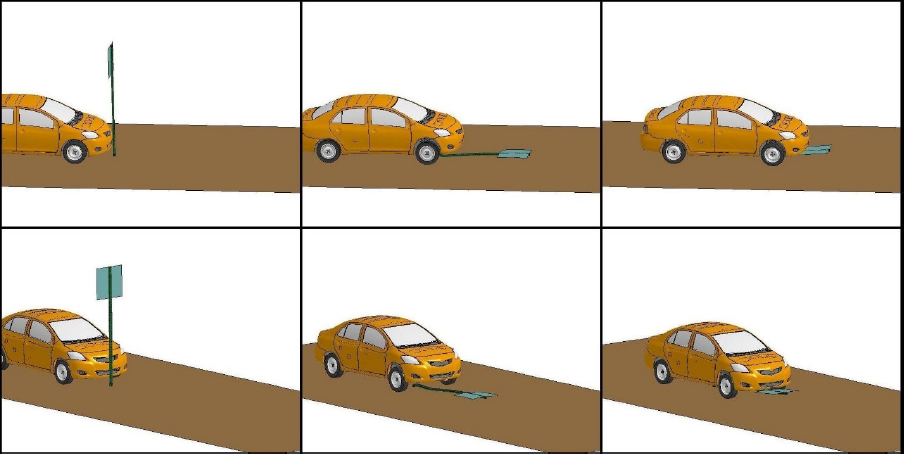 | ||||||||||
| Evaluation Criteria | ||||||||||
| B | The test article should readily activate in a predictable manner by breaking away, fracturing, or yielding. | Pass | ||||||||
| D | Detached elements, fragments, or other debris from the test article should not penetrate or show potential for penetrating the occupant compartment, or present undue hazard to other traffic, pedestrians, or personnel in a work zone. | Pass | ||||||||
| All Deformations of, or intrusions into, the occupant compartment should not exceed limits set forth in Section 5.3 and Appendix E of MASH. [Roof less than 4.0 in (101.6 mm). Windshield-no tear of plastic liner and maximum deformation of 3 in (76.2 mm)] | Roof ≤ 101.6 mm | 0 | Pass | |||||||
| Windshield ≤ 76.2 mm | 0 | |||||||||
| F | The vehicle should remain upright during and after the collision. The maximum pitch & roll angles are not to exceed 75 degrees. | Max Roll (Deg) | 0 | Pass | ||||||
| Max Pitch (Deg) | 2 | |||||||||
| H | Longitudinal & lateral occupant impact velocities (OIV) should fall below the preferred value of 10 ft/s (3.0 m/s), or at least below the maximum allowed value of 16 ft/s (4.9 m/s) | Vx (m/s) | 2.5 | Pass | ||||||
| Vy (m/s) | 0.0 | |||||||||
| I | Longitudinal & lateral occupant ridedown accelerations (ORA) should fall below the preferred value of 15.0 g, or at least below the maximum allowed value of 20.49 g | Ax (g) | 0.2 | Pass | ||||||
| Ay (g) | 0.2 | |||||||||
| N | Vehicle trajectory behind the test article is acceptable | Pass | ||||||||
| Single PSST Post Sign Support System Mounting-Height: 7 ft; A1011 Gr.50 Post; Aluminum Panel; Anchor Embedment depth: 36 in | ||||||||||
| Post Size | Anchor Size | Panel Size | MASH Impact | Impact Location | Impact Angle | Wind Beam | ||||
| 2¼” x 2¼” 12 gauge | 2½” x 2½” 12 gauge | 2.5’ x 2.5’ 0.12” thick | 3-60 | Offset Driver | 0 deg | No | ||||
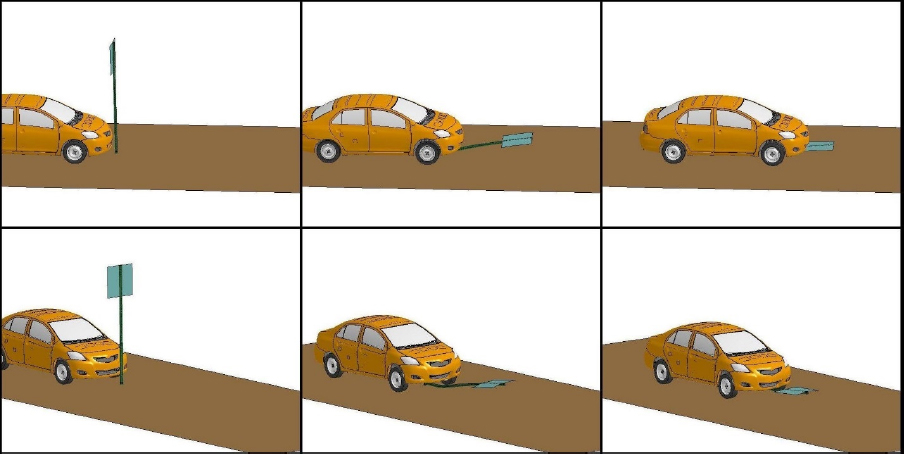 | ||||||||||
| Evaluation Criteria | ||||||||||
| B | The test article should readily activate in a predictable manner by breaking away, fracturing, or yielding. | Pass | ||||||||
| D | Detached elements, fragments, or other debris from the test article should not penetrate or show potential for penetrating the occupant compartment, or present undue hazard to other traffic, pedestrians, or personnel in a work zone. | Pass | ||||||||
| All Deformations of, or intrusions into, the occupant compartment should not exceed limits set forth in Section 5.3 and Appendix E of MASH. [Roof less than 4.0 in (101.6 mm). Windshield-no tear of plastic liner and maximum deformation of 3 in (76.2 mm)] | Roof ≤ 101.6 mm | 0 | Pass | |||||||
| Windshield ≤ 76.2 mm | 0 | |||||||||
| F | The vehicle should remain upright during and after the collision. The maximum pitch & roll angles are not to exceed 75 degrees. | Max Roll (Deg) | 1 | Pass | ||||||
| Max Pitch (Deg) | 2 | |||||||||
| H | Longitudinal & lateral occupant impact velocities (OIV) should fall below the preferred value of 10 ft/s (3.0 m/s), or at least below the maximum allowed value of 16 ft/s (4.9 m/s) | Vx (m/s) | 2.6 | Pass | ||||||
| Vy (m/s) | 0.0 | |||||||||
| I | Longitudinal & lateral occupant ridedown accelerations (ORA) should fall below the preferred value of 15.0 g, or at least below the maximum allowed value of 20.49 g | Ax (g) | 0.2 | Pass | ||||||
| Ay (g) | 0.4 | |||||||||
| N | Vehicle trajectory behind the test article is acceptable | Pass | ||||||||
| Single PSST Post Sign Support System Mounting-Height: 7 ft; A1011 Gr.50 Post; Aluminum Panel; Anchor Embedment depth: 36 in | ||||||||||
| Post Size | Anchor Size | Panel Size | MASH Impact | Impact Location | Impact Angle | Wind Beam | ||||
| 2¼” x 2¼” 12 gauge | 2½” x 2½” 12 gauge | 2.5’ x 2.5’ 0.12” thick | 3-60 | Offset Passenger | 0 deg | No | ||||
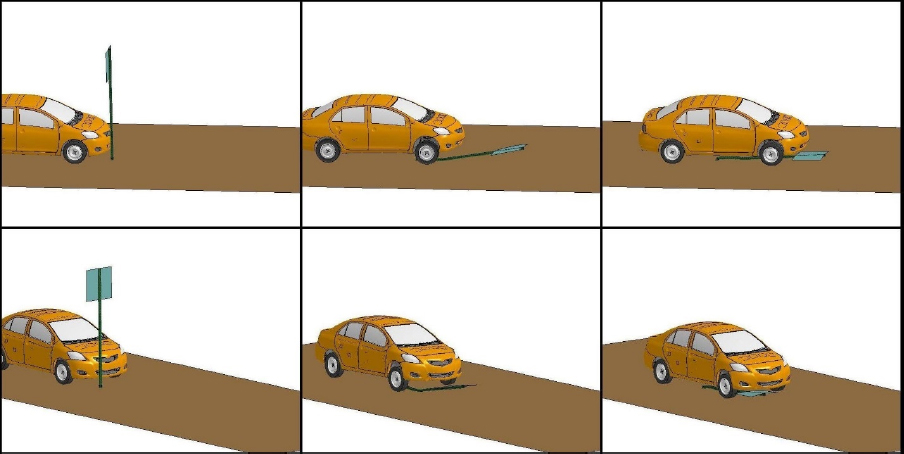 | ||||||||||
| Evaluation Criteria | ||||||||||
| B | The test article should readily activate in a predictable manner by breaking away, fracturing, or yielding. | Pass | ||||||||
| D | Detached elements, fragments, or other debris from the test article should not penetrate or show potential for penetrating the occupant compartment, or present undue hazard to other traffic, pedestrians, or personnel in a work zone. | Pass | ||||||||
| All Deformations of, or intrusions into, the occupant compartment should not exceed limits set forth in Section 5.3 and Appendix E of MASH. [Roof less than 4.0 in (101.6 mm). Windshield-no tear of plastic liner and maximum deformation of 3 in (76.2 mm)] | Roof ≤ 101.6 mm | 0 | Pass | |||||||
| Windshield ≤ 76.2 mm | 0 | |||||||||
| F | The vehicle should remain upright during and after the collision. The maximum pitch & roll angles are not to exceed 75 degrees. | Max Roll (Deg) | 2 | Pass | ||||||
| Max Pitch (Deg) | 2 | |||||||||
| H | Longitudinal & lateral occupant impact velocities (OIV) should fall below the preferred value of 10 ft/s (3.0 m/s), or at least below the maximum allowed value of 16 ft/s (4.9 m/s) | Vx (m/s) | 2.7 | Pass | ||||||
| Vy (m/s) | 0.0 | |||||||||
| I | Longitudinal & lateral occupant ridedown accelerations (ORA) should fall below the preferred value of 15.0 g, or at least below the maximum allowed value of 20.49 g | Ax (g) | 0.2 | Pass | ||||||
| Ay (g) | 0.7 | |||||||||
| N | Vehicle trajectory behind the test article is acceptable | Pass | ||||||||
| Single PSST Post Sign Support System Mounting-Height: 7 ft; A1011 Gr.50 Post; Aluminum Panel; Anchor Embedment depth: 36 in | ||||||||||
| Post Size | Anchor Size | Panel Size | MASH Impact | Impact Location | Impact Angle | Wind Beam | ||||
| 2¼” x 2¼” 12 gauge | 2½” x 2½” 12 gauge | 2.5’ x 2.5’ 0.12” thick | 3-61 | Center | 0 deg | No | ||||
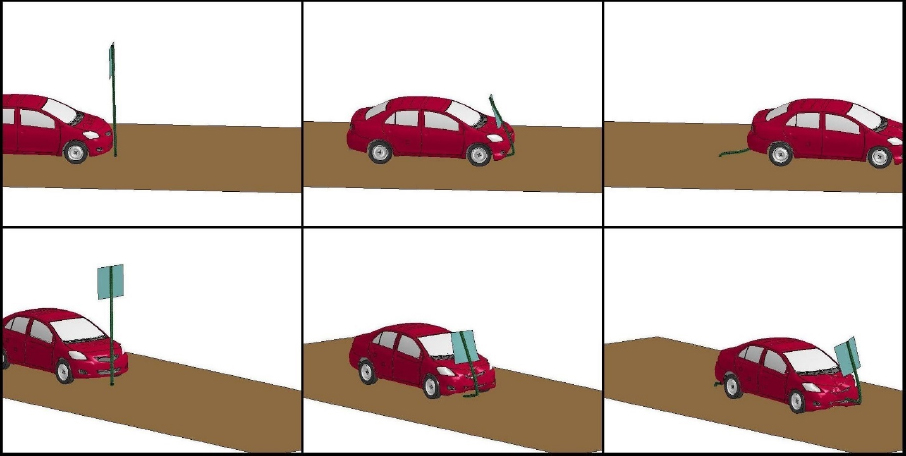 | ||||||||||
| Evaluation Criteria | ||||||||||
| B | The test article should readily activate in a predictable manner by breaking away, fracturing, or yielding. | Pass | ||||||||
| D | Detached elements, fragments, or other debris from the test article should not penetrate or show potential for penetrating the occupant compartment, or present undue hazard to other traffic, pedestrians, or personnel in a work zone. | Pass | ||||||||
| All Deformations of, or intrusions into, the occupant compartment should not exceed limits set forth in Section 5.3 and Appendix E of MASH. [Roof less than 4.0 in (101.6 mm). Windshield-no tear of plastic liner and maximum deformation of 3 in (76.2 mm)] | Roof ≤ 101.6 mm | 0 | Pass | |||||||
| Windshield ≤ 76.2 mm | 0 | |||||||||
| F | The vehicle should remain upright during and after the collision. The maximum pitch & roll angles are not to exceed 75 degrees. | Max Roll (Deg) | 0 | Pass | ||||||
| Max Pitch (Deg) | 1 | |||||||||
| H | Longitudinal & lateral occupant impact velocities (OIV) should fall below the preferred value of 10 ft/s (3.0 m/s), or at least below the maximum allowed value of 16 ft/s (4.9 m/s) | Vx (m/s) | 2.1 | Pass | ||||||
| Vy (m/s) | 0.0 | |||||||||
| I | Longitudinal & lateral occupant ridedown accelerations (ORA) should fall below the preferred value of 15.0 g, or at least below the maximum allowed value of 20.49 g | Ax (g) | 0.0 | Pass | ||||||
| Ay (g) | 0.0 | |||||||||
| N | Vehicle trajectory behind the test article is acceptable | Pass | ||||||||
| Single PSST Post Sign Support System Mounting-Height: 7 ft; A1011 Gr.50 Post; Aluminum Panel; Anchor Embedment depth: 36 in | ||||||||||
| Post Size | Anchor Size | Panel Size | MASH Impact | Impact Location | Impact Angle | Wind Beam | ||||
| 2¼” x 2¼” 12 gauge | 2½” x 2½” 12 gauge | 2.5’ x 2.5’ 0.12” thick | 3-61 | Center | -25 deg | No | ||||
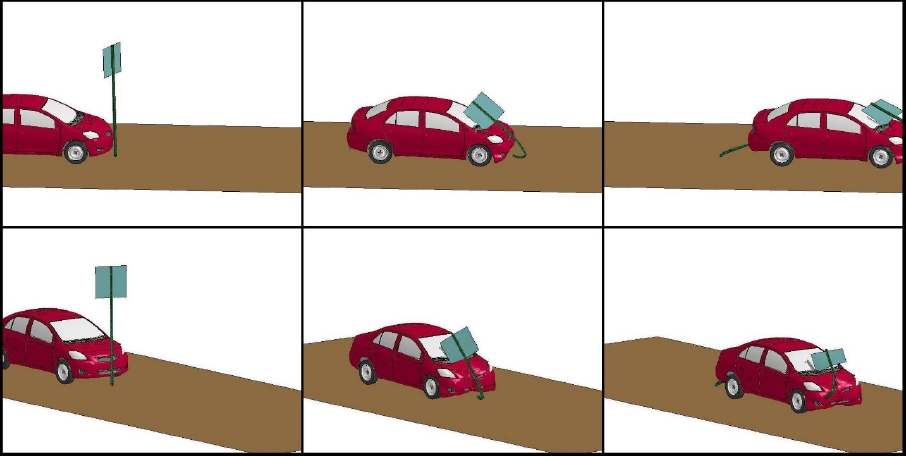 | ||||||||||
| Evaluation Criteria | ||||||||||
| B | The test article should readily activate in a predictable manner by breaking away, fracturing, or yielding. | Pass | ||||||||
| D | Detached elements, fragments, or other debris from the test article should not penetrate or show potential for penetrating the occupant compartment, or present undue hazard to other traffic, pedestrians, or personnel in a work zone. | Pass | ||||||||
| All Deformations of, or intrusions into, the occupant compartment should not exceed limits set forth in Section 5.3 and Appendix E of MASH. [Roof less than 4.0 in (101.6 mm). Windshield-no tear of plastic liner and maximum deformation of 3 in (76.2 mm)] | Roof ≤ 101.6 mm | 0 | Fail | |||||||
| Windshield ≤ 76.2 mm | 17 (tear) | |||||||||
| F | The vehicle should remain upright during and after the collision. The maximum pitch & roll angles are not to exceed 75 degrees. | Max Roll (Deg) | 0 | Pass | ||||||
| Max Pitch (Deg) | 1 | |||||||||
| H | Longitudinal & lateral occupant impact velocities (OIV) should fall below the preferred value of 10 ft/s (3.0 m/s), or at least below the maximum allowed value of 16 ft/s (4.9 m/s) | Vx (m/s) | 1.9 | Pass | ||||||
| Vy (m/s) | 0.1 | |||||||||
| I | Longitudinal & lateral occupant ridedown accelerations (ORA) should fall below the preferred value of 15.0 g, or at least below the maximum allowed value of 20.49 g | Ax (g) | 0.0 | Pass | ||||||
| Ay (g) | 0.0 | |||||||||
| N | Vehicle trajectory behind the test article is acceptable | Pass | ||||||||
| Single PSST Post Sign Support System Mounting-Height: 7 ft; A1011 Gr.50 Steel Post; Aluminum Panel; Anchor Embedment depth: 36 in | ||||||||||
| Post Size | Anchor Size | Panel Size | MASH Impact | Impact Location | Impact Angle | Wind Beam | ||||
| 2¼” x 2¼” 12 gauge | 2½” x 2½” 12 gauge | 2.5’ x 2.5’ 0.12” thick | 3-61 | Center | +25 deg | No | ||||
 | ||||||||||
| Evaluation Criteria | ||||||||||
| B | The test article should readily activate in a predictable manner by breaking away, fracturing, or yielding. | Pass | ||||||||
| D | Detached elements, fragments, or other debris from the test article should not penetrate or show potential for penetrating the occupant compartment, or present undue hazard to other traffic, pedestrians, or personnel in a work zone. | Pass | ||||||||
| All Deformations of, or intrusions into, the occupant compartment should not exceed limits set forth in Section 5.3 and Appendix E of MASH. [Roof less than 4.0 in (101.6 mm). Windshield-no tear of plastic liner and maximum deformation of 3 in (76.2 mm)] | Roof ≤ 101.6 mm | 0 | Fail | |||||||
| Windshield ≤ 76.2 mm | 10 (tear) | |||||||||
| F | The vehicle should remain upright during and after the collision. The maximum pitch & roll angles are not to exceed 75 degrees. | Max Roll (Deg) | 0 | Pass | ||||||
| Max Pitch (Deg) | 1 | |||||||||
| H | Longitudinal & lateral occupant impact velocities (OIV) should fall below the preferred value of 10 ft/s (3.0 m/s), or at least below the maximum allowed value of 16 ft/s (4.9 m/s) | Vx (m/s) | 2.2 | |||||||
| Vy (m/s) | 0.1 | Pass | ||||||||
| I | Longitudinal & lateral occupant ridedown accelerations (ORA) should fall below the preferred value of 15.0 g, or at least below the maximum allowed value of 20.49 g | Ax (g) | 0.0 | Pass | ||||||
| Ay (g) | 0.0 | |||||||||
| N | Vehicle trajectory behind the test article is acceptable | Pass | ||||||||
| Single PSST Post Sign Support System Mounting-Height: 7 ft; A1011 Gr.50 Post; Aluminum Panel; Anchor Embedment depth: 36 in | ||||||||||
| Post Size | Anchor Size | Panel Size | MASH Impact | Impact Location | Impact Angle | Wind Beam | ||||
| 2¼” x 2¼” 12 gauge | 2½” x 2½” 12 gauge | 2.5’ x 2.5’ 0.12” thick | 3-61 | Offset Driver | 0 deg | No | ||||
 | ||||||||||
| Evaluation Criteria | ||||||||||
| B | The test article should readily activate in a predictable manner by breaking away, fracturing, or yielding. Pass | |||||||||
| D | Detached elements, fragments, or other debris from the test article should not penetrate or show potential for penetrating the occupant compartment, or present undue hazard to other traffic, pedestrians, or personnel in a work zone. | Pass | ||||||||
| All Deformations of, or intrusions into, the occupant compartment should not exceed limits set forth in Section 5.3 and Appendix E of MASH. [Roof less than 4.0 in (101.6 mm). Windshield-no tear of plastic liner and maximum deformation of 3 in (76.2 mm)] | Roof ≤ 101.6 mm | 108 | Fail | |||||||
| Windshield ≤ 76.2 mm | 320 (tear) | |||||||||
| F | The vehicle should remain upright during and after the collision. The maximum pitch & roll angles are not to exceed 75 degrees. | Max Roll (Deg) | 1 | Pass | ||||||
| Max Pitch (Deg) | 1 | |||||||||
| H | Longitudinal & lateral occupant impact velocities (OIV) should fall below the preferred value of 10 ft/s (3.0 m/s), or at least below the maximum allowed value of 16 ft/s (4.9 m/s) | Vx (m/s) | 0.8 | Pass | ||||||
| Vy (m/s) | 0.2 | |||||||||
| I | Longitudinal & lateral occupant ridedown accelerations (ORA) should fall below the preferred value of 15.0 g, or at least below the maximum allowed value of 20.49 g | Ax (g) | 0.0 | Pass | ||||||
| Ay (g) | 0.0 | |||||||||
| N | Vehicle trajectory behind the test article is acceptable | Pass | ||||||||
| Single PSST Post Sign Support System Mounting-Height: 7 ft; A1011 Gr.50 Post; Aluminum Panel; Anchor Embedment depth: 36 in | ||||||||||
| Post Size | Anchor Size | Panel Size | MASH Impact | Impact Location | Impact Angle | Wind Beam | ||||
| 2¼” x 2¼” 12 gauge | 2½” x 2½” 12 gauge | 2.5’ x 2.5’ 0.12” thick | 3-62 | Center | 0 deg | No | ||||
 | ||||||||||
| Evaluation Criteria | ||||||||||
| B | The test article should readily activate in a predictable manner by breaking away, fracturing, or yielding. | Pass | ||||||||
| D | Detached elements, fragments, or other debris from the test article should not penetrate or show potential for penetrating the occupant compartment, or present undue hazard to other traffic, pedestrians, or personnel in a work zone. | Pass | ||||||||
| All Deformations of, or intrusions into, the occupant compartment should not exceed limits set forth in Section 5.3 and Appendix E of MASH. [Roof less than 4.0 in (101.6 mm). Windshield-no tear of plastic liner and maximum deformation of 3 in (76.2 mm)] | Roof ≤ 101.6 mm 0 | Pass | ||||||||
| Windshield ≤ 76.2 mm | 0 | |||||||||
| F | The vehicle should remain upright during and after the collision. The maximum pitch & roll angles are not to exceed 75 degrees. | Max Roll (Deg) | 0 | Pass | ||||||
| Max Pitch (Deg) | 1 | |||||||||
| H | Longitudinal & lateral occupant impact velocities (OIV) should fall below the preferred value of 10 ft/s (3.0 m/s), or at least below the maximum allowed value of 16 ft/s (4.9 m/s) | Vx (m/s) | 0.7 | Pass | ||||||
| Vy (m/s) | 0.0 | |||||||||
| I | Longitudinal & lateral occupant ridedown accelerations (ORA) should fall below the preferred value of 15.0 g, or at least below the maximum allowed value of 20.49 g | Ax (g) | 0.0 | Pass | ||||||
| Ay (g) | 0.0 | |||||||||
| N | Vehicle trajectory behind the test article is acceptable | Pass | ||||||||
| Single PSST Post Sign Support System Mounting-Height: 7 ft; A1011 Gr.50 Post; Aluminum Panel; Anchor Embedment depth: 36 in | ||||||||||
| Post Size | Anchor Size | Panel Size | MASH Impact | Impact Location | Impact Angle | Wind Beam | ||||
| 2¼” x 2¼” 12 gauge | 2½” x 2½” 12 gauge | 2.5’ x 2.5’ 0.12” thick | 3-62 | Center | +25 | No | ||||
 | ||||||||||
| Evaluation Criteria | ||||||||||
| B | The test article should readily activate in a predictable manner by breaking away, fracturing, or yielding. | Pass | ||||||||
| D | Detached elements, fragments, or other debris from the test article should not penetrate or show potential for penetrating the occupant compartment, or present undue hazard to other traffic, pedestrians, or personnel in a work zone. | Pass | ||||||||
| All Deformations of, or intrusions into, the occupant compartment should not exceed limits set forth in Section 5.3 and Appendix E of MASH. [Roof less than 4.0 in (101.6 mm). Windshield-no tear of plastic liner and maximum deformation of 3 in (76.2 mm)] | Roof ≤ 101.6 mm | 0 | Pass | |||||||
| Windshield ≤ 76.2 mm | 0 | |||||||||
| F | The vehicle should remain upright during and after the collision. The maximum pitch & roll angles are not to exceed 75 degrees. | Max Roll (Deg) | 0 | Pass | ||||||
| Max Pitch (Deg) | 0 | |||||||||
| H | Longitudinal & lateral occupant impact velocities (OIV) should fall below the preferred value of 10 ft/s (3.0 m/s), or at least below the maximum allowed value of 16 ft/s (4.9 m/s) | Vx (m/s) | 0.9 | |||||||
| Vy (m/s) | 0.0 | Pass | ||||||||
| I | Longitudinal & lateral occupant ridedown accelerations (ORA) should fall below the preferred value of 15.0 g, or at least below the maximum allowed value of 20.49 g | Ax (g) | 0.0 | Pass | ||||||
| Ay (g) | 0.0 | |||||||||
| N | Vehicle trajectory behind the test article is acceptable | Pass | ||||||||
| Single PSST Post Sign Support System Mounting-Height: 7 ft; A1011 Gr.50 Post; Aluminum Panel; Anchor Embedment depth: 36 in | ||||||||||
| Post Size | Anchor Size | Panel Size | MASH Impact | Impact Location | Impact Angle | Wind Beam | ||||
| 2¼” x 2¼” 12 gauge | 2½” x 2½” 12 gauge | 3’ x 3’ 0.08” thick | 3-60 | Offset Driver | 0 deg | No | ||||
 | ||||||||||
| Evaluation Criteria | ||||||||||
| B | The test article should readily activate in a predictable manner by breaking away, fracturing, or yielding. | Pass | ||||||||
| D | Detached elements, fragments, or other debris from the test article should not penetrate or show potential for penetrating the occupant compartment, or present undue hazard to other traffic, pedestrians, or personnel in a work zone. | Pass | ||||||||
| All Deformations of, or intrusions into, the occupant compartment should not exceed limits set forth in Section 5.3 and Appendix E of MASH. [Roof less than 4.0 in (101.6 mm). Windshield-no tear of plastic liner and maximum deformation of 3 in (76.2 mm)] | Roof ≤ 101.6 mm | 0 | Pass | |||||||
| Windshield ≤ 76.2 mm | 0 | |||||||||
| F | The vehicle should remain upright during and after the collision. The maximum pitch & roll angles are not to exceed 75 degrees. | Max Roll (Deg) | 2 | Pass | ||||||
| Max Pitch (Deg) | 2 | |||||||||
| H | Longitudinal & lateral occupant impact velocities (OIV) should fall below the preferred value of 10 ft/s (3.0 m/s), or at least below the maximum allowed value of 16 ft/s (4.9 m/s) | Vx (m/s) | 2.7 | Pass | ||||||
| Vy (m/s) | 0.0 | |||||||||
| I | Longitudinal & lateral occupant ridedown accelerations (ORA) should fall below the preferred value of 15.0 g, or at least below the maximum allowed value of 20.49 g | Ax (g) | 0.4 | Pass | ||||||
| Ay (g) | 0.9 | |||||||||
| N | Vehicle trajectory behind the test article is acceptable | Pass | ||||||||
| Single PSST Post Sign Support System Mounting-Height: 7 ft; A1011 Gr.50 Post; Aluminum Panel; Anchor Embedment depth: 36 in | ||||||||||
| Post Size | Anchor Size | Panel Size | MASH Impact | Impact Location | Impact Angle | Wind Beam | ||||
| 2¼” x 2¼” 12 gauge | 2½” x 2½” 12 gauge | 3’ x 3’ 0.08” thick | 3-61 | Center | 0 deg | No | ||||
 | ||||||||||
| Evaluation Criteria | ||||||||||
| B | The test article should readily activate in a predictable manner by breaking away, fracturing, or yielding. | Pass | ||||||||
| D | Detached elements, fragments, or other debris from the test article should not penetrate or show potential for penetrating the occupant compartment, or present undue hazard to other traffic, pedestrians, or personnel in a work zone. | Pass | ||||||||
| All Deformations of, or intrusions into, the occupant compartment should not exceed limits set forth in Section 5.3 and Appendix E of MASH. [Roof less than 4.0 in (101.6 mm). Windshield-no tear of plastic liner and maximum deformation of 3 in (76.2 mm)] | Roof ≤ 101.6 mm | 0 | Fail | |||||||
| Windshield ≤ 76.2 mm | 30 (tear) | |||||||||
| F | The vehicle should remain upright during and after the collision. The maximum pitch & roll angles are not to exceed 75 degrees. | Max Roll (Deg) | 0 | Pass | ||||||
| Max Pitch (Deg) | 1 | |||||||||
| H | Longitudinal & lateral occupant impact velocities (OIV) should fall below the preferred value of 10 ft/s (3.0 m/s), or at least below the maximum allowed value of 16 ft/s (4.9 m/s) | Vx (m/s) | 1.9 | Pass | ||||||
| Vy (m/s) | 0.0 | |||||||||
| I | Longitudinal & lateral occupant ridedown accelerations (ORA) should fall below the preferred value of 15.0 g, or at least below the maximum allowed value of 20.49 g | Ax (g) | 0.0 | Pass | ||||||
| Ay (g) | 0.0 | |||||||||
| N | Vehicle trajectory behind the test article is acceptable | Pass | ||||||||
| Single PSST Post Sign Support System Mounting-Height: 7 ft; A1011 Gr.50 Post; Aluminum Panel; Anchor Embedment depth: 36 in | ||||||||||
| Post Size | Anchor Size | Panel Size | MASH Impact | Impact Location | Impact Angle | Wind Beam | ||||
| 2¼” x 2¼” 12 gauge | 2½” x 2½” 12 gauge | 3’ x 3’ 0.08” thick | 3-61 | Center | -25 deg | No | ||||
 | ||||||||||
| Evaluation Criteria | ||||||||||
| B | The test article should readily activate in a predictable manner by breaking away, fracturing, or yielding. | Pass | ||||||||
| D | Detached elements, fragments, or other debris from the test article should not penetrate or show potential for penetrating the occupant compartment, or present undue hazard to other traffic, pedestrians, or personnel in a work zone. | Pass | ||||||||
| All Deformations of, or intrusions into, the occupant compartment should not exceed limits set forth in Section 5.3 and Appendix E of MASH. [Roof less than 4.0 in (101.6 mm). Windshield-no tear of plastic liner and maximum deformation of 3 in (76.2 mm)] | Roof ≤ 101.6 mm | 60 | Fail | |||||||
| Windshield ≤ 76.2 mm | 110 (tear) | |||||||||
| F | The vehicle should remain upright during and after the collision. The maximum pitch & roll angles are not to exceed 75 degrees. | Max Roll (Deg) | 0 | Pass | ||||||
| Max Pitch (Deg) | 1 | |||||||||
| H | Longitudinal & lateral occupant impact velocities (OIV) should fall below the preferred value of 10 ft/s (3.0 m/s), or at least below the maximum allowed value of 16 ft/s (4.9 m/s) | Vx (m/s) | 1.9 | Pass | ||||||
| Vy (m/s) | 0.1 | |||||||||
| I | Longitudinal & lateral occupant ridedown accelerations (ORA) should fall below the preferred value of 15.0 g, or at least below the maximum allowed value of 20.49 g | Ax (g) | 0.0 | Pass | ||||||
| Ay (g) | 0.0 | |||||||||
| N | Vehicle trajectory behind the test article is acceptable | Pass | ||||||||
| Single PSST Post Sign Support System Mounting-Height: 7 ft; A1011 Gr.50 Steel Post; Aluminum Panel; Anchor Embedment depth: 36 in | ||||||||||
| Post Size | Anchor Size | Panel Size | MASH Impact | Impact Location | Impact Angle | Wind Beam | ||||
| 2¼” x 2¼” 12 gauge | 2½” x 2½” 12 gauge | 3’ x 3’ 0.08” thick | 3-61 | Center | +25 deg | No | ||||
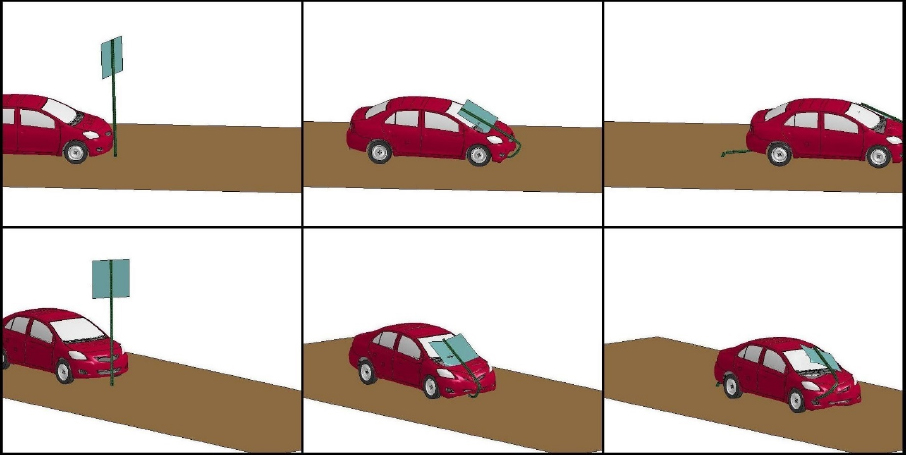 | ||||||||||
| Evaluation Criteria | ||||||||||
| B | The test article should readily activate in a predictable manner by breaking away, fracturing, or yielding. | Pass | ||||||||
| D | Detached elements, fragments, or other debris from the test article should not penetrate or show potential for penetrating the occupant compartment, or present undue hazard to other traffic, pedestrians, or personnel in a work zone. | Pass | ||||||||
| All Deformations of, or intrusions into, the occupant compartment should not exceed limits set forth in Section 5.3 and Appendix E of MASH. [Roof less than 4.0 in (101.6 mm). Windshield-no tear of plastic liner and maximum deformation of 3 in (76.2 mm)] | Roof ≤ 101.6 mm | 0 | Fail | |||||||
| Windshield ≤ 76.2 mm | 40 (tear) | |||||||||
| F | The vehicle should remain upright during and after the collision. The maximum pitch & roll angles are not to exceed 75 degrees. | Max Roll (Deg) | 0 | Pass | ||||||
| Max Pitch (Deg) | 1 | |||||||||
| H | Longitudinal & lateral occupant impact velocities (OIV) should fall below the preferred value of 10 ft/s (3.0 m/s), or at least below the maximum allowed value of 16 ft/s (4.9 m/s) | Vx (m/s) | 2.2 | |||||||
| Vy (m/s) | 0.0 | Pass | ||||||||
| I | Longitudinal & lateral occupant ridedown accelerations (ORA) should fall below the preferred value of 15.0 g, or at least below the maximum allowed value of 20.49 g | Ax (g) | 0.0 | Pass | ||||||
| Ay (g) | 0.0 | |||||||||
| N | Vehicle trajectory behind the test article is acceptable | Pass | ||||||||
| Single PSST Post Sign Support System Mounting-Height: 7 ft; A1011 Gr.50 Post; Aluminum Panel; Anchor Embedment depth: 36 in | ||||||||||
| Post Size | Anchor Size | Panel Size | MASH Impact | Impact Location | Impact Angle | Wind Beam | ||||
| 2¼” x 2¼” 12 gauge | 2½” x 2½” 12 gauge | 3’ x 3’ 0.08” thick | 3-61 | Offset Driver | 0 deg | No | ||||
 | ||||||||||
| Evaluation Criteria | ||||||||||
| B | The test article should readily activate in a predictable manner by breaking away, fracturing, or yielding. | Pass | ||||||||
| D | Detached elements, fragments, or other debris from the test article should not penetrate or show potential for penetrating the occupant compartment, or present undue hazard to other traffic, pedestrians, or personnel in a work zone. | Pass | ||||||||
| All Deformations of, or intrusions into, the occupant compartment should not exceed limits set forth in Section 5.3 and Appendix E of MASH. [Roof less than 4.0 in (101.6 mm). Windshield-no tear of plastic liner and maximum deformation of 3 in (76.2 mm)] | Roof ≤ 101.6 mm | 100 | Fail | |||||||
| Windshield ≤ 76.2 mm | 330 (tear) | |||||||||
| F | The vehicle should remain upright during and after the collision. The maximum pitch & roll angles are not to exceed 75 degrees. | Max Roll (Deg) | 1 | Pass | ||||||
| Max Pitch (Deg) | 1 | |||||||||
| H | Longitudinal & lateral occupant impact velocities (OIV) should fall below the preferred value of 10 ft/s (3.0 m/s), or at least below the maximum allowed value of 16 ft/s (4.9 m/s) | Vx (m/s) | 0.8 | Pass | ||||||
| Vy (m/s) | 0.2 | |||||||||
| I | Longitudinal & lateral occupant ridedown accelerations (ORA) should fall below the preferred value of 15.0 g, or at least below the maximum allowed value of 20.49 g | Ax (g) | 0.0 | Pass | ||||||
| Ay (g) | 0.0 | |||||||||
| N | Vehicle trajectory behind the test article is acceptable | Pass | ||||||||
| Single PSST Post Sign Support System Mounting-Height: 7 ft; A1011 Gr.50 Post; Aluminum Panel; Anchor Embedment depth: 36 in | ||||||||||
| Post Size | Anchor Size | Panel Size | MASH Impact | Impact Location | Impact Angle | Wind Beam | ||||
| 2¼” x 2¼” 12 gauge | 2½” x 2½” 12 gauge | 3’ x 3’ 0.08” thick | 3-62 | Center | 0 deg | No | ||||
 | ||||||||||
| Evaluation Criteria | ||||||||||
| B | The test article should readily activate in a predictable manner by breaking away, fracturing, or yielding. | Pass | ||||||||
| D | Detached elements, fragments, or other debris from the test article should not penetrate or show potential for penetrating the occupant compartment, or present undue hazard to other traffic, pedestrians, or personnel in a work zone. | Pass | ||||||||
| All Deformations of, or intrusions into, the occupant compartment should not exceed limits set forth in Section 5.3 and Appendix E of MASH. [Roof less than 4.0 in (101.6 mm). Windshield-no tear of plastic liner and maximum deformation of 3 in (76.2 mm)] | Roof ≤ 101.6 mm | 0 | Pass | |||||||
| Windshield ≤ 76.2 mm | 0 | |||||||||
| F | The vehicle should remain upright during and after the collision. The maximum pitch & roll angles are not to exceed 75 degrees. | Max Roll (Deg) | 0 | Pass | ||||||
| Max Pitch (Deg) | 1 | |||||||||
| H | Longitudinal & lateral occupant impact velocities (OIV) should fall below the preferred value of 10 ft/s (3.0 m/s), or at least below the maximum allowed value of 16 ft/s (4.9 m/s) | Vx (m/s) | 0.4 | Pass | ||||||
| Vy (m/s) | 0.0 | |||||||||
| I | Longitudinal & lateral occupant ridedown accelerations (ORA) should fall below the preferred value of 15.0 g, or at least below the maximum allowed value of 20.49 g | Ax (g) | 0.0 | Pass | ||||||
| Ay (g) | 0.0 | |||||||||
| N | Vehicle trajectory behind the test article is acceptable | Pass | ||||||||
| Single PSST Post Sign Support System Mounting-Height: 7 ft; A1011 Gr.50 Post; Aluminum Panel; Anchor Embedment depth: 36 in | ||||||||||
| Post Size | Anchor Size | Panel Size | MASH Impact | Impact Location | Impact Angle | Wind Beam | ||||
| 2¼” x 2¼” 12 gauge | 2½” x 2½” 12 gauge | 3’ x 3’ 0.08” thick | 3-62 | Center | +25 | No | ||||
 | ||||||||||
| Evaluation Criteria | ||||||||||
| B | The test article should readily activate in a predictable manner by breaking away, fracturing, or yielding. | Pass | ||||||||
| D | Detached elements, fragments, or other debris from the test article should not penetrate or show potential for penetrating the occupant compartment, or present undue hazard to other traffic, pedestrians, or personnel in a work zone. | Pass | ||||||||
| All Deformations of, or intrusions into, the occupant compartment should not exceed limits set forth in Section 5.3 and Appendix E of MASH. [Roof less than 4.0 in (101.6 mm). Windshield-no tear of plastic liner and maximum deformation of 3 in (76.2 mm)] | Roof ≤ 101.6 mm | 0 | Fail | |||||||
| Windshield ≤ 76.2 mm | 100 | |||||||||
| F | The vehicle should remain upright during and after the collision. The maximum pitch & roll angles are not to exceed 75 degrees. | Max Roll (Deg) | 0 | Pass | ||||||
| Max Pitch (Deg) | 0 | |||||||||
| H | Longitudinal & lateral occupant impact velocities (OIV) should fall below the preferred value of 10 ft/s (3.0 m/s), or at least below the maximum allowed value of 16 ft/s (4.9 m/s) | Vx (m/s) | 0.5 | Pass | ||||||
| Vy (m/s) | 0.0 | |||||||||
| I | Longitudinal & lateral occupant ridedown accelerations (ORA) should fall below the preferred value of 15.0 g, or at least below the maximum allowed value of 20.49 g | Ax (g) | 0.0 | Pass | ||||||
| Ay (g) | 0.0 | |||||||||
| N | Vehicle trajectory behind the test article is acceptable | Pass | ||||||||
| Single PSST Post Sign Support System Mounting-Height: 7 ft; A1011 Gr.50 Post; Aluminum Panel; Anchor Embedment depth: 36 in | ||||||||||
| Post Size | Anchor Size | Panel Size | MASH Impact | Impact Location | Impact Angle | Wind Beam | ||||
| 2¼” x 2¼” 12 gauge | 2½” x 2½” 12 gauge | 3’ x 3’ 0.12” thick | 3-60 | Offset Driver | 0 deg | No | ||||
 | ||||||||||
| Evaluation Criteria | ||||||||||
| B | The test article should readily activate in a predictable manner by breaking away, fracturing, or yielding. | Pass | ||||||||
| D | Detached elements, fragments, or other debris from the test article should not penetrate or show potential for penetrating the occupant compartment, or present undue hazard to other traffic, pedestrians, or personnel in a work zone. | Pass | ||||||||
| All Deformations of, or intrusions into, the occupant compartment should not exceed limits set forth in Section 5.3 and Appendix E of MASH. [Roof less than 4.0 in (101.6 mm). Windshield-no tear of plastic liner and maximum deformation of 3 in (76.2 mm)] | Roof ≤ 101.6 mm | 0 | Pass | |||||||
| Windshield ≤ 76.2 mm | 0 | |||||||||
| F | The vehicle should remain upright during and after the collision. The maximum pitch & roll angles are not to exceed 75 degrees. | Max Roll (Deg) | 2 | Pass | ||||||
| Max Pitch (Deg) | 2 | |||||||||
| H | Longitudinal & lateral occupant impact velocities (OIV) should fall below the preferred value of 10 ft/s (3.0 m/s), or at least below the maximum allowed value of 16 ft/s (4.9 m/s) | Vx (m/s) | 2.9 | Pass | ||||||
| Vy (m/s) | 0.0 | |||||||||
| I | Longitudinal & lateral occupant ridedown accelerations (ORA) should fall below the preferred value of 15.0 g, or at least below the maximum allowed value of 20.49 g | Ax (g) | 0.5 | Pass | ||||||
| Ay (g) | 0.7 | |||||||||
| N | Vehicle trajectory behind the test article is acceptable | Pass | ||||||||
| Single PSST Post Sign Support System Mounting-Height: 7 ft; A1011 Gr.50 Post; Aluminum Panel; Anchor Embedment depth: 36 in | ||||||||||
| Post Size | Anchor Size | Panel Size | MASH Impact | Impact Location | Impact Angle | Wind Beam | ||||
| 2¼” x 2¼” 12 gauge | 2½” x 2½” 12 gauge | 3’ x 3’ 0.12” thick | 3-61 | Center | 0 deg | No | ||||
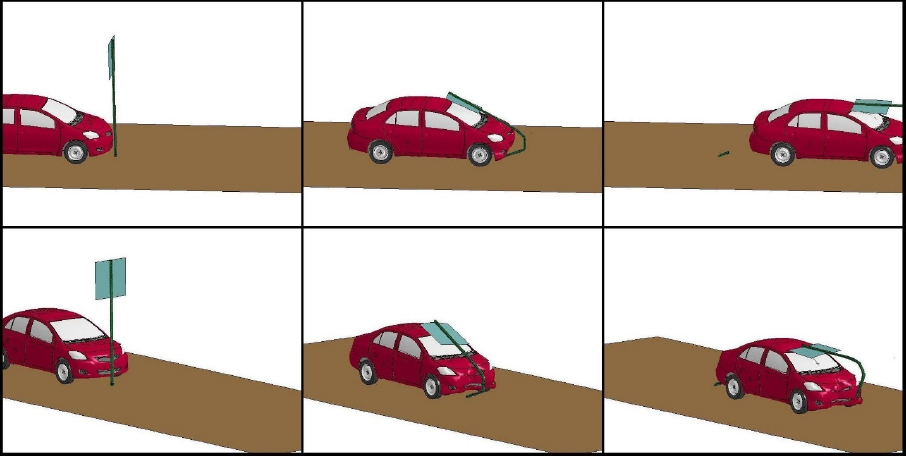 | ||||||||||
| Evaluation Criteria | ||||||||||
| B | The test article should readily activate in a predictable manner by breaking away, fracturing, or yielding. | Pass | ||||||||
| D | Detached elements, fragments, or other debris from the test article should not penetrate or show potential for penetrating the occupant compartment, or present undue hazard to other traffic, pedestrians, or personnel in a work zone. | Pass | ||||||||
| All Deformations of, or intrusions into, the occupant compartment should not exceed limits set forth in Section 5.3 and Appendix E of MASH. [Roof less than 4.0 in (101.6 mm). Windshield-no tear of plastic liner and maximum deformation of 3 in (76.2 mm)] | Roof ≤ 101.6 mm | 70 | Fail | |||||||
| Windshield ≤ 76.2 mm | 120 (tear) | |||||||||
| F | The vehicle should remain upright during and after the collision. The maximum pitch & roll angles are not to exceed 75 degrees. | Max Roll (Deg) | 0 | Pass | ||||||
| Max Pitch (Deg) | 0 | |||||||||
| H | Longitudinal & lateral occupant impact velocities (OIV) should fall below the preferred value of 10 ft/s (3.0 m/s), or at least below the maximum allowed value of 16 ft/s (4.9 m/s) | Vx (m/s) | 1.8 | Pass | ||||||
| Vy (m/s) | 0.1 | |||||||||
| I | Longitudinal & lateral occupant ridedown accelerations (ORA) should fall below the preferred value of 15.0 g, or at least below the maximum allowed value of 20.49 g | Ax (g) | 0.0 | Pass | ||||||
| Ay (g) | 0.0 | |||||||||
| N | Vehicle trajectory behind the test article is acceptable | Pass | ||||||||
| Single PSST Post Sign Support System Mounting-Height: 7 ft; A1011 Gr.50 Post; Aluminum Panel; Anchor Embedment depth: 36 in | ||||||||||
| Post Size | Anchor Size | Panel Size | MASH Impact | Impact Location | Impact Angle | Wind Beam | ||||
| 2¼” x 2¼” 12 gauge | 2½” x 2½” 12 gauge | 3’ x 3’ 0.12” thick | 3-61 | Center | -25 deg | No | ||||
 | ||||||||||
| Evaluation Criteria | ||||||||||
| B | The test article should readily activate in a predictable manner by breaking away, fracturing, or yielding. | Pass | ||||||||
| D | Detached elements, fragments, or other debris from the test article should not penetrate or show potential for penetrating the occupant compartment, or present undue hazard to other traffic, pedestrians, or personnel in a work zone. | Pass | ||||||||
| All Deformations of, or intrusions into, the occupant compartment should not exceed limits set forth in Section 5.3 and Appendix E of MASH. [Roof less than 4.0 in (101.6 mm). Windshield-no tear of plastic liner and maximum deformation of 3 in (76.2 mm)] | Roof ≤ 101.6 mm | 0 | Fail | |||||||
| Windshield ≤ 76.2 mm | 30 (tear) | |||||||||
| F | The vehicle should remain upright during and after the collision. The maximum pitch & roll angles are not to exceed 75 degrees. | Max Roll (Deg) | 0 | Pass | ||||||
| Max Pitch (Deg) | 1 | |||||||||
| H | Longitudinal & lateral occupant impact velocities (OIV) should fall below the preferred value of 10 ft/s (3.0 m/s), or at least below the maximum allowed value of 16 ft/s (4.9 m/s) | Vx (m/s) | 0.9 | Pass | ||||||
| Vy (m/s) | 0.0 | |||||||||
| I | Longitudinal & lateral occupant ridedown accelerations (ORA) should fall below the preferred value of 15.0 g, or at least below the maximum allowed value of 20.49 g | Ax (g) | 0.0 | Pass | ||||||
| Ay (g) | 0.0 | |||||||||
| N | Vehicle trajectory behind the test article is acceptable | Pass | ||||||||
| Single PSST Post Sign Support System Mounting-Height: 7 ft; A1011 Gr.50 Steel Post; Aluminum Panel; Anchor Embedment depth: 36 in | ||||||||||
| Post Size | Anchor Size | Panel Size | MASH Impact | Impact Location | Impact Angle | Wind Beam | ||||
| 2¼” x 2¼” 12 gauge | 2½” x 2½” 12 gauge | 3’ x 3’ 0.12” thick | 3-61 | Center | +25 deg | No | ||||
 | ||||||||||
| Evaluation Criteria | ||||||||||
| B | The test article should readily activate in a predictable manner by breaking away, fracturing, or yielding. | Pass | ||||||||
| D | Detached elements, fragments, or other debris from the test article should not penetrate or show potential for penetrating the occupant compartment, or present undue hazard to other traffic, pedestrians, or personnel in a work zone. | Pass | ||||||||
| All Deformations of, or intrusions into, the occupant compartment should not exceed limits set forth in Section 5.3 and Appendix E of MASH. [Roof less than 4.0 in (101.6 mm). Windshield-no tear of plastic liner and maximum deformation of 3 in (76.2 mm)] | Roof ≤ 101.6 mm | 0 | Fail | |||||||
| Windshield ≤ 76.2 mm | 50 (tear) | |||||||||
| F | The vehicle should remain upright during and after the collision. The maximum pitch & roll angles are not to exceed 75 degrees. | Max Roll (Deg) | 0 | Pass | ||||||
| Max Pitch (Deg) | 1 | |||||||||
| H | Longitudinal & lateral occupant impact velocities (OIV) should fall below the preferred value of 10 ft/s (3.0 m/s), or at least below the maximum allowed value of 16 ft/s (4.9 m/s) | Vx (m/s) | 2.4 | Pass | ||||||
| Vy (m/s) | 0.0 | |||||||||
| I | Longitudinal & lateral occupant ridedown accelerations (ORA) should fall below the preferred value of 15.0 g, or at least below the maximum allowed value of 20.49 g | Ax (g) | 0.0 | Pass | ||||||
| Ay (g) | 0.0 | |||||||||
| N | Vehicle trajectory behind the test article is acceptable | Pass | ||||||||
| Single PSST Post Sign Support System Mounting-Height: 7 ft; A1011 Gr.50 Post; Aluminum Panel; Anchor Embedment depth: 36 in | ||||||||||
| Post Size | Anchor Size | Panel Size | MASH Impact | Impact Location | Impact Angle | Wind Beam | ||||
| 2¼” x 2¼” 12 gauge | 2½” x 2½” 12 gauge | 3’ x 3’ 0.12” thick | 3-61 | Offset Driver | 0 deg | No | ||||
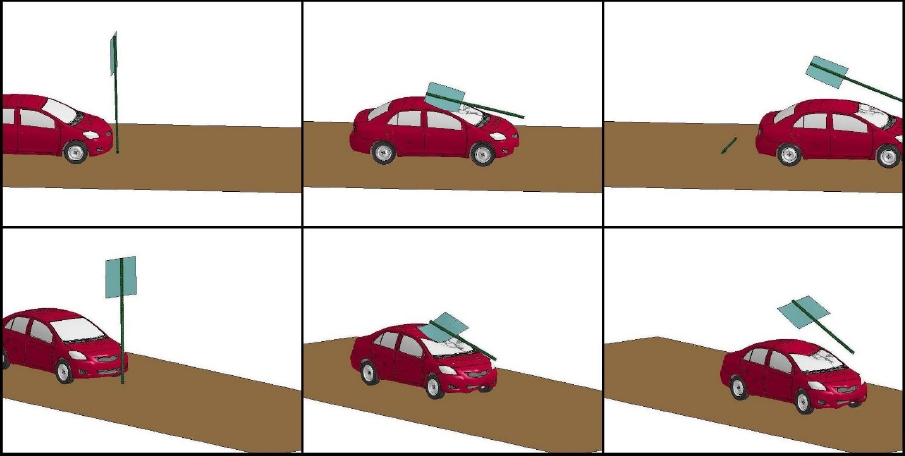 | ||||||||||
| Evaluation Criteria | ||||||||||
| B | The test article should readily activate in a predictable manner by breaking away, fracturing, or yielding. | Pass | ||||||||
| D | Detached elements, fragments, or other debris from the test article should not penetrate or show potential for penetrating the occupant compartment, or present undue hazard to other traffic, pedestrians, or personnel in a work zone. | Pass | ||||||||
| All Deformations of, or intrusions into, the occupant compartment should not exceed limits set forth in Section 5.3 and Appendix E of MASH. [Roof less than 4.0 in (101.6 mm). Windshield-no tear of plastic liner and maximum deformation of 3 in (76.2 mm)] | Roof ≤ 101.6 mm | 100 | Fail | |||||||
| Windshield ≤ 76.2 mm | 300 (tear) | |||||||||
| F | The vehicle should remain upright during and after the collision. The maximum pitch & roll angles are not to exceed 75 degrees. | Max Roll (Deg) | 1 | Pass | ||||||
| Max Pitch (Deg) | 1 | |||||||||
| H | Longitudinal & lateral occupant impact velocities (OIV) should fall below the preferred value of 10 ft/s (3.0 m/s), or at least below the maximum allowed value of 16 ft/s (4.9 m/s) | Vx (m/s) | 0.8 | Pass | ||||||
| Vy (m/s) | 0.2 | |||||||||
| I | Longitudinal & lateral occupant ridedown accelerations (ORA) should fall below the preferred value of 15.0 g, or at least below the maximum allowed value of 20.49 g | Ax (g) | 0.0 | Pass | ||||||
| Ay (g) | 0.0 | |||||||||
| N | Vehicle trajectory behind the test article is acceptable | Pass | ||||||||
| Single PSST Post Sign Support System Mounting-Height: 7 ft; A1011 Gr.50 Post; Aluminum Panel; Anchor Embedment depth: 36 in | ||||||||||
| Post Size | Anchor Size | Panel Size | MASH Impact | Impact Location | Impact Angle | Wind Beam | ||||
| 2¼” x 2¼” 12 gauge | 2½” x 2½” 12 gauge | 3’ x 3’ 0.12” thick | 3-62 | Center | 0 deg | No | ||||
 | ||||||||||
| Evaluation Criteria | ||||||||||
| B | The test article should readily activate in a predictable manner by breaking away, fracturing, or yielding. | Pass | ||||||||
| D | Detached elements, fragments, or other debris from the test article should not penetrate or show potential for penetrating the occupant compartment, or present undue hazard to other traffic, pedestrians, or personnel in a work zone. | Pass | ||||||||
| All Deformations of, or intrusions into, the occupant compartment should not exceed limits set forth in Section 5.3 and Appendix E of MASH. [Roof less than 4.0 in (101.6 mm). Windshield-no tear of plastic liner and maximum deformation of 3 in (76.2 mm)] | Roof ≤ 101.6 mm | 120 | Fail | |||||||
| Windshield ≤ 76.2 mm | 100 | |||||||||
| F | The vehicle should remain upright during and after the collision. The maximum pitch & roll angles are not to exceed 75 degrees. | Max Roll (Deg) | 0 | Pass | ||||||
| Max Pitch (Deg) | 1 | |||||||||
| H | Longitudinal & lateral occupant impact velocities (OIV) should fall below the preferred value of 10 ft/s (3.0 m/s), or at least below the maximum allowed value of 16 ft/s (4.9 m/s) | Vx (m/s) | 0.7 | Pass | ||||||
| Vy (m/s) | 0.0 | |||||||||
| I | Longitudinal & lateral occupant ridedown accelerations (ORA) should fall below the preferred value of 15.0 g, or at least below the maximum allowed value of 20.49 g | Ax (g) | 0.0 | Pass | ||||||
| Ay (g) | 0.0 | |||||||||
| N | Vehicle trajectory behind the test article is acceptable | Pass | ||||||||
| Single PSST Post Sign Support System Mounting-Height: 7 ft; A1011 Gr.50 Post; Aluminum Panel; Anchor Embedment depth: 36 in | ||||||||||
| Post Size | Anchor Size | Panel Size | MASH Impact | Impact Location | Impact Angle | Wind Beam | ||||
| 2¼” x 2¼” 12 gauge | 2½” x 2½” 12 gauge | 3’ x 3’ 0.12” thick | 3-62 | Center | +25 | No | ||||
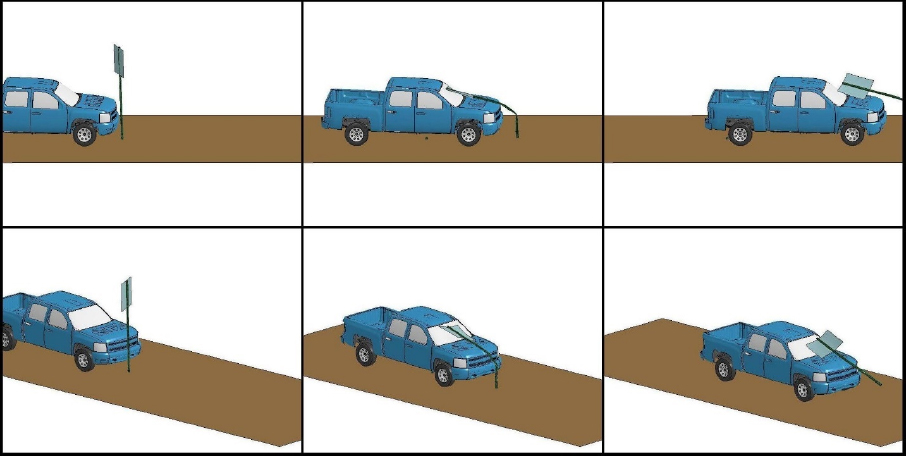 | ||||||||||
| Evaluation Criteria | ||||||||||
| B | The test article should readily activate in a predictable manner by breaking away, fracturing, or yielding. | Pass | ||||||||
| D | Detached elements, fragments, or other debris from the test article should not penetrate or show potential for penetrating the occupant compartment, or present undue hazard to other traffic, pedestrians, or personnel in a work zone. | Pass | ||||||||
| All Deformations of, or intrusions into, the occupant compartment should not exceed limits set forth in Section 5.3 and Appendix E of MASH. [Roof less than 4.0 in (101.6 mm). Windshield-no tear of plastic liner and maximum deformation of 3 in (76.2 mm)] | Roof ≤ 101.6 mm | 0 | Fail | |||||||
| Windshield ≤ 76.2 mm | 100 | |||||||||
| F | The vehicle should remain upright during and after the collision. The maximum pitch & roll angles are not to exceed 75 degrees. | Max Roll (Deg) | 0 | Pass | ||||||
| Max Pitch (Deg) | 0 | |||||||||
| H | Longitudinal & lateral occupant impact velocities (OIV) should fall below the preferred value of 10 ft/s (3.0 m/s), or at least below the maximum allowed value of 16 ft/s (4.9 m/s) | Vx (m/s) | 0.9 | Pass | ||||||
| Vy (m/s) | 0.0 | |||||||||
| I | Longitudinal & lateral occupant ridedown accelerations (ORA) should fall below the preferred value of 15.0 g, or at least below the maximum allowed value of 20.49 g | Ax (g) | 0.0 | Pass | ||||||
| Ay (g) | 0.0 | |||||||||
| N | Vehicle trajectory behind the test article is acceptable | Pass | ||||||||
| Single PSST Post Sign Support System Mounting-Height: 7 ft; A1011 Gr.50 Post; Aluminum Panel; Anchor Embedment depth: 36 in | ||||||||||
| Post Size | Anchor Size | Panel Size | MASH Impact | Impact Location | Impact Angle | Wind Beam | ||||
| 2¼” x 2¼” 12 gauge | 2½” x 2½” 12 gauge | 3’ x 4’ 0.08” thick | 3-60 | Offset Driver | 0 deg | No | ||||
 | ||||||||||
| Evaluation Criteria | ||||||||||
| B | The test article should readily activate in a predictable manner by breaking away, fracturing, or yielding. | Pass | ||||||||
| D | Detached elements, fragments, or other debris from the test article should not penetrate or show potential for penetrating the occupant compartment, or present undue hazard to other traffic, pedestrians, or personnel in a work zone. | Pass | ||||||||
| All Deformations of, or intrusions into, the occupant compartment should not exceed limits set forth in Section 5.3 and Appendix E of MASH. [Roof less than 4.0 in (101.6 mm). Windshield-no tear of plastic liner and maximum deformation of 3 in (76.2 mm)] | Roof ≤ 101.6 mm | 0 | Pass | |||||||
| Windshield ≤ 76.2 mm | 0 | |||||||||
| F | The vehicle should remain upright during and after the collision. The maximum pitch & roll angles are not to exceed 75 degrees. | Max Roll (Deg) | 2 | Pass | ||||||
| Max Pitch (Deg) | 2 | |||||||||
| H | Longitudinal & lateral occupant impact velocities (OIV) should fall below the preferred value of 10 ft/s (3.0 m/s), or at least below the maximum allowed value of 16 ft/s (4.9 m/s) | Vx (m/s) | 2.9 | Pass | ||||||
| Vy (m/s) | 0.0 | |||||||||
| I | Longitudinal & lateral occupant ridedown accelerations (ORA) should fall below the preferred value of 15.0 g, or at least below the maximum allowed value of 20.49 g | Ax (g) | 0.4 | Pass | ||||||
| Ay (g) | 0.7 | |||||||||
| N | Vehicle trajectory behind the test article is acceptable | Pass | ||||||||
| Single PSST Post Sign Support System Mounting-Height: 7 ft; A1011 Gr.50 Post; Aluminum Panel; Anchor Embedment depth: 36 in | ||||||||||
| Post Size | Anchor Size | Panel Size | MASH Impact | Impact Location | Impact Angle | Wind Beam | ||||
| 2¼” x 2¼” 12 gauge | 2½” x 2½” 12 gauge | 3’ x 4’ 0.08” thick | 3-61 | Center | 0 deg | No | ||||
 | ||||||||||
| Evaluation Criteria | ||||||||||
| B | The test article should readily activate in a predictable manner by breaking away, fracturing, or yielding. | Pass | ||||||||
| D | Detached elements, fragments, or other debris from the test article should not penetrate or show potential for penetrating the occupant compartment, or present undue hazard to other traffic, pedestrians, or personnel in a work zone. | Pass | ||||||||
| All Deformations of, or intrusions into, the occupant compartment should not exceed limits set forth in Section 5.3 and Appendix E of MASH. [Roof less than 4.0 in (101.6 mm). Windshield-no tear of plastic liner and maximum deformation of 3 in (76.2 mm)] | Roof ≤ 101.6 mm | 110 | Fail | |||||||
| Windshield ≤ 76.2 mm | 225 (tear) | |||||||||
| F | The vehicle should remain upright during and after the collision. The maximum pitch & roll angles are not to exceed 75 degrees. | Max Roll (Deg) | 0 | Pass | ||||||
| Max Pitch (Deg) | 1 | |||||||||
| H | Longitudinal & lateral occupant impact velocities (OIV) should fall below the preferred value of 10 ft/s (3.0 m/s), or at least below the maximum allowed value of 16 ft/s (4.9 m/s) | Vx (m/s) | 1.9 | Pass | ||||||
| Vy (m/s) | 0.0 | |||||||||
| I | Longitudinal & lateral occupant ridedown accelerations (ORA) should fall below the preferred value of 15.0 g, or at least below the maximum allowed value of 20.49 g | Ax (g) | 0.0 | Pass | ||||||
| Ay (g) | 0.0 | |||||||||
| N | Vehicle trajectory behind the test article is acceptable | Pass | ||||||||
| Single PSST Post Sign Support System Mounting-Height: 7 ft; A1011 Gr.50 Post; Aluminum Panel; Anchor Embedment depth: 36 in | ||||||||||
| Post Size | Anchor Size | Panel Size | MASH Impact | Impact Location | Impact Angle | Wind Beam | ||||
| 2¼” x 2¼” 12 gauge | 2½” x 2½” 12 gauge | 3’ x 4’ 0.08” thick | 3-61 | Center | -25 deg | No | ||||
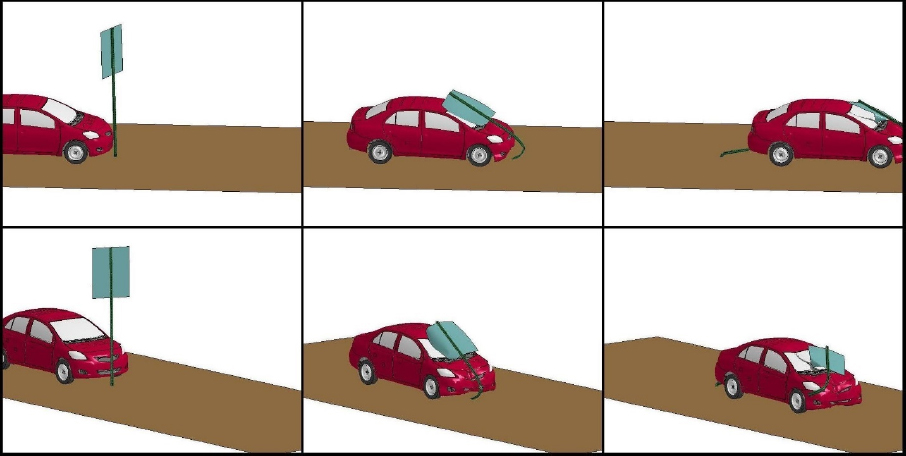 | ||||||||||
| Evaluation Criteria | ||||||||||
| B | The test article should readily activate in a predictable manner by breaking away, fracturing, or yielding. | Pass | ||||||||
| D | Detached elements, fragments, or other debris from the test article should not penetrate or show potential for penetrating the occupant compartment, or present undue hazard to other traffic, pedestrians, or personnel in a work zone. | Pass | ||||||||
| All Deformations of, or intrusions into, the occupant compartment should not exceed limits set forth in Section 5.3 and Appendix E of MASH. [Roof less than 4.0 in (101.6 mm). Windshield-no tear of plastic liner and maximum deformation of 3 in (76.2 mm)] | Roof ≤ 101.6 mm | 40 | Fail | |||||||
| Windshield ≤ 76.2 mm | 80 (tear) | |||||||||
| F | The vehicle should remain upright during and after the collision. The maximum pitch & roll angles are not to exceed 75 degrees. | Max Roll (Deg) | 0 | Pass | ||||||
| Max Pitch (Deg) | 0 | |||||||||
| H | Longitudinal & lateral occupant impact velocities (OIV) should fall below the preferred value of 10 ft/s (3.0 m/s), or at least below the maximum allowed value of 16 ft/s (4.9 m/s) | Vx (m/s) | 2.0 | Pass | ||||||
| Vy (m/s) | 0.0 | |||||||||
| I | Longitudinal & lateral occupant ridedown accelerations (ORA) should fall below the preferred value of 15.0 g, or at least below the maximum allowed value of 20.49 g | Ax (g) | 0.0 | Pass | ||||||
| Ay (g) | 0.0 | |||||||||
| N | Vehicle trajectory behind the test article is acceptable | Pass | ||||||||
| Single PSST Post Sign Support System Mounting-Height: 7 ft; A1011 Gr.50 Steel Post; Aluminum Panel; Anchor Embedment depth: 36 in | ||||||||||
| Post Size | Anchor Size | Panel Size | MASH Impact | Impact Location | Impact Angle | Wind Beam | ||||
| 2¼” x 2¼” 12 gauge | 2½” x 2½” 12 gauge | 3’ x 4’ 0.08” thick | 3-61 | Center | +25 deg | No | ||||
 | ||||||||||
| Evaluation Criteria | ||||||||||
| B | The test article should readily activate in a predictable manner by breaking away, fracturing, or yielding. | Pass | ||||||||
| D | Detached elements, fragments, or other debris from the test article should not penetrate or show potential for penetrating the occupant compartment, or present undue hazard to other traffic, pedestrians, or personnel in a work zone. | Pass | ||||||||
| All Deformations of, or intrusions into, the occupant compartment should not exceed limits set forth in Section 5.3 and Appendix E of MASH. [Roof less than 4.0 in (101.6 mm). Windshield-no tear of plastic liner and maximum deformation of 3 in (76.2 mm)] | Roof ≤ 101.6 mm | 0 | Fail | |||||||
| Windshield ≤ 76.2 mm | 78 (tear) | |||||||||
| F | The vehicle should remain upright during and after the collision. The maximum pitch & roll angles are not to exceed 75 degrees. | Max Roll (Deg) | 0 | Pass | ||||||
| Max Pitch (Deg) | 1 | |||||||||
| H | Longitudinal & lateral occupant impact velocities (OIV) should fall below the preferred value of 10 ft/s (3.0 m/s), or at least below the maximum allowed value of 16 ft/s (4.9 m/s) | Vx (m/s) | 2.2 | Pass | ||||||
| Vy (m/s) | 0.0 | |||||||||
| I | Longitudinal & lateral occupant ridedown accelerations (ORA) should fall below the preferred value of 15.0 g, or at least below the maximum allowed value of 20.49 g | Ax (g) | 0.0 | Pass | ||||||
| Ay (g) | 0.0 | |||||||||
| N | Vehicle trajectory behind the test article is acceptable | Pass | ||||||||
| Single PSST Post Sign Support System Mounting-Height: 7 ft; A1011 Gr.50 Post; Aluminum Panel; Anchor Embedment depth: 36 in | ||||||||||
| Post Size | Anchor Size | Panel Size | MASH Impact | Impact Location | Impact Angle | Wind Beam | ||||
| 2¼” x 2¼” 12 gauge | 2½” x 2½” 12 gauge | 3’ x 4’ 0.08” thick | 3-61 | Offset Driver | 0 deg | No | ||||
 | ||||||||||
| Evaluation Criteria | ||||||||||
| B | The test article should readily activate in a predictable manner by breaking away, fracturing, or yielding. | Pass | ||||||||
| D | Detached elements, fragments, or other debris from the test article should not penetrate or show potential for penetrating the occupant compartment, or present undue hazard to other traffic, pedestrians, or personnel in a work zone. | Pass | ||||||||
| All Deformations of, or intrusions into, the occupant compartment should not exceed limits set forth in Section 5.3 and Appendix E of MASH. [Roof less than 4.0 in (101.6 mm). Windshield-no tear of plastic liner and maximum deformation of 3 in (76.2 mm)] | Roof ≤ 101.6 mm | 90 | Fail | |||||||
| Windshield ≤ 76.2 mm | 120 (tear) | |||||||||
| F | The vehicle should remain upright during and after the collision. The maximum pitch & roll angles are not to exceed 75 degrees. | Max Roll (Deg) | 0 | Pass | ||||||
| Max Pitch (Deg) | 1 | |||||||||
| H | Longitudinal & lateral occupant impact velocities (OIV) should fall below the preferred value of 10 ft/s (3.0 m/s), or at least below the maximum allowed value of 16 ft/s (4.9 m/s) | Vx (m/s) | 0.8 | Pass | ||||||
| Vy (m/s) | 0.3 | |||||||||
| I | Longitudinal & lateral occupant ridedown accelerations (ORA) should fall below the preferred value of 15.0 g, or at least below the maximum allowed value of 20.49 g | Ax (g) | 0.0 | Pass | ||||||
| Ay (g) | 0.0 | |||||||||
| N | Vehicle trajectory behind the test article is acceptable | Pass | ||||||||
| Single PSST Post Sign Support System Mounting-Height: 7 ft; A1011 Gr.50 Post; Aluminum Panel; Anchor Embedment depth: 36 in | ||||||||||
| Post Size | Anchor Size | Panel Size | MASH Impact | Impact Location | Impact Angle | Wind Beam | ||||
| 2¼” x 2¼” 12 gauge | 2½” x 2½” 12 gauge | 3’ x 4’ 0.08” thick | 3-62 | Center | 0 deg | No | ||||
 | ||||||||||
| Evaluation Criteria | ||||||||||
| B | The test article should readily activate in a predictable manner by breaking away, fracturing, or yielding. | Pass | ||||||||
| D | Detached elements, fragments, or other debris from the test article should not penetrate or show potential for penetrating the occupant compartment, or present undue hazard to other traffic, pedestrians, or personnel in a work zone. | Pass | ||||||||
| All Deformations of, or intrusions into, the occupant compartment should not exceed limits set forth in Section 5.3 and Appendix E of MASH. [Roof less than 4.0 in (101.6 mm). Windshield-no tear of plastic liner and maximum deformation of 3 in (76.2 mm)] | Roof ≤ 101.6 mm | 60 | Fail | |||||||
| Windshield ≤ 76.2 mm | 140 | |||||||||
| F | The vehicle should remain upright during and after the collision. The maximum pitch & roll angles are not to exceed 75 degrees. | Max Roll (Deg) | 0 | Pass | ||||||
| Max Pitch (Deg) | 0 | |||||||||
| H | Longitudinal & lateral occupant impact velocities (OIV) should fall below the preferred value of 10 ft/s (3.0 m/s), or at least below the maximum allowed value of 16 ft/s (4.9 m/s) | Vx (m/s) | 0.7 | Pass | ||||||
| Vy (m/s) | 0.0 | |||||||||
| I | Longitudinal & lateral occupant ridedown accelerations (ORA) should fall below the preferred value of 15.0 g, or at least below the maximum allowed value of 20.49 g | Ax (g) | 0.0 | Pass | ||||||
| Ay (g) | 0.0 | |||||||||
| N | Vehicle trajectory behind the test article is acceptable | Pass | ||||||||
| Single PSST Post Sign Support System Mounting-Height: 7 ft; A1011 Gr.50 Post; Aluminum Panel; Anchor Embedment depth: 36 in | ||||||||||
| Post Size | Anchor Size | Panel Size | MASH Impact | Impact Location | Impact Angle | Wind Beam | ||||
| 2¼” x 2¼” 12 gauge | 2½” x 2½” 12 gauge | 3’ x 4’ 0.08” thick | 3-62 | Center | +25 | No | ||||
 | ||||||||||
| Evaluation Criteria | ||||||||||
| B | The test article should readily activate in a predictable manner by breaking away, fracturing, or yielding. | Pass | ||||||||
| D | Detached elements, fragments, or other debris from the test article should not penetrate or show potential for penetrating the occupant compartment, or present undue hazard to other traffic, pedestrians, or personnel in a work zone. | Pass | ||||||||
| All Deformations of, or intrusions into, the occupant compartment should not exceed limits set forth in Section 5.3 and Appendix E of MASH. [Roof less than 4.0 in (101.6 mm). Windshield-no tear of plastic liner and maximum deformation of 3 in (76.2 mm)] | Roof ≤ 101.6 mm | 20 | Pass | |||||||
| Windshield ≤ 76.2 mm | 70 | |||||||||
| F | The vehicle should remain upright during and after the collision. The maximum pitch & roll angles are not to exceed 75 degrees. | Max Roll (Deg) | 0 | Pass | ||||||
| Max Pitch (Deg) | 0 | |||||||||
| H | Longitudinal & lateral occupant impact velocities (OIV) should fall below the preferred value of 10 ft/s (3.0 m/s), or at least below the maximum allowed value of 16 ft/s (4.9 m/s) | Vx (m/s) | 0.5 | Pass | ||||||
| Vy (m/s) | 0.0 | |||||||||
| I | Longitudinal & lateral occupant ridedown accelerations (ORA) should fall below the preferred value of 15.0 g, or at least below the maximum allowed value of 20.49 g | Ax (g) | 0.0 | Pass | ||||||
| Ay (g) | 0.0 | |||||||||
| N | Vehicle trajectory behind the test article is acceptable | Pass | ||||||||
| Single PSST Post Sign Support System Mounting-Height: 7 ft; A1011 Gr.50 Post; Aluminum Panel; Anchor Embedment depth: 36 in | ||||||||||
| Post Size | Anchor Size | Panel Size | MASH Impact | Impact Location | Impact Angle | Wind Beam | ||||
| 2¼” x 2¼” 12 gauge | 2½” x 2½” 12 gauge | 3’ x 4’ 0.12” thick | 3-60 | Offset Driver | 0 deg | No | ||||
 | ||||||||||
| Evaluation Criteria | ||||||||||
| B | The test article should readily activate in a predictable manner by breaking away, fracturing, or yielding. | Pass | ||||||||
| D | Detached elements, fragments, or other debris from the test article should not penetrate or show potential for penetrating the occupant compartment, or present undue hazard to other traffic, pedestrians, or personnel in a work zone. | Pass | ||||||||
| All Deformations of, or intrusions into, the occupant compartment should not exceed limits set forth in Section 5.3 and Appendix E of MASH. [Roof less than 4.0 in (101.6 mm). Windshield-no tear of plastic liner and maximum deformation of 3 in (76.2 mm)] | Roof ≤ 101.6 mm | 0 | Pass | |||||||
| Windshield ≤ 76.2 mm | 0 | |||||||||
| F | The vehicle should remain upright during and after the collision. The maximum pitch & roll angles are not to exceed 75 degrees. | Max Roll (Deg) | 2 | Pass | ||||||
| Max Pitch (Deg) | 2 | |||||||||
| H | Longitudinal & lateral occupant impact velocities (OIV) should fall below the preferred value of 10 ft/s (3.0 m/s), or at least below the maximum allowed value of 16 ft/s (4.9 m/s) | Vx (m/s) | 3.2 | Pass | ||||||
| Vy (m/s) | 0.0 | |||||||||
| I | Longitudinal & lateral occupant ridedown accelerations (ORA) should fall below the preferred value of 15.0 g, or at least below the maximum allowed value of 20.49 g | Ax (g) | 0.5 | Pass | ||||||
| Ay (g) | 0.7 | |||||||||
| N | Vehicle trajectory behind the test article is acceptable | Pass | ||||||||
| Single PSST Post Sign Support System Mounting-Height: 7 ft; A1011 Gr.50 Post; Aluminum Panel; Anchor Embedment depth: 36 in | ||||||||||
| Post Size | Anchor Size | Panel Size | MASH Impact | Impact Location | Impact Angle | Wind Beam | ||||
| 2¼” x 2¼” 12 gauge | 2½” x 2½” 12 gauge | 3’ x 4’ 0.12” thick | 3-61 | Center | 0 deg | No | ||||
 | ||||||||||
| Evaluation Criteria | ||||||||||
| B | The test article should readily activate in a predictable manner by breaking away, fracturing, or yielding. | Pass | ||||||||
| D | Detached elements, fragments, or other debris from the test article should not penetrate or show potential for penetrating the occupant compartment, or present undue hazard to other traffic, pedestrians, or personnel in a work zone. | Pass | ||||||||
| All Deformations of, or intrusions into, the occupant compartment should not exceed limits set forth in Section 5.3 and Appendix E of MASH. [Roof less than 4.0 in (101.6 mm). Windshield-no tear of plastic liner and maximum deformation of 3 in (76.2 mm)] | Roof ≤ 101.6 mm | 110 | Fail | |||||||
| Windshield ≤ 76.2 mm | 210 (tear) | |||||||||
| F | The vehicle should remain upright during and after the collision. The maximum pitch & roll angles are not to exceed 75 degrees. | Max Roll (Deg) | 0 | Pass | ||||||
| Max Pitch (Deg) | 0 | |||||||||
| H | Longitudinal & lateral occupant impact velocities (OIV) should fall below the preferred value of 10 ft/s (3.0 m/s), or at least below the maximum allowed value of 16 ft/s (4.9 m/s) | Vx (m/s) | 1.9 | Pass | ||||||
| Vy (m/s) | 0.0 | |||||||||
| I | Longitudinal & lateral occupant ridedown accelerations (ORA) should fall below the preferred value of 15.0 g, or at least below the maximum allowed value of 20.49 g | Ax (g) | 0.0 | Pass | ||||||
| Ay (g) | 0.0 | |||||||||
| N | Vehicle trajectory behind the test article is acceptable | Pass | ||||||||
| Single PSST Post Sign Support System Mounting-Height: 7 ft; A1011 Gr.50 Post; Aluminum Panel; Anchor Embedment depth: 36 in | ||||||||||
| Post Size | Anchor Size | Panel Size | MASH Impact | Impact Location | Impact Angle | Wind Beam | ||||
| 2¼” x 2¼” 12 gauge | 2½” x 2½” 12 gauge | 3’ x 4’ 0.12” thick | 3-61 | Center | -25 deg | No | ||||
 | ||||||||||
| Evaluation Criteria | ||||||||||
| B | The test article should readily activate in a predictable manner by breaking away, fracturing, or yielding. | Pass | ||||||||
| D | Detached elements, fragments, or other debris from the test article should not penetrate or show potential for penetrating the occupant compartment, or present undue hazard to other traffic, pedestrians, or personnel in a work zone. | Pass | ||||||||
| All Deformations of, or intrusions into, the occupant compartment should not exceed limits set forth in Section 5.3 and Appendix E of MASH. [Roof less than 4.0 in (101.6 mm). Windshield-no tear of plastic liner and maximum deformation of 3 in (76.2 mm)] | Roof ≤ 101.6 mm | 40 | Fail | |||||||
| Windshield ≤ 76.2 mm | 78 (tear) | |||||||||
| F | The vehicle should remain upright during and after the collision. The maximum pitch & roll angles are not to exceed 75 degrees. | Max Roll (Deg) | 0 | Pass | ||||||
| Max Pitch (Deg) | 1 | |||||||||
| H | Longitudinal & lateral occupant impact velocities (OIV) should fall below the preferred value of 10 ft/s (3.0 m/s), or at least below the maximum allowed value of 16 ft/s (4.9 m/s) | Vx (m/s) | 1.9 | Pass | ||||||
| Vy (m/s) | 0.1 | |||||||||
| I | Longitudinal & lateral occupant ridedown accelerations (ORA) should fall below the preferred value of 15.0 g, or at least below the maximum allowed value of 20.49 g | Ax (g) | 0.0 | Pass | ||||||
| Ay (g) | 0.0 | |||||||||
| N | Vehicle trajectory behind the test article is acceptable | Pass | ||||||||
| Single PSST Post Sign Support System Mounting-Height: 7 ft; A1011 Gr.50 Steel Post; Aluminum Panel; Anchor Embedment depth: 36 in | ||||||||||
| Post Size | Anchor Size | Panel Size | MASH Impact | Impact Location | Impact Angle | Wind Beam | ||||
| 2¼” x 2¼” 12 gauge | 2½” x 2½” 12 gauge | 3’ x 4’ 0.12” thick | 3-61 | Center | +25 deg | No | ||||
 | ||||||||||
| Evaluation Criteria | ||||||||||
| B | The test article should readily activate in a predictable manner by breaking away, fracturing, or yielding. | Pass | ||||||||
| D | Detached elements, fragments, or other debris from the test article should not penetrate or show potential for penetrating the occupant compartment, or present undue hazard to other traffic, pedestrians, or personnel in a work zone. | Pass | ||||||||
| All Deformations of, or intrusions into, the occupant compartment should not exceed limits set forth in Section 5.3 and Appendix E of MASH. [Roof less than 4.0 in (101.6 mm). Windshield-no tear of plastic liner and maximum deformation of 3 in (76.2 mm)] | Roof ≤ 101.6 mm | 0 | Fail | |||||||
| Windshield ≤ 76.2 mm | 45 (tear) | |||||||||
| F | The vehicle should remain upright during and after the collision. The maximum pitch & roll angles are not to exceed 75 degrees. | Max Roll (Deg) | 0 | Pass | ||||||
| Max Pitch (Deg) | 1 | |||||||||
| H | Longitudinal & lateral occupant impact velocities (OIV) should fall below the preferred value of 10 ft/s (3.0 m/s), or at least below the maximum allowed value of 16 ft/s (4.9 m/s) | Vx (m/s) | 2.2 | Pass | ||||||
| Vy (m/s) | 0.1 | |||||||||
| I | Longitudinal & lateral occupant ridedown accelerations (ORA) should fall below the preferred value of 15.0 g, or at least below the maximum allowed value of 20.49 g | Ax (g) | 0.0 | Pass | ||||||
| Ay (g) | 0.0 | |||||||||
| N | Vehicle trajectory behind the test article is acceptable | Pass | ||||||||
| Single PSST Post Sign Support System Mounting-Height: 7 ft; A1011 Gr.50 Post; Aluminum Panel; Anchor Embedment depth: 36 in | ||||||||||
| Post Size | Anchor Size | Panel Size | MASH Impact | Impact Location | Impact Angle | Wind Beam | ||||
| 2¼” x 2¼” 12 gauge | 2½” x 2½” 12 gauge | 3’ x 4’ 0.12” thick | 3-61 | Offset Driver | 0 deg | No | ||||
 | ||||||||||
| Evaluation Criteria | ||||||||||
| B | The test article should readily activate in a predictable manner by breaking away, fracturing, or yielding. | Pass | ||||||||
| D | Detached elements, fragments, or other debris from the test article should not penetrate or show potential for penetrating the occupant compartment, or present undue hazard to other traffic, pedestrians, or personnel in a work zone. | Pass | ||||||||
| All Deformations of, or intrusions into, the occupant compartment should not exceed limits set forth in Section 5.3 and Appendix E of MASH. [Roof less than 4.0 in (101.6 mm). Windshield-no tear of plastic liner and maximum deformation of 3 in (76.2 mm)] | Roof ≤ 101.6 mm | 100 | Fail | |||||||
| Windshield ≤ 76.2 mm | 120 (tear) | |||||||||
| F | The vehicle should remain upright during and after the collision. The maximum pitch & roll angles are not to exceed 75 degrees. | Max Roll (Deg) | 0 | Pass | ||||||
| Max Pitch (Deg) | 1 | |||||||||
| H | Longitudinal & lateral occupant impact velocities (OIV) should fall below the preferred value of 10 ft/s (3.0 m/s), or at least below the maximum allowed value of 16 ft/s (4.9 m/s) | Vx (m/s) | 0.8 | Pass | ||||||
| Vy (m/s) | 0.2 | |||||||||
| I | Longitudinal & lateral occupant ridedown accelerations (ORA) should fall below the preferred value of 15.0 g, or at least below the maximum allowed value of 20.49 g | Ax (g) | 0.0 | Pass | ||||||
| Ay (g) | 0.0 | |||||||||
| N | Vehicle trajectory behind the test article is acceptable | Pass | ||||||||
| Single PSST Post Sign Support System Mounting-Height: 7 ft; A1011 Gr.50 Post; Aluminum Panel; Anchor Embedment depth: 36 in | ||||||||||
| Post Size | Anchor Size | Panel Size | MASH Impact | Impact Location | Impact Angle | Wind Beam | ||||
| 2¼” x 2¼” 12 gauge | 2½” x 2½” 12 gauge | 3’ x 4’ 0.12” thick | 3-62 | Center | 0 deg | No | ||||
 | ||||||||||
| Evaluation Criteria | ||||||||||
| B | The test article should readily activate in a predictable manner by breaking away, fracturing, or yielding. | Pass | ||||||||
| D | Detached elements, fragments, or other debris from the test article should not penetrate or show potential for penetrating the occupant compartment, or present undue hazard to other traffic, pedestrians, or personnel in a work zone. | Pass | ||||||||
| All Deformations of, or intrusions into, the occupant compartment should not exceed limits set forth in Section 5.3 and Appendix E of MASH. [Roof less than 4.0 in (101.6 mm). Windshield-no tear of plastic liner and maximum deformation of 3 in (76.2 mm)] | Roof ≤ 101.6 mm | 75 | Fail | |||||||
| Windshield ≤ 76.2 mm | 140 | |||||||||
| F | The vehicle should remain upright during and after the collision. The maximum pitch & roll angles are not to exceed 75 degrees. | Max Roll (Deg) | 0 | Pass | ||||||
| Max Pitch (Deg) | 0 | |||||||||
| H | Longitudinal & lateral occupant impact velocities (OIV) should fall below the preferred value of 10 ft/s (3.0 m/s), or at least below the maximum allowed value of 16 ft/s (4.9 m/s) | Vx (m/s) | 0.7 | Pass | ||||||
| Vy (m/s) | 0.0 | |||||||||
| I | Longitudinal & lateral occupant ridedown accelerations (ORA) should fall below the preferred value of 15.0 g, or at least below the maximum allowed value of 20.49 g | Ax (g) | 0.0 | Pass | ||||||
| Ay (g) | 0.0 | |||||||||
| N | Vehicle trajectory behind the test article is acceptable | Pass | ||||||||
| Single PSST Post Sign Support System Mounting-Height: 7 ft; A1011 Gr.50 Post; Aluminum Panel; Anchor Embedment depth: 36 in | ||||||||||
| Post Size | Anchor Size | Panel Size | MASH Impact | Impact Location | Impact Angle | Wind Beam | ||||
| 2¼” x 2¼” 12 gauge | 2½” x 2½” 12 gauge | 3’ x 4’ 0.12” thick | 3-62 | Center | +25 | No | ||||
 | ||||||||||
| Evaluation Criteria | ||||||||||
| B | The test article should readily activate in a predictable manner by breaking away, fracturing, or yielding. | Pass | ||||||||
| D | Detached elements, fragments, or other debris from the test article should not penetrate or show potential for penetrating the occupant compartment, or present undue hazard to other traffic, pedestrians, or personnel in a work zone. | Pass | ||||||||
| All Deformations of, or intrusions into, the occupant compartment should not exceed limits set forth in Section 5.3 and Appendix E of MASH. [Roof less than 4.0 in (101.6 mm). Windshield-no tear of plastic liner and maximum deformation of 3 in (76.2 mm)] | Roof ≤ 101.6 mm | 40 | Pass | |||||||
| Windshield ≤ 76.2 mm | 60 | |||||||||
| F | The vehicle should remain upright during and after the collision. The maximum pitch & roll angles are not to exceed 75 degrees. | Max Roll (Deg) | 0 | Pass | ||||||
| Max Pitch (Deg) | 1 | |||||||||
| H | Longitudinal & lateral occupant impact velocities (OIV) should fall below the preferred value of 10 ft/s (3.0 m/s), or at least below the maximum allowed value of 16 ft/s (4.9 m/s) | Vx (m/s) | 1.0 | Pass | ||||||
| Vy (m/s) | 0.0 | |||||||||
| I | Longitudinal & lateral occupant ridedown accelerations (ORA) should fall below the preferred value of 15.0 g, or at least below the maximum allowed value of 20.49 g | Ax (g) | 0.0 | Pass | ||||||
| Ay (g) | 0.0 | |||||||||
| N | Vehicle trajectory behind the test article is acceptable | Pass | ||||||||
| Single PSST Post Sign Support System Mounting-Height: 7 ft; A1011 Gr.50 Post; Aluminum Panel; Anchor Embedment depth: 36 in | ||||||||||
| Post Size | Anchor Size | Panel Size | MASH Impact | Impact Location | Impact Angle | Wind Beam | ||||
| 2¼” x 2¼” 12 gauge | 2½” x 2½” 12 gauge | 4’ x 5’ 0.08” thick | 3-60 | Offset Driver | 0 deg | No | ||||
 | ||||||||||
| Evaluation Criteria | ||||||||||
| B | The test article should readily activate in a predictable manner by breaking away, fracturing, or yielding. | Pass | ||||||||
| D | Detached elements, fragments, or other debris from the test article should not penetrate or show potential for penetrating the occupant compartment, or present undue hazard to other traffic, pedestrians, or personnel in a work zone. | Pass | ||||||||
| All Deformations of, or intrusions into, the occupant compartment should not exceed limits set forth in Section 5.3 and Appendix E of MASH. [Roof less than 4.0 in (101.6 mm). Windshield-no tear of plastic liner and maximum deformation of 3 in (76.2 mm)] | Roof ≤ 101.6 mm | 0 | Pass | |||||||
| Windshield ≤ 76.2 mm | 0 | |||||||||
| F | The vehicle should remain upright during and after the collision. The maximum pitch & roll angles are not to exceed 75 degrees. | Max Roll (Deg) | 2 | Pass | ||||||
| Max Pitch (Deg) | 1 | |||||||||
| H | Longitudinal & lateral occupant impact velocities (OIV) should fall below the preferred value of 10 ft/s (3.0 m/s), or at least below the maximum allowed value of 16 ft/s (4.9 m/s) | Vx (m/s) | 3.4 | Pass | ||||||
| Vy (m/s) | 0.2 | |||||||||
| I | Longitudinal & lateral occupant ridedown accelerations (ORA) should fall below the preferred value of 15.0 g, or at least below the maximum allowed value of 20.49 g | Ax (g) | 0.4 | Pass | ||||||
| Ay (g) | 1.0 | |||||||||
| N | Vehicle trajectory behind the test article is acceptable | Pass | ||||||||
| Single PSST Post Sign Support System Mounting-Height: 7 ft; A1011 Gr.50 Post; Aluminum Panel; Anchor Embedment depth: 36 in | ||||||||||
| Post Size | Anchor Size | Panel Size | MASH Impact | Impact Location | Impact Angle | Wind Beam | ||||
| 2¼” x 2¼” 12 gauge | 2½” x 2½” 12 gauge | 4’ x 5’ 0.08” thick | 3-61 | Center | 0 deg | No | ||||
 | ||||||||||
| Evaluation Criteria | ||||||||||
| B | The test article should readily activate in a predictable manner by breaking away, fracturing, or yielding. | Pass | ||||||||
| D | Detached elements, fragments, or other debris from the test article should not penetrate or show potential for penetrating the occupant compartment, or present undue hazard to other traffic, pedestrians, or personnel in a work zone. | Pass | ||||||||
| All Deformations of, or intrusions into, the occupant compartment should not exceed limits set forth in Section 5.3 and Appendix E of MASH. [Roof less than 4.0 in (101.6 mm). Windshield-no tear of plastic liner and maximum deformation of 3 in (76.2 mm)] | Roof ≤ 101.6 mm | 100 | Fail | |||||||
| Windshield ≤ 76.2 mm | 110 (tear) | |||||||||
| F | The vehicle should remain upright during and after the collision. The maximum pitch & roll angles are not to exceed 75 degrees. | Max Roll (Deg) | 0 | Pass | ||||||
| Max Pitch (Deg) | 0 | |||||||||
| H | Longitudinal & lateral occupant impact velocities (OIV) should fall below the preferred value of 10 ft/s (3.0 m/s), or at least below the maximum allowed value of 16 ft/s (4.9 m/s) | Vx (m/s) | 1.8 | Pass | ||||||
| Vy (m/s) | 0.0 | |||||||||
| I | Longitudinal & lateral occupant ridedown accelerations (ORA) should fall below the preferred value of 15.0 g, or at least below the maximum allowed value of 20.49 g | Ax (g) | 0.0 | Pass | ||||||
| Ay (g) | 0.0 | |||||||||
| N | Vehicle trajectory behind the test article is acceptable | Pass | ||||||||
| Single PSST Post Sign Support System Mounting-Height: 7 ft; A1011 Gr.50 Post; Aluminum Panel; Anchor Embedment depth: 36 in | ||||||||||
| Post Size | Anchor Size | Panel Size | MASH Impact | Impact Location | Impact Angle | Wind Beam | ||||
| 2¼” x 2¼” 12 gauge | 2½” x 2½” 12 gauge | 4’ x 5’ 0.08” thick | 3-61 | Center | -25 deg | No | ||||
 | ||||||||||
| Evaluation Criteria | ||||||||||
| B | The test article should readily activate in a predictable manner by breaking away, fracturing, or yielding. | Pass | ||||||||
| D | Detached elements, fragments, or other debris from the test article should not penetrate or show potential for penetrating the occupant compartment, or present undue hazard to other traffic, pedestrians, or personnel in a work zone. | Pass | ||||||||
| All Deformations of, or intrusions into, the occupant compartment should not exceed limits set forth in Section 5.3 and Appendix E of MASH. [Roof less than 4.0 in (101.6 mm). Windshield-no tear of plastic liner and maximum deformation of 3 in (76.2 mm)] | Roof ≤ 101.6 mm | 100 | Fail | |||||||
| Windshield ≤ 76.2 mm | 170 (tear) | |||||||||
| F | The vehicle should remain upright during and after the collision. The maximum pitch & roll angles are not to exceed 75 degrees. | Max Roll (Deg) | 0 | Pass | ||||||
| Max Pitch (Deg) | 1 | |||||||||
| H | Longitudinal & lateral occupant impact velocities (OIV) should fall below the preferred value of 10 ft/s (3.0 m/s), or at least below the maximum allowed value of 16 ft/s (4.9 m/s) | Vx (m/s) | 2.2 | Pass | ||||||
| Vy (m/s) | 0.0 | |||||||||
| I | Longitudinal & lateral occupant ridedown accelerations (ORA) should fall below the preferred value of 15.0 g, or at least below the maximum allowed value of 20.49 g | Ax (g) | 0.0 | Pass | ||||||
| Ay (g) | 0.0 | |||||||||
| N | Vehicle trajectory behind the test article is acceptable | Pass | ||||||||
| Single PSST Post Sign Support System Mounting-Height: 7 ft; A1011 Gr.50 Steel Post; Aluminum Panel; Anchor Embedment depth: 36 in | ||||||||||
| Post Size | Anchor Size | Panel Size | MASH Impact | Impact Location | Impact Angle | Wind Beam | ||||
| 2¼” x 2¼” 12 gauge | 2½” x 2½” 12 gauge | 4’ x 5’ 0.08” thick | 3-61 | Center | +25 deg | No | ||||
 | ||||||||||
| Evaluation Criteria | ||||||||||
| B | The test article should readily activate in a predictable manner by breaking away, fracturing, or yielding. | Pass | ||||||||
| D | Detached elements, fragments, or other debris from the test article should not penetrate or show potential for penetrating the occupant compartment, or present undue hazard to other traffic, pedestrians, or personnel in a work zone. | Pass | ||||||||
| All Deformations of, or intrusions into, the occupant compartment should not exceed limits set forth in Section 5.3 and Appendix E of MASH. [Roof less than 4.0 in (101.6 mm). Windshield-no tear of plastic liner and maximum deformation of 3 in (76.2 mm)] | Roof ≤ 101.6 mm | 91 | Fail | |||||||
| Windshield ≤ 76.2 mm | 161 (tear) | |||||||||
| F | The vehicle should remain upright during and after the collision. The maximum pitch & roll angles are not to exceed 75 degrees. | Max Roll (Deg) | 1 | Pass | ||||||
| Max Pitch (Deg) | 1 | |||||||||
| H | Longitudinal & lateral occupant impact velocities (OIV) should fall below the preferred value of 10 ft/s (3.0 m/s), or at least below the maximum allowed value of 16 ft/s (4.9 m/s) | Vx (m/s) | 1.0 | Pass | ||||||
| Vy (m/s) | 0.0 | |||||||||
| I | Longitudinal & lateral occupant ridedown accelerations (ORA) should fall below the preferred value of 15.0 g, or at least below the maximum allowed value of 20.49 g | Ax (g) | 0.0 | Pass | ||||||
| Ay (g) | 0.0 | |||||||||
| N | Vehicle trajectory behind the test article is acceptable | Pass | ||||||||
| Single PSST Post Sign Support System Mounting-Height: 7 ft; A1011 Gr.50 Post; Aluminum Panel; Anchor Embedment depth: 36 in | ||||||||||
| Post Size | Anchor Size | Panel Size | MASH Impact | Impact Location | Impact Angle | Wind Beam | ||||
| 2¼” x 2¼” 12 gauge | 2½” x 2½” 12 gauge | 4’ x 5’ 0.08” thick | 3-61 | Offset Driver | 0 deg | No | ||||
 | ||||||||||
| Evaluation Criteria | ||||||||||
| B | The test article should readily activate in a predictable manner by breaking away, fracturing, or yielding. | Pass | ||||||||
| D | Detached elements, fragments, or other debris from the test article should not penetrate or show potential for penetrating the occupant compartment, or present undue hazard to other traffic, pedestrians, or personnel in a work zone. | Pass | ||||||||
| All Deformations of, or intrusions into, the occupant compartment should not exceed limits set forth in Section 5.3 and Appendix E of MASH. [Roof less than 4.0 in (101.6 mm). Windshield-no tear of plastic liner and maximum deformation of 3 in (76.2 mm)] | Roof ≤ 101.6 mm | 84 | Fail | |||||||
| Windshield ≤ 76.2 mm | 104 (tear) | |||||||||
| F | The vehicle should remain upright during and after the collision. The maximum pitch & roll angles are not to exceed 75 degrees. | Max Roll (Deg) | 0 | Pass | ||||||
| Max Pitch (Deg) | 1 | |||||||||
| H | Longitudinal & lateral occupant impact velocities (OIV) should fall below the preferred value of 10 ft/s (3.0 m/s), or at least below the maximum allowed value of 16 ft/s (4.9 m/s) | Vx (m/s) | 0.8 | Pass | ||||||
| Vy (m/s) | 0.3 | |||||||||
| I | Longitudinal & lateral occupant ridedown accelerations (ORA) should fall below the preferred value of 15.0 g, or at least below the maximum allowed value of 20.49 g | Ax (g) | 0.0 | Pass | ||||||
| Ay (g) | 0.0 | |||||||||
| N | Vehicle trajectory behind the test article is acceptable | Pass | ||||||||
| Single PSST Post Sign Support System Mounting-Height: 7 ft; A1011 Gr.50 Post; Aluminum Panel; Anchor Embedment depth: 36 in | ||||||||||
| Post Size | Anchor Size | Panel Size | MASH Impact | Impact Location | Impact Angle | Wind Beam | ||||
| 2¼” x 2¼” 12 gauge | 2½” x 2½” 12 gauge | 4’ x 5’ 0.08” thick | 3-62 | Center | 0 deg | No | ||||
 | ||||||||||
| Evaluation Criteria | ||||||||||
| B | The test article should readily activate in a predictable manner by breaking away, fracturing, or yielding. | Pass | ||||||||
| D | Detached elements, fragments, or other debris from the test article should not penetrate or show potential for penetrating the occupant compartment, or present undue hazard to other traffic, pedestrians, or personnel in a work zone. | Pass | ||||||||
| All Deformations of, or intrusions into, the occupant compartment should not exceed limits set forth in Section 5.3 and Appendix E of MASH. [Roof less than 4.0 in (101.6 mm). Windshield-no tear of plastic liner and maximum deformation of 3 in (76.2 mm)] | Roof ≤ 101.6 mm | 82 | Fail | |||||||
| Windshield ≤ 76.2 mm | 85 | |||||||||
| F | The vehicle should remain upright during and after the collision. The maximum pitch & roll angles are not to exceed 75 degrees. | Max Roll (Deg) | 0 | Pass | ||||||
| Max Pitch (Deg) | 1 | |||||||||
| H | Longitudinal & lateral occupant impact velocities (OIV) should fall below the preferred value of 10 ft/s (3.0 m/s), or at least below the maximum allowed value of 16 ft/s (4.9 m/s) | Vx (m/s) | 0.7 | Pass | ||||||
| Vy (m/s) | 0.0 | |||||||||
| I | Longitudinal & lateral occupant ridedown accelerations (ORA) should fall below the preferred value of 15.0 g, or at least below the maximum allowed value of 20.49 g | Ax (g) | 0.0 | Pass | ||||||
| Ay (g) | 0.0 | |||||||||
| N | Vehicle trajectory behind the test article is acceptable | Pass | ||||||||
| Single PSST Post Sign Support System Mounting-Height: 7 ft; A1011 Gr.50 Post; Aluminum Panel; Anchor Embedment depth: 36 in | ||||||||||
| Post Size | Anchor Size | Panel Size | MASH Impact | Impact Location | Impact Angle | Wind Beam | ||||
| 2¼” x 2¼” 12 gauge | 2½” x 2½” 12 gauge | 4’ x 5’ 0.08” thick | 3-62 | Center | +25 | No | ||||
 | ||||||||||
| Evaluation Criteria | ||||||||||
| B | The test article should readily activate in a predictable manner by breaking away, fracturing, or yielding. | Pass | ||||||||
| D | Detached elements, fragments, or other debris from the test article should not penetrate or show potential for penetrating the occupant compartment, or present undue hazard to other traffic, pedestrians, or personnel in a work zone. | Pass | ||||||||
| All Deformations of, or intrusions into, the occupant compartment should not exceed limits set forth in Section 5.3 and Appendix E of MASH. [Roof less than 4.0 in (101.6 mm). Windshield-no tear of plastic liner and maximum deformation of 3 in (76.2 mm)] | Roof ≤ 101.6 mm | 70 | Pass | |||||||
| Windshield ≤ 76.2 mm | 45 | |||||||||
| F | The vehicle should remain upright during and after the collision. The maximum pitch & roll angles are not to exceed 75 degrees. | Max Roll (Deg) | 0 | Pass | ||||||
| Max Pitch (Deg) | 1 | |||||||||
| H | Longitudinal & lateral occupant impact velocities (OIV) should fall below the preferred value of 10 ft/s (3.0 m/s), or at least below the maximum allowed value of 16 ft/s (4.9 m/s) | Vx (m/s) | 0.9 | Pass | ||||||
| Vy (m/s) | 0.0 | |||||||||
| I | Longitudinal & lateral occupant ridedown accelerations (ORA) should fall below the preferred value of 15.0 g, or at least below the maximum allowed value of 20.49 g | Ax (g) | 0.0 | Pass | ||||||
| Ay (g) | 0.0 | |||||||||
| N | Vehicle trajectory behind the test article is acceptable | Pass | ||||||||
| Single PSST Post Sign Support System Mounting-Height: 7 ft; A1011 Gr.50 Post; Aluminum Panel; Anchor Embedment depth: 36 in | ||||||||||
| Post Size | Anchor Size | Panel Size | MASH Impact | Impact Location | Impact Angle | Wind Beam | ||||
| 2¼” x 2¼” 12 gauge | 2½” x 2½” 12 gauge | 4’ x 5’ 0.12” thick | 3-60 | Offset Driver | 0 deg | No | ||||
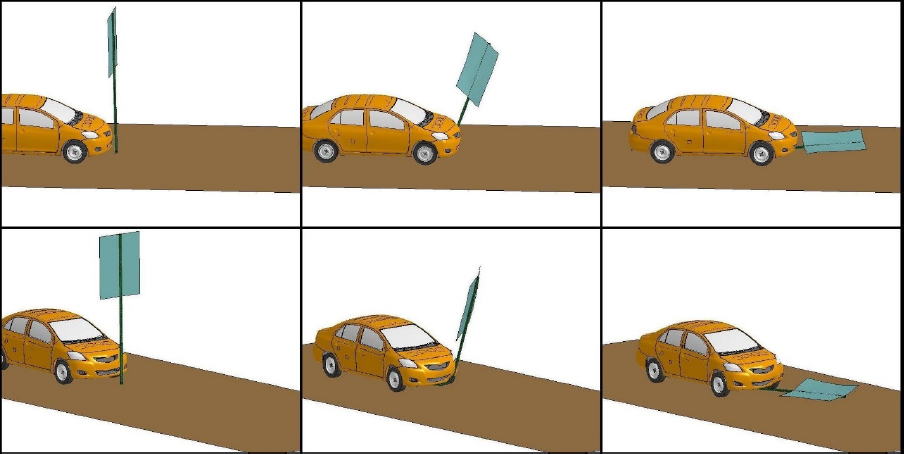 | ||||||||||
| Evaluation Criteria | ||||||||||
| B | The test article should readily activate in a predictable manner by breaking away, fracturing, or yielding. | Pass | ||||||||
| D | Detached elements, fragments, or other debris from the test article should not penetrate or show potential for penetrating the occupant compartment, or present undue hazard to other traffic, pedestrians, or personnel in a work zone. | Pass | ||||||||
| All Deformations of, or intrusions into, the occupant compartment should not exceed limits set forth in Section 5.3 and Appendix E of MASH. [Roof less than 4.0 in (101.6 mm). Windshield-no tear of plastic liner and maximum deformation of 3 in (76.2 mm)] | Roof ≤ 101.6 mm | 0 | Pass | |||||||
| Windshield ≤ 76.2 mm | 0 | |||||||||
| F | The vehicle should remain upright during and after the collision. The maximum pitch & roll angles are not to exceed 75 degrees. | Max Roll (Deg) | 3 | Pass | ||||||
| Max Pitch (Deg) | 1 | |||||||||
| H | Longitudinal & lateral occupant impact velocities (OIV) should fall below the preferred value of 10 ft/s (3.0 m/s), or at least below the maximum allowed value of 16 ft/s (4.9 m/s) | Vx (m/s) | 3.6 | Pass | ||||||
| Vy (m/s) | 0.0 | |||||||||
| I | Longitudinal & lateral occupant ridedown accelerations (ORA) should fall below the preferred value of 15.0 g, or at least below the maximum allowed value of 20.49 g | Ax (g) | 0.4 | Pass | ||||||
| Ay (g) | 0.9 | |||||||||
| N | Vehicle trajectory behind the test article is acceptable | Pass | ||||||||
| Single PSST Post Sign Support System Mounting-Height: 7 ft; A1011 Gr.50 Post; Aluminum Panel; Anchor Embedment depth: 36 in | ||||||||||
| Post Size | Anchor Size | Panel Size | MASH Impact | Impact Location | Impact Angle | Wind Beam | ||||
| 2¼” x 2¼” 12 gauge | 2½” x 2½” 12 gauge | 4’ x 5’ 0.12” thick | 3-61 | Center | 0 deg | No | ||||
 | ||||||||||
| Evaluation Criteria | ||||||||||
| B | The test article should readily activate in a predictable manner by breaking away, fracturing, or yielding. | Pass | ||||||||
| D | Detached elements, fragments, or other debris from the test article should not penetrate or show potential for penetrating the occupant compartment, or present undue hazard to other traffic, pedestrians, or personnel in a work zone. | Pass | ||||||||
| All Deformations of, or intrusions into, the occupant compartment should not exceed limits set forth in Section 5.3 and Appendix E of MASH. [Roof less than 4.0 in (101.6 mm). Windshield-no tear of plastic liner and maximum deformation of 3 in (76.2 mm)] | Roof ≤ 101.6 mm | 150 | Fail | |||||||
| Windshield ≤ 76.2 mm | 0 | |||||||||
| F | The vehicle should remain upright during and after the collision. The maximum pitch & roll angles are not to exceed 75 degrees. | Max Roll (Deg) | 0 | Pass | ||||||
| Max Pitch (Deg) | 1 | |||||||||
| H | Longitudinal & lateral occupant impact velocities (OIV) should fall below the preferred value of 10 ft/s (3.0 m/s), or at least below the maximum allowed value of 16 ft/s (4.9 m/s) | Vx (m/s) | 1.2 | Pass | ||||||
| Vy (m/s) | 0.0 | |||||||||
| I | Longitudinal & lateral occupant ridedown accelerations (ORA) should fall below the preferred value of 15.0 g, or at least below the maximum allowed value of 20.49 g | Ax (g) | 0.0 | Pass | ||||||
| Ay (g) | 0.0 | |||||||||
| N | Vehicle trajectory behind the test article is acceptable | Pass | ||||||||
| Single PSST Post Sign Support System Mounting-Height: 7 ft; A1011 Gr.50 Post; Aluminum Panel; Anchor Embedment depth: 36 in | ||||||||||
| Post Size | Anchor Size | Panel Size | MASH Impact | Impact Location | Impact Angle | Wind Beam | ||||
| 2¼” x 2¼” 12 gauge | 2½” x 2½” 12 gauge | 4’ x 5’ 0.12” thick | 3-61 | Center | -25 deg | No | ||||
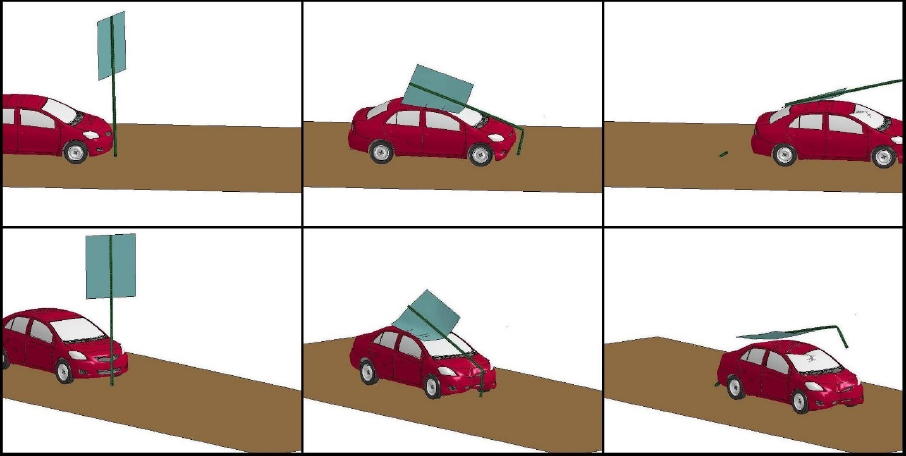 | ||||||||||
| Evaluation Criteria | ||||||||||
| B | The test article should readily activate in a predictable manner by breaking away, fracturing, or yielding. | Pass | ||||||||
| D | Detached elements, fragments, or other debris from the test article should not penetrate or show potential for penetrating the occupant compartment, or present undue hazard to other traffic, pedestrians, or personnel in a work zone. | Pass | ||||||||
| All Deformations of, or intrusions into, the occupant compartment should not exceed limits set forth in Section 5.3 and Appendix E of MASH. [Roof less than 4.0 in (101.6 mm). Windshield-no tear of plastic liner and maximum deformation of 3 in (76.2 mm)] | Roof ≤ 101.6 mm | 202 | Fail | |||||||
| Windshield ≤ 76.2 mm | 85 (tear) | |||||||||
| F | The vehicle should remain upright during and after the collision. The maximum pitch & roll angles are not to exceed 75 degrees. | Max Roll (Deg) | 0 | Pass | ||||||
| Max Pitch (Deg) | 1 | |||||||||
| H | Longitudinal & lateral occupant impact velocities (OIV) should fall below the preferred value of 10 ft/s (3.0 m/s), or at least below the maximum allowed value of 16 ft/s (4.9 m/s) | Vx (m/s) | 1.5 | Pass | ||||||
| Vy (m/s) | 0.0 | |||||||||
| I | Longitudinal & lateral occupant ridedown accelerations (ORA) should fall below the preferred value of 15.0 g, or at least below the maximum allowed value of 20.49 g | Ax (g) | 0.0 | Pass | ||||||
| Ay (g) | 0.0 | |||||||||
| N | Vehicle trajectory behind the test article is acceptable | Pass | ||||||||
| Single PSST Post Sign Support System Mounting-Height: 7 ft; A1011 Gr.50 Steel Post; Aluminum Panel; Anchor Embedment depth: 36 in | ||||||||||
| Post Size | Anchor Size | Panel Size | MASH Impact | Impact Location | Impact Angle | Wind Beam | ||||
| 2¼” x 2¼” 12 gauge | 2½” x 2½” 12 gauge | 4’ x 5’ 0.12” thick | 3-61 | Center | +25 deg | No | ||||
 | ||||||||||
| Evaluation Criteria | ||||||||||
| B | The test article should readily activate in a predictable manner by breaking away, fracturing, or yielding. | Pass | ||||||||
| D | Detached elements, fragments, or other debris from the test article should not penetrate or show potential for penetrating the occupant compartment, or present undue hazard to other traffic, pedestrians, or personnel in a work zone. | Pass | ||||||||
| All Deformations of, or intrusions into, the occupant compartment should not exceed limits set forth in Section 5.3 and Appendix E of MASH. [Roof less than 4.0 in (101.6 mm). Windshield-no tear of plastic liner and maximum deformation of 3 in (76.2 mm)] | Roof ≤ 101.6 mm | 130 | Fail | |||||||
| Windshield ≤ 76.2 mm | 200 (tear) | |||||||||
| F | The vehicle should remain upright during and after the collision. The maximum pitch & roll angles are not to exceed 75 degrees. | Max Roll (Deg) | 1 | Pass | ||||||
| Max Pitch (Deg) | 1 | |||||||||
| H | Longitudinal & lateral occupant impact velocities (OIV) should fall below the preferred value of 10 ft/s (3.0 m/s), or at least below the maximum allowed value of 16 ft/s (4.9 m/s) | Vx (m/s) | 1.9 | Pass | ||||||
| Vy (m/s) | 0.0 | |||||||||
| I | Longitudinal & lateral occupant ridedown accelerations (ORA) should fall below the preferred value of 15.0 g, or at least below the maximum allowed value of 20.49 g | Ax (g) | 0.0 | Pass | ||||||
| Ay (g) | 0.0 | |||||||||
| N | Vehicle trajectory behind the test article is acceptable | Pass | ||||||||
| Single PSST Post Sign Support System Mounting-Height: 7 ft; A1011 Gr.50 Post; Aluminum Panel; Anchor Embedment depth: 36 in | ||||||||||
| Post Size | Anchor Size | Panel Size | MASH Impact | Impact Location | Impact Angle | Wind Beam | ||||
| 2¼” x 2¼” 12 gauge | 2½” x 2½” 12 gauge | 4’ x 5’ 0.12” thick | 3-61 | Offset Driver | 0 deg | No | ||||
 | ||||||||||
| Evaluation Criteria | ||||||||||
| B | The test article should readily activate in a predictable manner by breaking away, fracturing, or yielding. | Pass | ||||||||
| D | Detached elements, fragments, or other debris from the test article should not penetrate or show potential for penetrating the occupant compartment, or present undue hazard to other traffic, pedestrians, or personnel in a work zone. | Pass | ||||||||
| All Deformations of, or intrusions into, the occupant compartment should not exceed limits set forth in Section 5.3 and Appendix E of MASH. [Roof less than 4.0 in (101.6 mm). Windshield-no tear of plastic liner and maximum deformation of 3 in (76.2 mm)] | Roof ≤ 101.6 mm | 60 | Pass | |||||||
| Windshield ≤ 76.2 mm | 75 | |||||||||
| F | The vehicle should remain upright during and after the collision. The maximum pitch & roll angles are not to exceed 75 degrees. | Max Roll (Deg) | 0 | Pass | ||||||
| Max Pitch (Deg) | 2 | |||||||||
| H | Longitudinal & lateral occupant impact velocities (OIV) should fall below the preferred value of 10 ft/s (3.0 m/s), or at least below the maximum allowed value of 16 ft/s (4.9 m/s) | Vx (m/s) | 0.9 | Pass | ||||||
| Vy (m/s) | 0.3 | |||||||||
| I | Longitudinal & lateral occupant ridedown accelerations (ORA) should fall below the preferred value of 15.0 g, or at least below the maximum allowed value of 20.49 g | Ax (g) | 0.0 | Pass | ||||||
| Ay (g) | 0.0 | |||||||||
| N | Vehicle trajectory behind the test article is acceptable | Pass | ||||||||
| Single PSST Post Sign Support System Mounting-Height: 7 ft; A1011 Gr.50 Post; Aluminum Panel; Anchor Embedment depth: 36 in | ||||||||||
| Post Size | Anchor Size | Panel Size | MASH Impact | Impact Location | Impact Angle | Wind Beam | ||||
| 2¼” x 2¼” 12 gauge | 2½” x 2½” 12 gauge | 4’ x 5’ 0.12” thick | 3-62 | Center | 0 deg | No | ||||
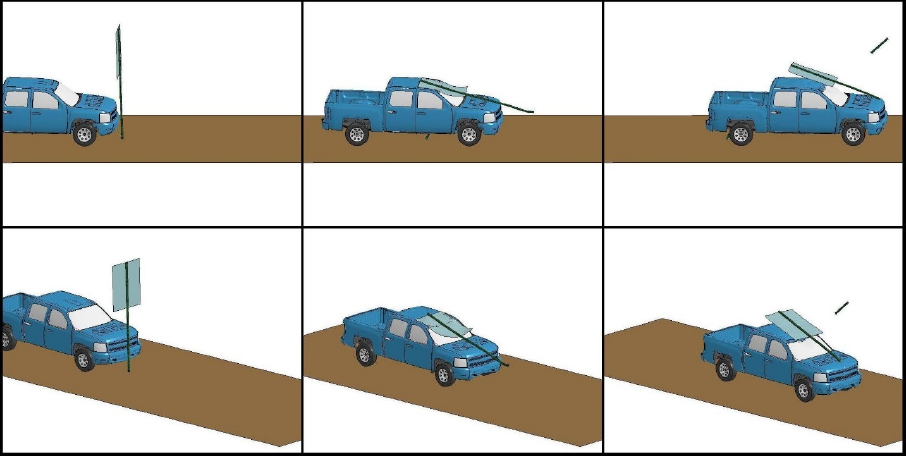 | ||||||||||
| Evaluation Criteria | ||||||||||
| B | The test article should readily activate in a predictable manner by breaking away, fracturing, or yielding. | Pass | ||||||||
| D | Detached elements, fragments, or other debris from the test article should not penetrate or show potential for penetrating the occupant compartment, or present undue hazard to other traffic, pedestrians, or personnel in a work zone. | Pass | ||||||||
| All Deformations of, or intrusions into, the occupant compartment should not exceed limits set forth in Section 5.3 and Appendix E of MASH. [Roof less than 4.0 in (101.6 mm). Windshield-no tear of plastic liner and maximum deformation of 3 in (76.2 mm)] | Roof ≤ 101.6 mm | 89 | Fail | |||||||
| Windshield ≤ 76.2 mm | 92 | |||||||||
| F | The vehicle should remain upright during and after the collision. The maximum pitch & roll angles are not to exceed 75 degrees. | Max Roll (Deg) | 0 | Pass | ||||||
| Max Pitch (Deg) | 1 | |||||||||
| H | Longitudinal & lateral occupant impact velocities (OIV) should fall below the preferred value of 10 ft/s (3.0 m/s), or at least below the maximum allowed value of 16 ft/s (4.9 m/s) | Vx (m/s) | 0.7 | Pass | ||||||
| Vy (m/s) | 0.0 | |||||||||
| I | Longitudinal & lateral occupant ridedown accelerations (ORA) should fall below the preferred value of 15.0 g, or at least below the maximum allowed value of 20.49 g | Ax (g) | 0.0 | Pass | ||||||
| Ay (g) | 0.0 | |||||||||
| N | Vehicle trajectory behind the test article is acceptable | Pass | ||||||||
| Single PSST Post Sign Support System Mounting-Height: 7 ft; A1011 Gr.50 Post; Aluminum Panel; Anchor Embedment depth: 36 in | ||||||||||
| Post Size | Anchor Size | Panel Size | MASH Impact | Impact Location | Impact Angle | Wind Beam | ||||
| 2¼” x 2¼” 12 gauge | 2½” x 2½” 12 gauge | 4’ x 5’ 0.12” thick | 3-62 | Center | +25 | No | ||||
 | ||||||||||
| Evaluation Criteria | ||||||||||
| B | The test article should readily activate in a predictable manner by breaking away, fracturing, or yielding. | Pass | ||||||||
| D | Detached elements, fragments, or other debris from the test article should not penetrate or show potential for penetrating the occupant compartment, or present undue hazard to other traffic, pedestrians, or personnel in a work zone. | Pass | ||||||||
| All Deformations of, or intrusions into, the occupant compartment should not exceed limits set forth in Section 5.3 and Appendix E of MASH. [Roof less than 4.0 in (101.6 mm). Windshield-no tear of plastic liner and maximum deformation of 3 in (76.2 mm)] | Roof ≤ 101.6 mm | 75 | Pass | |||||||
| Windshield ≤ 76.2 mm | 56 | |||||||||
| F | The vehicle should remain upright during and after the collision. The maximum pitch & roll angles are not to exceed 75 degrees. | Max Roll (Deg) | 0 | Pass | ||||||
| Max Pitch (Deg) | 1 | |||||||||
| H | Longitudinal & lateral occupant impact velocities (OIV) should fall below the preferred value of 10 ft/s (3.0 m/s), or at least below the maximum allowed value of 16 ft/s (4.9 m/s) | Vx (m/s) | 0.9 | Pass | ||||||
| Vy (m/s) | 0.1 | |||||||||
| I | Longitudinal & lateral occupant ridedown accelerations (ORA) should fall below the preferred value of 15.0 g, or at least below the maximum allowed value of 20.49 g | Ax (g) | 0.0 | Pass | ||||||
| Ay (g) | 0.0 | |||||||||
| N | Vehicle trajectory behind the test article is acceptable | Pass | ||||||||
This page intentionally left blank.


