Identifying Midlife Social Exposures That Might Modify Risks of Cognitive Impairment Associated with Early Life Disadvantage: Proceedings of a Workshop (2025)
Chapter: 7 Environmental and Cardiovascular Exposures
7
Environmental and Cardiovascular Exposures
This session focused on physical exposures as a particular type of environmental exposure.
THE RELATIONSHIP BETWEEN EARLY AND MIDLIFE CARDIOVASCULAR RELATED EXPOSURES AND LATE LIFE COGNITIVE HEALTH
Priya Palta, Associate Professor of Neurology in the Department of Neurology at the University of North Carolina, spoke on the relationship between early and midlife cardiovascular related exposures and late life cognitive health. The Lancet Commission on Dementia Prevention reported that 45 percent of dementia cases worldwide are potentially preventable by modifiable risk factors (Figure 7-1). Notably, many of these modifiable risk factors, particularly in midlife, are vascular in nature: diabetes, hypertension, obesity, and physical inactivity. What is interesting is the declining incidence in dementia over the last several decades. Some people have attributed this to improvements in certain vascular risk factors; blood pressure may be one of them, but secular trends in higher education may also be factors. These improvements in vascular risk factors are mostly the case in high-income countries. But the pattern is starting to shift. Data from the National Health and Nutrition Examination Survey that looked at trends in cardiometabolic conditions in health from 1999 to 2018 found a rise in poor levels of adiposity, and a slight rise in poor levels of blood glucose, complemented with a steep decline in the optimal levels of blood glucose. This suggests the downward trend in dementia incidence might not be likely to continue.
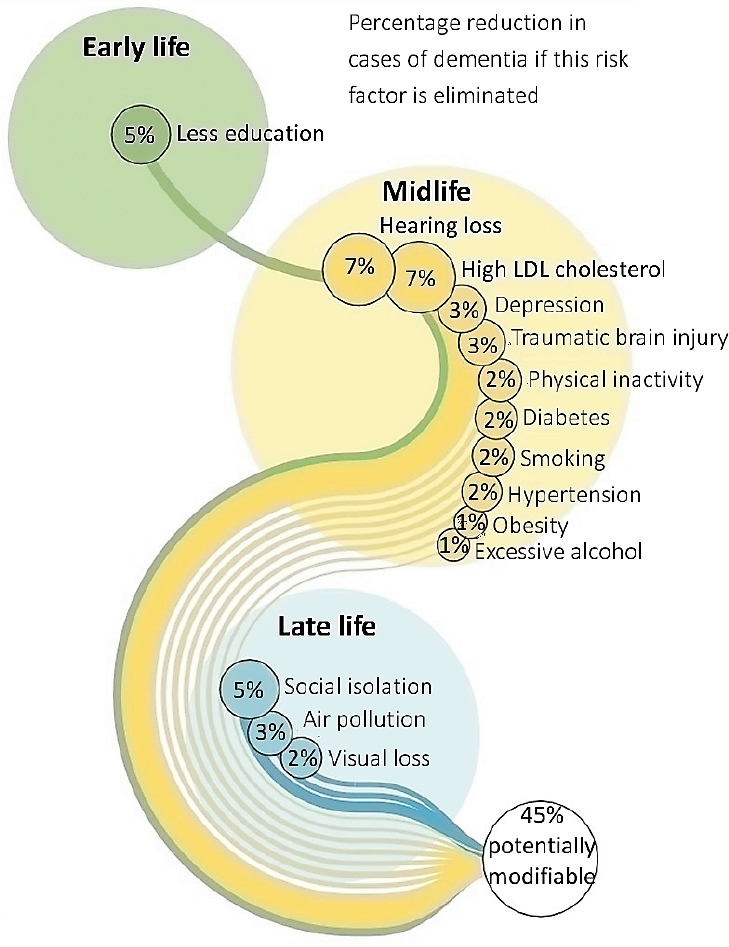
SOURCES: Presentation to the panel by Priya Palta on August 30, 2024; based on Livingston et al., 2024.
The Atherosclerosis Risk in Communities (ARIC) study is a National Heart, Lung, and Blood Institute (NHLBI)-funded community-based cohort, Palta said. It originally enrolled about 16,000 participants in the early 1980s. They were of middle age (45–64 years) at the time of enrollment. It found that high childhood SES was associated with lower cognitive decline but found no relationship for midlife SES (Kucharska-Newton et al., 2023).
Using data from the Rush Alzheimer’s Disease Clinical Core, Barnes et al. (2015) showed that Alzheimer’s dementia seldom occurs in isolation; most often there are mixed pathologies, and Alzheimer’s often co-occurs with vascular dementia in particular (Figure 7-2). Palta said there were racial differences in the frequency of different dementia pathologies, with Black people tending to have a lot more mixed pathology and a lot more vascular pathology than White people. Non-Alzheimer’s dementia is an important, growing field, and vascular pathologies can impact the pathways to dementia. About 5 to 10 percent of dementia cases alone are considered vascular or cerebrovascular in nature, making vascular dementia the second most common subtype of dementia.
Palta said that, arguably, one of the most important vascular risk factors is blood pressure and hypertension. Walker et al. (2019) showed that having hypertension over the 30-year period from midlife through late life

SOURCES: Presentation to the panel by Priya Palta on August 30, 2024; based on Barnes et al., 2015.
carried a significantly increased risk of dementia, but it was actually the participants who had hypertension in midlife and those who had hypotension or low blood pressure in late life who had the highest risk of dementia. This is supported by evidence suggesting that blood pressure declines in the years preceding a dementia diagnosis.
Palta said data from ARIC have also made significant contributions in the space of diabetes. Hu et al. (2024) showed that middle-aged onset of diabetes was associated with a higher lifetime risk of dementia than older onset of diabetes as well as those without diabetes. Those with middle-aged onset of diabetes developed dementia four years earlier than individuals without diabetes and one year earlier than those who had older-age onset diabetes.
Palta et al. (2019) showed, using ARIC, that engaging in high levels of physical activity in midlife was associated with a 28 percent reduced risk of dementia compared to individuals who did not engage in physical activity in midlife.
A major question is how much of the association observed between these early life risk factors (e.g., SES) and dementia risk is mediated or explained by the prevalence of vascular risk factors in midlife, Palta said. Liu et al. (2023) showed that 10 to 26 percent of the association between education and dementia was explained by vascular risk factors. As noted by Paola Gilsanz, the relevance of these specific mediators really depends on the level of the exposure. Palta said she would have expected that a larger proportion of the association between education and dementia would be mediated by these vascular risk factors. But she thought vascular risk factors partially mediate the effect of early life factors.
Williamson et al. (SPRINT MIND, 2019) found that intensive treatment of blood pressure to less than 120 was related to lower levels of mild cognitive impairment and to a composite of mild cognitive impairment or probable dementia as compared with treating blood pressure to the standard of less than 140.
In closing, Palta listed some of the research needs that she perceived:
- Palta said researchers need more knowledge about the timing of early life disadvantage with a particular need for data during the gestational period.
- More information is needed, in Palta’s view, about using vascular risk factors in combination rather than independently.
- Current SES measures are primarily limited to education, and Palta said additional measures are needed.
- More needs to be known, according to Palta, about the moderating role of contextual risk and resilience factors, such as psychosocial factors, optimism, and social support.
- Palta said researchers need to look at imaging and blood-based biomarkers of pathology and how those are related to early life factors.
- Given that pathology develops decades before clinical onset of symptoms, Palta said, it needs to be determined whether these early life factors are actually affecting the intermediate pathology.
- Palta said improvements are needed in the measurement of relevant modifiable risk factors. For example, measurement of physical activity often depends on self-reported data, but more objective and granular data are needed.
- There is a need to know about the impact of COVID-19 on cardiovascular health, Palta said, as well as COVID-19’s impact on schooling during the pandemic and on social interactions.
- Palta said that extant cohorts can be utilized, and that cross-cohort harmonization can be deployed to enhance studies’ racial, ethnic, and geographic diversity.
- Palta also urged the development of synthetic cohorts to address age gaps across the individual cohort studies.
- The linking of datasets to other external sources should be expanded, Palta said.
- Developing culturally tailored individual and multi-level interventions for cardiovascular health is going to be important, Palta said, especially in children and adolescents.
THE POTENTIAL LEGACY OF ENVIRONMENTAL EXPOSURES, ACROSS THE LIFE COURSE, ON DEMENTIA RISK
Jennifer Weuve, Professor of Epidemiology at the Boston University School of Public Health, discussed environmental exposure, defined as contact with a chemical, biological, or physical entity that is in our air, our water, our soil, the clothes we wear, and the products we put on our bodies, as well as whatever is part of our sensory landscape. Some examples include air pollution, heavy metals (e.g., lead, cadmium, mercury, arsenic), noise, radiation, persistent organic pollutants, green space, and the effects of climate change. Weuve gave four reasons for examining such exposures with regard to dementia risk.
First, Weuve said, exposure to known neurotoxicants is or was common among children and middle-aged adults, with lead as a primary example. A large portion of people who in 2015 were 20 years old or older were estimated to have had blood lead levels of five micrograms per deciliter or higher, the action level established by the Centers for Disease Control and Prevention (McFarland et al., 2022). Additionally, there has been wide exposure to pesticides: most children at home, most agricultural workers
on their jobs, and an estimated 50 million U.S. residents have been exposed through contaminated groundwater.
Second, Weuve said, environmental injustice over the life course may in fact be a critical source of racial and ethnic inequities in dementia. For example, levels of lead in children’s blood are much higher among non-Hispanic Black children than among White children, and the inequity has persisted.
Weuve noted, as a third reason, that while how to intervene is not known, it is worth learning how to intervene in dementia-promoting exposures that lie in the past. Another kind of past exposure is to natural disasters, such as hurricanes.
Finally, Weuve said there is the potential to relieve a great public health burden (dementia) when we intervene in childhood. The Abecedarian trial showed that a cognitive and social stimulation intervention for three- to five-year-olds was associated with better cardiometabolic health, creatinine, ability to afford health insurance, and access to healthcare when those children reached their mid-30s (Campbell et al., 2014). The Great Smoky Mountains Study involved cash transfers to families with children, and was associated with better mental health, better physical health, and better financial status when those children reached their late-20s and early-30s (Copeland et al., 2022). In a New Zealand study, those who as children (at age 11) had higher blood lead levels later as adults (in their 30s) had worse cognitive ability, faster cognitive decline, lower SES, and more extreme downward social mobility (Reuben et al., 2017).
Weuve also discussed some key timing dimensions. First, changes across time periods have decreased some hazards and increased others. Lead exposure is no longer extreme, in the wake of the banning of leaded fuel. Pesticides such as DDT and dioxin have been banned and are now at reduced levels in the environment. Current concerns are glyphosate and chlorpyrifos, both used as pesticides, and polyfluoroalkyl substances, chemicals used in our clothing and packaging. Another modern concern is the increased frequency and intensity of extreme weather events.
Second, age of exposure is an important factor, Weuve said. Some exposures, such as lead, have stronger effects in children than in adults. Age also affects the context for exposures, such as whether the exposures occur in school, at work, in the home, or in third places. Weuve said some other ways in which timing is important are the duration of an exposure, the residence time of chemicals in the body, and the persistence of the effect of a chemical into a later stage of life.
These considerations raise important research questions, Weuve said. Which exposure during which life stage matters most? What fraction of dementia cases in a given birth cohort can be attributed to an exposure during a particular life stage? When is it best to intervene? How does one
intervene, especially if that exposure is clearly in the past? As an example, if childhood exposure to lead matters more than adult exposure, then the time to intervene is in childhood. On the other hand, to the extent that lead exposure or other exposures contribute to hypertension, this is an area where one could potentially intervene (i.e., on hypertension) after someone has been exposed.
Several studies provide the opportunity to link life stages, Weuve noted, with midlife being the fulcrum. For the study cohorts of the Rush Alzheimer’s Disease Clinical Core, address histories have been developed that go fairly far back, though not to childhood. The Center for the Health Assessment of Mothers and Children of Salinas study provides a terrific opportunity to look forward from childhood to midlife. Three studies that provide the ability to look both forward and backward in time are the Multi-Ethnic Study of Atherosclerosis, ARIC study, and one of the Educational Studies for Healthy Aging Research cohorts.
Weuve said there are some serious challenges for research on the effects of life course environmental exposures on cognitive decline. Biomarkers of exposure are a valuable tool, but Weuve said one needs to be specific about the time period of interest. Spatiotemporal measures are valuable but may involve making assumptions about whether people occupy various locations for long periods. Policy measures provide the opportunity for natural experiments.
A job exposure index can help estimate the exposure to a specific chemical or other exposure on a job, Weuve said, adding that the use of mixtures of exposures could be critical because individuals are rarely exposed to just one agent at a time. Methods for assessing the exposome and for assessing environmental mixtures have been under development for the past 10-plus years. The Gateway Exposome Coordinating Center, for example, was just funded to estimate and distribute multiple environmental exposure measures within the Harmonized Cognitive Assessment Protocol cohorts. Weuve said researchers also need to address the intersection of environmental exposures with social and structural determinants of dementia. As an example, in an ongoing study Marcia Pescador Jimenez (Assistant Professor of Epidemiology, Boston University) combined environmental exposures (e.g., noise and air pollution) with social exposures, including neighborhood SES and crime.1
Weuve offered the following methodological recommendations:
- Researchers need better methods to reconstruct exposures of the past and need support for following up younger cohorts who have been well characterized with respect to their environmental exposures.
___________________
1 National Institutes of Health (NIH) Grant R01NS139186.
- Researchers and policymakers need to better understand how to intervene in the effects of exposures that have ended.
- Regarding interventions in the effects of past exposures, research should consider this within the context of reducing inequities in dementia that follow racial, ethnic, and socioeconomic lines.
COMMENTS ON THE SESSION
Jennifer Ailshire commented that while exposure to lead has been greatly reduced, it has not been eliminated. One source of exposure is through lead pipes, particularly in private wells, and another is the re-suspension of lead-contaminated soil.
Ailshire also pointed out neighborhood environmental and built features are often considered to be unmodifiable, when in fact they are modifiable. One example is an NIH-funded study through the National Institute of Environmental Health Sciences, in which trees and shrubs were planted in a few neighborhoods in Louisville. The researchers found that compared to those in the control group, the people in the treatment group had lower levels of C-reactive protein, which is an indicator of cardiovascular disease. Though there is evidence of the value of green space, the exact mechanism through which trees help is not clear. Trees also reduce noise, clean the air, and provide shade, which may be important in communities with heat islands.
A member of the audience asked about the relative merits of medication versus behavioral change. Palta replied that drugs might target one aspect of a cardiometabolic condition, whereas physical activity and diet can impact multiple aspects of the cardiometabolic pathway. Thus, while some combination of lifestyle and medication might be helpful, there is value in behavior changes.
Andrea Rosso, a member of the audience, asked if different environmental or chemical exposures are likely to change the pathological profiles of dementia. Weuve responded that she did not know. The little evidence thus far does not clearly implicate air pollution in the development of Alzheimer’s neuropathologies in the brain, but air pollution’s vascular effects are grounds for its potential promotion of cerebrovascular pathologies. With lead exposure, one might expect to see some reduction in brain size, since lead kills neurons and also increases blood pressure and thus may be related to cerebrovascular pathologies.
Responding to a question, Weuve discussed how exposures vary across the world. Air pollution in urban centers in Southeast Asia is quite high as compared with the United States. The presence of lead has been reduced around the world, but there are pockets of exposure in the United States and worldwide.
Eric Grodsky asked if there is anything we can do about the lead stored in our bodies. Weuve replied that much of the lead people are exposed to is stored in their bones. Over time, as the bone resorbs into the bloodstream, people are exposed to lead again. In a randomized controlled trial among pregnant women, women provided with calcium supplements transferred less lead to their infants. Weuve did not know if this works for older people. She also noted that the dosages of lead from that remobilization process are far lower than in the original exposure event. Ailshire commented that bone reabsorption also happens during older adulthood because of osteoarthritis and some of the acceleration of that bone breakdown process. There are behavioral interventions for that, like physical activity and high-impact sports that build bone density. Weuve later commented that postmenopausal hormone therapy also appears to slow bone resorption, leading to lower levels of lead in their blood relative to what was in their bones. However, hormone therapy after menopause is not a good idea for all women.
Hector González asked about the impact of anti-hypertensive therapies among non-White people, including Black, Latino, and other people, that are at risk for hypertension. Palta responded that current studies have generally been limited with respect to racial and ethnic diversity, and that they are happening too late in the lifespan, with an average of 68 years. At that age, the brain’s pathology is quite advanced. A struggle with dementia prevention trials is that it takes so long for the pathology to develop and for the clinical onset of symptoms to appear when we need to intervene a lot earlier. González said researchers need a long-enough study and resources to be able to follow those individuals post-intervention for decades. Some solutions might be found in cohort studies, quasi-experimental studies, and synthetic cohorts.
Cliff Whetung, in the online audience, asked if researchers should be studying localized exposures, such as uranium mines in Navajo and Pueblo communities or the recent New Brunswick outbreak of early-onset dementias, as a way of exploring the causal links. Weuve agreed and added that the contamination in Flint, Michigan, also merits attention. Ailshire added that the concentrations of pollutants that biologists experiment with on mice are greater than what people are exposed to, even in cities with high levels of pollution. These localized events could provide efficient sources of data, purposively sampling them and using very quick approaches to data collection.
Jessica Finlay asked what could be done to help harmonize the data across the various related studies. Palta commented that a lot of different groups are harmonizing cognitive data. It would be helpful to bring these groups together. Adina Zeki Al Hazzouri added that harmonization is doable, and most cohorts are excited to share their data. The hardest data to get are sometimes epigenetic data.
This page intentionally left blank.


