Following the Success of Artemis II, Scientists Will Shape What Comes Next for Lunar Exploration
Feature Story
By Ron Warnick
Last update April 13, 2026
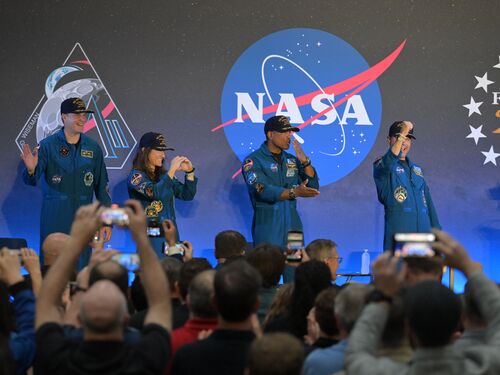
Image credit: NASA/Bill Stafford
The Artemis II mission ignited the curiosity of people around the world and rekindled interest in humanity’s shared investment in space exploration. NASA plans to launch more lunar missions soon, signaling a renewed era for science and exploration on the moon — and raising questions about what comes next.
For scientists helping guide future lunar exploration, the success of Artemis II underscores the importance of their work. It also opens up opportunities to explore possibilities for upcoming missions — which is the subject of a current National Academies study. Sponsored by NASA, the study will produce a report later this year that will identify key non polar landing sites for future crewed missions to the moon and what science goals could be achieved.
“There’s clearly a hunger out there for something new — for watching humans go beyond where we’ve been before,” said Daniel Dumbacher, a professor of engineering practice at Purdue University, who helped lead the development of the Artemis campaign and is co-chairing the National Academies study committee. “We’ve been working toward this for a long time, and now we’re finally here.”
As Artemis astronauts documented the moon’s far side, their real-time observations added context and interpretation that complemented instrument data — a powerful demonstration of how human presence contributes to scientific discovery.
“That human perspective is everything,” said James Day, a geochemist at Scripps Institution of Oceanography and co-chair of the National Academies study. “The ability of trained observers to describe what they’re seeing adds insight you simply can’t get from images alone.”
The observations help translate raw data into scientific understanding. They also point to a broader role for human exploration: not just collecting measurements but interpreting complex environments in ways that can guide future research.
What might come next for future human missions to the moon
Scientists are increasingly focused on where future exploration can deliver the greatest scientific return and in turn advance our ability to live and work in space.
“To really understand the moon, you have to go to multiple locations,” Day said. “If you only study one type of terrain, you’re only seeing part of the picture.”
Future experiments at landing sites across the moon could advance understanding of how the solar system formed and evolved, provide capability-enhancing opportunities for novel approaches to astronomy and heliophysics, and help assess how humans can stay healthy and utilize local resources during space missions.
“By going to multiple locations, that’s how we’re going to learn,” Dumbacher said. “It’s how we understand what’s there and how we can use it.”
For Dumbacher, Artemis II — in addition to being a remarkable technical achievement — marks a broader shift in how people engage with science and exploration.
“I think we’re seeing a rejuvenation of interest,” he said. “Across generations, people are getting excited again about what we’re doing.”
Related Resource
More like this



Discover
Events
Right Now & Next Up
Stay in the loop with can’t-miss sessions, live events, and activities happening over the next two days.
NAS Building Guided Tours Available!
Participate in a one-hour guided tour of the historic National Academy of Sciences building, highlighting its distinctive architecture, renowned artwork, and the intersection of art, science, and culture.