Wide Cracks and Joints in Flexible and Composite Pavements: State DOT Maintenance Practices (2025)
Chapter: 2 Literature Review
CHAPTER 2
Literature Review
Introduction
Crack sealing and crack filling are common treatments used to repair cracks and joints on asphalt and asphalt-surfaced pavements (both will be referred to as asphalt pavements in this report) induced by weathering, traffic loads, and aging (Carter 2004; Decker 2014; Truschke et al. 2014). These procedures involve the application of asphalt sealants to fill and seal pavement cracks effectively. The main objectives of this maintenance treatment in asphalt pavements include:
- Prevent water infiltration. Water infiltration is a primary cause of pavement deterioration, as it can weaken the base and subbase layers and accelerate the development of more severe issues such as potholes.
- Avoid freeze-thaw damage. In regions with cold winters, water that flows through pavement cracks and into the pavement cross section can freeze and expand during cold periods, causing further damage to the pavement.
- Extend pavement life. Crack sealing and filling are intended to retard the progression of cracks, which can extend the overall life of the asphalt pavement. Preventing the further development of cracks helps maintain the structural integrity and functionality of the pavement.
- Reduce pothole formation. If unaddressed, cracks will continue to deteriorate and could lead to the formation of potholes. Crack sealing and filling can reduce the likelihood of pothole formation and minimize the need for more extensive and costly repairs.
- Control the spread of reflective cracks. On composite pavement, crack sealing helps control the propagation of reflective cracks from the lower layers to the surface, maintaining the integrity of the overlaid pavement.
While crack filling and crack sealing sound like similar terms, they are distinct based on the depth of the application, the bonding characteristics with the pavement, and their selection (which depends on the presence of crack movement) (Smith and Romine 1999; Vargas-Nordcbeck and Jalali 2020). Crack filling involves the application of materials to occupy the voids in pavement cracks without necessarily establishing a robust bond with the adjacent asphalt. This approach is primarily used for cracks that do not experience opening and closing, also referred to as nonworking cracks, and is geared towards preventing water intrusion and inhibiting the spread of the cracks (Mazumder et al. 2019; MnDOT 2020). On the other hand, crack sealing not only fills cracks but also creates a bonded, waterproof barrier. Crack sealing aims to impede water intrusion, reducing the risk of pavement deterioration and enhancing the overall structural integrity. Crack sealing typically requires routing the upper portion of the crack to create a sealant reservoir and applying sealant materials with greater elasticity to withstand opening and closing (Mazumder et al. 2019; MnDOT 2020). The operational service life of crack sealants can vary between 2 to 8 years for crack sealing and 2 to 4 years for crack filling depending on the
material type and the installation method (Symons 1999; Peshkin et al. 2011). Vargas-Nordcbeck and Jalali (2020) have documented the estimated treatment lives of crack filling and sealing as somewhat longer, based on test sections constructed in Alabama, and note the significant effect of pavement condition at the time of sealing on treatment life.
Crack filling and sealing are typically applied to cracks greater than ⅛-inch wide up to 1-inch wide (Smith and Romine 1999; Caltrans 2009; Colorado Asphalt Pavement Association n.d.). Beyond a width of 1 inch, most crack sealant and filler materials are ineffective, although there are DOTs that allow a maximum width of up to 1.5 inches [Missouri Department of Transportation (MoDOT) 2005; Mn LRRB 2023]. If widened cracks are left untreated, the adjacent asphalt pavement weakens, creating a depression along the cracks, which further degrades the performance condition and riding quality of the road (Felker and Parcells Jr. 2009). Figure 2 shows non-sealed and sealed wide transverse cracks on asphalt pavements.
Using conventional crack filling or sealing techniques to treat wide cracks or joints is not advisable, as it might result in inadequate filling or early cohesive or adhesive failure and may require excessive amounts of material. Instead, some DOTs have incorporated a mastic asphalt repair technique as part of their maintenance practices for wide cracks and joints in flexible and composite pavements.
Mastic asphalt is a “hot-applied asphalt-based product combined with aggregates, polymers, and other modifiers to produce a flowable, load-bearing material that can be used to fill voids in the road surface.” (MnDOT 2020). Mastics do not require compaction and can be opened to traffic shortly after construction. The objectives of applying asphalt mastic repair to wide cracks are the same as those when filling or sealing conventional width pavement cracks.
The Michigan Department of Transportation (MDOT) includes asphalt mastic repair as part of its treatment tool kit in its Capital Preventive Maintenance manual (MDOT 2020) for cracks

wider than 1-¼ inch, as do Maryland DOT (MDSHA 2022b) and Minnesota DOT (MnDOT 2020). The main difference between asphalt mastics and regular crack sealants is that mastics contain mineral fine aggregate, or fillers, and not just liquid asphalt sealant (Gnatenko et al. 2016). The aggregate creates a stronger internal matrix, reduces the amount of pure liquid sealant required, and stiffens the mix.
Crack Mastic Materials
While it is possible to design an asphalt mastic blend for crack repair purposes, in recent years several commercially available products have become available. These are pre-packaged and ready to use by maintenance crews and contractors. The Wyoming Department of Transportation (WYDOT) commissioned a study with the University of Wyoming to investigate the effectiveness of some of these commercial pre-packaged mastic repair products (Ksaibati and Carter 2006). These materials are generally composed of highly modified polymer asphalt binders and selected weight aggregates. Sometimes, additional fillers like fly ash or supplemental materials such as crumbed rubber tires might be included in the product.
Some DOTs provide their own mastic specifications, but the industry standard is ASTM’s Standard Specification for Hot-Applied Asphalt Aggregate-Filled Mastic D8260 (ASTM 2020). The ASTM specification requires that the material can flow easily out of a gravity-fed field melter, can completely fill the treatment area without large voids, and that the material should be able to remain at the application temperature for at least 6 hours without any changes in composition or segregation. Based on results for mastic resilience, effects of rapid deformation crack bridging, and mastic stability at specific test temperatures, asphalt mastic can be classified into Type 1, 2, or 3. Type 1 materials are more suitable for warm climate applications while Type 3 materials are more suitable for colder regions.
As described in ASTM D8260, mastic resilience measures the material’s ability to recover after being compressed to a fixed thickness while retaining internal adhesion between the binder and the aggregate. This test is intended to mimic the compressing effort that mastic sealant will be subjected to on the field. This test method does not have a precision estimate; thus, it is suggested to be used for informational purposes rather than material acceptance.
The effects of the rapid deformation test, ASTM D2794 (ASTM 2019), and with some modifications described in ASTM D8260, evaluate the ability of the material to absorb a rapid impact shock without compromising the integrity of the test specimen. The test temperature depends on the type of classification the material intends to comply with.
The crack bridging test follows ASTM C1305 (ASTM 2016) and evaluates the ability of the mastic to retain its waterproofing characteristics after being subjected to extension cycles in a low-temperature environment. Similarly to the rapid deformation test, the test temperature depends on the type of classification the material aims for. ASTM D8260 adds that the test should be three test cycles instead of the regular 10 specified by ASTM C1305.
The final performance test evaluates the mastic stability against deformation under high temperatures. The test, detailed in ASTM 8260, measures how much deformation the specimens exhibit after being subjected to compressive pressure at high temperatures.
Mastic Application
The general application process of mastic sealants starts with placing the pre-packaged mastic blend into an appropriate melter, which is typically required to be heated between 450°F and 525°F while stirring the material to ensure a homogeneous blend. The cracks to be repaired
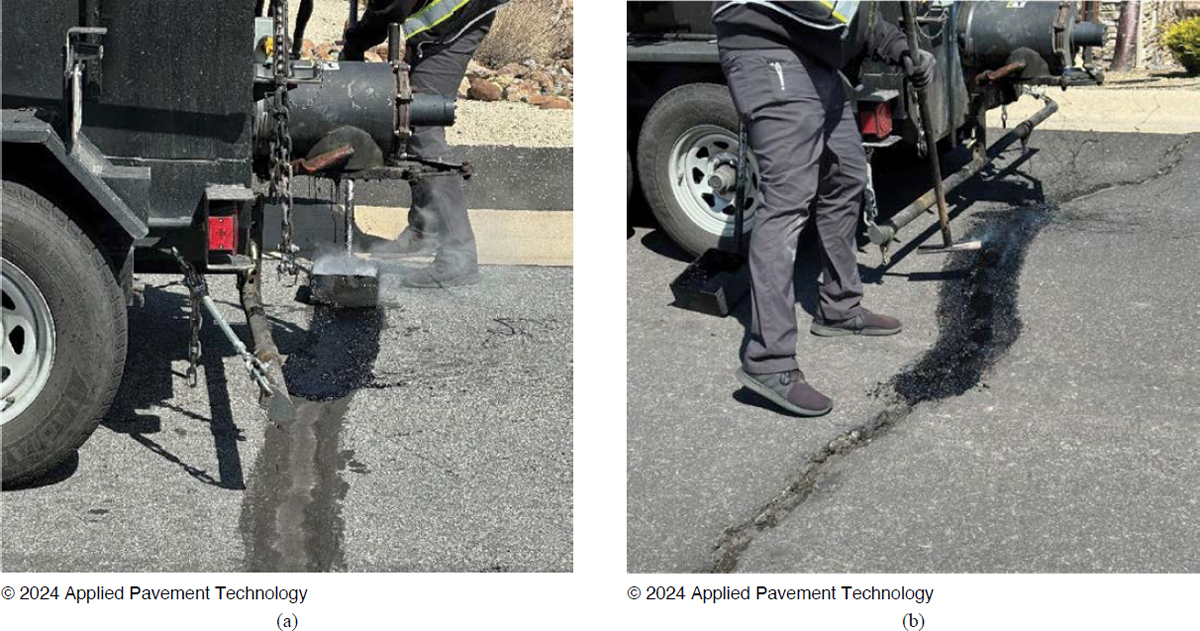
should be cleaned of debris and water. This is typically achieved by blowing compressed air into the cracks. The recommended pavement surface temperature for application is a minimum of 40°F. If the temperature is lower than 40°F, a heat lance or similar heating equipment should be used to heat the local area where the mastic will be applied. The application involves dispensing the mastic from the melter into a steel shoebox applicator, which is then dragged along the crack to allow the mastic to flow into the crack and create a mastic band on the surface (Figure 3a). Finally, a flat-end heated iron can be used to smoothen the surface (Figure 3b). If the affected area is depressed, a wider shoebox applicator could provide an overlay to level the area with the rest of the road. If the application is done where friction is a concern, applying dry topping aggregate on the finished mastic is recommended (Cheng et al. 2022; Crafco n.d.; Maxwell Products 2023). Figure 4 shows examples of an in-service pavement with an asphalt mastic-sealed crack.
Mastic Performance
Asphalt mastics can exhibit similar failure modes to those experienced by regular crack sealants, namely cohesion failure, adhesion failure, pullouts, and secondary cracking (Ksaibati and Carter 2006). Cohesion failure occurs when the mastic experiences fractures within the material, adhesion failure occurs when the mastic de-bonds from the adjacent pavement, pullouts are defined as a partial or complete removal of the material from the pavement, and secondary cracking is the formation of additional cracks parallel to the seal crack (Cuelho and Freeman 2004).
In a Minnesota Road Research Project (MnROAD), Worel and Clyne (2009) reported that secondary cracking and reflective cracking were the predominant mode of failure observed on slurry mastic sealants. However, they noted that because of the leveling effect generated by the

wide band of mastic on the surface, especially if the application was done in multiple layers, asphalt mastic repair applications have the best immediate post-treatment impact on improving ride quality, measured in terms of the International Roughness Index (IRI).
Similarly, a study by Ksaibati and Carter (2006) that investigated the performance of two different hot-applied mastic products installed on Wyoming Route 93, US Route 26, and Interstate 25, reported high adhesion and cohesion failure occurrences. The test site on Interstate 25 exhibited failure on almost all cracks within 2 years. On US Route 26, more than 40% of mastic repairs failed within 2 years, and on Wyoming Route 93, close to 40% of repairs failed after 4 years. A service life of 2 years could be considered at the low end of what is expected for typical crack sealing treatments, while 4 years would be in the medium range (Johnson 2000; Truschke et al. 2014).
Other DOTs have reported different experiences. In a survey by the Colorado Department of Transportation (CDOT) to update its best practices for crack sealing, one of the respondents reported excellent experiences using mastic to repair wide cracks (Truschke et al. 2014). They mentioned using a heat lance to warm up the pavement, following the manufacturer’s handling recommendations, and using a large enough melter to accommodate most of the product needed during the work shift to avoid adding additional ambient temperature mastic to the melter. However, the use of mastic has been limited as it is not part of the CDOT’s approved product list.
Other Wide Transverse Crack and Longitudinal Joint and Crack Repair Strategies
Wide cracks are a longstanding problem in asphalt-surfaced pavements. For example, in addition to crack filling and sealing and mastic repairs, Duncan et al. (2017) reported on the following materials and procedures used by the Ohio DOT for longitudinal paving joint repairs: partial-depth slot paving, spray injection patching, and crack filling. Findings from that study included that crack filling was the most cost-effective treatment until cracks became too wide to be treated effectively in that manner. A survey of DOT practices performed for the Ohio DOT


identified additional procedures that were being used to maintain wide cracks and joints in asphalt pavements:
- Micro surface patching (Illinois DOT, West Virginia DOT, Minnesota DOT, North Dakota DOT), as shown in Figure 5.
- Emulsion joint sealant (Indiana DOT).
- Milling over the crack followed by repair with asphalt (slot paving) (Tennessee DOT).
- Patching with spray injection patchers (Alberta Transportation, British Columbia Ministry of Transportation and Infrastructure), as shown in Figure 6.


