Wide Cracks and Joints in Flexible and Composite Pavements: State DOT Maintenance Practices (2025)
Chapter: 3 State of the Practice
CHAPTER 3
State of the Practice
Overview
To better understand state DOTs’ current practices for maintenance of wide cracks and joints in asphalt pavements, a survey of practice was developed, pre-tested, revised, and then distributed electronically to each of the 50 state DOTs, the District of Columbia DOT (DC), and the Puerto Rico Highway Authority DOT (PRHA). The voting members of the AASHTO Committee on Maintenance were targeted as the initial recipients, but the survey materials asked recipients to forward the survey to a more appropriate person if the voting member was not the best person to represent and describe the DOT’s relevant practices. Follow-up email reminders encouraged participation in the survey. These efforts resulted in completed surveys by 46 DOTs—a response rate of over 88%. Responding DOTs are indicated in Figure 7.
This chapter summarizes the findings from the survey of state DOT practices. The information is presented in several formats, including tables and graphs as appropriate. Appendix A includes a copy of the survey questions that were distributed electronically. Appendix B details the state survey responses, including any expanded responses (every survey question offered “Other” to further explain the response).
Survey Content
To minimize confusion, separate sections in the survey asked similar questions regarding transverse and longitudinal cracks. Survey questions were organized into the following categories:
- Procedures, Materials, and Specifications—Initial survey questions were intended to identify the width at which either a transverse or longitudinal crack was determined to be too wide to seal by conventional means. If the DOT did not distinguish between narrower and wider cracks, the remaining questions were skipped. Otherwise, the questions in this section covered how wide cracks were identified, whether specifications or guidelines were used to define crack repair procedures, whether secondary defects impacted the crack repair procedures, and the materials used for wide crack repair.
- Wide Crack Preparation Techniques—Respondents were asked to describe the techniques used to prepare a crack for treatment.
- Wide Crack Repair Performance—Questions covered whether test sections had been constructed, how treatment failure is defined, and typical treatment life. Questions also covered factors that affected the repair procedure and the impact of crack repairs on certain surface characteristics.
- Costs—In addition to questions about unit costs for crack repair materials/procedures, respondents were asked whether they had analyzed the cost-effectiveness of wide crack repairs.

Survey responses are presented and discussed in the remainder of this chapter. In the presentation of responses to each question, the number of respondents is “N.” Where respondents could only choose one response, the number of responses and the number of respondents is equal. However, there are multiple instances where more than one response could be selected, and the number of responses and respondents are not equal. For example, Figure 10 shows 38 respondents, but 106 responses.
Survey Results: Procedures, Materials, and Specifications
Definitions
The first survey question asked respondents whether they differentiated between narrow cracks suitable for maintenance with conventional sealants and fillers (such as materials complying with ASTM D6690 and D5078) and wide cracks where conventional sealing materials do not perform as well. This question also served as a screening question, in that DOTs that reported they did not make this distinction were advanced to the end of the survey. Fifteen of the 46 responses (32.6%) indicated that their DOT did not distinguish between narrow and wide cracks.

For those DOTs distinguishing between narrow and wide cracks, the next step was to identify at what width a crack was determined to be wide. Figure 8 summarizes the results from the 30 responses (65.2%) for transverse cracks.
Sixteen of 30 (53.3%) responses indicated a wide transverse crack is defined as either 1 to 1.5 inches wide or 1.5 to 2 inches wide, while eight of 30 (26.7%) responses identified a wide crack as being between ¾ and 1 inch.
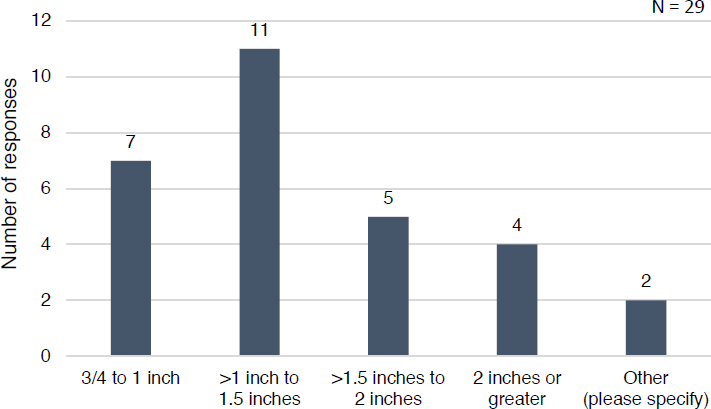
The responses for longitudinal cracks were similar, as shown in Figure 9. Sixteen of 29 responses (55.2%) indicated a wide longitudinal crack as either 1 to 1.5 inches wide or 1.5 to 2 inches wide. One response identified (3.4%) a difference for longitudinal cracks in that a wide longitudinal crack was identified as 3 inches or greater, whereas their response for transverse cracks was 2 inches or greater.
Defining cracks by their width and treating cracks differently based on their width are not necessarily the same. The survey asked about methods for distinguishing and treating wide cracks and produced a range of answers among the 14 responses. Six DOTs (42.9%) did not have a method for making the distinction between narrow and wide cracks and two DOTs (14.3%) provided their crack severity rating scheme based on crack widths. Two DOTs (14.3%) described a practice of sealing narrower cracks and patching wider cracks. Two other DOTs (14.3%) that responded “no” to this question pointed to the absence of a definition of wide cracking in their maintenance management system or maintenance operations manual, while at the same time acknowledging that at a certain width, treatments changed from crack sealing to either crack pouring or mastic use.
Identification of Wide Cracks
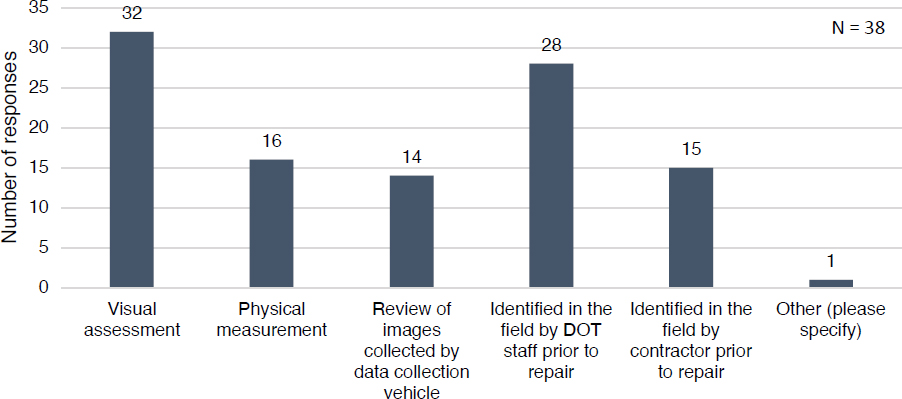
If distinctions in crack treatments are made based on crack widths, there needs to be a way to distinguish between cracks based on those widths. Figure 10 summarizes the responses to the question of how wide cracks are detected in the field. The number of methods used (106) adds up to much more than the number of respondents (38), documenting that DOTs use multiple means of identifying wide cracks. The most common responses were visual assessment (84.2%), while additional techniques used were physical measurement (42.1%), and review of images from a data collection vehicle (DCV) (36.8%). Before the crack repair, 73.7% (28 responses) stated wide cracks were identified in the field by DOT staff and 39.5% (15 responses) stated wide cracks were identified in the field by the contractor.
Twenty-five of 38 (65.8%) responding DOTs reported that they had some form of written documentation describing the materials and/or procedures used to repair wide cracks, and links to that documentation were provided where available. These online links pointed to different types of documents, including standard specifications, special provisions, material specifications, specifications applicable to wide crack repair, and preservation or maintenance guidelines or manuals. All links provided by respondents are found in the questionnaire responses in Appendix B.
As cracks widen, secondary distresses may develop and contribute to crack deterioration. This crack deterioration includes additional cracking, crack raveling or spalling, crack deepening, and potholing. Building on the question about documentation, respondents were asked about specifications, guidelines, or other written documentation that addressed how the presence of

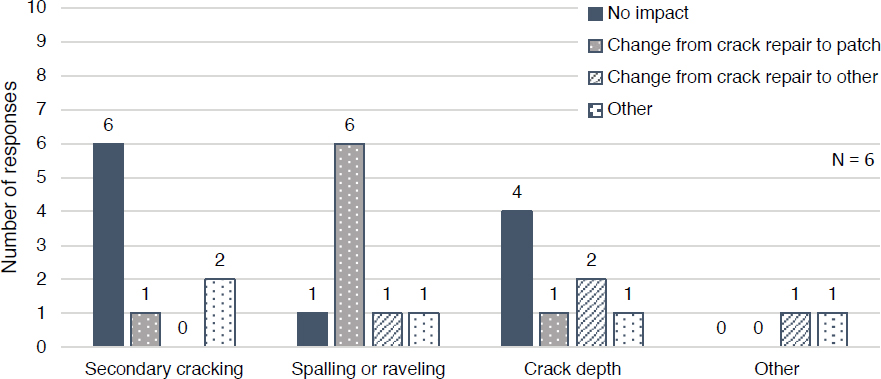
distresses other than crack width affects the decision to repair wide cracks. Twelve of 37 (32.4%) DOTs responded that such documentation existed and specific responses for wide transverse and longitudinal cracks are presented in Figures 11 and 12.
Responses indicate that there are only slight differences between how wide transverse cracks and wide longitudinal cracks are addressed. Secondary cracking had less of an impact on the repair strategy while spalling or raveling of the crack more often led to patching than to crack repair. Four of eight DOTs (50%) did not change their maintenance practice based on crack depth, while two (25%) changed from a crack repair to another strategy both for transverse and longitudinal cracks.
The impact of crack widths on the crack maintenance strategy was assessed through a separate question about when cracks would be identified as too wide to use crack repair techniques. As shown in Figure 13, no established crack width limit was the most common response (25 of 37, or 67.6%). One (2.7%) DOT reported an upper crack width limit of 6 inches.

Respondents were also asked whether traffic volumes, roadway classifications, climate, or other factors were used to establish crack width repair limits. One of the 36 responses (2.8%) indicated that such limits existed. North Dakota DOT pointed to Chapter 5 of their maintenance operations manual, which relates the IRI on rural interstates, the interregional highway system, state corridor, district collector, and district corridor, and the need for repairs to depressed transverse cracks (North Dakota DOT 2023). That manual further notes that the current treatment of depressed transverse cracks is to fill them with micro surfacing material.
Wide Transverse Crack Repair Materials
A range of materials are used in the repair of wide transverse cracks. These include conventional crack fillers and sealers, mastics, and other materials extended with sand or aggregate. DOT usage is summarized in Figure 14.

The “other” responses include a mix of generic patching materials, other mastic-like products, and other crack-sealing materials. No differentiation of the material used is made based on traffic volume, roadway classification, or climatic region/environmental zone by 36 of 37 respondents (97.3%), with California DOT noting that different sealant types are specified for different climatic regions. Drilling down further, respondents were asked about the wide transverse crack repair materials on their approved product list, as well as those being used that are not yet on an approved product list. The approved products list included general references to rubberized crack sealers, hot-applied sealers, and crumb rubber crack filler, references to materials meeting ASTM D6690 or ASTM D5078, and references to specific manufacturers’ products for crack sealing, filling, and mastic repair. See the responses to Question 9 in Appendix B for more information about the products on the approved product list. Eight of 33 DOTs (24.2%) responded that they have or are currently using products not yet on an approved list. Those materials included mastics (referred to both generically and by product name), blow patch (also referred to as spray injection) repairs, and micro surfacing repairs, and are listed in the responses to Question 10 in Appendix B.
Wide Longitudinal Crack Repair Materials
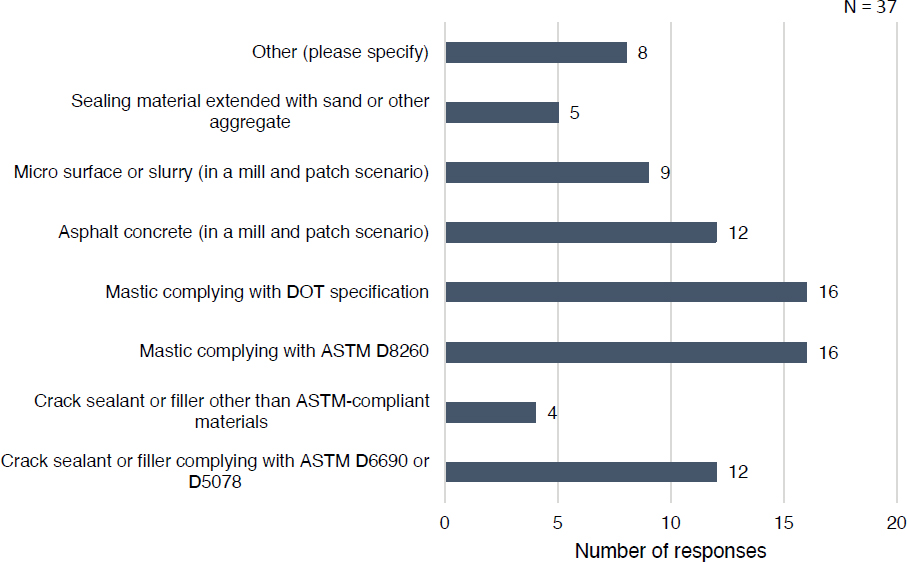
More materials or strategies are used to repair wide longitudinal cracks than wide transverse cracks. Figure 15 shows that 32 of 37 responses (86.5%) indicate the use of mastics for such repairs, with asphalt repairs in a mill-and-patch scenario used by 32.4% and micro surface repairs used by 24.3% of the 37 responding DOTs.
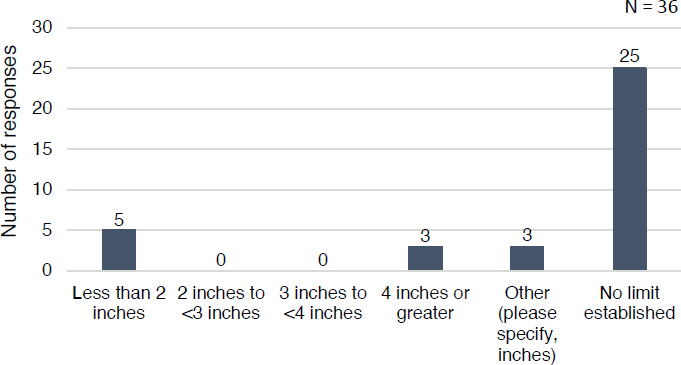
As seen in Figure 16, 69.4% (25 of 36) of the responding DOTs do not set a maximum width for longitudinal cracks too wide for wide crack repair techniques. Others set limits ranging from less than 2 inches to 6 inches (11 of 36, or 30.6%). Kentucky DOT reported limits based on roadway functional classification and California DOT reported limits based on climate.
Twelve DOTs responded to a question about wide longitudinal crack repair materials on an approved product list. Three of those 12 (25%) noted that there were no such materials on their
list while the other nine (75%) referred to crack sealing/filling materials and mastics. DC DOT and Maine DOT both identified using mastic materials not yet approved.
Survey Results: Crack Preparation
The performance of crack repairs is dependent in part on following good crack preparation techniques. Survey responses indicated that DOTs use a variety of steps to prepare wide cracks for maintenance. Figure 17 shows the distribution of responses: 33 of 38 DOTs (86.8%) clean the wide crack with compressed air, 24 (63.2%) use a hot air lance, four (10.5%) remove loose material with a jackhammer, and seven (18.4%) mill out loose material. Four (10.5%) responded that crack repairs were placed directly over the wide crack. Note that the survey permitted multiple steps to be selected. As such, the responses might either indicate that multiple steps are part of one procedure or that the respondent uses different procedures at different times.
There were also seven (18.4%) responses of “other” and the following explanations of “other” were provided:
- Follow the manufacturer’s recommendations.
- Route or saw as needed.

- Backpack blowers.
- Preheat crack edges.
- Remove debris and loose deteriorated pavement.
Survey Results: Repair Performance
Six survey questions asked the DOTs about various aspects of wide crack repair performance. Two of the questions specifically asked about the typical performance life of both wide transverse and longitudinal crack repair materials and techniques. The responses for transverse crack repairs are shown in Figure 18 and those for longitudinal crack and joint repairs are shown in Figure 19. Respondents were asked to base their answers on specific material/procedure combinations and those details are available in Appendix B responses.
Of the 24 responses for wide transverse cracks, 13 (54.2%) responded that the performance life was unknown and 12 (50%) said there was insufficient performance life data. There was no clear distinction between the performance lives of crack sealants and mastics in wide cracks. The most


frequent responses that identified a performance life—either 1 to 3 years (9 responses, or 37.5%) or 4 to 6 years (13 responses, or 54.2%)—appeared for both materials. Of the eight responses in Figure 19, six (75%) identified the typical performance life for repairs of wide longitudinal cracks and joints was in the 4- to 6-year range.
Because performance could be defined in different ways, respondents were asked about the indicators used to assess performance. Multiple responses were allowed and Figure 20 shows that the following were the most common among the 37 responses:
- Material displacement/loss (20 responses, or 54.1%).
- Material deterioration (20 responses, or 54.1%).
- Continued widening of crack or joint (19 responses, or 51.4%).
The majority of the respondents had not constructed test sections to evaluate the performance, cost-effectiveness, or other performance aspects of wide transverse and longitudinal crack performance [34 of 37 respondents (91.9%) answered no to this question]. In a separate question, 2 of 37 (5.4%) respondents indicated that they had evaluated crack repair performance by other means. Nevada DOT directly documents the performance of their repairs and Washington State DOT referred to a study of preventive maintenance treatment performance (Anderson et al. 2018).
Another aspect of performance is the effect on pavement performance of the treatment application. Respondents were asked to identify the effect of repairs to wide transverse cracks in terms of pavement roughness, friction, and noise. The same question was not asked for longitudinal cracks and joints on the assumption that most of those repairs are found between traffic lanes where they would have little to no effect on those three measures. The 36 responses, summarized in Table 2, indicated that between 61.1% (22 responses for roughness) and 83.3% (30 responses for friction) of the respondents did not identify an effect. Of the responses where impacts on surface performance measures were identified, the effects on roughness were mixed [of those responses indicating an effect, five of 14 (35.7%) said the repairs made ride smoother and seven of 14 (50%) said they made it rougher], there was limited identified effect on friction [one of six responses (16.6%) identified a decrease in friction], and an increase in noise was reported by eight of 13 DOTs (61.5%) while a decrease was reported by three DOTs (23.1%).

Table 2. DOT-observed impacts of wide transverse crack repairs on surface performance measures.
| Roughness | Friction | Noise | |
|---|---|---|---|
| Number of responses for each identified effect | Smoother—5 (13.9%) | Improved—0 | Increases—8 (22.2%) |
| Rougher—7 (19.4%) | Decreases—1 (2.8%) | Decreases—3 (8.3%) | |
| No impact—2 (5.5%) | No impact—5 (13.9%) | No impact—2 (5.5%) | |
| Unknown—22 (61.1%) | Unknown—30 (83.3%) | Unknown—23 (63.9%) |
Survey Results: Treatment Costs
The final questions were about crack material costs. The responses showed that costs are reported in variations of costs per linear measure and costs per pound. Responses were also provided in costs per lane mile and Wyoming DOT provided costs per cubic yard. While crack filling and sealing are done on comparatively very narrow cracks which are also shallow and payment is often made by a linear measure, both the width and depth of wide cracks can vary widely. This helps to explain why mastic costs were provided by weight or volume of material. Mastic costs ranged from $2 to $4 per linear foot, based on the material. The following are approximate costs for three different wide transverse crack repair materials/procedures from MnDOT:
- Mastic = $5,600/lane mile.
- Blow patcher = $1,310/lane mile.
- Micro surfacing scratch course = $0.31/square foot for large-scale application (assuming 1 lane mile = 63,360 square feet, this is equivalent to $19,641.60/lane mile).
No significant material cost differences were identified for longitudinal crack or joint repair materials/procedures.
Summary
Fifteen of the 46 respondents (32.6%) indicated that they do not distinguish between narrow and wide cracks in determining crack maintenance treatments, as shown in Figure 21. Sixteen of 30 (53.3%) responses indicated wide transverse and longitudinal cracks as either 1 to 1.5 inches wide or 1.5 to 2 inches wide, while eight of 30 (26.7%) responses identified a wide transverse crack as being between ¾ and 1 inch and seven of 29 responses (24.1%) identified between ¾ and 1 inch as a wide longitudinal crack.
Different materials and procedures are being used for wide crack maintenance. DOTs are using mastics, but they are also using crack fillers or sealers and other wide crack maintenance strategies, such as mill and patch and micro surface. More varying strategies are used for wide longitudinal crack maintenance, where higher production rates are possible by milling and replacing or micro surfacing.
The performance of wide transverse crack maintenance strategies was varied. Twenty-four DOTs provided information on the performance of one or more material/procedure combinations, for a total of 48 separate responses. Nine of the responses (18.7%) identified 1 to 3 years as the typical performance life and 13 responses (27.1%) identified that performance as 4 to 6 years. There were also 13 responses (27.1%) stating that performance life was unknown and 12 responses (25%) stating that there was insufficient performance life data available to answer this question.


