The Case for the Science Popularizer
Perspectives
By guest contributor Dr. J. Marshall Shepherd
Last update June 25, 2024
Dr. J. Marshall Shepherd is the Georgia Athletic Association Distinguished Professor and director in the Atmospheric Sciences Program at the University of Georgia. He is a member of the National Academy of Engineering and the National Academy of Sciences.
Establish your scientific credentials, and then allow everything to flow from that expertise. So advised my valuable mentor, Dr. Warren Washington, a recipient of the Presidential Medal of Science who resides on the Mount Rushmore of my career influences, when I was a young scholar. I sensed concern in Dr. Washington’s tone. As a fellow African American scientist, Dr. Washington understood the lack of representation within the atmospheric sciences. Recent data from the American Meteorological Society (AMS) place African American membership at around 2%. Dr. Washington was the first African American president of the AMS. I would go on to become the second. Dr. Washington was also the second African American, behind Dr. Charles Anderson, to receive a doctorate in meteorology.
Even as an undergraduate and graduate student at Florida State University and eventually as a scientist at NASA, I recognized that my skillset was broader than the scientific method. While I was known for being a weather geek by my friends, I was very active in student government, my fraternal organization Alpha Phi Alpha, and sports. I also had a knack for speaking publicly, writing clearly, and conveying complex scientific topics in an understandable manner. Early in my career at the NASA Goddard Space Flight Center, I was often requested to appear on major national media outlets or before high-level policymakers.
While Dr. Washington’s advice ran counter to what I had come to recognize as my broad skillset, I understood where he was coming from. Without saying it directly, he expressed that young Black scholars like me were often typecast as outreach specialists or mentors. I took his advice to heart and focused on my science acumen. Ultimately, I was fortunate enough to be elected a fellow of the AMS and received a Presidential Early Career Award for Scientists and Engineers at the White House. In 2021, I was elected to the National Academy of Sciences, the National Academy of Engineering, and the American Academy of Arts and Sciences. I often reflect on my interactions with Dr. Washington. Was he worried that I would be labeled a “science popularizer”?
What is Science Popularization?
Dr. Gustaaf C. Cornelis, a professor of the philosophy of science, defines the popularization of science as “nothing else than an endeavor to image scientific ideas in such a way that everyone (especially non-scientists) can grasp the fundamental concepts and have an idea of what science in essence is.” He identifies good and bad examples of science popularizers. However, he ultimately concludes that science popularization is only possible if the popularizers “take responsibility and be honest in their efforts, both toward science as well as the public.”
Dr. Cornelis cites one of the most famous science popularizers, Dr. Carl Sagan. Even as a young scientist, I was aware of Dr. Sagan and always had the perception that he was significant. Dr. Sagan was an accomplished and prolific scholar and the David Duncan Professor of Astronomy and Space Sciences and director of the Laboratory for Planetary Studies at Cornell University. He was also a Pulitzer Prize-winning author who regularly wrote for mainstream media outlets and appeared on television many times throughout his career. Many in the establishment scientific community took issue with Dr. Sagan’s popularity — displaying what has become known as the “Sagan Effect.” In “Has Contemporary Academia Outgrown the Carl Sagan Effect?,” which was published in the Journal of Neuroscience in 2016, neuroscientist Dr. Susana Martinez-Conde defines the Sagan Effect as “the perception that popular, visible scientists are worse academics than those scientists who do not engage in public discourse.”
Evolving from the Sagan Effect
As I became further enmeshed in the ivory tower, it became apparent to me that the term “popularizer” seemed to carry a negative connotation. Perhaps this was Dr. Washington’s concern for my career trajectory. Even early in my career, there were innuendos and microaggressive comments about “serious scientists” not talking to the media, refraining from all of that “new” stuff like Twitter (now X), or writing public-facing literature. While the microaggressive comments have subsided as my career has matured, I still occasionally get peppered with these questions:
How do you find the time to do all the extra stuff?
Don’t you worry that posting on social media sucks away your time?
Have you ever wondered if your scholarship suffers from engaging more broadly?
These questions seem to be rooted in a couple of ivory tower misconceptions that need to evolve. First, the currency of academia, federal labs, and so forth is peer review literature and research funding. Both are of first-order significance in the promotion or tenure process. As such, many scholars do not feel incentivized to engage in any activities that are not aligned with the “publish or perish” directive or securing funding. Second, academics are trained to be ... wait for it ... academics. Our graduate training consists of coursework, theses, dissertations, conferences, proposal writing, postdoctoral fellowships, and the like.
Scholars are often discouraged from being “too public.” “Don’t be too well known outside the field,” theoretical physicist and philosopher Dr. Sean Carroll writes about the dos and don’ts for getting tenure at a major research university. “I hate to say this, but the evidence is there: if you have too high of a public profile, people look at you suspiciously. Actual quote: ‘I’m glad we didn’t hire Dr. X; he spends too much time in the New York Times and not enough time in the lab.’ And that’s the point — it’s not that people are jealous that you are popular, it’s that they are suspicious you care about publicity more than you do about research.”
Ironically, the research, ideas, and voices of scholars, especially young scholars, are exactly what the media, policymakers, and stakeholders need to hear. This is particularly important for the discipline of climate science, my field of expertise. Climate change impacts every aspect of the connected Earth system and is revealed through changes in weather patterns, sea level, cryospheric processes, the hydrologic cycle, and biogeochemical cycles. Such complexities affect every aspect of humanity — food supply, health, water availability, socio-political stability, economics, infrastructure, and so forth. As such, it is paramount that information about climate science be accessible and disseminated widely. In fact, I view public engagement as an inherent part of my scholarship.
As science and engineering continue to evolve, it is imperative that scholars, particularly young investigators, are incentivized to engage more broadly, not penalized for it. I would love to see quantitative incentives in evaluation and promotion guidelines for scholars to engage the public. Dr. Nasreen Jessani and colleagues offer recommendations in a 2021 article for Nature on how to implement tempered approaches for various levels of engagement or service.
We need a renaissance in how scientists are trained. I consider myself an “end-to-end scientist” (EES) and believe that we need to incorporate attributes of that paradigm into our system of educating scientists. Attributes of an EES paradigm might include:
Incorporating science communication development (written and verbal)
Traditional media training
Social media training
Summer internships or immersive experiences in graduate school
Policy workshops
Teambuilding exercises
Conflict resolution
These skillsets, coupled with traditional graduate training, will enable scholars to formulate research questions and communicate them beyond traditional dissemination formats like journals, books, or conference proceedings. To be clear, those formats are critical because they are the foundational checks and balances for the rigor and credibility of scientific research. It is still quite common to see members of the broader public or even decisionmakers misuse gray literature, unsubstantiated sources, or internet conspiracy theories in discourse. However, our standard scholarly outlets should not be the final resting place for science. If we are not in broader forums as scientific experts, people with misinformation and agendas will happily fill the void that we leave behind.
Carl Sagan understood this. A well-cited journal article might have 100 or 1,000 readers, but Dr. Sagan understood that a well-placed media appearance could reach millions. He also understood something that is increasingly important: Public dollars fund a large percentage of research. We should brim with pride and excitement to tell people about the returns on their investments.
Many people don’t think about the connections between research and development and their latest weather app, GPS guidance, or heart medication. When people mention weather apps to me, I jokingly remind them that the information is not coming from the “weather fairy.” A recent Pew Research Center study finds that American trust in and positive views of science continue to decline. These findings are likely related to misinformation, ideological posturing, and science literacy gaps. However, the stubbornness of the scientific enterprise to tell its stories in understandable or meaningful ways is probably a culprit too.
Beyond Flawed Narratives: Science Popularization as a Necessity
Academic critiques of science popularization are often based on the premise that being a science popularizer and having a successful academic career are mutually exclusive. Dr. Martinez-Conde shows that narratives about the efficacy of popularizers in academia are flawed. Using quantitative data like citation indices and impact scores, she found no substantial evidence that science dissemination impeded a successful academic career. Heck, I am living proof of that too.
On the contrary, Dr. Martinez-Conde found that some of the most competitive, productive scientists in her sample engaged broadly and effectively. Her study concluded that “most disseminators incur no net penalty in their careers—and may even benefit slightly—yet they obtain few or no institutional rewards for their communication activities.” Dr. Martinez-Conde went as far as recommending that organizations implement guardrails and mitigative structures to counter ambivalence, misperception, and barriers associated with the Sagan Effect.
Here’s where critics err with people like Dr. Neil deGrasse Tyson, Sagan, and others who venture into science popularization: They evaluate science popularizers through a narrow, biased filter rather than a filter that takes into account the moment, intent, and audience. Effective science popularizers have a solid grasp of their audience and the moment, and they tailor their messages accordingly. My TEDxUGA talk on what shapes perceptions of science has almost 3 million views at this time of writing. I understood the audience for that evening and delivered the talk in a style that resonated with them. I could easily convert that same talk into a scholarly paper or research proposal, but the narrative or packaging would be different.
I argue that science popularization should not be considered as inferior to or detracting from traditional scientific research. Rather, science popularization is necessary to move us forward. Grand and wicked challenges in science and engineering require sound, public-facing expertise.
When I was elected to the National Academy of Sciences and the National Academy of Engineering, my citations acknowledged my contributions to the fields of urban or hydrometeorological processes. I know Dr. Washington was proud. However, the citations also gave a nod to my public intellectualism and efforts to shift mainstream narratives. I am equally proud of that too.
Disclaimer
The views expressed in this perspective are those of the author and not necessarily of the author’s organizations, the National Academy of Engineering (NAE), or the National Academies of Sciences, Engineering, and Medicine (the National Academies). This perspective is intended to help inform and stimulate discussion. It is not a report of the NAE or the National Academies.
© National Academy of Sciences. All rights reserved.
More like this
Discover
Events
Right Now & Next Up
Stay in the loop with can’t-miss sessions, live events, and activities happening over the next two days.
NAS Building Guided Tours Available!
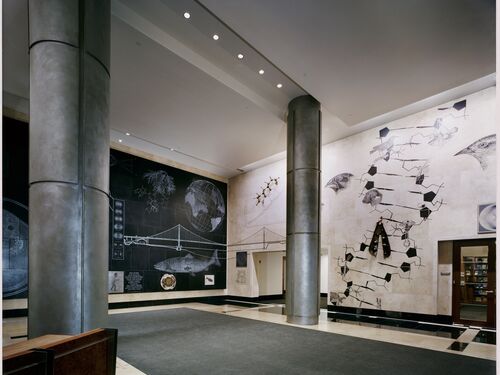
Participate in a one-hour guided tour of the historic National Academy of Sciences building, highlighting its distinctive architecture, renowned artwork, and the intersection of art, science, and culture.