The Current Status and Future Direction of High-Magnetic-Field Science and Technology in the United States (2024)
Chapter: 7 Helium as a Critical Material for High Magnetic Fields and Adjacent Research
7
Helium as a Critical Material for High Magnetic Fields and Adjacent Research
INTRODUCTION
It is impossible to understate the importance of helium in the research enterprise for magnetic fields (and the discoveries such fields facilitate). Across chemistry, medicine, particle and nuclear physics, condensed matter physics, magnetic fusion, materials science, and biological chemistry, helium is a material without substitute that impacts all these fields. Therefore, helium is a critical element for many aspects of the research addressed in this National Academies report.
Helium alone can achieve the lowest temperatures required for the coldest studies of condensed matter, and it is requisite for our current high-magnetic-field technologies. Superconducting magnets dominate much of the high-magnetic-field arenas (e.g., Nuclear Magnetic Resonance [NMR], Magnetic Resonance Imaging [MRI], condensed matter physics) where superconductivity is imparted through the low temperatures achieved through cryogenic cooling of materials by liquid helium (LHE). Importantly, such superconducting magnets (a high-capital cost form of equipment) must have a continuous and uninterrupted supply of liquid helium; in the absence of LHE, a magnet can become permanently damaged if the superconducting materials are warmed above their critical temperatures because the electrical current passing through the windings is not terminated (indicating an inadequate quench protection system).
It is therefore undisputed that helium is a critical element for the sustenance of our research infrastructure. In terms of economics, it has extremely steep inelastic demand curve, in that researchers will pay nearly any price, because of the need
to sustain this instrumentation. Similarly, for low-temperature physics (as well as chemistry and materials science), without sources of helium, studies are forced to be put on hold when supplies dwindle. Therefore, researchers in these communities are keenly sensitive to the impacts of price and accessibility (i.e., supply). Committee members have seen with their own eyes how since 2000–2010 NMR capacity has slowly but surely disappeared from states such as Illinois, Indiana, Michigan, California, Utah, Iowa, Kansas, Pennsylvania, and New York (often in several or all of the state campuses) and how NMR instruments operating in the 800 MHz and 900 MHz ranges in all these places have been decommissioned, most likely for good.
With all this context, it is incredibly unfortunate that we have now experienced over two decades of both supply shocks and price increases that are undermining the viability of the science enterprise that relies on helium. In the 1990’s, it was decided by Congress that the U.S. government should not be in the business of selling helium. To quote a member of Congress “the National Helium Reserve has really been a laughingstock, I think, for several decades,” claiming that the helium reserve was an example of ballooning government waste.1 It was decided that the U.S. government would sell both the helium infrastructure (the National Helium Reserve)2 and the stockpile of helium gas that is contained therein.
After the announcement of the Helium Privatization Act (1996), there have been large-scale issues with both price and supply, detailed below.
The National Academies had previously published two reports on the helium reserve as outlined in Box 7-1. Consequently, the helium supply is a topic that is threaded throughout this report, touching on many aspects of the U.S. research mission and new technology developments in all areas that utilize helium for cryogenic cooling. Chapter 1 in particular documents the many ongoing issues for the magnetic resonance community. “The cost of installing and running NMR instruments has been strongly affected by recent liquid helium shortages and increases in liquid helium prices. Rising helium costs have forced the shutdown of single-investigator NMR labs and departmental NMR facilities in chemistry departments across the United States. Chapter 2 summarizes a complex landscape for helium, where the siting of a clinical MRI magnet can require “thousands of liters of liquid helium.” This is a field that has benefited from technology to adopt hardware on modern instruments for on-site liquefaction of that helium using cryo-coolers. In addition, ultrahigh-field MRI systems were noted to consume large quantities of LHE for cooldown. In Chapter 5, there is a callout to the community to develop novel high-density HTS superconducting cables based on advanced
___________________
1 House of Representatives, 1996, “Congressional Record,” Proceedings and Debates of the 104th Congress, Second Session 142(57), https://www.congress.gov/crec/1996/04/30/CREC-1996-04-30.pdf.
2 Bureau of Land Management, 2024, “The Federal Helium Program,” https://www.blm.gov/programs/energy-and-minerals/helium/federal-helium-program.
BOX 7-1
National Academies of Sciences, Engineering, and Medicine Reports on the Helium Reserve
The National Academies have previously published two reports from two consensus studies on the sale of the National helium reserve, The Impact of Selling the Federal Helium Reserve (2000) and Selling the Nation’s Helium Reserve (2010). An in-depth study of the helium issues was not in scope for this committee; however, the sponsor requested that a discussion on access and usage of helium be addressed.
As mentioned in this chapter, the 2000 study gave the following recommendation:
Although the committee believes that the implementation of the Helium Privatization Act of 1996 should not have an adverse effect on the overall production and usage of helium over the next two decades, there are a number of research programs and follow-on studies that should be considered because they would ensure that sufficient supplies of helium continue to be available to satisfy the needs of known and potential users beyond 2020.
As of the publication of the current high-magnetic-field science study by the National Academies and described here, there have been several massive disruptions to the international and domestic helium markets that were unforeseen at the time. It is possible that there could be deleterious effects related to the sale of the helium reserve as the full recommendation was not acted upon.
The follow-on study in 2010 had additional recommendations, and two especially relevant to this study are given here.
The crude helium in-kind program and its associated customer priorities should be extended by the Bureau of Land Management, in cooperation with the main federal agencies not currently participating in the in-kind program—for example, the National Science Foundation, the National Institutes of Health, and the extramural grant programs of the Department of Energy—to research being funded in whole or in part by government grants.
Federal agencies such as the Department of Energy, the National Science Foundation, the National Aeronautics and Space Administration, and the Department of Defense, which support research using helium, should help researchers at U.S. universities and national laboratories acquire systems that recycle helium or reduce its consumption, including low-boil-off cryostats, modular liquefaction systems, and gaseous recovery systems.
Additional findings and recommendations can be found in the previous National Academies reports to advise the relevant decision makers as the United States continues to act upon them in order to protect the critical need for helium for current and future generations.
superconducting materials and (notably) to achieve helium-free cooling. Lastly in Chapter 10, a finding that can be repeated here: “Consumption of liquid helium is a significant cost at the High Flux Isotope Reactor (HFIR) and the Spallation Neutron Source (SNS), and supply is a concern. Compact, cryogen-free, high-Tc neutron scattering magnets would be beneficial.”
SUMMARY FINDINGS OF CHAPTER 7
Ongoing Disruptions in Supply
Access to helium has been increasingly uncertain over a period approaching two decades. The United States is the second-largest supplier of helium, worldwide, as shown in Figure 7-1 below. Supply shocks have a variety of sources, including a (partial) shutdown of the U.S. Helium Reserve for maintenance, geopolitical instability (closing off access to one of the approximately 4 major suppliers of helium), and more obvious economic drivers such as the heavy increase in demand for helium required by other industries (e.g., for semiconductor chip manufacturing).
The inability to reliably source this critical element for superconducting magnets is a threat to the ongoing development of this area. USGS reports U.S. consumption of helium continues to increase while helium recovered from natural gas has continued to decline.3 The helium supply chain is also extremely vulnerable to disruptions. With a cargo ship blocking the Suez Canal in 2021, helium supplies to Europe could not reach users as LHE could not take lengthier routes around Africa.4 Helium supplies are also in jeopardy based on terrorist activities in the Red Sea and Gulf of Aden because of Houthi attacks.5 International supplies are also endangered with the ongoing war in Ukraine.6 Domestic supplies were in jeopardy
___________________
3 S.T. Anderson, 2018, “Economics, Helium, and the US Federal Helium Reserve: Summary and Outlook,” Natural Resources Research 27:455–477, https://doi.org/10.1007/s11053-017-9359-y.
4 D.J. Lynch, 2021, “Suez Canal Mishap Puts Battered Supply Chains Under More Pressure,” Washington Post, March 27, https://www.washingtonpost.com/us-policy/2021/03/27/suez-canal-economy.
5 P. Kornbluth, 2024, “Houthi Attacks Raise Concerns About Helium Supply,” Gasworld, January 18, https://www.gasworld.com/story/houthi-attacks-raise-concerns-about-helium-supply/2132899.article.
6 C. Bettenhausen, 2022, “War in Ukraine Makes Helium Shortage More Dire,” C&E News 100(10), https://cen.acs.org/business/specialty-chemicals/War-Ukraine-makes-helium-shortage-more-dire/100/i10.
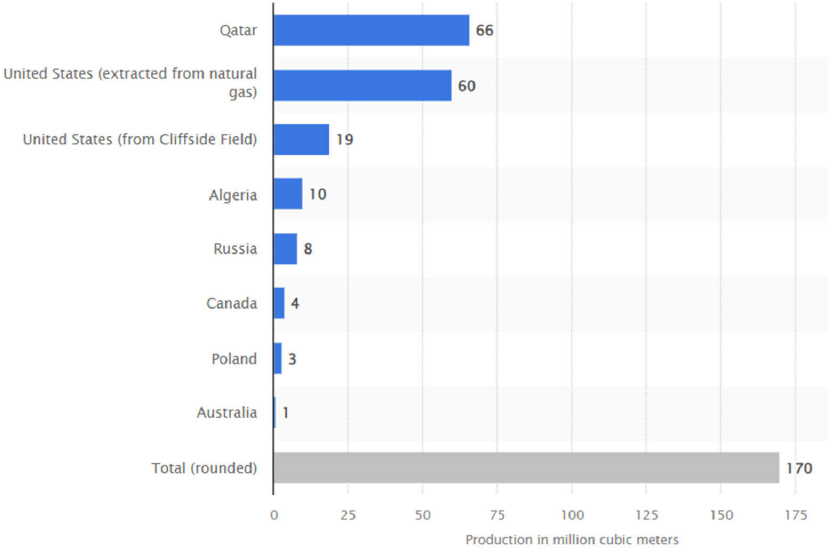
SOURCE: Data from U.S. Geological Survey, 2024, “Helium,” pp. 88–89 in Mineral Commodity Summaries, January, https://doi.org/10.3133/mcs2024.
in 2022 because of a 5-month shut down of the U.S. Helium Reserve and described by the research and user community as the helium shortage 4.0.7
Finding: What we have learned from two decades of experience is that nearly any disruption to the helium supply, results in shortages and an inability to source helium, sometimes “at any price.”
Finding: Superconducting magnets have been decommissioned across the United States because of helium access, and some university administrators have expressed reluctance to hire faculty and researchers in areas that require helium.
___________________
7 J. Rosen, 2023, “Impending Sale of Scientifically Critical Helium Sparks Worries,” Science Insider, November 6, https://www.science.org/content/article/impending-sale-scientifically-critical-helium-sparks-worries; J. Siliezar, 2022, “Global Helium Shortage Slams Brakes at Harvard Labs,” Harvard Gazette, June 13, https://news.harvard.edu/gazette/story/2022/06/helium-shortage-4-0-makes-its-way-to-harvard; P. Kornbluth, 2022, “Helium Markets Now Experiencing ‘Helium Shortage 4.0,’ ” Gasworld, February 8, https://www.gasworld.com/story/helium-markets-now-experiencing-helium-shortage-4-0/2093551.article.
Conclusion: The inability to reliably source helium has long-reaching impacts, that need to be addressed for the health and resilience of the U.S. research enterprise.
Ever Increasing Prices (and Large Fluctuations)
As a commodity with an inelastic demand curve, helium’s price has an outsized impact on researchers. At the start of the 1996 Act, Congress set prices for helium, which was therefore not driven by market forces. What resulted over the past two decades were prices that had a lot of unpredictability. As depicted in the 2016 report (“Responding to the U.S. Research Community’s Liquid Helium Crisis”) were charts of large price increases over time, and a lack of consistency between prices and any other discernable factor, such as regional variation or quantity of orders.
Such price instability is highly disruptive to researchers, who are largely on fixed research budgets. The price volatility prevents long-term planning or the ability to site new instruments. In addition, with budgets for federally funded grants being “flat” over this same period, the increasing cost for helium had to come at the expense of some other budget line item, such as graduate student support, faculty summer salary, or reduction in the scope of work via materials and supplies.
Conclusion: Helium shortages and rationing have been experienced for nearly two decades, and the consequences are inhibiting the U.S. research enterprise.
Conclusion: The community is justly and deeply concerned by the scarcity and pricing of helium for basic research and medical practices, both using high-magnetic-field instrumentation. The helium market is critical for multiple (competing) interests in the semiconductor industry, in ultrahigh-field research, and in lifting applications. Therefore, ensuring a secure supply is a primary concern. One advantage of the U.S. Strategic Helium Reserve that distinguished it from other sources (i.e., Algeria, Qatar) is that it offered the ability to store an inventory of helium.
Key Recommendation 13: Secure helium access for research (short-term solution). The U.S. government (through the Department of the Interior or potentially the Department of Commerce) should immediately establish a royalty “in-kind” program for helium, whereby vendors extracting helium from federal lands would be required to refine and sell the helium to federally funded researchers. Doing so will enable preferred access to helium for basic research and development for physics, chemistry, biology, materials science, and medical magnetic resonance imaging support.
Recommendation 7-1: Secure helium supplies (short-term solution). The U.S. government should establish, as soon as possible, a new helium reserve through the Department of the Interior that can create a stockpile of helium for emergency use—analogous to the U.S. Petroleum Reserve.
FACT FINDING AND ANALYTICS
The scenarios described above related to inconsistent helium supplies and rapidly changing prices point to a market that is uncertain and volatile. Quoting the Bureau of Land Management’s website,8 “For many of these applications, there is no substitute for helium. Helium is a nonrenewable resource found in recoverable quantities in only a few locations around the world, many of which are being depleted. Accordingly, the United States has important economic and national security interests in ensuring a reliable supply of helium.” To state the situation without being sensational, if the supply of helium were to enter a long-term shortage, superconducting magnet systems such as those used for MRI medical applications and research instruments would be decommissioned (sometimes irrevocably) over time.
Perhaps one of the most unfortunate statements comes from the National Research Council report9 from 2000 stating “Under the most likely scenarios considered by the committee, the implementation of the Helium Privatization Act of 1996 will have only a modest impact on producers and users of helium over the next 10 to 15 years.” This early study that came on the heels of the 1996 legislation points to the unintended long-term consequences of both the Act and the subsequent analysis by scientific and engineering experts. The helium market may not be easily represented by other commodity markets, because there is no viable alternative for this element.
Given the recent sale of the U.S. Strategic Helium Reserve to a commercial entity, the future of the helium marketplace is an unknown. Because helium remains a “critical element” for U.S. industries, as well as for the research enterprise, a more thorough understanding of the current and future state of this market would help protect those entities that depend on this resource.
The U.S. government maintains lists of critical materials and elements, via multiple federal departments. These lists recognize those elements deemed economically important, at a high risk of supply disruption, that serve essential functions, and difficult to substitute owing to unique properties. These lists include the
___________________
8 Bureau of Land Management, 2024, “About Helium,” Department of the Interior, https://www.blm.gov/programs/energy-and-minerals/helium/about-helium.
9 National Research Council, 2000, The Impact of Selling the Federal Helium Reserve, Washington, DC: National Academy Press, https://doi.org/10.17226/9860.
recent Department of Energy (DOE) 2023 Critical Materials list,10 where helium is currently not identified today. This list enters legislation in the recent past, referring to the Energy Act of 202011 and lists maintained by the Secretary of Energy, DOE, as well as the Critical Minerals12 as defined by the Secretary of the Interior, the director of the U.S. Geological Survey, and the Department of Defense. These lists build awareness of the significance of these elements and materials and lead to a complex set of actions to address issues related to both supply and demand. Quoting13 one such agency:
recommends a whole-of-government approach to diversify international supply chains and move global markets toward sustainably, responsibly produced sources of critical minerals and materials, as well as a mineral-by-mineral strategy to explore and expand sustainable domestic production, processing, and recycling of critical minerals and materials domestically.
Recommendation 7-2: As one of the few truly nonrenewable resources, this element, helium (as a commodity chemical) should be added to the list of “Critical Materials” or “Critical Minerals” as defined by one or more U.S. government agencies.
Recommendation 7-3: A resource economics analysis of how to address long-term price and supply forecasting is critically needed as soon as possible. This should be commissioned by the federal agencies that depend on helium, including the National Aeronautics and Space Administration, Department of Defense, Department of Energy, National Science Foundation, and National Institutes of Health.
___________________
10 Department of Energy, 2023, “Notice of Final Determination on 2023 DOE Critical Materials List,” 88 FR 51792, Federal Register 88(149):51792–51798, https://www.federalregister.gov/documents/2023/08/04/2023-16611/notice-of-final-determination-on-2023-doe-critical-materials-list.
11 U.S. Congress, 2020, Energy Act of 2020, https://www.energy.senate.gov/services/files/32B4E9F4-F13A-44F6-A0CA-E10B3392D47A.
12 U.S. Geological Survey, 2022, 2022 Final List of Critical Minerals, https://www.federalregister.gov/documents/2022/02/24/2022-04027/2022-final-list-of-critical-minerals.
13 Department of Defense, 2021, “Department of Defense Takes Immediate Action to Shore Up Critical Materials Supply Chain,” 100-Day Strategic and Critical Materials—Topline Recommendations/Fact Sheet, https://media.defense.gov/2021/Jun/08/2002737124/-1/-1/0/DOD-FACT-SHEET-CRITICAL-MATERIALS-SUPPLY-CHAIN-2021.06.07.PDF.
RECYCLING AND REUSE OF HELIUM IS A CRITICAL NEXT STEP, REQUIRING SUBSTANTIAL CAPITAL INVESTMENT (LONG-TERM SOLUTION)
Capital equipment can be acquired to ensure recycling of helium on individual instruments and at large-scale facilities. One of the earliest examples was proposed in a Report14 to Congress as far back as 2015 by program managers at NSF recognizing the risk to researchers. Such programs were initiated at NSF in 201815 but limited to just a few researchers at a time, given the high capital cost of these recycling systems. NIH followed soon after, in 2019 offering “administrative supplements” to specific grant holders in the NIGMS program.16
Over time, these programs have led to multiple helium liquefaction systems being installed at laboratories nationwide. This is progress, but it is both slow (only a handful of units each budget cycle is funded) and comes with a learning-curve in terms of best practices for installation and new processes for helium handling. There are also operating costs that must be absorbed, including the need for personnel to service and manage the equipment, additional substantial energy requirements, and both maintenance and infrastructure needs.
Finding: The transition to a sustainable helium capture and reuse infrastructure is feasible today using commercial equipment. While the equipment is available, its optimal installation and practices for use need to be socialized within the research community. More “market penetration” and adoption of this equipment will lead to a better knowledge base in terms of best practices for the helium-using community.
Recommendation 7-4: For the security of the research enterprise in the United States, more funding is needed to support the capital equipment and installation cost of helium recycling systems. There must be a recognition
___________________
14 Secretary of the Interior, 2015, Report to Congress on Items Required by Sec. 19 of the Helium Stewardship Act of 2013 Public Law 113-40, as Authorized under 50 U.S.C. 167 by the Secretary of the Interior, Washington, DC, https://www.blm.gov/sites/blm.gov/files/NM_Report%20to%20Congress%20Section%2019%20HSA_FINAL%20to%20DC%20062015%20Sec%20508%20Compliant.pdf.
15 One agency, the Division of Materials Research within the National Science Foundation (NSF), has allocated $1 million per year to qualifying NSF grantees for the purchase of helium recovery units.
16 National Institute of General Medical Sciences (NIGMS), 2019, “NIGMS Administrative Supplements for Helium Recovery Systems, July 11, 2019,” National Institutes of Health, https://loop.nigms.nih.gov/2019/07/nigms-administrative-supplements-for-helium-recovery-systems/#more-12626; NIGMS, 2020, “NIGMS Administrative Supplements for Helium Recovery Systems, February 6, 2020,” National Institutes of Health, https://loop.nigms.nih.gov/2020/02/nigms-administrative-supplements-for-helium-recovery-systems-2.
that this may require dedicated personnel to operate the infrastructure, and the ongoing maintenance and (new) helium handling practices require a long-term investment.
LAUNCH OF NEW EXPLORATORY RESEARCH AND DISCOVERY OF NEXT GENERATION OF CRYOGENFREE TECHNOLOGY (LONG-TERM SOLUTION)
Ongoing developments of permanent and HTS magnets can help reduce the risk to the distributed “inventory” of superconducting magnets. Chapter 3 illustrates in detail how there should be a pursuit of new superconducting magnet technologies. It is important to note that many HTS magnets still require the use of liquid helium for operation as there are significant increases in superconductor performance at the low temperature of liquid helium (4.2 K at sea level atmospheric pressure).
To reiterate an earlier narrative, the use of liquid helium has no substitute in condensed matter physics research, where it is a critical material for achieving the lowest temperatures necessary for cutting-edge discoveries. Given that superconducting magnets are required by all universities conducting chemistry and biochemistry research, and industries who need such NMR and EPR instrumentation to enable commercial research, avoidance of superconductor technologies that require helium has a long reach in the research community. It is also vital to consider the positive impacts to the security of the medical (and research) MRI community by envisioning a future state, whereby magnet designs could allow the replacement of current superconducting technologies with HTS materials and overcome the challenges related to critical current (and a concomitant avoidance of helium).
Recommendation 7-5: Research into superconducting materials and magnet designs that reduce or avoid the use of helium, yet with performance metrics at the cutting edge of research and application needs, should be supported by one or more funding agencies, in particular, the National Science Foundation, National Institutes of Health, and Department of Energy.


