Assessing and Measuring the Business Value of Knowledge Management (2026)
Chapter: Appendix A1: Article Summaries
Appendix
Appendix A1: Article Summaries
Forty-nine article summaries are presented in Appendix A1. The summaries follow the format described in Transportation Research Circular E-C194: Literature Searches and Literature Reviews for Transportation Research Projects.
The summaries are presented in two groups: 1) DOT-specific KM reports and articles, and 2) Other Relevant KM articles. The articles are listed in alphabetical order by title.
A1.1 DOT-Specific KM Reports and Articles
This section contains summaries of reports and articles about knowledge management in departments of transportation both in the United States and abroad.
A1.1.1 A Guide to Agency-Wide Knowledge Management for State Departments of Transportation
NCHRP Report 813: A Guide to Agency-Wide Knowledge Management for State Departments of Transportation, 2015, NCHRP Project 20-98
Spy Pond Partners, LLC
This guide was prepared to be a starting point for agencies interested in implementing KM. Most of the KM approaches and techniques described in the guide are still valid today, even though the document is eight years old.
The guide has a substantial section on KM measurement. It outlines a framework that covers costs, outputs, exposure/use, and outcomes.
The KM-related technologies listed in this document have significantly changed since the report was published.
Table 6, Pages 43-4, lists transportation agencies with KM initiatives. The table provides the name and title of the primary points of contact. The points of contact sit in various functions, including HR, technology transfer, engineering, organizational effectiveness, administrative services, risk and ethics, and policy departments, as well as KM.
A1.1.2 AASHTO KM Maturity Model
https://transportation.org/km/resources/introduction-to-knowledge-management/
Knowledge management maturity models are frameworks that help organizations assess and improve their knowledge management capabilities. They typically describe different maturity levels, from initial to optimized and provide criteria and indicators for each level. Popular models include:
- The Knowledge Management Maturity Model (KMMM) was developed by Siemens in 2001. It is based on the Capability Maturity Model (CMM) for software engineering, and it consists of five levels: initial, aware, defined, managed, and optimized. The KMMM evaluates the knowledge management practices of an organization along four dimensions: people, process, technology, and culture. The KMMM is widely used and recognized as a comprehensive and systematic model.
- The K3M model was introduced by Kucza in 2001. It is also based on the CMM, but it simplifies the structure and reduces the number of levels to three: ad hoc, systematic, and proactive. The K3M model focuses on the knowledge processes of an organization, such as identification, creation, sharing, and utilization. The K3M model is easy to understand and apply and emphasizes continuous improvement’s importance.
- The KM2 model was developed by the Asian Productivity Organization (APO) in 2007. It is based on the Balanced Scorecard (BSC) approach, and it consists of four levels: initial, repeatable, defined, and managed. The KM2 model evaluates the knowledge management performance of an organization along four perspectives: learning and growth, internal process, customer, and financial. The KM2 model is holistic and balanced, and it links knowledge management to organizational strategy and outcomes.
- The Knowledge Management Maturity (KMM) model was proposed by Peel and Ganci in 2002. It is based on the Deming Cycle (PDCA) of plan-do-check-act, and it consists of six levels: unaware, aware, reactive, proactive, managed, and integrated. The KMM model assesses the knowledge management maturity of an organization along five elements: leadership, culture, process, technology, and measurement. The KMM model is flexible and adaptable, and it encourages a cycle of learning and improvement.
The AASHTO KM Maturity Model is valuable because it was created with transportation agencies in mind. It specifically looks at four stages of development:
- Learning
- Getting started with a KM initiative
- Expanding KM
- Reaching maturity
Perhaps more than a maturity model, it is a detailed roadmap to help organizations think about where they are in their KM journey. This document provides an excellent avenue to explore the various state DOTs’ operations and activities.
A1.1.3 AASHTO: CKM Awareness Campaign
Oklahoma Transportation
August 23, 2022
This paper was designed to leave participants of the session with a set of tools for introducing KM at their agency. Session participants included 19 members from state DOTs. Content was introduced through a look at KM activities at Oklahoma Transportation, which appears to have a relatively robust KM system that employs social network analysis and has a formal knowledge transfer plan in place.
Of particular interest was a question asked to attendees about which KM activities they are aware of happening at their agency. The list of activities covers a broad spectrum illustrated below.
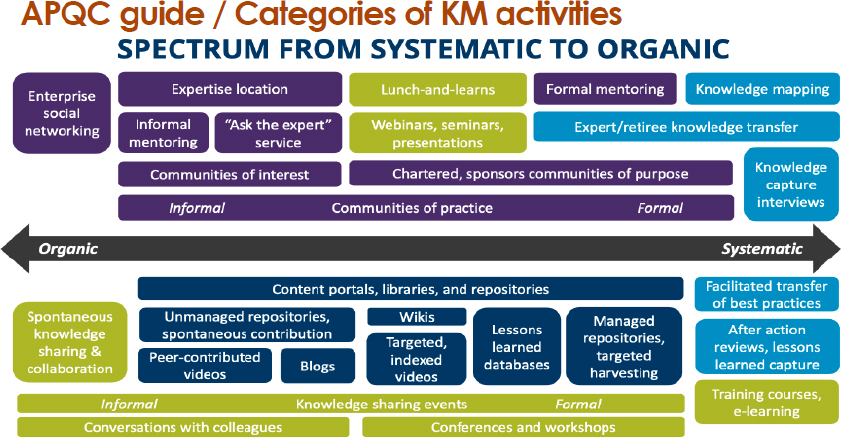
The activities in green were the most prevalent. It is interesting to note that they tend to focus on organic rather than systematic. This indicates that knowledge management is relatively immature in state DOTs from a functional development standpoint. However, it shows a high awareness of KM (although perhaps not an understanding of the value proposition). Specific comments in the presentation also provide insight into the relative maturity of several DOTs.
A1.1.4 Advances in Transportation Agency Knowledge Management
Scan Team Report: Advances in Transportation Agency Knowledge Management
NCHRP Project 20-68A, Scan 12-04
May 2014
This voluminous report summarizes the findings from a scan workshop of Knowledge Management within transportation agencies and other organizations. The purpose of the scan was to identify and document successful KM practices and identify additional needs to advance KM in transportation agencies. Several key findings included:
- An overriding motivation to implement KM is concern about loss of staff due to retirements
- KM seen as a driver of efficiency and innovation
- KM implementation varied greatly, ranging from formal, centralized functions to multi-hatted staff doing “KM stuff”
One of the most interesting conclusions from the scan team was the conclusion that a formal KM function with a designated lead and staff resources is a strategy that should be considered to effect meaningful and sustained change. However, the team also acknowledged that organizations that cannot establish a central KM office can still derive value by implementing KM techniques within individual business units. This is a critical point. As long as there is a vision and a movement toward a KM goal, then any activity (big or small, centralized or decentralized, audacious or modest) represents progress.
The wide range of programs discussed by the participants indicates a lack of coalescing around a central vision but does show considerable maturity of thought. For example. Developing a recognition program to reinforce organizational values of knowledge sharing and teamwork implies a culture of sharing that already exists; it just needs to be “activated.”
Of particular interest was Chapter 3, KM Implementation Strategies for State DOTs, to consider when creating, building, and implementing KM practices. The strategies were broken into five categories – Leadership, Human Resources and Intellectual Capital Management, Recognition for Collaboration and Information Sharing, Fostering Networks and Communities of Practice, and Knowledge Capture and Application. This scan was conducted in 2013, and it will be interesting to see how these pillars of KM have been adopted/adapted.
A1.1.5 Best Practices for WisDOT Workforce Transition
Wisconsin Highway Research Program
Report No. 0092-10-15, CFIRE 04-03, September 2011.
This brief summarizes Project 0092-10-15, “Best Practices in Guidance for Workforce Transition and Succession Planning,” produced through the Wisconsin Department of Transportation Research Program. The business problem was much of the expertise held by soon-to-retire workers was not captured by documentation.
This study aimed to collect best practices in knowledge management and workforce transition and use these methods to create pilot products for WisDOT’s Bureau of Transit, Local Roads, Railroads and Harbors, and a handbook for all of WisDOT. The handbook contains 24 options for knowledge retention and management.
We included this document in the Literature Review Summary because the study captured practices actually used within WisDOT. The research investigated which options were implemented and which metrics were proven most effective. The metrics could be added to our project’s list of KM assessment and measurement methods for state DOT business practices.
A1.1.6 Conducting the Knowledge Profile
Notes on Virginia DOT’s Knowledge Management Program Knowledge Profile Process
Leni Oman, Washington State DOT
January 20, 2011
These notes talk about creating Knowledge profiles through interview with employees. The notes cover a laundry list of topics that can be covered that would be of interest to the organization. For example, from a sales perspective questions are asked about key customers, from a project perspective, questions are asked about those completed and pending, from an operations perspective questions are asked about threats and risks.
The piece that is not covered here is how the information that is captured is used. For example, if collecting information on an individual, is that then fed back into an HRIS system, such as Salesforce or Workday. A listing of products or skills will then be fed into some sort of expertise location system. Will
contacts for key projects and insights on clients be fed into a customer relationship management system. Collecting the knowledge is critical, and the author focuses on the elicitation process and provides a valuable knowledge profile interview checklist. However, disseminating that information so it can be used to drive operational excellence is critical as well.
The author highlights a very critical element in conducting these interviews – the importance of creating a safe environment where the employee may feel free to speak without concern that misspoken, out-of-context or unflattering information is transcribed or shared. A critical piece of this is allowing the individual to review the transcript and redact or revise comments as appropriate.
A1.1.7 Create KPIs That Reflect Your Strategic Priorities
Graham Kenny
Harvard Business Review, February 4, 2020
This article argues that a company should structure its key performance indicators around key stakeholder groups, such as customers, employees, suppliers, regulators, funding sources, and the communities in which they operate. The author writes, “An organization is only as strong as its weakest link within its group of key stakeholders. That’s why I tell clients that ‘measuring performance is measuring relationships.’”
For DOTs, the author suggests the key stakeholders are: road users, local government, affected community, service providers, central agencies, and employees. Road users include an array of people and organizations, from cyclists to trucking companies. Local government refers to councils whose cooperation is essential to building the road system across the state. Affected community refers to landowners adjacent to any road expansion whose property might be infringed upon. Service providers covers a range of groups, most notably contractors who build the roads. Central agencies refer to other government entities on which main roads might depend (for example, the state treasury) for funding. Employees refers to paid staff.
Since knowledge management strategy must support and be aligned with the business strategy, then KM KPIs should align with and support the business KPIs.
The critical point is that managers who fail to structure key performance indicators around stakeholder groups risk ignoring performance along key dimensions necessary for success. Leaders should begin by identifying the important stakeholder groups and then listing a full range of measures that track both how well the company meets stakeholder expectations and vice versa.
A1.1.8 Creating a Knowledge Book for WSDOT: Lessons and Future Directions
Washington State Department of Transportation, WA-RD 897.1, October 30, 2019.
Frances D. Harrison and Leni Oman
Spy Pond Partners, LLC
This report describes the application of the Method for Acquiring and Structuring Knowledge (MASK) technique, an approach for capturing knowledge from experts and developing a formal model of this knowledge, in the domain of highway crash diagnostics. We included this article in the Literature Review
Summary because we want to include this novel approach for capturing and retaining critical knowledge in the guidebook.
A1.1.9 Determinants of Knowledge Management Strategies on Organizational Performance in Libyan Transportation Industry
Ahmad Mohamad Omar Omran and S. M. Ferdous Azam
European Journal of Management and Marketing Studies, Vol. 8, No. 3 (2023)
https://oapub.org/soc/index.php/EJMMS/article/view/949
This article described a survey on knowledge management conducted with employees in Libya’s transportation sector. This article tries to identify linkages between the existence and maturity of KM programs to the level of organizational performance.
A1.1.10 Developing a Knowledge Management Practice—One State’s Experience
Michigan Department of Transportation
TR News 305: Applying Knowledge Management
September-October 2016, Pages 32-5
Michigan DOT has been running leaner for nearly two decades. The agency’s workforce is half the size it was when highway construction was at its peak in the 1970s. Michigan DOT has weathered at least three waves of early retirements in the past two decades—in 1997, 2001, and most recently 2011—as well as three reorganizations. Michigan DOT has not hired a new employee under the old-style pension system since the spring of 1997.
This short article discusses data management, decentralized expertise, performance management, foundational curriculum, e-construction, and process documentation techniques for helping the DOT capture and manage its knowledge. These techniques should be documented in the new guidebook.
A1.1.11 Developing Knowledge Management Strategies
Research Report Number: KTC-18-07/SPR16-516-1F
Bryan Gibson, Candice Wallace, and Doug Kreis
Kentucky Transportation Center, University of Kentucky. April 2018.
https://doi.org/10.13023/ktc.rr.2018.07
This report focuses on how KM can be used to stem the loss of institutional knowledge from retirements and other personnel turnover. The authors profiled KM activities in seven state DOTs. The purpose of this study was to explore knowledge management strategies and identify the most effective methods and processes organizations can use to retain, store, and disseminate knowledge.
The report identifies and describes 15 strategies (i.e., approaches) for KM, clustered into four high-level groups (workforce tools, workforce planning, information collaboration, and formal collaboration). Additional KM strategies are provided in the individual state DOT profiles.
The report contains several sections that address performance metrics. The report should be used for input into developing KM assessment and measurement methods.
The report also lists the placement of the KM function within the organization for the seven state DOTs. See Table 2 on Page 18.
Lastly, the report drills down into the KM practices for Kentucky DOT.
A1.1.12 Developing Strategic Systems Supporting Communities of Practice in Georgia Department of Transportation
GDOT Research Project No. 10-05
Task Order No. 02-70
Final Report
Prepared by Office of Materials and Research, Georgia Department of Transportation
December 2011
This paper looks at strategies through which the Georgia Department of Transportation (GDOT) develops communities of practice (CoPs) to help employees facilitate critical exchanges of knowledge, support organizational learning and achieve better performance outcomes. For this study, GDOT defined CoPs as groups of professionals working on behalf of the organization who develop ongoing informal knowledge exchanges as a means of learning about key job-related processes and skills. This is a rather narrow application of CoPs.
Communities of practice are typically organized around three aspects: role, business or process. Typically, members share knowledge, discover methods, learn cases, and exchange tools that can help the other community members solve common problems. There is a shared repertoire of resources: experience, stories, tools, ways of addressing recurring problems, etc.
One of the principal conclusions from the research was that the current state of knowledge exchanges within GDOT would benefit from a more systematic development of CoPs. A critical and necessary missing link is taking the information created and curated in the CoP and making it available, to the extent relevant to a broader audience. The value of CoPs is diminished greatly if the knowledge within is not broadly disseminated. Often times, this is due to not having the appropriate transmission belt in place (IT application). But it can also be due to a knowledge management architecture and culture that does not truly recognize the value of knowledge and its applicability.
A1.1.13 Keeping What You Paid For—Retaining Essential Consultant-Developed Knowledge Within DOTs
NCHRP Research Report 867: Keeping What You Paid For—Retaining Essential Consultant-Developed
Knowledge Within DOTs, 2017, NCHRP Project 20-104
Frances D. Harrison, Myra Howze Shiplett, and Malcolm T. Kerley
This report presents guidance for state DOTs and other agencies on the use of knowledge capture and active learning to ensure that essential, mission-critical knowledge is maintained within the agency when a contractor’s work is finished. Knowledge capture is the process of transforming human knowledge into codified information (for example, through documentation of interviews with key
contractor personnel) and making the information available to others. Active learning occurs when DOT staff work directly with contractors or consultants.
This report is valuable because DOTs increasingly use external consultants and contractors to supplement their employee workforce. Any KM tools and techniques used by employees must also be used by contractors to capture their knowledge; only a fraction of a contractor’s knowledge is documented in their deliverables.
Techniques are presented for knowledge capture and learning. Case studies from five DOTs are provided, along with several examples of templates, forms, and other tools that can be used for knowledge capture.
We’ve included this document in this Literature Review Summary because of the expanding scope of state DOT outsourcing, the need to capture knowledge from contractors, and the use of different approaches to incent contractors to contribute their knowledge. The report is relevant to addressing KM performance metrics and the development of internal partnerships that support knowledge capture and retention (e.g., partnerships with contracting, finance, and legal departments).
A1.1.14 Knowledge Management – Instructor Guide
West Virginia Department of Transportation, Human Resources, Training & Development Section, FY 2015
This document is the speaker notes for an introductory presentation on knowledge management. Missing are the presentation slides and the participant guide. It makes sense to obtain these materials so that the project team can see one example of how KM is being taught in state DOTs. This will be important to understand the degree of emphasis placed on the cultural dimensions of KM. Culture is briefly discussed on Page 21, and knowledge sharing is discussed on Page 23.
A1.1.15 Knowledge Management Portfolio
Office of Policy and Research (OPR) Research and Knowledge Management Division
Maryland Department of Transportation State Highway Administration (MDOT SHA)
This document contains a selection of slides, speaker notes, screenshots, and images of electronic forms from the Maryland Department of Transportation State Highway Administration (MDOT SHA) KM training program.
This document is relevant to the guidebook because it is one of just a few that describe the role of IT systems as a KM enabler in a state DOT. The document describes records management, search, and the use of SharePoint to support the DOT’s KM initiatives.
The document also describes the DOT’s efforts around developing Directives and Standard Operating Procedures (SOPs). We believe that business process maps are a critical input to KM because the knowledge needed for making decisions at each process step can be made explicit and guide the knowledge collection activities.
The document describes specific knowledge artifacts that aren’t mentioned elsewhere, such as Position Workbooks, which describe the critical information and knowledge necessary of a specific job role.
A1.1.16 Knowledge Management Resource to Support Strategic Workforce Development for Transit Agencies
Transit Cooperative Research Program (TCRP) Research Report 194: Knowledge Management Resource to Support Strategic Workforce Development for Transit Agencies, 2018, TCRP Project F-23
Candace Blair Cronin, Allison Alexander, Elora Majumdar, Chelsey Thompson, Ream Lazaro, and Valerie Lazaro
This document is a comprehensive and practical guidebook for transit agencies that seek to collect, manage, store, and share organizational knowledge and information. It guides transit agencies through knowledge management (KM) and its implementation, providing resources and examples relevant to the transit industry to help transit agencies understand and utilize KM strategies.
The guidebook defines five core elements of KM: KM culture, KM planning, knowledge capture, knowledge retention, and knowledge transfer. Each element is featured in a chapter with a description of the element and associated challenges that transit agencies may encounter. Importantly, the guidebook provides detailed action plans to assist in strategy implementation of each element of KM.
The document devotes an entire chapter to culture but does not discuss performance measurement or the positioning of a KM group within the organization structure. Still, it will be a useful exercise to mine this report for insights that are relevant to the NCHRP KM guidebook, while recognizing the differences between DOTs and transit agencies.
A1.1.17 Knowledge Management (KM) Roadmap for MDOT
Randy Battey and Camryn Jones
Mississippi Department of Transportation
State Study No. 325
Report No. FHWA/MDOT-RD-23-325
December 31, 2022
MDOT loses institutional knowledge every time an employee leaves. Experienced employees hold a wealth of knowledge about critical processes that others may not have; preservation of that knowledge is essential.
This 90-page report outlines a consultant’s processes and methodologies to create a knowledge management (KM) roadmap for the Mississippi Department of Transportation (MDOT), including a Literature Review, interviews with KM participants at other states’ DOTs, interviews with employees engaging in KM at MDOT, and final recommendations and implementation schedules.
This report is valuable to NCHRP Project #23-17 for several reasons. First, it provides a relatively current review of 11 state DOT KM programs (i.e., 2022). The reviews include detailed interview transcripts that provide insight into several aspects of state-level KM programs.
Second, the report provides detailed recommendations about KM implementation. The recommendations include governance, roles and responsibilities, and a sample implementation schedule. These sections will help inform the guidebook on organizational design and the development of a responsibility assignment (RACI) matrix.
A1.1.18 Knowledge Transfer Guidebook
Caltrans
As of March 2014, approximately 54 percent of Caltrans’ workforce – and 66 percent of the Department’s Managers and Supervisors – were at, or were within three years of, retirement age. Caltrans must make a concerted effort to capture and impart the institutional knowledge within its ranks before staff leave via retirement. To address the looming gaps in workforce knowledge, common practices and techniques of knowledge transfer utilized by many public and private entities are summarized in this guidebook.
The guidebook goes into detail on more than 15 tacit knowledge transfer approaches (e.g., Boot Camp, Best Practices Meetings / Studies, Communities of Practice, Critical Incident Reviews / Lessons Learned, Expert Storytelling, and Knowledge Fairs). While documenting these approaches is not the direct focus of this project (NCHRP Project #23-17), the detailed descriptions offer insights into the definitions of performance metrics.
A1.1.19 Knowledge Transfer Needs and Methods: Final Report
Alaska University Transportation Center, Alaska Department of Transportation and Public Facilities
December 2012
Dr. Robert E. Perkins and Dr. F. Lawrence Bennett
FHWA-AK-RD-12-26
This paper looks at knowledge transfer in the Alaska Department of Transportation and Public Facilities, based on over 60 interviews with employees regarding the types of knowledge they need for their jobs and the techniques used to acquire that knowledge. The paper identifies six areas of knowledge that were partly to fully ineffective. These were: 1) regulations policies and procedures and compliance with these, 2) review process and findings, 3) project management process, 4) working with agencies and elected officials, 5) manuals,6) budgeting, cost accounting and control.
It makes seven recommendations: 1) supporting formal and informal meetings both within and across specialist groups; 2) recognizing the limitations of manuals and Standard Operating Procedures (SOPs) as well as helping newer employees learn to supplement and update manuals and SOPs; 3) making job shadowing and double fills a priority; 4) recognizing the need for informal KT between various specialty groups; 5) recognizing the value of formal “lessons learned” meetings and presentations, but also recognizing the need for less formal sessions; 6) developing yellow pages and communities of practice, and dedicating resources to update the system; and 7) capturing more of the knowledge of departing experts with a semiformal debriefing to rising professionals and managers.
This report is of particular value because of the width and breadth of the research conducted. For example, in an examination of knowledge transfer it looks not only at the case of Alaska DOT, but other
state DOTs, public transportation agencies and finally a macro-look at knowledge transfer in the government. The findings continue to illustrate that KM maturity levels vary considerably by individual organization, and although there are key concepts of KM that are generally adhered to, their application varies greatly.
A1.1.20 Leadership Guide for Strategic Information Management for State Departments of Transportation
NCHRP Report 829: Leadership Guide for Strategic Information Management for State Departments of Transportation, 2016, Project 20-96
Frances Harrison, Michael Gordon, and Gary Allen
https://doi.org/10.17226/23480
This document is designed to be a guidebook (nine-step roadmap) for executives and managers on effectively developing and maintaining an agency’s capability to provide key information to stakeholders when, where and how they need it. In developing the guidebook, the authors looked broadly at approaches employed by both private and public sector entities to understand best practices for strategic information management.
The report outlines well the key challenges, opportunities and risks associated with information management and how this is a multifaceted task that is only becoming more complex in an era where data is not only growing exponentially, but becoming more readily available. Layer on the improved technology (Artificial intelligence [AI] and machine learning-enable tools) to sense-make and it becomes apparent the criticality of knowledge management.
Of key value is the recommendations offered for charting a course (develop a current state-end state plan, create appropriate policies and processes to set the organization up for success) and equipping the organization to address the current and emerging challenges (a robust governance structure). Critical elements of a solution require the interplay of people, process, technology, content and culture. Finally, the issue of resiliency is addressed – building a system that will last and be flexible enough to adapt to a rapidly changing technological landscape.
A1.1.21 Lessons Learned from State DOTs on Innovation and Knowledge Management Programs
North Carolina Department of Transportation (NCDOT)
Communicating Lessons, Exchange Advice, Record (CLEAR) Program
Noah Augustine, Neeka Mahdavi, D.J. Mason, and Jordan Wainer-Katz
March 2021
U.S. DOT Volpe National Transportation Systems Center
Semi-structured interviews were conducted by telephone in late 2020 and early 2021 with seven state DOTs. This document summarizes the findings of these interviews and provides a broad overview of the various approaches to managing innovation, methods for collecting and disseminating knowledge, and common themes and challenges among the various DOTs.
This document is valuable because it addresses the guidebook’s objective of identifying and describing the connections between KM activities and other organizational practices. In this document,
connections are identified between KM and innovation programs, Six Sigma programs, and continuous improvement programs. Four of the seven state DOTs operate their KM programs independently from other internal programs.
This document is also valuable because it describes approaches for building an innovative culture. These approaches should also be considered for enabling a knowledge-sharing culture. It addresses topics such as the change management process, identifying program champions, establishing metrics and measurement, and program outreach.
A1.1.22 Preserving and Using Institutional Memory Through Knowledge Management Practices
NCHRP Synthesis 365: Preserving and Using Institutional Memory Through Knowledge Management Practices, 2007, Project 20-5
Maryanne Ward
https://doi.org/10.17226/14035
This synthesis report documents practices regarding the preservation and use of institutional memory through knowledge management practice for 34 of the 50 state DOTs as well as four Canadian provincial transportation agencies. Of note is that fact that only ½ (19 of 38) reported having KM-related programs in existence at some organizational level. More promising was the fact that 33 of 34 STAs noted they are making efforts to retain knowledge of retiring employees, but even here the data did not show that STAs typically addressed this issue in an ongoing, methodical manner. Overall, the data shows an uneven application of KM across organizations, from a size, initiatives and process standpoint.
From an institutional memory perspective, state DOTs have adopted a wide range of approaches. Exit interviews were the most popular approach to retaining institutional memory. Almost 1 in 5 had some succession plan. process in place. Several assigned individuals to document expertise and several assigned knowledge-capturing tasks to senior staff. With the vast number of initiatives and processes underway among the respondents, it is clear that the issue of institutional memory is receiving attention.
While the information is dated, it does help establish some insights into how state DOTs think about knowledge management. It also provides a rough baseline to develop future lines of inquiry with the state DOTs. The list of state DOTs with enterprise-wide KM programs (Arizona, Kansas, Kentucky, Missouri, and Ohio) and those in the roll-out phase (California, Minnesota, Idaho, Pennsylvania and Virginia) will be helpful in shaping priority discussions with state DOTs.
A1.1.23 Supporting Workforce Continuity: Minnesota Department of Transportation’s Knowledge Books
Nancy Daubenberger
TR News 323: Transportation Workforce of the Future
September-October 2019, Page 45
This short article talks about Minnesota DOTs creation of continuity books to share documented processes and information resources within the agency. The books are not books per se, but information
packets that include videos as well. Their goal is to capture deep technical expertise from key subject matter experts.
By 2023, 31 percent of MnDOT’s workforce will be eligible for retirement. The departure of highly experienced engineers, administrators and other staff may carry with it a significant loss of accumulated knowledge and expertise about MnDOT’s highway and bridge infrastructure, best practices, successful and unsuccessful approaches to construction and maintenance, and other topics. This data is consistent with other state DOTs and the model is a valuable one. In developing these knowledge books, key issues need to be addressed.
The first is recency. These books, which focus on technical knowledge, need to be kept up to date. Regular views by SMEs are required. Second, you need to make the information available across a wide variety of platforms. Principally, the information needs to be mobile-friendly. With Gen X, Gen Y, Gen Z, baby boomers and millennials in the workforce – each of whom consume information differently – you need to make sure you the information is available, because if not presented appropriately, there can be severe value degradation. The Minnesota DOT case mentions videos. Audio and graphic-rich data is also an important consideration. Finally, you need to establish metrics to determine the efficacy of the knowledge books – and remember that the content and its accuracy is critical, but rendering it in a way that optimizes consumption is also important.
A1.1.24 The National Transportation Knowledge Network: A Community of Practice for Transportation Information Professionals
2019 AASHTO Agency Administration Conference
Information for Knowledge Workers
May 6, 2019
Mary Moulton
Communities of Practice (CoPs) are critical to the functioning of organizations as they promote the flow of information. They serve the critical function of educating (by collecting and sharing information related to questions and issues of practice), supporting (by organizing interactions and collaboration among members), cultivating (by assisting groups to start and sustain their learning), encouraging (by promoting the work of members through discussion and sharing) and integrating (by encouraging members to use their new knowledge for real change in their own work).
This presentation talks about the National Transportation Knowledge Network (NTKN), which leads, supports, and guides the nation’s transportation knowledge networks in their efforts to organize, share, and preserve transportation information, data, and knowledge for their stakeholders in the transportation community.
This presentation is extremely valuable because it sheds light on an incredible resource in understanding knowledge management at the state DOT level. Since its inception, the NTKN has grown considerably and spawned three regional networks: Midwest Transportation Knowledge Network (MTKN), Eastern Transportation Knowledge Network (ETKN), and Western Transportation Knowledge Network (WTKN). The website (https://transportation.libguides.com/NTKN/about) is a treasure trove of information with a resource guide, blog and TRB resource page.
A1.1.25 Use of Knowledge Management Strategies to Prevent Knowledge Loss in a Government Agency
Ike Hlongwane and Kamogelo Molekwa
Proceedings of the 24th European Conference on Knowledge Management, ECKM 2023
Pages 557-63.
This article describes a KM initiative at a public rapid rail transportation agency in the Republic of South Africa.
The study used the APQC’s Knowledge Management Capability Assessment Tool (KM CAT) to assess KM initiatives in the agency. The agency used the KM CAT’s analysis only in the KM process category, and not in three others (Strategy, People, and Content and Information Technology). Our working hypothesis is that the KM CAT would be a suitable framework for measuring overall KM programs at state DOTs, with the caveat that the objective metrics used by the framework be updated because the KM CAT was developed more than a decade ago.
This article also has a good section on KM processes, which we believe can be used to help identify and develop cross-functional business processes, which will uncover the internal partnerships that support knowledge capture, retention, and sharing. The article used the KM life cycle to identify the following processes: knowledge creation, acquisition, storage, sharing, and application.
A1.1.26 Vermont Agency of Transportation Employee Retention and Knowledge Management Study
Glenn McRae, Carol Vallett, and Jennifer Jewiss
University of Vermont Transportation Research Center, October 2018.
Report #2018-01
VTrans leaders were concerned with the knowledge loss from employee turnover on the agency’s operations. The results of an employee survey provide useful insights.
The report includes a scan of six other state DOTs concerning knowledge retention and KM practices. They found that the greatest barriers to KM in state DOTs are budgetary limitations and issues with organizational culture. See Section 3.1, Pages 13-4.
Many of the recommended solutions in the report seemed dated, such as new hire orientation, job shadowing, job rotation, and exit interviews.
Appendix A contains the Knowledge Management Assessment Survey Report. It might provide useful information about developing and measuring KM programs.
Finally, the document contains an Annotated Bibliography for KM. See Pages 80-94. Consider carefully reviewing the sources.
A1.1.27 WisDOT Skills Readiness and Knowledge Management Project
Wisconsin Department of Transportation, Research & Library Unit
WisDOT Report No. 0092-22-69, January 31, 2023
Romila Singh, Xiao Qin, and Mark Gottlieb
Institute for Physical Infrastructure and Transportation
University of Wisconsin-Milwaukee
The purpose of this project was to understand and analyze the nature of gaps in skills needed for job performance and the current status of knowledge management (KM) practices across WisDOT and offer recommendations on how best to address some of the gaps using insights derived from a review of best practices and analysis of survey data.
This report is valuable to the guidebook because it describes human resources, and more specifically, strategic workforce management, as a core enabler of knowledge management. Results of an employee survey provided a detailed snapshot of sources of information for decision-making.
A1.2 Relevant KM Articles
This section contains summaries of articles about one or more facets of knowledge management relevant to the guidebook’s four primary research objectives.
A1.2.1 A Literature Review on Knowledge Management in Organizations
Research in Business and Management, February 2017 Vol. 4 No. 1
Colin Ting Si Xue
DOI: 10.5296/rbm.v4i1.10786
http://dx.doi.org/10.5296/rbm.v4i1.10786
This paper provides an overview of knowledge management and its importance in the organization. It concludes that knowledge management not only drives innovation and creativity, but represents the main key for organizations to stay competitive.
While the paper talks about the four key elements of knowledge management – knowledge creation, knowledge storage, knowledge dissemination and knowledge application, the real value is the discussion about knowledge management in organizations. Knowledge management is important for organizations in that it creates a sustainable competitive advantage and improves business processes, primarily by reducing processing times, promoting exchange of best practices and harnessing the collective wisdom of an organization and using it for such critical tasks as problem solving, design and customer service.
A1.2.2 A Scrutiny of the Role of Knowledge Management in Employees’ Organizational Culture, Motivation, and Success
Seyyed Kashef
Chapter from From Theory of Knowledge Management to Practice, August 24th, 2023
https://www.intechopen.com/online-first/1151007
This 9-page article investigates the connection between KM and organizational knowledge. Organizational culture encompasses organization-related assumptions, which have a major influence on the behavior of the employees in the organizations. These assumptions are considered to be the underlying principles of behavior in the organization. New employees are provided with organizational culture-based education in order to be able to adhere to the principles in a satisfactory way. The
organizational culture determines the interaction patterns of the employees. Knowledge management has a profound impact on the employees’ organizational culture.
This article is relevant to our research because it explores the relationship between KM and culture. Can an understanding of KM motivate employees to perform knowledge-sharing behaviors? This article cites many references for further review.
A1.2.3 APQC Levels of Knowledge Management Maturity
APQC KO6126
Darcy Lemons and Cindy Hubert
2017
Knowledge management maturity models are frameworks that help organizations assess and improve their knowledge management capabilities. They typically describe different levels of maturity, from initial to optimized, and provide criteria and indicators for each level. Popular models include:
- The Knowledge Management Maturity Model (KMMM) was developed by Siemens in 2001. It is based on the Capability Maturity Model (CMM) for software engineering, and it consists of five levels: initial, aware, defined, managed, and optimized. The KMMM evaluates the knowledge management practices of an organization along four dimensions: people, process, technology, and culture. The KMMM is widely used and recognized as a comprehensive and systematic model.
- The K3M model was introduced by Kucza in 2001. It is also based on the CMM, but it simplifies the structure and reduces the number of levels to three: ad hoc, systematic, and proactive. The K3M model focuses on the knowledge processes of an organization, such as identification, creation, sharing, and utilization. The K3M model is easy to understand and apply, and it emphasizes the importance of continuous improvement.
- The KM2 model was developed by Asian Productivity Organization (APO) in 2007. It is based on the Balanced Scorecard (BSC) approach, and it consists of four levels: initial, repeatable, defined, and managed. The KM2 model evaluates the knowledge management performance of an organization along four perspectives: learning and growth, internal process, customer, and financial. The KM2 model is holistic and balanced, and it links knowledge management to organizational strategy and outcomes.
- The Knowledge Management Maturity (KMM) model was proposed by Peel and Ganci in 2002. It is based on the Deming Cycle (PDCA) of plan-do-check-act, and it consists of six levels: unaware, aware, reactive, proactive, managed, and integrated. The KMM model assesses the knowledge management maturity of an organization along five elements: leadership, culture, process, technology, and measurement. The KMM model is flexible and adaptable, and it encourages a cycle of learning and improvement.
This article is valuable because it looks at perhaps the most popular and widely used KM maturity model, APQC’s Levels of Knowledge Management (KM) Maturity. It is a framework for describing the status of an organization’s KM program. The Levels of KM Maturity form the basis for APQC’s Knowledge
Management Capability Assessment Tool, a diagnostic that lets KM practitioners measure every aspect of their KM programs, from strategy and business case development to specific processes and technologies, and find out how they stack up against the competition. It consists of five levels – Initiate, Develop, Standardize, Optimize and Innovate.
A1.2.4 Artificial Intelligence and Knowledge Management: A Partnership Between Human and AI
Mohammad Hossein Jarrahi, David Askay, Ali Eshraghi, and Preston Smith
Business Horizons (2023) 66, 87-99
Artificial intelligence (AI) capabilities will likely pervade nearly all organizational activities, including knowledge management (KM). This article aims to uncover opportunities associated with the implementation of emerging systems empowered by AI for KM. We clarify the potential role of AI in supporting fundamental dimensions of KM: creation, storage and retrieval, sharing, and application of knowledge. The authors then propose practical ways to build the partnership between humans and AI in supporting organizational KM activities and provide several implications for the development and management of AI systems based on the components of people, infrastructures, and processes.
Table 1 lists potential AI applications for the four core KM processes (i.e., knowledge creation, knowledge storing and retrieving, knowledge sharing, and knowledge application).
The authors state that the most effective roles assigned to AI in KM will mostly augment humans rather than replace them, thereby achieving collaborative intelligence, in which AI and humans enhance each other’s complementary strengths. Figure 1 lists four possible AI roles and four human roles for the managing knowledge process. Additional discussion is presented around the topic of specialized intelligence versus general intelligence.
The paper has over 50 references that should be examined to further explore the joint concepts of KM and AI.
A1.2.5 Embedding KM in the Way We Work
APQC Prepared for the 2022 AASHTO Conference
August 2022
Darcy Lemons
This workshop focused on three key areas – emerging trends in knowledge management, best practices in embedding KM in organizations, and how best to get adoption and engagement. While the much-discussed impact of COVID leading to new hybrid work policies was examined, the resulting decrease in tacit knowledge was equally explored. With less “water cooler” chat, tacit knowledge exchange has decreased. Organizations recognize this and have out an emphasis on tacit knowledge transfer. Unfortunately, the “how” was not really explored. Emerging technologies have created virtual water coolers and created platforms for these types of knowledge exchanges, but they were not discussed.
APQC offers a simple solution for embedding KM, distilled into the formula: Skills + Process equals sustained change. It follows a thoughtful 5-step approach, illustrated below:
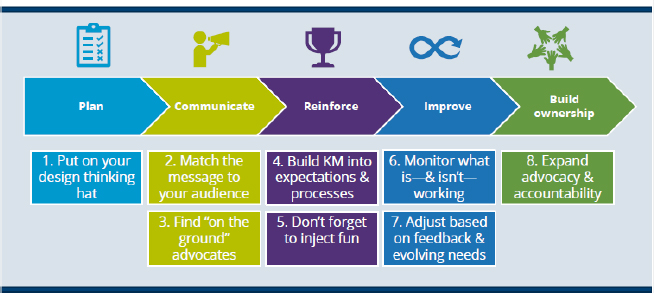
At the core of embedding KM in your organization is understanding the knowledge customer, and her APQC puts together a thoughtful continuum for life cycle knowledge management – it begins with the new hire, progresses to learner, then contributor, then expert and finally retiree. Needs and opportunities change over the course of an employee’s career, but the key point is that each of these groups needs to be catered to. APQC offers good examples from its experience with major corporations like Shell, MITRE and Prudential Financial.
A1.2.6 Key Program-Level Measures for Knowledge Management
APQC KO4025
2022
APQC is the world’s foremost authority in benchmarking, best practices, and process and performance improvement. This paper lists some of the commonly used measures that evaluate KM and inform leaders and sponsors about where and how efficiently KM resources are being deployed.
The paper talks about 20 critical measures. It is a non-exhaustive list, but is valuable as a starter to think about relevant metrics. When establishing performance metrics, there are three questions that need to be answered: Does it inform decision? Does it check progress and does it show we matter? And the metrics need to be SMART:
- Specific – answer the question Who, what, what, where, when, which, why
- Measurable – answer the question How much, How many, How will I know when it is accomplished
- Attainable – answer the question Is it do-able, is it action-oriented
- Realistic – answer the question Are you willing and able to work toward it, is it worth it
- Timely – answer the question Can it be achieved in the time frame
A1.2.7 KM Leadership &KM Champion Role; Communicating the Value of KM to Gain Stakeholder Buy-In
Presentation A105. KM Leadership & KM Champion Role delivered at KM World Conference
Washington, DC
November 6, 2021
Hasan Syed and Mary Little
One of the biggest challenges KM professionals face is communicating the value of KM to relevant stakeholders. KM often doesn’t get a seat at the table because there are common misunderstandings
about what knowledge management even is, or organizational leaders are skeptical about its benefits because they’ve been burned by previous failed efforts. Having a KM champion within an organization can help connect those in need of KM solutions with the experts, tools, processes, and know-how to improve collaboration and knowledge flow between team members and departments. This paper is a case study (Federal Home Loan Bank of Chicago) of how to communicate the value of KM to gain stakeholder buy-in.
The key to success is developing an actionable knowledge management plan in which KM solutions are aligned to departmental/organizational needs. Having a “North Star” anchoring a knowledge management plan is critical. Also critical is having buy-in from leadership. An important element is ensuring that leadership does not just talk about the values, but demonstrates them through action. This involves spending time with leadership and training them so they understand well the value proposition. Employees willingness to “buy-in” to KM is greatly enhanced when they see leadership leading by example.
Another critical point is developing KM champions or ambassadors throughout the organization. It is important to note that these individuals can be found at all levels, with the only prerequisite is a passion for KM. To be a champion requires: (1) understanding KM terms, concepts and practices; (2) communicating the value of KM efforts; and (3) serving as a liaison to the rest of the community.
A1.2.8 Knowledge Management and Knowledge Security – Building an Integrated Framework in Light of COVID-19
Knowledge Process Management 2022; 29: 121-131
Special Issue Article
Malgorzata Zieba and Ivano Bongiovanni
This paper looks at knowledge management through the lens of COVID-19. Specifically, it looks at the risks to knowledge created by the pandemic and what steps can be taken to protect knowledge from future risks, such as cybersecurity attacks or data loss/corruption stemming from man-made or natural crises. The paper creates a framework for handling organizational knowledge in critical situations around two pillars: building appropriate knowledge risk measures and controls; on the other hand, holistically tackling knowledge risks as part of knowledge management activities.
This framework is extremely valuable. Controls and measures need to be built around knowledge risks. Specifically with three targets in mind – people, process and products. For people, risk is mitigated by training and awareness. In terms of process, communication management capabilities need to be developed. For products, information security measures need to be incorporated.
But this framework is only a start. What the research is missing is the critical next steps. For example, what type of training and awareness should take place. How often should it occur, and should it be targeted at all levels of the organization or only at identified key stakeholders. Communication management capabilities need to be developed – but by whom and with what target audience and message in mind? While specificity is lacking, the paper does shed light on a critical element of knowledge management that is often overlooked – knowledge security and its increasing importance is this digital age.
A1.2.9 Knowledge Management, Decision-Making Style, and Organizational Performance
Abubakar, Elrehail, Alatailat, and Elci
Journal of Innovation & Knowledge, 2017.
https://www.sciencedirect.com/science/article/pii/S2444569X17300562?via%3Dihub
This paper presents an excellent description of knowledge management processes and enablers. A process-based description of KM provides an explicit disaggregation of the activities and steps involved with a comprehensive KM program. A process-based approach provides one perspective for developing performance metrics.
A discussion on KM enablers helps to address two of the guidebook’s primary objectives: improve the understanding of KM connections to other organizational practices, and foster internal partnerships that support knowledge retention, sharing, and development. KM enablers include human resources practices, technology, culture, and organizational structures that permit and support the KM business processes.
This paper also addresses organizational culture as a KM enabler.
A1.2.10 Knowledge Management in Practice
Intercom: The Magazine for the Society of Technical Communication
Feature
September 2020
Maureen Hammer
https://www.stc.org/intercom/2020/12/knowledge-management-in-practice/
This article looks at how to build your knowledge management capability by reviewing four common goals: mitigate the loss of knowledge, make knowledge findable, improve performance, and support innovation. The paper begins by providing commonly accepted definitions for both knowledge and knowledge management.
While the key goals of knowledge management outlined are common and generally accepted, the paper touches on interesting approaches to achieving these goals. For example, in order to mitigate the loss of knowledge, you must first fundamentally understand what knowledge you have. The author proposes conducting a knowledge audit to establish a current state baseline. Organizations too often forget to do this and do not have a benchmark to determine loss.
On the topic of supporting innovation, the author highlights the importance of coaching and mentoring to encourage employees to address challenges more creatively and innovatively. Innovation in organizations depends on empowered people (through access to knowledge) and motivated and creative ones who are constantly challenged and pushed. This results from a culture of sharing and collaborating, facilitated by coaching and mentoring. Good coaches and mentors nurture not only people but also ideas. They provide valuable feedback to build ideas, connect those ideas with similar or linked concepts and people, and encourage original thinkers when it is hard to stay motivated.
A1.2.11 Knowledge Management Strategies and Emerging Technologies—An Overview of the Underpinning Concepts
Siddhartha Paul Tiwari
International Journal of Innovative Technologies in Economy 1 (37), March 25, 2022
https://arxiv.org/abs/2205.01100
Mr. Tiwari is an employee of Google Asia Pacific in Singapore. This paper is relevant to the creation of the guidebook in two ways. First, he updates the definition of knowledge management by defining KM from a 2022 business perspective. Second, and more importantly, he looks at KM with other emerging technologies, such as cloud-based reusable services and artificial intelligence. The purpose of KM systems and tools is ultimately to assist the organization in achieving a competitive advantage. KM shouldn’t be used to control or dictate the KM pipeline. If KM is to be useful, the KM business processes need to become more effective.
He concludes by saying there is no single solution that will fit all organizations utilizing new technologies for KM, and we need to look at each case on its own merit. Increasing the accuracy of decision-making through the use of KM and emerging technologies is crucial for an organization’s success.
A1.2.12 Knowledge Management Systems and Tacit Knowledge
International Journal of Innovation and Learning, Vol. 29, No. 2, pp. 166-180.
January 2021
Srecko Natek and Dusan Lesjak
DOI: 10.1504/IJIL.2021.112994
This paper looks at tacit and explicit knowledge through the lens of knowledge management (KM) systems, which are defined as software solutions using technology to develop knowledge management applications. Specifically, it explores how knowledge management systems can support tacit knowledge collection. KM systems to support explicit knowledge are well covered in mainstream and technical publications, but tacit knowledge systems less so. Two key questions are asked and answered: How do knowledge management systems support tacit knowledge and how do you develop guidelines for knowledge workers and managers in order to distinguish support tools for knowledge management.
Tacit knowledge is embedded in individual humans, so direct use of IT to process the brain activity and signals is not yet possible for business and other purposes. However, the growth of AI and ML (machine learning) has opened up new paths of exploration. Of high value is the importance of drawing the key distinction between knowledge management systems for explicit and tacit knowledge. When thinking about building knowledge management capabilities and the use of technology, this is an important factor to keep in mind. As IT capabilities to support human cognitive activities are rising with each new computer and algorithm generation, future research will mostly be oriented toward IT abilities to support the human when mentally processing tacit knowledge, thus exploring the potential of sensors, AI and virtual reality oriented KMS.
A1.2.13 Knowledge Sharing: Insights, Applications &Best Practices
White Paper
LumApps, 2022
LumApps, a leading Employee Experience Platform provider, developed this white paper, which is largely a marketing piece and does not cover much new ground in discussing issues such as the challenges around knowledge sharing (too much time spent searching, organizational silos, information overload), types of knowledge (implicit, explicit, tacit, tribal, institutional) and common methods of knowledge sharing (file storage, chatbots, employee generated content, wikis).
However, in discussing how to create a knowledge-sharing environment, the white paper does point out that the physical environment is as important as the digital one. Office dynamics and interior design have a direct impact on knowledge sharing. For instance, open offices with loud disturbances cause more people to isolate with headphones or distance. Cubicle-heavy offices aren’t ideal either. Experts suggest an office with both options, a collaborative area and a quiet zone. Or modular furniture and desks that can be moved and adjusted based on team needs. The same holds true in a remote work environment. Although not delved into at all knowledge sharing can be promoted, although it requires deliberate strategies and tools since spontaneous, face-to-face interactions are limited. Some strategies and practices to foster knowledge sharing among remote teams include:
- Regular Check-ins and Meetings: Scheduled daily or weekly team meetings can help in sharing updates, insights, and challenges. Video conferencing tools like Zoom, Webex or Google Meet can simulate face-to-face interactions.
- Create Interest-based Channels: In communication tools like Slack or Teams, create channels dedicated to specific topics or interests where team members can share articles, courses, or relevant insights.
- Use Gamification: Introduce elements of gamification (like points, badges, or leaderboards) to motivate employees to contribute to knowledge bases or engage in training modules.
- Implement a Buddy System: Pair up newer team members with veterans so that they have a go-to person for questions, facilitating faster onboarding and knowledge transfer.
- Engage in Informal Interactions: Not all interactions need to be formal. Hosting virtual coffee breaks, happy hours, or team-building activities can foster relationships, trust, and, indirectly, knowledge sharing.
A1.2.14 Knowledge Transfer in the Context of Interorganizational Networks: Foundations and Intellectual Structures
Journal of Innovation & Knowledge 5 (2020) 130-139
Danilo Marchiori and Mário Franco
This conceptual paper is the result of research on scientific production related to knowledge transfer in the context of interorganizational networks. Combining various bibliometric techniques, such as co-occurrence analysis, bibliographic coupling and co-citation of documents and authors, 102 articles on the topic published in the main database of scientific knowledge worldwide, Web of Science, were analyzed in detail.
This paper is valuable because it discusses the critical issue of knowledge sharing within organizations and how knowledge networks, both formal and informal, internal and external, promote an organization’s absorptive capability. Furthermore, the critical distinction between knowledge sharing and knowledge transfer is drawn. Knowledge sharing refers to the transmission of knowledge from one to another, while knowledge transfer refers to the extent to which the receiver acquires the knowledge
and effectively uses it in operations. Building networks and developing processes to both share and transfer knowledge is critical to success.
A1.2.15 Linking Knowledge Management, Organizational Learning and Memory
Journal of Innovation & Knowledge 5 (2020) 140-149
Helder de Jesus Ginja Antunes and Pauko Goncalves Pihiero
This paper examines the link between knowledge management, learning and memory. This involved a systematic literature review from two databases; a total of 2511 scientific articles between 1960 and 2017 were analyzed.
This research is valuable because it highlights that an organization’s ability to use and leverage knowledge is highly dependent on its human resources, which effectively create, share, and use that knowledge. Human Resource Management (HRM) plays a key role in helping achieve the desired organizational results through its possible bearing on employee behavior and skills. Furthermore, the research emphasizes the importance of creating organizational memory, defined as the storage of knowledge for future use.
A1.2.16 Measuring Knowledge Management Performance
European Journal of Scientific Research
January 2009, pp. 242-253
Rifat O. Shannak
http://www.eurojournals.com/ejsr.htm
As Peter Drucker famously noted, “you can’t change it if you can’t measure it.” This research paper examines knowledge management performance and identifies performance indicators for measuring KM systems. It presents several case studies (Erickson, Xerox, Siemens, Schlumberger, KPMG, HP) that are valuable in thinking about KM performance and assessment indicators. Lists of performance indicators are identified are useful as a reference.
Of high value is the author’s creation of a Matrix of Performance Indicators, in which sixty categories of performance indicators are outlined. In addition, how to measure the performance is addressed. The author states that a Balanced Scorecard is the only established method identified to handle results stemming from quantitative indicators. While The Balanced Scorecard (BSC) is a widely recognized framework for performance management that provides a balanced view of organizational performance by looking at a combination of financial and non-financial measures, there are several other frameworks and methods to measure key performance indicators. Some of these alternatives include:
- Key Performance Indicator (KPI) Dashboards. These are custom sets of KPIs chosen by organizations to track the performance metrics most relevant to them. Dashboards visually represent these metrics using charts, graphs, and tables.
- Total Quality Management (TQM). An approach focused on improving the quality of all processes in an organization. Its goal is to improve the quality of products and services by continuously refining processes with feedback loops.
- Performance Prism. Focus on the performance and satisfaction of stakeholders rather than just the organization. It examines the relationship between the business and its stakeholders and then defines the performance metrics accordingly.
- Six Sigma. A methodology focused on process improvement and variation reduction through the application of statistical tools and techniques. Six Sigma uses specific metrics like defects per million opportunities (DPMO) and process sigma level.
- Value Reporting Framework. Developed by PricewaterhouseCoopers, this framework focuses on both tangible and intangible value drivers, helping companies provide a more comprehensive view of their performance.
- Objectives and Key Results (OKRs). A popular goal-setting framework that requires organizations to define and track objectives and their outcomes. Companies like Google have used OKRs to align teams and ensure everyone is working toward a common goal.
- Results-Based Management (RBM). This is a whole-of-organization approach to performance management. RBM focuses on achieving results, improving performance, and demonstrating outcomes.
- Logical Framework Approach (LFA). Commonly used in project management, especially by international development agencies. It’s a systematic planning procedure for the analysis of problems, objectives, and the selection and design of projects.
- EFQM Excellence Model. Developed by the European Foundation for Quality Management, this model provides a framework for organizational self-assessment and improvement. It evaluates organizations across a range of criteria, from leadership to results.
- Performance Measurement Matrix (PMM). It focuses on integrating various performance dimensions (efficiency, effectiveness, and relevance) into a single model. This tool can be customized based on the specific requirements of the organization.
Each of these alternatives to the Balanced Scorecard offers a unique approach to measuring and managing performance. The right choice depends on the organization’s goals, industry, operational scale, and the nature of its challenges. Often, organizations will use a combination of these frameworks or customize them to best fit their needs.
A1.2.17 Preserving Institutional Knowledge Through Knowledge Books: Models, Insights, and Impacts
Nanako Murapp
TR News 305: Applying Knowledge Management
September-October 2016, Pages pp 22-26
This article starts with the shocking statistic that every day for the next 13 years, an average of 10,000 baby boomers will retire from the workforce. Not surprisingly, the article addresses the loss of institutional knowledge and the critical need for institutions to address this issue to ensure business continuity and capture knowledge before the experts retire. The focus is on a large organization’s (Kraft) effort to capture this information and structure the knowledge into accessible knowledge books.
Kraft used the MASK process, which posits that a body of knowledge can be reflected through six fundamental points of view. These points of view, displayed as models, provide the basic structure for building the knowledge books. The six are:
- Concept model. The concept model classifies key topics or concepts known by the expert; examples from the Kraft context include types of defects, cheese types, or types of measurement. The model for each concept incorporates unique insights and learning acquired through years of experience in that area.
- Activity model. The activity model reflects the processes used within the organization, such as business, formulation, or manufacturing. The model is a cognitive reflection of how the experts apply knowledge at each step as they work through the process.
- Task model. The task model outlines the expert’s reasoning in formulating a conclusion, a recommendation, or information—for example, in data analysis, data generation, risk assessment, or troubleshooting. The model reflects iterative, sequential, parallel, or conditional steps in reaching the desired output.
- Phenomena model. Kraft used this model most often to describe scientific events—such as fat crystallization, foam generation, or taste perception—that an expert may want to manipulate. The model reflects the impacts of internal and external triggers on the events and shows how these impacts can be promoted or inhibited.
- History model. A description of the history or timeline of the knowledge can explain changes and developments—for example, understanding the history of cream cheese formulations for food service applications can help develop formulations for current and future customers.
- Evolution model. Used in combination with the history model, the evolution model explains the choices made by the experts to adapt their knowledge as the context has evolved.
One of the critical challenges of the MASK Model is that it is designed to model knowledge contained in technical documents. It is complex and requires rigorous analysis and structuring, which is time-consuming. Therefore, it has limited applicability. It also requires involvement from those with high domain expertise. There are numerous alternatives to MASK, and an organization keen on preserving tacit knowledge should spend the time to analyze the requirements of the task at hand, the type of knowledge to be presented, the desired level of granularity, and the intended application of the knowledge before choosing an approach.
A1.2.18 Tacit Knowledge
USAID Briefs
Knowledge-Driven Microenterprise Development (KDMD) project, implemented by the QED Group, LLC
September 2013
This paper looks at one of the key challenges of knowledge management, converting tacit knowledge (information which resides in peoples’ heads) to explicit knowledge (common knowledge that can be stored, replicated and documented).
This paper is valuable because it outlines key questions that would help an organization identify what is deemed critical tacit knowledge and how to go about collecting that information. It also discusses the idea of After-Action Reviews and Exit interviews as a formal way to collect tacit knowledge, as well as Wikis (an informal way). It is important to remember that tacit knowledge collection is a life cycle event
and should not be viewed as simply a discreet activity at a point in time. Finally, it raises the critical issue of creating a safe environment for speech – collecting tacit knowledge requires people to be forthcoming and express both positive and negative feelings – without fear of recrimination or judgment.
A1.2.19 Tacit Knowledge Elicitation Process for Industry 4.0
Discover Artificial Intelligence (2022) 2:6, March 10, 2022
Fenoglio, Kazim, Latapie, and Koshiyama
https://link.springer.com/article/10.1007/s44163-022-00020-w
The authors state there are no systematic procedures to incorporate tacit knowledge into Enterprise Resource Planning (ERP) systems. This paper describes a proposed solution for a tacit knowledge elicitation process for capturing operational best practices of experienced workers in industrial domains based on a mix of algorithmic techniques and a cooperative game.
The authors describe how they used domain ontologies for Industry 4.0 and reasoning techniques to discover and integrate new facts from textual sources into an Operational Knowledge Graph. They also describe a concepts formation iterative process in a role game played by human and virtual agents through socialization and externalization for knowledge graph refinement.
For the NCHRP project, we felt the automation applied by the authors to extract facts and knowledge from text-based documents was highly relevant to DOTs because much of the DOT knowledge has been codified into large PDF manuals. We also want to study their proposed knowledge elicitation process to see if their approach could help improve the effectiveness or efficiency of the approaches currently used within the DOTs.
A1.2.20 The New Knowledge Management: The Human Factor Activates the Collective Intelligence
Deloitte Insights 2021
Deloitte University EMEA
Stefan Weiss, Sandy Becker, Faris Behme
www.deloitte.com/insights
This Deloitte research paper considers three key questions: How can their employees gain knowledge more rapidly? How can they be quicker to build new capabilities for increasingly complex problems? And how can the organization’s collective intelligence be used? The paper begins by positing that for future success, organizations should shift their focus from knowledge capture to knowledge transfer and creation and champion a knowledge-sharing culture.
This last statement is critical because the function – knowledge management – implies the movement of already extent data and information. But content creation and transfer are just as essential elements of a successful KM program. The research in this paper relies heavily on Deloitte studies – the Global Human Capital Trends Report and the European Workforce Survey – but the results are broadly applicable. Organizations need to rethink the way that they share data and make knowledge available.
While the rise of AI and natural language processing will no doubt enable knowledge management to overcome some obstacles, it is by no means a complete panacea. Emerging technologies will no doubt help with the findability and usability of information (both structured and unstructured) found in various repositories. However, it is important to remember that the data is only as good as what is entered into the repository. Developing a culture of knowledge sharing and transfer is critical to developing robust data/information repositories. People have to trust the repositories, actively support their use and find ways of sharing so that the repositories can support their needs.
Finally, there is the human element. If people are not motivated to collect, share and utilize the data (for whatever reason), the system falls apart. The Deloitte research indicates that organizations are failing on the human factor. Two ways to rectify this are putting in place an effective incentivization system and building their skills to use the platform and tools (since a frequent shift in roles and positions often leaves individuals unprepared to optimize the tools and technologies available).
A1.2.21 Why KPIs Don’t Work; and How to Fix Them
Forbes
February 15, 2021
Steve Denning
In this article, Steve Denning, a noted businessman and philanthropist, critiques traditional Key Performance Indicators (KPIs) by highlighting their misalignment with unclear organizational goals, leading to bureaucratic structures and ineffective measurements. He advocates for a shift toward digital-era leadership, focusing on delivering value to external customers and using external measures for KPIs. His case consists of:
- Critique of traditional Key Performance Indicators (KPIs) in organizational management.
- Emphasis on the disparity between stated organizational goals and actual behavior.
- Challenges arising from shifting organizational goals, impacting KPI alignment.
- Bureaucratic work structures stemming from the goal of maximizing shareholder value.
- Misalignment between public-facing goals and behavior at lower organizational levels.
- Difficulty in implementing and measuring abstract concepts like trust through KPIs.
- Advocacy for a transition to digital-era leadership, centered on customer value and external measures for KPIs.
This paper is valuable because it not only criticizes traditional KPIs, but also offers a solution: a shift to customer-focused, digital-era leadership for more effective and relevant performance management strategies. This requires seven steps:
- Assessment of Organizational Goals: Evaluate the alignment between the company’s stated goals and actual behavior, addressing any discrepancies that could impact performance management accuracy.
- KPI Redesign: Collaboratively redesign KPIs to reflect the organization’s newly defined goals and values, ensuring that they are focused on delivering customer value and fostering trust and collaboration.
- Training and Communication: Provide training to employees on the importance of the updated KPIs, emphasizing how they align with the organization’s strategic direction. Communicate the rationale behind the changes to foster understanding and buy-in.
- Continuous Review and Adaptation: Establish a framework for ongoing review and adaptation of KPIs to stay aligned with the dynamic business landscape, ensuring that performance management remains relevant and effective.
- Data Analysis and Insights: Analyze the data collected through the new KPIs to gain insights into performance trends, customer satisfaction, and other relevant metrics. Use these insights to inform strategic decision-making.
- Regular Communication: Maintain open lines of communication with teams and departments regarding the progress and impact of the updated performance management approach. Encourage sharing of success stories and best practices.
- Iterative Improvement: Continuously iterate and improve the performance management approach based on feedback, changing business needs, and emerging trends in digital-era leadership and customer-centric strategies.
A1.2.22 Workplace Knowledge Flows
National Bureau of Economic Research
NBER Working Paper Series
Working Paper 26660
January 2020
http://www.nber.org/papers/w26660
This paper addresses what prevents the spread of information among coworkers and what activities/actions promote workplace knowledge flows. It determined that social concerns (e.g., reluctance to approach unfamiliar coworkers or a fear of signaling incompetence), coordination difficulties (e.g., setting up meetings), and search frictions (e.g., knowing who to ask) were the principal culprits.
What is interesting to note is that within organizations, little evidence exists on the role of management practices to spark knowledge sharing. Instead, the focus is largely on formal reporting practices or patterns of delegation. The case study chosen here, an inbound-sales call center with 730 people, has limited specific applicability to state DOTs. However, it does raise the central question of how best to spark knowledge sharing as it is a critical element of successful knowledge management programs. Here, the paper falls short.
The simple answer is to create a knowledge-sharing culture. Possible steps include:
- Encourage Open Communication. The cornerstone of a company that thrives on collaboration and exchange of ideas is unhindered communication. If you want your employees to share their insights, it’s important that you create a trusting environment.
- Create A Knowledge-Sharing Hub. Although communication is of utmost importance, sometimes it is easier said than done. The volume of task-related interactions employees have every day can make useful information very difficult and time-consuming to find. To avoid this issue, you can develop a collaborative platform designed to hold and manage any type of information your employees want to share with their colleagues.
- Reward Knowledge Sharing. Often, knowledge sharing doesn’t come naturally to everyone, which is why you need to find ways to incentivize employees. Rewarding employees for graciously sharing their expertise or relevant information they have discovered is a great way to
- get the ball rolling and slowly form a culture of sharing. There are various ways to reward those who contribute to the company’s “knowledge library.” For example, you can use gamification and award your employees with badges or points.
- Develop A Mentorship Program. Sparking knowledge sharing among your current staffers is one thing, but what about new additions? No matter how skilled a new employee is, it’s going to be hard for them to share their knowledge while trying to figure out the ins and outs of their position. Therefore, assign every new employee a mentor who can streamline the onboarding process, answer questions, and get them accustomed to tools, procedures, and workflows as fast as possible.
- Organize Activities That Promote Collaboration. Days can get hectic, and employees might fall behind in their knowledge-sharing culture habits. Support your company’s sharing culture and keep employee engagement high by organizing activities and creating time for knowledge transfer.
- Model The Behavior You Want to See. Most behaviors in a work environment start from the top. No matter how much leadership tries to encourage knowledge sharing, if they don’t practice what they preach, no real difference will be made. Therefore, if you really want to see your company excel through idea exchange, encourage leading by example. Urge all leaders to communicate with their teams, share their successes as well as their failures, and the results with ripple through the organization.


