Globalization of Materials R&D: Time for a National Strategy (2005)
Chapter: Appendix E Results of Community Poll
E
Results of the Community Poll
To understand better some of the globalization trends as perceived by members of the materials community, a Web-based poll was organized and completed over a 2-week period, November 8–23, 2004. With the assistance of materials professional societies, an e-mail announcing the poll was circulated to their members, who came from institutions in the United States and overseas (Figure E.1).
It is important to recall when considering the results of the poll that the exercise is based on a self-selected group of 719 respondents. While the range of societies assisting in this exercise was broad (the American Ceramic Society, the American Physical Society, the Federation of Materials Societies, the Materials Research Society, the Society for Biomaterials, the Society of Manufacturing Engineers, and The Minerals, Metals and Materials Society), it cannot be claimed with certainty that the self-selected group is representative of the MSE community, which is increasingly interdisciplinary. The poll should, therefore, be considered to reflect in a general way the global nature of MSE activity. A more reliable poll would require the application of statistical criteria to achieve a response group that is statistically relevant. Figures E.2 through E.7 analyze the results of the questionnaire.
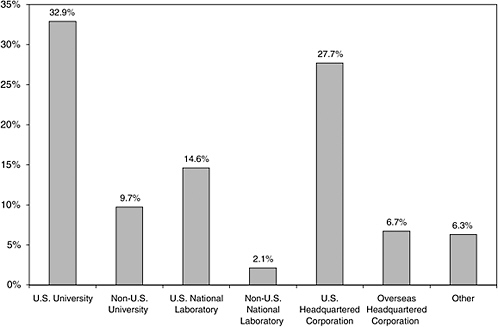
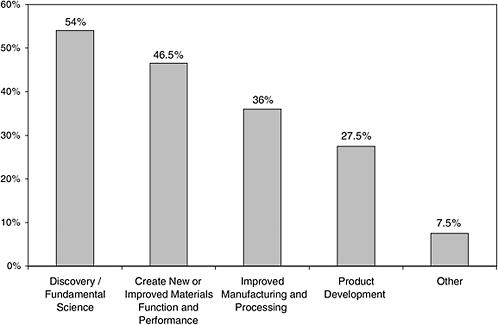
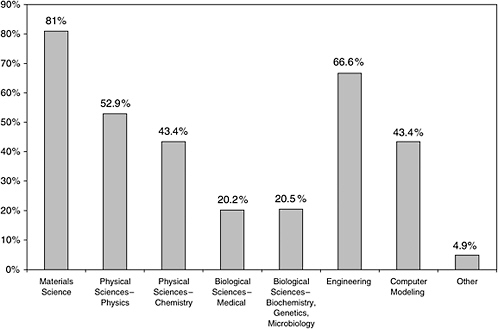
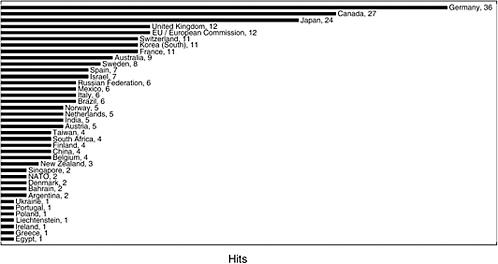
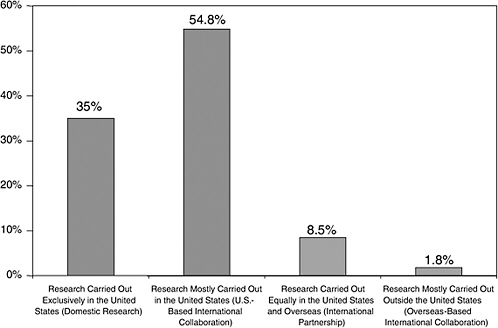
FIGURE E.5 Nature of the collaboration. Thirty-five percent of U.S.-based respondents say their research is carried out exclusively in the United States. Most U.S.-based researchers (65 percent) are involved with international collaborations, with the majority of work being carried out in the United States and in academic-academic collaborations. There is significant internationalization of U.S. corporate research, with nearly 36 percent of the research being U.S. corporate research with a foreign partner of one type or another. (Note: these data are indicative only and not based on a statistically relevant sampling.)
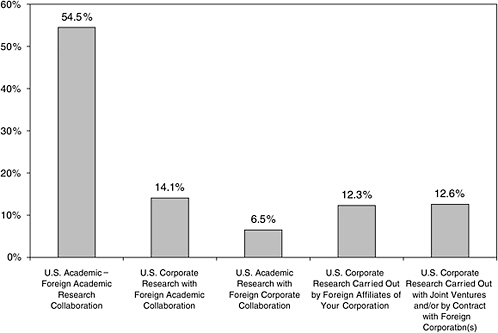
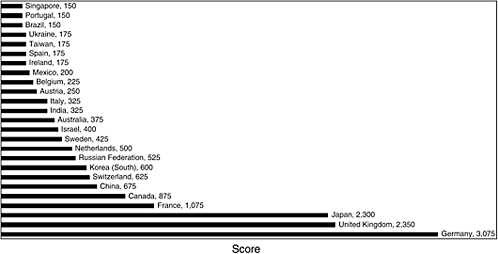
FIGURE E.7 Top three international partners. The committee weighted the first choice by an arbitrary score factor of 100, the second choice by 50, and the third choice by 25. The rankings above are based on the total weighted scores. International partnerships dominated by activity with Germany, Japan, and the United Kingdom. (Note: the rankings are indicative only and not based on a statistically relevant sampling.)


