An Assessment of Selected Research Programs and Goals of the Engineering Laboratory at the National Institute of Standards and Technology: Fiscal Year 2024 (2025)
Chapter: 2 Overview of the Engineering Laboratory
2
Overview of the Engineering Laboratory
The Engineering Laboratory (EL) is one of the National Institute of Standards and Technology’s (NIST’s) six major laboratories and one of NIST’s fundamental metrology laboratories.1 It is located at NIST’s Gaithersburg, Maryland, campus. EL describes its mission as promoting “U.S. innovation and industrial competitiveness by advancing measurement science, standards, and technology for engineered systems in ways that enhance economic security and improve quality of life” (NIST 2021).
EL is organized into five divisions. These are the Building Energy and Environment Division (BEED), Fire Research Division, Intelligent Systems Division (ISD), Materials and Structural Systems, and Systems Integration Division (SID).
BEED focuses its work on buildings that are cost-effective, energy-efficient, integrated into the grid, healthy and comfortable for their occupants, and have reduced impacts on the environment. It accomplishes its work by advancing measurement science and developing standards.
The Fire Research Division quantifies the behavior of fire by developing, verifying, and using measurements and predictive methods. The goal is to find means to reduce the impact of fire on people, property, and the environment. This work integrates laboratory measurements, verified methods of prediction, and large-scale fire experiments to demonstrate the use and value of the research products.
ISD works to speed the development, adoption, and integration of leading-edge intelligent technologies to advance U.S. manufacturing performance. It does this by developing, advancing, and deploying measurement science and standards.
The Materials and Structural Systems Division develops and promotes science-based tools—such as measurements, data, models, protocols, and reference standards—and their use to enhance the global competitiveness of U.S. industry and the safety, security, and sustainability of the nation’s buildings and physical infrastructure.
SID promotes U.S. innovation and industrial competitiveness in areas of critical national priority by anticipating and meeting the measurement science and standards needs for integrating engineering information systems used in manufacturing, construction, and cyber-physical systems in ways that enhance economic prosperity and improve the quality of life (NIST 2021).
As described in Chapter 1, EL’s work is organized into goals and related programs rather than by division. For this report, EL requested that the panel assess the following goals and their associated programs:
- Advanced Manufacturing Goal (work performed by ISD and SID)
- Advanced Manufacturing Data Infrastructure and Analytics Program
- Measurement Science for Additive Manufacturing Program
- Measurement Science for Manufacturing Robotics Program
- Energy-Efficient, High-Performance Buildings Goal (work performed by BEED)
- Embedded Intelligence in Buildings program
- Net-Zero Energy, High-Performance Buildings program (NIST 2021)
___________________
1 The other five laboratories are the Center for Neutron Research, Communications Technology Laboratory, Information Technology Laboratory, Material Measurement Laboratory, and Physical Measurement Laboratory.
AWARDS, HONORS, AND PUBLICATIONS
Most of the information in this report is organized by goal and program. This is because that is how EL structured most of the information it provided to the panel. However, two categories of information provided—awards and honors, and publications—were presented broken out by division, in addition to the information provided at the meeting in the subpanel breakout meetings. The division-level information is presented here in the EL overview to give the reader the division-specific picture as well as the information contained in Chapters 4–6.
Awards and Honors
The information on staff awards and honors covers fiscal years (FYs) 2020 (for BEED only), 2021, 2022, 2023, and through April for FY 2024.2
In this assessment period, ISD staff won 17 awards and honors in FY 2021, 8 in FY 2022, 11 in FY 2023, and 4 to date in FY 2024 (some were shared by multiple people; the panel does not have a complete head count). These include awards and honors such as the following:
- Department of Commerce (DOC) Gold Medal
- NIST Bronze Medal
- NIST Slichter Award
- 2022 Acta Materialia Outstanding Reviewer Award
- American Society of Mechanical Engineers (ASME) Best Organizer of Symposium and Sessions Award
- 2020 ASME Outstanding Paper Award
- ASTM International3 Award of Merit, with the accompanying title of ASTM fellow
- ASTM International Additive Manufacturing Young Professional Award
- Washington Academy of Sciences 2022, 2023, and 2024 Leadership Award in Manufacturing Engineering
In this assessment period, SID staff won 10 awards and honors in FY 2021, 3 in FY 2022, 4 in FY 2023, and 4 to date in FY 2024 (some were shared by multiple people; the panel does not have a complete head count). These include awards and honors such as the following:
- NIST Bronze Medal
- AgGateway President’s Award
- 2023 ASME Computers and Information in Engineering Distinguished Service Award
- ASTM Additive Manufacturing Award of Excellence in Research
- A staff member elected president of the North American Manufacturing Research Institute in FY 2023
- A staff member elected fellow of the American Association for the Advancement of Science in FY 2023
- A staff member elected fellow of the ASME in FY 2024
Altogether, staff members supporting the Advanced Manufacturing goal won 27 awards and honors in FY 2021, 11 in FY 2022, 15 in FY 2023, and 8 to date in FY 2024.
___________________
2 For the U.S. federal government, the fiscal year runs from October through September. Thus, FY 2021 began in October 2020 and ended in September 2021.
3 ASTM International was formerly known as the American Society for Testing and Materials.
In this assessment period, BEED staff won 2 awards and honors in FY 2020, 5 in FY 2021, 11 in FY 2022, 9 in FY 2023, and 2 to date in FY 2024 (some were shared by multiple people; the panel does not have a complete head count). These include awards and honors such as the following:
- ASHRAE4 Distinguished Service Award
- ASTM International Award of Merit
- NIST Edward Bennet Rosa Award
- NIST Eugene Casson Crittenden Award
- NIST Judson C. French Award
- NIST Jacob Rabinow Applied Research Award
- DOC Gold Medal
- Drexel University Excellence in Co-Operative Education Award
- International Building Performance Simulation Association-USA Emerging Contributor Award
- Johns Hopkins University Outstanding Instructor Award
- Purdue University Dave Tree Distinguished Service Award
- Washington Academy of Sciences 2024 Distinguished Career Award in Engineering Sciences
Publications
The three divisions supporting the research goals and programs assessed in this report have an extensive publication history, summarized as follows: ISD in Table 2-1 and Figure 2-1, SID in Table 2-2 and Figure 2-2, and BEED in Table 2-3 and Figure 2-3. The drop in ISD and SID publications from FY 2020 is the result of the COVID-19 pandemic affecting research and the resulting publications.
TABLE 2-1 Intelligent Systems Division Publications by Fiscal Year (FY) and by Type, 2014–2024
| FY | Book | Conference | Journals | NIST Publications | Other | Total for FY |
|---|---|---|---|---|---|---|
| 2014 | 0 | 16 | 16 | 11 | 1 | 44 |
| 2015 | 3 | 18 | 10 | 4 | 7 | 42 |
| 2016 | 1 | 39 | 23 | 14 | 6 | 83 |
| 2017 | 3 | 26 | 21 | 13 | 6 | 69 |
| 2018 | 2 | 35 | 25 | 14 | 2 | 78 |
| 2019 | 3 | 27 | 28 | 16 | 4 | 78 |
| 2020 | 4 | 17 | 33 | 19 | 5 | 78 |
| 2021 | 0 | 22 | 31 | 9 | 4 | 66 |
| 2022 | 2 | 17 | 13 | 13 | 2 | 47 |
| 2023 | 2 | 26 | 18 | 4 | 1 | 41 |
| 2024 | 0 | 7 | 8 | 4 | 1 | 20 |
NOTE: FY 2024 numbers are through April 26, 2024.
SOURCE: Data courtesy of NIST Engineering Laboratory.
___________________
4 ASHRAE, formerly known as the American Society of Heating, Refrigerating, and Air-Conditioning Engineers.
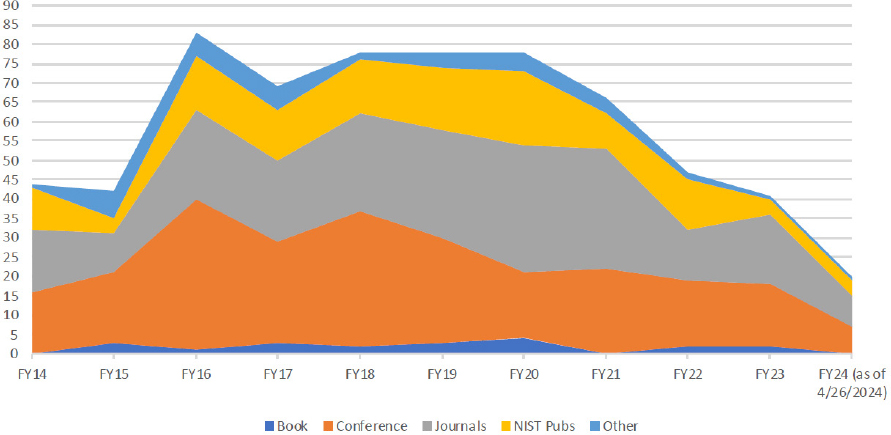
NOTE: NIST, National Institute of Standards and Technology.
SOURCE: Courtesy of NIST Engineering Laboratory.
TABLE 2-2 Systems Integration Division Publications by Fiscal Year (FY) and by Type, 2014–2024
| FY | Book | Conference | Journals | NIST Publications | Other | Total for FY |
|---|---|---|---|---|---|---|
| 2014 | 1 | 15 | 15 | 9 | 3 | 43 |
| 2015 | 2 | 25 | 17 | 8 | 3 | 54 |
| 2016 | 3 | 32 | 20 | 10 | 5 | 70 |
| 2017 | 5 | 30 | 15 | 7 | 3 | 60 |
| 2018 | 1 | 33 | 20 | 7 | 1 | 62 |
| 2019 | 0 | 33 | 17 | 9 | 2 | 61 |
| 2020 | 1 | 29 | 35 | 11 | 4 | 80 |
| 2021 | 0 | 23 | 21 | 6 | 1 | 51 |
| 2022 | 2 | 20 | 10 | 4 | 0 | 36 |
| 2023 | 3 | 29 | 9 | 3 | 3 | 47 |
| 2024 | 0 | 9 | 5 | 0 | 0 | 14 |
NOTE: FY 2024 numbers are through April 26, 2024.
SOURCE: Data courtesy of NIST Engineering Laboratory.
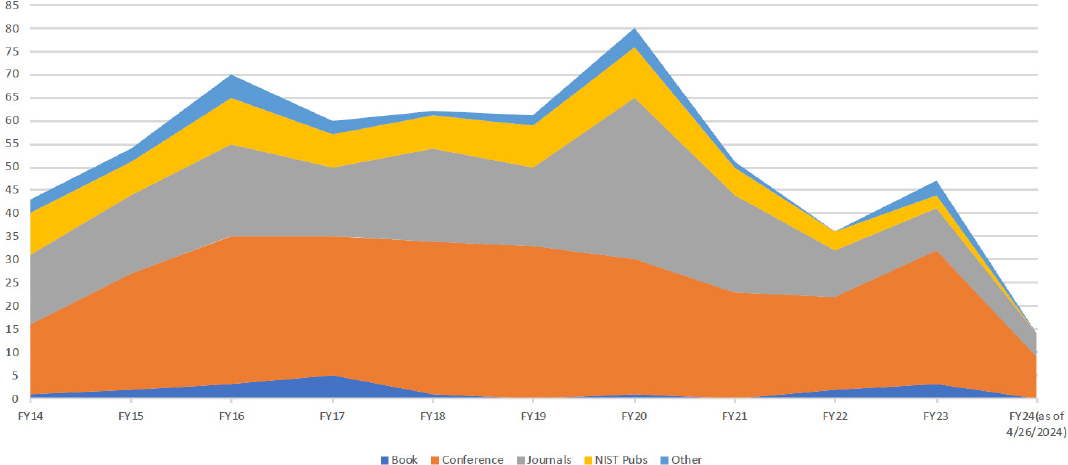
NOTE: NIST, National Institute of Standards and Technology.
SOURCE: Courtesy of NIST Engineering Laboratory.
TABLE 2-3 Building Energy and Environmental Division Publications by Fiscal Year (FY) and by Type, 2014–2024
| FY | Book | Conference | Journals | NIST Publications | Other | Total for FY |
|---|---|---|---|---|---|---|
| 2014 | 3 | 27 | 28 | 18 | 1 | 77 |
| 2015 | 0 | 20 | 26 | 11 | 3 | 60 |
| 2016 | 0 | 15 | 24 | 14 | 7 | 60 |
| 2017 | 1 | 20 | 20 | 11 | 4 | 56 |
| 2018 | 1 | 22 | 19 | 19 | 3 | 64 |
| 2019 | 0 | 10 | 17 | 15 | 4 | 46 |
| 2020 | 0 | 15 | 18 | 13 | 4 | 50 |
| 2021 | 3 | 14 | 22 | 14 | 2 | 55 |
| 2022 | 1 | 17 | 27 | 14 | 10 | 69 |
| 2023 | 2 | 10 | 20 | 12 | 2 | 46 |
| 2024 | 0 | 5 | 8 | 2 | 1 | 16 |
NOTE: FY 2024 numbers are through April 26, 2024.
SOURCE: Data courtesy of NIST Engineering Laboratory.
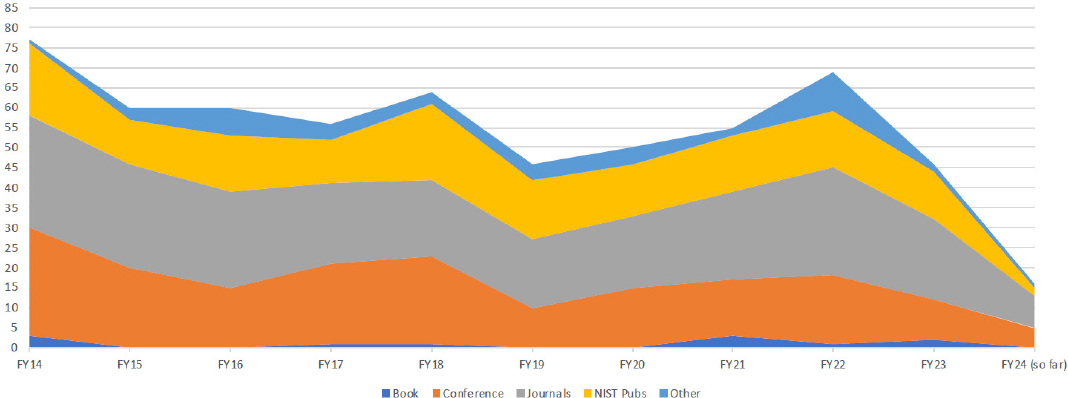
NOTE: NIST, National Institute of Standards and Technology.
SOURCE: Courtesy of NIST Engineering Laboratory.
SOURCE: Courtesy of NIST Engineering Laboratory.
BUDGET
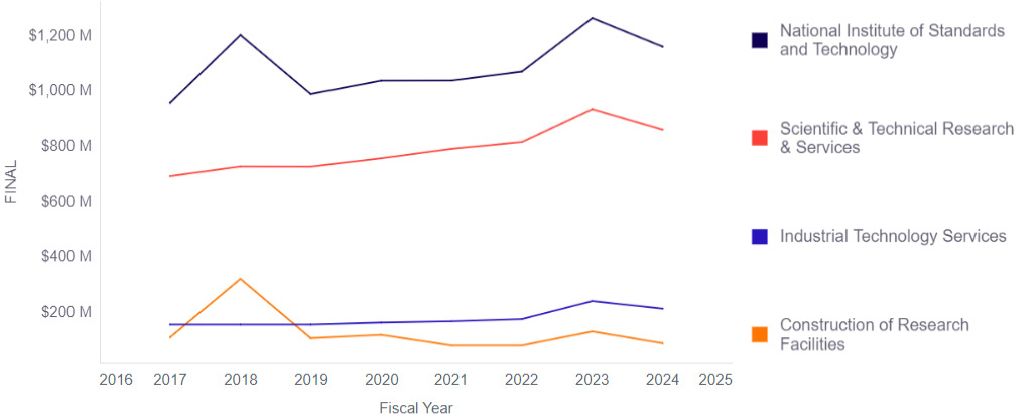
NIST’s budget trends between FY 2016 and FY 2024 are shown in Figure 2-4. The budget information provided to the panel is not corrected for inflation. Three major categories of funding are shown. The Scientific and Technical Research Services (STRS) budget funds NIST’s scientific and technical work. The Industrial Technology Services budget mainly funds the Manufacturing Extension
Partnership5 and the Office of Advanced Manufacturing (Manufacturing USA).6 The Construction of Research Facilities (CRF) budget is a separate appropriation for facility and utility major maintenance, renovation, and construction. CRF funds support the buildings, utilities, and other infrastructure for NIST; major facility funding is not included in STRS funding.
As can be seen, the total funding for NIST has seen modest growth with spikes in FY 2018 and FY 2023. The spike in FY 2018 was a one-time infusion of infrastructure funding. The spike in STRS funding in FY 2023 reflects a one-time funding bump. For the EL work assessed in this report, STRS funding included $1 million for high-performance premise plumbing and $2 million for a robotics training center (some of this was directed for use at an academic institution). EL also received $3 million for forward-looking building standards, $750,000 for pyrrhotite testing and mitigation, and $1.5 million for wildfires and wildland–urban interface fires research—all under EL’s Disaster-Resilient Buildings, Infrastructure, and Communities Goal, which is not assessed in this report. While NIST’s total funding has seen modest overall growth since FY 2016, the CRF budget has decreased over the same time. NIST is facing, increasingly, several facilities and infrastructure challenges that are, in some cases, endangering its ability to accomplish its core mission. The CRF funding is even more dire when one factors in inflation. See Box 1-1, which treats the facilities and budget issues in more depth, including budget recommendations from the 2023 National Academies of Sciences, Engineering, and Medicine report Technical Assessment of the Capital Facility Needs of the National Institute of Standards and Technology (NASEM 2023).
EL’s budget trends broken out by goal are shown in Figure 2-5.
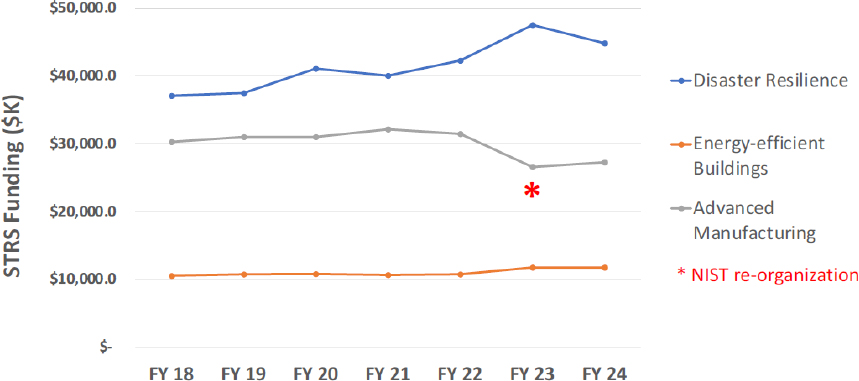
NOTES: FY, fiscal year; STRS, Scientific and Technical Research Services. The Disaster-Resilient Buildings, Infrastructure, and Communities Goal is not assessed in this report.
SOURCE: Courtesy of NIST Engineering Laboratory.
___________________
5 For more information, see NIST, “Manufacturing Extension Partnership,” https://www.nist.gov/mep, accessed December 11, 2024.
6 For more information, see NIST, “Office of Advanced Manufacturing,” https://www.nist.gov/oam, and the Manufacturing USA website at https://www.manufacturingusa.com (both accessed December 11, 2024).
Again, these figures are not adjusted for inflation. As can be seen, the Disaster Resilience Goal budget has increased over time from FY 2018 through FY 2024. The Advanced Manufacturing Goal budget grew modestly from FY 2018 through FY 2022 and then decreased. This decrease resulted from a NIST reorganization in FY 2023 that saw three groups move from EL to the Communications Technology Laboratory. The Energy-Efficient, High-Performance Buildings Goal budget has been mostly steady over the same time (and, so, has lost ground to inflation). Budget observations appear in Chapters 3–6, where the panel has assessments to offer.
No attempts were made to correct the budget numbers for inflation, but when inflation is factored in, slowly growing budgets could easily be flat, and flat budgets are likely declining in real terms.
REFERENCES
NASEM (National Academies of Sciences, Engineering, and Medicine). 2023. Technical Assessment of the Capital Facility Needs of the National Institute of Standards and Technology. The National Academies Press. https://doi.org/10.17226/26684.
NIST (National Institute of Standards and Technology). 2021. “About EL.” Updated June 2. https://www.nist.gov/el/about-el.


