Asset Management Practices for Mechanically Stabilized Earth Walls (2025)
Chapter: 1 Introduction
CHAPTER 1
Introduction
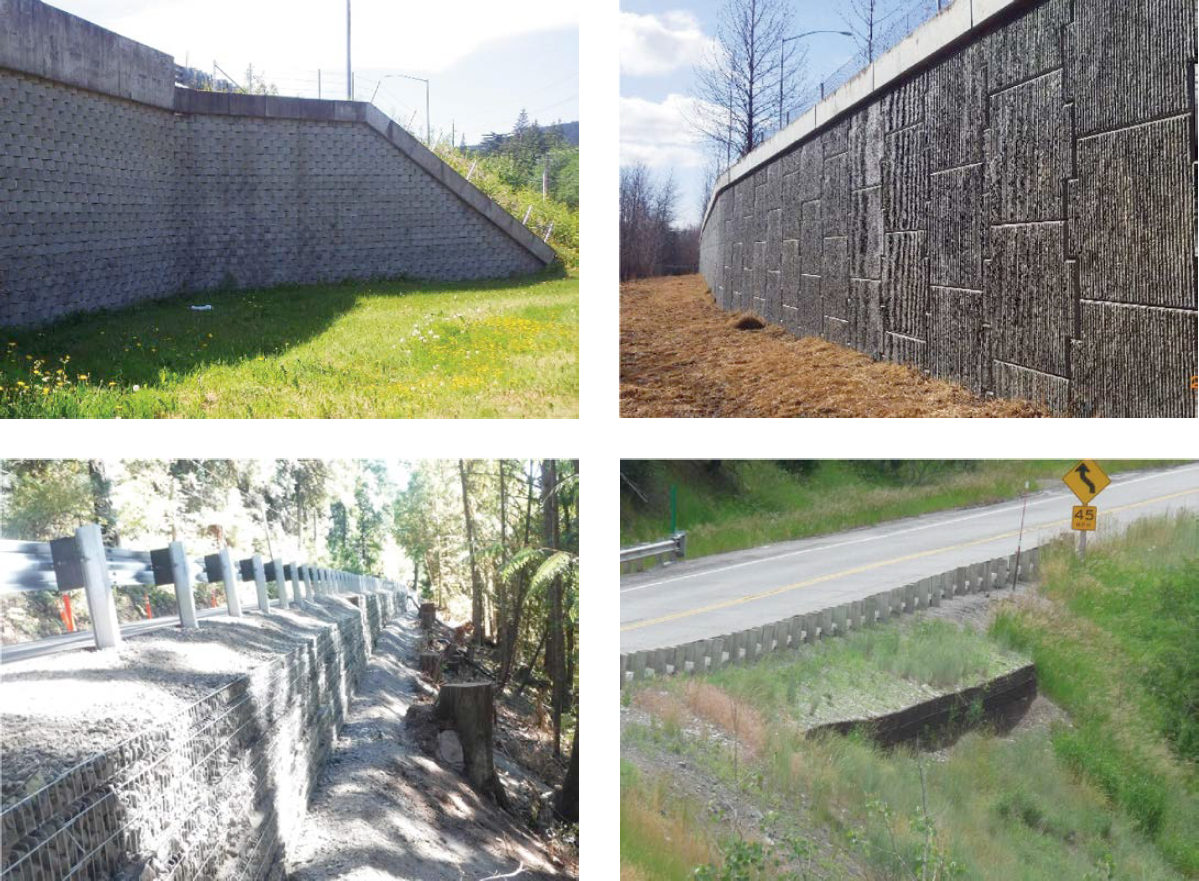
Since their initial development in the 1970s, MSE walls have become a standard component of the retaining wall portfolio for most state DOTs (Figure 1). MSE walls are composite structures that rely on using either metallic or geosynthetic reinforcement (strips or grids) to reinforce soil backfill. The reinforcement is connected to the wall’s facing elements to prevent the loss of backfill material. Typically, these types of walls are both cost- and time-efficient to construct. Following construction, MSE walls can tolerate horizontal or vertical deformation, such as the settlement of foundation soils, while maintaining support for the roadway.
The relatively recent development of this wall type means that most MSE walls managed by DOTs have not yet met their design life. In addition, design guidance, reinforcement materials, and construction protocols for MSE walls have all been updated over the last 50 years. This includes a transition from Allowable Stress Design (ASD) to Load and Resistance Factor Design (LRFD) and the introduction and increased use of geosynthetic reinforcement. Although resilient to foundation deformation, MSE walls have also failed after construction due to corrosion or deterioration of reinforcement components, loss of backfill from scour or gaps between facing panels, and deformation because of internal or external drainage issues.
Currently, MSE walls are not required to be included in a DOT’s transportation asset management (TAM) plan. However, FHWA and multiple DOTs have developed retaining wall inventories over the past 20 years and assessed the condition of these walls. Application of asset management principles to MSE walls can help agencies better understand long-term maintenance and rehabilitation costs, deterioration rates, and anticipated future condition of DOT MSE assets based on current budget expenditures. Over time, asset management can help DOTs anticipate future rehabilitation and budget needs and improve overall reliability of the transportation network.
Synthesis Objective
The objective of this synthesis is to document DOT practices on asset management of MSE wall assets, including inventory and assessment, design guidance, repair and rehabilitation methods, development of metrics for MSE wall condition and risk, and determination of life-cycle costs.
This synthesis gathered information on the following topics:
- Administrative practices for MSE asset management;
- Approaches to inventorying and categorizing MSE walls based on their designs;
- Definition of distress, malfunction, or service failure for MSE walls;
- Methods of collecting and processing field inspection data to support asset management;
- Approaches to rating MSE walls (risk, consequence, condition, etc.);
- Tools, technologies, and techniques used to monitor and evaluate MSE wall performance for existing, new, and under-construction structures;
- Performance indicators used in MSE wall inspections to assess wall condition;
- Methods for proactive mitigation or repair of distressed walls;
- Management methods for MSE walls at the end of their project lifespans;
- Methods of factoring long-term deterioration of MSE walls into the design and construction of existing and new MSE wall assets; and
- Methods of keeping records of as-built conditions (design, shop drawings, and contract plans) for use in asset management.
Terminology
Terms related to embankments and their maintenance or repair may carry multiple meanings and definitions may vary throughout the United States. Key terms used in this synthesis are defined below in alphabetical order:
Asset Management: “A strategic and systematic process of operating, maintaining, upgrading and expanding physical assets effectively throughout their life cycle. It focuses on business and engineering practices for resource allocation and utilization, with the objective of better decision-making based on quality information and well-defined objectives.” (AASHTO 2019)
Life-Cycle Cost: The estimated total spent on an asset over its useful lifespan, including such aspects as construction, maintenance, rehabilitation, and replacement/disposal.
Mechanically Stabilized Earth (MSE) Wall: A wall system that depends on metal or geosynthetic reinforcements in the backfill soil to stabilize it and has an inclined face steeper than 70 degrees.
Performance Issues: For this synthesis, performance issues are related to how distress of an existing MSE wall is affecting or could affect roadway function. This distress can appear as settlement or cracking of the roadway above the wall, or deformation that could retrogress to the roadway. These issues can lead to reduced highway function and safety hazards for road users.
Proactive Measure: Effort taken to reduce the likelihood of service failure of a retaining wall before such a failure occurs. This effort can consist of recurring maintenance or as a one-time rehabilitation or replacement project.
Service Failure: The point at which an asset’s performance no longer meets the expectations of the agency or transportation network user.
Report Organization
This synthesis of the current state of asset management of MSE wall assets by transportation agencies is organized as follows:
- Literature Review. This review summarizes available practices and recommendations for managing MSE wall assets in use at the DOT level. Identification, assessment, and commonly applied mitigation and repair practices are discussed, along with common issues and concerns regarding MSE asset management.
- State of the Practice. The results of the 35-question survey sent to asset management personnel in various DOTs are presented in this section. The survey questions are presented in Appendix A while a compilation of individual responses is provided in Appendix B. Appendix C of the contractor’s final report (DOT-Provided Information in the Survey) is not included herein but is available on the National Academies Press website (nap.nationalacademies.org) by searching for “NCHRP Synthesis Report 644: Asset Management Practices for Mechanically Stabilized Earth Walls.”
- Case Examples. Based on their responses to the State of the Practice Survey, five DOTs were interviewed to provide detailed responses. Representatives from Colorado, Connecticut, Indiana, Louisiana, and Minnesota gave additional insight regarding their DOTs’ asset management practices for MSE retaining walls, including design, inventory, and repair and rehabilitation practices.
- Summary of Findings. Appendix D of the contractor’s final report (Case Example Information) is not included herein but is available on the National Academies Press website (nap.nationalacademies.org) by searching for “NCHRP Synthesis Report 644: Asset Management Practices for Mechanically Stabilized Earth Walls.” This section summarizes the information obtained via the literature review, survey, and case examples to provide an overview of current design practices for asset management of MSE walls. The summary identifies knowledge gaps and suggests research for DOTs seeking to adopt more formal asset management practices in their own jurisdictions or incorporate additional goals capturing inspection, assessment, and mitigation.


