Charting a Course to Advance U.S. Innovation
Feature Story
By Molly Galvin
Last update October 19, 2022
By Molly Galvin
When the National Academies convened a symposium in February 2020 to imagine the next 75 years in science, few would have predicted that in a matter of weeks, the COVID-19 pandemic would disrupt the entire research enterprise in almost every way. The event, which marked the 75th anniversary of “Science: The Endless Frontier” — former presidential science adviser Vannevar Bush’s landmark report and a blueprint for American science after World War II — kicked off a national dialogue on how to ensure that U.S. advances in science, engineering, and medicine would continue to fuel U.S. prosperity and national security in the coming decades.
Fast-forward to September 2022. “[The COVID-19 pandemic] is not dissimilar to the global crisis that Bush encountered at the end of World War II — when everything had changed, and everything was upended,” said National Academy of Sciences President Marcia McNutt, in opening the Endless Frontiers Symposium 2022: Research and Higher Education Institutions for the Next 75 years. “We have the same call as Bush did at that time … to reassess, redefine, and rebuild our scientific institutions, so that 75 years from now, we can say, ‘We are still strong, and we are still serving the public good.’”
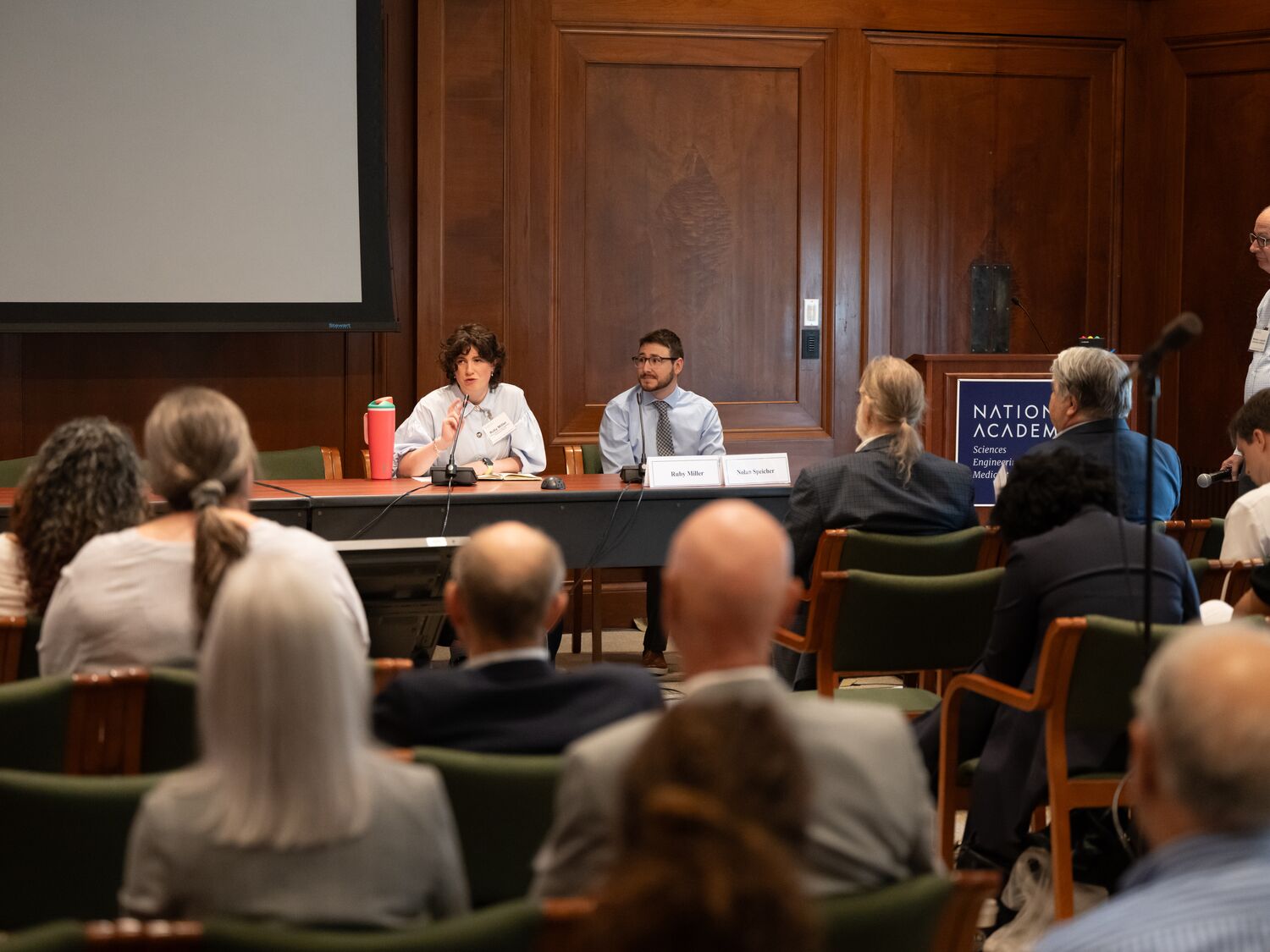
Hosted by the National Academies of Sciences, Engineering, and Medicine, in collaboration with the Kavli and Alfred P. Sloan foundations and Issues in Science and Technology, the follow-on event brought together leaders of U.S. academic and government research institutions, policymakers, the private sector, and philanthropy to continue exploring the future of science and discuss the transformations that will be needed to address complex and global challenges such as pandemics.
‘The Most Significant Threats Are Actually From Within’
The event began with an exploration of how science is structured. “I fear that the science enterprise that Vannevar Bush envisioned — and that has brought our nation wealth, power, influence, beyond at least his wildest dreams — is in danger,” said Frances Arnold, co-chair of the President’s Council of Advisors on Science and Technology and Linus Pauling Professor of Chemical Engineering, Bioengineering, and Biochemistry at the California Institute of Technology. Although many are concerned about global S&T competition with other nations, she noted, “The most significant threats actually are from within — threats that are intrinsic to the rapidly changing nature of science and technology, and from the inability of some of our institutions to adapt.”
The recent passage of key pieces of legislation — particularly the bipartisan CHIPS and Science Act and infrastructure bills, along with the Inflation Reduction Act — was noted by several speakers, including in in prerecorded remarks from U.S. Sen. Todd Young, U.S. Rep. Eddie Bernice Johnson, chair, House Committee on Science, Space, and Technology, and U.S. Rep. Frank Lucas, ranking member, of the committee.
At a session moderated by Richard Meserve, president emeritus of the Carnegie Institution for Science and senior counsel at Covington & Burling LLP, he noted on the CHIPS and Science Act in particular, “If funds on this scale are appropriated, it clearly will significantly expand [The National Science Foundation’s] focus well beyond the pursuit of fundamental science.” Focused research at the U.S. Department of Energy and the National Institute of Standards and Technology is also included.
At the same time, funding from private philanthropy has grown significantly, particularly in the past few years. “Philanthropy as an institutional component of the ecosystem for science offers advantages of independence, a spirit of collaboration, an appetite for risk, speed and agility, spectrum of interest, and a willingness to invest in people, including those from underrepresented groups at critical career stages,” said Harvey Fineberg, president of the Gordon and Betty Moore Foundation. He noted, however, “The independence of philanthropies also means that there is not a unifying coherence in the assignment or allocation of the philanthropic resources. And, I think it’s one of the institutional challenges we have … mapping the mechanisms, the systems, the capacities to make allocation decisions across these broad areas.”
Another session examined the translational gaps between research and innovation — which has become so difficult that many refer to this stage of science as “crossing the valley of death.” Geraldine Richmond, undersecretary for science and innovation at DOE, described the agency’s efforts to help reduce risks for private companies that are developing new products based on their research, for example by sponsoring demonstration projects. “Companies can come in and learn from [them], and then go on to deployment.” In addition, government loans are available that can help companies take on riskier projects.
Demis Hassabis, co-founder and CEO of DeepMind, a company specializing in artificial intelligence R&D, noted that researchers receive little training in management and leadership. “And I think that is what government and funding bodies could do — build programs or add to [existing] programs to actually give young leading scientists … experiences in entrepreneurial areas, management … how to articulate a vision, these kinds of things that I think are essential for to get across the ‘valley of death.’”
Producing the Right Technical Workforce
A major theme throughout the symposium was the importance of developing the next generation of scientists, engineers, and health professionals. “Human capital is absolutely key,” said Angela Belcher, James Mason Crafts Professor and head of the department of biological engineering at the Massachusetts Institute of Technology. However, to truly expand and diversify the STEM workforce, efforts should begin in grades K-12. “I think we need to do it at the kindergarten level and the first grade level, engaging those children in having the opportunity to play such an important part of the future.”
Several speakers noted the importance of inspiring young people to work on the big challenges of our time such as climate change. “We can align our teaching of science to be able to convey to students the possibility … to contribute to solving the big [existential problems],” added Keith Yamamoto, vice chancellor for science policy and strategy, director of precision medicine, and professor of cellular and molecular pharmacology, University of California, San Francisco. “In learning about the approaches of science, [we should encourage] being excited about the potential for you to make a discovery that would have great impact.”
Participants stressed the importance of mentoring and connecting STEM students at all levels with real-world experiences. “I think that we can reimagine a program like [the Small Business Innovation Program],” said Kafui Dzirasa, K. Ranga Rama Krishnan Endowed Associate Professor at Duke University and investigator at the Howard Hughes Medical Institute. “If you can design for us in a space that is adjacent to our academic [work], we’re actually going to [give you a job] in creating that into a small business.”
The research enterprise should be more open to the contributions of young scientists. “We appreciate that a 20-year-old computer scientist can come out of college and change the entire world,” said Dzirasa. “What does it look like when that happens in the biological research space? I think this world where we are open to the possibility that the solutions to cancer, heart disease, COVID, mental illness … lies with brains of our talented youth, who would transform our systems down the line.”
Realigning career incentives is critical so that the best science is rewarded, Yamamoto added. “We need to center, motivate, and reward … capacity for bold discovery and application, to underscore both [scientific] rigor and excitement and its impact on societal challenges.”
In the last session of the symposium, participants discussed how science could be better leveraged to benefit everyone. “We marvel at applications of science and technology research just about every day,” said Alondra Nelson, deputy assistant to the president and deputy director for science and society at the White House Office of Science and Technology Policy. “But when we scan the headlines more closely, we can’t help but acknowledge how often we have to retrofit solutions because people have gotten left behind in the pursuit of innovation,” she said.
“It is our collective responsibility as academics, as innovators, policymakers, and more to be deliberate about closing those gaps presented by the climate crisis, health disparities, environmental and justices, and more by increasing equity of resources, equity of opportunities, equity of outcomes, and indeed … equity in the experience of discovery for all of America.”
Related Resources
Archived video recording of symposium
The Next 75 Years of Science Policy: A special section from Issues in Science and Technology