As Demand for Electricity Grows, Energy Parks Are Being Explored as Potential Solutions
Feature Story
By Molly Galvin
Last update February 26, 2026
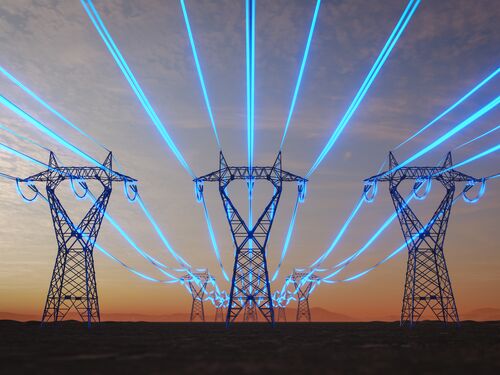
After decades of relative stability in U.S. electricity use, demand is skyrocketing with the proliferation of large artificial intelligence (AI) data centers, along with an increase in electrification for transportation and industrial manufacturing. One potential solution to help the aging electric grid meet demand quickly and more affordably is to create energy parks — regional hubs that integrate multiple nearby energy sources and storage capabilities and locate them with large-scale users such as data centers or manufacturers, interconnecting at a single point on the electric grid.
“We’re adding the equivalent of many large cities’ worth of load to the grid in AI hyperscaler data centers every year for the rest of the decade, and that’s posing lots of challenges,” said Andrew Levitt, a senior consultant with the Brattle Group who participated in a recent National Academies webinar that explored the potential benefits and barriers to creating energy parks. “Wholesale prices for electricity are going up faster than inflation at a time when affordability is front of mind. New [energy] supply is needed quickly, because demand is coming in so quickly.”
An energy park configuration would alleviate strain that a large-scale user would put on the electric grid, said Eric Gimon, technical expert, research scholar, and policy adviser with Energy Innovation. It would also enable faster connection to new energy generation, including renewable energy such as solar and wind power. “A renewable [energy] generation portfolio is not always creating electricity exactly where and when you want it,” said Gimon. The energy park concept allows for a more balanced distribution of energy production and use. “That [distribution] helps with affordability, because you’re using your infrastructure for the highest and best use. At the same time, you generate resilience in these islands, where the storage and extra energy is, where you don’t have to depend on the grid as much.”
Energy parks could also offer faster solutions for bringing electricity generation onto the system because they do not require building out transmission lines and adding to the grid infrastructure — since the power being generated is going directly to the co-located users, said Levitt. “You are significantly reducing the need for new transmission, and that accelerates the connection process, and it reduces costs. Consumers are winning with improved reliability and lower prices, and the energy park customer is winning by connecting their demand centers more quickly.”
For an energy park to be an attractive investment, energy supply and large-scale demand — such as a data center or manufacturing hub — should be co-located and operate in a stable yet flexible manner, said Valerie Karplus, associate director of the Wilton E. Scott Institute for Energy Innovation and professor of engineering and public policy at Carnegie Mellon University. Taking full advantage of existing assets will be essential. “If we look at just our industrial and data center geography in the U.S., you can really see how there are some natural places where supply and demand may match up,” she said — for example, in the mid-Atlantic region, in Texas and the southern U.S., and in California.
Regional energy parks also offer the potential to bring other economic and social benefits to states and localities that host them, said Gimon. “By capturing some of that energy locally, you’re able to bring local benefits to people — that flow not just to the property owner of a given energy project, but to the whole community by attracting new industry and providing new jobs in that region.” He likened a major user in an energy park to an anchor tenant in a shopping mall. “There are opportunities for other stores to open up nearby that could take advantage.”
However, there is no guarantee that, for example, an energy park with a data center as its anchor will create more jobs, cautioned Karplus. “There are certainly construction jobs up front, but running a data center doesn’t require that many jobs.” For local communities where the parks are sited, she said, industries, utilities, and policymakers should draw on lessons learned from efforts such as the U.S. Department of Energy’s Clean Hydrogen Hubs program — which pledged investment in hydrogen hubs across the U.S. to create a national network of hydrogen producers, consumers, and connective infrastructure — to ensure that economic benefits reach local citizens.
Before energy parks are implemented on a wide scale, several institutional and regulatory barriers must be overcome, the participants agreed. “The generator interconnection process is a very prescribed process,” said Levitt. “Energy parks don’t have much impact on [the] transmission system, but you actually have to integrate these two processes, under different authorities with different timelines and cost allocations. That poses a really big challenge to grid operators, to utilities, to regulators.” As a result, energy park co-location configurations must go through an arduous regulatory process to interconnect.
In addition, realizing the benefits of energy parks depends on compliance with existing environmental laws and regulations, said Karplus. “It is absolutely essential that state and federal authorities are prepared to continue oversight established by the Clean Air Act and other legislation. To me, [environmental sustainability] does not represent a major cost barrier for [parks].” Instead, it is an opportunity to innovate in ways that allow parks to take advantage of already low-cost clean and renewable energy sources, she said.
The U.S. should look to the example of China and the way they have mandated clean energy for data centers and large industrial parks, which exist today on a much larger scale, added Karplus. “The risks are too great” to local air quality and human health, to the climate, and to long-term economic competitiveness if we do not require that parks be powered by efficient, clean, and resilient sources of energy, she added.
For energy parks to be deployed in the U.S., the nation should decide whether it is prepared to provide the policy and regulatory certainty “that an energy park investment would need to play out,” said Karplus. “These are long-term investments.”
A full recording of the webinar, the first of a two-part series on energy parks hosted by the National Academies’ Forum on Energy Systems Transformation and Decarbonization, is available. The second webinar, to take place March 10 at 11 a.m. ET, will explore challenges in the siting, permitting, operation, and governance of energy parks.