What Shapes What We Believe: Andy Luttrell on Opinion Science
Feature Story
By Olivia Hamilton
Last update August 21, 2025
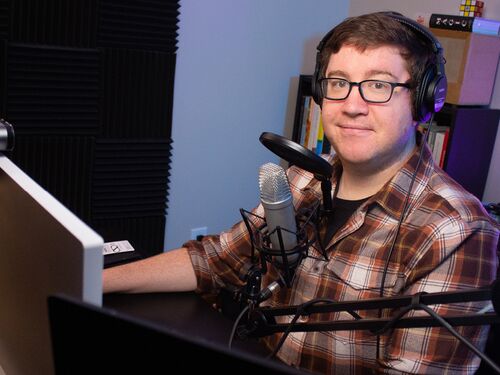
Social psychologist and podcaster Andy Luttrell, a 2024 winner of the Eric and Wendy Schmidt Awards for Excellence in Science Communications

Andy Luttrell is a social psychologist studying people’s opinions and how they change. When he’s not conducting new research or teaching in the classroom, he hosts and produces the podcast Opinion Science, which features interviews with social scientists and professional communicators about their work and what it means.
With over 100 episodes, including a special series on science communication and behavioral economics, the podcast reaches a global audience to share important social science research on topics ranging from polarization to prejudice to persuasion.
Luttrell has also produced popular YouTube videos that break down concepts in social psychology, and he is an associate editor for the Society for Personality and Social Psychology’s blog Character & Context, helping academics communicate their work to the public.
In 2024, he was a winner of the National Academies’ Eric and Wendy Schmidt Awards for Excellence in Science Communications.
We asked Luttrell about social science, what sparked his efforts to communicate about it, and lessons from his podcast, Opinion Science.
What first sparked your interest in learning about how people form and change their opinions?
Luttrell: My first passion as a kid was doing magic tricks, and I came to learn that the tricks I loved for entertainment were also being used to peddle phony claims. It made me interested in the psychology of where our beliefs come from.
Tell us something you wish everyone knew about opinion formation or attitude change and why it’s important.
Luttrell: What convinced you may not be what convinces someone else. When they’re trying to be persuasive, people will often make the kinds of arguments that resonate with them, but people differ in their values, goals, and prior beliefs. Take the time to learn more about your audience first.
What motivated you to start the Opinion Science podcast, and how has it evolved since the first episode?
Luttrell: I’ve been a podcast fan for 20 years. So, it was an obvious choice as an outlet for my interest in science communication. The show has maintained a similar focus and style since the beginning, although the audio quality has improved! I’ve also enjoyed collaborating with other creators.
Your SciComm Summer series of the podcast features some fellow award winners and other prominent science communicators and looks at how they got into science communication, their approach to conveying research findings in an engaging way, and what others can do to be more effective communicators. Across your interviews, what recurring themes or strategies stood out among effective science communicators?
Luttrell: I’ve noticed that a lot of great science communicators have other skills or passions they can’t shake, and it enhances their work. When people lean into their unique strengths — whether that’s a love of drawing, making movies with friends, or writing short stories — it sets their science communication work apart.
Can you tell us more about your letterpress printing studio? How did you get into letterpress, and what do you enjoy most about it?
Luttrell: I took a letterpress workshop and loved the chance to be visually creative in such a tactile way. I got a small press (that’s expanded to more) and built a collection of equipment over time. I’ve also grown to appreciate that letterpress connects me to a centuries-old technology for mass communication. My interest in communication struck again!
Where have you seen social science show up in your life recently?
Luttrell: In such fractured times, I’m always seeing the science of opinion in action! In general, though, one finding that sticks with me is that people often think things will be worse than they turn out to be. It might seem overwhelming to talk with someone you disagree with, but it’s too easy to forget that other people want to get along, too.