Acute Exposure Guideline Levels for Selected Airborne Chemicals: Volume 17 (2014)
Chapter: 7 Trimethylacetyl Chloride Acute Exposure Guideline Levels
7
Trimethylacetyl Chloride1
Acute Exposure Guideline Levels
PREFACE
Under the authority of the Federal Advisory Committee Act (FACA) P.L. 92-463 of 1972, the National Advisory Committee for Acute Exposure Guideline Levels for Hazardous Substances (NAC/AEGL Committee) has been established to identify, review, and interpret relevant toxicologic and other scientific data and develop AEGLs for high-priority, acutely toxic chemicals.
AEGLs represent threshold exposure limits for the general public and are applicable to emergency exposure periods ranging from 10 minutes (min) to 8 hours (h). Three levels—AEGL-1, AEGL-2, and AEGL-3—are developed for each of five exposure periods (10 and 30 min and 1, 4, and 8 h) and are distinguished by varying degrees of severity of toxic effects. The three AEGLs are defined as follows:
AEGL-1 is the airborne concentration (expressed as parts per million or milligrams per cubic meter [ppm or mg/m3]) of a substance above which it is predicted that the general population, including susceptible individuals, could experience notable discomfort, irritation, or certain asymptomatic, nonsensory
_____________________________
1This document was prepared by the AEGL Development Team composed of Cheryl Bast (Oak Ridge National Laboratory), Heather Carlson-Lynch (SRC, Inc.), Lisa Ingerman (SRC, Inc.), Chemical Manager George Rusch (National Advisory Committee [NAC] on Acute Exposure Guideline Levels for Hazardous Substances), and Ernest V. Falke (U.S. Environmental Protection Agency). The NAC reviewed and revised the document and AEGLs as deemed necessary. Both the document and the AEGL values were then reviewed by the National Research Council (NRC) Committee on Acute Exposure Guideline Levels. The NRC committee has concluded that the AEGLs developed in this document are scientifically valid conclusions based on the data reviewed by the NRC and are consistent with the NRC guidelines reports (NRC 1993, 2001).
effects. However, the effects are not disabling and are transient and reversible upon cessation of exposure.
AEGL-2 is the airborne concentration (expressed as ppm or mg/m3) of a substance above which it is predicted that the general population, including susceptible individuals, could experience irreversible or other serious, long-lasting adverse health effects or an impaired ability to escape.
AEGL-3 is the airborne concentration (expressed as ppm or mg/m3) of a substance above which it is predicted that the general population, including susceptible individuals, could experience life-threatening health effects or death.
Airborne concentrations below the AEGL-1 represent exposure concentrations that could produce mild and progressively increasing but transient and nondisabling odor, taste, and sensory irritation or certain asymptomatic, nonsensory effects. With increasing airborne concentrations above each AEGL, there is a progressive increase in the likelihood of occurrence and the severity of effects described for each corresponding AEGL. Although the AEGL values represent threshold concentrations for the general public, including susceptible subpopulations, such as infants, children, the elderly, persons with asthma, and those with other illnesses, it is recognized that individuals, subject to idiosyncratic responses, could experience the effects described at concentrations below the corresponding AEGL.
SUMMARY
Trimethylacetyl chloride is a clear colorless liquid. It is corrosive and is a moisture-sensitive lachrymator. Trimethylacetyl chloride is used as an intermediate in the preparation of trialkylacetic acids, which are used in polymers, pharmaceuticals, agricultural chemicals, cosmetics, and metal-working fluids.
Data were insufficient to derive AEGL-1 values for trimethylacetyl chloride. Therefore, AEGL-1 values are not recommended.
In the absence of appropriate chemical-specific data on trimethylacetyl chloride, the AEGL-3 values were divided by 3 to derive AEGL-2 values. That approach is justified by the steep concentration-response curve. In a mouse irritation study, a 30-min exposure to trimethylacetyl chloride at 115 ppm resulted in 25% mortality, and a 1.6 increase in the concentration resulted in a 3-fold increase in mortality (75% mortality at 180 ppm) (Hardy and Kieran, 1992). Rats or mice exposed to trimethylacetyl chloride at 78, 115, 180, and 249 ppm for 30 min to 6 h experienced 0, 25, 75, and 100% mortality, respectively (Eastman Kodak 1992; Hardy and Kieran 1992).
An exposure to trimethylacetyl chloride causing no death in rats (78 ppm for 6 h) (Eastman Kodak 1992) was used as the point of departure for the AEGL-3 values. Rough coat, labored breathing, and body weight loss were noted at that concentration, and 100% mortality was noted at the next highest concentration tested (249 ppm for 3.5 h). Values were scaled across time using the equation Cn × t = k, with default values of n = 3 when extrapolating to shorter
durations and n = 1 when extrapolating to longer durations to derive values protective of human health (NRC 2001). The 30-min value was adopted as the 10-min value because of the added uncertainty of extrapolating a 6-h point of departure to a 10-min AEGL-3 value. Two uncertainty factors of 10 were applied; one factor to account for interspecies differences and one factor to account for the absence of information available to describe interindividual variability. Although clinical signs and pathology from the available data set suggest contact irritation and corrosion (labored breathing, gasping, and corneal opacity in rats, and decreased respiratory rate, lung necrosis, and increased lung weight in mice) and that type of portal-of-entry effect is not expected to vary greatly between species, the available data are not sufficient to conclusively describe the mechanism of toxicity. In addition, RD50 (concentration that reduces the respiratory rate by 50%) data suggest that the mouse is more sensitive than the rat (estimated 30-min LC50 value of 101-182 ppm from the mouse RD50 study [Hardy and Kieran 1992]). A modifying factor of 3 was applied to account for the sparse database. Therefore, the total adjustment is 300. The AEGL values for trimethylacetyl chloride are presented in Table 7-1.
1. INTRODUCTION
Trimethylacetyl chloride is a clear colorless liquid (Hardy and Kieran 1992). It is corrosive and is a moisture-sensitive lachrymator (ChemFinder 2007). Trimethylacetyl chloride is used as an intermediate in the preparation of trialkylacetic acids, which are used in polymers, pharmaceuticals, agricultural chemicals, cosmetics, and metal-working fluids. The chemical and physical properties of trimethylacetyl chloride are presented in Table 7-2.
TABLE 7-2 Chemical and Physical Properties of Trimethylacetyl Chloride
| Parameter | Value | References |
| Synonyms | Pivaloyl chloride; 2,2-dimethyl-propanoyl chloride | ChemFinder 2007 |
| CAS registry no. | 3282-30-2 | ChemFinder 2007 |
| Chemical formula | C5H9ClO | ChemFinder 2007 |
| Molecular weight | 120.58 | ChemFinder 2007 |
| Physical state | Clear, colorless liquid | Hardy and Kieran 1992 |
| Melting point | -56°C | ChemFinder 2007 |
| Boiling point | 105°C | ChemFinder 2007 |
| Flash point | 19°C | ChemFinder 2007 |
| Density | 0.979 | ChemFinder 2007 |
| Solubility in water | Moisture sensitive | ChemFinder 2007 |
| Vapor pressure | 27 mm Hg at 20°C | ChemFinder 2007 |
| Conversion factors | 1 ppm = 4.9 mg/m3 1 mg/m3 = 0.20 ppm |
2. HUMAN TOXICITY DATA
No human toxicity data or odor threshold data on trimethylacetyl chloride were found.
3. ANIMAL TOXICITY DATA
3.1. Acute Toxicity
Groups of three rats were exposed to trimethylacetyl chloride at 78 ppm for 6 h or at 249 ppm for 3.5 h, followed by a 14-day observation period (Eastman Kodak 1992). No further experimental details were provided. Rats in the 249-ppm group exhibited dark eyes, labored breathing, loss of coordination, gasping, and jumping during exposure. All three were prostrate 3 h into exposure and dead within 3.5 h of exposure. Corneal opacity was found at death. No mortality was observed at 78 ppm. However, clinical signs including rough coat and labored breathing, and an average weight loss of 8 g in the 14-day follow-up period were observed.
In an RD50 irritancy test, groups of four male albino mice were exposed to trimethylacetyl chloride at 0, 115, 180, or 634 ppm (analytic concentrations) for 30 min, followed by a 24-h observation period (Hardy and Kieran 1992). Flow rate was 13 L/min, and the test atmosphere was analyzed by gas chromatography. The study followed GLP guidelines. An RD50 of 290 ppm was calculated. Mortality occurred at all test concentrations; one of four rats died at 115 ppm, three of four at 180 ppm, and three of four at 634 ppm. Absolute lung weight and relative lung-to-body-weight ratios were increased in a concentration-dependent manner in animals surviving 24 h. Microscopic lung pathology in animals surviving 24 h included vascular congestion, alveolar edema, single cell necrosis of bronchiolar epithelium, alveolar duct necrosis, debris in the alveolar ducts, and generalized necrosis of bronchiolar epithelium. Because the RD50 was also associated with lethality in the test population, it was not used for the development of AEGL values. An LC50 value of 101-182 ppm for 30 min was estimated by the study authors. (The benchmark dose modeling failed because the lower limit included zero.)
3.2. Developmental and Reproductive Toxicity
No data on developmental or reproductive toxicity on trimethylacetyl chloride were found.
3.3. Genotoxicity
No genotoxicity data on trimethylacetyl chloride were found.
3.4. Chronic Toxicity and Carcinogenicity
No data on chronic toxicity or carcinogenicity of trimethylacetyl chloride were found.
3.5. Summary
Animal toxicity data on trimethylacetyl chloride are sparse. Clinical signs and lung pathology in rats and mice are consistent with severe irritation and corrosion. No data on developmental or reproductive toxicity, genotoxicity, or chronic toxicity and carcinogenicity were available.
4. SPECIAL CONSIDERATIONS
4.1. Metabolism and Disposition
No information concerning the metabolism and disposition of trimethylacetyl chloride was found.
4.2. Mechanism of Toxicity
Acute inhalation exposure to trimethylacetyl chloride appears to cause irritation (Hardy and Kieran 1992; Eastman Kodak 1992).
4.3. Structure-Activity Relationships
No information was available on structure-activity relationships relevant to trimethylacetyl chloride.
4.4. Other Relevant Information
4.4.1. Species Variability
No information was available on species variability in response to trimethylacetyl chloride.
4.4.2. Susceptible Populations
No information was available on populations sensitive to trimethylacetyl chloride toxicity. However, clinical signs are consistent with irritation. Therefore, effects are not expected to vary widely among individuals.
4.4.3. Time Scaling
The concentration-time relationship for many irritant and systemically acting vapors and gases may be described by the equation Cn × t = k, where the exponent n ranges from 0.8 to 3.5 (ten Berge et al. 1986). Data on trimethylacetyl chloride were inadequate to derive an empirical value for n, so default values of n = 3 when extrapolating to shorter durations and n = 1 when extrapolating to longer durations were used (NRC 2001).
5. DATA ANALYSIS FOR AEGL-1
5.1. Human Data Relevant to AEGL-1
No human data relevant to development of AEGL-1 values for trimethylacetyl chloride were available.
5.2. Animal Data Relevant to AEGL-1
No animal data relevant to development of AEGL-1 values for trimethylacetyl chloride were available.
5.3. Derivation of AEGL-1 Values
No human or animal data were available for derivation of AEGL-1 values for trimethylacetyl chloride. Therefore, AEGL-1 values are not recommended.
6. DATA ANALYSIS FOR AEGL-2
6.1. Human Data Relevant to AEGL-2
No human data relevant to development of AEGL-2 values for trimethylacetyl chloride were available.
6.2. Animal Data Relevant to AEGL-2
No mortality was observed in rats exposed to trimethylacetyl chloride at 78 ppm for 6 h. Rough coat, labored breathing, and body weight loss were noted at that concentration (Eastman Kodak 1992). Mortality (100%) was noted at the next highest concentration tested (249 ppm for 3.5 h). No lower concentrations were tested.
6.3. Derivation of AEGL-2 Values
No suitable data that provided a point of departure for deriving AEGL-2 values for trimethylacetyl chloride were available. In the absence of appropriate chemical-specific data, the AEGL-3 values were divided by 3 to estimate AEGL-2 values for trimethylacetyl chloride. That approach is justified by the steep concentration-response curve. In the mouse irritation study, a 30-min exposure to trimethylacetyl chloride at 115 ppm resulted in 25% mortality, and 1.6 increase in the concentration resulted in a 3-fold increase in mortality (75% mortality at 180 ppm) (Hardy and Kieran 1992). Rats or mice exposed to trimethylacetyl chloride at 78, 115, 180, and 249 ppm for 30 min to 6 h experienced 0, 25, 75, and 100% mortality, respectively (Eastman Kodak 1992; Hardy and Kieran 1992). AEGL-2 values for trimethylacetyl chloride are presented in Table 7-3.
7. DATA ANALYSIS FOR AEGL-3
7.1. Human Data Relevant to AEGL-3
No human data relevant to development of AEGL-3 values for trimethylacetyl chloride were available.
7.2. Animal Data Relevant to AEGL-3
No mortality was observed in rats exposed to trimethylacetyl chloride at 78 ppm for 6 h. Rough coat, labored breathing, and body weight loss were noted at that concentration (Eastman Kodak 1992). Mortality (100%) was noted at the next highest concentration tested (249 ppm for 3.5 h). No other concentrations were tested.
7.3. Derivation of AEGL-3 Values
The concentration of trimethylacetyl chloride causing no death in rats (78 ppm for 6 h) (Eastman Kodak 1992) was used as the point of departure for the AEGL-3 values. Rough coat, labored breathing, and body weight loss were found at that concentration, and mortality (100%) was noted at the next highest concentration tested (249 ppm for 3.5 h). Two uncertainty factors of 10 were applied; one factor to account for interspecies differences and one factor due to the absence of information available to describe interindividual variability. Although clinical signs and pathology from the sparse data set suggest contact irritation and corrosion (labored breathing, gasping, and corneal opacity in rats, and decreased respiratory rate, lung necrosis, and increased lung weight in mice) and that type of portal-of-entry effect is not expected to vary greatly between species, the available data are not sufficient to conclusively describe the mechanism of toxicity. In addition, the RD50 data on trimethylacetyl chloride suggest that the mouse is more sensitive than the rat (estimated 30-min LC50 value of 101-
182 ppm from the mouse RD50 study [Hardy and Kieran 1992]). A modifying factor of 3 was applied to account for the sparse database. Therefore, the total adjustment was 300.
Time scaling was performed using the equation Cn × t = k, with default values of n = 3 when extrapolating to shorter durations and n = 1 when extrapolating to longer durations to derive values protective of human health (NRC 2001). The 30-min value for trimethylacetyl chloride was adopted as the 10-min value because of the added uncertainty of extrapolating a 6-h point of departure to a 10-min AEGL-3 value.
The AEGL-3 values for trimethylacetyl chloride are presented in Table 7-4, and the calculations are presented in Appendix A.
8. SUMMARY OF AEGLS
8.1. AEGL Values and Toxicity End Points
AEGL values for trimethylacetyl chloride are presented in Table 7-5. AEGL-1 values are not recommended due to insufficient data. AEGL-2 values were derived by taking one-third of the AEGL-3 values, and AEGL-3 values were based on an exposure causing no death in rats exposed to trimethylacetyl chloride for 6 h.
TABLE 7-3 AEGL-2 Values for Trimethylacetyl Chloride
| 10 min | 30 min | 1 h | 4 h | 8 h |
| 0.20 ppm (0.98 mg/m3) |
0.20 ppm (0.98 mg/m3) |
0.16 ppm (0.78 mg/m3) |
0.10 ppm (0.49 mg/m3) |
0.07 ppm (0.34 mg/m3) |
TABLE 7-4 AEGL-3 Values for Trimethylacetyl Chloride
| 10 min | 30 min | 1 h | 4 h | 8 h |
| 0.60 ppm (2.9 mg/m3) |
0.60 ppm (2.9 mg/m3) |
0.47 ppm (2.3 mg/m3) |
0.30 ppm (1.5 mg/m3) |
0.20 ppm (0.98 mg/m3) |
TABLE 7-5 AEGL Values for Trimethylacetyl Chloride
| Classification | 10 min | 30 min | 1 h | 4 h | 8 h |
| AEGL-1 (nondisabling) |
NRa | NRa | NRa | NRa | NRa |
| AEGL-2 (disabling) |
0.20 ppm (0.98 mg/m3) |
0.20 ppm (0.98 mg/m3) |
0.16 ppm (0.78 mg/m3) |
0.10 ppm (0.49 mg/m3) |
0.07 ppm (0.34 mg/m3) |
| AEGL-3 (lethal) |
0.60 ppm (2.9 mg/m3) |
0.60 ppm (2.9 mg/m3) |
0.47 ppm (2.3 mg/m3) |
0.30 ppm (1.5 mg/m3) |
0.20 ppm (0.98 mg/m3) |
aNot recommended. Absence of an AEGL-1 value does not imply that exposures below the AEGL-2 value are without adverse effect.
8.2. Other Standards and Guidelines
There are no other exposure standards or guidelines for trimethylacetyl chloride.
8.3. Data Adequacy and Research Needs
There are no human data on trimethylacetyl chloride, and there are no animal data relevant to AEGL-1 or AEGL-2 end points. Available toxicity data on trimethylacetyl chloride are limited to unpublished lethality data in groups of three rats exposed to two concentrations for 3.5 or 6 h (Eastman Kodak 1992) and a 30-min RD50 test in mice, in which mortality occurred at all exposure concentrations (Hardy and Kieran 1992). There are no data on nonlethal toxicity in animals, metabolism, or disposition of trimethylacetyl chloride in humans or animals, or on the mechanism of action of the chemical. Additional research on workplace exposures (if applicable), acute inhalation toxicity in animals, toxicokinetics, and mechanism of action would enhance confidence in the AEGL values.
9. REFERENCES
ChemFinder. 2007. Pivaloyl Chloride (CAS Reg. No. 3282-30-2) [online]. Available: http://www.cambridgesoft.com/ [accessed July 2007].
Eastman Kodak Co. 1992. Initial Submission: Acute Inhalation Toxicity Study with Pivaloyl Chloride in Rats. Submitted to EPA, Washington, DC, by Eastman Kodak Co, Rochester, NY with Cover Letter Dated August 10, 1992. EPA Document No. 88-920005125. Microfiche No. OTS0544099.
Hardy, C.J., and P.C. Kieran. 1992. Assessment of the Respiratory Tract Irritancy of Trimethyl Acetyl Chloride in the Mouse. Huntingdon Research Centre, Ltd., Huntingdon, Cambridgeshire, England. SLL 206/911521. July 16, 1992. Submitted to EPA, Washington, DC, by Shell Oil Company, Houston, TX with Cover Letter Dated November 12, 1992. EPA Document No. 88-930000053. Microfiche No. OTS0538315.
NRC (National Research Council). 1993. Guidelines for Developing Community Emergency Exposure Levels for Hazardous Substances. Washington, DC: National Academy Press.
NRC (National Research Council). 2001. Standing Operating Procedures for Acute Exposure Guideline Levels for Selected Airborne Chemicals. Washington, DC: The National Academies Press
ten Berge, W.F., A. Zwart, and L.M. Appelman. 1986. Concentration-time mortality response relationship of irritant and systemically acting vapours and gases. J. Hazard. Mater. 13(3):301-309.
APPENDIX A
DERIVATION OF AEGL VALUES FOR TRIMETHYLACETYL CHLORIDE
Derivation of AEGL-1 Values
Data are insufficient to derive AEGL-1 values for trimethylacetyl chloride. Therefore, AEGL-1 values are not recommended.
Derivation of AEGL-2 Values
Data are insufficient to derive AEGL-2 values for trimethylacetyl chloride. Therefore, AEGL-2 values were derived by taking one-third of the respective AEGL-3 values. That approach is justified by the steep concentration-response for the chemical.
| 10-min AEGL-2: | 0.60 ppm ÷ 3 = 0.20 ppm |
| 30-min AEGL-2: | 0.60 ppm ÷ 3 = 0.20 ppm |
| 1-h AEGL-2: | 0.47 ppm ÷ 3 = 0.16 ppm |
| 4-h AEGL-2: | 0.30 ppm ÷ 3 = 0.10 ppm |
| 8-h AEGL-2: | 0.20 ppm ÷ 3 = 0.07 ppm |
| Derivation of AEGL-3 Values | |
| Key study: | Eastman Kodak Co. 1992. Initial Submission: Acute Inhalation Toxicity Study with Pivaloyl Chloride in Rats. Submitted to EPA, Washington, DC, by Eastman Kodak Co, Rochester, NY with Cover Letter Dated August 10, 1992. EPA Document No. 88-920005125. Microfiche No. OTS0544099. |
| Toxicity end point: | No death in rats (78 ppm for 6 h) |
| Time scaling: | Cn × t = k (ten Berge et al. 1986), with default values of n = 3 when extrapolating to shorter durations and n = 1 when extrapolating to longer durations to derive values protective of human health (NRC 2001). (78 ppm)3 × 6 h = 2,847,312 ppm-h (78 ppm)1 × 6 h = 468 ppm-h |
| Uncertainty factors: | 10 for interspecies differences 10 for intraspecies variability |
| Modifying factor: | 3 for sparse database |
| 10-min AEGL-3: | 0.60 ppm (set equal to the 30-min AEGL-3 value) |
| 30-min AEGL-3: | C3 × 0.5 h = 2,847,312 ppm-h C3 = 5,694,624 ppm C = 179 ppm 179 ppm ÷ 300 = 0.60 ppm |
| 1-h AEGL-3: | C3 × 1 h = 2,847,312 ppm-h C3 = 2,847,312 ppm C = 142 ppm 142 ppm ÷ 300 = 0.47 ppm |
| 4-h AEGL-3: | C3 × 4 h = 2,847,312 ppm-h C3 = 718,578 ppm C = 89.3 ppm 89.3 ppm ÷ 300 = 0.30 ppm |
| 8-h AEGL-3: | C1 × 8 h = 468 ppm-h C = 58.5 ppm 58.5 ppm ÷ 300 = 0.20 ppm |
APPENDIX B
ACUTE EXPOSURE GUIDELINE LEVELS FOR TRIMETHYLACETYL CHLORIDE
Derivation Summary
AEGL-1 VALUES
Data were insufficient to derive AEGL-1 values for trimethylacetyl chloride. Therefore, AEGL-1 values are not recommended for trimethylacetyl chloride.
AEGL-2 VALUES
| 10 min | 30 min | 1 h | 4 h | 8 h |
| 0.20 ppm (0.98 mg/m3) |
0.20 ppm (0.98 mg/m3) |
0.16 ppm (0.78 mg/m3) |
0.10 ppm (0.49 mg/m3) |
0.07 ppm (0.34 mg/m3) |
| Data adequacy: Data on trimethylacetyl chloride are sparse. AEGL-2 values were derived by dividing the AEGL-3 values for trimethylacetyl chloride by 3. That approach is supported by the steep concentration-response curve (0% mortality in rats exposed at 78 ppm for 6 h and 100% mortality at 249 ppm for 3.5 h (Eastman Kodak 1992); 25% mortality in mice exposed at 115 ppm and 75% mortality at 180 ppm for 30 min (Hardy and Kieran 1992). | ||||
AEGL-3 VALUES
| 10 min | 30 min | 1 h | 4 h | 8 h |
| 0.60 ppm (2.9 mg/m3) |
0.60 ppm (2.9 mg/m3) |
0.47 ppm (2.3 mg/m3) |
0.30 ppm (1.5 mg/m3) |
0.20 ppm (0.98 mg/m3) |
| Key reference: Eastman Kodak Co. 1992. Initial Submission: Acute Inhalation Toxicity Study with Pivaloyl Chloride in Rats. Submitted to EPA, Washington, DC, by Eastman Kodak Co, Rochester, NY with Cover Letter Dated August 10, 1992. EPA Document No. 88-920005125. Microfiche No. OTS0544099. | ||||
| Test species/Strain/Number: Rat; strain and sex not specified; 3/group | ||||
| Exposure route/Concentrations/Durations: Inhalation; various concentrations for up to 6 h | ||||
| Effects: 249 ppm for 3.5 h: 3/3 rats died; clinical signs included labored breathing, loss of coordination, gasping, and corneal opacity. 78 ppm for 6 h: No mortality; rough coat, labored breathing, and body weight loss. |
||||
| End point/Concentration/Rationale: No mortality in rats exposed at 78 ppm for 6 h; considered a threshold for lethality. | ||||
| Uncertainty factors/Rationale: Total uncertainty factor of 100. Interspecies: 10, RD50 data suggest that the mouse is more sensitive than the rat (estimated 30-min LC50 value of 101-182 ppm from the mouse RD50 study) (Hardy and Kieran 1992) |
||||
| Intraspecies: 10 | ||||
| Modifying factor: 3, because of the sparse database. | ||||
| Animal-to-human dosimetric adjustment: None | ||||
| Time scaling: Cn × t = k, with default values of n = 3 when extrapolating to shorter durations and n = 1 when extrapolating to longer durations to derive values protective of human health (NRC 2001). The 30-min value was adopted as the 10-min value because of the added uncertainty of extrapolating the 6-h point of departure to the 10-min AEGL-3 value. | ||||
| Data adequacy: Sparse data set. Values are considered protective. The 30-min AEGL-3 value is approximately 75-fold lower than the estimated 30-min LC50 of 101-182 ppm from the mouse RD50 study (Hardy and Kieran 1992), and the 4-h AEGL-3 value is approximately 250-fold lower than the 249 ppm that caused 100% mortality in rats exposed to trimethylacetyl chloride for 3.5 h (Eastman Kodak 1992). |
APPENDIX C
CATEGORY PLOT FOR TRIMETHYLACETYL CHLORIDE
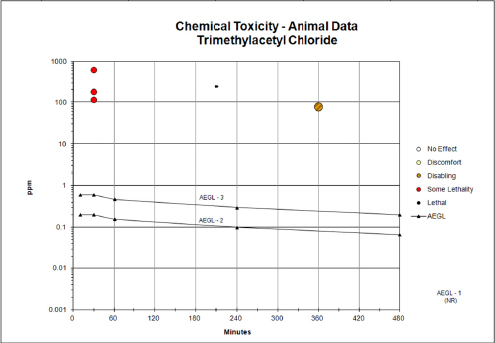
FIGURE C-1 Category plot of toxicity data and AEGL values for trimethylacetyl chloride.
TABLE C-1 Data Used in the Category Plot for Trimethylacetyl Chloride
| Source | Species | Sex | No. Exposures | ppm | Minutes | Category | Effect |
| AEGL-2 | 0.20 | 10 | AEGL | ||||
| AEGL-2 | 0.20 | 30 | AEGL | ||||
| AEGL-2 | 0.16 | 60 | AEGL | ||||
| AEGL-2 | 0.10 | 240 | AEGL | ||||
| AEGL-2 | 0.07 | 480 | AEGL | ||||
| AEGL-3 | 0.60 | 10 | AEGL | ||||
| AEGL-3 | 0.60 | 30 | AEGL | ||||
| AEGL-3 | 0.47 | 60 | AEGL | ||||
| AEGL-3 | 0.30 | 240 | AEGL | ||||
| AEGL-3 | 0.20 | 480 | AEGL | ||||
| Eastman Kodak 1992 | Rat | 1 | 78 | 360 | 2 | Rough coat, labored breathing, body weight loss. | |
| Eastman Kodak 1992 | Rat | 1 | 249 | 210 | 3 | Mortality 3/3 | |
| Hardy and Kieran 1992 | Mouse | 1 | 115 | 30 | SL | Mortality 1/4 | |
| Hardy and Kieran 1992 | Mouse | 1 | 180 | 30 | SL | Mortality 3/4 | |
| Hardy and Kieran 1992 | Mouse | 1 | 634 | 30 | SL | Mortality 3/4 |
For category: 0 = no effect, 1 = discomfort, 2 = disabling, SL = some lethality, 3 = lethal.


