Structural Racism and Inequity in the U.S. Aviation Industry: Foundations and Implications (2024)
Chapter: 3 Settler Colonialism

3. SETTLER COLONIALISM
LEARNING GOALS
This chapter explains the origins and impacts of settler colonialism and the dispossession of Indigenous land in the United States.
- Understand the violent history of white settler land occupation.
- Recognize how colonial values shaped contemporary notions of land ownership in the United States and contributed to the subversion of Indigenous land stewardship.
- Explain present-day examples of ongoing erasure and perpetuation of settler colonial ideologies within aviation.
INSIGHT WARM-UP

Historical Context
The forced and violent removal of indigenous people throughout North America is inextricably linked to Western European nations’ pursuit of power via land acquisition, who justified their colonization practices via the Doctrine of Discovery. Later, Americans used Manifest Destiny to continue the justification for indigenous dispossession. What do you know about the dispossession of people on the land an airport now occupies? What opportunities exist to connect the land to its pre-Colonial history?

Lenses and Ways of Knowing
Historians increasingly acknowledge that hundreds of nations of indigenous people on the land now named the United States of America experienced violence to the extent of genocide, a charge that has been recognized by indigenous people and racial justice advocates.
Land stewardship practices among tribal nations was, and in some ways remains, distinct from Americans’ private land commodification practices. Indigenous scholars note that the stewardship, cultivation, and maintenance of the land and the natural balance of its ecosystems were violently disrupted when it was invaded, stolen, parceled, and monetized.

Present-Day Legacies in Aviation
Geographic isolation of tribal nations limits Native Americans’ access to the aviation system. Displacement from their ancestral lands can impede their ability to protect their sacred sites when in proximity to airports. Distrust over centuries of broken treaties, contemporary land sovereignty laws, and self-governance practices can challenge Federal-Tribal, Nation-to-Nation cooperation on present-day infrastructure funding, planning, and operations.
3. SETTLER COLONIALISM
This chapter explains the origins and impacts of settler colonialism and the dispossession of indigenous land in the United States. Settler colonialism is defined by Lorenzo Veracini as “a specific mode of domination where a community of exogenous settlers permanently displace to a new locale, eliminate or displace indigenous populations and sovereignties, and constitute an autonomous political body” (Veracini 2019). This definition establishes three main elements of settler colonialism: (1) the intent of one group to dominate another, (2) the imposition of one group’s dominance is exacted through a pervasive presence on the land of another group, and (3) the genocide and/or displacement of people who are indigenous to the land being dominated. The term settler colonialism refers to “circumstances where [colonizers] ‘come to stay’ and to establish new political orders for themselves…[establishing] a new society that replicates the original one…inevitably premised on the possibility of controlling and dominating indigenous peoples” (Veracini 2019). Today, the continued degradation of native lands, the socio-cultural erasure of indigenous people, and references to indigenous people as “Indians” are examples of ongoing erasure and perpetuation of settler colonial ideologies.
This chapter includes four subsections that explain White settler expansion and Manifest Destiny (which included a land-grabbing framework known as the Doctrine of Discovery), dispossession of indigenous persons, violent acquisition and control of land, and legacies of settler colonialism within aviation. This chapter allows the reader to:
- Understand the violent history of White settler land occupation.
- Recognize how colonial values shaped contemporary notions of land ownership in the United States and contributed to the subversion of indigenous land stewardship.
- Explain present-day examples of ongoing erasure and perpetuation of settler colonial ideologies within aviation.
3.1 White Settler Expansion and Manifest Destiny
Moufawad-Paul (2013) uses the term sublimated colonialism to describe the revisionist histories which imply that land and culture belonging to indigenous people underwent simple processes of secession. In actuality, “the colony-motherland arrangement [was] discarded [and] the concrete colonial relationship of colonizer–colonized [was] pushed beneath an ideology of post-colonial secessionism [setting] the tone for all future colonialisms” (Moufawad-Paul 2013).
In order that he may subsist as a colonialist...it is necessary that the mother country eternally remain a mother country. And the mother country can eternally remain the mother country because the colony has transformed itself into its own motherland: “land of the free and the home of the brave,” asserts the American national anthem; the Canadian national anthem claims Canada as “our home and native land.” The colonialist becomes a rabid patriot as the colony becomes a sovereign nation; ideologies of divine right and manifest destiny are mobilized again to hide the colonizer’s true face behind the mask of pseudo-nativism. This ideology of motherland is intrinsic to all remaining colonialisms (Memmi 2013).
Contrary to the broadly accepted narrative that the United States was discovered by Christopher Columbus in 1492, the land that is now referred to as North America was invaded. In They Came Before Columbus, Ivan Van Sertima (1976) writes:
“It would be an irony, indeed, to find that Americans ‘discovered’ Europe many centuries before Europeans ‘discovered’ America. But the whole notion of any race (European, African or American) discovering a full-blown civilization is absurd. They presume some innate superiority in the ‘discoverer’ and something inferior and barbaric in the people ‘discovered.’... What I have sought to prove is not that Africans ‘discovered’ America, but that they made contact on at least half a dozen occasions, two of which were culturally significant for Americans.”
After invading North America, Columbus returned to Europe to inform fellow conquistadors of his “discovery” which inspired the Doctrine of Discovery (R. J. Miller 2010). The Doctrine of Discovery was an “international law principle developed primarily by Spain, Portugal, England, and the Church in the fifteenth and early sixteenth centuries” (R. Miller et al. 2010). This principle was used by colonial powers to legitimize and “legalize” (Reid 2010) the seizure of indigenous land, globally. The doctrine decreed the quest to rally colonial powers to spread the values of the “Church” (R. J. Miller 2011), cultivate “unused” land (Bauer 2014), promote racial superiority (Charles and Rah 2019), and strengthen European control across the globe (McNeil 2015). As the American territories were settled, artist depictions of colonization contributed to a propaganda, or mythology, of an ethical and harmonious colonization. For example, Figure 8 displays a lithograph of the various depictions of William Penn’s meeting with the Lenape and Delaware Indians and shows a quaint scene of fair trade, absent weapons or manipulated land deeds.
Manifest Destiny, the continuation of the Doctrine of Discovery, describes conquest based on the belief that White people were anointed by God to claim and rule over the land that is now known as the Americas. The principles which were used to justify violent settlement in North America were (1) the supremacy of American values and governance structures, (2) the belief that the United States exists to save the west and reproduce Eastern European ways of life in the west, and (3) the duty to accomplish these aims, at all costs (R. J. Miller 2006). As White settlers set their sights on expansion, racial inferiority was perpetuated through narratives describing indigenous and racialized people as “beasts” (H. N. Smith 1970), “dark”, “demonic”, brute-like “savages” (Takaki 1992) in need of “God’s chosen people” (McSloy 1996) to save them. The legacy of Manifest Destiny and the Doctrine of Discovery continues to produce present-day outcomes such as violence, cultural erasure, environmental degradation, and modern slavery.

Source: Created by Napoleon Sarony and Nathaniel Currier in the mid- to late-1800s, Public Domain, https://www.nga.gov/collection/art-object-page.32734.html
3.2 Dispossession of Indigenous Persons
Land use practices in the United States are rooted in the violent dispossession of indigenous people from their land through the means and justification of settler colonialism by white Anglo-Protestants (Dunbar-Ortiz 2014). For several decades, academics denied the charge of genocide made by indigenous people and racial justice advocates as it pertains to the harm enacted upon indigenous people in the United States. However, the literature reveals that hundreds of nations of indigenous people, the original inhabitants of the land referred to as the United States, were colonized as a means of establishing the systemic framework for British governance over stolen indigenous territories and subjected to violence and genocide.
Historians have documented the processes of land acquisition in the United States as violent acts of displacement (Hagan 1980; Hawk 2012; HoSang, LaBennett, and Pulido 2012). Historians also recognize destruction of indigenous ways of place-based being and knowing (Coates 2004), erasure of cultures and languages (Bielenberg 1998; S. P. Harvey and Rivett 2017), and a massacre of millions of indigenous people (Maybury-Lewis 2002). Oral histories (Mahuika 2019) and institutional knowledge illustrate that the oppression and inequitable outcomes currently impacting indigenous communities stems from the original theft that allowed for “white settler expansion” (Bonds and Inwood 2016), manifest destiny
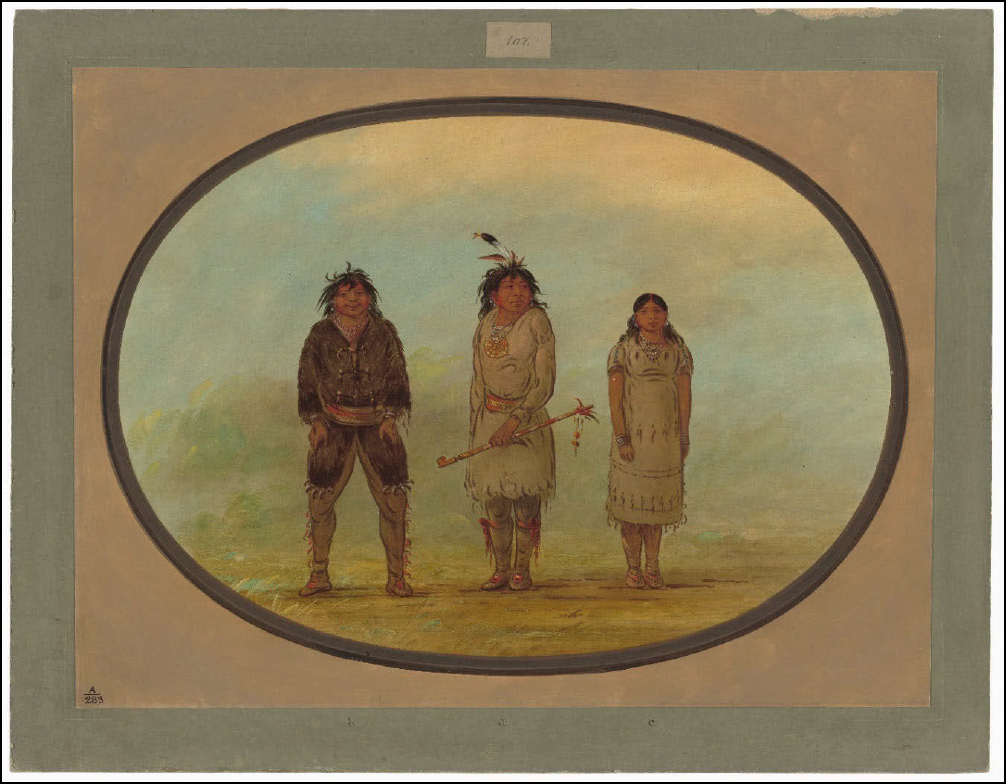
(Moreton-Robinson 2009), conquest (Robertson 2005), and capitalism (T. Hall 2010). Figure 9 shows a portrait of Three Selish Indians by George Catlin circa 1855/69. Catlin produced many portraits of indigenous people, scenes, and western landscapes. The original catalog entry for this piece reads: “Cart. No. 107. Selish. a. -- U-ná-sits (He who complains); a warrior who had taken five scalps. b. -- Oó-na (-----); a young man, wearing a tunic made of the skin of a grizzly bear. c. -- Sée-cha (-----); wife of the warrior. A small band of the Flathead Tribe, on the coast of the Pacific, British Columbia. 1855.”
Source: Portrait by George Catlin circa 1855/69, Public Domain, https://www.nga.gov/collection/art-object-page.50474.html
3.3 Violent Acquisition and Control of Land
Indigenous scholars assert that the primary point of contention regarding all forms of oppression and inequity in the United States (and North America more broadly) is rooted in a struggle for land. Indigenous scholars clarify and acknowledge that the stewardship, cultivation, and maintenance of the land and the natural balance of its ecosystems were violently disrupted when it was invaded, stolen, turned into a commodity, and parceled for monetization (Moreton-Robinson 2015; K. Whyte 2018).
Violent acquisition of indigenous land resulted in multi-century contention, rooted in racism and antiIndigeneity, whereby African people were kidnapped, enslaved, and forced to work the land to produce goods for consumption and profit for the colonizers’ benefit (Franklin 1969). White settlers forced
kidnapped and enslaved Africans to labor over a stolen land through the dehumanizing system of chattel slavery (see Section 4.1). Land use was enforced through the policing of access and movement through the land, as well as through racist restrictions to so-called land ownership. This foundation of the United States invoked the modern social construction of racism (Kendi 2019), the economic system of racial capitalism (Kaba, Nopper, and Murakawa 2021), the mandated criminalization of Black people through Jim Crow laws of the 1860s (Wilkerson 2011), and policies and plans whose legacies continue to impact racialized communities—like redlining practices (K.-Y. Taylor 2019; Crouch and Willis-Thomas 2002) and interstate highway construction (Loewen 2006).
3.4 Legacies of Settler Colonialism within Aviation
In March 2022, the FAA hosted the first Symposium on Tribal Aviation to learn from and share information with tribal nations. Former FAA Administrator Stephen M. Dickson opened the Symposium with the following remarks:
“Our intention is to create a trusted community between the FAA and Tribal Nations, so we can communicate openly and regularly about all areas of aviation, including opportunities to be part of it. For this to happen, we have to acknowledge that Native Nations have been mistreated by the Federal Government. We must be mindful of how this history shapes the challenges and conditions that affect tribes today. We strongly support President Biden’s Executive Order calling for the Federal Government to advance equity for ALL people, including those who have been historically underserved.” (Dickson 2022)
Featured speaker and USDOT Assistant Secretary for Tribal Affairs, Arlando Teller, remarked that the years of the COVID pandemic highlighted the importance of airport access for life-saving medical care. However, this time period also highlighted gaps in airport access and challenges in the airport planning process across Indian Country. Significant barriers for tribal nations to participate in American federal aviation planning process include maintaining sovereignty, managing the tribal land base, securing financial and knowledge capital, inadequate political recognition and inclusion, and ongoing experiences of epistemic injustice. For example, the rules, procedures, and grant assurances associated with federal aviation programs can conflict with a tribal government’s commitment to protect their sovereignty. This barrier is closely linked to the specific challenges in tribal communities that do not have a land base.

Source: Arizona State Legislature, Public Domain, https://www.azleg.gov/house-member/?legislature=54&session=121&legislator=1896
Figure 10 displays a photograph of Arlando Teller, a former member of the Arizona State legislature and the first Native American graduate of Embry-Riddle Aeronautical University in 1995.
3.4.1 Geographic Isolation of Tribal Nations
Tribal nations face unique physical infrastructure challenges as they are often located in rural areas, may lack comprehensive planning processes, and struggle to obtain consistent funding for development projects (U.S. Commission on Civil Rights 2018). The U.S. Commission on Civil Rights published a report in 2018 titled Broken Promises: Continuing Federal Funding Shortfall for Native Americans. The report identifies the needs of tribal communities and the inadequacy of federal funding to meet those needs in five major areas: criminal justice, health care, education, housing, and economic development. Economic development covers physical infrastructure, including transportation networks, utilities, housing, and telecommunications. Highlights of the report are included in the following quote.
“Due at least in part to the failure of the Federal Government to adequately address the well-being of Native Americans over the last two centuries, Native Americans continue to rank near the bottom of all Americans in terms of health, education, and employment. Many Native Americans face unique challenges and harsh living conditions resulting from the United States having removed their tribes to locations without access to adequate resources and basic infrastructure upon which their tribal governments can foster thriving communities… Native Americans are more likely to live in poverty, be unemployed, experience rape or abuse, and be killed by police than any other ethnic or racial group.” (U.S. Commission on Civil Rights 2018, 1)
For example, the Rosebud Sioux Tribe reservation is home to close to 20,000 citizens and located in rural South Dakota, 2½ hours from the nearest full-service hospital via ground transportation and almost 20 miles away from the nearest airport to transfer trauma patients via air (NCAI 2013). “The reservation, in its relative isolation, has roads that are nearly inaccessible at night and in poor weather conditions, making access to health care, external markets, and supplies a challenge” (NCAI 2010). The Tribe had long planned for and sought development of an airport to provide access to life-saving emergency medical health care for its citizens and to create opportunities for economic development. The Tribe obtained funding through the American Recovery and Reinvestment Act of 2009 to build the Rosebud Sioux Tribal Airport (NCAI 2010).
3.4.2 Tribal Nations Lack of Access to Airport Facilities
Regarding the impact of airport access for tribal nations, a few core themes emerged from the FAA Tribal Aviation Symposium (2022): local tourism, advocacy and governance, fishing, and emergency health care access. For example, Albuquerque International Sunport Airport in New Mexico provides intrastate connectivity to the state capital, Santa Fe, which is significant to the political and legislative activity of the more than 20 sovereign tribal nations within New Mexico.
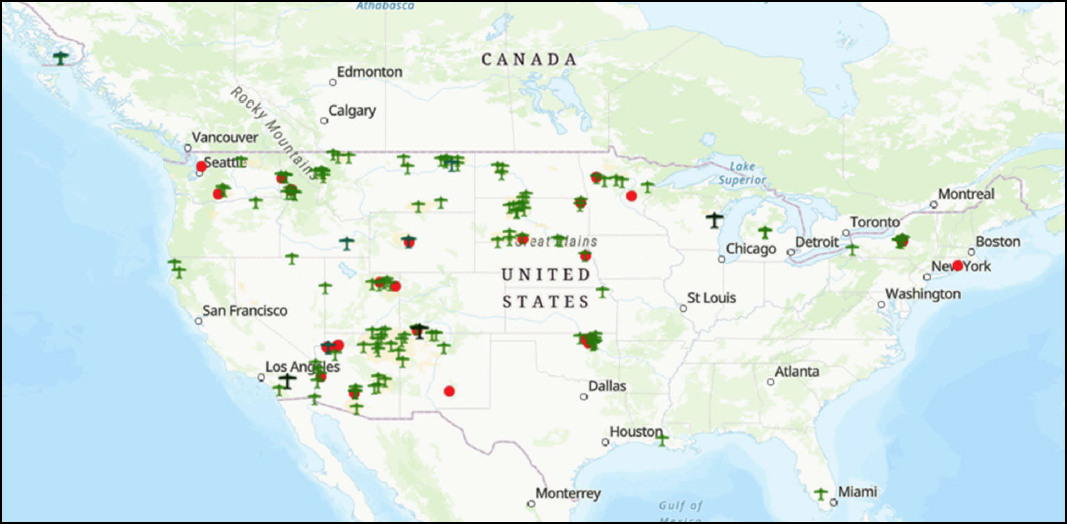
More information is needed to better understand network connectivity and accessibility of airport facilities across Indian Country. Table 1 and Figure 11 provide estimated counts and locations of the airport facilities that serve Indian Country. The estimates are created with a dataset published by Esri in 2014 curated from the FAA’s National Airspace System Resource Aeronautical Data Product. The geospatial attribute data describes the physical and operational characteristics of the landing facility, current usage including enplanements and aircraft operations, congestion levels and usage categories.
While it is not clear which year the data represents, the data is closest to the National Plan of Integrated Airport Systems (NPIAS) airport counts published around 2005. Of the 19,527 records listed in the dataset, only 156 airport facilities are located within Tribal Census tracts (see Table 1 and Figure 11). When the geographic boundary is expanded to tribal areas (which includes tribal statistical areas), the airport facility count rises to 948.
Table 1. Count of Airport Facilities by Type
| Facility Type | Within U.S. and Territories | Within Tribal Areas | Within Tribal Census Tracts |
|---|---|---|---|
| Airport (+1M enplanements) | 86 | 1 | 0 |
| Airport (100K – 1M enplanements) | 136 | 6 | 3 |
| Airport (<100K enplanements) | 651 | 118 | 5 |
| Airport (enplanements not recorded) | 12,446 | 615 | 118 |
| Heliport | 5,579 | 139 | 28 |
| Seaplane Base | 457 | 64 | 2 |
| Gliderport | 35 | 0 | 0 |
| Ultralight | 124 | 5 | 0 |
| Balloonport | 13 | 0 | 0 |
| TOTAL | 19,527 | 948 | 156 |
Source: Esri, ArcGIS Hub, https://hub.arcgis.com/maps/5d93352406744d658d9c1f43f12b560c/about
Source: Data from Esri, ArcGIS Hub, https://hub.arcgis.com/maps/5d93352406744d658d9c1f43f12b560c/about; Map generated by The Ohio State University
3.4.3 Disruption of Sacred Sites
Epistemic justice (see Section 6.3.3) deals with the ethics of knowledge production (Fricker 2007):
- Who is invited into the knowledge production process?
- Who is excluded?
- Whose knowledge is not granted respect or legitimacy?
This can be expanded to include the concept of hermeneutical injustice, whereby some groups are prohibited from communicating their own understandings and interpretations due to rigidity and insufficiency of the dominant culture’s knowledge production norms and practices. In aviation planning involving indigenous groups, there can be concerns about how specific indigenous knowledge is shared and protected. This concern is most pronounced in the protection of sacred sites, wherein tribal knowledge-holders guard precise location information. This tribal practice conflicts with mapping approaches and knowledge production norms used by aviation planners, who may be interested in avoiding disrupting such sites. However, this knowledge exchange is further marred by harmful histories and practices, where sacred sites (when precise location is known) become the object of aviation tourism for observation and consumption.
The planning process for infrastructure is fundamentally an exercise in knowledge production to inform decision-making. When airport planning teams lack diversity, systemic social biases can be perpetuated creating epistemic injustice in the airport planning process. Airport planning teams can foster epistemic justice by coordinating with affected tribes during project planning and construction to ensure sacred sites are protected. Tribes must also be consulted under Section 106 of the National Historic Preservation Act. For example, the FAA and other stakeholders “consulted with 11 tribes in the Great Plains region to protect sacred sites during construction of a new airport project in Williston, North Dakota. This effort included having 41 Traditional Cultural Specialists present as monitors during construction” (Dickson 2022). Specialists monitored excavation of the 1,600-acre construction site of Williston Basin International Airport to ensure protection of any cultural resources that were identified (Jean 2017).
Another topic of roundtable discussion during the Tribal Aviation Symposium was protecting sacred tribal sites from overflights. Administrator Dickson noted that “the FAA has initiated consultations with more than 130 Native American Tribes to ensure they have a meaningful opportunity to express concerns regarding air tours over U.S. national parks, many of which encompass sacred sites and other areas of importance to tribes” (Dickson 2022). In 2021, the FAA Safety Team advised helicopter pilots to maintain a minimum altitude of 2,000 feet above lands administered by the National Park Service, referencing an incident in Arizona over the Montezuma Castle National Monument, an ancient cliff dwelling site for the Sinagua people. The FAA noted that “helicopter overflights risk damaging ancient cliff dwellings that are sacred places for Native American tribes” (FAA Safety Team 2021). Eight federal agencies, including the Department of Transportation, signed a Memorandum of Understanding in November 2021 to continue to collaborate with tribal nations to protect sacred lands and sites (U.S. Department of the Interior, et al. 2021).
3.4.4 Land Sovereignty
The Doctrine of Discovery (see Section 3.1) is an origin of the principles governing land ownership and land occupation in the United States, as constructed and enforced by the British “Crown.” As a legacy of
the Doctrine of Discovery, tribal lands are currently owned and managed through a complex web of treaties and trusts across multiple governance structures. For example, the current system of “trust lands” involves the U.S. Department of the Interior’s oversight to allow the U.S. Federal Government to hold land titles for the benefit of tribes and their individual members. The “trust land” designation is distinct from “fee land,” which describes land under complete control of the owner (and the owner may be a Tribe, an individual, or another entity). Federal American tribal reservations are yet another land arrangement between sovereign tribal governments and the U.S. Federal Government.
Additionally, the Doctrine of Discovery created fundamental differences in society’s understanding of the relationship between land and people. The Doctrine of Discovery laid groundwork for the private land ownership principles in which land is considered a resource and an investment for personal gain. This belief contrasts with some contemporary indigenous communities’ views of communal land ownership in which land is ancestral family and there are sacred stewardship responsibilities to maintain healthy ecosystems. Scholars have identified this dichotomy as an example of hermeneutical injustice:
“In our view, the fact that Indigenous peoples are required...to articulate their relation to land in the ill-suited language of property amounts to a form of institutional hermeneutical injustice. Hermeneutical injustice, according to Fricker, occurs when people of a certain socially disempowered type are precluded from rendering some aspect of their own experience intelligible because of a ‘gap’ in the available hermeneutical resources where these resources include more than just socially shared concepts, but also languages, social norms, social practices, narratives, and various other tools for understanding one’s own social experience and that of others” (Townsend and Townsend 2021).
These variations in land ownership practices and governance complicate the fundamentals of cooperating on federally funded airport development programs, as well as transportation planning more broadly, within tribal lands. These challenges have been apparent to tribal nations for decades and, in 1988, tribal leaders proposed to Congress the establishment of a Tribal Self-Governance Program that was later adopted by the Department of the Interior and the Department of Health and Human Services Indian Health Service. Per Resolution #MSP-15-016 Support for Tribal Self-Governance within the Department of Transportation, the National Congress of American Indians affirmed that “federal programs are more efficiently implemented and expended than when federal officials exercised oversight rather than direct administration” and expressed support for “the expansion of the Tribal Self-Governance Program within all of U.S. Department of Transportation programs” (NCAI 2015). In 2022, the Cherokee Nation signed the first compact under the department’s TTSGP, established 2020), which enables the Cherokee Nation to plan and oversee its own road construction and transit projects “without having to seek federal permission and oversight” (Rowley 2022).


