Developing a Research Agenda on Contrails and Their Climate Impacts (2025)
Chapter: Summary
Summary
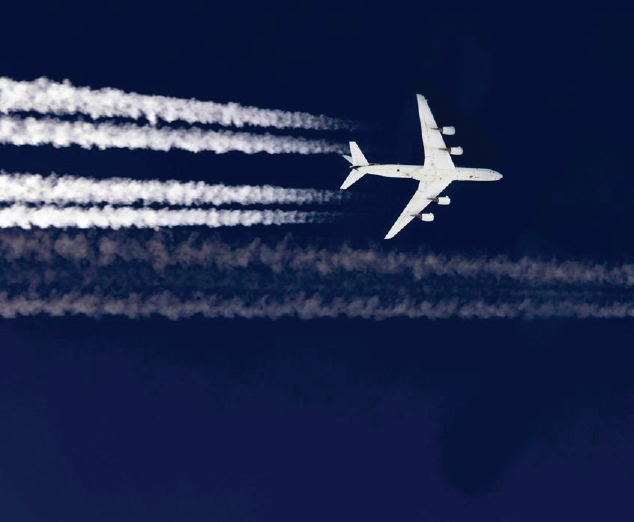
Aviation has significant global climate impacts that stem from the interaction of jet engine exhaust with the atmosphere. Aviation CO2 emissions from burning fossil jet fuel are about 2.5 percent of total anthropogenic CO2 emissions and are a contributor to total anthropogenic climate forcing. Aviation non-CO2 climate effects are estimated to be the same order of magnitude as aviation CO2 climate effects. One of the largest non-CO2 climate effects of aviation is due to persistent condensation trails (contrails) and aviation-induced cirrus clouds. Contrails form when the cooling aircraft engine exhaust plume becomes supersaturated with respect to liquid water (i.e., relative humidity exceeds 100 percent), causing the formation of many small water droplets that freeze to create a visible white trail. When the surrounding atmosphere is supersaturated with respect to ice, these initial contrails can grow and persist into contrail cirrus clouds for hours (Figure S-1); otherwise, the contrail sublimates. Persistent contrail cirrus, like naturally occurring cirrus clouds, will both scatter incoming sunlight back to space (cooling) and trap Earth’s outgoing thermal radiation (warming). Nighttime contrails are always warming, while daytime contrails can be either cooling or warming depending on the atmospheric and surface conditions as well as the optical properties of the contrail. Modeling both of these radiative effects shows that overall, considering all the persistent contrails generated by the current aircraft fleet, persistent contrails and aviation-induced cirrus create a warming effect. Furthermore, since only persistent contrail cirrus are climatically relevant, it is critical to be able to forecast and diagnose these ice-supersaturated regions (ISSRs) of the atmosphere, which are thought to be horizontally vast (~hundreds of kilometers) but vertically shallow (~hundreds of meters). Throughout this report, the terms contrails, persistent contrails, contrail cirrus, and aviation-induced cloudiness are used synonymously.
The United States has been actively engaged and leading in all aspects of aviation, including contributing to cutting-edge research on the science of flight and its environmental effects. The U.S. government, in coordination with industry and academia, has tremendous resources to assist industry in making intelligent choices to mitigate the environmental impact of aviation, and maintain and enhance global competitiveness. In recent years, international organizations have begun to regulate various aspects of these impacts, affecting both U.S. commercial airlines and aircraft manufacturers. The United States needs sufficient data on the causes and effects of persistent contrails, and possible mitigating actions, to enable a response to this emerging regulatory environment. There is strong industry support for emissions and contrails research and an opportunity to enhance U.S. market differentiation and economic competitiveness.
In early 2024, NASA tasked the National Academies of Sciences, Engineering, and Medicine to develop a national research agenda that enhances the scientific understanding of persistent contrails and aviation-induced
SOURCE: Copyright © Boeing.
cloudiness and accelerates the development of technical and operational solutions for reducing their climate impacts. NASA has been the lead U.S. government agency for over a decade in the study of persistent contrails and aviation-induced cloudiness and has been working in close collaboration with researchers across the U.S. government and around the globe. It has flown several research campaigns to observe the generation of contrails, including as recently as November 2024. In addition, NASA has a long history of the development of Earth-observing spacecraft as well as data products that have been used by operational agencies, such as the National Oceanic and Atmospheric Administration (NOAA), and has developed sensors that can be used by commercial aircraft to measure atmospheric conditions related to contrail formation. NASA has also been involved in the development of new propulsion technologies and aviation fuels and has close ties with industry in these areas. Finally, NASA has a long-standing relationship with the Federal Aviation Administration (FAA), including the development of air traffic control (ATC) technologies, experience, and connections that will be valuable in future contrail mitigation strategies.
The Committee on the Research Agenda for Reducing the Climate Impact of Aviation-Induced Cloudiness and Persistent Contrails from Commercial Aviation was established in late spring 2024 and soon began data-gathering sessions and meetings with commercial industry, U.S. government agencies, regulators, and international organizations throughout the second half of 2024 to develop a specific set of prioritized research recommendations. The committee’s statement of task is included in Appendix A.
The bulk of the warming effect of contrails results from a relatively small percentage of all flights. Further research will enable better understanding of the causes of persistent contrails, methods to model their effects, and emerging factors like the development of new propulsion systems and synthetic fuels that affect the generation of contrails. International organizations have already begun the process of measuring, reporting, and verifying the generation of emissions including contrails. Without significant research, the United States is at risk of becoming less competitive with its commercial aviation industry if, for instance, it does not develop improved technologies and operational procedures to respond to emerging regulations.
There are several ways to characterize the location and extent of contrails, including space-based sensors and in situ sensors that can be mounted on commercial aircraft fleets. The primary uncertainty in the formation and persistence of contrails is the ability to observe and/or predict ISSRs where the relative humidity over ice (RHi) is greater than 100 percent. RHi along flight paths is calculated from upper tropospheric temperature and humidity. Accurate, high-resolution vertical and horizontal measurements of humidity are needed to constrain model forecasts and nowcasts of cruise-level ISSRs and contrail-forming conditions.
Atmospheric modeling systems already exist and are used for multiple purposes such as weather prediction, climate prediction, and air quality. Individual contrails are often modeled using very detailed and small-scale plume models. Only a few atmospheric modeling systems include contrails in them. As contrail forecasting gains in importance and more data about them are collected, models of the atmosphere and contrails need to be linked into a seamless system so that differing models and meteorological data can be tested and utilized for contrail prediction.
The major gap in our understanding of the location and occurrence of persistent contrails is the lack of high-precision humidity observations in aircraft flight regions of the upper troposphere (temperature is already measured from aircraft). Accuracy of 1–2 parts per million (ppm) is desired down to a lower detection limit of 20–30 ppm. Current in situ sensor systems for commercial aircraft lack the reliability and calibration stability necessary for widespread deployment across the commercial fleet. Sensors need to integrate with existing aircraft data downlink systems and be certified for new and existing aircraft. Deployment of a large number of water vapor sensors across the commercial airline fleet would be invaluable to simulate and forecast cruise-level ice supersaturation for NOAA, FAA, and other national and international stakeholders.
As previously noted, there is confidence that persistent contrails create a warming effect. Even though there is ±70 percent uncertainty in the magnitude of climate warming from contrails, the sign of the warming effect (i.e., warming versus cooling) is robust when integrated across the whole fleet. Uncertainty in the climate effect of persistent contrails for any single flight, however, remains large. Contrail effects with a short lifetime (hours) need to be compared to effects of CO2 emissions with a long lifetime (decades to centuries), and the metrics for comparison have both physical and social assumptions (timescale of interest).
Better data on contrail formation can enable mitigation strategies. There are several methods for reducing or mitigating the climate impact of persistent contrails. Changing how aircraft operate to avoid the generation of high-impact contrails is one possible method. Some specific contrails contribute notably to climate warming, and mitigating them through operational measures in situations that do not introduce significant additional CO2 emissions is a robust strategy regardless of the selected metric. Operational contrail mitigation requires working within the current air traffic control system to safely reroute aircraft to avoid contrail formation regions. Elements of the current air traffic control system could limit the ability of aircraft to execute effective avoidance strategies while maintaining safety. Other potential mitigation factors could be through the use of alternate fuels and advanced engine combustion technologies that could reduce contrail formation and persistence.
The recommendations in this report represent the priorities for a national contrails research strategy and provide a vision for how research could eventually support operational contrails mitigation. The committee has further prioritized them into key short-term and long-term research priorities, and other priorities.
KEY RESEARCH PRIORITIES
The highest-priority research areas are listed in this section. While all these items are high priority and should ideally be initiated as soon as possible, they are organized into items that will have near-term impacts and long-term impacts, as well as places where NASA can make a real and unique difference. Note that long-term impacts may start now, but will continue and require more integration with others.
Near-Term Impacts
There are several key actions—using current observations, forecasting models, and the aviation system—that could be done in the near term to advance the understanding of contrails and demonstrate effective contrail mitigation strategies.
The primary uncertainty in forecasting contrails is predicting the formation and evolution of persistent contrails, which occur in ISSRs of the atmosphere, which requires upper tropospheric temperature and humidity measurements. Existing forecast systems can partially predict ISSRs, but enhancements to vertical resolution and more accurate RHi forecasts are critical. To accurately predict ice supersaturation, better observations of humidity at flight altitudes are needed. This will likely require improving humidity sensors for commercial aircraft, deploying them, and using this information in models that predict where contrails are likely to form. Mapping observations of persistent contrails with aircraft location data can also improve the understanding of ISSRs.
Short-Term Priority Recommendations
Recommendation: NASA should support the development, testing, and certification of advanced and accurate commercial-aircraft-capable humidity and temperature sensors for contrail-forming regions as well as onboard contrail-detecting cameras and automated contrail-detection image-recognition algorithms. (Chapter 3)
Recommendation: NASA should support research and observational studies to improve the understanding of the extent and frequency of ice-supersaturated regions (ISSRs) and the level of skill in simulating ISSRs and contrails. (Chapter 3)
Recommendation: NASA should apply its current Earth system modeling efforts in support of simulating ice-supersaturated regions and contrails as a pathway to demonstrate the use of observations and advanced modeling tools for developing a contrail forecast and prediction system and estimating contrail radiative forcing. (Chapter 5)
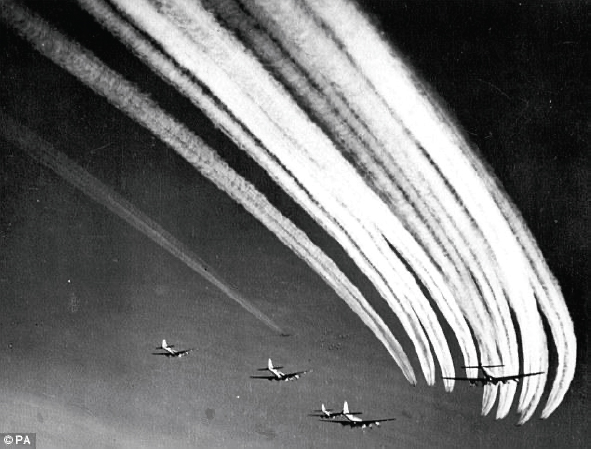
Persistent contrails are not a new phenomenon, and were commonly observed during World War II, but the scientific study of them has increased in recent decades (Figure S-2). As indicated in the chapters of this report, NASA is already engaged in some of these activities, although there are also transitions under way (e.g., NASA recently retired its DC-8 research aircraft and its replacement will not be available until 2026).
SOURCE: Courtesy of the U.S. Air Force Historical Research Agency. Photo by Unknown.
Long-Term Impacts
There are several priorities for starting research now to benefit long-term strategies to constrain and reduce the radiative forcing of persistent contrails and aviation-induced cloudiness. Research efforts to evaluate the impact of sustainable aviation fuel chemistry and low-emission engine technologies on the particulate emissions that influence contrail formation, evolution, and radiative forcing should be prioritized. Moreover, observations of aviation emissions and background particulates (ambient aerosols) at flight altitudes are critical to understand the background atmosphere and clouds at flight levels, supporting the long-term deployment of advanced aircraft engines and sustainable aviation fuels that reduce contrail radiative forcing. Lastly, ensuring the development of large-scale systems for observing contrails is also important for the validation of physics-based models and for constraining estimates of contrail radiative forcing.
Long-Term Priority Recommendations
Recommendation: NASA, in coordination with the Federal Aviation Administration, the Department of Energy, and the Department of Defense, should support laboratory and engine research studies to improve the understanding of how fuel composition, combustor technology, and engine operating conditions impact particulate emissions (volatile and non-volatile) and contrail properties. (Chapter 2)
Recommendation: NASA should continue to collect in-flight observational data of contrails, cruise emissions (CO2, NOx, and ice-nucleating particles) from aviation that advance the understanding of the factors that influence contrail properties. (Chapter 2)
Recommendation: NASA should identify and enable a minimum set of key aerosol instruments that can be flown on multiple missions with the goal of characterizing the aerosol composition of the upper troposphere and uncovering the contribution of aviation emissions relative to other sources. (Chapter 3)
AIRCRAFT ENGINE EMISSIONS
Contrail ice crystals form on particles emitted from the aircraft engines, as well as ambient particles in the upper troposphere. Aircraft engine particulate emissions influence contrail properties and resultant radiative forcing. Aircraft engine particulate emissions are strongly influenced by fuel composition, engine operating conditions, lubrication oil venting, combustion system technology, and maintenance cycle. Because of the importance of particulate emissions in contrail dynamics, advanced engine technologies that reduce particulate emissions can play a key role in mitigating contrail radiative forcing. These technology levers include advanced combustor designs, vent oil management, and alternative fuels.
The largest impact of alternative fuels on contrails is likely to be through changes in the particulate content of aircraft exhaust. Developing the ability to identify the composition and roles of all these contributors is needed to predict how changes in fuel composition and engine technology will influence engine particle emissions relevant for contrail formation.
Recommendation: NASA, in coordination with the Federal Aviation Administration, the Department of Energy, the Department of Defense, other relevant federal agencies, and the private sector, should support development of low-particle-emitting combustion technologies, as well as sustainable aviation fuels with inherently low particulate-formation tendencies. (Chapter 2)
ATMOSPHERIC MEASUREMENTS
The number and distribution of necessary sensors deployed across the fleet have yet to be optimized and will depend on the operational avoidance and verification goals and whether these are to be realized at the individual flight or fleet level.
Recommendation: NASA should support observing system simulation experiments to define widespread water vapor sensor deployment to best inform contrail forecast systems and individual verification and avoidance efforts. (Chapter 3)
NASA is uniquely positioned to test novel in situ temperature and humidity sensors using existing Science Mission Directorate Airborne Science Program aircraft and state-of-the-art research instruments.
Satellites also can provide necessary data for contrail prediction and modeling. Next-generation geostationary satellite sounders that may be relevant for measuring flight-level temperature and humidity and tracking persistent contrails will launch over the coming decade. Low Earth orbit satellites and constellations also show strong promise for inferring temperature, humidity, and persistent contrail tracking. NASA fills an important research role within the United States in developing and demonstrating satellite data products and assimilating these products into models that can eventually be deployed to operational agencies (e.g., NOAA, FAA).
Satellite- and ground-based imagers and airborne lidars, automated detection algorithms, and flight trajectory information are important tools for validating contrail model predictions. Artificial intelligence and machine learning are becoming more widely used for automated contrail observation and detection from satellite and ground-based imagery. This research is ongoing and is necessary for informing satellite design decisions.
Recommendation: NASA should support satellite remote sensing research for diagnosing persistent contrails and ice-supersaturated regions to develop readiness for the next-generation geostationary sounders and imagers. (Chapter 3)
MODELING
Understanding and predicting aviation-induced cloudiness requires global models designed to simulate aerosol evolution and ice nucleation, evaluated with measurements of aerosols.
Recommendation: As part of a national strategy, NASA should support development and assessment of models for all scales of contrail prediction. These models range from wake vortex to global climate to contrail plume to ice supersaturation forecasting. (Chapter 4)
CONTRAIL FORECAST AND VERIFICATION
Reliable prediction of ISSRs with the spatiotemporal requirements sufficient for informing contrail avoidance strategies is likely possible and feasible with evolution of current models and sufficient humidity and temperature data at flight level. Current forecasts of ISSRs and persistent contrails are limited by (1) lack of flight-level in situ humidity data for constraining ISSR locations at flight altitudes, (2) poor parameterizations of cloud physics in weather forecast models that do not permit ice supersaturation, (3) low vertical resolution in the upper troposphere, and (4) lack of adequate models for ice nucleation on existing or aircraft exhaust particles. Current attempts at operational forecast of individual flight or system-level contrail locations and radiative effects are insufficient for making robust net climate impact-reduction mitigation decisions with sufficient skill scores.
New machine learning methods for contrail identification from satellite imagery are showing great promise, but databases are currently fragmented, use different methods, and are not global. Low Earth orbit and geostationary satellite data can be used with aviation location data and machine learning to improve model accuracy and are
vital for model validation and testing. Verification of contrail predictions requires good observations of contrails globally. This requires use of multiple satellites and ground-based cameras in an open-source setting.
Recommendation: NASA should support development of a global contrail observing system as a foundation for research, analysis, and future verification. (Chapter 5)
The manner in which Earth science is conducted is evolving. For example, there are private parties exploring the deployment of a specific constellation of satellites to observe contrails. NASA is in a unique position to advise these efforts to ensure that they are best architected and that resulting data are accessible to maximize utility for the broader community. A contrail prediction system requires a forecast model to predict ice supersaturation, which necessitates accounting for the degree of ice supersaturation and improved vertical resolution. New observations for humidity and even contrail imagery would also improve forecasting ISSRs and contrails.
There are several critical priorities to enable contrail mitigation in the near term with higher certainty. First are high-vertical-resolution forecasts, which require improving weather forecast models. Second is estimating high relative humidity regions and ISSRs, which requires better in situ humidity observation, probably from commercial aircraft. It would be best to focus on more certain contrails with known high impact. High-impact contrails have large positive radiative forcing, which comes from long lifetime, high relative humidity, and certain conditions, like nighttime over warm surfaces.
OPERATIONS
The global policy landscape and accuracy of contrail forecast/validation tools are evolving rapidly and are trending toward more widespread adoption of operational avoidance efforts over the coming decades.
Even while the positive warming impact of some contrails is clear, continued research to reduce uncertainties on climate impacts is needed to incentivize airlines and regulators to introduce the additional cost and operational complexity associated with introducing broad avoidance measures.
Current air traffic control systems have difficulty accommodating the rerouting of large traffic volumes for contrail avoidance. Certain operational contrail mitigation concepts, focusing on forecasting the vertical structure of large ISSRs and moving aircraft vertically to avoid high-impact contrails while minimizing extra fuel burn would more readily fit into the current ATC systems.
Trial efforts for rerouting aircraft could be developed with the current air traffic control system to test and evaluate the effectiveness of implementing broad-scale contrail detection and avoidance. To identify specific improvements to the current system, trial tests would
- Illustrate any disruptions or limitations of the current air traffic management system and the current set of models and operations.
- Focus on regions where it is clear that contrails would be high impact (large ISSRs with high amounts of ice at night over warm surfaces).
- Focus on rerouting aircraft vertically (changing flight altitude).
- Engage operators and Air Navigation Service Providers (such as FAA).
- Include significant observations for evaluation by archiving satellite and ground based imagery, as well as use in situ aircraft (including NASA observation aircraft) to measure contrails.
- Test different weather forecast models.
Recommendation: NASA, in collaboration with airline operators and Air Navigation Service Providers, should continue research, development, and operational evaluation of advanced high-altitude air traffic control concepts of operations to enable flexibility to accommodate fuel efficient and contrail avoidance flight trajectories. (Chapter 6)
VISION FOR CONTRAILS RESEARCH
A key objective for the United States is maintaining leadership in the aviation sector, and contrails research is important for the United States’ ability to address this emerging aviation issue. The committee has recommended both short- and long-term contrails research activities. The committee’s vision for national contrails research is that it will provide sufficient knowledge that can be used by a broad range of government, industry, academic, and international actors. It could ultimately inform a contrails mitigation strategy. The United States is strongly positioned to conduct this research to enable the country to have a competitive advantage both economically and diplomatically, while leveraging the existing body of international, collaborative research in this area. A national research strategy with NASA coordinating with other relevant government agencies and commercial and international partners is vital for demonstrating that the United States will not be left behind in this area.


