Developing a Research Agenda on Contrails and Their Climate Impacts (2025)
Chapter: 6 Operational Concepts
6
Operational Concepts
Assuming that the radiative forcing impact of aviation-induced contrails is sufficiently strong to justify mitigation measures, it is likely that operational strategies that avoid flying through regions that would generate the most impactful warming contrails would be the most effective mitigation measure (Kärcher 2018). This is particularly true in the near term as operational contrail avoidance can be done with the existing aircraft fleet as other mitigations such as low-emission alternate fuels and improved combustion technology will take time to develop, certify, and be implemented at large scale.
The industry has demonstrated interest and willingness to participate in operational avoidance as demonstrated in the recent operational avoidance trials shown in Box 6-1. These trials demonstrate the capability of operators to modify routes and altitudes but are not capable of validating the effectiveness of contrail avoidance because there are currently insufficient forecast skills to know if the unmodified routes would have generated persistent contrails. In addition, the limited number of flights do not address the air traffic control (ATC) issues that would emerge if significant numbers of flights were to request contrail avoiding routes and altitudes.
There is emerging government interest in operational contrail mitigations, particularly in the European Union, which has recently imposed non-CO2 emission monitoring, reporting, and verification requirements on air carriers which operate within Europe.
Finding: The global policy landscape is evolving rapidly and is trending toward more widespread monitoring and control of non-CO2 aviation impacts, which may result in the adoption of operational avoidance efforts over the coming decades.
Any operational contrail avoidance approach must balance the total change in radiative impact due to the reduction of contrails against any potential additional CO2 or other emissions generated by avoidance trajectory. Because of the difference in impact timescales and uncertainty in contrail radiative forcing, the exact trade-off between contrail and additional CO2 is not fully known, but there are clearly some situations where high-impact potential contrails could be avoided with limited additional CO2 emissions and would have a net positive environmental impact.
Finding: Some specific contrails contribute notably to climate warming, and mitigating them through operational measures in situations that do not introduce significant additional CO2 emissions is a net positive environmental strategy.
BOX 6-1
Some Recent Operational Avoidance Trials
Air France, Meteo France: Meteo France provided predictions of contrail-prone areas (ice-supersaturated regions [ISSRs]) and Air France undertook operational trails avoiding those regions. The number of flights were limited and a diversion was not always possible due to airspace constraints. The partnership is now working on a campaign for pilots to take photographs of contrails at altitude to verify and validate Meteo France’s weather predictions.
Delta Air Lines, Massachusetts Institute of Technology (MIT): Delta conducted a contrail avoidance trial with certain flights and MIT used satellite observations of flights and contrails and attempted to verify whether current weather models provided successful reroutings. Results from the trial have not yet been published in peer-reviewed scientific journals.
American Airlines, Google Research, Breakthrough Energy: Limited flight trials (around 70 flights) were conducted by American Airlines to determine contrail formation from certain flights using satellite observation of flights and contrails and artificial intelligence in “almost” real time. Questions remain as to the methodology and usefulness of results due to difficulties in validating contrail avoidance, and uncertainties in the model and satellite observations.
Eurocontrol Maastricht Upper Air Centre (MUAC): Overnight contrail avoidance trial. The study found challenges in determining the limits of horizontal bands of ISSRs. Tactical simulations with controllers discovered some safety challenges and a potential 20 percent capacity hit.
Airbus, Meteo France, IAGOS, DLR, NLR, ONERA, UPC, Imperial College, Breakthrough Energy, Air France, Swiss International Airlines, easyJet, NATS, DSNA, Eurocontrol, Boeing: The SESAR-funded CICONIA project (2023–2026) develops mitigation Concepts of Operations and their assessment in comparison to legacy operations. CICONIA integrates CO2 and non-CO2 trade-offs, metrics, the integration of different climate models and aircraft specificities. Extensive simulations and trials in oceanic and continental airspace will be performed.
SOURCE: “Waypoint 2050,” Air Transportation Action Group, Briefing Paper #20, June 2024.
Finding: Even while the positive warming impact of some contrails is clear, continued research to reduce uncertainties on climate impacts and traceability is needed to incentivize airlines and regulators to introduce the additional cost and operational complexity associated with introducing broad avoidance measures.
The geometry of contrail-forming ice-supersaturated regions (ISSRs) will strongly impact the feasibility of operational contrail avoidance. Many observational studies have documented that contrail-forming ISSRs can have significant horizontal extent, and most horizontal deviations from a wind-optimal flight route to avoid contrail formation are likely to have a net negative impact on radiative forcing as the fuel burn and resulting CO2 emission will scale with the additional flight distance.
In contrast, altitude deviations for contrail avoidance hold more promise—because ISSRs are thought to have vertically stratified structure, fuel efficiency for transport aircraft scales weakly for small changes in cruise altitude, and aircraft commonly fly off the fuel-optimal cruise altitudes to conform with standard flight levels and ATC restrictions. A deviation of 2,000 ft would result in less than a 1 percent fuel burn increase for a typical narrow body aircraft and less than an 0.5 percent increase for a typical wide body aircraft (Jensen and Hansman 2014). Since the altitude deviation would only be required for the contrail-impacted duration of the flight, vertical deviations are likely to be a viable avoidance strategy, depending on net value of avoiding the contrail.
Finding: Evaluating the feasibility of effective (net-positive) operational contrail avoidance is dependent on understanding the vertical structure of contrail-forming ISSRs.
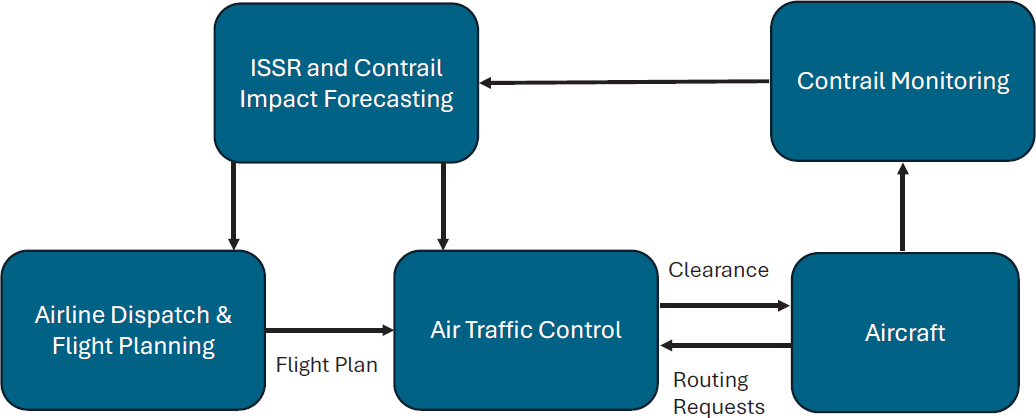
Assuming a future environment where the magnitude of contrail impact has been determined to be sufficient to justify policy incentives for operators and Air Navigation Service Providers (ANSPs) to reduce high-impact contrails, an information flow for a general concept of operations for operational avoidance can be seen in Figure 6-1, highlighting the required elements for operation contrail avoidance.
The first required elements are high-quality and high-vertical-resolution forecasts of the contrail-forming ISSRs, as well as a forecast of the radiative forcing (RF)/effective radiative forcing impact of any formed contrail that would include contrail persistence, optical depth, time of day, and natural cloud layers, albedo, and surface information. Current forecast models are insufficient (particularly in the vertical dimension) to support operational contrail avoidance. These forecast models could be improved and informed by any available contrail-monitoring technologies (remote or in situ). This requires observations discussed in Chapter 3, models in Chapter 4 integrated into forecast systems for ISSRs, and warming contrails in Chapter 5.
Finding: Improving the ability to forecast ISSRs is critical for operational mitigation of warming contrails.
The ISSR and contrail impact forecasts would be used by airline operators in their flight planning processes that file requested routes, altitudes, and departure times with ATC (i.e., ANSP). It should be noted that the vertical structure of ISSR regions will be critical to the effectiveness of operational mitigations because ISSRs are thought to be vertically limited and stratified. If this is found to be true, small changes in requested flight levels could mitigate contrails with minor impacts in fuel burn and CO2 emission. The airline-requested flight plans would be optimized to minimize total operational costs, which would include fuel burn, schedule, turbulence, and any contrail-avoidance incentives.
The requested flight plans are evaluated and modified by ATC to account for safety (aircraft separation, weather, other factors), efficiency, and the capacity of the airspace and airports. ATC issues route clearances that authorize aircraft to fly a specific route and altitude. These routes and altitudes can be modified by the tactical air traffic controllers at the request of the aircraft. This is often done for ride quality reasons due to turbulence but could also be done for unpredicted contrail generation. Depending on future policies, ATC could also have a role in contrail avoidance by limiting access to high contrail-impact airspace or flight levels.
NOTE: ANSP, Air Navigation Service Provider; ATC, air traffic control; ISSR, ice-supersaturated region; RF, radiative forcing.
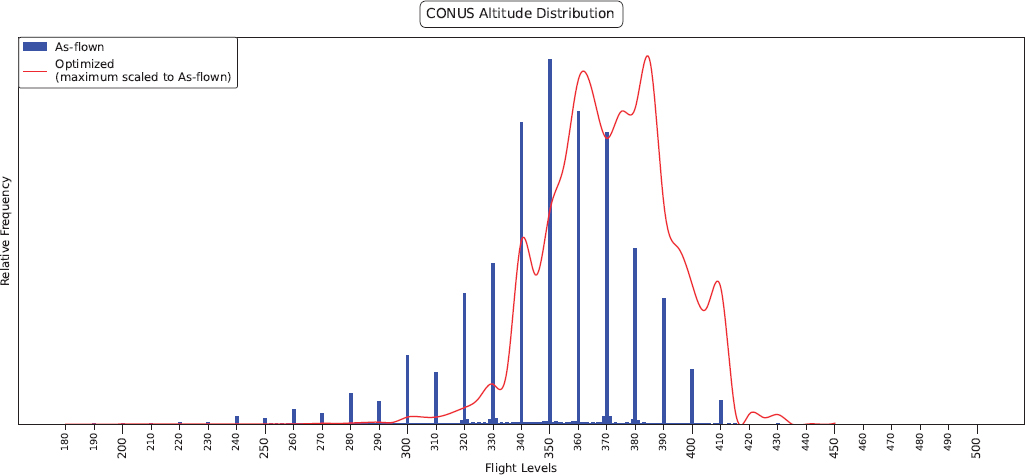
The ability to implement operational contrail avoidance at scale will be limited by the capability of the ATC system to safely accommodate contrail-minimizing trajectories and altitudes. While only a small number of flights would need to avoid high-impact contrail-forming regions, there will be a natural concentration of traffic at the low-impact altitudes and the boundaries of the high-impact regions. The limitations of the current ATC system to accommodate optimal cruise altitudes can be seen in Figure 6-2, which shows the distribution of Automatic Dependent Surveillance-Broadcast (ADS-B) observed cruise altitudes for 1 year over the continental United States along with the corresponding distribution of cruise altitudes if each aircraft flew at the optimal altitude for minimum fuel burn. Aircraft commonly fly lower than the fuel-optimal cruise altitudes and must conform with standard flight levels, altitude for direction of flight conventions, and ATC restrictions (Figure 6-3).
Aircraft also often fly off of the optimal cruise altitudes when deviating for turbulence and ride quality reasons. This is normally managed by the local ATC controller on an individual flight basis and indicates that limited vertical maneuvering for contrail avoidance would be feasible in the near term.
Finding: Certain operational contrail mitigation concepts, focusing on forecasting large ISSRs with potential for warming contrails and moving all aircraft only vertically to minimize extra fuel burn (if possible), would more readily fit into the current ATC systems.
Because the current ATC system limits the ability of aircraft to fly at their optimal altitudes, advanced ATC approaches that increase vertical flexibility would have dual benefits, both for contrail avoidance and reduced fuel burn, thus reducing CO2 emissions. NASA’s Aeronautics Research Mission Directorate has a long history of developing future concepts and advanced ATC systems and would be well positioned to develop and investigate advanced ATC systems with the flexibility to safely accommodate routes avoiding high contrail-impact potential and reduced fuel burn and CO2 emission as well as safety and turbulence avoidance.
SOURCE: Courtesy of Marek Travnik, Massachusetts Institute of Technology.

Finding: Contrail mitigation requires working within the current operational aviation system to safely reroute aircraft to avoid contrail-formation regions. Elements of the current system limit the ability of aircraft to do effective avoidance strategies.
Recommendation: NASA, in collaboration with airline operators and Air Navigation Service Providers, should continue research, development, and operational evaluation of advanced high-altitude air traffic control concept of operations to enable flexibility to accommodate fuel-efficient and contrail-avoidance flight trajectories.
REFERENCES AND FURTHER READING
Borella, A., O. Boucher, K.P. Shine, M. Stettler, K. Tanaka, R. Teoh, and N. Bellouin. 2024. “The Importance of an Informed Choice of CO2-Equivalence Metrics for Contrail Avoidance.” Atmospheric Chemistry and Physics 24:9401–9417. https://doi.org/10.5194/acp-24-9401-2024.
Engberg, Z., R. Teoh, T. Abbott, T. Dean, M.E.J. Stettler, and M.L. Shapiro. 2025. “Forecasting Contrail Climate Forcing for Flight Planning and Air Traffic Management Applications: The CocipGrid Model in Pycontrails 0.51.0.” Geoscientific Model Development 18:253–286. https://doi.org/10.5194/gmd-18-253-2025.
Jensen, L., and R.J. Hansman. 2014. Fuel Efficiency Benefits and Implementation Considerations for Cruise Altitude and Speed Optimization in the National Airspace System. ICAT Report 2014-04. http://hdl.handle.net/1721.1/88517.
Kärcher, B. 2018. “Formation and Radiative Forcing of Contrail Cirrus.” Nature Communications 9:1824.
Martin Frias, A., M. Shapiro, Z. Engberg, R. Zopp, M. Soler, and M.E.J. Stettler. 2024. “Feasibility of Contrail Avoidance in a Commercial Flight Planning System: An Operational Analysis.” Environmental Research: Infrastructure and Sustainability 4(1):015013. https://doi.org/10.1088/2634-4505/ad310c.


