Recently completed
Topics
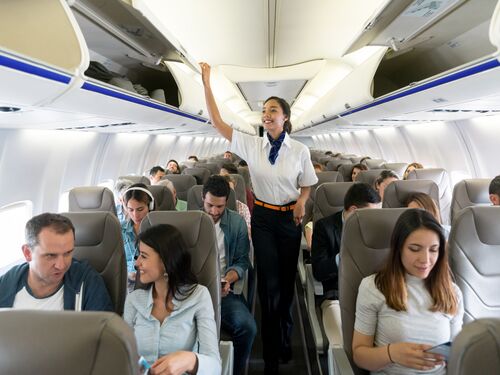
Unusually high or low air temperatures in commercial aircraft cabins, occurring before, during, and after boarding, may affect the health and safety of passengers and crew. An ad hoc committee of the National Academies of Sciences, Engineering, and Medicine will conduct a study to assess the health and safety impacts of temperatures in aircraft cabins. The committee will examine data on cabin temperatures and evidence on health and safety impacts. It will also assess the applicability and feasibility of applying existing standards on air temperatures and humidity levels in enclosed settings to ensure the health and safety of cabin occupants.
Featured publication
Consensus Study Report
·2026
Commercial aircraft cabins expose passengers and flight attendants to a range of environmental conditions, including at times excessively hot or cold temperatures that may affect health, safety, and comfort. While aircraft systems are generally effective at maintaining acceptable cabin conditions, c...
View details
Statement of Task
An ad hoc committee of the National Academies of Sciences, Engineering, and Medicine will assess the health and safety impacts of temperatures in the passenger cabins of airlines operating under a Part 121 certificate of the Federal Aviation Administration.
Specifically, the committee will:
- Identify and review available data from Part 121 operators on cabin air temperatures and available evidence on potential health and safety impacts on passengers and cabin crew members.
- Review existing standards on safe air temperatures and humidity levels in enclosed environments intended for public occupancy and consider their applicability to ensuring the health and safety of occupants of aircraft operated by Part 121 airlines.
- Examine the feasibility of applying identified temperature and humidity standards to aircraft cabin environments, considering input gathered from aircraft manufacturers.
- Seek input from Part 121 operators, aviation labor organizations, and other interested parties on health and safety impacts of cabin temperatures.
Based on this review, the committee will develop a short consensus report with its findings and conclusions, and, as appropriate, recommendations to inform strategies for monitoring, assessing, and managing passenger cabin air temperature levels and any associated health and safety impacts.
Contributors
Committee
Chair
Member
Member
Member
Member
Member
Member
Member
Member
Member
Member
Member
Member
NAM Fellow
Conflict of Interest Disclosure
Disclosure of Unavoidable Conflict of Interest Statement: David Space
The conflict of interest policy of the National Academies of Sciences, Engineering, and Medicine (http://www.nationalacademies.org/coi) prohibits the appointment of an individual to a committee authoring a Consensus Study Report if the individual has a conflict of interest that is relevant to the task to be performed. An exception to this prohibition is permitted if the National Academies determines that the conflict is unavoidable and the conflict is publicly disclosed. A determination of a conflict of interest for an individual is not an assessment of that individual's actual behavior or character or ability to act objectively despite the conflicting interest.
Mr. David Space has a conflict of interest in relation to service on Committee on Health and Safety Impacts of Aircraft Cabin Temperatures based on stock holdings attributable to his past employment with The Boeing Company, an aircraft manufacturer.
The National Academies has concluded that for the committee to accomplish the tasks for which it was established, its membership must include at least one person who has current knowledge, practical expertise, and business understanding of aircraft manufacturing and environmental control systems. As described in his biographical summary, Mr. Space has extensive expertise and experience in cabin environment research, including thermal comfort, humidity, and ventilation.
The National Academies has determined that the expertise and experience of Mr. Space is needed for the committee to accomplish the task for which it has been established. The National Academies could not find another available individual with the equivalent expertise and experience who does not have a conflict of interest. Therefore, the National Academies has concluded that the conflict is unavoidable.
The National Academies believes that Mr. Space can serve effectively as a member of the committee, and the committee can produce an objective report, taking into account the composition of the committee, the work to be performed, and the procedures to be followed in completing the study.
Committee Membership Roster Comments
9/24/2025 - Minor edit made to the bio of Fabiano Amorim
Sponsors
Department of Transportation
Staff
Autumn Downey
Lead
Emanuel Robinson
Thomas Menzies
Ashley Bologna
Major units and sub-units
Center for Health, People, and Places
Lead
Transportation Research Board
Collaborator
Center for Advancing Science and Technology
Collaborator
Consensus and Advisory Studies Division
Collaborator
Biomedical and Health Sciences Program Area
Lead
Computing Research, Technologies, and Systems Program Area
Collaborator