Resilient Zero-Emission Transit Bus Fleets: A Guide (2025)
Chapter: Appendix C: Resilience Planning

APPENDIX C
Resilience Planning
This appendix provides high-level information on general resilience planning.
The first step an agency should consider when conducting resilience planning is information gathering. Assessing agency needs and requirements, available resources, and institutional priorities is a critical first step (Linscott and Posner 2021). Begin by researching an agencyʼs capital requirements, current asset inventory, institutional goals, operational goals, and technology capabilities. This will include understanding the agencyʼs administrative structure, financial resources, modes and services, and external influences.
Next, the agency will need to determine who should be involved in engagement, planning, and implementation. Assembled stakeholders should identify opportunities and barriers to greater resilience. Stakeholder engagement should include input from staff across the transit agency as well as external stakeholders that can help weigh the trade-offs that come with prioritizing decisions within a transportation agency (Linscott and Posner 2021; Weilant, Strong, and Miller 2019). External stakeholders can include the state departments of transportation, planners in metropolitan planning organizations, utility organizations and interdependent infrastructure, transportation consulting organizations, academics, local emergency response management organizations, and other relevant agencies.
The next step an agency should consider is taking stock of known and unknown variables that will impact resiliency. This includes assessing vulnerabilities and risks, processes that support resilience adoption, and the status of ongoing resilience activities. Developing a hazard assessment document to identify current and future hazards is an informative process, and the document should be updated regularly as risks evolve over time. As part of this process, it is important to recognize how different departments within an agency could be impacted by and respond to different hazards. Resilience planning should be holistic and framed around the idea of building resilience across all sectors of transit agency business. By identifying opportunities and barriers within an agency, the agency can identify avenues of success.
This assessment needs to be done broadly. Transportation infrastructure and services have impacts beyond the transportation system itself (Weilant, Strong, and Miller 2019). Infrastructure interdependencies exist across all infrastructure sectors where a disruption or degradation of one infrastructure sector can have cascading impacts to other sectors. A transportation service impact can cause collateral impacts to other sectors. For example, a disruption to transportation can impact the presence of critical staff who operate other sectors in the community, and who are also riders on a local transit system (Figure 16).
By including internal and external stakeholders in resilience planning, transit agencies can better develop informed approaches to transportation system assets, outputs and outcomes, and long-term community well-being (Ehlen and Vargas 2013).
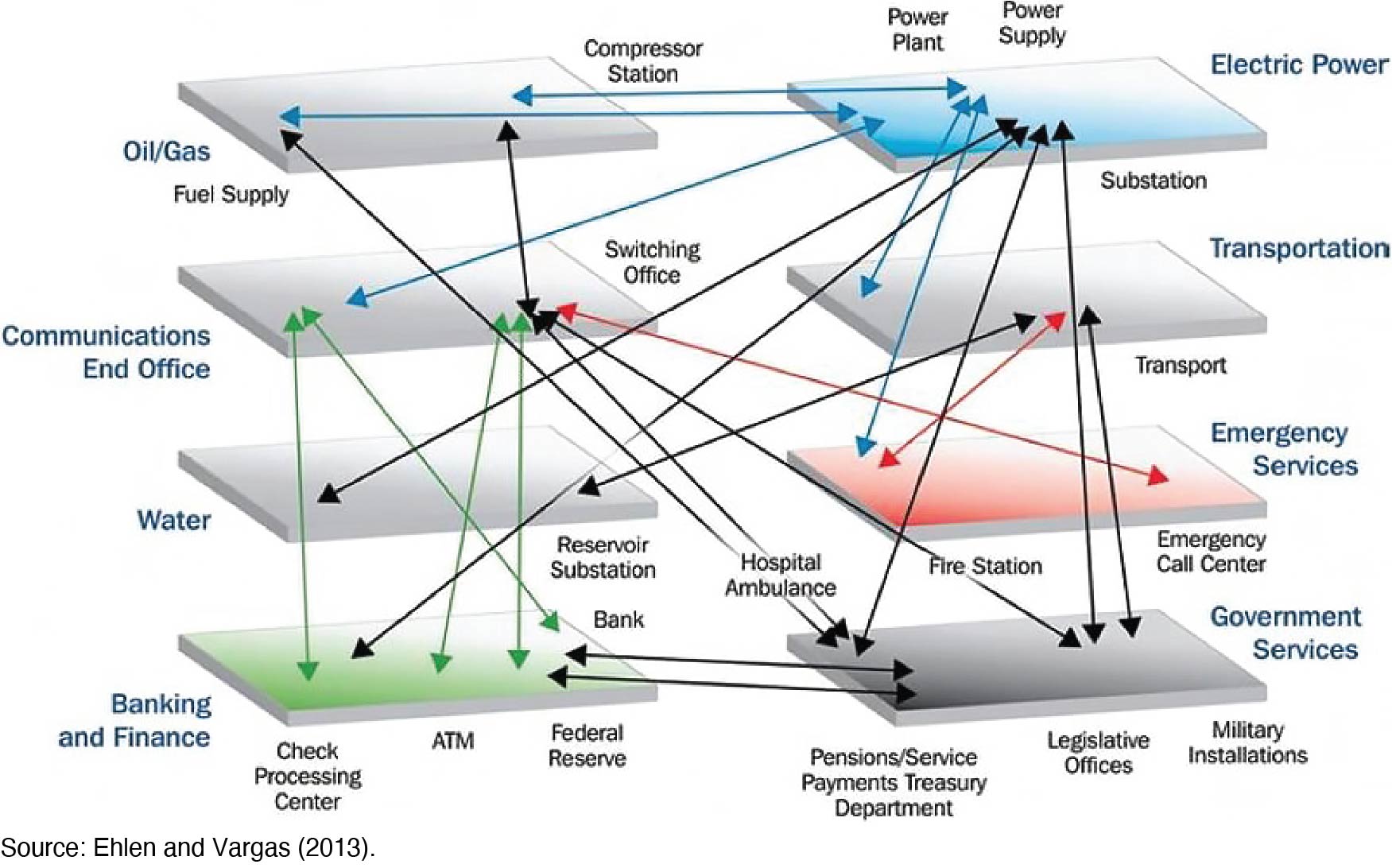
Long Description.
The eight systems are Oil or gas, Communications end office, Water, Banking and finance, Electric power, Transportation, Emergency services, and Government services. The data given in the schematic are as follows: 1, Oil or gas: Fuel supply and compressor station. 2, Communications end office: Switching office. 3, Water: Reservoir substation. 4, Banking and finance: Check processing center, ATM, Federal Reserve, and Bank. 5, Electric power: Power plant, power supply, and substation. 6, Transportation: Transport. 7, Emergency services: Hospital ambulance, Fire station, and Emergency call center. 8, Government services: Pensions or service payments Treasury Department, Legislative offices, and Military installations. Oil or gas is connected to Electric power, Communications end office, and Government services. Electric power is connected to Oil or gas, Transportation, Communications end office, Water, Banking and Finance, Government services, and Emergency services. Communications end office is connected to Oil or gas, Banking and Finance, Government services, and Emergency services. Transportation is connected to Water, Emergency services, and Government services. Water is connected to Electric power and Transportation. Emergency Services is connected to the Electric Power, Transportation, and Communications end office. The department of Banking and finance is connected to the Communications end office, Electric power, and Government services. Government Services is connected to Banking and Finance, Oil or gas, Communications end office, Electric power, and Transportation. Source: Ehlen and Vargas (2013).
When evaluating resilience against hazards such as dependencies on power, it is important to characterize and prioritize facilities and assets based upon criticality and impacts, such as service demand, transit agency financial and community economic impacts related to disruption or degradation of service, estimates of time needed to restore services to an acceptable level, and other related consequence factors.
Using impact or consequence analysis frameworks when prioritizing facilities allows agencies to consider multiple types of resilience factors when developing all-hazards, risk-based remediation and strategies. Consequence identification includes determinations of assets or facilities being compromised and the general magnitude of consequences that can reasonably be expected (Brashear and Jones 2010). Hazards that create the most significant impacts to service or costs associated with replacement, remediation, business interruption, negligence or liability, and/or loss of consumer confidence should be considered higher priorities than those reasonable hazards that cause lower-magnitude impacts. For further information, agencies can reference the RAMCAP Model (Brashear and Jones 2010).
It is important to establish needs and constraints when conducting resilience planning. To do so, the agency must first identify key motivations that will inform the agencyʼs plan. These motives (financial, health, environmental, operational, etc.) will help an agency determine clear goals as well as help assess needs, requirements, and constraints to attain these goals.
After developing an understanding of risks, supportive strategies, and barriers, the agency can move forward with planning. During the planning process, the stakeholder group articulates a resilience vision including goals and desired outcomes. Once a high-level understanding of needs has been developed, the actual plan can be drafted. While drafting an initial plan, the agency should consider conducting risk assessments or asset analyses to build on in future revisions (Linscott and Posner 2021). The agency should revisit the plan every 2 years to provide updates on lessons learned, deployment data, and any changes to transit operations. Additional plans, such as action plans, Threat and Hazard Identification and Risks Assessments (THIRAs),
or mitigation plans, may be completed prior to creating an overarching strategic plan as a tool to inform decisions. Any plans that are created should be updated regularly. For further information, agencies can reference FEMAʼs guide to THIRAs (FEMA 2020b).
Once a plan has been developed, monitoring policies should be implemented. These policies should include identifying performance measures and metrics, collecting and tracking data, and evaluating success and adjusting as needed. For example, an agency can review interoperability data to ensure proper connection and tracking between systems. Another example is to conduct staff training to determine if resiliency practices are effective. Each step in this cycle can be revisited, changed, and updated as needed to account for emerging factors that inhibit resilience. At any stage in developing a plan and process, an agency should reach out to external stakeholders. Coordinating with external agencies that work with transit agencies can further increase regional resilience.
Investing in resilience often requires up-front funding, and the benefits of a project may not be realized immediately upon implementation (Transportation Research Board 2021). The decision to invest in resilience planning and adaptation measures requires consideration of prospective benefits and costs that accrue over the lifecycle of the investment. According to the National Institute of Building Sciences, natural hazard mitigation saves on average $6 for every $1 spent on federal mitigation grants (Federal Insurance and Mitigation Administration 2018). Similarly, a report issued by IBM recommended resiliency planning considerations to minimize costly data breaches (Ponemon Institute 2023). Natural hazards and data breaches are only two factors that a transit agency must consider when investing in resilience planning. However, a proactive approach to resilience planning could end up saving an agency millions of dollars in recovery costs.


