Quadrennial Review of the National Nanotechnology Initiative (2025): Securing U.S. Global Leadership Through Renewed and Expanded Infrastructure (2025)
Chapter: 4 Barriers to Use for Communities Not Fully Engaging in Nanotechnology Infrastructure
4
Barriers to Use for Communities Not Fully Engaging in Nanotechnology Infrastructure
This chapter begins by describing the reason that broad access to nanotechnology infrastructure is so critical: it is essential to both workforce development as well as commercial expansion of nanotechnology-enabled industry. It then examines how awareness, interaction models, peer-review models, financial and travel logistics, remote access resources, intellectual property, and contractual agreements may present barriers to the use of nanotechnology infrastructure. It also explores opportunities to enhance data and resource sharing as well as strategies for incentivizing the use of the nanotechnology infrastructure. To gain clarity into the many complex issues at play in infrastructure access, the committee adopted a framework that considered how awareness, accessibility, and affordability all influence the user experience. Using town halls and invited speakers with firsthand experiences, the committee identified common barriers to use. Its recommendations detail improvements to achieve broad and impactful national engagement in, and use of, existing infrastructure.
OUTREACH ACTIVITIES KEY FOR WORKFORCE DEVELOPMENT FOR THE INDUSTRIES OF THE FUTURE
Ensuring broad access to nanotechnology infrastructure is important if the nation is to have the skilled workforce it needs to reap the economic benefits of this research. The committee considered information about the users and infrastructure access in part to respond to its task to “improve the value of the NNI’s [National Nanotechnology Initiative’s] research and development strategy, portfolio, and
infrastructure investments to enhance economic prosperity and national security of the United States.” The committee agreed that a major success, and important continuing contribution, of the NNI is in enhancing the economic security of the United States. In terms of NNI infrastructure, economic impact results from fundamental research that leads to the creation of new technologies, which companies then develop into commercial products. By supporting each of these activities through its nanotechnology enterprise, the United States can be assured of leadership in critical related areas such as semiconductor manufacturing, quantum computing, and biotechnology. However, these outcomes are at risk if there is not a workforce fully trained in nanotechnology available. Other reports focus specifically on the importance of early STEM (science, technology, engineering, and mathematics) education plus its impact on U.S. economic and national security priorities, including the 2025 report Scaling and Sustaining Pre-K–12 STEM Education Innovations: Systemic Challenges, Systemic Responses.1
Recent trends suggest that without action the U.S. nanotechnology workforce may not be sufficient to fully capitalize and commercialize applications in many critical and emerging areas. The 2020 NNI Quadrennial Review2 noted a concern that there may not be enough nanotechnology-literate workers. Four years later, this is still a looming concern. For example, the CHIPS and Science Act of 2022 (P.L. 117-167) promised to generate new jobs, many of them reliant on skills that could be trained in nanotechnology infrastructure facilities. However, the United States does not have the people to fill these jobs; some estimates suggest that by 2030, 1.4 million jobs will go unfilled of the projected demand for computer scientists, engineers, and technicians in advanced technology industries.3
Other industries will also need workers skilled in nanotechnology. Data from the 2017 U.S. Economic Census, the latest available data, revealed that there were 3,700 U.S. companies with a primary business focus on nanotechnology research and development (R&D).4 These companies reported a combined $42 billion in revenue in 2017 and employ 171,000 people. These numbers are expected have grown significantly in the past 5 years as nanomaterials have become more closely integrated and critical in medicine, electronics, energy, personal care, and the environment. This demonstrates that the investment has added important products and workers
___________________
1National Academies of Sciences, Engineering, and Medicine (NASEM), 2025, Scaling and Sustaining Pre-K–12 STEM Education Innovations: Systemic Challenges, Systemic Responses, The National Academies Press, https://doi.org/10.17226/27950.
2NASEM, 2020, A Quadrennial Review of the National Nanotechnology Initiative: Nanoscience, Applications, and Commercialization, The National Academies Press, https://doi.org/10.17226/25729.
3SIA and Oxford, 2023, Chipping Away, p. 10, https://www.semiconductors.org/wp-content/uploads/2023/07/SIA_July2023_ChippingAway_website.pdf.
4United States Census Bureau, 2017, “2017 Economic Census Data,” https://www.census.gov/programs-surveys/economic-census/data/tables.2017.html.
directly to the U.S. economy. Therefore, continuing to fund and cultivate an environment that promotes invention, innovation, and translations into the economy will ensure U.S. technological leadership and train and support a future workforce.
Shrinking this labor gap is possible by drawing out even more of the best and brightest prospective workers across the United States. STEM education and nanotechnology in particular have to appeal to an expansive workforce that elicits interest to develop enough talent able to work in these lucrative and important emerging industries. Toward this end, staff at nanotechnology infrastructure facilities must also be representative of the population they serve, which is an important consideration in workforce development. Personnel working in infrastructure facilities are essential to training users and engaging the community. These experts can provide a more personal engagement with the nanotechnology infrastructure and can be influential in inspiring the next generation of nanotechnologists. Having transparent recruiting processes and supporting a workforce that captures the broad representation of the U.S. human capital at the facilities themselves will help students and users envision themselves in the nanotechnology workforce.
Finding 4.1: Nanotechnology infrastructure facilities are critical for training students, postdocs, and other users who will make up the future workforce for nanotechnology and other critical and emerging technologies.
Finding 4.2: In addition, outreach activities at the National Science Foundation (NSF) and the Department of Energy (DOE) nanotechnology infrastructure facilities are outstanding in developing a nano-literate workforce. Many sites support a wide array of activities including K–12 programs, community college partnerships, R2 universities, and liberal arts programs.
Finding 4.3: These programs are greatly limited in their scale by a lack of funding, which is generally a small proportion of the support for infrastructure facility operation. Staff can be overburdened because these activities add to their research and facility training responsibilities, and the overall numbers of engaged participants is far lower than the projected workforce needs.
Finding 4.4: Facilities were not uniformly measured on the success and breadth of their outreach activities. Many infrastructure leaders reported that the quantity and impact level of publications was a primary focus of their evaluations with outreach and training considered but at a secondary level.
Conclusion 4.1: There are evidence-based models for engagement and outreach to allow nanotechnology infrastructure facilities to engage a broader cross section
of the population in order to develop a trained workforce for the many industries that rely or will rely on nanotechnology.
The following is a priority recommendation.
Recommendation 4.1: All agencies that fund nanotechnology infrastructure should include in their infrastructure evaluations measures of performance that capture the breadth and heterogeneity of the associated user bases.
NANOTECHNOLOGY INFRASTRUCTURE AND USER METRICS
The metrics used to measure success, in fundamental or applied research, will in turn provide incentives that then govern actions. For instance, if the number of publications in high-profile journals is the major metric of success for a nanoscale research facility, then projects that are likely to produce such a result would be favored. If a diverse user demographic is a major metric of success, then projects that are likely to produce that result would then be favored. Peer-review models for user proposals face similar issues.
The focus of DOE nanotechnology infrastructure facilities is primarily scientific output, which is certainly important and vital for innovation and commercialization. Their outreach activities are notably less expansive than those described by nanotechnology infrastructure supported by NSF. The National Nanotechnology Coordinated Infrastructure (NNCI) sites, for example, support high-impact research, user training, and broad outreach and are evaluated accordingly. However, many of the NSF NNCI facilities at universities are part of much larger infrastructure operations that receive substantial co-funding from their university. This naturally leads to site usage that is dominated by campus users and can, if not carefully managed, limit access of new and offsite users.
Given the growing importance of workforce, it is important that all nanotechnology infrastructure sites measure and be evaluated on the extent to which they have a broad user base. In Table 4-1, the committee lists some representative examples of relevant measures and their associated goals.
Ideas explored in other reports, such as federal agencies “ensuring broader access of prototyping facilities for academic researchers and small to medium-sized firms,” may be very useful.5
___________________
5National Academies of Sciences, Engineering, and Medicine, 2024, Strategies to Enable Access to Semiconductors for the Department of Defense, The National Academies Press, https://doi.org/10.17226/27624.
TABLE 4-1 Metrics to Enhance Workforce Development and Translation to Industry
| Representative Metric | Workforce or Translation Goal |
| Number of non-R1 users | Expand nano-literate workforce beyond research universities |
| Number of industry users | Accelerate translation of research and the product development cycle, increase access of industry to future employees |
| Number of collaborative academic–industry projects | Accelerate translation of research and the product development cycle, increase access of industry to future employees |
| Extent of K–12 and community outreach | Increase interest and awareness of nanotechnology as a career path |
| Users’ disciplinary identity | Nurture innovation at intersection of conventional disciplines |
| Percentage of new users each year | Engage users from emerging areas of science and engineering |
| Formal agreements with R2 universities, Primarily Undergraduate Institutions, and community colleges (certificate programs) | Expand the nano-literate workforce beyond research universities |
AWARENESS AS A BARRIER TO USE
Awareness is the first step in the interaction cycle between a user and an infrastructure facility. The committee’s data-gathering process consisted of a series of public meetings, the collection of information submitted by outside parties, reviews of scientific and analytical data, and individual investigations by committee members and staff. The committee took steps to solicit input from individuals who are involved in various aspects of nanotechnology infrastructure, either as staff/directors or as users, as well as industrial users, equipment developers, and others. For a full list of experts who spoke to the committee, see Appendix C, “Public Meeting Presentations.”
It is important to note that this process was limited as it self-selects for researchers who are already aware of NNI facilities and, in most cases, are established users. A more exhaustive consideration of awareness as a barrier would require a randomized and national-level survey to identify and query potential users who are not aware of the nanotechnology infrastructure. User data of the NNI infrastructure, particularly the NSF-supported NNCI and DOE Nanoscale Science Research Centers (NSRCs), can be found in Chapter 1 (e.g., Tables 1-3 and 1-4). These data were invaluable in characterizing the existing user base but contained only limited demographic data, including distance from the site (urban versus rural), socioeconomics, and other relevant information.
With that caveat, it is important that improving awareness of the NNI facilities be a central goal. As noted in Chapter 1, the majority of users reported that they discovered information about the facilities from conversations with other users. If professional networks are the primary vehicle for advertising the resources, then less well-resourced research institutions are at a disadvantage. The nano.gov website has a list of facilities, but this is difficult to find, even for an expert (under Reports and Resources, then under Infrastructure).6 One can imagine many better ways to increase broad public awareness of the facilities and their instruments. At the very least, this information could be on the landing page of the nano.gov website. As one example, the Research Triangle Nano Network provides a list of all equipment in the Research Triangle (Chapel Hill, Durham, and Raleigh, North Carolina) in addition to a list of the facilities.7 This allows users who are looking for a specific piece of equipment to find it easily. (Although it is important to note that this equipment list does not link to the facility that houses it, making it less useful than it could be.) Similarly, the NNCI has a searchable list of tools, but that list is only accessible to people who know where to look for it. As the home of nanotechnology, the committee encourages nano.gov to centralize and highlight tool information.
Finding 4.5: The National Nanotechnology Coordinating Office (NNCO) and nano.gov do not provide an easily accessible list of NNI resources. NNCO structure/responsibilities are challenging to unravel.
As noted in Chapter 1, the committee recommends that the NNCO should conduct a census of the most significant infrastructure available for public use and create an online map of the resources (see Figure 1-8). Toward better access through improved awareness, infrastructure needs to be front and center of the NNI/NNCO mission and clearly defined in outward-facing materials.
Beyond an easily accessible list of facilities, each infrastructure site could build its user base by advertising to potential users by reaching out to local communities, schools, and industries. Many of the NNI facility directors the committee met with had good approaches to outreach. Current activities include outreach at conferences, partnerships with R1, R2, and R3 universities, and so on. A good model used by a number of facilities was to leverage host-laboratory user engagement programs.
Finding 4.6: Facilities benefit from organized meetings and coordination that helps them scale successful outreach programs and share best practices for increasing access with other organizations.
___________________
6National Nanotechnology Initiative, n.d., “NNI R&D User Facilities,” https://www.nano.gov/userfacilities, accessed November 15, 2024.
7Research Triangle Nanotechnology Network, n.d., “Facilities,” https://rtnn.ncsu.edu/facilities, accessed October 4, 2024.
Recommendation 4.2: The National Nanotechnology Coordination Office should convene nanotechnology infrastructure site leaders and outreach directors regularly and assist in gathering and promoting evidence-backed best practices to increase awareness of resources in potential user populations and ultimately achieve broader usage.
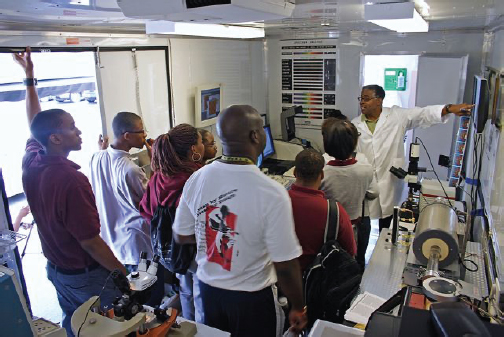
Infrastructure facilities’ efforts around awareness can also take the form of broader public awareness, through outreach and training of nontraditional users. Indeed, extensive efforts are already being made on this front. Both the quantity and quality of outreach and training efforts being made by nanotechnology facilities within the U.S. NNI infrastructure to reach people more broadly is remarkable. In a broad generalization, NSF-supported sites are more education-focused in their outreach, while the DOE centers’ outreach is to bring in more users and a more expansive user base. Nevertheless, the overall and individual scope of efforts is impressive. The committee heard of examples ranging from outreach to communities of scientists through attendance at conferences to laboratory internships and fellowships, to mobile van programs such as the “NanoExpress” at Howard University, to development of curricula and certificate programs in nanoscience.8
The committee reviewed numerous outstanding outreach programs, with many effective and productive initiatives clearly taking place nationwide. It is important to consider which are unique and, importantly, which are scalable. Here, the committee highlights a few examples. One example was a mobile van called the “NanoExpress” at Howard University (see Figure 4-1). Another is traveling nanoscience exhibits developed by the Nebraska Nanoscale Facility. The “Teach the Teacher” workshops for high school teachers, community college instructors, and university instructors held by Pennsylvania State University’s Center for Nanotechnology Education and Utilization was an interesting example of vertical integration of higher education content as well. This type of programming once started can become self-propagating as participants in workshops go on to teach the next generation of users. Other noteworthy programs include internships at the nanotechnology facilities for community college students and a 12-week certificate training program on microelectronics for veterans that leads directly to workforce development in the semiconductor industry.
Despite significant existing efforts, it is clear that more needs to be done. The next-generation nanotechnology R&D infrastructure means not just the physical infrastructure for nanotechnology that leads to new discoveries, new equipment, new technologies, and entire new markets, but also more importantly the human capital: people and expertise. With the CHIPS Act, together with the U.S. focus
___________________
8National Nanotechnology Infrastructure Network, n.d., “Nanoexpress,” https://www.nnin.org/nanoexpress-0, accessed October 4, 2024.
SOURCE: National Nanotechnology Initiative, Educational Resources for K–12 Students, https://www.nano.gov/education-training/k12. CC BY 3.0.
on advanced domestic manufacturing, workforce development is paramount. The United States could lose competitiveness globally if it does not continue to invest in people and training. Increasing public literacy around science, continued outreach efforts to K–12, and even programs aimed at training skilled workforce at the bachelor’s, master’s, and PhD levels, are areas in which the NNI facilities do and can play a central role.
ACCESSIBILITY AS A BARRIER TO USE
While a user may be aware of a facility, they may not be able to access the resources. Issues that limit accessibility of NNI facilities are numerous and include difficulty obtaining permission to use the facilities, time needed to travel to the site and/or engage in remote access, availability of equipment, proposal success (in the case of DOE), and acceptable intellectual property agreements. The committee evaluated these and other accessibility issues and found several common barriers.
Permission for Use
The process for obtaining access to the facilities differs based on funding agency. DOE user facilities use peer review of individual or collaborative proposals. NSF facilities operate independently with each facility determining the best way
to match users with equipment. This approach is clearly spelled out by the NNCI, encouraging potential users to contact the facility nearest to them.9 The National Institute of Standards and Technology (NIST) facility, the Center for Nanoscale Science and Technology, also uses a fee-based model where potential users have early contact with NIST to ensure the NanoFab has the equipment and process to complete the work then submit an application for project approval.10 Regarding the National Institutes of Health’s Nanotechnology Characterization Laboratory, academic, industry, and government researchers submit applications for various services, including an Assay Cascade Characterization Service (at no cost), sponsor-funded contractor Cooperative Research and Development Agreements, and Technical Services for purchase.11
The committee found that, in general, accessibility to time on the instrument, through whatever channel, is not a significant barrier to access. The committee’s analysis focused on the ability of users to access NSF and DOE facilities. A survey of access success rates showed self-reported access rates approaching 100 percent for many facilities, suggesting that users who try to gain access get instrument time. For this reason, the committee centered its strongest recommendations on awareness, particularly geared toward nontraditional users.
It is important that DOE and other facilities using peer review use best practices and have transparent review processes to ensure equitable access. Research on double-blind review has identified scoring strategies that increase proposal success for new and diverse users.12 The committee encourages these facilities and funders to optimize their peer review for workforce development and translation.
Travel and Remote Access
A surprising discovery by this committee was that in-person, hands-on access was preferred over remote access by the majority of the users and facility staff. This was also echoed by equipment developers and industrial equipment makers. This is the first quadrennial review post-COVID-19, and the committee expected that remote access would be common and normalized. On the one hand, it is true that remote access is important to maintain, especially for instruments like scanning electron microscopes that lend themselves to remote access. Some
___________________
9National Nanotechnology Coordinated Infrastructure, n.d., “Becoming a User,” https://nnci.net/becoming-user, accessed November 13, 2024.
10National Institute of Standards and Technology, 2023, “NIST User NanoFab Project Initiation,” https://www.nist.gov/cnst/nist-user-project-initiation.
11National Cancer Institute, n.d., “Nanotechnology Characterization Laboratory (NCL),” https://www.cancer.gov/nano/research/ncl, accessed December 17, 2024.
12A. Hatt, 2024, “Improving Peer Review at User Facilities,” Presentation to the committee, November 13, National Academies of Sciences, Engineering, and Medicine.
facilities reported that a small fraction of their users, maybe as high as 10 percent, can access equipment remotely; in these cases, they emphasized that while this may save time for users, it increases the demands on already overworked technical staff. Remote operation of a cutting-edge electron microscope is not completely automated, for example. Moreover, remote users were generally reported to be the more experienced users that had already logged a great deal of time on the instruments.
The primary outcome of the COVID-19 era is to have underscored for nearly all stakeholders the importance and centrality of in-person access to nanotechnology infrastructure. There are three specific points that were emphasized by the community. First, the goal of workforce development includes the need for hands-on experimental training, which is vital to developing young researchers and teaching experimental design. Second, remote access does not open up more instrument time, because staff are still necessary to carry out the experiments, and experiments are not generally run overnight. Third, several international contributors emphasized that hands-on training is a unique and beneficial aspect of U.S. training. This focus differentiates U.S. students from European and Chinese students in the global marketplace. Hands-on training, while important for workforce development, is not as important for companies. Often they would rather rely on facility staff with expertise to efficiently collect the needed information.
Finding 4.7: Although the COVID-19 pandemic normalized remote interactions, in-person training and equipment use is preferred for nanotechnology infrastructure facilities.
Conclusion 4.2: Remote access can be effective in some circumstances, especially for more experienced users, but is not a substitute for the hands-on operation and training that are the foundation for developing skilled researchers and the future nanotechnology-literate workforce.
Recommendation 4.3: Within 6 months, federal agencies that fund nanotechnology infrastructure should provide guidance that remote access should complement in-person visits; however, hands-on and onsite training should be prioritized for new users.
Availability of Equipment
Once a user has access to the facilities, it is essential that equipment is up and running. This is especially important for users who travel to the site, in terms of both time and cost. A team traveling from a less research-active university for a week of data collection that encounters an instrument that is down is not likely to be able to return easily. As Chapter 2 notes, this is an increasing risk as the
instruments age and there are few mechanisms for renewing the most basic infrastructure. Renewing the existing nanotechnology infrastructure, as recommended in Chapter 2, is also critical for ensuring broader access and the associated workforce development.
The committee also considered the value of expanding access by distributing lower-cost nanotechnology infrastructure tools at a broader range of institutions, including community colleges, non-R1 universities, and even high schools. There are nanotechnology-oriented laboratories, for example, being developed in community colleges that will use inexpensive and tabletop microscopes and 3D printers. While this could be a fruitful direction for developing the workforce, many stakeholders noted significant challenges to pursuing the strategy at scale. Nanotechnology topics are not easily associated with the conventional topics of standard science laboratories, so institutions would need to have nanotechnology-specific degree programs to justify the expense and instructional time for a dedicated class. Instrument upkeep and maintenance can be very challenging at teaching-intensive locations, and experimental nanotechnology is not yet routine, which makes it risky to offer laboratory exercises at scale to hundreds of students. Community college partnerships with major nanotechnology infrastructure facilities could de-risk this approach over time and could be an important element of a site’s outreach strategy. For example, this is the approach taken at the Nanotechnology Collaborative Infrastructure Southwest NNCI site, where Arizona State University is the primary university and affiliated partners are Northern Arizona University, Rio Salado College, and Science Foundation Arizona.
INTELLECTUAL PROPERTY AND CONTRACTUAL AGREEMENTS AS A BARRIER TO USE
Infrastructure collaboration with industry and startups is beneficial on multiple levels. It gives students exposure to commercialization, internships, and product development. However, intellectual property (IP) agreements can present a potential barrier to use for industries and startup companies. NSF-funded infrastructure sites have been able to overcome this barrier with acceptable use agreements. Due to these favorable IP agreements, projects funded by member companies of the Semiconductor Research Corporation (SRC) are now being executed at six different NSF-supported NNCI sites. A significant contractual barrier for SRC member companies was identified for the DOE NSRCs. This barrier is referred to as the U.S. preference clause, which requires that any company operating there make products that are substantially manufactured in the United States. The clause is impossible for major industries to comply with because many components are manufactured internationally.
Finding 4.8: NSF-sponsored centers appear to not have any significant IP barriers that prevent utilization of their facilities by industry and startup companies. Conversely, significant barriers to use of national laboratory facilities do exist because of the stipulations in IP agreements.
Recommendation 4.4: The Department of Energy should within a year conduct a review of its intellectual property agreements at its nanotechnology infrastructure facilities and endeavor to bring them more in line with the successful agreements used at National Science Foundation facilities, which may lower barriers to utilization of their facilities by industry and startup companies.
FINANCIAL AND TRAVEL LOGISTICS AS A BARRIER TO USE
As the committee met with facility users, a recurring theme was the immense challenge of paying for travel and housing necessary for facility users. It was identified by the committee as the most critical barrier to access, especially for those from non-R1 institutions, rural institutions, and those distant from existing infrastructure. While some sites offer travel grants, those funds are generally highly limited. In some cases (e.g., at the Molecular Foundry), users often stay for weeks or months, with the average length of stay approximately 3 months. Affordable nearby lodging and/or significant grants to cover travel and lodging expenses is critical.
Facility directors at both DOE and NSF sites were aware of this issue but had no way to address it, given the constraints of their funding. The lack of support for travel creates a significant problem for broad access, because only those users with substantial support and time available for research can access the nanotechnology infrastructure. The committee heard from users from community colleges and less research-intensive institutions who also noted that time off from teaching was an additional concern. Preferential access during summer months is thus critical for their participation.
The committee considered, and ultimately rejected, the concept of bringing the equipment to the user as a way to facilitate broader access to the nanotechnology infrastructure. One way to accomplish this is via remote access (see above). Another is to decentralize access to tools and facilities (see above). An example of a tool that could lend itself to decentralized access are low-cost commercial scanning electron microscope units. As noted above, the committee found that many less research-intensive institutions could lack sufficient personnel to support its maintenance and operation.
Finding 4.9: The cost of travel and housing are a major impediment to use of NNI facilities.
The following is a priority recommendation.
Recommendation 4.5: All agencies that fund nanotechnology infrastructure should increase program funding or provide a competitive travel grant program to include dedicated travel support for users and, where feasible, summer access for academics, researchers, and students who are not from R1 institutions.


