Quadrennial Review of the National Nanotechnology Initiative (2025): Securing U.S. Global Leadership Through Renewed and Expanded Infrastructure (2025)
Chapter: 3 Trends, Opportunities, and Emerging Use Cases for Next-Generation Research and Development Nanotechnology Infrastructure
3
Trends, Opportunities, and Emerging Use Cases for Next-Generation Research and Development Nanotechnology Infrastructure
The National Nanotechnology Initiative (NNI), and its associated infrastructure, has developed in close contact with the leading edges of conventional academic disciplines as well as cutting-edge emerging areas. Its capabilities have expanded to include a wide range of material systems far beyond silicon, fabrication of integrated devices across multiple length scales, and characterization tools that cover vast time and length scales. Nanotechnology infrastructure capabilities have also supported new applications of nanotechnology, which themselves have spawned major new initiatives with significant societal, economic, and national security impact.
All of this evolution has occurred during a time of enormous progress in high-throughput data analysis, laboratory automation, and increased acceptance of remote work. This chapter will explore these trends and opportunities and examine the impact of U.S. nanotechnology–relevant infrastructure on current and emerging use cases.
FACILITY TRENDS AND OPPORTUNITIES: THE NEED FOR EXPANSION
The ability to form and analyze nanoscale structures has evolved substantially in the decades since the founding of the NNI, and this growth has created an acute need for an updated and expanded nanotechnology infrastructure. One trend to address is the identification of nanoscale phenomena and materials in a broader set of phenomena and disciplines than that conceptualized 20 years ago. Research at these interfaces, discussed in the following section, has in turn motivated new developments in nanotechnology infrastructure. Nanoscale fabrication now reaches far beyond silicon and encompasses tools to shape and form devices formed from nearly all key electronic and optical materials. Characterization tools are increasingly multi-modal, combining atomic imaging with vibrational spectroscopy, often over many orders of magnitude with respect to length and timescales. The infusion of nanotechnology into growing numbers of practical applications has also driven tool development for in situ and failure analysis.
Nanotechnology infrastructure facilities have done what they can to seize the opportunities presented by their growing relevance to the U.S. science and technology enterprise. They are well adapted to serve an evergreen clientele of novice researchers exploring how nanoscale phenomena play a role in their disciplines. Because it is the size of nanostructures that matters, the effects of quantum mechanics can significantly affect the properties of these materials. Additionally, in this nanoscale regime, the dimensions are in the range of electron scattering lengths and smaller than wavelengths of electromagnetic radiation of visible light. The characterization of the altered properties of nanostructures, along with the advances in fabrication and analysis, have opened the door to exploitation of nanotechnology in important technological applications of growing impact and importance. Certain areas of nanotechnology research, such as quantum dots, are by now well established, and their related technologies are commercialized in everyday items like television sets. However, as will be described in this chapter, new examples of nanotechnology’s relevance in research are continually revealed, as illustrated by the explosion of interest in nanoscale phenomena and technology in agriculture. By centering its identity on a critical length scale, rather than a phenomenon or material, nanotechnology’s relevance to scientific inquiry as yet has no bounds.
The vast majority of technologies on the Critical and Emerging Technologies Lista identified by the Office of Science and Technology Policy are directly enabled by nanotechnology. These include quantum information and enabling technologies, human–machine interfaces, biotechnologies, semiconductors, and microelectronics.
________
a Executive Office of the President, 2024, Critical and Emerging Technologies List Update, Fast Track Subcommittee on Critical and Emerging Technologies, National Science and Technology Council, Office of Science and Technology Policy, February.
INTEGRATION OF ARTIFICIAL INTELLIGENCE AND NANOTECHNOLOGY
Expansions to nanotechnology infrastructure will be needed to fully capitalize on advances in artificial intelligence (AI) and deep learning. Using these computational tools, it is possible to predict thousands of stable chemical materials and identify those that can be candidates for technologies ranging from batteries to solar cells, as discussed below.1 This is an important trend for nanomaterials and nanomanufacturing. A recent review article “Bridging Nanomanufacturing and Artificial Intelligence—A Comprehensive Review” describes the impact of AI and deep learning for nanomaterials and nanomanufacturing and how it can be applied in medicine, robotics, sensory technology, semiconductors, and consumer electronics.2 This evolving AI capability will advance the availability of nanotechnology-enabled technologies. Specifically, in nanofabrication as well as in commercial semiconductor fabrication processes, AI is beginning to be utilized for optimizing complex process development. With support for nanotechnology infrastructure expansion, as noted in the priority recommendation of Chapter 1, these capabilities will impact the evolving processes available in NNI facilities of the future.
The prospect of using closed-loop AI models that learn from laboratory automation is perhaps a more distant opportunity but one that could have profound impact on the entire experimental enterprise, not just nanotechnology. High-throughput screening of material properties, for example, allows researchers to rapidly test and identify key features of nanostructures crucial for applications; retrofits of existing instruments for speed and automation are often needed to acquire the large data sets needed to build accurate models from. Machine learning
___________________
1A. Merchant, S. Batzner, S.S. Schoenholz, M. Aykol, G. Cheon, and E.D. Cubuk, 2023, “Scaling Deep Learning for Materials Discovery,” November 29, Nature 624.
2M. Nandipati, O. Fatoki, and S. Desai, 2024, “Bridging Nanomanufacturing and Artificial Intelligence—A Comprehensive Review,” April 2, Materials 17(7).
algorithms can analyze vast data sets to predict the properties and performance of new nanomaterials, leading to faster innovation cycles. In addition, automation in synthesis and fabrication processes improves precision and reproducibility, which are crucial for achieving consistent performance in nanostructured devices. The prospect of marrying physics-informed models of material properties with automated synthesis and fabrication tools that can fully explore material production may someday transform experimental science and nanotechnology infrastructure.
OPPORTUNITIES TO EXPAND RELATIONSHIPS WITH INDUSTRY
As noted in Chapters 1 and 2, nanotechnology’s commercialization is developing after its research accomplishments have been recognized, making this the decade for nanotechnology applications to become a visible force in the U.S. economy. The nanotechnology infrastructure is a key element in accelerating innovation into practical outcomes. One clear case study can be found in the semiconductor manufacturing industry. The close link between nanotechnology and electronics was a clear opportunity identified at the inception of the NNI; the predicted trends of electronics following Moore’s law made clear that the future of transistors had to include devices of a few nanometers. The NNI infrastructure has provided a strong base for restoring U.S. integrated circuit manufacturing capabilities with world-leading technological capabilities.
With the recent massive government investments in the microelectronics industry through the CHIPS and Science Act (P.L. 117-167), there are emerging opportunities to expand the already strong relationships between manufacturing companies and nanotechnology infrastructure facilities. Not only can these shared laboratories provide training for a technical workforce skilled in traditional lithography, they can also help shed light on the complex interface between nano- and micro- and mesoscale device structures and phenomena. Furthermore, the nanotechnology infrastructure facilities are uniquely positioned to provide for early-stage pilots of novel processing tools and concepts before they are integrated into full-scale manufacturing sites. Furthermore, the recent report Strategies to Enable Assured Access to Semiconductors for the Department of Defense recommended various strategies to ensure access to chips, including partnering with industry to nimbly adopt emerging technologies.3 Similar strategies could be implemented for nanotechnology infrastructure facilities.
Other industries also stand to benefit from a strong and expanded national nanotechnology infrastructure. As in the case of electronics manufacturing, the
___________________
3National Academies of Sciences, Engineering, and Medicine, 2024, Strategies to Enable Access to Semiconductors for the Department of Defense, The National Academies Press, https://doi.org/10.17226/27624.
nanotechnology infrastructure can provide workforce development, use-inspired research, and testbeds for innovations in processing and control. Biotechnology and biomedical applications, for example, have reached human trials and broad use in diagnostic technology. Similarly, the growing importance of nanomaterials in energy technologies and in the environment has become clearer. Most recently, the powerful utilization of nanotechnology in agriculture and biomaterial design has also become notable. Beyond these industry benefits, an expanded nanotechnology infrastructure also serves the research enterprise of the United States. The committee heard from multiple experts, not specialized in nanotechnology, who made passionate cases for the relevance and role of its infrastructure in their own areas.
EMERGING USE CASES FOR NANOTECHNOLOGY INFRASTRUCTURE
Semiconductors and the Next Generation of Electronic Devices
Humans are living in the information age. That information is doubling every 1 to 2 years with more than 12 million text messages sent every minute of every day. Unlike in the past, when text or illustrations were carved on the walls of caves or printed on paper, today information is stored on silicon and electrons are the ink. The flow of these electrons is manipulated by devices made from semiconductors. Semiconductors are materials whose conductivity is determined by tiny amounts of impurities, which are controllably added. By adjusting the amounts of these impurities, it is possible to change the electrical resistance from that of an insulator to that of a metal leading to conductivity changes more than 10 orders of magnitude. Semiconductors are found in automobiles, cell phones, laptop computers, wearable electronics, pacemakers, deep brain implants, and the spacecraft launched to visit neighboring planets—literally everywhere. These materials, also known as “chips,” have become the foundation of the world’s information age economy.
There is a symbiotic relationship between semiconductors and nanotechnology. The original definition of microelectronics came from fabrication of devices with critical dimensions of one micron (1 × 10⁻⁶ m). Now critical dimensions have shrunk 1,000 times smaller to 14 nm. It is the micro- and nanotechnology research in unit processes of crystal growth, oxidation, lithography, doping, etching, and deposition that made the massive growth in the semiconductor industry possible. For many years, the microelectronics industry was able to increase speed and complexity and reduce the size of microelectronic devices while reducing the cost. This is no longer the case and according to the Semiconductor Research Corporation roadmap and decadal plan, the industry is facing seismic issues driven by emerging security challenges, memory demands that will outstrip global silicon supply, and rising energy demands for computing that promise to outstrip global energy
production in a matter of years.4 Even with these profound challenges, the most pressing need is for engineers and scientists to work in the microelectronics industry. It is estimated that beginning in 2025 there will be a shortfall of more than 4,000 trained microelectronics engineers per year. Meeting these workforce demands is made that much more challenging by the lack of a robust workforce. Advanced semiconductor research and development (R&D) is a significant part of the CHIPS and Science Act of 2022. There is an enormous need for semiconductor research that will allow leading-edge research to take place in the United States. Even with the advent of new semiconductor manufacturing R&D facilities, including infrastructure in the new National Semiconductor Technology Center, there is also need for fundamental research that the nanotechnology infrastructure is ideally positioned to support. Strategies to Enable Assured Access to Semiconductors for the Department of Defense includes several research and workforce-focused recommendations for the Department of Defense, the Department of Commerce, and the National Science Foundation.5 NNI facilities that include basic cleanroom operations, nanoscale metrology, and techniques heavily used in the semiconductor industry are an excellent training ground for the next generation of scientists and engineers in this highly competitive space.
Quantum Sciences
Nanotechnology is deeply connected to the emerging work in quantum information science and technology. While the study of quantum mechanics and quantum phenomena is by no means new, the prospect of using quantum phenomena more intentionally in electronics and photonics motivated the National Quantum Initiative, a legislative act that followed the model used for the NNI.6 Quantum science promises to provide the United States with entirely new approaches to computation (quantum computing), for example, based on processes that function with far more efficiency than conventional electronics. These quantum properties typically emerge at extremely small length scales, often involving individual particles or excitations. Advances in nanotechnology are thus crucial for unlocking the full potential of quantum phenomena, as they enable precise structuring and examination of matter at these critical scales. While there is a great deal of diversity in the possible materials and structures used to fully exploit quantum phenomena, all of them rely on foundational fabrication
___________________
4Semiconductor Research Corporation, 2021, “Decadal Plan for Semiconductors,” https://www.src.org/about/decadal-plan.
5National Academies of Sciences, Engineering, and Medicine, 2024, Strategies to Enable Access to Semiconductors for the Department of Defense, The National Academies Press, https://doi.org/10.17226/27624.
6P. Stimers, 2019, “The U.S. National Quantum Initiative,” Computer 52(10).
and characterization tools found in nanotechnology infrastructure facilities. For example, nanoscale devices play a vital role in quantum metrology, facilitating precise measurements of fundamental quantities such as electric current. Additionally, many examples of solid-state quantum light sources, such as quantum dots and two-dimensional materials, are nanoscale materials and these now offer some of the most promising platforms for advancing quantum photonics.
Energy Technology
Nanotechnology infrastructure has a profound impact on energy research by enabling the discovery and development of more efficient energy conversion and storage materials and systems. It facilitates the design of advanced materials at the nanoscale, which can lead to improved solar cells, batteries, and fuel cells. By manipulating materials at the atomic and molecular levels, researchers can enhance properties like electronic conductivity, catalytic activity, thermal stability, and electrochemical stability, leading to innovative solutions for energy sustainability. Additionally, nanotechnology allows for better energy harvesting and management, contributing to the overall efficiency of renewable energy systems.
One example that showcases the importance of nanotechnology infrastructure and the broad impact of nanotechnology is the cathode material found in some lithium-ion batteries, lithium iron phosphate (LiFePO4). By using nanostructured LiFePO4 particles of 100–200 nm diameters with uniform thin carbon coatings, it is possible to improve lithium-ion diffusion and conductivity. Researchers have developed nano-sized LiFePO4 composites, incorporating conductive materials like carbon nanotubes or graphene, which enhance the electrical conductivity of the electrodes. These advancements have resulted in higher energy density and faster charging times, making LiFePO4 a competitive option for lithium-ion batteries used in electric vehicles and renewable energy storage systems.
Nanostructures also play a role in the stability of perovskite solar cells by enhancing their resistance to environmental factors such as moisture, temperature fluctuations, and ultraviolet radiation. For instance, incorporating nanostructured materials can create a more robust and compact layer that protects the perovskite layer from degradation. Additionally, nanostructured additives can help in reducing the formation of defects and improving the crystallinity of the perovskite material, which further enhances its operational stability and longevity. By optimizing the interface between the perovskite materials and charge transport layers through nanostructures, researchers can reduce ion migration and improve overall device stability. Specific nanomaterials that enhance the stability of perovskite solar cells include titanium dioxide (TiO2) nanostructures, which provide a protective layer and improve charge transport. Additionally, the use of silicon dioxide (SiO2) nanoparticles can help encapsulate the perovskite material, shielding it from moisture and environmental
degradation. Graphene oxide is another promising nanomaterial, known for its excellent barrier properties against moisture and its ability to improve the electrical conductivity of the cell. Finally, nanocrystalline alumina (Al2O3) can be used to create a robust interface that reduces ion migration and enhances overall stability.
Fuel cell efficiencies have also improved continuously in the past decade through the use of optimized nanostructured catalysts that enhance the electrochemical reaction kinetics. For example, well-dispersed platinum nanoparticles can be used to increase the surface area available for reactions, leading to higher catalytic activity and lower activation energy. This allows for more efficient conversion of chemical energy into electrical energy with less usage of precious metal. By utilizing nanoparticles with a high surface area, researchers can achieve the same level of catalytic activity with less material, which directly lowers the cost of the fuel cell. Additionally, alternative nanomaterials, such as transition metal oxides or non–precious metal catalysts, can be developed to replace expensive platinum entirely, further driving down costs. The improved conductivity and stability provided by nanostructured materials lead to longer lifespans for fuel cells, reducing the need for frequent replacements and maintenance.
Specific nanomaterials being explored as alternatives to platinum in fuel cells include transition metal carbides, such as tungsten carbide (WC) and molybdenum carbide (MoC), which exhibit catalytic properties similar to platinum. Another promising category includes metal-nitrogen-carbon (M-N-C) catalysts, which incorporate transition metals like iron, cobalt, or nickel into a carbon matrix and demonstrate significant activity in oxygen reduction reactions. Additionally, researchers are investigating perovskite oxides and non–precious metal alloy catalysts, which can provide effective performance at a lower cost. Lastly, recently developed nanostructured materials, such as conductive polymers and graphene-based composites, are also showing potential as catalytic supports.
Trends in nanotechnology infrastructure that will drive energy research innovations include the following:
- Development of hybrid nanomaterials that combine multiple functionalities, enhancing the performance of energy devices.
- Increased integration of AI and machine learning to streamline the discovery and optimization of nanomaterials, allowing for faster innovation cycles.
- Advancements in scalable nanofabrication techniques, which are expected to lower production costs and improve the accessibility of nanostructured materials.
- A growing focus on sustainable and environmentally friendly nanomaterials that can reduce the ecological footprint of energy technologies.
- Improvements in automated processing and printing of nanomaterials to ensure robust device performance.
Sustainability in nanomaterials for energy is crucial for several reasons. First, it is important that the production and use of nanomaterials minimize environmental impact, which includes using non-toxic, abundant materials and reducing waste during manufacturing. Second, sustainable nanomaterials can enhance the efficiency of energy devices, leading to lower energy consumption and greenhouse gas emissions during operation. Third, developing recyclable or biodegradable nanomaterials can facilitate the circular economy by ensuring that materials can be repurposed or safely decomposed after their life cycle ends. Finally, sustainable practices in nanotechnology can help promote public acceptance and regulatory support for new energy technologies, which is crucial for their adoption.
Agriculture and Food
Nanotechnology provides new approaches to address pressing challenges in agriculture and food security. The demand for innovative approaches has grown due to climate change, population growth, and political instability. Nanotechnology is seen as a method to enhance crop yields and improve food safety and availability.
The availability of the U.S. nanofabrication facilities is providing this community with the tools necessary for exploiting the possibilities of nanotechnology to address food availability. Nanotechnology has already begun to revolutionize agriculture and food production in several ways. This is occurring both in the efficiency of crop production and improvement in food safety. Figure 3-1 illustrates directions of nanotechnology research and use in agriculture.
Applications include the development of nano fertilizers and nano pesticides, which in nano formulations offer more efficient nutrient delivery and pest control compared to traditional chemical formulations. This can enhance the uptake of nutrients by plants, reduce the amount of chemicals needed, and minimize environmental impact of pesticides and fertilizers.7
For example, the 2019 publication by Kah, Tufenkii, and White, “Nano-Enabled Strategies to Enhance Crop Nutrition and Protection,” lays out the potential impact of nano-enabled strategies to improve crop production and meet global food needs.8 They note the need to increase food production by 50 percent by mid-century compared to 2012 levels. This article highlights promising and wide-ranging research in nano-enabled crop nutrition and protection to increase crop yield. One approach, analogous to nanoparticle drug formulations increasing effectiveness of existing drugs, is work under way to use nanoformations to enhance the effectiveness of
___________________
7H. Chen, J.C. White, A.J. Baeumner, and D. Luo, 2022, “Nanoscale Science and Engineering for Agriculture and Food Systems,” June 14, The Bridge 52(2).
8M. Kah, N. Tufenkji, and J.C. White, 2019, “Nano-Enabled Strategies to Enhance Crop Nutrition and Protection,” Nature Nanotechnology 14:532–540.
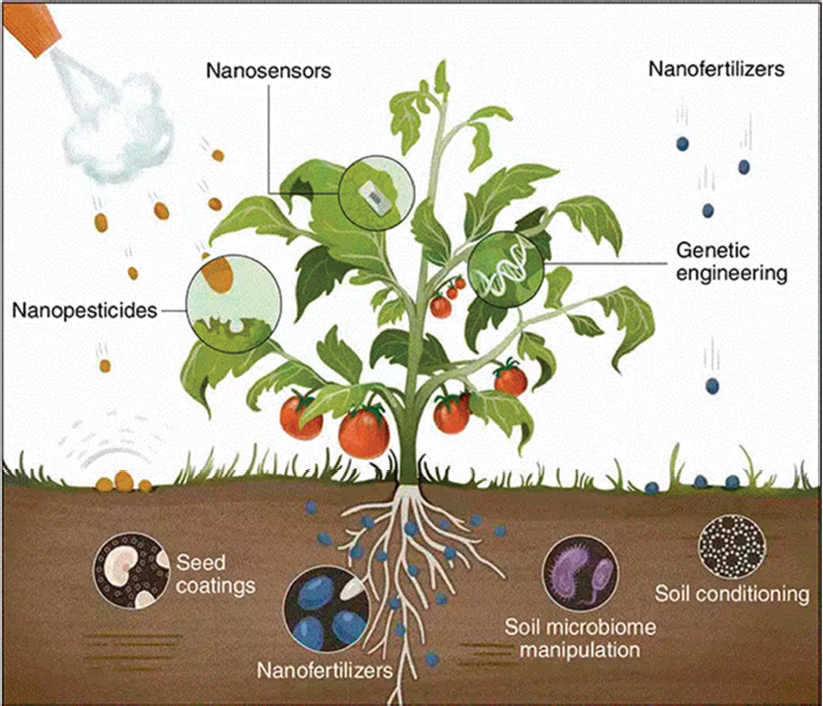
SOURCE: T. Hoffman, G.V. Lowry, S. Ghoshal, et al., 2020, “Technology Readiness and Overcoming Barriers to Sustainably Implement Nanotechnology-Enabled Plant Agriculture,” Nature Food 1:416–425, https://doi.org/10.1038/s43016-020-0110-1, Springer Nature.
pesticides, fungicides, and nutrients. They cite an example of the use of nanoscale materials to improve plant nutrition as a defense against disease. Nanoparticles of copper, zinc, magnesium, and sulfur were used to suppress fungal, viral, and bacterial infection. This article notes the growing number of product registration requests by regulatory agencies and the growing number of patents for nano formulations as an indication of growing interest in and application of nanotechnology for agriculture.
Climate change is impacting global agriculture, including altered weather patterns, increased frequency of extreme weather events, drought, and shifting pest and disease dynamics. Nanotechnology offers potential solutions to mitigate these impacts. For example, nano-enabled sensor-based delivery systems can provide
targeted release of agrochemicals, reducing waste and environmental impact. Nanomaterials can also be used to develop drought-resistant crop varieties and improve soil health through enhanced nutrient management. Other opportunities for nano-based solutions for sustainable agriculture include the use of nanomaterials for soil remediation and water purification.
The use of nanosensors to monitor crop health, soil conditions, and environmental factors in real time enables farmers to make data-driven decisions and optimize resource use. These sensor data provide input to AI systems that can help optimize crop management and minimize agrochemical use.
In food science, nanotechnology is being used to improve food safety by improving packaging and extending shelf life. A major effort is directed toward nanosensors that can detect pathogens and contaminants in food products, enabling better monitoring of the food supply and enforcement of safety standards.
Nanotechnology provides a path for transforming agriculture and food production, offering solutions to enhance productivity, sustainability, and crop resilience. As R&D continue to advance, interdisciplinary approaches involving nanotechnology point the way to the needed improvements in sustainable and secure food systems. The support of U.S. nanofabrication facilities and government initiatives will be instrumental in realizing these prospects.
Biology, Biotechnology, and Medicine
The advances in nanotechnology have had a striking impact on biology, biotechnology, and medicine. Nanotechnology has made new tools available to biology researchers that allow imaging and observing biological processes at the molecular scale. Devices enabled by nanoscale structures are creating a new class of sensors for chemically probing biological systems and sequencing of DNA and RNA in fundamentally new ways. The delivery of drugs using nanoparticles has revolutionized drug delivery and vaccine development. The advancements in biology and medicine have been supported by access to the most modern nanofabrication and imaging tools made available to this expanding community by the nanotechnology infrastructure. The biology and medical communities have effectively utilized the advances in nanotechnology and infrastructure of the NNI.
Examples of impact and continued opportunity for basic biological studies include the following:
- Nanotechnology enables single-molecule studies and imaging, which is crucial for understanding complex biological mechanisms. Techniques such as atomic force microscopy (AFM), scanning tunneling microscopy (STM), transmission electron microscopy (TEM), and super-resolution fluorescence microscopy allow researchers to image biological structures and engineered
- nanostructures with atomic resolution. Semiconductor quantum dots and metallic nanoparticles can be used to label, identify, and track molecules within cells, providing a unique picture of cellular functions and biomolecular interactions. Figure 3-2 illustrates three imaging techniques to image lipid nanoparticles.
- Nanofabrication of biological and biomimetic structures allows for the precise fabrication of engineered structures that can be used as models to test biological activities. Biomimetic structures that mimic the properties of natural biological systems in other material systems present a path to form functional materials and devices inspired by biological systems. This includes the creation of artificial scaffolds and vascular systems that can be used to study cell function and tissue engineering.
- Genetic research has made practical use of a range of nanostructures. For example, nanoparticles are used to deliver genetic material into cells for research on delivery of therapeutic molecules. This is essential for gene editing and gene therapy research, where precise delivery of DNA or RNA is required to modify genetic information within cells. Both nanofabricated and naturally occurring nanopores have been used to directly read the sequence of DNA and RNA molecules, revealing genetic information that would have been obscured with earlier techniques. Advances in the area of genetics and epigenetics continue to be advanced by nanostructure utilization and influence the practice of medicine.
The field of nanomedicine has opened new avenues for disease diagnosis, treatment, and prevention. Nanotechnology has enabled the creation of biosensors and diagnostic devices with unprecedented sensitivity that can detect biomarkers and diagnose diseases at early stages, leading to better patient outcomes. Nanotechnology has facilitated the development of advanced drug delivery systems. The National Cancer Institute “established the Nanotechnology Characterization Laboratory to support the extramural research community to accelerate the progress of nanomedicine by providing preclinical characterization and safety testing of nanoparticles.”9 Nanoparticles can be designed to target drugs to specific cells or tissues, improving the efficacy and reducing the side effects of treatments. The use of lipid nanoparticles to deliver RNA to cells represented a breakthrough in vaccine development that had a profound effect on the world’s response the COVID-19 pandemic and ushered in an entirely new approach to treatment of a
___________________
9National Cancer Institute, n.d., “Nanotechnology Characterization Lab,” https://ostr.ccr.cancer.gov/resources/provider_details/nanotechnology-characterization-laboratory-ncl, accessed November 14, 2024.

SOURCE: J. Szebeni, B. Kiss, T. Bozó, K. Turjeman, Y. Levi-Kalisman, Y. Barenholz, and M. Kellermayer, 2023, “Insights into the Structure of Comirnaty COVID-19 Vaccine: A Theory on Soft, Partially Bilayer-Covered Nanoparticles with Hydrogen Bond-Stabilized mRNA–Lipid Complexes,” ACS Nano 17(14):13147–13157, https://doi.org/10.1021/acsnano.2c11904. CC BY 4.0. Copyright © 2023 The Authors. Published by American Chemical Society. Scales were added as modifications to the TEM and Cryo-TEM panels.
range of diseases. This revolutionary ability to modify the immune system was a direct result of basic science and capabilities to engineer nanoparticles.
The use of nanoparticles has also advanced medical imaging techniques, allowing for more precise and earlier diagnosis of diseases. Nanoparticles can also improve contrast and add chemical information to imaging techniques such as MRI (magnetic resonance imaging) and CT (computed tomography) scans.
FUTURE INFRASTRUCTURE PROSPECTS AND CHALLENGES
The nanotechnology infrastructure is a national asset that facilitates cross-disciplinary advancement of science and translation of science and technology into areas that significantly impact the economy and wellbeing of Americans. For example, the use of nanotechnology in biology and medicine has dramatically increased understanding of living systems and is enabling new approaches for disease diagnosis and treatment. These advances were facilitated by the robust infrastructure to support nanotechnology R&D in the United States. The National Nanotechnology Coordinated Infrastructure (NNCI), for example, provides researchers with access to state-of-the-art facilities and expertise. These types of facilities provide an opportunity for fields as divergent as microelectronics and medicine to share technology advances.
Despite its strong infrastructure, the United States faces challenges in maintaining its leadership in nanotechnology. One major challenge is global competition as discussed in Chapter 2. Countries like China and South Korea have significantly increased their investments in nanotechnology R&D, narrowing the gap with the United States. This increased competition requires the United States to continuously innovate and invest in cutting-edge research to remain competitive. Failure to support widely used nano infrastructure will inhibit science and technological advances that are important to Americans.
Another challenge, discussed earlier, is funding durability and resource allocation. As noted in Chapter 2, there is a real risk that funding for the U.S. nanotechnology research ecosystem could be diminished, raising concerns about the sustainability and long-term investments in nanotechnology infrastructure. Such investments are vital and ensure that equipment is continually updated and that a steady number of users are trained and available for the U.S. workforce.
This chapter highlights the need for expansion of the infrastructure, so it can be responsive to the needs of emerging areas. Such agility will require attention to several key elements, including the following:
- Support for expert staff that can train and assist users from different disciplines, beyond nanotechnology, to be effective and efficient;
- Investments in staff training that center on updating their knowledge base, particularly in emerging areas of importance;
- Computational resources and AI/machine learning for process development and data analysis will grow in importance;
- Adapting lithographic and analytical tools to new materials, with strategies that address materials compatibility, to stimulate wider utilization; and
- Novel multiscale fabrication methods to integrate nanostructures with functional macroscopic devices.
The U.S. nanotechnology infrastructure is a critical resource for maintaining U.S. technological leadership, economic growth, and advances in health care. This durable infrastructure has been available to support emerging use areas such as those discussed above. The committee anticipates that unknown opportunities will arise, and to benefit the United States, it will be important to ensure that the nanotechnology infrastructure is renewed and has the capability for agile expansion to meet new demands and bring together those experienced in the use of nanotechnology with emerging areas proven to be effective at harnessing nanotechnology infrastructure in new ways. This has been the case, for example, with the nascent research on nanotechnology and agriculture.
Finding 3.1: There are many new and emerging areas of science and technology that rely on nanotechnology infrastructure for advancement.
Finding 3.2: Nanotechnology integrates knowledge from a broad set of disciplines, and emerging areas of science and technology are leveraging and extending its infrastructures to advance their own disciplines.
Recommendation 3.1: The National Nanotechnology Coordination Office should develop infrastructure gap analyses through annual workshops that engage researchers in relevant emerging areas with nanotechnology infrastructure experts.
Finding 3.3: The existence of an accessible infrastructure with state-of-the-art nanofabrication and characterization facilities, combined with expert staff, is important for supporting emerging science and technology initiatives.
Finding 3.4: The existing nanotechnology infrastructure has been available to researchers who otherwise would not consider themselves as working in nanotechnology, and this accessibility has been central to breakthroughs that have impacted the lives of all Americans.
Conclusion 3.1: Maintaining world-leading facility access is important for the U.S. economy and national security, as well as for ensuring continued leadership in science and engineering research.
Recommendation 3.2: The National Nanotechnology Coordination Office should coordinate and communicate with the National Quantum Coordination Office, the CHIPS Research and Development Office, and the Microelectronics Commons program—all of which have an interest in the scope, size, and support of nanofabrication and nanocharacterization capabilities and access in the United States.
This is a priority recommendation.
Recommendation 3.3: Federal agencies that support nanotechnology infrastructure should within the next year, and periodically thereafter, prioritize investment in new capabilities that advance fabrication, materials synthesis, characterization, and data analysis to support emerging technologies to help the United States maintain its commercial edge.


