Advancing Health and Resilience in the Gulf of Mexico Region: A Roadmap for Progress (2023)
Chapter: Summary
Summary1
Natural disasters of all kinds—hurricanes, tornados, winter storms, drought, floods—as well as the COVID-19 pandemic, have challenged the lives and livelihoods of the people who live and work in the Gulf of Mexico region. These repeated assaults have taken a cumulative toll on the health and well-being of people in the Gulf and tested their resilience. Compounding the damages caused by natural disasters are long-standing societal challenges related to institutional racism, poverty, educational issues, inequitable living situations, and underemployment. Although such challenges are not unique to the Gulf region, their intersection with recurring natural disasters has resulted in chronic stresses for vulnerable residents of the Gulf states, particularly for marginalized populations.
In this context, the Gulf Research Program (GRP), a division of the National Academies of Sciences, Engineering, and Medicine, sponsored a study with the goal of helping to advance the development of sustainable systems that support activities focused on health and community resilience, and of supporting more robust and consistent scientific scholarship in the area of health and community resilience for organizations or individuals, including federal and state institutions and funders, community-based organizations, public and private organizations, philanthropic groups, academic institutions and student groups, and others that work in this important space. This report reviews existing definitions and models for health and community resilience; examines roadblocks, gaps, and challenges faced
___________________
1 This summary does not include references. Citations for the discussion presented in the summary appear in the subsequent report chapters.
by people who live and work in the Gulf region; recommends actions to facilitate sustainable progress through the lenses of data, governance, infrastructure, human capital, and funding; and presents a viable road map for facilitating and sustaining progress toward health and community resilience in the Gulf region at the community, state and regional, and national levels.
STUDY CHARGE AND SCOPE
To conduct this study, the National Academies appointed a 12-member ad hoc committee with a broad range of academic and professional expertise, including disaster research, community health, behavioral health, disaster response and recovery, public policy, economics, and housing and community development. During the study period, September 2021 to November 2022, the committee held 10 in-person or virtual meetings; a commissioned paper examining the current state of health and community resilience in the Gulf of Mexico supplemented the committee’s research and deliberations. The committee’s charge included the following tasks:
- Review major efforts (past or present), common challenges, and/or key priorities in health and community resilience across the five Gulf of Mexico states (i.e., Florida, Alabama, Mississippi, Louisiana, and Texas).
- Develop an approach that could be used to assess the progress of health and community resilience across the Gulf of Mexico region over time through future studies in this series.
- Consider opportunities that could lead to significant progress in enhancing or improving health and community resilience across the Gulf of Mexico region.
- Identify major challenges or critical gaps (e.g., in research, data/information, planning, policy) that could be addressed to advance the health and community resilience in the Gulf of Mexico region, including potential innovative or transformative approaches.
While the study was sponsored by the GRP, the committee was not charged with making recommendations for that program, but rather with taking a broader view of the funding and programs that contribute to both the development and assessment of health and community resilience in the Gulf region. Early in the committee’s work, it became clear that both the concepts of health and community resilience and the Gulf of Mexico region encompass a significant diversity of communities, resources, circumstances, history, needs, and opportunities. Accordingly, the committee did not seek to define a single set of methodological criteria for assessing health and community resilience in the Gulf region. Instead, the committee focused
on identifying models and approaches that are both useful in assessing the current state of the region and that could be applied consistently at points in the future. Similarly, in its approach to addressing challenges or gaps, the committee endeavored to strike a balance throughout this report between being sufficiently specific to be useful and remaining flexible enough to be widely applicable across the Gulf region.
Based on its work throughout this study, the committee identified four key roadblocks that need to be addressed if progress is to be made toward more sustainable and effective health and community resilience efforts in the Gulf of Mexico region (Figure S-1):
- The lack of a holistic systems approach to program development and delivery of community health and resilience services and resources to communities;
- Incomplete, ineffective, and uncoordinated efforts to capture data related to the health and resilience of communities, which results in a lack of understanding of community needs and capacities and the inability to translate needs and resources into action;
- Insufficient financial and human resources reaching communities in need, as well as limitations of oversight and accountability, as well as engagement and coordination with elected officials; and
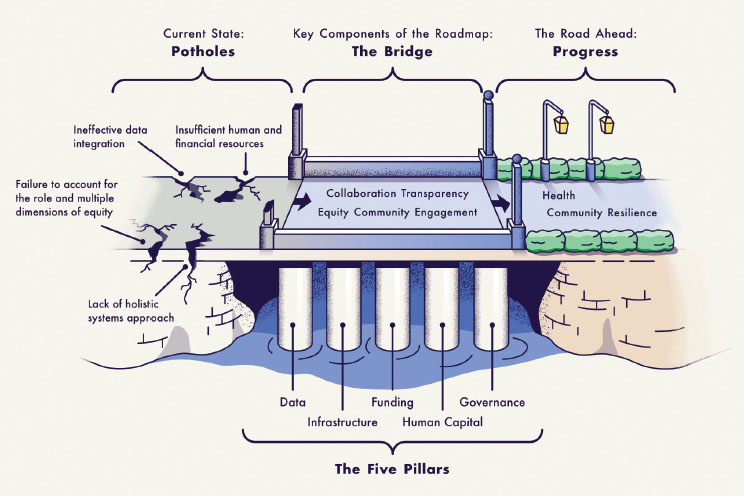
- The failure of current systems to account effectively for the role and multiple dimensions of equity in rendering communities persistently vulnerable, and the need to recognize that sustainable progress will require intentional efforts to overcome structural and historical inequities while centering communities.2
The report explores each of these issues in turn before presenting a road map for action. In developing its conclusions and recommendations, and conscious of the rich diversity of risks, needs, and capacities of communities in the Gulf region, as well as the varied structures of government and the plethora of different nongovernmental and community-based organizations active in different areas, the committee has endeavored to provide conclusions and recommendations sufficiently specific to create guideposts on a path forward, but flexible enough to be tailored to the needs and circumstances of individual states, localities, and communities, as well as situations. Illustrative examples of challenges, successes, and potential practices are provided throughout the report.
THE NEED FOR A SYSTEMS APPROACH TO HEALTH AND COMMUNITY RESILIENCE
We’ve unfortunately developed a disaster culture, so when disasters hit there’s a money flow, opportunities for inroads to programs to help us try out solutions, but the issue is sustaining those opportunities.
—Lanor Curole, Director,
Vocational Rehabilitation, United Houma Nation, Houma, Louisiana
As a prelude to considering the specifics of health and community resilience in the Gulf of Mexico region, it is important to consider the foundational work that has been undertaken to describe systems of health and community resilience more generally, including the components that make such a system successful. Throughout this report, the discussion is informed by the following definition of a system of health:
A system of health comprises systems or parts of systems that interact strongly to produce health. It includes both upstream drivers of health that mitigate health problems (i.e., social determinants of health) and those systems that produce health gains.
Developing a road map for progress toward health and community resilience in the Gulf region requires going beyond a broad construct for
___________________
2 Centering communities is a concept in which those closest to a particular risk or hazard get to determine the priorities for change and are at the forefront of facilitating that change.
a system of health; it is also important to consider the components of that system individually. To this end, it is necessary to explore:
- models of sustainable public health infrastructure, encompassing leadership and governance;
- appropriate integration of proximal and distal indicators of health;
- the ways in which data are gathered, analyzed, interpreted, and applied to support decision making;
- whether sufficient financial and human resources are employed appropriately and sustainably; and
- appropriate applications of a multidimensional context of equity, which is essential not only to advance progress, but also to overcome historical inequities that play an essential role in the current challenges facing the Gulf region.
In applying its findings, conclusions, and recommendations as a practical matter, the committee believes communities will be best served in adopting a “health in all domains” approach, integrating health and community resilience activities and concepts into existing offices and programs in the majority of cases, and taking an additive approach only when necessary.
ADDRESSING CRITICAL GAPS IN THE DATA ON GULF HEALTH AND COMMUNITY RESILIENCE
Addressing issues of incomplete, ineffective, and uncoordinated data collection is critical for any effort to improve health and community resilience in the Gulf region. On the front end, lacking consistent, high-fidelity data on the health and resilience of people and communities limits the ability of government, community organizations, funders, and service providers to understand the needs and thus to identify, plan for, and provide the services necessary to meet those needs in a meaningful and sustainable way. During the operation of programs, the limitations of available data can make it difficult, if not impossible, to track progress; assess the success, or lack thereof, of interventions; and make adjustments needed to meet program goals.
Over the longer term, data limitations create challenges in measuring success, identifying best practices or opportunities for learning on a regional or national scale, and translating programs and service delivery models to other contexts. On a broader level, the lack of consistent data across communities hinders efforts to identify factors that may require more targeted mitigation efforts because of community- or location-specific needs, and impedes program assessment, as well as governance and accountability efforts on a regional or national scale.
The committee’s research, analysis, and deliberations yielded several overarching conclusions regarding the current state and potential areas of improvement in the collection, analysis, and use of data related to health and community resilience in the Gulf of Mexico region:
Conclusion 3-1: Substantial gaps exist in the quality and robustness of health data in the Gulf states.
Conclusion 3-2: Further efforts to require improvements in data quality are needed nationally. Alongside national efforts, Gulf state policy makers have an important role to play in promoting data- and evidence-based programs and investments.
Conclusion 3-3: In addition to higher-quality data, improved data analyses are needed. This research, often built through partnerships with local academic institutions, could fill gaps in understanding of the links from contextual causes, to social and environmental determinants, to health outcomes in the Gulf. Further evaluation of the potential causal links between social determinants and environmental and demographic factors would advance understanding of specific interactions and effects with respect to how contextual determinants have evolved and are currently experienced.
Conclusion 3-4: Current determinants of health outcomes related to the quality of and access to health care services and their providers surface as likely opportunities for significant improvements in data quality. They include access to positive health care resources, such as health insurance and quality, affordable health care providers. Opportunities to improve data quality also exist with regard to hazard- and risk-related determinants, including reduced exposures to environmental pollutants and hazard effects.
Conclusion 3-5: Current data collection and analysis are insufficient to meet the needs and achieve the quality standards recommended in this report for comprehensive empirical study and corresponding policy action.
Conclusion 3-6: Although financial resources for data collection in the Gulf states and local communities, as well as their public health officials, are a priority, the knowledge and engagement of civil-sector entities and local organizers and leaders are critical as well. It is a best practice to involve and compensate these entities for their health data collection and research design involvement. Nonprofit and for-profit health care providers play a critical role in data reporting as well but are not consistently compensated for this effort.
Conclusion 3-7: The available evidence shows clearly that disparities in health and resilience exist between the Gulf states and other regions of the United States, and these disparities are especially pronounced within the Gulf states in less- versus more-resourced localities. This variation reflects spatial distributions by race and income, with African American and Native populations, immigrants, linguistically diverse communities, low- and extremely low-income households, and communities with higher proportions of youth being at particular disadvantage.
Based on the above conclusions, the committee recommends a number of actions focused on better connecting the proximal and distal indicators of health and resilience in policy and practical applications. The first of these is one of two national strategies envisioned by the committee to facilitate a more consistent approach to collection and analysis across the Gulf region and the nation, thereby supporting improved efforts to measure progress over time and across communities.
Recommendation 3-1: The Secretary of the U.S. Department of Health and Human Services (HHS), should convene HHS agencies, including the Administration for Children and Families, the Centers for Disease Control and Prevention, the National Institutes of Health, the National Center for Health Statistics (NCHS), and the Substance Abuse and Mental Health Services Administration, and professional organizations, including the National Association of County and City Health Officials and the Association of State and Territorial Health Officials, to develop and promulgate a national strategy for the collection and use of health and resilience data. Components of this strategy should include:
- a consistent set of standards and measures for the collection of community-level health and resilience data and a set of uniform protocols for data collection and management;
- the identification of methods for improving the quality of data collection (including instrumentation and population data quality controls) for marginalized communities in particular;
- the identification of best practices and supporting mechanisms for engaging a diverse group of collaborators, including communities, nonprofit organizations, for-profit and nonprofit health care organizations, and academic institutions and researchers, in data collection and management;
- a strategy for supporting robust, consistent data collection and timely sharing efforts across government through NCHS’s
- engagement with other federal agencies outside HHS collecting health and resilience data, including the Environmental Protection Agency, the National Oceanic and Atmospheric Administration, the National Science Foundation, and the Department of Housing and Urban Development, as well as state-level data coordinators.
Recommendations 3-2 and 3-3 focus largely on communication and engagement between funders and community members and between funders and service-providing organizations, including state and local health departments and community organizations, to improve the applicability, sustainability, and impact of these efforts.
Recommendation 3-2: Funders supporting research in the Gulf region should take steps to ensure that local communities are engaged in the research through a range of strategies, including the public participation approaches and more in-depth community engagement partnerships. Community engagement will be important for collecting, understanding, and translating data on health and community resilience.
Recommendation 3-3: When developing and communicating their programmatic priorities, federal research funders, including the National Institutes of Health, the Centers for Disease Control and Prevention, and the National Science Foundation, and major philanthropic organizations should be explicit about their longer-term research agendas, gaps to be filled in both current and future funding cycles, and funding availability and sustainability expectations over time.
STRENGTHENING THE FOUNDATION: PILLARS FOR BUILDING HEALTH AND COMMUNITY RESILIENCE IN THE GULF REGION
The community has to be in charge of its own recovery because the government always goes home.
—Jane Cage, Chair,
Citizens Advisory Recovery Team (CART), Joplin, Missouri
Improved data with which to better understand the needs of communities and the various factors influencing their health and resilience and to measure progress over time is one essential pillar forming the foundation for building health and community resilience in the Gulf region. The committee identified four additional pillars that need to be improved: infrastructure, human capital, funding, and governance.
Infrastructure and Governance
In many ways, the infrastructure and governance challenges in the Gulf of Mexico region are connected at the level of state government. State legislatures and executive agencies are the nexus between the majority of funding for both physical and organizational infrastructure and the priorities that dictate how that funding is delivered to communities. During the course of this study, the committee sought to engage with a diverse group of state and local government officials and community leaders throughout the Gulf to better understand the challenges they currently face in both delivering and overseeing programs for health and community resilience in communities. That engagement led to the following conclusions with respect to infrastructure for and governance of efforts focused on health and community resilience in the Gulf region:
Conclusion 4-1: Government leadership has not consistently ensured that infrastructure supporting community health and resilience is capable of withstanding a range of disaster impacts. Efforts to ensure health infrastructure is capable will likely necessitate collaboration and robust partnership with private-sector organizations, many of which own and operate much of U.S. health care delivery.
Conclusion 4-2: State-level and local-level bottlenecks have consistently limited the flow of resources to communities.
Conclusion 4-3: Building sustainable resilience funding and adaptive programming will be reliant on innovative funding approaches and strategies that supplement vital existing philanthropic resources.
Conclusion 4-4: Federal funders exercise limited oversight to ensure that funding reaches the organizations who most need it in ways they can best use it.
Human Capital and Funding
More consistent and sustainable applications of human and financial resources are critical to improved progress toward health and community resilience in the Gulf region. On the human side, greater effort is needed to ensure that communities and community leaders are appropriately engaged in the identification of needs and the development of priorities for their particular communities and that health and community resilience efforts undertaken are consistent with those needs and priorities. To address the need for increased involvement of community
leadership in health and resilience efforts, the committee makes the following recommendations:
Recommendation 4-1: Public health and community resilience initiatives should facilitate public participation that is designed around specific community needs and priorities, supports bidirectional learning and engagement, and is, where possible, integrated with existing community resilience activities (e.g., infrastructure resilience plans, community emergency response and recovery plans) consistent with a health in all domains approach.
- State and local leaders should develop public health and community resilience initiatives that facilitate public participation and are designed around specific community needs. Engagement initiatives should support bidirectional learning and engagement.
- Funders should intentionally broaden their outreach to local leaders and facilitate opportunities to engage with nontraditional and non-hierarchical service delivery organizations to identify opportunities for community collaboration and participation in projects.
Addressing the financial component of the resource issue requires understanding that both government and nongovernmental entities have a role to play in funding, and by extension in developing, implementing, and evaluating health and community resilience programs. To a large extent, the committee finds that a collaborative and holistic approach to funding that encompasses states, localities, the federal government, major philanthropic organizations, community representatives, and community-based organizations is best suited to addressing this significant challenge. Accordingly, the committee recommends that a second large-scale national strategy be developed to address health and community resilience funding encompassing both organizational and operational components.
Recommendation 4-2: Under the leadership of the Centers for Disease Control and Prevention and the Federal Emergency Management Agency, the federal government should convene key governmental and philanthropic funders of health and community resilience programs to collaboratively develop an interdisciplinary and cross-sectorial strategy to support sustainable funding efforts in the Gulf of Mexico region. The successful development and implementation of this strategy is dependent on both organizational and operational elements.
Organizational components of this strategy include the following:
- Health in all domains: A commitment to a health in all domains approach to funding that aligns with existing activities, where
- possible, and encompasses diverse groups that can contribute to the health and resilience of a community, including health care and mental health care, education, housing, and social infrastructure.
- Transdisciplinary and cross-sectoral efforts: A commitment to supporting transdisciplinary efforts to break down silos and develop more comprehensive understanding of the successes and needs in health and community resilience in communities. All funders should articulate meaningful requirements for transdisciplinary and cross-sector collaboration in their requests for proposals and should give preference to applicants who can demonstrate specific and meaningful collaboration for their projects.
- Building community capacity: Plans, financed largely by state and local funders of health and community resilience programs, to develop and operationalize foundational capacity among community-based organizations to receive and manage funding from federal and state sources.
- Practical applications: The development of funder portfolios that include research and programmatic efforts focused on practical applications and on impacts of value as identified by the local communities collaborating in the work.
Operational components of this strategy include the development of plans, resources, and measurable milestones focused on the following objectives:
- Shift funding models to facilitate the engagement of and partnership with historically Black colleges and universities (HBCUs) and minority serving institutions (MSIs) so that they are the primary recipients of increased quantities of funding targeted to minority populations with the capabilities to partner with other institutions and organizations, instead of funds being disbursed to groups and institutions with requirements to partner with HBCUs and MSIs.
- Facilitate the creation of funding models and mechanisms that can meet community needs in a more responsive and adaptive manner.
- Facilitate an increased focus on community engagement. The strategy should help funders identify proactive steps for ensuring that transdisciplinary approaches emphasize representation and self-determination by communities.
- Guide the promotion and support of work that identifies future gaps or risks before or in the early stages of disaster impact to communities. Ongoing and future funding opportunities should be developed based on the reevaluation of risks and gaps and the assessment of the incremental and appropriate progress of prior funded efforts.
Furthermore, the committee made two recommendations focused on stronger governance and oversight of health and community resilience efforts at the state level:
Recommendation 4-3: State legislators and leaders within executive agencies in state government should prioritize the inclusion of data in policy making and ensure that they are using specific and consistent data to inform decision making around health and community resilience programs. State leadership should also take steps to ensure that the development, operation, and evaluation of such programs include meaningful engagement with community members and leaders, providing opportunities for participation in both state capitals and local communities.
Recommendation 4-4: To best align priorities and resources and derive benefits from a learning system,3 state and local governments should explicitly designate a senior official responsible for health and community resilience efforts, even in cases in which responsibility for those efforts spans multiple offices or agencies.
A ROAD MAP FOR ADVANCING PROGRESS IN THE GULF REGION
There’s no one to help us but us.
—Gary Wiltz, MD,
CEO Teche Action Clinics, Franklin, Louisiana
From its first discussions, the committee intended that this report should provide some form of road map that was accessible to communities and community leaders to help facilitate their participation in making progress toward health and community resilience in the Gulf of Mexico region. The realization of that intention is the conclusion of this report. The committee presents a road map for advancing progress toward health and community resilience that is organized by the actor or set of actors the committee believes is best positioned to lead on each of its recommendations, while emphasizing that the majority of the recommendations should involve the whole of the community in refining and implementing.
___________________
3 A learning system in this context is an organization that follows a process of regular, deliberate evaluation and incorporates the findings of those evaluations into policies and programs to guide the next evolution, in this case the response to the next disaster.


