Advancing Health and Resilience in the Gulf of Mexico Region: A Roadmap for Progress (2023)
Chapter: 5 A Road Map for Advancing Progress Toward Health and Community Resilience in the Gulf Region
5
A Road Map for Advancing Progress Toward Health and Community Resilience in the Gulf Region
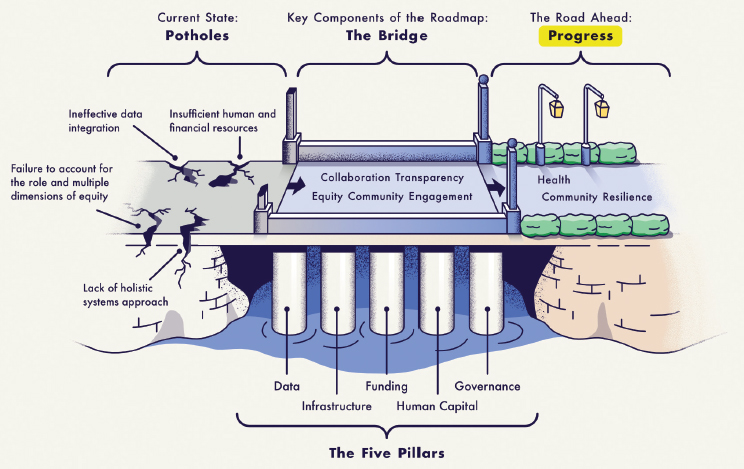
In its statement of task (p. 2), the committee was charged with identifying major challenges or critical gaps to be addressed in advancing health and community resilience in the Gulf of Mexico region, considering opportunities that could lead to significant progress in health and community resilience, and developing an approach to measuring that progress over time, as well as reviewing efforts, challenges, and priorities around health and
resilience in the Gulf region based on past and present efforts. This final chapter highlights four key areas (roadblocks) where progress is currently limited and should be addressed, and the chapter provides a road map for actions by communities, funders, including state and local governments and nongovernmental organizations (NGOs), and national leadership to overcome these obstacles. Included in the recommendations are actions that the committee believes will provide consistency and higher fidelity to efforts at measuring health and resilience going forward, and to the levels of planning, oversight, and accountability necessary for building and sustaining success.
ROADBLOCKS ON THE PATH: MAJOR CHALLENGES AND CRITICAL GAPS
Based on its efforts over the past year, the committee concludes that progress toward better, more sustainable health and community resilience efforts in the Gulf of Mexico region is inhibited by the presence of four significant roadblocks:
- The lack of a holistic, systems approach to program development and service delivery;
- Incomplete, ineffective, and uncoordinated efforts to capture data related to the health and resilience of communities’ resulting in a lack of understanding of community need and community capacity, and an inability to translate needs and resources into action;
- Insufficient financial and human resources reaching communities in need, with the support that does exist hobbled by bottlenecks, inequities, and limitations of oversight and accountability; and
- An enduring failure of current systems to effectively account for the role and multiple dimensions of equity in rendering communities persistently vulnerable. Sustainable progress will require intentional efforts to overcome structural and historical inequities while centering communities.
This lack of a holistic systems approach is in part the result of challenges related to funding, which will be addressed further on, but it is also related to the limitations of planning, as well as physical, technological, and human capacity when it comes to service development and delivery. The Gulf of Mexico region, in particular, suffers from recurrent disasters that have reduced its physical infrastructure, separated communities from resources, and exacerbated the challenges required to deliver the right services, in the right place at the right time, and in the ways that are most beneficial to the communities. The development of a holistic, systems approach to meeting the health and community resilience needs of people living in the Gulf region will be dependent on a planful and deliberate effort
that aligns the service delivery needs with both appropriate investments in physical infrastructure and the human and material resources necessary to carry it out, with appropriate accountability and sustainability built in.
The committee provides several recommendations aimed at coordinating funding sources and building a more equitable and sustainable system for funding health and community resilience programs in the Gulf of Mexico region. We see such improvements as the first steps in achieving an improved system for both making and measuring progress toward health and community resilience goals.
Limited financial and human resource capacity, as well as resulting limitations in sustainability, are the result of outdated frameworks and methodologies by which resources flow to the communities where services are delivered and programs implemented. On the financial side, health and community resilience efforts are supported in part by federal funds channeled through state and local governments, where priorities are often interpreted, and funding applied, in different, and inconsistent, fashions as funds pass through each level of government, and in part by direct funding by both the federal government through research funding and nongovernmental, philanthropic organizations, as well as additional funding provided by states and localities. These differentiated funding streams create challenges in both the availability of funds across places and activities, as well as limitations in application and support for sustainability in communities.
On the human resources side, again the varying priorities across levels of government can make service delivery difficult for the community organizations delivering services, as can the limitations created by often ad-hoc, grant-based funding that in many cases does not provide for capability development within community organizations or the consistency of a sustainable focus and funding. Because of this ad-hoc funding, in cases where funding does exist, it often cannot be fully used by communities and community organizations owing to the challenges inherent in grant management, programmatic reporting, or other administrative limitations. The skill set required to manage these efforts is entirely different from that required to provide services in communities, but it is often not supported or not fully supported by funding streams.
Larger, and in many cases, older organizations, have resources and structures to fill these gaps, but smaller community-based or demographically focused health and resilience organizations will require additional support to develop this capacity. Further, where funding has been made available for health and resilience programs, often limitations on oversight and accountability have led to some stunning instances of fraud and waste, which both diverts resources from communities and undermines trust in the organizations that attempt to provide services.
The committee offers recommendations aimed at developing and implementing a modern vision for delivering resources to support health and
community resilience efforts to local communities in a way that is consistent, sustainable, more equitable, and better informed by community needs. We believe there are essential first steps toward empowering communities as leaders in health and community resilience and overcoming historical inequities that have continued to inhibit progress.
The issue of incomplete, ineffective, and uncoordinated efforts with regard to data is critical for any effort to improve health and community resilience. On the front end, lacking consistent, high-fidelity data about the health and resilience of people and communities limits the ability of government, community organizations, funders, and service providers to understand the needs of communities and, as a result, properly identify, plan for, and resource the services necessary to make meaningful and sustainable improvements. During the operation of programs, the limitations of available data can make tracking progress, assessing the success, or lack thereof, of interventions, and making appropriate adjustments needed to meet goals difficult, if not impossible.
On a longer-term or postprogram basis, data limitations create challenges and limitations in measuring success, identifying best practices or opportunities for learning on a regional or national scale, and translation of programs and service delivery models to other areas. On a broader level, the lack of consistent data across communities hinders efforts to identify factors that might require more targeted mitigation efforts because of community- or location-specific needs and inhibits program assessment as well as governance and accountability efforts on a regional or national scale.
The committee offers several recommendations aimed at improving data at the local, state, and national levels, as well as a need for attention to more sophisticated analyses of those data. Such data improvements will lead to better understanding the needs of communities, as well as improved planning, resource allocation, and capacity to scale up lessons learned within the Gulf region and beyond.
Woven throughout all these issues is the effect of historical and structural inequities within the Gulf of Mexico region. While such inequities are present throughout the United States, their impact in the Gulf region is particularly acute in combination with other regional factors including the risk of chronic and recurrent disasters. Limitations of infrastructure, funding, human and community capital, and challenges related to governance and accountability are all tied to a historical failure to address equity effectively. Equity, as discussed here, is multidimensional and should be addressed from both the perspective of policy makers and community members. The committee believes that the most appropriate approaches to progress toward health and community resilience are those that center communities, empowering those that are closest to harm to determine priorities for change, and facilitating their being at the forefront of that change.
Implicit in this is the importance of overcoming historic and structural inequities, and the intention is that a community’s perspective of what is appropriate, accessible, and valuable to them should be prioritized. Several of the committee’s recommendations are aimed at advancing equity, especially in the areas of data collection, program funding, and capacity development. Throughout its work the committee sees equity as an essential component of implementing all of its recommendations.
MAKING PROGRESS—IDENTIFYING A ROAD MAP FOR ACTORS
The principal question this report endeavors to address is how to create a road map for action to address these limitations to health resilience in the Gulf region. While the report presents findings, conclusions, and recommendations throughout, this chapter reorganizes the committee’s recommendations in light of what is most likely achievable when being driven by key actors: by communities and community-based organizations, by intermediate actors such as larger philanthropic organizations or state government, and needed leadership from the national or federal government level.
Recommendations for Community-Level Leadership and Action
The ability of local community members and community organizations to drive significant change is to a large degree underestimated in health and community resilience literature. The committee’s experiences on site visits in Houma and New Orleans, Louisiana, and discussion with community leaders around the Gulf region highlighted significant ability and opportunity for communities to drive progress, especially when organized and effectively resourced. This report makes recommendations for enhancing community leadership in health and resilience efforts, and the committee encourages communities and community organizations to use these recommendations to ensure their voice is heard.
Recommendation 4-1: Public health and community resilience initiatives should facilitate public participation that is designed around specific community needs and priorities, supports bidirectional learning and engagement, and is, where possible, integrated with existing community resilience activities (e.g., infrastructure resilience plans, community emergency response and recovery plans) consistent with a health in all domains approach.
- State and local leaders should develop public health and community resilience initiatives that facilitate public participation and are designed around specific community needs. Engagement initiatives should support bidirectional learning and engagement.
- Funders should intentionally broaden their outreach to local leaders and facilitate opportunities to engage with nontraditional and non-hierarchical service delivery organizations to identify opportunities for community collaboration and participation in projects.
Similar to the recommendation’s call for bidirectional learning and engagement, the committee encourages a dual-mandate approach to implementing this recommendation. External leaders of public health and community resilience initiatives, be they public officials, clinicians, or researchers, should approach public participation in a way that meets community needs and facilitates access. At the same time, community leaders should proactively think about and be prepared to communicate and organize around bringing resources or opportunities to community members in ways that are consistent with the community’s needs. External leaders may not know what they do not know and may make assumptions based on efforts in other communities. Community leaders can help by facilitating solutions that work to meet the needs specific to their communities. Funders who are supporting the collaboration and local community leaders can play a significant role in defining who needs to be at the table in support of a particular project or initiative. By completing community resources inventories or similar planning efforts, community leaders can be prepared to engage with the funders who are looking for broad-based community engagement.
Finally, communities and community organizations can contribute to the implementation of Recommendation 3-2, that funders supporting research in the Gulf region should take steps to ensure that local communities are engaged in the research through a range of strategies, including the public participation approaches and more in-depth community engagement partnerships. Community engagement will be important for collecting, understanding, and translating data on health and community resilience. Such engagement will create a well-developed inventory of the communities’ resources and needs so that they can clearly identify when and how they are able to participate in research endeavors, what the community is looking to see in terms of supporting their participation, and what research might best benefit the community.
Recommendations for Leadership by Funders, Including Local and State Officials and NGOs
This report makes many recommendations targeted to those funding health and resilience initiatives and research, several of which are most appropriately led by a combination of philanthropic funding organizations who work on a local or regional basis and/or the state and local officials who make key decisions in the application of both their own budget dollars
and federal funds provided to the states. In addition to being a willing and approachable collaborator on the three recommendations noted above, this intermediate level of actors is best positioned to lead several categories of recommendations including those related to infrastructure, those around particular funding models and vehicles, and ensuring that efforts are cross-disciplinary and cross-sectorial. The committee finds that state leadership has not consistently ensured that infrastructure supporting community health and resilience is able to withstand a range of disaster impacts and that there are consistently limitations of the availability of resources flowing down to communities as a result of state-level bottlenecks.
In response to this issue, the committee makes several recommendations about funding models and vehicles to support health and resilience initiatives (Box 5-1) tied to a more robust and truly collaborative engagement with the communities being served or participating in research. Several recommendations call for broader engagement and reshaping of the funding opportunities both to ensure that all the participants who can contribute to the success of the effort are appropriately engaged, and that all contributors are appropriately supported and compensated for their time and effort as well.
One of the organizational elements of Recommendation 4-2 encourages funders to consider different funding vehicles to make funding more available to community-based organizations:
Building Community Capacity: Plans, financed largely by state and local funders of health and community resilience programs, to develop and operationalize foundational capacity among community-based organizations to receive and manage funding from federal and state sources.
This could enable more funds to be available to community-based organizations by expanding the availability of federal funds directly from the state, without a local pass through requiring additional cost and administration. Also a significant conclusion, focuse on a municipal level, or on state application to the municipal level, indicates benefit could be derived from an increased exploration of social impact bonds as a potential resource for supporting community health and resilience, as discussed in Chapter 4.
Three recommendations, components of Recommendation 4-2, targeted for action by funders at this level focus on the importance of interdisciplinary and cross-sectoral efforts (see Box 5-2). While these recommendations could be implemented under direction from federal authorities as part of funding programs, many of the health programs as well as related social services, housing, infrastructure, education, and other services are under the direct control of state and local officials. The committee strongly encourages both public officials and private and nonprofit funders to
emphasize a whole-of-community approach to work done under their auspices, and to take steps to ensure that work done on health and community resilience is complementary to efforts being funded across the other interconnected domains.
Recommendations for National Leadership
Finally, two of the committee’s recommendations require the leadership of the federal government and national organizations to contribute to the far-reaching and substantial changes envisioned by the committee (see Box 5-3). These recommendations call for the creation and resourcing of a pair of national strategies, one focused on health and community resilience data collection, analysis, and use, and another focused on sustainable funding; individually and together they could reshape the future of health and community resilience in the Gulf of Mexico region. While components of each of these strategies would require significant engagement, and leadership by communities and states, and are thus included in earlier sections of this chapter, the fulfillment of both strategic recommendations will require significant national leadership.
Consistent with the inclusive theme of this report, this chapter is not intended to suggest limited opportunities for communities, funders, or public officials at any level to engage around particular recommendations, but rather to suggest that in making progress toward health and community resilience and using this report as a resource to assist in that effort, different actors may be best positioned to lead in different places. The committee is also conscious of feedback from community members and community leaders seeking resources that are actionable to them, by them, and the first section of this chapter is an effort to be responsive to that feedback. Overall, the recommendations contained in this report are intended to drive a broader, more collaborative effort toward progress.


