Advancing Health and Resilience in the Gulf of Mexico Region: A Roadmap for Progress (2023)
Chapter: 1 Introduction
1
Introduction
Natural calamities of all kinds—hurricanes, tornados, winter storms, drought, floods—as well as the COVID-19 pandemic, have challenged the lives and livelihood of the people who live and work in the Gulf of Mexico region. These repeated assaults have left a cumulative toll on the health and well-being of people in the Gulf and have tested the resilience of residents in these vulnerable areas. Compounding the damages brought by these natural disasters are long-standing societal challenges such as institutional racism and issues such as poverty, educational concerns, inequitable living situations, and underemployment. Although concerns such as these are not unique to the Gulf region, the intersection of reoccurring natural disasters coupled with the myriad problems associated with historical and ongoing racism and poverty, especially for marginalized populations, have resulted in chronic stresses that have created innumerable challenges for vulnerable populations in the Gulf states.
Storms have long threatened the U.S. states that rim the Gulf of Mexico—Alabama, Florida, Louisiana, Mississippi, and Texas—but fueled by warming seas and other effects of climate change, storms reaching the Gulf region are occurring more frequently and are larger and slower, causing devastating damage for those in the storm’s path and beyond (Figure 1-1; Kossin et al., 2020). As recently as the fall of 2022, when this committee was completing deliberations, Hurricane Fiona hit Puerto Rico and Hurricane Ian roared into Florida causing an estimated $29.3 billion in combined damages (NCEI, 2022). As these disasters hit one after the other, people in the storm’s path were faced with what amounts to overlapping recoveries as they struggle to recover from the latest disaster while still trying to grapple with damages from past storms or floods.
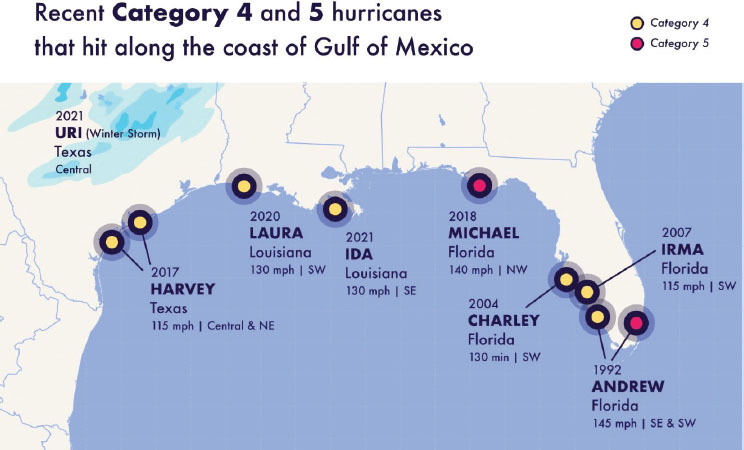
While the most observable form of recovery after a weather emergency is often the repairing or rebuilding infrastructure—homes, roads, power grid, water—the health needs of affected individuals and communities are too often given short thrift or ignored. In addition to immediate health concerns after a storm, individuals exposed to multiple disasters have been shown to be more susceptible to chronic health outcomes such as increased anxiety, post-traumatic stress disorder (PTSD), depression, and other mental health concerns (An et al., 2019; Blackmon et al., 2017; Cherry et al., 2015; Harville et al., 2011, 2018; Osofsky et al., 2016). A study of 3,030 U.S. Gulf Coast state residents by Karaye et al. (2020) found that compared to national standards, Gulf residents reported having poorer mental and physical health.
Additionally, individuals living in Gulf states who face economic hardship are disproportionately affected by mental health issues, depression, and other adverse psychological outcomes (An et al., 2019; Blackmon et al., 2017; Callender et al., 2022; Collins et al., 2019). This also includes children and adolescents who, when raised in socioeconomically disadvantaged environments, have been found to be two to three times more likely to develop mental health issues (Reiss, 2013).
People who live and work in the Gulf region face additional obstacles if they belong to communities that have been historically disadvantaged or marginalized because of race or socioeconomic status. One recent exemplar of this occurred in August 2022 when approximately 150,000 residents in Jackson, Mississippi, lost access to clean drinking water indefinitely after flooding from late-summer storms shut down the local water treatment plant (Flavelle et al., 2022). For decades prior to this disaster, mayors, city council members, and the Environmental Protection Agency had advocated for investments in the local water treatment facility to address issues related to aging infrastructure and staffing, but their concerns remained unaddressed (Kohli, 2022).
Underinvestment in disadvantaged and marginalized communities such as this, coupled with hurricanes, flooding, and other threats, result in chronic shocks and public health emergencies that threaten the lives of Gulf residents. Equitable investments in these areas are needed that will create safe, thriving communities that support the health of all their members, regardless of race, socioeconomic status, or other marginalizing factors. Exploring connections between health and community resilience in the Gulf region are the focus of this committee’s work.
ORIGIN OF TASK
The work of this committee has been sponsored by the Gulf Research Program (GRP),1 a division of the National Academies of Sciences, Engineering, and Medicine (referred to as the National Academies). Originating in 2013, the GRP was established when the National Academies received $500 million dollars in settlement funds stemming from the Deepwater Horizon oil spill disaster to conduct projects, studies, and other activities to advance and apply science, engineering, and public health knowledge in order to reduce the risks associated with oil spills and to help enable communities plan for, mitigate, and recover from natural or human-made disasters. This consensus study is one part of a broad body of science-based initiatives sponsored by the GRP. The goal of this study is to advance scientific scholarship in the area of health and community resilience for organizations or individuals, including federal and state institutions and funders, community-based organizations, public and private organizations, philanthropic groups, academic institutions and student groups, and others who work in the area of community health research.
___________________
1 For more information, see https://www.nationalacademies.org/gulf/gulf-research-program (accessed October 18, 2022).
COMMITTEE CHARGE AND METHODS OF THE STUDY
This report explores a broad range of issues relevant to the assessment of health and community resilience in the Gulf of Mexico region and on progress toward a goal of improved health and enhanced community resilience in that region. Specifically, the committee was provided a statement of task that asked them to address the following:
- Review major efforts (past or present), common challenges, and/or key priorities in health and community resilience across the five Gulf of Mexico states (i.e., Alabama, Florida, Louisiana, Mississippi, and Texas).
- Develop an approach that could be used to assess the progress of health and community resilience across the Gulf of Mexico region over time through future studies in this series.
- Consider opportunities that could lead to significant progress in enhancing or improving health and community resilience across the Gulf of Mexico region.
- Identify major challenges or critical gaps (e.g., in research, data/information, planning, policy) that could be addressed to advance the health and community resilience in the Gulf of Mexico region, including potential innovative or transformative approaches.
To address the study’s statement of task, the National Academies appointed a 12-member committee with a broad range of academic and professional experiences including disaster research, community health, behavioral health, disaster response and recovery, public policy, economics, and housing and community development. The committee deliberated from September 2021 to November 2022, and during that time the committee held 10 in-person or virtual meetings. Because of the effect of the COVID-19 pandemic, the committee’s first three meetings were entirely virtual, while remaining meetings involved both in-person and virtual collaboration among members.
THE COMMITTEE’S APPROACH
This study was brought to the committee as part of the National Academies GRP’s efforts to continuously assess progress in its areas of engagement, including health and community resilience. The committee was charged with taking a broad view of the funding and programs that contribute to both the development and assessment of health and community resilience in the Gulf region. While the committee was not charged with providing recommendations to the GRP, the outcomes of this effort are expected to help inform the GRP’s work, and discussions with GRP staff
were integral to the committee’s understanding of the program, as well as its approach to the statement of task. From discussions with GRP staff and community partners the committee understood its task to be one of framing approaches that could address historical challenges in community health and resilience in the Gulf region, and measure progress, while supporting opportunities that are adaptable to the diverse and variable circumstances of communities throughout the region.
This dynamic tension between specificity and flexibility is one that the committee grappled with throughout the development of this report. In framing support for recommendations, the committee has endeavored to provide illustrative examples from communities to help contextualize how the recommendations could be implemented, without limiting them to any particular set of circumstances. The committee’s approach to exploring the factors influencing community and health resilience in the Gulf region is grounded in the framework of social determinants of health (SDOH). As defined by World Health Organization (WHO), SDOH are “the conditions in which people are born, grow, work, live, and age, and the wider set of forces and systems shaping the conditions of daily life.” The committee’s choice to rely on SDOH as a framing for the report’s discussions is grounded in the inherent and inseparable relationship between social determinants and factors of equity.
In addition to the core social determinants, the committee also relied on a more expansive understanding that includes political and structural drivers as determinants of health, as articulated by Dawes (2018). In particular, the committee proceeds from the premise that
our understanding of health disparities demonstrates that it is not one factor that has driven the inequities in health care and health status, but multiple intersecting determinants, driven in large part by law and policy.
The committee focused its efforts on policy-based and structurally cognizant solutions to chart a path forward for progress in health and community resilience.
Early in the committee’s work, it became clear that both the concepts of health and community resilience and the Gulf of Mexico region encompass a significant variety of communities, resources, circumstances, history, needs, and opportunities. Given that diversity, the committee did not seek to define a single set of methodological criteria for assessing health and community resilience in the Gulf region, but rather it sought to identify models and approaches that are both useful in identifying the current state of the region and that could be applied consistently at points in the future. Similarly, in its approach to challenges or gaps, the committee endeavored throughout the report to strike a balance between approaches that are sufficiently specific as to be useful but flexible enough to be widely applicable across the Gulf region.
The work of the committee was informed by several different mechanisms and activities—two public sessions, two site visits, a public workshop, electronic public comments, a commissioned paper, and a literature review. The committee hosted multiple open-to-the-public information-gathering sessions. In May 2022, the committee convened a 1-day hybrid workshop that brought together community members, health and resilience researchers and practitioners, and other relevant experts to discuss their experiences and perspectives on making and assessing progress toward health and community resilience in the Gulf region. This workshop included a public comment session.
The committee’s fifth meeting also included site visits hosted by the United Houma Nation, the City of New Orleans, and a federally qualified health center in La Fouche Parish, Louisiana. Public comments were formally solicited during the first and fifth in-person meetings of the committee in September 2021 and May 2022, respectively, and written comments from the public were accepted electronically for the entirety of the deliberative process. These public information-gathering sessions were supplemented by peer-reviewed and gray literature and by a commissioned paper by Kelsey Gleason and Maryann Makosiej examining the current state of health and community resilience in the Gulf of Mexico. The paper is referred to throughout the text, and the full text is presented in Appendix C of this report.
DEFINITIONS OF KEY TERMS USED IN THIS REPORT
From the outset of its work, the committee wrestled with the appropriate definitions of several terms and concepts used in discussions of health and community resilience, particularly in the context of diverse communities. In the interest of clarity, the committee presents the following as a set of consistent definitions for key terms used in this report. The committee acknowledges that these are not the only definitions available in the literature for these terms, nor are they necessarily the definitions used in all communities or by all practitioners. They are presented for the purpose of establishing a shared understanding of how terms are used in this report, and unless particularly addressed within a recommendation in this report, are not intended for any other purpose than establishing a shared understanding between the committee and the reader (see Box 1-1).
RELEVANT NATIONAL ACADEMIES REPORTS
The National Academies has published several reports that focused on issues related to the intersection between health and community resilience. The work of the current committee builds upon the findings, conclusions, and recommendations of prior National Academies committees who were
responsible for previous reports on these topics. Box 1-2 provides some examples of previous National Academies’ work that is relevant to the work of this committee.
ORGANIZATION OF THE REPORT
In organizing this report, the committee has relied on the framing, as the title suggests, of building a road map toward progress in advancing health and community resilience in the Gulf of Mexico region. Figure 1-2
is intended to help illustrate that road, and the report as a bridge toward progress. Chapter 2 describes foundational frameworks helpful in understanding the systems of health and community resilience as they currently exist and as the committee envisions they could exist, highlighting the significant challenges (gaps or cracks on the road to progress) facing communities in the Gulf region. Chapter 3 presents the first pillar supporting the committee’s bridge to progress and takes a substantially deeper look at the issue of data in understanding and addressing the challenges facing health and community resilience in the Gulf of Mexico region. Chapter 3 also
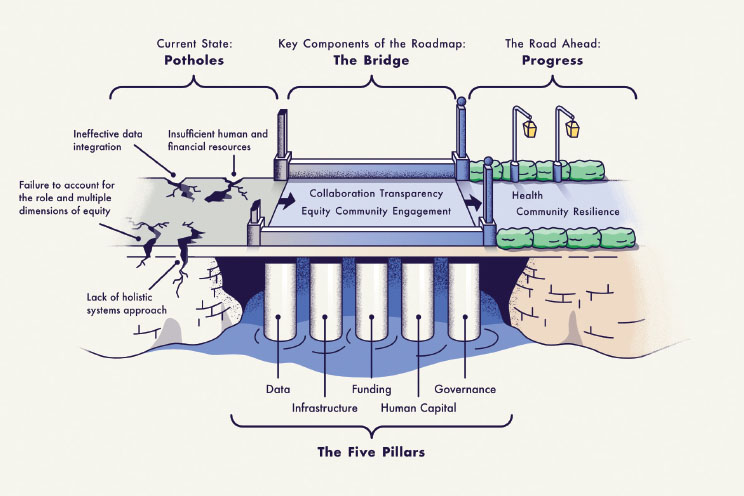
explores the current state of data collection and analysis efforts, the factors contributing to communities in the Gulf region diverging from similarly situated communities in other areas of the country and makes recommendations for how better data practices can contribute to sustainable progress toward health and community resilience in the region.
Chapter 4 continues to present the committee’s efforts to define a stronger foundation on which health and community resilience can be built through four additional interconnected pillars—infrastructure, human capital, funding, and governance—and presents the committee’s conclusions and recommendations to advance progress in those areas, completing the bridge. Chapter 5 provides a view of the road ahead, a road map for action, reframing the committee’s recommendations from throughout the report related to the actor or actors the committee feels is best situated to lead on particular recommendations. While the committee feels that many of its recommendations will require a whole-of-community engagement to refine and implement, Chapter 5 is designed to provide a map through which individual actors at the community, state, regional, and national levels can consider their role in advancing progress.


