1
Introduction
In early 2023, the United States set an ambitious goal to meet 80 percent of U.S. energy needs with renewable energy generation by 2030. This transition away from fossil fuel sources will require scaling up of a portfolio of efficient clean energy resources. One such potential resource is offshore wind. The National Renewable Energy Laboratory estimates the potential for offshore wind to generate more than 4,200 gigawatts of capacity/year, fulfilling energy needs along U.S. coastlines, where nearly 40 percent of the nation’s people reside.
In the United States, offshore wind is in the early stages of implementation with (at the time of this study) only two offshore wind farms in operation in U.S. waters—one offshore Virginia and one offshore Rhode Island. However, there are ambitions and plans for potential build-out of additional offshore wind farms on the U.S. East, West, and Gulf coasts. Part of the permitting process required to install and operate offshore wind farms includes assessing any potential ecosystem impacts, regulated by the Bureau of Ocean Energy Management (BOEM).
Assessing the ecosystem impacts of offshore wind development has a unique set of challenges. One challenge is to understand how the oceanography might be altered by the presence of a single offshore wind turbine, by an offshore wind farm, or by a region of adjacent offshore wind farms. An offshore wind turbine can alter flow by interrupting the winds that drive circulation processes and by causing turbulence in the water column surrounding the pile. The associated challenge is understanding how the altered flow may potentially affect the ecosystem, from phytoplankton to marine mammals.
Offshore wind development activity, specifically in the Nantucket Shoals region1 of the Atlantic Northwest (Figure 1.1), is the impetus for this study. BOEM is seeking to understand how offshore fixed-bottom wind turbines in this unique region may alter
___________________
1 The Nantucket Shoals region is defined as the geographic area including the nine offshore wind lease areas sited to the west of Nantucket Shoals.
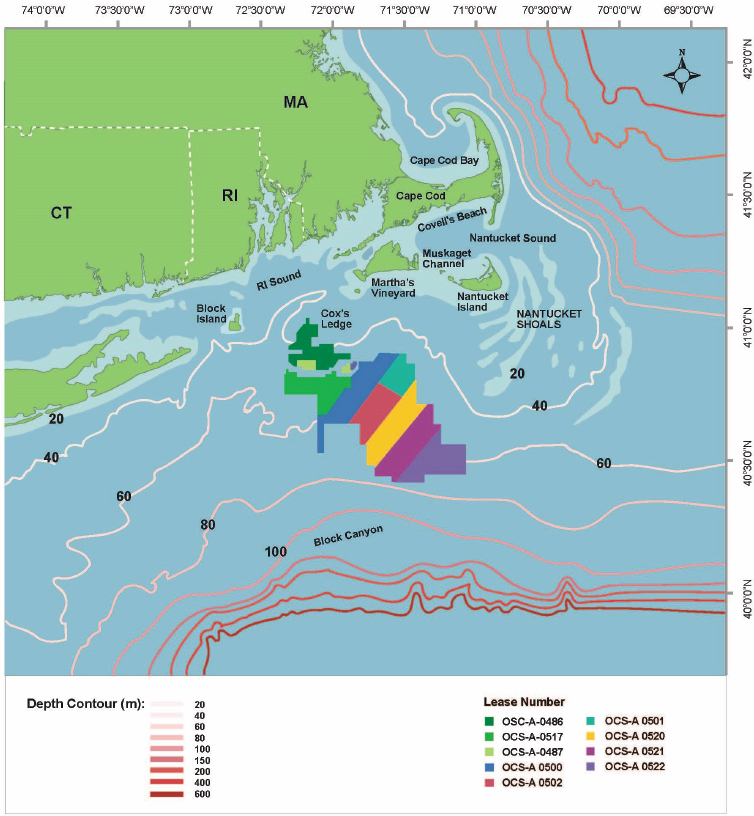
physical processes such as seasonal stratification, tidal fronts, waves, and currents on local to regional scales with the key motivation to assess the potential impacts of offshore turbines on zooplankton productivity and aggregations, which may affect foraging for higher-trophic-level organisms such as the North Atlantic right whale (Eubalaena glacialis).
The North Atlantic right whale is critically endangered with an estimated population size of 340 animals (Pettis et al., 2022). This species of baleen whales is threatened by elevated mortality rates caused by ship strikes and fishing gear entanglement (Knowlton et al., 2012; Moore et al., 2021), and depressed reproduction rates linked to
fluctuations in prey availability (Meyer-Gutbrod et al., 2015, 2021). Preliminary studies of right whale occurrence in wind energy lease areas off the coast of Massachusetts and Rhode Island indicated that use of this area was seasonally restricted to the winter and spring (Leiter et al., 2017; Stone et al., 2017). However, more recent studies show that right whales are increasing their use of this region and have been observed in this location during all times of the year, with peak occurrences in the winter and spring (Quintana-Rizzo et al., 2021; Meyer-Gutbrod et al., 2022; O’Brien et al., 2022). Right whales have been observed foraging in this region year-round, and social behaviors associated with mating have been observed in the winter and spring seasons (Leiter et al., 2017; Quintana-Rizzo et al., 2021).
Zooplankton taxa that right whales feed on in this region are likely similar to their prey in the nearby Cape Cod Bay, which consists of Calanus finmarchicus, Pseudocalanus spp. complex, and Centropages spp. (Pendleton et al., 2009; Hudak et al., 2023). This study will review the known mechanisms for zooplankton production and aggregation in the Nantucket Shoals wind energy area and the potential hydrodynamic effects of bottom-fixed wind turbines on these mechanisms. Direct and indirect impacts of wind turbine–induced hydrodynamic effects on right whales will be considered.
ORIGIN AND PURPOSE OF THE STUDY
This study is sponsored by BOEM for the purposes of informing environmental impact assessment of the Nantucket Shoals region and informing future work so that impacts of offshore wind farm turbines on hydrodynamics and associated changes to ecosystem dynamics can be better understood in the Nantucket Shoals region and elsewhere. The specific charge to the committee is provided in Box 1.1.
STUDY APPROACH AND REPORT ORGANIZATION
The deliberations and resulting conclusions and recommendations from the committee relative to its specific charge (Box 1.1) were informed by the committee’s collective expertise, review of scientific literature, and public information-gathering meetings. The public meetings (see Appendix B) included discussions and presentations with additional experts from academia, government, and nongovernmental organizations, including perspectives from offshore wind developers in the United States and from countries with a more mature offshore wind industry.
The committee responded to the statement of task at three main levels of questioning. The first focus was on understanding the hydrodynamic effects—how well can existing hydrodynamic models estimate the effects of fixed-bottom wind turbines on local hydrodynamics and what are the key parameters to include in a model? The second main question is, given estimated changes to the hydrodynamics, what are the potential local and regional effects on the ecosystem? The third question is then, how might the estimated potential effects on the hydrodynamics and subsequent changes to the ecosystem directly or indirectly affect endangered species, specifically the North Atlantic right whale’s prey field?
The report is organized to answer the three levels of questioning in the broad sense and in the context of the Nantucket Shoals region. Based on the literature review and information gathering, Chapter 2 provides a description of the Nantucket Shoals region in terms of geography, oceanography, meteorology, biology, and ecology. Chapter 3 then summarizes what is known about the effects of offshore wind turbine structures and operation on marine hydrodynamics, including the application of that knowledge to the Nantucket Shoals region, as well as the applicability of existing hydrodynamics models to the Nantucket Shoals region. Chapter 4 discusses potential effects of hydrodynamic perturbation on the offshore ecosystem broadly, and potential effects specific to the environmental characteristics of the Nantucket Shoals region, including North Atlantic right whale foraging. The committee’s conclusions and recommendations are included within the supporting text.
Some terminology related to the statement of task varies in context and across sectors. Appealing to a wide range of audiences and for general readability, the following terminology is adapted in this report:
- Hub height: Distance from the sea surface to the middle of the turbine’s rotor.
- Mid-Atlantic Bight: Offshore coastal region extending from Cape Hatteras to the south and Cape Cod to the north; Nantucket Shoals is at the extreme northern end of the Bight.
- Nantucket Shoals region: Geographic area including the nine offshore wind lease areas sited to the west of Nantucket Shoals.
- North Atlantic right whale: Eubalaena glacialis; also referred to as “right whale” throughout the report, in the context of the North Atlantic.
- Offshore wind farm: An offshore wind turbine development, array of turbines, or wind plant, sometimes referred to as wind energy field or wind energy area (WEA).
- Offshore wind region: Multiple, adjacent offshore wind farms.
- Offshore wind turbine: For the purpose of this report, an individual, fixed-bottom, offshore wind turbine generator (WTG); in the context of offshore wind, also referred to simply as “turbine” throughout the report.
- WEA: a region of proposed and/or developed wind farms; can be a single farm/lease or a grouping of farms/leases; terminology commonly used by BOEM for federal offshore wind leases.
This page intentionally left blank.


