Measuring Meaningful Outcomes for Adult Hearing Health Interventions (2025)
Chapter: 1 Introduction
1
Introduction
Hearing loss is “the most prevalent sensory disorder in the United States,” with approximately 22 percent of the population (nearly 73 million individuals) experiencing hearing loss (Haile et al., 2024, p. 261). The prevalence and severity of hearing loss (as well as of hearing difficulties increase with age (Haile et al., 2024). Similar trends are seen when individuals are asked about their perceptions of their own hearing difficulties (Dillard et al., 2024; Humes, 2023a,b). The value of interventions for hearing loss in adults depends, in part, on what aspects of an individual’s lived experience with hearing loss matter the most to that person. Evaluations of the effectiveness of interventions may not reflect an individual’s perception of their functional abilities or the effect that their hearing difficulties have on their quality of life. That is, changes in various outcomes that might be statistically significant at the group level and used as evidence for the effectiveness of an intervention may have no bearing on an individual’s assessment of their own improvement.
STUDY ORIGIN AND STATEMENT OF TASK
With support from a coalition of sponsors, including the National Institutes of Health (the National Institute on Deafness and Other Communication Disorders and the National Institute on Aging), the Centers for Disease Control and Prevention (CDC), the Defense Health Agency, and the Department of Veterans Affairs (VA), the National Academies of Sciences, Engineering, and Medicine (the National Academies) formed the Committee on Meaningful Outcome Measures in Adult Hearing Health Care in late 2023. The sponsors charged the committee with examining the state of the science in outcomes
BOX 1-1
Statement of Task
An ad hoc committee of the National Academies of Sciences, Engineering, and Medicine will examine the state of the science in outcomes research for interventions in adult hearing health care (excluding surgically placed prosthetic devices), with an emphasis on measures that are meaningful to the individual and the clinician. The committee will determine a core set of existing standard outcome measures, define the core outcome domains (including hearing, communication, and other domains) that should be measured, and develop strategies and a set of recommendations to guide the development of standardized and meaningful measures that are fit for use in different settings.
Specifically, the committee will:
- Identify and engage appropriate partners, including relevant federal agencies, the academic/professional community of researchers and clinicians, professional organizations, industry, and patient/consumer groups, to gain their perspectives as input to committee deliberations.
- Provide a brief contextual background describing the contribution of hearing to overall health and well-being, the etiology of hearing loss, the personal and societal costs of untreated hearing loss, the benefits of treatment for hearing loss, and disparities in treatment.
research for interventions in adult hearing health care with an emphasis on measures that are meaningful to adults with hearing difficulties and the clinicians who treat them (see the full statement of task in Box 1-1).
PREVIOUS WORK OF THE NATIONAL ACADEMIES
Previous reports from the National Academies relevant to this current study include the titles listed in the following paragraphs.
Hearing Loss: Determining Eligibility for Social Security Benefits critically evaluates the measures used to diagnose hearing loss and quantify hearing function for Social Security benefits. The report recommends a standard otolaryngological examination and an audiological examination. Additionally, for adults, the report recommends a pure-tone threshold test, a speech threshold test, a speech recognition test, and an objective physiological test (NRC, 2005).
Hearing Loss Research at NIOSH: Reviews of Research Programs of the National Institute for Occupational Safety and Health (2006) assesses the effect of the Hearing Loss Research Program on worker health and safety, and recommends effective leadership in program planning and implementation,
- Broadly describe the various interventions (e.g., hearing aids, rehabilitative strategies or training, pharmaceutical or biological therapies, etc.).
- Describe the outcome measures currently available to assess hearing function and communication in adults, available measures in outcome domains beyond communication (e.g., social connectivity, activity limitations, participation restrictions, economic productivity) that should be measured, and gaps where development of new outcome measures is urgently needed.
- Identify in which settings the metrics are most applicable (e.g., establishing efficacy in clinical trials, assessing patient response in clinical care and by type of intervention, conducting hearing health monitoring, assessing patient satisfaction).
- Provide recommendations on the standardized use of existing outcome measures for hearing health, including hearing, communication, and other domains (“core set of measures”), and the necessary qualities and strategies for adoption of new meaningful measures that could be implemented in the short term as well as longer timeframes with an eye toward large-scale adoption and standardization (e.g., national databases and repositories).
In the circumstance where robust evidence is lacking or absent, the committee is encouraged to make recommendations based on sound scientific reasoning in the context of the current health care environment.
improvements in evaluations, and incorporation of the expertise of epidemiologists and noise control engineers to improve surveillance data for occupational hearing loss and workplace noise exposure (IOM and NRC, 2006).
Noise and Military Service: Implications for Hearing Loss and Tinnitus recommends consistent use of hearing protection and required audiograms before exposure and after exposure to make it possible to better pinpoint the cause of hearing loss. The report notes that these audiogram records should include questions evaluating hearing loss and measuring hearing thresholds at 8000 Hz and that individuals with significant changes between audiograms should receive additional monitoring. The report also recommends improving the Defense Occupational and Environmental Health Readiness System to track reports of tinnitus and exposures to hazardous noise and allow Veterans Administration personnel to access these records for disability claims (IOM, 2006).
Hearing Loss and Healthy Aging: Workshop Summary examines how age-related hearing loss affects healthy aging and how public and private parties can collaborate to address this issue (IOM and NRC, 2014). Panels included consumer perspectives, the connection between hearing
loss and healthy aging, current approaches to hearing health care delivery, innovative models of care, hearing technologies, contemporary issues in hearing health care, and collaborative strategies for the future.
Hearing Healthcare for Adults: Priorities for Improving Access and Affordability emphasizes that many adults with hearing loss do not seek or receive treatment. The report recommends increased efforts by relevant government agencies, advocacy groups, and nonprofit organizations to “collect, analyze, and disseminate prospective population-based data,” to collaborate with each other and align best practices, to inform patients about their rights regarding their audiograms and hearing aid programming history, and to collaborate with providers incentivizing diversity and cultural competence in the field. The report also recommended that the Food and Drug Administration establish a new category of over-the-counter wearable hearing devices (NASEM, 2016).
The Promise of Assistive Technology to Enhance Activity and Work Participation evaluates products and technologies that assist adults with disabilities, including hearing impairments. The report summarizes the existing information, accommodations offered by employers, and associated costs (NASEM, 2017).
Functional Assessment for Adults with Disabilities discusses how to assess an adult’s mental and physical abilities relative to their workplace demands and how to collect this information (NASEM, 2019). The report considers the measures of functional hearing. Overall, the report concluded that “determinations about a person’s ability to sustain full-time work are more complicated than can be indicated by an assessment of individual body structures, functions, or impairments.”
Transforming Human Health: Celebrating 50 Years of Discovery and Progress summarizes human health milestones (NASEM, 2022). The report briefly covers the history of newborn hearing screening, restoring hearing through cochlear implants, the first digital hearing aid, and efforts to remove background noise from hearing aids.
STUDY APPROACH
The Committee on Meaningful Outcome Measures in Adult Hearing Health Care consisted of 13 members with a broad range of expertise, including hearing health care (both clinical care and research), etiology of and interventions for hearing loss, outcome measurement (e.g., patient-reported outcome measures), primary care (e.g., family medicine, geriatrics, and nursing), disability and rehabilitation, quality of life, health disparities, public health, and epidemiology. Appendix E provides brief biographies of the committee members, fellows, and staff.
The committee deliberated during seven full committee meetings and many working group calls between December 2023 and March 2025. Additionally, the committee held three virtual public webinars and invited panelists
to offer comments to inform the committee’s deliberations. The panelists provided valuable input from a broad range of perspectives, including adults with hearing difficulties, clinicians, and hearing health professional groups. The committee also completed an extensive search of the peer-reviewed literature and the gray literature, including publications by private organizations, advocacy groups, and government entities. In addition, the committee established an online system for collecting narratives from clinicians and adults with hearing difficulties on measuring outcomes of hearing health intervention. Selected quotes from these narratives are included in Chapter 4.
Definitions and Terminology
The sections below present some definitions and distinctions in terminology developed by the committee that are important for the focus of this report. For a full list of definitions, see Appendix A.
Outcomes and Outcome Domains
An intervention’s health outcome is the effect of the intervention on one’s health. That is, health outcomes refer to changes in the health of an individual or population after an intervention. Several related outcomes may be grouped into a category called an outcome domain. For example, an outcome domain of speech communication includes many individual outcomes such as understanding speech in quiet, understanding speech in noise, and perception of nonspeech sounds.
Core Outcome Set
A core outcome set is an agreed-upon standardized minimum set of meaningful outcomes that are measured and reported across settings and interventions. When assessing the effect of an intervention, researchers and clinicians can consider a multitude of outcomes to measure. A core outcome set recommends, at a minimum, the specific outcomes to be measured and reported. The use of a core set of outcomes (and corresponding standardized measures) helps to enhance the consistency and quality of research, allows for the pooling of data, and facilitates the comparison of different interventions.
Outcome Measures
“Outcome measures reflect the impact of the health care service or intervention on the health status of patients” (AHRQ, 2015). While the terms measure, measurement tool, and measurement instrument are used interchangeably and are fairly synonymous, this report will use the term measure.
Diagnostic Assessment versus Outcome Assessment
A diagnostic test or assessment is used to identify a condition or disease, and the results from a diagnostic assessment can help determine a treatment plan or intervention, if needed (Deeks and Bossuyt, 2023). By contrast, outcome measures are used to evaluate an intervention’s effect on an individual. This report focuses on meaningful outcomes and the measures used to evaluate the efficacy and effectiveness of interventions, rather than focusing on the types of assessments used to diagnose hearing loss or determine candidacy for various devices.
Meaningfulness versus Importance to Measure
In general, the meaningfulness of an outcome reflects the perceived importance of that outcome by adults with hearing difficulties and clinicians. For this study, given the limited direct evidence on which outcomes are perceived as most meaningful, the committee used evidence on the prevalence and severity of hearing-related complaints among adults with hearing difficulties as supplemental evidence of meaningfulness. A related concept, importance to measure, reflects whether an intervention has the ability to directly affect the outcome or whether measurement of the outcome provides information that would be helpful for clinical decision making.
Hearing Loss versus Hearing Difficulties
In this report, the committee elected to use the term adult with hearing difficulties rather than adult with hearing loss whenever possible. Hearing loss is generally used to reflect a clinical measurement of hearing ability, often using the pure-tone audiogram. Hearing difficulties, on the other hand, are more strongly associated with hearing trouble perceived by the individual and may or may not be reported by adults with audiometric hearing loss. Hearing difficulties may also be perceived by individuals who do not have audiometric hearing loss (Spankovich et al., 2018). Furthermore, hearing difficulties may be undiagnosed (especially when they are mild), whereas hearing loss is most often a clinical diagnosis. The term hearing loss is used in this report in cases of direct quotes or as defined in cited studies or when specifically appropriate to a discussion of diagnosis.
Study Focus
Outcome measurement is important in health care, as the resulting data can help clinicians, researchers, and individuals understand which interventions work best for which populations and thereby improve the
patient experience (ICHOM, n.d). While the committee does believe that outcome measurement is an important part of clinical practice and research, this study does not focus on the question of whether outcome measurement should be done. Rather, it starts with the assumption that outcome measurement is being performed and, given that, presents the evidence on how outcome measurement should be carried out in the field of hearing health. In addition, this study focuses primarily on assessing the efficacy and effectiveness of interventions for hearing health rather than on ways to assess hearing health as a part of the diagnostic process or process for determining candidacy for various devices. Determination of the legitimacy of the target disorder as well as assessment of the diagnostic accuracy of measures was also outside of the committee’s scope of work. Instead, the committee starts with the assumption that hearing loss has been properly diagnosed, and a treatment has been applied. The study and associated recommendations target the twin issues of what is most meaningful to measure (core outcome set) and which measures are most appropriate to use in order to create more consistency in outcome measurement for hearing health interventions.
Generally speaking, the first step in the development of a core outcome set is setting the scope of what the core outcome set will cover. While in this case the scope was largely determined by the statement of task, the committee set the following parameters for its examination of evidence. This study focuses on adults with hearing difficulties; while the committee considered all adults (age 18 and older), it focused primarily on older age groups, as the prevalence of hearing loss and hearing difficulties increases with age. The committee also considered a wide range of etiologies, but primarily focused on acquired, adult-onset hearing loss, which is most often caused by aging, noise exposure, or both. The committee considered its scope to apply to a wide range of interventions such as devices (including some assistive devices at the level of the individual), rehabilitation and training strategies, and pharmaceuticals and biological therapies. It approached its work broadly so as to apply its recommendations to both current and emerging interventions. The committee’s focus was on interventions at the level of the individual rather than systemic approaches (e.g., hearing loops).1 Furthermore, the committee also focused on improvement due to a single intervention (e.g., based on the comparison of aided versus unaided listeners) rather than comparing results among intervention types or different technologies or determining why people abandon the use of certain devices. Per the statement of task, the committee excluded consideration of
___________________
1A hearing loop is an assistive listening system placed in a public setting that helps transmit sound directly from a microphone into hearing aids (equipped with telecoils) and cochlear implants. This system “can make speech and music in public places more understandable” (HLAA, 2025).
surgically placed prosthetic devices (e.g., cochlear implants, bone-anchored hearing aids).
The committee focused on outcomes related directly to the efficacy and effectiveness of the intervention itself and excluded the assessment of outcomes that could be highly influenced by systems or practice patterns such as cost-effectiveness and patient satisfaction. The committee did not consider the effects of interventions on the family, friends, and care partners of adults with hearing difficulties. Additionally, the focus of the committee’s work was not on the accessibility or affordability of hearing health care, which was the focus of a previous National Academies report Hearing Health Care for Adults: Priorities for Improving Access and Affordability (2016).
Committee Process
In its work, the committee followed several general best practices that have been identified for developing core outcome sets, including specifying a clear scope, involving key partners, and using a consensus process (see Chapter 3). For this study, as described above, the statement of task (with refinement from the committee) largely specified the scope. In any National Academies consensus study it is standard practice to include key partners and use a consensus process, although the particular approach to consensus will vary from study to study. However, the committee’s review of best practices for core outcome set development found that there is currently wide variation in the specifics of how core outcome sets are developed. For example, in many cases a Delphi-type voting process is used, with multiple parties and multiple rounds of balloting determining the outcome set. Another valid approach, the one used by this committee, is an evidence-based review and synthesis of the literature, for defining a broadly applicable core outcome set in hearing health care as well as the best measures to assess those outcomes. While the committee recognizes that there may be some isolated situations where its recommendations will not apply, it sought to develop recommendations that would be as broadly applicable as possible. The committee further recognizes that the measurement of additional outcomes may be warranted in many contexts.
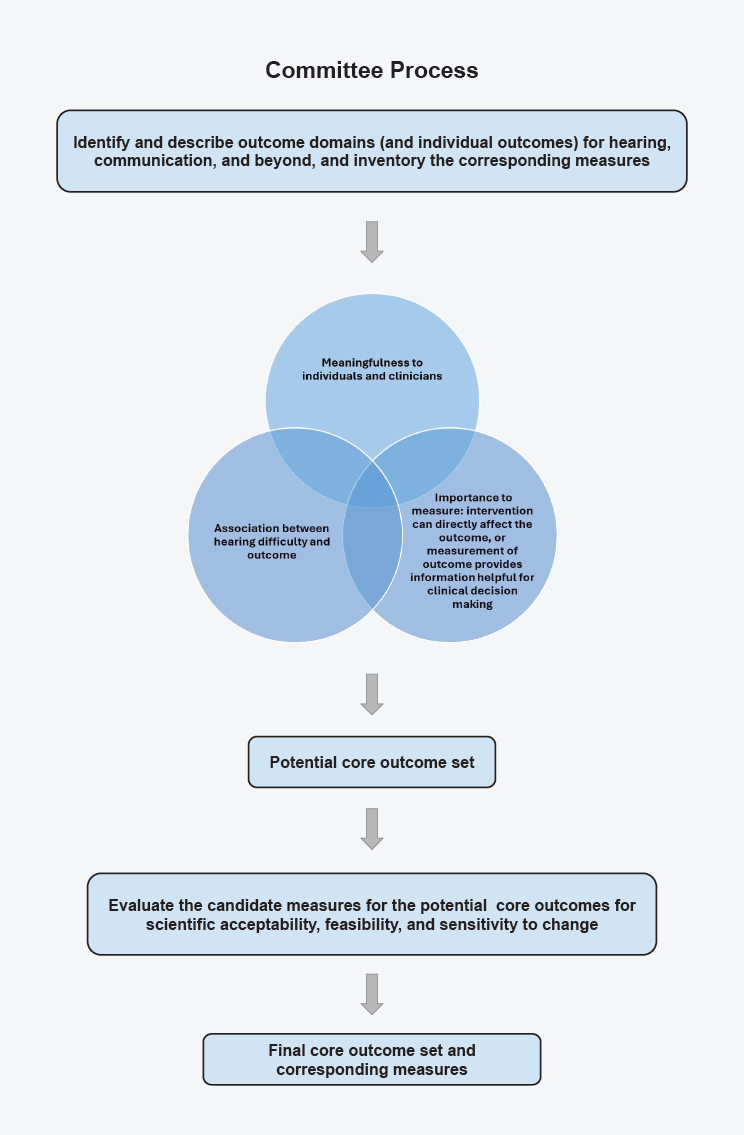
Figure 1-1 provides an overview of the committee’s overall process for determining a core outcome set (i.e., which areas of hearing, communication, and beyond should be assessed for impact of the intervention) and corresponding measures (i.e., which tools or instruments to use to assess the core outcomes). Note that while assembling an initial list of outcomes to consider for the core set, the committee simultaneously examined the hearing health outcome literature to begin an inventory of existing outcome measures for each of the candidate core outcomes (see Appendix B).
Core Outcome Set
In determining the core outcome set, the committee first needed to identify which outcome domains and individual outcomes to consider. Although several other groups have created core outcome sets for specific hearing loss etiologies or interventions, there is a lack of consistency in which outcomes have been measured. Therefore, the committee first considered an extensive list of outcomes based on literature reviews of outcome domains and individual outcomes typically reported in studies of hearing interventions. The committee also hosted public webinars to hear directly from adults with hearing difficulties, clinicians, and hearing health professional organizations. An online platform that members of the public could use to submit their comments also was established. Based on the information collected from these sources, the committee conducted multiple iterative discussions to create a comprehensive and clearly defined set of outcomes to be considered for a core outcome set. Chapter 5 of this report defines the outcomes identified by the committee and describes the connection between each outcome and hearing difficulties.
Next, the committee conducted a more in-depth exploration into which of these outcomes are the most meaningful to adults with hearing difficulties and to their clinicians. As noted earlier, meaningfulness was defined as a combination of perceived importance of the outcome, prevalence of difficulty in that outcome, and severity of the difficulty. The committee looked to several evidence-based sources for determining the meaningfulness of the outcome. First, the committee reviewed the existing peer-reviewed literature as well as industry and consumer group surveys regarding which outcomes were most meaningful. Additionally, the committee considered information gathered through public webinars and the project’s public call for comments. See Chapter 4 for evidence of meaningfulness.
Since the committee was charged with recommending a core outcome set that applies across interventions (excluding surgical implants), in multiple settings (e.g., clinic, research), for multiple purposes (e.g., efficacy, effectiveness), and a range of severities and etiologies of hearing loss, the committee concluded that any outcome in the core set needs to be universally meaningful and important to measure across all contexts. The broadness of the scope of applications of the core outcome set also means that the core set needs to be feasible to measure in all contexts. Therefore, after amassing a list of outcomes to consider (see Chapter 5), the committee used several criteria to narrow down the outcomes to be considered for the core set (see Figure 1-1).
First, the committee required that the outcome needed to be consistently defined across the literature and have a strong established association with hearing difficulties; several outcomes were excluded from consideration for the core outcome set because either the evidence on the connection between the outcome and hearing difficulties is inconclusive or because
the outcome is poorly defined in the literature and follows no consistent definition. Second, the outcome needed to be meaningful for virtually all adults with hearing difficulties and clinicians. The committee recognizes that any single outcome will be meaningful to some individuals or populations, and depends on context, but the committee sought to determine which outcomes were meaningful across populations. Finally, the committee considered the evidence for “importance to measure”—that is, the extent to which hearing health interventions can significantly affect the outcome or whether measurement of the outcome helps inform treatment. The ability to measure the outcome is implicit to this criterion, given that the existence of evidence of the intervention’s effect on the outcome requires the availability of measures to generate such evidence.
Outcome Measures
With an initial list of outcomes to consider for the core set, the committee next consulted its list of potential measures to recommend for each of the candidate core outcomes; see Appendix B for the committee’s initial measure inventory. For some outcomes the committee found multiple possible measures and narrowed the list of outcome measures to be examined based on the amount of available evidence on the development and psychometric assessment of that measure. The committee developed a set of criteria for measure evaluation that included scientific acceptability (including reliability, validity, and sensitivity to change) and feasibility (see Chapter 6 and Appendix C). The committee carefully reviewed the literature on the psychometric properties of each candidate measure, using value judgments regarding the sufficiency of the amount and quality of the evidence for each criterion. Through iterative discussions, the committee determined the final core outcome set and the best existing measure for each core outcome.
Dissemination and Implementation
For the final part of its charge, the committee reviewed general evidence on best practices for dissemination and implementation as well as for best practices specifically for the uptake of core outcome sets. Chapter 7 provides further details of this evidence.
ORGANIZATION OF REPORT
This introductory chapter provides the study context, charge to the committee, and committee approach. Chapter 2 presents a contextual background of adult hearing health care, including an overview of etiologies of
hearing loss and types of interventions. Chapter 3 describes general principles for the development of core outcome sets and the identification of appropriate measures. Chapter 4 describes the concepts of meaningfulness and importance to measure in hearing health care, providing evidence from various sources. Chapter 5 reviews outcomes for hearing health care, and Chapter 6 explores the measurement of those outcomes. Finally, Chapter 7 considers various strategies to encourage the uptake of core outcome sets and the use of standardized measures. The report has five appendixes: Appendix A is a glossary of terms, Appendix B contains a measure inventory (as part of the committee’s early evidence-gathering phase), Appendix C includes the committee’s measure evaluation worksheet, Appendix D provides a side-by-side comparison of two of the measures considered by the committee for a core outcome, and Appendix E presents the biosketches of the committee members and project staff.
REFERENCES
AHRQ (Agency for Healthcare Research and Quality). 2015. Types of health care quality measures. https://www.ahrq.gov/talkingquality/measures/types.html (accessed May 22, 2024).
Deeks, J. J., and P. M. Bossuyt. 2023. Evaluating medical tests. In Cochrane handbook for systematic reviews of diagnostic test accuracy. Version 2.0., Pp. 19–33. https://doi.org/10.1002/9781119756194.ch2
Dillard, L. K., L. J. Matthews, and J. R. Dubno. 2024. Prevalence of self-reported hearing difficulty on the Revised Hearing Handicap Inventory and associated factors. BMC Geriatrics 24(510). https://doi.org/10.1186/s12877-024-04901-w.
Haile, L. M., A. U. Orji, K. M. Reavis, P. S. Briant, K. M. Lucas, F. Alahdab, T. W. Bärnighausen, A. W. Bell, C. Cao, X. Dai, S. I. Hay, G. Heidari, I. M. Karaye, T. R. Miller, A. H. Mokdad, E. Mostafavi, Z. S. Natto, S. Pawar, J. Rana, A. Seylani, J. A. Singh, J. Wei, L. Yang, K. L. Ong, and J. D. Steinmetz. 2024. Hearing loss prevalence, years lived with disability, and hearing aid use in the United States from 1990 to 2019: Findings from the Global Burden of Disease Study. Ear and Hearing 45(1).
HLAA (Hearing Loss Association of America). 2025. Hearing loop technology. https://www.hearingloss.org/find-help/hearing-assistive-technology/hearing-loop-technology (accessed March 11, 2025).
Humes, L. E. 2023a. U.S. population data on hearing loss, trouble hearing, and hearing-device use in adults: National Health and Nutrition Examination Survey, 2011-12, 2015-16, and 2017-20. Trends in Hearing 27. https//doi.org/10.1177/23312165231160978.
Humes, L. E. 2023b. U.S. population data on self-reported trouble hearing and hearing-aid use in adults: National Health Interview Survey, 2017-2018. Trends in Hearing 27. https://doi.org/10.1177/23312165231160967.
ICHOM (International Consortium for Health Outcomes Measurement). n.d. Why measure outcomes? https://www.ichom.org/why-measure-outcomes/ (accessed November 12, 2024).
IOM (Institute of Medicine). 2006. Noise and military service: Implications for hearing loss and tinnitus. Washington, DC: The National Academies Press.
IOM and NRC (National Research Council). 2006. Hearing loss research at NIOSH: Reviews of research programs of the National Institute for Occupational Safety and Health. Washington, DC: The National Academies Press.
IOM and NRC. 2014. Hearing loss and healthy aging: Workshop summary. Washington, DC: The National Academies Press.
NASEM (National Academies of Sciences, Engineering, and Medicine). 2016. Hearing health care for adults: Priorities for improving access and affordability. Washington, DC: The National Academies Press.
NASEM. 2017. The promise of assistive technology to enhance activity and work participation. Washington, DC: The National Academies Press.
NASEM. 2019. Functional assessment for adults with disabilities. Washington, DC: The National Academies Press.
NASEM. 2022. Transforming human health: Celebrating 50 years of discovery and progress. Washington, DC: The National Academies Press.
NRC (National Research Council). 2005. Hearing loss: Determining eligibility for Social Security benefits. Washington, DC: The National Academies Press.
Spankovich, C., V. B. Gonzalez, D. Su, and C. E. Bishop. 2018. Self reported hearing difficulty, tinnitus, and normal audiometric thresholds, the National Health and Nutrition Examination Survey 1999-2002. Hearing Research 358:30–36.
This page intentionally left blank.


