Review of WIC Food Packages: Improving Balance and Choice: Final Report (2017)
Chapter: 11 Recommendations for Implementation and Research
11
Recommendations for Implementation and Research
As part of the study task, the U.S. Department of Agriculture’s Food and Nutrition Service (USDA-FNS) asked the committee to develop recommendations to maximize effective implementation of the revised food packages and for research on improved methodological approaches, data collection, and analyses designed to document effects of the recommended food package revisions. This chapter begins with recommendations for implementation, followed by research recommendations. In each section, recommendations are placed in order of priority. Additionally, the committee outlines its suggestions for modifications to the packages should available funds exceed or fall short of the cost-neutral level. The chapter concludes with a brief review of multilevel approaches to improve intake of foods in the Special Supplemental Nutrition Program for Women, Infants, and Children (WIC) food packages, and some final remarks.
RECOMMENDATIONS FOR IMPLEMENTATION OF THE REVISED FOOD PACKAGES
The Complexities of Implementation
As noted in Chapter 2, administration of the WIC food packages involves stakeholders at many levels: federal, state, local, participant, clinic, vendor, and food manufacturer. At each level, a series of factors ease or pose barriers to redemption of WIC foods by program participants. This was apparent to the committee in their WIC site visits and shopping experiences, from the review of literature conducted in phase I (NASEM, 2016), and
from information presented at several workshops and public comment sessions organized for this study. Box 11-1 provides a summary of challenges that affect participant redemption of WIC foods. Once electronic benefit transfer (EBT) systems have been implemented nationwide and adaptation to these systems is complete, some of the barriers noted may be reduced in magnitude or may no longer be present.
Key Recommendations Related to Implementation
The committee was charged to optimize implementation of the revised food packages by considering how to maximize the cost-effectiveness and efficiency of program administration. To achieve this goal, the committee offers the following recommendations:
11-1. The U.S. Department of Agriculture’s Food and Nutrition Service (USDA-FNS) should develop the tools and strategies needed to assist state agencies, local agencies, and vendors to inform participants about and support them to make the best use of the expanded options of the revised food packages.
Rationale: The revised food packages include a variety of new options. Given the complexities of implementation listed in Box 11-1, it is essential that USDA-FNS strategically support states, agencies, clinics, and vendors to minimize barriers to WIC food redemption. Tools and strategies may include the development or support of Web-based materials and/or smart phone applications (“apps”) that assist participants and vendors in maximizing redemption at the point of purchase. USDA-FNS could also lead dissemination of these tools and strategies among states and regions. Content that demonstrates the expanded options for vegetables and fruits, fish, dairy, and whole grains may enhance the shopping experience for WIC participants. Given that the revised packages may require vendors to offer more options, collaboration with vendors and food manufacturers to address challenges with stocking of WIC foods is essential to enhance participants’ ability to locate and redeem these foods. Finally, with expansion of the cash value voucher (CVV), particularly for breastfeeding women, it will be important for USDA-FNS to encourage states that are not yet using the EBT system to issue paper CVVs in amounts that encourage full redemption (e.g., increments of $5 to $10).
11-2. USDA-FNS should maximize the extent to which the revised food packages motivate the choice to initiate and continue breastfeeding among all racial and ethnic groups by enhancing and stabilizing the funding available (independent of the food packages) for peer counseling and other lactation support staff at WIC sites.
Rationale: The committee’s vision for WIC in the future is that all women receive adequate counseling and support prenatally through the first month postpartum and that the issuance of formula is individually tailored (not routinely issued) to meet the unique needs of every mother–infant dyad in
the first 30 days after the infant’s birth. After 30 days, food packages would continue to be designed to support each participant’s level of breastfeeding.
The committee recognizes that that there are substantial societal barriers to breastfeeding that are outside of USDA’s control. Improvements to the food packages for breastfeeding women are insufficient to support breastfeeding by themselves. Evidence indicates that enhanced breastfeeding support (e.g., the WIC Loving Support© program) is essential for improving breastfeeding outcomes among WIC participants (see the phase I report [NASEM, 2016] for a complete literature review). This support includes having WIC staff work closely with pregnant women and mothers as they make early feeding decisions, particularly during the third trimester of pregnancy through the first month postpartum. To meet demand, breastfeeding support programs need to be funded adequately and consistently from year to year.
Additional Considerations for Implementation
In its evaluation of the food packages, the committee reviewed the current federal implementation guidance to states. Several aspects of this guidance were considered particularly important to retain and/or enhance as part of the food package revisions. These are:
- Continue to encourage state agencies to authorize as many food options as feasible within the limits of cost-containment, stocking requirements, and the redemption patterns of WIC participants.
Rationale: WIC participants appreciate choice in meeting their nutritional needs and accommodating their cultural and personal food preferences. The additional choices being offered in the revised packages also promote redemption of the WIC benefit. Examples of these additional choices include multiple forms of whole grains in addition to whole wheat bread and allowing a range of container sizes for yogurt (i.e., 30–32 ounces to accommodate purchase of multiple 5-ounce containers). - Continue to encourage state agencies to include lower-sodium options (where available) on state WIC food lists.
Rationale: The 2015-2020 Dietary Guidelines for Americans (DGA) recommend that individuals limit their sodium intake. As a result, added sodium is not permitted in the specifications for some WIC food categories (e.g., frozen vegetables and fruits). In other food categories (e.g., canned vegetables), lower-sodium products are now widely available but are not always included in state food lists. Including them in such lists would allow WIC participants access to these lower-sodium choices.
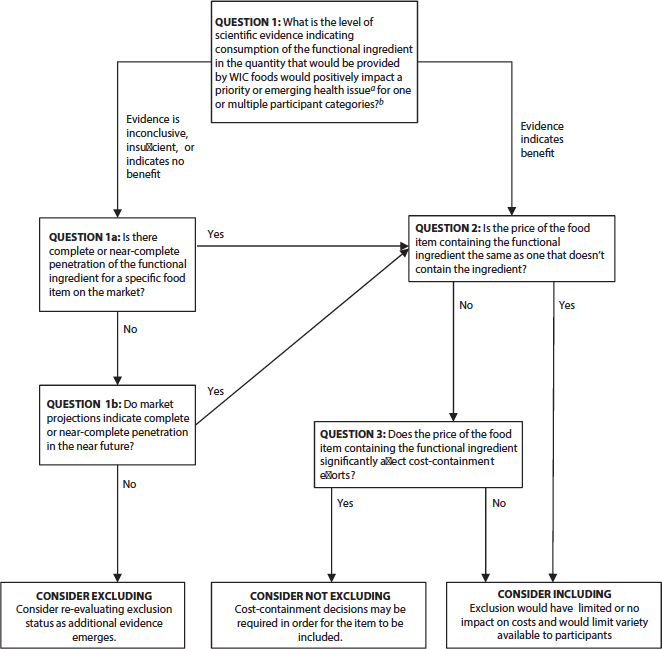
NOTES: This schematic assumes that the safety of infant formulas, foods, and ingredients permitted therein are assured by the U.S. Food and Drug Administration’s (FDA’s) regulatory processes. Each individual food item or formula should undergo the full evaluation presented. a A priority or emerging health issue as indicated in the phase I Review of WIC Food Packages report (NASEM, 2016), or based on other evidence collected by USDA-FNS specific to the WIC-eligible population. b The assessment of scientific evidence is conducted by a review of (1) statements or assessments of authoritative bodies such as the American Academy of Pediatrics, the Academy of Nutrition and Dietetics, or others deemed appropriate by USDA-FNS; (2) evaluation of Cochrane reviews; (3) evaluation of systematic reviews that follow a generally accepted and transparent procedure, and (4) other sources deemed appropriate by USDA-FNS.
- Initiate discussions with national and state Medicaid programs to address barriers to ensuring they are the payer of the full cost of all exempt infant formulas and medical foods issued to WIC participants nationally.
Rationale: The purpose and scope of WIC does not include providing care to medically fragile infants (7 C.F.R. § 246.1); therefore, Medicaid is the appropriate primary payer (see WIC Policy Memorandum #2015-07). Enhanced collaboration between USDA-FNS and Medicaid at the national and state levels could reduce the complexity of the reimbursement process and remove WIC as the payer. - Evaluate inclusion of foods and infant formulas containing functional ingredients using the decision tree developed by the committee.
Rationale: The committee was tasked to consider the current science on functional ingredients1 added to foods for infants, children, and adults (see the phase I report, NASEM [2016]) to determine how USDA-FNS might approach the inclusion of foods containing these ingredients in the WIC food packages. For this report, the committee outlined an approach that could be applied by USDA-FNS, and, potentially, state agencies, to determine whether foods or formula with these ingredients should be included in food packages (see Figure 11-1).
RESEARCH AND DATA COLLECTION RECOMMENDATIONS FOR EVALUATION OF THE WIC FOOD PACKAGES
Consistent with its task, the committee developed a prioritized list of recommendations for research and data collection. The majority of the research gaps identified also align with the research areas identified in the 2010 workshop, Planning a WIC Research Agenda (IOM, 2011), which indicates that many of the same data needs persist. Three high-priority research gaps were:
- How the food packages affect participants’ diet quality, food security, program satisfaction, and participation in WIC in combination with other nutrition assistance programs;
__________________
1 At the time this report was written, the FDA had not established a definition for functional foods or ingredients. Functional ingredients are permitted in foods if evidence indicates the ingredients are safe at estimated national levels of consumption, but efficacy of these ingredients is not evaluated or regulated by the FDA. Broadly, functional foods and ingredients are thought to provide a “health benefit beyond basic nutrition,” and may be beneficial to long-term health (Crowe and Francis, 2013).
- The effect of program support and the food packages on the choice to initiate and continue breastfeeding; and
- How choices regarding the purchase of vegetables and fruits can be optimized through the enhanced CVV.
Coordination of future WIC research timelines to allow completion by 2024 would ensure availability for the next review of WIC food packages. The specific recommendations that align with these priorities follow.
11-3. USDA-FNS should fund research to evaluate the effects of the recommended revisions to the WIC food packages on participant satisfaction, participation in the program, redemption of WIC foods, and participants’ diets and health.
11-3a. USDA-FNS should collect WIC state agency policies on an annual basis and establish a national database of electronic benefit transfer (EBT) expenditures by program participants.
11-3b. USDA-FNS and the U.S. Department of Health and Human Services should collaborate to achieve expansion of nationally representative collection of data on the dietary intakes for pregnant, breastfeeding, and postpartum women and breastfed infants in the National Health and Nutrition Examination Survey. USDA-FNS should request that the data on breastfeeding women include an indicator on the intensity of breastfeeding (i.e., exclusive or partial).
Rationale: Although results from regional and state studies provided the committee with important evidence about the effects of the 2009 food package changes, no nationally representative study evaluated how the new food packages affected participant satisfaction, participation in the program, and use of the new WIC foods.2,3 In addition, only limited information was
__________________
2 To understand the effect of policy changes on participant purchasing patterns and/or nutrition and health outcomes, a study that applies the difference-in-difference approach, which is common in economics and health information research, to the timing of the policy changes is needed. For example, the U.S. Department of Agriculture created a Supplemental Nutrition Assistance Program (SNAP) Policy Database that includes information on the timing of policy changes and how they affect outcomes. Availability of these data has resulted in informative research about SNAP policies and how they affect outcomes. To understand the effects of the WIC program, it is also important to know when non-participants become participants, and vice-versa, particularly for children.
3 Near the close of the committee’s deliberations, Oh et al. (2016), which is a nationally representative study of whole grain purchases by WIC participants, was published.
available on how participants from different racial, ethnic, and cultural groups selected and used foods in the revised packages.
The EBT system, scheduled for implementation in all states by the year 2020, provides a unique opportunity to collect participant- and state-level data on redemption of issued foods (USDA/ERS, 2014). Under the direction of USDA-FNS, these individual-level data could be collected, anonymized,4 and analyzed (or, importantly, left disaggregated and made publicly available) to provide, for example, information about regional and national purchasing patterns, price variations, and how purchasing patterns and price variation interact with state-level regulations about cost containment. To determine whether the food package is meeting the needs of participants, it is essential to link the food redeemed to the specific food package. It is also essential that the timing of implementation nationally is clearly documented. Given that it may only be possible to collect these data in states using EBT, data collected before food package revisions are implemented would ensure that a strong baseline is established. Annual collection of state-level policies, paired with the creation of a national EBT database, would help USDA-FNS and other researchers examine the effect of variations in food package policies on redemption of WIC foods and participation in the program. These data could also be added to other online datasets as part of the current open-data initiative (TWH, 2016) to allow access to information collected via the EBT system.5
The committee lacked information on how foods in the WIC packages are used in the context of participants’ overall diets, in conjunction with participation in other programs, such as the Supplemental Nutrition Assistance Program (SNAP), and in combination with foods purchased with participants’ own funds. Such data would inform how the WIC food packages can be designed to optimize the overall diet and complement other food resources. The recently released Food Acquisition and Purchase Survey (FoodAPS) dataset holds the potential for evaluating food acquisition and purchase in addition to household participation in multiple programs. Although there are limitations in the currently available data,6 subsequent rounds of this survey could modify data collection to better address these issues, in addition to having data on low-income nonparticipants.
Research questions that could complement the various data sources mentioned here, applied in studies that use causal techniques, include:
__________________
4 Data for this purpose would be stripped of all personally identifying information.
5 Data that are not open-access could be made available by allowing researchers to apply for restricted access to anonymized data in a setting where confidentiality can be protected, following the model of the Federal Statistical System Research Data Centers.
6 The Food Acquisition and Purchase Survey dataset is limited in terms of verifying WIC participation with administrative data and in linking specific food items acquired and purchased to the use of WIC benefits.
providing breastfeeding counseling in conjunction with customizing infant formula helps women to achieve their breastfeeding goals. Behavioral economics research may help elucidate how breastfeeding can be promoted through further revisions to the food packages and/or increased investments in sound breastfeeding protection, promotion, and support efforts.
Specific research questions could include
- From birth to age 1 year, what are the patterns of breastfeeding exhibited by mother–infant dyads on WIC? How well are these patterns aligned with the food packages issued? How is breastfeeding affected by the food package change?
- Paired with support, how does tailoring the food package to provide an amount of formula that supports the needs of the dyad in the first 30 days affect the duration and intensity of breastfeeding?
- What incentives motivate WIC participants to choose to breastfeed as well as to continue to breastfeed beyond 4 to 6 weeks postpartum? Did the package changes affect these outcomes?
- Outside of the food package for mother–infant dyads, what level and type of support (peer counseling, lactation consultation, etc., for what duration/periodicity) is optimal to promote and support breastfeeding?
To investigate these research questions, it will be necessary to collect and evaluate state-level data on the efficacy of various breastfeeding promotion and support practices and policies, including the number of peer counselors available at local agency sites, the ratio of peer counselors to women participants, the state agency formula issuance policy, and demographic characteristics (including race and ethnicity) of WIC participants at the state level. These data could be collected on a routine basis (e.g., once annually), linked to participant outcome data, and disseminated to researchers. If possible, it would be ideal to test different approaches for the promotion of breastfeeding through randomized controlled trials. USDA-FNS could provide funding (and waivers if needed) to allow states to explore how varying policies and resources affect breastfeeding initiation, exclusive breastfeeding duration, and overall duration. This evidence could help ensure that cost-effective approaches are used.7
11-5. USDA-FNS should fund research to assess how inclusion of the cash value voucher as a component of WIC food packages affects: food package redemption rates; participant choice of
__________________
7 In alignment with 7 C.F.R. § 246.26, all participant or applicant information would remain confidential.
Hawaii, and the U.S. Virgin Islands. The average food package costs in these areas are 21, 18, 81, and 82 percent higher, respectively, than the average for all U.S. states and territories (USDA/FNS, 2016a). For most foods in the WIC package, participants receive a specific quantity of the WIC-approved food, an amount that does not vary with the price of the food. However, as a cash benefit, the amount of food available to the participant through the CVV reflects the regional price difference and thus, it is likely that fewer vegetables and fruits can be purchased with the CVV in those high-cost areas. For example, the U.S. Department of Agriculture’s Economic Research Service (USDA-ERS) (2011) reported that commonly purchased vegetables and fruits may cost up to 70 percent more in the most expensive markets, compared to the least expensive markets. Therefore, the available benefit varies at the participant level if participants nationwide receive a flat purchase value with the CVV. In the proposed revised food packages, the CVV makes up a larger proportion of the food package benefit than the current packages; thus vegetable and fruit intake may be influenced to a greater degree by geographic variations in their price.
A first step to address the inequity in high-cost areas is to adjust the CVV using the SNAP cost adjustments assigned to these four high-cost regions (see USDA/FNS, 2016b).8 If adjusted in this manner, on average, the CVV would be 49 percent higher (unweighted; 60 percent when weighted by the state population) for WIC participants in these areas. Inasmuch as WIC participants in these areas make up 1 percent of the total WIC population (USDA/FNS, 2016a), the effect on overall program costs will be minor. A second step would be to consider adjustments that account for higher costs of vegetables and fruits in additional states.
PRIORITIES FOR FUNDING OUTSIDE COST-NEUTRALITY
USDA-FNS asked that the committee identify changes to the food packages that should be made if funding for the WIC food packages is either 10 percent higher or 10 percent lower than cost neutrality. The committee’s priority in case of additional funding is enhancement of food package IV (for children).
11-7. The committee recommends that in the case that USDA-FNS has funding above cost neutrality, the value of the CVV should be increased for all children on the program.
__________________
8 An alternative for Alaska and Hawaii is to use an adjustment factor based on the Thrifty Food Plan food cost estimates for these two states (USDA/CNPP, 2016).
packages is not known. An alternate option would be to add fish only to food packages for women and then assess participant acceptability before revising the food packages for children.
MULTILEVEL APPROACHES TO IMPROVING CONSUMPTION OF WIC FOODS
Nutrition Education
WIC is the only federal nutrition assistance program that requires nutrition education as part of its core services. There is some evidence to suggest that the WIC program is a key resource for nutrition education within the WIC-participating population (Hromi-Fiedler et al., 2016; USDA/FNS, 2016a). Effective nutrition education and counseling are essential to encourage WIC participants to consume the foods provided in the food packages. Nutrition education is also a means of encouraging overall healthy dietary behaviors among the WIC population. There is growing recognition that individual and group-based direct education efforts alone are less effective than when they are implemented in the context of multilevel interventions and in connection with the broader community and public health approaches (IOM, 2012). Therefore, it is important to provide effective opportunities for WIC participants to increase their knowledge and skills related to food purchasing, storage, handling, and preparation.
A review of best practices of nutrition education strategies for low-income audiences indicated that effective nutrition education should be theory driven and evidence based; target multiple levels (individual, family, organization, community, and policy); consider the goals, learning styles, culture, and literacy level of participating audiences; and include experiential activities and incentives to reinforce behaviors (Baker et al., 2014). Additionally, models and approaches should allow sites and educators to offer nutrition education strategies in the appropriate frequency and duration to produce behavior change but also with enough flexibility to tailor strategies across contexts and settings (Baker et al., 2014). For example, there is some evidence that the use of hands-on cooking instruction with low-income families is associated with improved dietary behaviors (Hersch et al., 2014; Reicks et al., 2014; Eisenberg and Burgess, 2015). Moreover, recent studies have shown that innovative approaches currently being implemented in WIC, such as Internet-based and participant-centered education, show great promise (Au et al., 2016a,b). USDA-FNS recently released a report describing delivery of nutrition education within WIC, phase I of a three-phase study (USDA/FNS, 2016c). Phase II of the study tests the effect of nutrition education in six pilot regions and phase III is to design a national study. The results will represent the first national study of
the efficacy of WIC nutrition education and will be useful in the subsequent review of WIC food packages.
Collaboration between WIC and other USDA programs, such as SNAP-Education and the Expanded Food and Nutrition Education Program as well as other community stakeholders, is a way to provide additional experiences for hands-on nutrition education (USDA/FNS, 2016c) for program participants, as well as increase the availability and affordability of healthy food options through policy, system, and environmental change initiatives, and promote effective use of the CVV within the shopping experience. Use of funds allocated to these programs for nutrition education could be made more effective by coordinating messaging across programs.
In Chapter 4, the committee describes its findings on the high intakes of sodium, saturated fat, and added sugars among WIC participants. Many vegetables and fruits are commonly served with added sodium, saturated fat, or added sugars. Additionally, more participants may have access to canned vegetables as a result of the recommended requirement that states now offer a canned, frozen, or dried form and provide an option to purchase canned legumes. Thus, it is important to include in nutrition education some science-based guidance on how to limit the addition of sodium, saturated fat, and added sugars to foods so that the foods consumed by WIC participants align with the DGA.
Optimizing Redemption and Consumption of WIC Foods
To increase the availability of vegetables and fruits to WIC participants, the committee increased the value of the CVV in the revised food packages by $4 to $24. This decision was prompted by evidence that vegetable intakes were particularly low across participant subgroups (see Chapter 4), and evidence that the CVV is more often used to obtain fruits than vegetables. One strategy to encourage participants to select more vegetables with their CVV is “nudging,” for example, intentionally naming vegetables first (e.g. “the vegetable and fruit voucher”) or suggesting to participants that they should use the CVV as a “vegetable voucher” first and then buy fruits if funds are still left.
Behavioral Approaches Beyond Nutrition Education
A number of studies have cited the shopping experience as a key barrier to selecting and redeeming vouchers or electronic benefits for WIC foods (Woelfel et al., 2004; Bertmann et al., 2014). As discussed in Chapter 5, emerging evidence indicates that behavioral economics approaches could potentially provide additional strategies to overcome this and other barriers to consumption of foods provided in the food packages. Behavioral
science draws from principles in economics, marketing, and psychology to influence decision making processes that guide behavior. USDA has maintained a strong focus on the use of behavioral economics approaches to improve dietary quality among individuals and families participating in federal food and nutrition assistance programs (USDA/ERS, 2007). In particular, approaches to reducing cognitive load (the amount of information that must be processed at one time) have been demonstrated to improve individual food-choice behavior (USDA/ERS, 2007; USDA/FNS, 2014). A number of other behavioral economics studies of potential relevance to WIC participants are currently under way, funded through the Behavioral Economics Research Center at Duke University (Ammerman, 2016; BECR, 2016). Outcomes of this and future work may yield additional practical and applicable strategies for improving WIC participant redemption and intake of foods provided in the food packages.
CONSIDERATIONS FOR THE NEXT REVIEW
The committee evaluated a number of potential revisions to the food packages that ultimately were rejected. The committee’s key ideas are shown in Appendix Q. In many cases, revisiting these ideas at the time of the next review of the WIC food packages may be helpful as a result of changes in the landscape of food availability, nutritional needs, and participant preferences. Among the potential revisions considered, support for breastfeeding emerged as a priority concern and therefore is discussed below.
Infant Nutrition Needs in the First 6 Months of Life
In contrast to other components of the WIC food packages that were reduced to conform to the committee’s definition of “supplemental,” the provision of infant formula was retained at its current level of approximately 100 percent of infant needs from birth to 6 months. The committee was concerned that reducing the amount of infant formula currently provided would impose a cost burden on families served by the program. Additionally, the committee found no suitable alternatives for these participants. Moreover, the committee found that, until breastfeeding was fully and universally supported by the program, it would remain aspirational for many WIC participants.
Thus, the committee retained the recommendations of the prior committee (IOM, 2006), which revised the amount of formula provided to infants. However, the committee believes that the provision of formula by WIC should be reconsidered at the time of the next review. Revisions to Dietary Reference Intakes may have occurred by then as well as changes to the composition of infant formulas used in the program. As noted
elsewhere in the report, infant formula is procured by WIC through a competitive bidding process with few bidders. The formulas available to WIC participants closely track options available to nonparticipants. Changes to these products have been frequent in recent years, as have increases in prices to the consumer (see section above on functional ingredients). As a result, a future committee could face a different infant formula market, one that could influence the ability of the WIC program to meet an infant’s full need for formula.
The fact that WIC currently meets nearly 100 percent of young infants’ needs for infant formula as well as the perceived value of that formula may influence women’s choices to breastfeed (Haughton et al., 2010; Jensen and Labbok, 2011; Varela Ruiz et al., 2011; Hedberg, 2013). The committee received comments suggesting that reducing the perceived value of the infant packages by reducing the amount of formula provided would result in a shift in women’s breastfeeding choices. In the absence of pilot studies demonstrating that this would be the outcome from such a change, paired with uncertainty that the infrastructure currently exists to ensure that all women have the support needed to breastfeed, the committee considered it important to ensure that all needs of young infants continue to be met. In accordance with the recommendation in this report that protection, promotion, and support of breastfeeding should be evaluated and fully supported, it may be warranted for USDA-FNS to consider reducing the amount of formula provided to infants once there is sufficient evidence to do so, and there is adequate support in place for WIC participants who choose breastfeeding. The Center for Nutrition Policy and Promotion Nutrition Evidence Library work under way to support the 2020 DGA (USDA, 2016) is likely to yield information pertinent to further refinement of the infant packages.
CONCLUDING REMARKS
Although the committee completed its task, much work remains. Three major issues emerged as priorities for future consideration: support for breastfeeding, encouraging consumption of vegetables, and availability and use of WIC data.
Historically, the WIC program has given priority to exclusive breastfeeding by optimizing the food package for women who exclusively breastfeed. This committee continued that practice. However, given the barriers to breastfeeding faced by low-income women in the United States, it is possible that WIC may be reaching nearly all those who are willing and able to breastfeed exclusively. To promote and encourage any breastfeeding, the committee also chose to enhance the food package for partially breastfeeding women and allow issuance of this package in the first month postpartum. As stated above, the committee’s vision is that all women
should receive adequate counseling and support for breastfeeding prenatally through the first month postpartum. This is especially the case for women who find exclusive breastfeeding incompatible with other constraints in their lives, but are nonetheless interested in breastfeeding and can be successful with partial breastfeeding. WIC can enhance its stated commitment to breastfeeding (USDA/FNS, 2016d) by reaching and supporting these women. However, achieving the committee’s vision will require the expansion and full coordination of the several WIC resources that promote and support breastfeeding. The committee strongly encourages USDA-FNS to meet this challenge.
Although the committee was able to respond to its primary task by increasing the variety and balance of foods in the WIC food packages, providing some priority nutrients in adequate amounts (i.e., potassium, vitamin D, and choline) is limited even in the DGA food patterns. In addition, finding ways to encourage redemption of vegetables with the CVV remained a challenge. This is because of WIC participants’ preference for fruits. Participants who receive the largest increase in the CVV in the revised food packages should be able to satisfy their preference for fruits and begin to purchase more vegetables. However, to increase vegetable redemption, the CVV may have to be substantially increased for all participants and accompanied by appropriate nutrition education and perhaps further incentives as well. In a cost-neutral environment, this may require reductions in the amount of other high-cost items such as dairy products and infant formula, which are provided in amounts at the high end of “supplemental” in the recommended revised packages. To assist USDA-FNS in identifying ways to accomplish this goal, the committee’s recommendations include specific ideas for data collection and analyses.
This committee had access to a limited amount of data on redemption and also the distribution of redemption of WIC foods. This information was crucial for understanding how participants use the program, but more such data as well as many other kinds of data that would have assisted the committee were unavailable, so the committee has provided recommendations to address these data needs for future decision making. Moreover, the committee views it as essential that WIC identify ways to increase the availability of program data so interested researchers can contribute their expertise to determine which aspects of the program work and how and which aspects are cost effective and scalable.
The committee’s strategy for revisions included several noteworthy innovations that are anticipated to lead to improvements to the WIC food packages. Highlights of these innovations include development of the concept of “supplemental” and its use as a criterion for the revision of the food packages (the concept of supplemental is discussed in Chapter 6); use of data on redemption and the distribution of redemption to inform estimates
of actual use of the food packages (an explanation of how redemption data were used is provided in Chapter 7); and consideration of the dyadic nature of infant feeding related to the contents of the food packages (the committee’s consideration of the mother–infant dyad is discussed in Chapters 6 and 7). These innovations permitted the committee to make important revisions to the food packages within the constraint of cost neutrality. In particular, the committee was able to balance the food packages to increase the variety of foods included, increase participants’ choices within food categories, and develop a more thoughtful and comprehensive approach to the use of the packages to support breastfeeding of all durations and intensities. To be fully effective, the committee’s recommended revisions to the food package should be accompanied by the recommendations for implementation presented in this chapter. As the committee’s experience indicated, it is necessary for USDA-FNS to invest in data collection and research that can inform the next revision of these packages. These revisions to the food packages, when accompanied by their successful implementation, should improve both the attractiveness of the program to participants and success in meeting the WIC program’s goals to promote and support breastfeeding and to safeguard the health of low-income women, infants, and children through the provision of foods that provide key nutrients.
REFERENCES
Ammerman, A. 2016. Buying wisely and well: Managing WIC food costs while improving the WIC customer’s shopping experience. BECR Center at Duke-UNC. https://becr.sanford.duke.edu/wp-content/uploads/2016/05/BECR-WIC-Research-Brief.pdf (accessed October 3, 2016).
Au, L. E., S. Whaley, K. Gurzo, M. Meza, and L. D. Ritchie. 2016a. If you build it they will come: Satisfaction of WIC participants with online and traditional in-person nutrition education. Journal of Nutrition Education and Behavior 48(5):336–342.
Au, L. E., S. Whaley, N. J. Rosen, M. Meza, and L. D. Ritchie. 2016b. Online and in-person nutrition education improves breakfast knowledge, attitudes, and behaviors: A randomized trial of participants in the Special Supplemental Nutrition Program for Women, Infants, and Children. Journal of the Academy of Nutrition and Dietetics 116(3):490–500.
Baker, S. A., C. MacKinnon, A. Ammerman, G. Hanula, B. Lohse, M. Scott, E. Serrano, E. Tucker, and M. Wardlaw. 2014. Best practices in nutrition education for low-income audiences. Colorado State University. https://snaped.fns.usda.gov/snap/CSUBestPractices.pdf (accessed September 30, 2016).
BECR (Duke-UNC USDA Center for Behavioral Economics and Healthy Food Choice Research). 2016. Funded 2015 WIC white papers. https://becr.sanford.duke.edu/funding/wic (accessed August 30, 2016).
Bertmann, F. M., C. Barroso, P. Ohri-Vachaspati, J. S. Hampl, K. Sell, and C. M. Wharton. 2014. Women, infants, and children cash value voucher (CVV) use in Arizona: A qualitative exploration of barriers and strategies related to fruit and vegetable purchases. Journal of Nutrition Education and Behavior 46(3 Suppl):S53–S58.
Crowe, K. M., and C. Francis. 2013. Position of the Academy of Nutrition and Dietetics: Functional foods. Journal of the Academy of Nutrition and Dietetics 113(8):1096–1103.
Eisenberg, D. M., and J. D. Burgess. 2015. Nutrition education in an era of global obesity and diabetes: Thinking outside the box. Academic Medicine 90(7):854–860.
Haughton, J., D. Gregorio, and R. Pérez-Escamilla. 2010. Factors associated with breastfeeding duration among Connecticut Special Supplemental Nutrition Program for Women, Infants, and Children (WIC) participants. Journal of Human Lactation 26(3): 266–273.
Hedberg, I. C. 2013. Barriers to breastfeeding in the WIC population. MCN The American Journal of Maternal/Child Nursing 38(4):244–249.
Hersch, D., L. Perdue, T. Ambroz, and J. L. Boucher. 2014. The impact of cooking classes on food-related preferences, attitudes, and behaviors of school-aged children: A systematic review of the evidence, 2003–2014. Preventing Chronic Disease 11:E193.
Hromi-Fiedler, A., D. Chapman, S. Segura-Pérez, G. Damio, P. Clark, J. Martinez, and R. Pérez-Escamilla. 2016. Barriers and facilitators to improve fruit and vegetable intake among WIC-eligible pregnant Latinas: An application of the health action process approach framework. Journal of Nutrition Education and Behavior 48(7):468–477.
IOM (Institute of Medicine). 2006. WIC food packages: Time for a change. Washington, DC: The National Academies Press.
IOM. 2011. Planning a WIC research agenda: Workshop summary. Washington, DC: The National Academies Press.
IOM. 2012. Accelerating progress in obesity prevention: Solving the weight of the nation. Washington, DC: The National Academies Press.
Jensen, E., and M. Labbok. 2011. Unintended consequences of the WIC formula rebate program on infant feeding outcomes: Will the new food packages be enough? Breastfeeding Medicine 6(3):145–149.
NASEM (National Academies of Sciences, Engineering, and Medicine). 2016. Review of WIC food packages: Proposed framework for revisions: Interim report. Washington, DC: The National Academies Press. doi: 10.17226/21832.
Oh, M., H. Jensen, and I. Rahkovsky. 2016. Did revisions to the WIC program affect household expenditures on whole grains? Applied Economic Perspectives and Policy 38(4):578-598. doi: 10.1093/aepp/ppw020.
Reicks, M., A. C. Trofholz, J. S. Stang, and M. N. Laska. 2014. Impact of cooking and home food preparation interventions among adults: Outcomes and implications for future programs. Journal of Nutrition Education and Behavior 46(4):259–276.
TWH (The White House). 2016. Open government initiative. https://www.whitehouse.gov/open (accessed September 30, 2016).
USDA (U.S. Department of Agriculture). 2016. USDA-HHS Dietary Guidance Development Project for Pregnancy & Birth to 24 Months (P/B-24). http://www.nel.gov/birth-to-24-overview (accessed October 24, 2016).
USDA/CNPP (U.S. Department of Agriculture/Center for Nutrition Policy and Promotion). 2016. USDA food plans: Cost of food. https://www.cnpp.usda.gov/USDAFoodPlansCostofFood (accessed September 30, 2016).
USDA/ERS (U.S. Department of Agriculture/Economic Research Service). 2007. Could behavioral economics help improve diet quality for nutrition assistance program participants? http://ben.cornell.edu/pdfs/USDA-BeEcon.pdf (accessed December 9, 2016).
USDA/ERS. 2011. The WIC fruit and vegetable cash voucher: Does regional price variation affect buying power? https://www.ers.usda.gov/webdocs/publications/eib75/7452_eib75.pdf (accessed December 2, 2016).
USDA/ERS. 2014. Cost containment in the WIC program: Vendor peer groups and reimbursement rates. https://www.ers.usda.gov/webdocs/publications/err171/48701_err171_summary.pdf (accessed December 2, 2016).
USDA/FNS (U.S. Department of Agriculture/Food and Nutrition Service). 2014. Evaluation of the healthy incentives pilot (HIP): Final report. http://www.fns.usda.gov/sites/default/files/HIP-Final.pdf (accessed December 9, 2016).
USDA/FNS. 2015. WIC policy memorandum #2015-7 to WIC state agency directors: Medicaid primary payer for exempt infant formulas and medical foods.
USDA/FNS, 2016a. WIC program data. http://www.fns.usda.gov/pd/wic-program (accessed November 7, 2016).
USDA/FNS. 2016b. FY 2016 maximum allotment amounts for Alaska, Hawaii, Guam and U.S. Virgin islands. http://www.fns.usda.gov/sites/default/files/snap/FY16-Allotments-AKHIGUVI-1.pdf (accessed September 30, 2016).
USDA/FNS. 2016c. WIC nutrition education study, phase I report. http://www.fns.usda.gov/wic-nutrition-education-study-phase-I-report (accessed November 7, 2016).
USDA/FNS. 2016d. Breastfeeding policy and guidance. http://www.fns.usda.gov/sites/default/files/wic/WIC-Breastfeeding-Policy-and-Guidance.pdf (accessed November 4, 2016).
Varela Ruiz, M., H. Arroyo, R. R. Davila Torres, M. I. Matos Vera, and V. E. Reyes Ortiz. 2011. Qualitative study on WIC program strategies to promote breastfeeding practices in Puerto Rico: What do nutritionist/dietician’s think? Maternal and Child Health Journal 15(4):520–526.
Woelfel, M. L., R. Abusabha, R. Pruzek, H. Stratton, S. G. Chen, and L. S. Edmunds. 2004. Barriers to the use of WIC services. Journal of the American Dietetic Association 104(5):736–743.


