A Tour of America’s Home for Science Offers Many Rich Discoveries
Feature Story
By Molly Galvin
Last update July 29, 2025
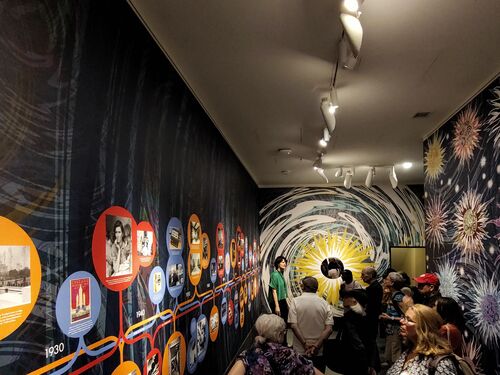
Photos by Bill Sullivan, courtesy Cultural Programs of the National Academy of Sciences
In a city teeming with monuments, museums, and historical sites, it could be easy to overlook the National Academy of Sciences building, located on Washington, D.C.’s National Mall, across from the Vietnam and Lincoln memorials. However, those who sign up for a guided tour of the nation’s “home for science” are in for a treasure trove of interesting architecture, art, and — of course — stories of science, scientists, and luminaries who have passed through the building over the past 100 years.
The free tours, a new offering from the Cultural Programs of the National Academy of Sciences, usually take about an hour or so and are led by trained docents several times a month. “You really can go into more depth about so much more on these tours,” said senior program associate Alana Quinn, who also occasionally leads the tours. “It’s fun to share these stories. And there are so many interesting stories.”
Although created in 1863 by a congressional charter signed by Abraham Lincoln to advise the nation on issues related to science and technology, the NAS did not have its own home until the building opened in 1924. Designed by lead architect Bertram Grosvenor Goodhue to be a “temple for science,” the building’s architecture immediately takes center stage with its unique blend of Egyptian, Hellenic, Byzantine, and art deco elements.
From the grand and ornate Great Hall accentuated by an elaborate dome featuring iconography commissioned from artist and sculptor Hildreth Meière; to the Board Room, which displays a prominent, apocryphal painting that imagines Abraham Lincoln standing alongside the Academy’s founders; to the Members Center, whose striking carved limestone mantelpiece depicts the history of reading and the written word from ancient Egypt to the Gutenberg printing press — each of the many rooms and spaces on the tour showcases artistic elements and designs that emphasize scientific disciplines, discoveries, and the pursuit of knowledge.
“It’s fun to look at people’s faces when they walk into the Great Hall for the first time — they’re just like, ‘wow,’” Quinn said. “And then, we’ve been ending the tour in the Fred Kavli Auditorium. You open those doors, and people say, ‘I had no idea this was here.’” Designed by Cyril Harris, a member of both the NAS and National Academy of Engineering, the auditorium opened in 1970 and has hosted everything from international summits to classical music performances to U.S. presidents and Nobel laureates. The room’s ceiling is an acoustics masterpiece made up of 70 adjoining diamond-shaped projections that were fabricated in place and arranged along cycloid-shaped curves to enable optimal distribution of sound.
The tour often includes discussions about notable members of the NAS and its sister academies — the National Academy of Engineering and the National Academy of Medicine. Members are elected by their peers for their outstanding contributions to research, and being elected is considered one of the highest honors a scientist, engineer, and health professional can achieve. Members include Albert Einstein — whose statue on the NAS grounds is a popular attraction — Thomas Edison, Florence Sabin, Maryam Mirzakhani, and Frances Arnold, many of whom are also Nobel laureates.
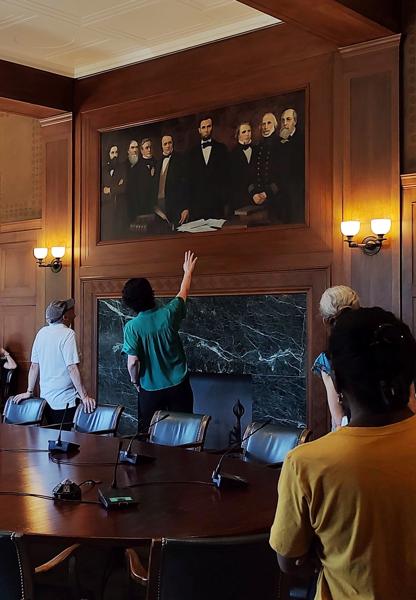
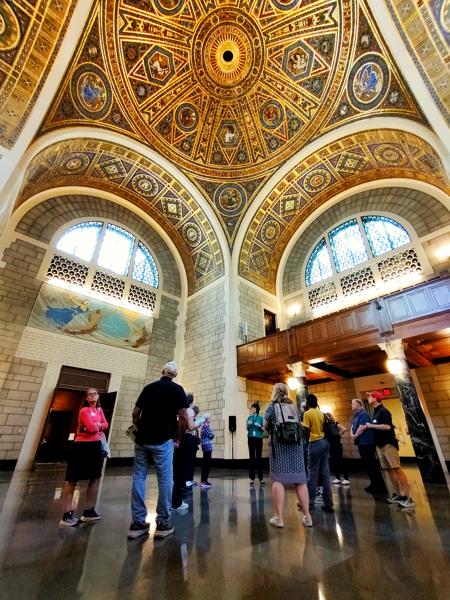
“I’ve especially enjoyed learning the personal stories of NAS members, and how remarkably international their legacy is,” said volunteer docent William Hearst Sullivan. “They range from Benjamin Apthorp Gould, an NAS founder who went on to establish Argentina’s national weather service, to Philip Handler, an NAS president whose leadership helped pave the way for joint spaceflight between the United States and the Soviet Union.”
An exhibit that celebrates women in STEM includes not only prestigious members of the Academies but also some surprises — such as the actress Hedy Lamarr, who happened to be an accomplished inventor whose work laid the foundation for WiFi, Bluetooth, and other wireless communications. Other building exhibits include a centennial timeline that highlights the work of the NAS and the National Academies in service to public welfare.
The tour also points out many of the significant guests and events the building has hosted, including a visit from Marie Curie to accept a funding grant in October 1929 — on the eve of the stock market crash and Great Depression; international negotiations for the first Antarctic Treaty; and a 1958 press conference that propelled the nation officially into the “Space Race,” in response to the launch of Sputnik the year before.
Quinn says that so far, people are drawn to the tour both for their interest in architecture and passion for science. “I’m delighted by the demand. Almost all of the tours have been at capacity so far. Surveys of those who have taken the tour are overwhelmingly positive. And I’m delighted that there are people who are willing to volunteer their time to lead these tours,” said Quinn, who hopes to recruit more volunteer docents in the coming months.
“My favorite aspect of the tour is the way it invites guests to observe closely and make meaningful connections,” said Hearst Sullivan. “Whether it’s noticing the design of the handrails, looking up at the dome, or linking the work of the NAS to its broader impact on American and global life, weaving these details together reveals the depth and significance of the NAS in a truly rewarding way.”
To attend a tour, visitors must register in advance and bring an ID.