Review of the Department of Energy's Plans for Disposal of Surplus Plutonium in the Waste Isolation Pilot Plant (2020)
Chapter: Appendix F: High-Risk Items Within the Risk and Opportunity Analysis Report
Appendix F
High-Risk Items Within the Risk and Opportunity Analysis Report
INTRODUCTION
The Risk and Opportunity Analysis Report (ROAR) (SRNS, 2018a) provides analyses by the Department of Energy’s National Nuclear Security Administration (DOE-NNSA) of cost and schedule risks for the proposed dilute and dispose plan. Some risks may need continuous review as details of designs for the proposed facilities, equipment, processes, and operations are developed in preparation for a program Conceptual Design at stages CD-1 (approved in late 2019) and the start of construction activities after CD-3A approval (approved in early 2020, DOE-NNSA, 2018).
This committee has not reviewed the underlying operations data used by DOE-NNSA to conduct the ROAR and Life-Cycle Cost Estimate (LCCE) evaluations (SRNS, 2018a,b). That is, the committee did not independently verify the stated frequency of realized risks such as unplanned process excursions, equipment breakdowns, or accidents that were used by DOE-NNSA to determine programmatic risks to cost and schedule. The U.S. Army Corps of Engineers’ review also did not investigate the underlying operations data. The operations data are based on experience at the sites or models developed in the course of the various dilute and dispose activities and trial runs to date.
Pantex’s role is to provide 26.2 metric tons (MT) of pit material in classified amounts in a licensed Type B package under a classified schedule to the Los Alamos National Laboratory (LANL). This step is unchanged from the previous plan to dispose of surplus plutonium using irradiated mixed oxide fuel. Currently the FL-type Type B container is certified for transportation from Pantex; for the dilute and dispose plan, a new MD-2 container is expected to be certified and used (Whitworth, 2018). See Figure F-1.
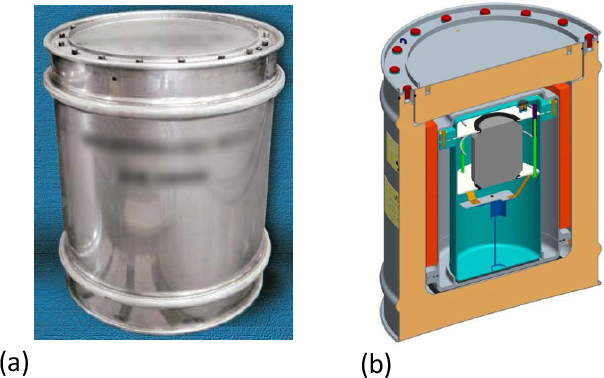
DOE-NNSA plans to qualify and build the MD-2 container, which is stronger than the FL package and has an improved ceramic insulation formulation to pass drop and burn tests. The new MD-2 enables the pits to be kept in current sealed containers and is expected to be ready for use in FY 2021. In terms of Technology Readiness Level (TRL) the MD-2 is listed as TRL-7 (Cantey and Robertson, 2019) and should be able to come online well ahead of the time that it is needed for dilute and dispose operations ramp-up in 2023. Other plans related to improved containers for LANL operations are outlined in Box F-1.
ROAR REVIEW
The ROAR document identifies risks for the dilute and dispose program ranked low, moderate, and high. The ROAR also identifies a number of opportunities to offset the risks. Below, we provide an overview of the high risks and opportunities for the program.
Los Alamos National Laboratory
There are several scale-up risks for operations at LANL that are ranked as high risk to program schedule and cost.1 These have to do with both equipment and operations:
- Anomalous events causing delays. These are unforeseen and known to occur; this is a matter of normal contingency planning. Such events must be accepted and accounted for in the program plan. Process upsets often result in major shutdowns. Background documentation for the program does not indicate how much time is built into the schedule for such anomalous events, although the ROAR does say that serious events can disrupt production for 1 year or more, stopping activity downstream at SRS and the Waste Isolation Pilot Plant. The documentation does not specify the nature of potential anomalous events.
- Equipment installation schedule delays. The program plan calls for efforts to mitigate this risk, presumably during the ramp-up phase of the program.
___________________
1 In October 2019, the U.S. Government Accountability Office issued a report that examined DOE’s capacity to produce plutonium oxide as DOE-NNSA begins to plan an expanded capability to produce pits (GAO, 2019).
- Inability to use a SAVY container for storing and shipping oxide product to SRS. The committee assumes that is a schedule risk but not a scale-up risk. That is, use of the 3013 instead of the SAVY container may slow down the operations, thus diminishing concerns about scale-up but extending program completion beyond the 2049-2056 time frame.
- Lower than planned oxide production rate. The ROAR document says that this can be mitigated at a cost of $150 million. Although the ROAR does not specify it, the committee assumes that these funds would be applied to increase the number of lines and/or shifts. The committee notes that the needed oxide production rate is much greater than previously demonstrated, a significant risk as noted in the ROAR.
- Productivity impact of insufficient storage. The ROAR document says this can be avoided for $10 million.
The opportunities to offset scale-up risks at LANL are
- Install additional capacity at a cost of $67 million. There is no detail as to how much schedule improvement would result with this expenditure.
- Share with other installations at LANL in the proximity of the dilute and dispose operations.
- Maximize production prior to and/or during facility modifications. This can be achieved for $22.3 million, according to the document.
- Perform small in-line sample analysis. An additional expenditure of $3.5 million is assumed by DOE-NNSA to facilitate the process throughout.
Savannah River Site
The ROAR document (SRNS, 2018a) identifies two risks at SRS that are ranked as high risk to program schedule and cost. These have to do with both equipment and operations:
- Failure of characterization equipment. The plans are to perform non-destructive assay (NDA), real-time radiography (RTR), and flammable gas analysis (FGA) without standby equipment. To mitigate this risk, the costs of purchasing spare NDA, RTR, and FGA equipment are included in the LCCE baseline.
- Delay in K Area operations. Savannah River Nuclear Solutions may not complete the necessary steps allowing K Area operation to begin. Even with mitigation efforts this risk remains high.
The ROAR document also identifies a number of SRS scale-up risks ranked as moderate or low in terms of cost and schedule and identifies a number of opportunities to offset risks at SRS:
- Increase criticality control overpack (CCO) loading. Increasing the loading of a CCO from 300 g Pu to 330 g Pu would decrease glovebox labor and reduce the number of containers, amount of container handling and storage, and the number of shipments. However, it would demand high-accuracy measurements in K Area with unacceptable third-party entrance into K Area. Therefore, this opportunity is deemed of low probability of success.
- Optimize storage requirements. Among the SRS requirements for ensuring safe storage of nuclear material in K Area are multiple mass measurements of incoming fissile materials for criticality analysis. Work is in progress to eliminate these multiple measurements at LANL by using multiple scales and independent verification, which would reduce cost and personnel exposure at LANL.
- Streamline waste tracking methods. Current waste characterization processes are designed for differing small-quantity wastes and necessitate significant effort. However, the dilute and dispose waste is uniform, and a streamlined waste tracking process in E Area is possible, leading to significant cost savings.
- Treat E Area facility as contamination free. Currently five or more radiological surveys are made when CCOs are moved before shipping. There is a potential to eliminate many of these surveys to be reflected in cost savings.
REFERENCES
Cantey, T., and S. Robertson. 2019. Surplus Plutonium Disposition Program Container Utilization. SRNS‐MS‐201900071. Aiken, SC: Savannah River Nuclear Solutions.
DOE-NNSA (Department of Energy’s National Nuclear Security Administration). 2018. Surplus Pu Disposition Master Summary Schedule, June. Provided to the committee by DOE-NNSA (accessed March 8, 2020).
GAO (Government Accountability Office). 2019. Surplus Plutonium Disposition: NNSA’s Long-Term Plutonium Oxide Production Plans Are Uncertain. GAO-20-166. https://www.gao.gov/assets/710/702239.pdf (accessed March 8, 2020).
SRNS (Savannah River Nuclear Solutions). 2018a. Risk and Opportunity Management Plan for the National Nuclear Security Administration Surplus Plutonium Disposition Program Dilute and Dispose Approach. Y-RMP-G-00023, Rev. 1, February. Aiken, SC: SRNS.
SRNS. 2018b. Surplus Plutonium Disposition Program Dilute and Dispose Approach Life Cycle Cost Estimate, Summary Report. SRNS-RP-2018-00570, Rev. 0, May. Aiken, SC: SRNS.
SRNS. 2018c. Surplus Plutonium Disposition Technical Baseline Description for the Proposed Dilute and Dispose Approach. SRNS-TR-2016-00285, Rev. 1, June. Aiken, SC: SRNS.
Stone, T. 2012. Los Alamos National Laboratory Overview of the SAVY-4000 Design: Meeting the Challenge for Worker Safety. LA-UR-12-01729. Presented at Fifty-Third Annual Meeting of the Institute of Nuclear Materials Management. https://permalink.lanl.gov/object/tr?what=info:lanl-repo/lareport/LA-UR-12-01729 (accessed March 31, 2020).
Whitworth, J. 2018. “ARIES Oxide Production Program Dilute and Dispose LCCE Overview, Material Management and Minimization Program,” LA-UR- 18-28648, Independent Validation Review, August 28–30, 2018. https://permalink.lanl.gov/object/tr?what=info:lanl-repo/lareport/LA-UR-18-28648 (accessed March 22, 2020).


