Carbon Utilization Infrastructure, Markets, and Research and Development: A Final Report (2024)
Chapter: Appendix J: Background Information About Life Cycle, Techno-Economic, and Societal/Equity Assessments
J
Background Information About Life Cycle, Techno-Economic, and Societal/Equity Assessments
Material in this appendix provides additional information on techno-economic assessments (TEAs) and life cycle assessments (LCAs), including an example of resources for supporting TEAs and supplemental examples of the wide variation observed in a review of LCA results for production of CO2-based chemicals.
Given the variety of techniques available, guidelines for selecting an uncertainty analysis method for TEAs are gaining traction in the literature. Figure J-1 shows an example decision tree recommending the type of uncertainty analysis based on purpose.
Tables J-1 and J-2 show compiled LCA results for CO2 emissions released to produce dimethyl ether (DME) and dimethyl carbonate (DMC) from Garcia-Garcia et al. (2021), demonstrating the wide variety of technologies and processes that have been examined and how these technologies and processes for the same product may incur different environmental impacts.
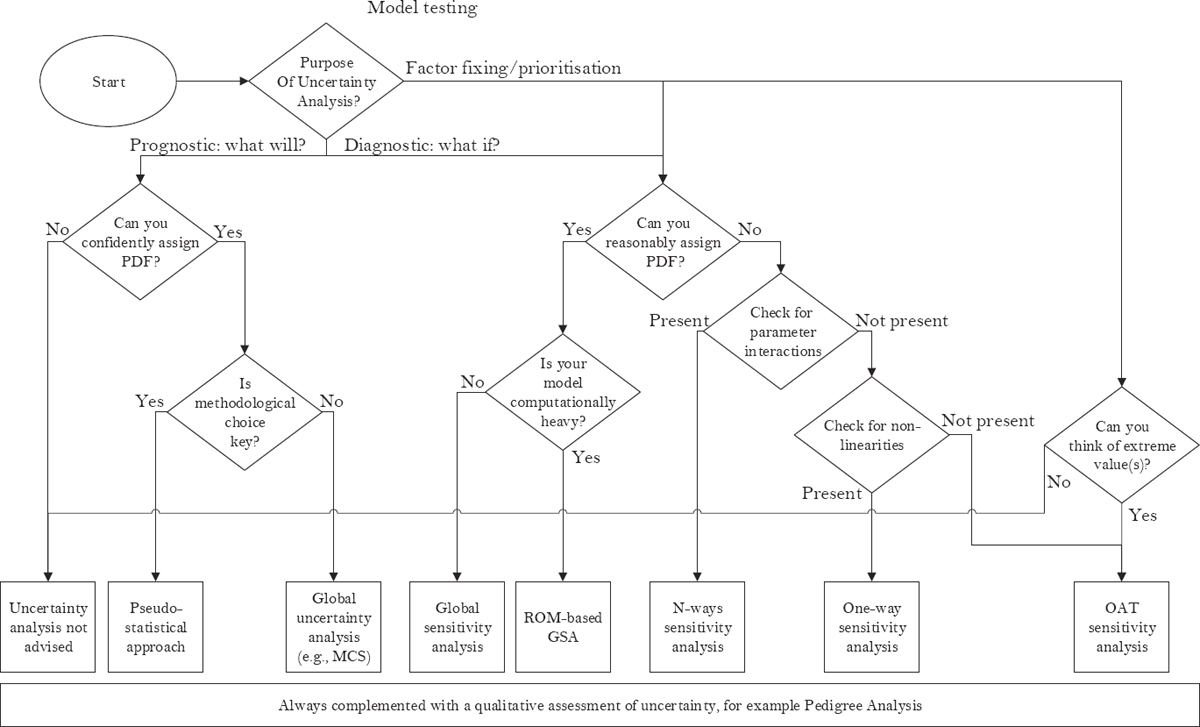
NOTE: GSA = global sensitivity analysis; MCS = Monte Carlo simulation; OAT = one-at-a-time sensitivity analysis; PDF = probability distribution function; ROM = reduced order model.
SOURCE: Roussanaly et al. (2021), https://doi.org/10.2172/1779820. CC BY 4.0.
TABLE J-1 Compiled Life Cycle Assessment Results for CO2 Emissions Using Different System Boundaries, Assumptions, and Processes for Dimethyl Ether (DME) Production from CO2
| Technology/Process | System Boundaries | CO2 Emissions |
|---|---|---|
| Synthesis by dehydrogenation of methanola | Cradle-to-gate | 1.27 kgCO2 eq kg−1DME |
| DME from natural gasa | Cradle-to-grave, including feedstock production and transport, fuel production, distribution and reforming, and vehicle fueling and combustion | 91.1 gCO2 eq MJ−1DME |
| CO2 converted to syngas via dry reforming of methane (Ni/Rh/Al2O3 catalyst), then transformed into DME (γ-Al2O3 catalyst) | Cradle-to-gate plus combustion Cradle-to-gate | 35.8 gCO2 eq MJ−1DME 0.12–0.15 kgCO2 eq MJ−1DMEb −1.07–0.48 kgCO2 eq kg−1DMEb |
| DME from high solid anaerobic digestion of food and yard waste | Cradle-to-grave, including feedstock production and transport, fuel production, distribution and reforming, and vehicle fueling and combustion | −5 gCO2 eq MJ−1DME |
| CO2 converted to methanol, then transformed to DME via a condensation reaction | Cradle-to-gate | 0.5 tCO2 eq MJ−1DME |
| CO2 enhanced gasification of gumwood to produce DME | Cradle-to-gate including the pre-treatment process; production of DME; and utilization of DME as renewable fuel for diesel engines. | bio-DME emissions 46.2 kgCO2 eq per 100 km, and 162 kgCO2 eq per 100 km for diesel |
a Standard production (non-CO2 utilization) processes for comparison
b Range contingent on hydrogen and electricity sources and other assumptions
SOURCE: Adapted from Garcia-Garcia (2021), Table 7.
TABLE J-2 Compiled Life Cycle Assessment Results for CO2 Emissions Using Different System Boundaries, Assumptions, and Processes for Dimethyl Carbonate Production from CO2
| Technology/Process | System Boundaries | CO2 Emissions (kgCO2 eq kg−1DMC) |
|---|---|---|
| Conventional production, via phosgene from CO and Cl2, and the Bayer processa | Cradle-to-gate | 0.52–132 |
| Direct synthesis from CO2 and methanol | Cradle-to-gate | 7.26–7.33b |
| Electrochemical reaction of CO2 with methanol in the presence of potassium methoxide and 1-butyl-3-methylimidazolium bromide | Cradle-to-gate | 381–465b |
| Electrosynthesis from CO2 and methanol | Cradle-to-gate | 78.9 |
| Oxidative carbonylation of methanol (Eni) | Cradle-to-gate | 3.18 |
| Transesterification of ethylene carbonate | Cradle-to-gate | 0.45–0.77b |
| Transesterification of urea | Cradle-to-gate | 2.94 |
| Via ethylene oxide | Cradle-to-gate | 0.86 |
| Via urea from NH3 and CO2 | Cradle-to-gate | 30.6 |
| Via urea methanolysis | Cradle-to-gate | 0.34 |
a Standard production (non-CO2 utilization) processes for comparison
b Range contingent on hydrogen and electricity sources and other assumptions
SOURCE: Adapted from Garcia-Garcia et al. (2021).
REFERENCES
Garcia-Garcia, G., M. Cruz Fernandez, K. Armstrong, S. Woolass, and P. Styring. 2021. “Analytical Review of Life-Cycle Environmental Impacts of Carbon Capture and Utilization Technologies.” ChemSusChem 14(4):995–1015. https://chemistry-europe.onlinelibrary.wiley.com/doi/10.1002/cssc.202002126.
Roussanaly, S., E. Rubin, M. Der Spek, G. Booras, N. Berghout, T. Fout, M. Garcia, et al. 2021. “Towards Improved Guidelines for Cost Evaluation of Carbon Capture and Storage.” OSTI ID:1779820. https://doi.org/10.2172/1779820.


