Carbon Utilization Infrastructure, Markets, and Research and Development: A Final Report (2024)
Chapter: 2 Priority Opportunities for CO2- or Coal WasteDerived Products in a Net-Zero Emissions Future
2
Priority Opportunities for CO2- or Coal Waste–Derived Products in a Net-Zero Emissions Future
2.1 CARBON FLOWS IN A NET-ZERO EMISSIONS FUTURE AND PATH TO CO2-DERIVED PRODUCTS
Carbon-based materials derived from biogenic and fossil carbon currently play essential roles in our lives and the economy. Decomposition from decay or combustion of these materials leads to excess flows of CO2 into the atmosphere, resulting in accumulating concentrations of CO2, especially when the material was originally fossil derived. In a net-zero future, carbon flows will be in a global equilibrium so that CO2 no longer accumulates in the atmosphere. Reducing emissions and CO2 removal are needed to bring atmospheric CO2 concentrations to levels that support stabilizing the global climate at acceptable conditions for human life, and then maintain those lower, stable concentrations of CO2 in the atmosphere. Carbon flows in the economy, and the associated CO2 emissions, will be greatly reduced by zero-carbon replacements for many products, especially fuels. However, carbon-based materials cannot be entirely eliminated because they (1) will continue to be part of natural and engineered biological and geological carbon cycles; (2) will continue to be necessary components of many products important in daily life; and (3) can be used to store carbon away from the atmosphere in durable products, or engineered and natural sequestration. CO2 utilization can play a role in creating sustainable, circular, or net-zero-emissions; carbon-based systems for our future material needs; alongside other sustainable carbon feedstocks like biomass or recycled material. This chapter focuses on the market opportunities for CO2 utilization in a net-zero future.1 This report examines what carbon-based materials will be needed in a net-zero future, possible sources of sustainable carbon feedstocks for those materials, and what role CO2 could play in supplying sustainable carbon.
Carbon-based biomass (24.6 gigatonnes [Gt]) and fossil hydrocarbons (15.1 Gt) represent nearly 40 percent of global resource flows today, with the remainder being minerals and ores (50.8 Gt, and 10.1 Gt, respectively) (de Wit et al. 2020, Figure 1). Carbon is not just an ingredient but is in fact the key element in such products as fuels, plastics, fertilizers, chemicals and chemical intermediates, and elemental carbon materials. Today, carbon-based chemical, fuel, and material products are dominantly manufactured with fossil carbon feedstocks,2 so at the end of life, their consumption, disposal, or decay adds net-positive CO2 emissions to the atmosphere. Using alternative feedstocks that enable circular carbon flows for carbon-based products is a key strategy for reducing
___________________
1While this chapter focuses on CO2 utilization market opportunities, priority products from coal waste are also considered, especially critical minerals. The report covers coal waste utilization opportunities in detail in Chapter 9.
2Feedstocks are material inputs to industrial processes to generate a product.
fossil carbon emissions to the atmosphere. These feedstocks must be derived from sources or materials with low or zero life cycle greenhouse gas (GHG) emissions and integrated into industrial processes in a more sustainable way.3 Examples of carbon feedstocks with lower life cycle emissions include biomass, recycled or waste carbon products such as plastics, captured CO and CO2, biogas, and municipal solid waste.4 Another important class of materials that can use CO2 feedstocks is CO2-derived mineral carbonates incorporated into construction materials, which do not traditionally incorporate CO2, but where CO2 can be incorporated as long-duration stored carbon.5 During the transition to net-zero, an alternative to circular carbon feedstocks is the continued use of fossil feedstocks with compensatory capture and sequestration to prevent or remove an equivalent full life cycle amount of CO2 emissions from the atmosphere. This report is tasked with examining a circular carbon future, and so this possibility of linear fossil production with offsetting is noted but not explored in depth. The report is also tasked to examine coal waste utilization opportunities, which are addressed in Section 2.2.3 and Chapter 9.
This chapter describes the market opportunities for products that will use captured CO2 or coal waste as feedstocks to provide useful carbon-derived products in a net-zero future. Products fall into two classes: durable storage materials, with lifetimes greater than 100 years, and circular carbon materials, with lifetimes less than 100 years. The product lifetime distinction is important for understanding the two classes’ climate impact. Durable storage materials will act as long-term sinks for carbon and could become instrumental in achieving an overall net-zero carbon future. Circular carbon materials will enable the sustainable cycling of nonfossil carbon in both natural and human-made systems, an essential aspect of moving from an extractive model of carbon mining and waste deposition into the atmosphere to a net-zero future with substantial climate and economic benefits.
There is no consensus on the stable need for carbon-based products in a net-zero future. Product volumes depend heavily on technology potential, the pace of transition, population and economic growth, available resources (CO2, enabling, and competing), and policy choices based on priorities for decarbonization and other societal goals. Durable storage materials and circular carbon materials are distinct in their growth potential. Most durable storage materials have significant carbon utilization growth potential: they are currently not produced in large quantities (e.g., carbon fiber, nanotubes), have undeveloped yet significant potential for applications in new markets (e.g., carbon black in concrete, direct use of coal waste in construction materials), or have production method alternatives that incorporate CO2 as a new ingredient, rather than a replacement for fossil carbon (e.g., concrete, aggregates). Because of their growth potential and the future need for carbon removal in a net-zero future, durable storage materials could result in both cost-effective removal of carbon from open environments and production of revenue-generating products at scales of Gt per year.
Short-lived, circular carbon materials to replace fossil-derived fuels and chemicals have a divergent growth trajectory, with some products expected to shrink and others expected to grow. In a net-zero future, some current hydrocarbon markets are expected to largely disappear and be replaced by zero-carbon solutions, notably electric power replacing fuels for ground transportation (NASEM 2023a). For example, the daily use of gasoline fuel in the United States is about 8 million barrels (EIA 2024). Within the fuels class, the production of aviation fuels will remain a large-volume need that could be met with CO2 conversion (NASEM 2023b). Demand for other essential short-lived carbon products (e.g., chemicals and fertilizers) is expected to continue growing and can be integrated into a circular economy based on alternative carbon feedstocks, including CO2. Within the chemicals class, this report distinguishes chemical intermediates from end products to emphasize their versatile role in the chemical industry. For example, ethylene or ethanol could be used as intermediates in the production of polymer material or aviation fuel. Figure 2-1 shows one estimate of (1) the embedded carbon in fuels for energy and transport, and in materials and chemicals in 2020 and 2050, and (2) a detailed description of the carbon embedded in chemicals
___________________
3Chapter 3 discusses life cycle assessment as applied to carbon utilization.
4It is also conceivable that some carbon-based products could be replaced in the future with materials that use silicon or sulfur as the backbone atom, but these options will not be addressed in this report (Barroso et al. 2019; Kausar et al. 2014; Petkowski et al. 2020).
5In this report, concrete and aggregates are considered carbon-derived materials, even though they traditionally do not use carbon as a feedstock. This helps to reduce the significant carbon burden created by life cycle emissions associated with construction materials (Park et al. 2024).

SOURCE: Kähler et al. (2023).
and derived materials globally.6,7,8 The analysis indicates that fuel demand will drop by 50 percent in the energy sector and 90 percent in the transport sector. Demand for chemicals and materials is projected to double by 2050. When focused on the subset of materials and chemicals that includes chemicals and derived materials, especially polymers, the total carbon demand was 550 Mt annually in 2020, with 88 percent of that derived from fossil material, 8 percent derived from bio-based materials, and less than 5 percent being recycled or CO2-derived (0.03 percent) (see Figure 2-1). In 2050, 25 percent of carbon demand for chemicals and derived materials is projected to be sourced from CO2. Table 2-1 describes the committee’s assessment of the priority products for a net-zero future. These include both durable storage and circular carbon materials.
The following sections describe existing markets and anticipated growth for three use cases for CO2 or coal waste feedstocks: (1) incumbent products that could be replaced by products made from new carbon sources (e.g., sustainable aviation fuels, polymers, or chemicals and intermediates); (2) products that traditionally are not made from fossil carbon (e.g., concrete, aggregates) but that could incorporate CO2 as a feedstock; and (3) products for which a current market is small but could grow substantially in a net-zero future (e.g., carbon fiber as a substitute for steel and aluminum). Specific market considerations for key product categories are analyzed in detail. Relevant factors for the market introduction of products from new carbon feedstocks are discussed, including access and availability to new feedstocks, suitable conversion technologies and infrastructure, consumer demand and acceptance, and regulatory environments. Sections on cost and financial risk are followed by a discussion of the need for techno-economic and life cycle assessments as well as analyses of the risk of unintended consequences. (Further material on these aspects is covered in Chapters 3 and 4 of this report.) The chapter then concludes with a summary of findings and recommendations.
2.2 MARKET OPPORTUNITIES FOR CO2-DERIVED PRODUCTS
2.2.1 Factors That Impact Ease of Making Products from CO2
In principle, all hydrocarbon fuels and chemicals, and many other materials, including inorganic carbonates, elemental carbon materials, and plastics, can be synthesized from CO2. However, only some products and markets are likely to be attractive for investment in CO2 conversion processes, relative to other sustainable carbon feedstock alternatives. The costs of producing specific products via various CO2 utilization pathways versus competing pathways and feedstocks must be considered. Competing sustainable pathways include substituting the product with zero-carbon alternatives like electricity and hydrogen (most relevant for fuels) and manufacturing the product with other non-fossil carbon feedstocks like biomass or recycled carbon wastes. Uncertainties in future policy, market, and regulatory environments, as well as unknowns related to technological advancements, make it impossible to predict and compare future costs of producing specific products from different feedstocks. However, the physicochemical properties of CO2 and potential CO2-derived products provide some guidance on the ease of making different classes of products from CO2 versus production from either incumbent net-positive emission feedstocks, or other net-zero emission feedstocks.
___________________
6Embedded carbon is the carbon present in the molecules or materials that constitute products. It differs from embodied carbon, which describes the life cycle carbon emissions associated with a product.
7As defined in Kähler et al. (2023), chemicals and derived materials are organic chemicals and polymers originating from the global chemical industry, including human-made fibers and rubber. This does not include chemicals derived from the heavy oil fraction (bitumen, lubricants, and paraffin waxes), nor does it include wood, pulp and paper, or natural textiles. The total estimated global demand for carbon embedded in chemicals and derived materials is approximately 550 megatonnes (Mt) per year, and 1200 Mt per year when the additional classes of materials and chemicals are included. None of the analyses in Kähler et al. (2023) include global embedded carbon in fuel products, such as gasoline, diesel, aviation fuel, natural gas, or coal.
8The future 2050 scenario for renewable carbon-based fuels, chemicals, and derived materials outlined in Kähler et al. (2023) assumes that demand for carbon-based fuels in the energy sector is reduced by 50 percent through use of electricity, hydrogen, and solar heating. Transportation carbon needs reduce by 90 percent due primarily to electrification and some hydrogen fuel. Demand increases by 100 percent, assuming a combined annual growth rate of 2.5 percent, for chemicals and derived materials. In this scenario, the shares of the renewable carbon sources for chemicals and derived materials are estimates based on ambitious rates of recycling (55 percent of embedded carbon), biomass limited by planting areas (20 percent), and the remainder of embedded carbon produced from CO2 utilization (25 percent).
TABLE 2-1 Committee’s Assessment of Priority Products from CO2
| Product Class | Example Priority Products | Competitors to CO2-Derived Production in a Net-Zero Future | Current Global Production and Future Demand (gigatonnes [Gt] per year, year of estimate)a | Climate Benefits (lighter blue = lower climate benefit, darker blue = higher climate benefit) | Conversion Technology | Market Driver and Advantages of CO2 Feedstock | ||
|---|---|---|---|---|---|---|---|---|
| Durable carbon storage or circular carbon product | Amount of CO2 used (tCO2/tonne product)a | Global scale (Gt per year, estimated in 2050)a | ||||||
| Fuels | Jet fuel Marine fuel Lipids | Biomass-derived carbon fuels Electrification Hydrogen Ammonia | Jet fuel 0.305 (2020) 3.07 (2050) | Circular | 3–6 (Jet fuel) | 3.07 (Jet fuel) | Chemical Biological |
|
| Marine fuel 0.3 (2020)b |
| |||||||
| Inorganic Construction Materials | Concrete Aggregates | Incumbent construction materials (conventional concrete, aggregates, steel, aluminum, wood) Coal waste–derived products | Concrete 7 (2020) 32.3 (2050) | Durable | 0.001–0.05 (Concrete) 0.087–0.44 (Aggregates) | 32.3 (Concrete) 119 (Aggregates) | Mineralization |
|
| Aggregates 45 (2020) 119 (2050) | ||||||||
| Polymers | Polycarbonates Polyurethanes Polylactic acid Polyhydroxyalkanoate | Biomass-derived polymers Recycling | Polycarbonates 0.0015 (2007)c 0.024 (2020) | Circular or Durable | 0.05–0.25 (Polyurethane) | 0.06 (Polyurethane) | Chemical Biological |
|
| Polyurethanes 0.06 (2050) | ||||||||
| Agrochemicals Including Fertilizers | Urea | Biomass-derived agrochemicals | 0.13 (2019)d 0.27 (2032)e | Circular | 0.73f | Chemical |
| |
| Chemicals and Chemical Intermediates | Chemical products: CO Methanol Ethylene Formic acid Bioproducts: Butanediol Succinic acid Lactic acid | Biomass-derived chemicals Recycling | Methanol 0.110 (2022)g 0.432 (2050) | Circular | 1.28–1.5 (Methanol) 0.49–0.96 (Formic acid) | 0.432 (Methanol) 0.25 (Ethylene)h 0.0140 (Formic acid) | Chemical Biological |
|
| Ethylene 0.168 (2020)g 0.25 (2050)h | ||||||||
| Formic acid 0.00078 (2020) 0.0140 (2050) | ||||||||
| Elemental Carbon Materials | Carbon black Carbon fiber Carbon nanotubes Graphene | Methane-derived elemental carbon materials Biomass-derived elemental carbon materials Coal waste | Carbon black 0.014 (2020) 0.07 (2050) | Circular or Durable | 3.7–4.2 (Carbon black) | 0.07 (Carbon black) | Chemical |
|
| Food and Animal Feed | Spent microbes | Low-impact animal and plant food production | Animal feed 0.337 (2020) 1.9 (2050) | Circular | 0.5–0.7 | 1.9 | Biological |
|
a Unless otherwise noted, data are from Sick et al. (2022b).
b From Statista Research Department (2023).
c From Neelis et al. (2007).
d From IEA (2019).
e From Chemanalyst (2023b).
f From Bazzanella and Ausfelder (2017).
g From CAETS (2023).
h From IEA (2018).
NOTE: The Climate Benefits column is color-coded, where light blue indicates low benefit, blue indicates medium benefit, and dark blue indicates high benefit.
SOURCES: Based on data from Bazzanella and Ausfelder (2017); CAETS (2023); Chemanalyst (2023b, 2023c); IEA (2019); Kähler et al. (2023); Mallapragada et al. (2023); Neelis et al. (2007); Sick et al. (2022b); Statista Research Department (2023).
TABLE 2-2 Standard Gibbs Free Energy to Convert CO2 and Water to Reduced Productsa
| Product | Reaction | ΔG0rxn (kJ/mol) |
|---|---|---|
| Carbon monoxide | CO2 (g) → CO (g) + 1/2O2 (g) | 257 |
| Formic acid | CO2 (g) + H2O (l) → HCOOH (l) + 1/2O2 (g) | 270 |
| Methanol | CO2 (g) + 2H2O (l) → CH3OH (l) + 3/2O2 (g) | 703 |
| Ethanol | 2CO2 (g) + 3H2O (l) → C2H5OH (l) + 3O2 (g) | 1326 |
| Ethylene | 2CO2 (g) + 2H2O (l) → C2H4 (g) + 3O2 (g) | 1331 |
| Ethane | 2CO2 (g) + 3H2O (l) → C2H6 (g) + 7/2O2 (g) | 1468 |
a All thermodynamic quantities are calculated as described in Nitopi et al. (2019), using data from the NIST Chemistry Webbook (Linstrom and Mallard n.d.) and Lange’s Handbook (Dean 1999).
CO2 is a highly oxidized, single-carbon, and relatively unreactive feedstock. It can be transformed into products via low energy, non-reductive pathways where the carbon remains highly oxidized, such as into inorganic and organic carbonates, polycarbonates, urea, and carboxylic acids (Martín et al. 2015). CO2 can also be converted into reduced carbon products, such as hydrocarbons and alcohols, via higher energy pathways (Shaw et al. 2024). Table 2-2 shows the energy required to form several reduced carbon products, with higher Gibbs free energy representing more thermodynamically difficult reactions (the related electrochemical reaction energetics are shown in Table 7-2) (Nitopi et al. 2019). All reactions are thermodynamically unfavorable (positive free energy) under standard conditions, which is to be expected from reductive transformations of CO2 and water to form hydrocarbons and alcohols, and the most reduced and longer carbon chain products are more challenging thermodynamically.
The cost of making products depends both on the fundamental thermodynamics of conversion processes as well as reaction kinetics, and a variety of technology- and market-specific technical and economic factors. Kinetically, formation of single-carbon products is easier than multi-carbon products, which require challenging multi-step transformations. Improved catalysis, reaction design, and systems design can improve reaction kinetics (selectivity, rate, and yield). Sections 2.2.2 and 2.2.3 further describe the demand-side and supply-side market considerations for CO2 utilization, and section 2.2.4 describes market considerations by product class. Chapter 7 examines the technology readiness (Figure 7-3) and compares scaling factors (Section 7.2.2.2) for processes to convert CO2 to certain priority chemical intermediates and final products, providing an example of technical and economic factors to consider when selecting a conversion pathway for a particular product.
2.2.2 Demand for Products Derived from CO2
The carbon-based product system will need to transform to one that can be net-zero-emitting while continuing to provide the remaining product services to the economy without relying on fossil carbon feedstocks. Future markets for short-lived, circular carbon products derived from CO2 will be dependent on the demand for fuels, chemicals and chemical intermediates, and other such products; by the potential to supply such products from different sustainable feedstocks and will reflect restructuring of chemical markets based on competition with zero-carbon substitutes. Many of today’s carbon-containing products, including most fuels, chemicals, and plastics, are derived from fossil carbon (petroleum, natural gas, and coal). Short-lived products emit their fossil carbon into the atmosphere during use or after disposal. In the future, a major class of these carbon-containing materials, hydrocarbon fuels for land- and sea-based transport, heating, and electricity generation, will largely disappear owing to improved zero-carbon options, and the limits placed on emissions that are likely to be required to achieve net-zero. Although projections for the rates of reduction in fossil fuel use vary, an example scenario is shown in Figure 2-2. The International Energy Agency’s (IEA’s) Net-Zero-Emissions Scenario projects a decline of fossil-carbon-derived fuels to 20 percent of all energy supply in 2050 (IEA 2021), from 80 percent in 2020.
The transition away from fossil fuels will follow different timelines in the developed world and developing regions where the demand for basic materials, electricity, and water, as well as the lack of infrastructure for net-zero options, might require the use of fossil carbon feedstocks to a larger extent and for longer times.

NOTE: EJ = exajoules.
SOURCE: IEA, 2021, Net Zero by 2050: A Roadmap for the Global Energy Sector, Paris: IEA, https://iea.blob.core.windows.net/assets/deebef5d-0c34-4539-9d0c-10b13d840027/NetZeroby2050-ARoadmapfortheGlobalEnergySector_CORR.pdf. CC BY 4.0.
In contrast to falling fuel demand, demand for the many nonfuel, carbon-based products is expected to grow, tracking with expected global economic development. For example, the IEA projected that demand for petrochemicals would represent nearly a third of demand growth for oil in 2030 and about half in 2050 (IEA 2018). To better understand the current chemical industry, Appendix I, Table I-1 describes the major fossil-derived chemical products, excluding fuels, by global volume in 2007, and their production methods. Although the data are from 2007, it describes a baseline of fossil chemical production, which in the future will need to evolve into an industry producing a related but not identical suite of products, with sustainable carbon feedstocks, and likely at larger volume overall, with projected increases in demand for chemicals production. The key question becomes how to source the required carbon to manufacture these products. In principle, all hydrocarbon fuels and chemicals can be synthesized from CO2 and hydrogen. However, only some products and markets are likely to be attractive for investment in CO2 conversion processes, relative to other sustainable carbon feedstock alternatives. The costs of producing specific products via various CO2 utilization pathways versus competing pathways and feedstocks must be considered. Competing sustainable pathways include substituting the product with zero-carbon alternatives (most relevant for fuels), manufacturing the product with other nonfossil carbon feedstocks like biomass or recycled carbon wastes, or offsetting fossil carbon emissions from the product life cycle using negative emission technologies, such as capturing and geologically storing an equivalent amount of CO2.
Preparing for the transition to non-fossil-sourced chemicals production needs to factor in the risks to growth in product demand, as it will play a crucial role in research investments, and planning and deploying new supply chains and infrastructure to provide raw material streams. The total addressable market estimates the demand for carbon-based products that could be satisfied by production from sustainable carbon feedstocks, including CO2. Figure 2-3 illustrates examples of growth projections of the total addressable market for key product categories for which CO2 utilization could be considered (Sick 2022b), based on a market analysis of historical published growth rates and industry leader expectations. Based on that, product-specific and constant compound annual growth rates were assumed to project the market demand.
Market penetration during the transition to net zero will depend critically on the cost of the new products compared to the incumbents, especially fossil-derived products. All hydrocarbon products derived from CO2 require

SOURCE: Adapted from Sick (2022b), https://dx.doi.org/10.7302/5825. CC BY 4.0.
the input of energy and hydrogen, either in molecular form or as water or another hydrogen donor. Most products also require the formation of carbon-carbon (C-C) bonds, which may need additional, capital-intensive reaction and separation steps. Fossil feedstocks already contain carbon in chemically reduced form (“hydrocarbons”) and often also contain the desired C-C bonds. Given the large amounts of energy required and the capital intensity of the conversion processes, synthetic hydrocarbon products are therefore more expensive than those derived from petroleum or natural gas at their current prices. Any “green premium” can be an insurmountable barrier to (broad) market introduction. Procurement incentives, “buyers’ clubs” such as the First Movers Coalition, and direct subsidies via tax rebates and other policy means will be important to kickstart the emerging industry. For CO2 utilization to play a role in a future net-zero economy, the levelized cost of managing CO2 via conversion to products compared to sequestration will have to be reduced, and the true (societal) cost of using fossil carbon needs to be incorporated into the economy as well (Black et al. 2023). Chapter 4 discusses policy needs for CO2 utilization in greater depth.
2.2.3 Supply-Side Considerations for CO2-Derived Products
Using CO2 as a major feedstock for carbon-based products requires building up an entirely new industry, albeit one that can integrate substantial elements of current industries—for example, the construction material and chemical industries. The translation from invention to market-ready product gets increasingly expensive the closer the technology is to market introduction. Table 2-3 defines the technology readiness level (TRL) scale that describes the progress of a technology from research through development, and demonstration to operation. For technologies that achieve full commercial operation, times to market readiness usually are on the order of a decade, and any acceleration requires additional funding. The urgency to address climate change and secure access to sustainable carbon makes the long time-to-market a significant challenge.
TABLE 2-3 Definitions of Technology Readiness Levels
| Level of Technology Development | Technology Readiness Level | TRL Definition | Description |
|---|---|---|---|
| System Operations | 9 | Actual system operated over the full range of expected conditions | The technology is in its final form and operated under the full range of operating conditions. |
| System Commissioning | 8 | Actual system completed and qualified through test and demonstration | The technology has been proven to work in its final form and under expected conditions. |
| 7 | Full-scale, similar (prototypical) system demonstrated in relevant environment | Demonstration is shown of an actual system prototype in a relevant environment. | |
| Technology Demonstration | 6 | Engineering/pilot-scale, similar (prototypical) system validation in relevant environment | Engineering-scale models or prototypes are tested in a relevant environment. This represents a major step up in a technology’s demonstrated readiness. |
| Technology Development | 5 | Laboratory scale, similar system validation in relevant environment | The basic technological components are integrated so that the system configuration is similar to (matches) the final application in almost all respects. |
| 4 | Component and/or system validation in laboratory environment | The basic technological components are integrated to establish that the pieces will work together. This is relatively “low fidelity” compared with the eventual system. | |
| Research to Prove Feasibility | 3 | Analytical and experimental critical function and/or characteristic proof of concept | Active research and development (R&D) is initiated. This includes analytical studies and laboratory-scale studies to physically validate the analytical predictions of separate elements of the technology. |
| 2 | Technology concept and/or application formulated | Practical applications can be invented. Applications are speculative, and there may be no proof or detailed analysis to support the assumptions. | |
| Basic Technology Research | 1 | Basic principles observed and reported | Scientific research begins to be translated into applied R&D. |
SOURCE: Adapted from DOE (2011).
CO2 utilization could be implemented in several industries to manufacture products for a variety of applications. Table 2-4 collects the assessment of priority products from CO2 utilization as examined in various studies, and their various applications in the economy. Some themes in priority products identified across studies include oxygenated chemicals like alcohols, aldehydes, and organic acids; chemical industry intermediates like CO, ethylene, and ethanol; chemicals with fuel applications like jet fuel, methanol, and gasoline; chemicals with organic carbonate groups, such as cyclic carbonates and polycarbonates and inorganic carbonates; and elemental carbon materials like carbon black and graphene. Most of these priority products follow the physicochemical trends identified in Section 2.2.1 that make them advantageous to synthesize from CO2. Most have industry-facing applications like chemical intermediates and manufacturing inputs, while some have consumer-facing applications like fuels. Manufacturers of chemicals, fuels, polymers, and inorganic carbonates will find opportunities for CO2 utilization.
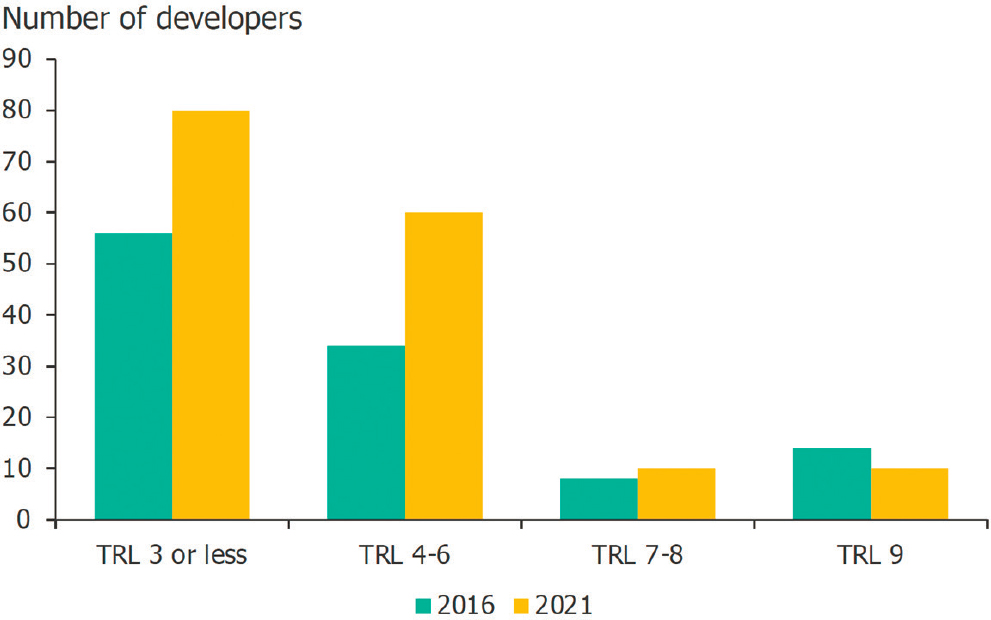
The nascent CO2 conversion industry is seeing increasing development, in response to expected demand for CO2-derived products, existing market opportunities, and incentives. As shown in Figure 2-4, based on data from a global industry and literature survey, the number of developers working on technologies for CO2 conversion to products has increased from 2016 to 2021, especially at lower TRL. Market-ready production capabilities were still very low. Another survey and analysis of self-reported data of developers in 2022 shows nearly a third of them operating at TRL 8 and 9 (Circular Carbon Network 2022).
Although the current petrochemical industry could be re-created with CO2 as a feedstock, net-zero emissions requirements will entail shifts in supply and demand factors likely to result in a different composition of the chemical industry (IEA 2020). For supply-side factors, today’s portfolio of chemicals in production and use
TABLE 2-4 Product Targets from CO2 Utilization as Described in Selected Studies of Technical Potential
| Chemicals and Materials | Product Application | Citations That Reference Priority Products |
|---|---|---|
| Acetic acid | Chemical intermediate Solvent | Huang et al. 2021 |
| Alcohols | Solvent Detergent Fuel | Bazzanella and Ausfelder 2017 |
| Aldehydes | Polymer Solvent Dye Cosmetics | Bazzanella and Ausfelder 2017 |
| Carbon black | Filler for tires Pigment | Sick et al. 2022b |
| Carbon fiber | Replacements for steel and aluminum | Biniek et al. 2020 |
| Carbon monoxide | Chemical intermediate | Grim et al. 2023 Sick et al. 2022b Huang et al. 2021 Biniek et al. 2020 |
| Carbon nanotubes | Strengthener for concrete Optoelectronics Catalysis | Sick et al. 2022b |
| Cyclic carbonates | Solvent Battery electrolyte Intermediate for polymer synthesis | Bazzanella and Ausfelder 2017 |
| Diesel/jet fuel/hydrocarbon fuels | Fuel | Sick et al. 2022b Huang et al. 2021 Biniek et al. 2020 IEA 2019 |
| Dimethyl ether | Fuel additive LPG substitute | Huang et al. 2021 Bazzanella and Ausfelder 2017 |
| Ethanol | Chemical intermediate Fuels | Grim et al. 2023 Huang et al. 2021 Biniek et al. 2020 IEA 2019 |
| Ethylene | Chemical intermediate | Grim et al. 2023 Huang et al. 2021 Biniek et al. 2020 |
| Formic acid | Preservative Adhesive Precursor Fuel cell substrate | Sick et al. 2022b Huang et al. 2021 Biniek et al. 2020 Bazzanella and Ausfelder 2017 |
| Gasoline | Fuel | IEA 2019 |
| Graphene | Electronics Batteries | Sick et al. 2022b |
| Inorganic carbonates | Cement Aggregate Concrete Soil stabilization Mineral filler | Sick et al. 2022b Biniek et al. 2020 IEA 2019 Bazzanella and Ausfelder 2017 |
| Methane | Fuel | Sick et al. 2022b Huang et al. 2021 Biniek et al. 2020 IEA 2019 |
| Chemicals and Materials | Product Application | Citations That Reference Priority Products |
|---|---|---|
| Methanol | Acetic acid Ethylene, propylene Dimethyl ether Fuel Polymer precursor | Grim et al. 2023 Sick et al. 2022b Huang et al. 2021 Biniek et al. 2020 IEA 2019 Bazzanella and Ausfelder 2017 |
| Organic acids | Surfactants Food industry Pharmaceutical industry | Bazzanella and Ausfelder 2017 |
| Organic carbamates | Pesticide Polymer precursor Isocyanate precursor Agrochemicals Cosmetics Preservative | Bazzanella and Ausfelder 2017 |
| Oxalic acid | Cleaning | Huang et al. 2021 |
| Polycarbonate etherols | Polyurethane foams | Bazzanella and Ausfelder 2017 |
| Polycarbonates | Polymer | Sick et al. 2022b Biniek et al. 2020 IEA 2019 |
| Polyhydroxyalkanoate | Polymer | Sick et al. 2022b Biniek et al. 2020 |
| Polyhydroxybutyrate | Polymer | Huang et al. 2021 |
| Polypropylene carbonate | Packing foils/sheets | Bazzanella and Ausfelder 2017 |
| Polyurethane | Polymer | Sick et al. 2022b Biniek et al. 2020 IEA 2019 |
| Protein for animals | Animal feed | Sick et al. 2022b OECD-FAO Agriculture 2021 |
| Protein for humans | Food | Sick et al. 2022b |
| Salicylic acid | Pharmaceuticals Cosmetics | Bazzanella and Ausfelder 2017 |
| Urea | Fertilizer Resin | Bazzanella and Ausfelder 2017 |
NOTES: Bazzanella and Ausfelder (2017) evaluated the technologies, pathways, and abatement opportunities and challenges for the European chemical industry to be carbon neutral by 2050, including economic constraints, investments, and research and innovation requirements. Sick et al. (2022b) evaluated the utilization amount and market size for building materials, carbon additives, polymers, chemicals, food, and fuels between 2022 and 2050 in the context of the total addressable market for respective products. Additionally, they examined these products’ development stages and developers in the market. Biniek et al. (2020) assessed current technologies and reviewed current developments for technology adoption and the economics of a range of use and storage scenarios. Grim et al. (2023) examined CO2 conversion via low-temperature electrolysis and reported products that could most impact global emission levels, especially those that could serve as intermediate feedstock inputs to known, commercialized upgrading pathways for producing high-volume chemicals. Huang et al. (2021) examined direct (low- and high-temperature electrolysis, microbial electrosynthesis) and indirect (biological conversion, thermochemical conversion) pathways for production of 11 chemicals from CO2, H2, and electrical energy. The priority chemicals were identified by their near-term technical viability. IEA (2019) considered the near-term market potential for five categories of CO2-derived services and products, including fuels, chemicals, building materials from minerals, building materials from waste, and CO2 use to enhance the yields of biological processes, to scale them up to a market size of at least 10 MtCO2/yr. OECD-FAO (2021) provided an assessment of the economic and social prospects and trends through 2030 for national, regional, and global agricultural commodity and fish markets with inputs from member countries of the Organisation for Economic Co-operation and Development and the Food and Agriculture Organization of the United Nations and commodity organizations, assuming no major changes in weather conditions or policies. The assessment highlighted that the implementation of climate smart production processes can mitigate the emissions impact of agriculture, especially in the livestock sector, discussed the prices, production, consumption and trade developments for biofuels, and the policies, regulations, and mandates for low-carbon agricultural practices, applications, and products in the member countries.
SOURCE: Sick et al. (2022b), https://dx.doi.org/10.7302/5825. CC BY 4.0.
stems from petroleum feedstock for carbon and focuses on oxidative conversions. Switching to carbon oxides as feedstock changes chemical pathways to reductive conversions, which changes the conversion processes and the intermediates and by-products involved. When using CO2 as a feedstock, more chemicals likely will be produced via CO or alcohols, for example, versus when starting with hydrocarbons, where ethylene or aromatics are more common precursors. Such restructuring can have a significant impact on research and development (R&D) needs, as discussed in Chapters 5–8. Attention needs to be paid to which chemicals are likely to transition first, which might no longer be needed, and for which alternative carbon sources or noncarbon alternatives might be an option. The same will be true for inorganic carbonates (aggregates), concrete, and elemental carbon products. Decision criteria will include the cost of production compared to incumbents, specific demand-pull, and supply-push, especially via policy instruments. Estimates for those criteria, regional variations, and demand projections are inherently uncertain. As such, it is not surprising to find variations between studies that evaluate priority products for CO2 utilization, as summarized in Table 2-4.
2.2.4 Markets for Materials from Coal Waste
Chapter 9 provides a deeper discussion of market opportunities for products made from coal waste, which offer the additional benefits of environmental and land remediation. Single- to double-digit growth rates of billion-dollar markets are projected for products from coal waste, including critical minerals and metals, pigments, direct use in construction materials, and coal waste–derived carbon materials (Fortune Business Insights 2023a, 2023b; Grand View Research 2022; SkyQuest Technology 2024; Stoffa 2023; Straits Research 2022).
Leveraging coal waste presents distinct challenges, primarily related to its fossil origin and the resulting potential for net-positive emissions, regional availability, and eventual diminishing supply. Any coal-derived product needs to be durable to avoid the introduction of new, fossil carbon into the atmosphere. The largest market
value for durable products for beneficial coal waste reutilization include construction materials, energy storage materials/electronics, cement, and concrete (see Table 9-2). Coal ash is already a common additive in many concrete products. Globally, 70 to 90 million tons of coal impoundment waste are generated annually (Gassenheimer and Shaynak 2023), and several billion tons are stored in nearly 600 slurry impoundments across the United States (Environmental Integrity Project 2019). Although coal waste is localized and volume limited, existing transportation infrastructure for coal could be repurposed and leveraged to mitigate logistical hurdles. The value-added potential of coal waste utilization extends beyond carbon conversion or critical minerals extraction and encompasses environmental cleanup efforts, and local job creation or preservation in coal communities. Incentives driven by the growing demand for critical minerals could catalyze efforts to repurpose coal and simultaneously address local pollution concerns associated with coal waste piles, including fly ash cleanup (Granite et al. 2023).
2.2.5 Product-Specific Market Considerations
As outlined in Table 2-1, this section explores some of the main product classes targeted for CO2 utilization (inorganic construction materials, fuels, polymers, chemicals and chemical intermediates, elemental carbon, and food and animal feed) and the specific market considerations for the future viability of each product class. Each section describes the incumbent production and use of the product class, why a transition in production is needed for a net-zero future, the implications of different sustainable carbon feedstocks, and the key market considerations for the product class.
2.2.5.1 Inorganic Carbonate Construction Materials
The inorganic carbonate construction materials product class includes cement, concrete, and aggregates used for constructing buildings and infrastructure—for example, roads, water systems, and so on. These materials are produced at a large scale and with low profit margins from raw materials such as ores, rocks, and wastes by mining, crushing, grinding, processing, and/or heating at high temperatures. Incumbent manufacturing processes do not employ CO2 as a feedstock in concrete production and, in fact, emit large quantities of CO2 through energy use and process emissions associated with the chemical transformations of the materials for cement production. Production and use of construction materials are distributed geographically, with limited long-distance transportation owing to their weight and volume. A net-zero future could result in reduced CO2 emissions, consumption of waste materials including CO2, and improved material properties (such as improved compressive strength).
Net-zero compatible alternatives to the production of inorganic construction materials include recycled materials, biogenic materials, and technologies that bypass the process-related CO2 emissions inherent to cement production from carbonate minerals. Recycling is common in the construction industry, particularly in road infrastructure. Recycled materials can include inorganic materials, recycled plastic, and other wastes as fillers or formed into construction components. Biogenic materials include timber, laminated beams, and particle boards used in structural or other roles in buildings. Recycled or biogenic construction materials as replacements for inorganic building materials could have the advantages of reducing waste streams and resource depletion. However, based on competing needs in other parts of the economy and suitability for structural applications, the use of biogenic materials may be limited. Lower-emissions technologies are in development to produce cement and concrete. These novel approaches bypass the process-related emissions from the conversion of carbonate rocks to reactive calcium clinker, instead converting noncarbonate minerals to reactive calcium species. These technologies also often have reduced need for high-temperature reaction conditions, and thus can be electrified, providing further opportunities to reduce CO2 emissions on a life cycle basis.
CO2 utilization to produce inorganic construction materials includes direct reaction of dissolved CO2 with minerals to form aggregates or powders; carbonation of alkaline industrial and demolition wastes to form components of concrete; exposing construction materials to CO2 to enhance carbonation, including to cure concrete; and formation of alternative cementitious materials. (R&D status and needs for CO2 utilization to produce inorganic carbonates are detailed in Chapter 5.) These processes are relatively well developed compared to other CO2 utilization processes, could be rapidly deployed, and in some cases, result in cost advantages (Carey 2018;

SOURCE: Based on figures and material from Sick et al. (2022b), https://dx.doi.org/10.7302/5825. CC BY 4.0.
NASEM 2019; St. John 2024). The transformation produces solid carbonates, a stable, solid form of carbon that provides durable storage. Figure 2-5 maps the product-market fit via key market needs for the introduction of these new aggregates (listed as row headers: defossilization, residual material use, mechanical performance, and low cost), as well as features of CO2-derived aggregates that may meet those market needs (listed as column headers: long-term CO2 storage, drop-in capability, feedstock flexibility, and scalability), producing a heat map of areas with high potential for market pull. The market introduction of CO2-based aggregates will be advantageous if the capabilities can successfully address the needs. As illustrated in the figure, CO2-derived aggregates are advantaged in long-term CO2 storage capability and feedstock flexibility to meet the market needs of defossilization and use of residual materials from construction and other industry sectors—for example, steel and coal wastes. Ensuring the required mechanical stability of new types of aggregate materials is a given expectation, and improved performance does not appear to create a market advantage. Equally, in a low-margin commodity market, low cost is expected.
Advantages of CO2 utilization over incumbent concrete materials include improved properties, reduced material use, flexible feedstocks, reduced environmental impacts for a circular economy, and lower costs. For example, in precast concrete production, CO2 curing accelerates the curing process, increases strength, reduces material needs, and can be cost-efficient. Also, technologies that mineralize CO2 to limestone powders or carbonate fly ash can support novel three-dimensional (3D) concrete printing, which has the potential to provide environmental benefits, including less concrete waste and lower water use, faster construction, and lower costs (Yu et al. 2021; Zhu et al. 2021). The product–market fit for CO2-cured concrete is summarized in Figure 2-6, showing a heat map of areas of high potential for market pull. Market inhibitors, such as local building codes and the cost and time required for testing and documentation can limit or prohibit the use of new materials, especially for small-scale producers, but are not fundamental inhibitors based on technical performance.
Key market questions for future viability of CO2-derived inorganic carbonate building materials: Can new production technologies and reprocessing of waste materials overcome market inhibitors such as low profit margins, limited long-distance transportation of heavy, low-value commodities, and regulatory hurdles such as composition-based building codes? How can CO2 availability accommodate the distributed nature of the construction industry?

SOURCE: Based on figures and material from Sick et al. (2022b), https://dx.doi.org/10.7302/5825. CC BY 4.0.
2.2.5.2 Fuels
The global economy relies heavily on fossil fuels, with more than 80 percent of total energy from coal, oil, and natural gas (IEA 2019). Their combustion releases CO2 and uses the energy in the fuel for electricity generation, vehicle propulsion, heating of buildings and industrial processes, and other energy needs. Fossil fuel production and combustion pollute the local and global environment, are harmful to human health, and are a major cause of climate change.
To eliminate the harms from fossil fuel production and use, most uses of fossil fuels must be replaced by zero-carbon alternatives in a net-zero future. Potential zero-carbon replacements for fossil fuel–powered systems include electric power generated from zero-carbon energy sources, hydrogen-powered systems including fuel cells, and energy efficiency measures to reduce the need for heat and power. Transitioning to zero-carbon electric power is more efficient than combustion, is less polluting, and leverages the existing power grid infrastructure. Drawbacks to electric power—for example, poor energy density and long recharging times for batteries—may make electricity unsuitable for some fuel substitution applications, especially in long-haul air and ocean transportation. Hydrogen fuel cell power is less efficient than using electric power directly, although it can have higher energy density. A major obstacle to hydrogen power is the requirement of new vehicle propulsion systems and hydrogen production, storage, and delivery infrastructure. For shipping, sustainably produced ammonia is being explored as an alternative zero-carbon fuel. However, the major concerns are safety, health issues, and the risk of highly elevated NOx emissions from ammonia combustion (Bertagni et al. 2023).
Carbon-based alternatives to fossil fuel incumbents include biofuels such as ethanol, biodiesel, and jet fuel derived from bio-based sources. Bioethanol is already a major part of the transportation fuel system and can often be used in existing combustion, storage, and delivery systems with relatively minor modifications. Biofuels require significant land and water for crop production and result in pollution impacts from industrial agriculture, groundwater depletion, and fuel combustion. More details on the national prospects for the use of biomass resources can be found in the recently released DOE 2023 Billion-Ton Report (DOE-BETO 2023).
Synthetic CO2-derived liquid fuels can be produced by chemical and biological CO2 utilization. (R&D status and needs for chemical and biological CO2 utilization to fuels are detailed in Chapters 7 and 8, respectively.)
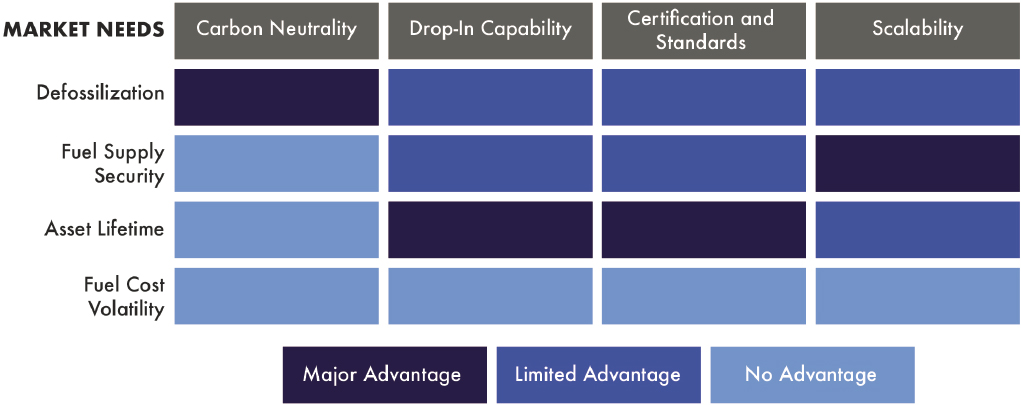
CO2-derived fuels have similar advantages to biofuels, being energy-dense and in many cases, usable in the existing fuel combustion, storage, and delivery systems. CO2-derived liquid fuel targets include methanol, ethanol, and jet fuel. They also have similar drawbacks to biofuels, including being less efficient and more expensive to produce than electricity or hydrogen, and leading to air pollution when combusted, although they are likely to have fewer land-use impacts than biofuels (Gabrielli et al. 2023). Synthetic aviation fuel will likely be the primary target for liquid fuel use, because of a lack of feasible technological alternatives, a greater need for energy density, the ability to absorb higher prices, and less concern about proximity to air pollution from combustion, with marine fuel (methanol) as an additional potentially important market. Aviation fuel may command a greater premium than marine fuel, depending on consumer willingness to pay (World Economic Forum 2023). The product–market fit for CO2-derived fuels is summarized in Figure 2-7, showing a heat map of areas of high potential for market pull. A key advantage of synthetic aviation fuel is that it can be produced to meet the properties of current fossil-based fuels and used as a direct drop-in replacement, preserving all assets in the value chain, including aircraft. Distributed, co-located CO2 capture and conversion plants could support scaling and increase supply stability, including for military needs (DoD 2023; U.S. Naval Research Laboratory 2012). Another competitor is offsetting fossil fuel combustion emissions with negative emissions technologies, which may have lower costs than replacing fossil fuel with bio-derived or synthetic CO2-derived aviation fuel. However, CO2-derived synthetic fuels offer more direct climate benefits than the purchase of negative emissions offsets and may be favored by future markets or regulatory structures.
Key market questions for future viability of CO2-derived fuels: Where and when can synthetic fuels compete with direct electrification and other alternative fuels? How will utilization for short-lived products compete with sequestration for CO2 sources? How will rereleased CO2 be accounted for in market and regulatory monitoring, reporting, and verification schemes? What is the capacity to provide synthetic fuels in the context of competing demands for zero-carbon electricity and hydrogen?
SOURCE: Based on figures and material from Sick et al. (2022b), https://dx.doi.org/10.7302/5825. CC BY 4.0.
2.2.5.3 Polymers
Polymers are currently predominantly synthesized from chemical intermediates derived from fossil carbon, with a smaller but significant market share derived from biomaterials or recycled polymer materials. Current methods of production and use result in CO2 emissions, significant solid-waste streams, and local pollution.
Currently, the most important alternatives to fossil-derived polymers are biopolymers and polymers derived from recycled materials. In 2019, the polymer and plastics industry caused 3.4 percent of the global carbon emissions (OECD 2022). Furthermore, petrochemical plastics are notoriously recalcitrant to environmental degradation, causing substantial environmental hazards, including microplastics that impact human and wildlife health. Bioplastics, which encompass polymers made from biomass and polymers that biodegrade, represent a significant opportunity to reduce carbon emissions and other environmental hazards. Biopolymers like polyhydroxyalkanoate and polylactic acid provide local environmental benefits, as they are biodegradable or compostable and avoid lingering microplastics. Bio-based polymers produced from starch or sucrose derived from feedstocks like corn and sugarcane may confer an advantage over petrochemical plastics in reducing carbon emissions, although cultivation of corn and sugarcane comes with direct and indirect land use implications. Composting or recycling, described below, requires a value chain that includes infrastructure for separating and appropriate time and conditions for degradation.
Some polymers can be recycled either by mechanical or chemical recycling. Pure mechanical recycling via grinding or melting plastic products down to their base polymer requires high-quality, contaminant-free feedstock with uniform molecular composition. Mechanical recycling produces polymers with the same composition as its feedstock (Maureen 2023). Chemical or molecular recycling utilizes additional chemical inputs (solvents, enzymes) to break down recyclate into its constituent components (monomers, oligomers) to produce the same or different polymers (Luu 2023). Although often used synonymously with molecular recycling, chemical recycling sometimes refers to waste-to-energy processes, in which case CO2 emissions are not minimized (Bell 2021). The viability of chemical or molecular recycling is limited by the complexity of plastic recyclate. Common additives like plasticizers and colors complicate the chemical recycling process owing to uncertainty or complexity of composition overwhelming existing molecular separation methods. Existing mechanical and chemical recycling methods can be energy-, water-, and land-intensive (Uekert et al. 2023). CO2 emissions benefits of recycled versus virgin plastic manufacturing are circumstantial based on the composition, complexity, and quality of available feedstock.
CO2 utilization to form polymers can proceed via the same intermediates as fossil fuel–derived polymers, but using CO2-derived feedstocks, or via novel processes to incorporate CO2 as a feedstock directly or via different intermediates. (R&D status and needs for chemical and biological CO2 utilization to polymers are described in detail in Chapters 7 and 8, respectively.) Chemical intermediates such as ethylene, propylene, and aromatics used in current polymer production, to polyethylene, or polypropylene or polystyrene, can be generated from CO2 via synthesis gas (Gao et al. 2017, 2020; Saeidi et al. 2021; Zhang et al. 2019). Direct utilization of CO2 offers routes to other classes of polymers, such as polyurethanes made from CO2-based polyols, polycarbonates, and polyhydroxyalkanoates (Afreen et al. 2021). These types of polymers or their building blocks could become key entry points for CO2 use, with polyols already containing 20–40 percent CO2 by weight. Limitations in thermal stability and mechanical properties of polycarbonates, polyols, and polyhydroxyalkanoates have restricted their widespread use (Ali et al. 2018; Capêto et al. 2024; Grignard et al. 2019; Styring et al. 2014). On the other hand, progress is being made to improve properties—for example, new synthesis methods have demonstrated polymers built from CO2 that have flame-retardant properties (Ma et al. 2016). The product–market fit for CO2-derived polymers is summarized in Figure 2-8, showing a heat map of areas of high potential for market pull. The market introduction of polymers made with CO2 is facilitated not only by helping to defossilize the polymer industry but in particular by offering continued use of production facilities, improved recyclability, and the opportunity to provide entirely new performance characteristics.
Key market questions for future viability of CO2-derived polymers: Can production costs be reduced, such as by co-location with CO2 emitters? Can suitable CO2-based polymers be made with favorable performance/cost balances? What is the competition for CO2-derived versus bio-derived polymers and can biomass sourcing meet biopolymer demand? Can new, reductive synthesis methods that start with CO2 be strategically used to design polymers with unique new purposes—for example, purpose-designed lifetimes?

SOURCE: Based on figures and material from Sick et al. (2022b), https://dx.doi.org/10.7302/5825. CC BY 4.0.
2.2.5.4 Chemicals and Chemical Intermediates
Current production of chemicals and chemical intermediates is almost entirely from fossil feedstocks of oil and gas and represents a small portion of fossil hydrocarbon use. The demand for chemical products is growing faster than the U.S. gross domestic product (GDP) and fuel demand. In a net-zero future, when fuel demand is likely to decrease dramatically, chemical demand will become a much more significant player in carbon-based product needs.
Alternatives to chemicals and intermediate production are primarily biobased materials. The efficiency and competitiveness of CO2-derived chemicals compared to biomass-derived ones depend on factors like feedstock cost, energy requirements, and land/water use. Biomass is often more competitive for products requiring carbon-carbon bonds, which are often already present in bio-derived carbon feedstocks. Both CO2- and biomass-derived materials are better suited to making oxygenated compounds, relative to fossil fuels. Biomass is used more easily for reduced compounds as compared to CO2. Bio-derived compounds face higher water and land use implications than CO2-derived materials (Gabrielli et al. 2023).
Carbon utilization is attractive for commodity chemical production to leverage existing infrastructure. Repurposing established facilities and processes offers a potentially cost-effective means to convert CO2 to valuable products while simultaneously reducing GHG emissions. Chemical product targets include carbon monoxide, alcohols, light olefins, and carboxylic acids, both as final products and intermediates. The production of sustainable aviation fuels from CO2 will result in many by-products that can enter the supply and production chains for chemicals in the same way that many chemicals we use today are by-products from reforming petroleum into gasoline, diesel, and kerosene fuels. Therefore, we may see some currently used chemicals and chemical intermediates disappear from markets while others enter.
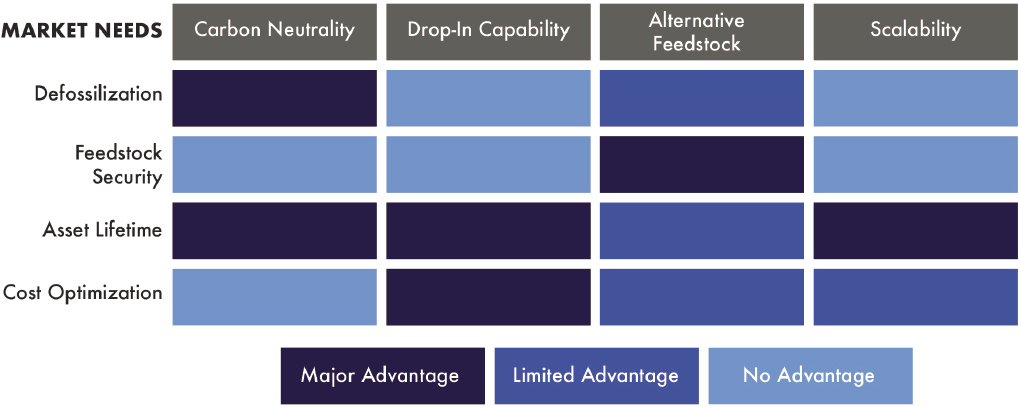
Opportunities for broader market introduction will be higher the more downstream applications a product will have. This makes the drop-in replacement of entry-level chemicals and intermediates for a wider range of final products attractive. A key example is methanol, with high market needs as a base chemical and a potential new marine fuel. The product–market fit for CO2-derived methanol is summarized in Figure 2-9, showing a heat map of areas of high potential for market pull. CO2-derived methanol is a cost-effective drop-in replacement for its
SOURCE: Based on figures and material from Sick et al. (2022b), https://dx.doi.org/10.7302/5825. CC BY 4.0.
chemically identical incumbent. The preservation of existing infrastructure in the chemical industry will be a key factor for adoption as geographically flexible feedstock availability and supply stability are increased.
Key market questions for future viability of CO2-derived chemicals and chemical intermediates: Can CO2-derived chemicals overcome the efficiency and competitiveness challenges presented by biomass-derived chemicals? Will future markets demand a price premium for a more sustainable product? Which opportunities exist for new products not yet available in this class? Will a new and different by-product stream from synthetic fuel production alter the chemical industry’s well-established and global integrated supply chains and product mix?
2.2.5.5 Elemental Carbon Materials
Elemental carbon materials offer opportunities for long-term carbon storage, can potentially replace products made via high-carbon-emitting processes like steel production in some applications, and be used in high-value applications like electronics. Today, elemental carbon materials are primarily produced through combustion or pyrolysis of organic compounds (fossil sources) and synthesis through chemical vapor deposition techniques. Starting with biomass as a carbon source followed by subsequent combustion or pyrolysis could provide more sustainable pathways to elemental carbon products. These processes yield a range of materials, such as carbon black, graphite, graphene, and other carbon nanostructures, each with different properties and applications. Additionally, some of these materials can be produced through processes like electrochemical reduction or catalytic conversion, making them feasible CO2 utilization targets. Particularly, graphene has many potential applications in energy, electronics, construction, and health care owing to its flexibility, lightness, and attractive mechanical and electronic properties.
Some elemental carbon products are likely to be used at lower volume, but in high-value applications, like electronics. Others could be deployed in very high-volume applications, with lower value, such as in construction materials. Small-volume, high-value markets may enable CO2 utilization if buyers put a premium on CO2-derived materials. Larger-volume, lower-value applications in the building industry present a significant market for material amendment or replacement. However, substituting carbon fibers and composites for steel and aluminum requires a significant industry shift and is more expensive, particularly for concrete. The product–market fit for elemental

SOURCE: Based on figures and material from Sick et al. (2022b), https://dx.doi.org/10.7302/5825. CC BY 4.0.
carbon materials is summarized in Figure 2-10, showing a heat map of areas of high potential for market pull. Key needs to address for successful market introduction are defossilization of target industries and providing suitable products to replace incumbents that suffer from a high carbon footprint—for example, aluminum and steel. While the production of carbon fibers, nanotubes, and graphene from CO2 is still in its early stages, their value and potential to replace carbon-emission-intensive metals can lead to substantial growth. Conversion of CO2 to carbon black could be pursued as a drop-in substitute for current production, but competition with incumbent producers will likely delay market penetration.
Key market questions for the future viability of CO2-derived elemental carbon: Can new products overcome cost barriers and industry conservatism to replace carbon-emission-intensive metals like steel and aluminum in large-volume applications, particularly in the construction and automotive industry? What incentives may be needed? Can elemental carbon materials be recycled at the end of their use phase, which might be less than 100 years?
2.2.5.6 Food and Animal Feed
Current food and animal feed production is of biological origin, using plants and animals, and has sustainability challenges. While it is estimated that about 30 percent of produced food is wasted (NASEM 2023a), many lack access to enough food. The rising impacts of climate change also pose substantial risks to the food system through desertification and reduced land availability. Overfishing contributes to the loss of biodiversity and food resources from the oceans. Agricultural runoff pollutes waters and soils, leading to further ecosystem degradation. Animal agriculture (particularly the production of red meat) is especially resource-intensive and requires sustainability solutions in light of the growing global demand for animal protein. Alternatives need to be considered to ensure adequate nutrition for the world’s human population and reduce the environmental burdens of food production.
The main alternatives to carbon dioxide utilization for food and animal feed are climate-smart agricultural methods. In addition to emissions reduction, these methods enhance agricultural resilience to climate-related risks, increase agricultural productivity, and improve financial returns for farmers (Kazimierczuk et al. 2023). Regenerative, digital, and controlled environment agriculture methods are among the most promising alternatives (Kazimierczuk et al. 2023). Regenerative methods focus on carbon sequestration through improved soil health
and fertility, increasing water retention and percolation, reducing runoff, and strengthening system biodiversity and resilience (Elevitch et al. 2018). Digital methods integrate real-time or near-real-time feedback between sensors and equipment to make automated adjustments for emissions reduction and yield optimization. Controlled environment methods use indoor farming configurations like vertical farms, greenhouses, container farms, and integrated aquaponic systems to closely regulate the agricultural environment and reduce land and water usage (Goodman and Minner 2019).
CO2 utilization can be leveraged in two ways in food production. First, increasing microbe-based production of drugs, food supplements, fuels, and chemicals leaves spent microbes as a waste material, which have high protein content and could be used directly as animal feed (LanzaTech 2023). This is analogous to other energy systems that use spent material as animal feed, such as ethanol production’s coproduct of dry distillers grains, producing 38 million metric tons of feed for agricultural animals annually in 2018/19 (Olson and Capehart 2019). Department of Energy (DOE)-supported efforts on the algae-based conversion of CO2 were recently summarized at the 2023 DOE’s Office of Fossil Energy and Carbon Management/National Energy Technology Laboratory Carbon Management Research Project Review Meeting (NETL 2023).
Second, compounds derived from CO2 conversion can be directly used for protein production via tissue engineering (e.g., cultivated meat or animal muscle cell cultures grown in reactors). Several such targeted commercialization activities are under way (Corbyn 2021; Mishra et al. 2020; Pander et al. 2020; Sillman et al. 2019). While market-ready production scales and acceptance are not expected until 2050 and beyond, consumer attitudes have been identified as a key issue in the market success of food replacements, especially alternative proteins (Van Loo et al. 2020). Competition for carbon-free electricity and hydrogen from other parts of the economy will be challenging for an emerging food production industry and is a key barrier for the industry. Additionally, regulatory barriers could challenge market entry.9 The product–market fit for food and feeds is summarized in Figure 2-11, showing a heat map of areas of high potential for market pull.
Key market questions for the future viability of CO2-derived food and animal feed: How can new products achieve Food and Drug Administration approval for human consumption? Will customers adopt “synthetic food”? What incentives may be needed? What are the techno-economic assessment (TEA) and life cycle assessment (LCA) considerations for cultivated protein products?
2.3 INFLUENCES ON CO2 UTILIZATION MARKET DEVELOPMENTS
Potential revenue streams for CO2-based products are trillions of dollars per year (Mason et al. 2023; NASEM 2023b), which could be an attractive driver to build up production capacity, depending on the unit economics per market. However, the successful market introduction of products made from new carbon feedstocks depends on a variety of factors, including feedstock availability and access, suitable conversion technologies and infrastructure, industrial participants in the value chain, consumer demand and acceptance, and regulatory environments. Furthermore, commercial success will depend on cost, cost-reduction strategies, financial risk management, and the ability to consistently meet demand, especially in commodity markets. TEA and LCA, including societal aspects, will be essential to understand environmental and equity risks and opportunities, and avoid unintended consequences. (See Chapter 3 for further details on LCA and TEA.)
Several studies project sizable opportunities for both climate benefits and economic potential for CO2 as a carbon feedstock, especially conversion to long-lived products. Projections show that this could be possible at several Gt/year within decades (Biniek et al. 2020; Hepburn et al. 2019; IEA 2019; Jacobson and Lucas 2018; Sick 2018; Sick et al. 2022b).
Product adoption depends strongly on how fast market penetration proceeds, with timelines that stretch over decades. Figure 2-12 projects time needed to reach 10 percent market penetration and the time required to achieve a CO2 utilization rate of 0.1 Gt per year for selected products. Given the urgent need to replace fossil carbon with
___________________
9As an example of regulatory inconsistency, the commercial sale of single-cell grown chicken meat for human consumption was recently allowed by regulators in the United States (Toeniskoetter 2022). In contrast, around the same time, the Italian government imposed a €60,000 fine for producing, selling, or importing laboratory-grown meats (Kirby 2023).

SOURCE: Based on figures and material from Sick et al. (2022b), https://dx.doi.org/10.7302/5825. CC BY 4.0.
sustainable alternatives and produce durable stores of carbon, these low market uptake rates point to the need for rapid action to accelerate deployment. Comprehensive planning and evaluation are needed to ensure environmental benefits while also including economic and societal considerations (Newman et al. 2023).
Sections 2.3.1–2.3.8 detail important determinants of CO2 market developments—namely cost, availability and access to feedstocks, technology and infrastructure, supply chains, consumer demand and acceptance, the regulatory environment, financial risks, and environmental and equity impacts. Establishing a CO2 utilization industry would

SOURCE: Adapted from Sick et al. (2022b), https://dx.doi.org/10.7302/5825. CC BY 4.0.
benefit from a publicly available tracker that shows activity and progress with deployments, and the amounts of CO2-based products that enter markets. This will also support tracking how much CO2-based products contribute to reducing the carbon emissions burden.
2.3.1 Cost Factors for CO2 Utilization Markets
The future use of CO2 will be influenced by several cost factors that will determine the feasibility and scalability of carbon capture, utilization, and storage. One prevalent challenge is that, in many cases, the cost of producing CO2-derived products exceeds that of incumbent alternatives. This cost disparity is driven by several factors, including the high upfront capital cost of CO2 capture and transport, the energy expenditures required for possible purification and conversion processes, and the need to optimize and improve those processes (GAO 2022).
CO2 utilization will be a highly capital-intensive endeavor to build the necessary production facilities or to retrofit some existing factories. The global cumulative investment in production facilities will be substantial for raw materials, labor, and construction (Sick et al. 2022a). CO2 conversion facilities to form chemicals and fuels are especially capital-intensive, whereas facilities to produce aggregates and precast concrete, while more numerous, are less expensive to build to scale (Figure 2-13). For example, by 2050, meeting global aviation fuel demand with CO2 utilization is estimated to require about 21,000 production facilities with annual capacities of 100 million liters of jet fuel each and estimated to cost $4.8 trillion (Sick et al. 2022b). Furthermore, for many CO2-derived products, the dominant factor remains the cost of energy, typically electricity, which underscores the importance of energy efficiency and inexpensive, clean power generation in shaping the future of CO2 utilization (Huang et al. 2021).
Capital and operating costs associated with CO2 capture and transport are also important, especially as the industry evolves. The development of high-volume demand and compliance markets for some products will influence the trajectory of CO2 capture costs for the market as a whole. For example, the aviation industry’s quest for reduced carbon-intensity fuels could be a significant driver for increased capture volumes. Early opportunities for CO2 capture may arise from existing processes like ethanol production, which have high-purity, proven technology,

SOURCE: Based on data from Sick et al. (2022b), https://dx.doi.org/10.7302/5825. CC BY 4.0.
scale, and relatively low costs. The pace of capture process optimization, however, can become a critical cost driver. Local availability of sufficient sources of CO2 at competitive cost will increase competitiveness of technologies by avoiding the need for expensive and potentially controversial transportation infrastructure.
2.3.2 CO2 Supply Chains
The market for incumbent uses of CO2 in the food and beverage industry and as a process gas globally reached approximately 236 million tonnes in 2022 and is projected to grow at a compound annual growth rate of 6.5 percent until 2035 to reach approximately 520 million tonnes (Chemanalyst 2023a). The addition of and shift toward CO2 conversion to products could increase this market to Gt/year (IEA 2020; Sick et al. 2022b). Current CO2 sources include ethanol, ammonia, and natural gas processing facilities, and future sources may include other industrial point sources and facilities drawing from ambient sources such as direct air capture (DAC) and direct ocean capture (DOC). The existing supply chain for the CO2 industry lays a foundation for future CO2 utilization-to-products in a net-zero market but needs to evolve to meet the challenges of tackling climate change. The CO2 supply chain involves numerous aspects and actors, including carbon capture and separation from point or ambient sources, followed by purification, processing, and transportation to downstream applications and markets (DOE-EERE 2022). The success of CO2 utilization-to-products depends on identifying best practices from existing supply chains and optimizing them to create long-term sustainability benefits.
Reliable availability and price stability of a feedstock are essential to build up downstream uptake. If competing demands for a feedstock exist, they may jeopardize companies, especially during the early scale-up phase when their needs are not at final capacity and when they are not yet established as a stable customer. The majority of CO2 supply chains today have been developed for industrial applications that involve direct use of CO2 without chemical conversion. This includes the food and beverage industry, which had the largest revenue share of the merchant CO2 market in 2022, and enhanced oil recovery for depleted oil reserves. New applications for direct use of CO2 are gaining prominence, such as the use of CO2 in the medical sector as an inhalation gas in various surgeries (Grand View Research 2023) and CO2-assisted enhanced metals recovery from spent lithium-ion batteries (Bertuol et al. 2016).
Chemical and biological conversions of CO2 are not as prevalent in industry today, except in the manufacturing of urea for the fertilizer industry. However, as discussed throughout this chapter and projected in several market studies (Grand View Research 2023; Sick 2020), CO2 as a carbon feedstock for products will quickly grow in relevance, albeit at different rates across the industry landscape. For a comprehensive view of these products, refer to Table 2-1. Incumbent direct-use applications of CO2 will compete with emerging products for supply.
The industrial gas and the oil and gas industries historically have led investments in CO2 supply chain development for merchant and enhanced oil recovery applications, respectively. The Oil and Gas Climate Initiative, representing 12 of the world’s largest energy companies, is developing projects in regional, interconnected carbon capture, utilization, and storage supply chains at scale for industrial decarbonization (Oil and Gas Climate Initiative 2023). Alongside established companies, start-up companies will play a significant role in the carbon capture and utilization value chain, especially as new business models develop around “partial-chain” or specific components of supply (IEA 2023). In 2016, fewer than 200 entities were active in CO2 utilization (Sick 2018). By 2022, that number increased to 274 (Circular Carbon Network 2022), indicating some growth but still at the very bottom of a typical S-curve for economic development.
By contrast, the number of companies that are pursuing CO2 capture has risen more rapidly than those active in utilization. Government funding in the Infrastructure Investment and Jobs Act of 2021 (IIJA) and incentives provided in the Inflation Reduction Act of 2022 have spurred activity in both point source capture and DAC. For example, through the Carbon Capture Demonstration Projects Program, DOE has announced funding for three demonstration projects with the potential to capture nearly 8 million tons of CO2 per year and is supporting front-end engineering design studies for an additional nine projects (CATF 2023). In support of DAC deployment, DOE has selected 2 of the 4 Regional Direct Air Capture Hubs authorized and appropriated in the IIJA and is funding feasibility and design studies for an additional 19 DAC projects (CATF 2023). All of these projects are structured as cost-share agreements with investment from both public and private partners. Additionally, carbon capture
companies are being purchased by larger industrial entities. In 2023, Oxy, one of the largest oil producers in the United States, purchased all outstanding shares of the DAC company, Carbon Engineering Ltd., for approximately $1.1 billion (Oxy 2023). The resulting entity is one of the two initially selected Regional Direct Air Capture Hubs. Efforts in DOC of CO2 are impacted by the lack of emphasis on defining monitoring, reporting, and verification for DOC and policy support that instead favors point source and DAC.
Developments and investments in CO2 transport have also gained momentum, although these efforts have faced legal, regulatory, and societal acceptance challenges (see Chapter 10). In 2023, ExxonMobil acquired pipeline operator Denbury for $4.9 billion, making ExxonMobil the owner and operator of the largest CO2 pipeline network in the United States (AP News 2023). Through the Carbon Dioxide Transportation Infrastructure Finance and Innovation Act, enacted as part of the IIJA, DOE’s Loan Programs Office will support large-capacity, common carrier CO2 transportation projects (DOE-LPO n.d.). As discussed further in Chapter 10, three major CO2 pipelines that would traverse nearly 3600 miles were under development at the start of the committee’s writing, although one of those projects, accounting for 1300 miles of pipeline, has since been canceled. Developers are also exploring the possibility of converting natural gas pipelines for CO2 transport—for example, the Federal Energy Regulatory Commission approved Tallgrass Energy’s Trailblazer Pipeline Company LLC to convert its existing 400-mile-long Trailblazer natural gas pipeline to a CO2 transportation network (Ranevska 2023). However, as discussed in Section 10.3.2.2 of this report and Section 4.3.4 of the committee’s first report (NASEM 2023b), there are significant challenges to performing such retrofits, and their feasibility has to be evaluated on a case-by-case basis. Liquefied natural gas carriers and shipping companies are expanding into CO2 shipping (Northern Lights 2022), which is being explored as an alternative or complementary CO2 transportation method in some cases. More discussion of CO2 transport options, including multimodal transport, can be found in Chapter 10.
Developing a sustainable CO2-to-products supply chain for a net-zero market requires established sources of CO2 in significant quantities, coupled with long-term offtake agreements from CO2 emitters, and pathways for economically sourcing clean hydrogen, electricity, and water where applicable. New business models and novel monetization strategies, such as carbon capture as a service, self-capture with third-party CO2 offtake, CO2 transport tolling fees, and voluntary carbon markets, will all depend on a coordinated rollout of infrastructure along the supply chain and defined regulations on long-term liability for “partial-chain” models. Stable consumer demand for CO2-derived products will be driven by transparent definitions for carbon traceability and accounting and supportive government policies such as low-emission mandates and parity with incentives for CO2 storage (Carbon Capture Coalition 2023). Issues of life cycle assessment are discussed in Chapter 3, and policy incentives and requirements are in discussed Chapter 4.
2.3.3 Availability and Access to Competing, Non-CO2 Feedstocks
CO2 utilization competes with alternative net-zero carbon emissions products that either allow for circularity or lead to durable carbon storage. Competing feedstock options include CO2 (the focus of this report), biomass, and in some cases, replacement of the product with non-carbon-based alternative products or services. The choice and timescale for implementation of competing feedstocks will depend on infrastructure, feedstock source volume, consistent availability, price, and competition for the feedstock from other uses, and competition between different carbon feedstocks. A summary of non-CO2 feedstock availability and readiness of conversion technologies is presented in Table I-2, in Appendix I.
Competing nonfossil carbon feedstocks from biological and recycled plastic streams have advantages and disadvantages relative to CO2 feedstocks. Biomass and materials derived from biomass are already a feedstock for production of carbon-based materials, both as final products directly and as a feedstock to be converted to final products. However, biomass can cover only a fraction of all projected future carbon needs owing to its significant land use requirements and substantial competition for downstream use (food, animal feed) (Patrizio et al. 2021). Residual biomass and waste biomass, including municipal waste materials,10 can offer local opportunities for carbon-based product manufacture, and avoid increasing cropped areas. However, lignocellulosic biomass
___________________
10Municipal solid waste can also be a source of critical minerals and other metals (Allegrini et al. 2013; Šyc et al. 2020).
utilization (constituting the majority of waste and residual biomass) still faces challenges, including developing more fermentable carbohydrate intermediates, lignin utilization pathways, and overcoming the mass transfer challenges caused by high solid loads. Furthermore, some types of biomass are geographically and seasonally constrained or present technological and economic challenges with transportation and processing (Energy Transitions Commission 2021). CO2 conversion requires more energy, but typically less land use than biomass production.
Materials derived from recycled plastic will also compete with biomass and CO2 as sources of carbon for chemicals synthesis (Gabrielli et al. 2023; Lange 2021). It is uncertain how much recycling of materials will compete with conversion of CO2 as a carbon feedstock. To some extent, this is related to the uncertainty in material availability owing to multivariant routes for plastic materials (recycling, landfilling, incineration, loss as environmental pollution). As discussed in detail in Chapter 9, carbon-containing coal wastes can be used as a feedstock for durable storage materials, such as graphite, graphene, carbon fiber, carbon foam, and in concrete production.
In addition to competition from different carbon feedstocks, there is also competition for CO2 from other processes. Sourcing CO2 requires navigating a variety of complexities that range from entry-level maturity of some capture technologies, capture capacity, locations of sources and associated potential transportation requirements, needs for energy and other resources, and overall cost (Lebling et al. 2022; Mertens et al. 2023; Müller et al. 2020; NASEM 2019, 2022). Key federal legislation has favored CO2 capture and geologic sequestration rather than utilization; owing to the federal incentives and other cost drivers, the bulk of current financial and deployment interest is still very focused on geologic sequestration.
2.3.4 CO2 Utilization Technology and Infrastructure Development
Switching materials production to new carbon feedstocks for chemicals, elemental carbon materials, and inorganic carbonates often requires substantial investments in new equipment and/or infrastructure. Upfront capital investment as well as the ongoing operating costs will impact the choice of new feedstock. Petrochemical facilities will need to be retrofitted with large modifications to process CO2 with substantial capital requirements. Once key entry-level chemicals or intermediates have been produced from CO2—for example, methanol and ethylene—further upscaling is independent of the upstream process and can remain the same as is in production today, or in processes modified for sustainability, such as using renewable energy. Likewise, separation and reforming technology for fuel blends from Fischer-Tropsch synthesis can use installations from today’s refineries or future sustainable ones. The production of aggregates and CO2-cured concrete requires specialized new equipment that needs further technological development, investment, and a significant change to existing businesses. However, the distributed nature of concrete and aggregate production offers opportunities for local production, building on local CO2 emission sources, thereby eliminating the need for increasingly controversial CO2 transportation infrastructure (Adams 2023). Scale up of technologies from the laboratory to translated and tested real-world conditions will be a challenge because CO2 utilization technologies are in the early stages of development, or although fully developed, are infrequently employed. The growth of engineering, procurement, and construction firms experienced with the CO2 utilization industry will facilitate this design and manufacturing scale up. The choice of technology, particularly its efficiency and scalability, will need to be evaluated for each option. Chapter 10 provides additional details on infrastructure, and Chapter 4 discusses project impacts on host communities.
2.3.5 Consumer Demand and Acceptance
Consumer preferences and willingness to pay in a specific market can influence an investor’s choice of carbon feedstock. An increase in procurement incentives for low-embodied carbon construction materials at local, regional, and federal levels is beginning to grow demand for materials, such as concrete and aggregates made with CO2. Demand for CO2-derived construction materials has been demonstrated but cannot be met owing to a lack of installed production capacity (Li et al. 2022; Roach 2023). For example, the San Francisco International Airport has developed standards and procured concrete that incorporates CO2; however, none of the companies that they have worked with have been able to provide sufficient material to support new building construction, major renovations, and large infrastructure projects (Anthony Bernheim, personal communication, April 11, 2024). Similarly, demand
for sustainable aviation fuel is increasing, especially in the aftermath of concerns about inadequate carbon offset programs (Astor 2022; Greenfield 2021; SDG Global Council on Future Fuels 2023) used for air travel that did not provide durable removal (West et al. 2020). Chapter 4 includes related content on the International Civil Aviation Organization (ICAO) standard for sustainable aviation fuel. As in the case of construction materials, a lack of production capacity is limiting the expansion of market introduction, along with other factors such as high cost and limited availability of carbon-free electricity and hydrogen.
Some consumers, especially institutional consumers, may be willing to pay a premium for a more sustainable product. However, others are concerned that using captured CO2 in products perpetuates the use of fossil fuels, or they worry that CO2 capture and conversion uses large amounts of energy (NASEM 2023a). Besides cost and moral hazard concerns, consumers might have concerns about the quality, safety, and health impacts of the products, or the manufacturing processes (Arning et al. 2021; Inwald et al. 2023; Lutzke and Árvai 2021; NASEM 2019; Wolske et al. 2019). Chapter 4, Section 4.4.1.2, “Strengthening Public Understanding of CO2 Utilization through Engagement,” discusses methods of addressing public concerns via engagement, especially through educational programming. Such engagement can increase the public’s information about CO2 utilization technologies and develop trust, accountability, and transparency between project designers, developers, the general public, and host communities. Related topics are also addressed in Chapters 3 and 9.
2.3.6 The Regulatory Environment
In the absence of a price or binding limit on carbon emissions, nonfossil alternatives in most cases will be more costly than fossil-derived products. Therefore, the market introduction and growth of different carbon feedstocks will depend critically on suitable policy support (Renewable Carbon Initiative 2022), public support for carbon pricing schemes and various means to deploy the revenue (Valencia et al. 2023), and location-specific pricing mechanisms or tax incentives and subsidies for carbon reduction efforts that can make the use of captured CO2 or coal wastes more attractive (Thielges et al. 2022). These issues will be introduced here but are covered in more depth in Chapter 4.
The market need for net-zero carbon fuels offers an example of the regulatory environment considerations for CO2-derived products. Liquid fuels are globally traded and used as commodity carriers of energy. Liquid fuels can be produced from coal, natural gas, petroleum, biomass, CO2, or recycled waste materials such as plastics or paper. From a chemical and energy point of view, the most straightforward route to liquid fuels begins with petroleum, which contains stored energy in the form of hydrocarbons of appropriate size and composition to be easily refined into liquid fuels. Production of liquid fuels from petroleum is currently the least expensive option, given how the production and use of fossil fuels have developed and are supported (Black et al. 2023).
The alternative fossil and nonfossil feedstocks have chemical and energy disadvantages relative to petroleum. CO2 has very low energy and requires H2 or water and electricity to be converted to a fuel. It is also a one-carbon compound, and therefore requires the formation of carbon-carbon bonds to produce most liquid fuels. Most CO2-to-fuel processes are at an early stage of technical development, and fewer still have been demonstrated or implemented at scale. Chapters 7 and 8 have more details about the status of CO2-to-fuels processes. Despite these challenges, CO2-to-fuel processes have advantages over petroleum in low- or net-zero-emissions fuel synthesis.
Owing to this combination of emissions advantages and chemical/energy disadvantages, CO2-to-fuel conversion cannot be competitive with petroleum in the absence of broader policy support—that is, a price or limit on fossil carbon or fossil CO2 emissions—and a build-out of production facilities. Other policy supports—such as subsidies, procurement mandates, or investment by early movers—can help accelerate market development. These will increase the overall societal costs for liquid fuels production, relative to other options. Other regulatory aspects, not related to the cost of production, include materials specifications, standards, and certifications—for example, property standards for kerosene or concrete materials. Chapter 4 details the regulations and their impact on CO2 utilization opportunities.
2.3.7 Financial Risks
The cost factors described in Section 2.3.1 create many financial risks for producers and consumers. Fundamentally, a bankable business case is required for producers and finance providers to enter new markets and
capture economic gains. For producers, the most significant source of financial risk will be insufficient or unstable demand, and thus an inability to generate sufficient revenue to cover capital and operating expenses. The demand uncertainty, while a full-scale market is being established, can challenge the economic viability of early carbon utilization projects. To mitigate this risk, producers operating in early-stage markets can seek grants from public or private sources to offset their capital costs, providing a crucial upfront financial boost to get projects off the ground. Additionally, buyers’ clubs, like the First Movers Coalition, offer a way to pool demand and collectively ensure a price floor (World Economic Forum 2024). These coalitions help align carbon utilization projects within individual or collective marginal abatement curves, enabling better decision making based on the immediate need and availability of alternatives.
Consumers of CO2-derived products also face financial risks, including insufficient or unreliable supply, higher costs, and concerns about product quality. To address these issues, consumers can consider pooled demand mechanisms, where multiple entities collaborate to bolster demand and mitigate supply risks. Government involvement in backstopping supply and providing procurement grants can enhance the resilience of supply chains and ensure a consistent flow of products. Additionally, the uncertainty stemming from unstable policy landscapes can be mitigated by engaging with regulators and advocating for policies that support the growth of CO2-derived products, reducing financial risk for all stakeholders.
One of the most challenging financial risks stems from the commodity nature of many CO2-derived products. Most incumbent producers of products that could be replaced by CO2-derived alternatives are comfortable selling on global markets on future contracts and/or spot prices. Because of liquid markets, these producers can hedge the risk of being unable to offload their products by finding other buyers. In the current market, there is high illiquidity of CO2-derived versions of products, and thus producers of CO2-derived products rely on long-term contracts. This is a new way of doing business for buyers, who value the flexibility to acquire the best price as demand requires. Emerging approaches through financial engineering can accommodate this by having interested third parties purchase the “green premium” to offset the cost above the incumbent. However, these kinds of multilateral agreements could be cumbersome initially and will be heavily reliant on quick approval of IRS-sanctioned LCA models developed in consultation with DOE and the Department of the Treasury. Another alternative could be developing contractual vehicles that are analogous to physical or financial power purchase agreements used to encourage the development of solar and wind electricity.
2.3.8 Environmental and Equity Impacts
A switch of carbon feedstock from fossil sources to alternatives should offer CO2 emissions benefits, but comprehensive LCAs that include broad and local societal factors must be conducted to understand the overall environmental impacts, as detailed in Chapter 3.
Although some production capability for CO2- and coal waste–derived products could be based on adapted existing facilities, sourcing CO2 and hydrogen, along with the associated required fossil-free electricity, will add demands on land, water, and potentially the host communities (Beswick et al. 2021; Chemnick et al. 2023; Qiu et al. 2022). It will be paramount to involve communities in the planning process early on to obtain buy-in and support (see Finding 5.9 and Recommendation 5.6 from the committee’s first report; NASEM 2023b). Emergence of new technologies can falter if public opinion turns negative; in the broader context of carbon management, a substantial antagonistic attitude toward carbon capture, utilization, and storage technologies already exists (Arning et al. 2020; Bellamy and Raimi 2023). A key reason is a lack of familiarity in the public with the differences between—for example, CO2 capture and subsequent sequestration versus utilization of CO2 (Lutzke and Árvai 2021). In the context of using alternative carbon sources as product feedstock, consumer willingness to use such products is also not guaranteed (Engelmann et al. 2020; Lutzke and Árvai 2021). Suitable actions and policies are discussed in Chapter 4.
Environmental and economic impacts will depend strongly on the combination of the CO2 source and the downstream fate—that is, the conversion process and the nature of the final product—as shown in Figure 2-14. The nature of the final product will have more global impact—for example, via emissions from use or decomposition—while the conversion process will have the most consequences locally, at or near the production site—for example, using limited local water supplies. Competition of CO2 utilization for resources like hydrogen, CO2, or clean electricity could lead

SOURCE: Mason et al. (2023), https://doi.org/10.3389/fclim.2023.1286588. CC BY 4.0.
to environmental or social impacts, such as renewable energy distorting local energy markets to the disadvantage of private electricity consumers (Ravikumar et al. 2020). Systems-level studies are needed to understand the broader impact on the environment, resource (re-)allocation and how those differentiate over location and time, jobs gains and/or losses, and other impacts (Faber and Sick 2022; SDG Global Council on Future Fuels 2023).
Current fossil-derived carbon products (e.g., fuels, polymers, and chemicals) are inexpensive, in part because the costs of pollution, particularly climate pollution, are externalized. A net-zero future is unlikely to be achieved via incentives alone, and so an economy-wide disincentive for emissions of CO2, such as a cap or price on emissions, is likely to be required. The appropriate comparison to CO2-derived products in a net-zero future is not the current cost of products, but instead the cost of products when emissions are implicitly or explicitly priced. (Another relevant comparison would be the cost of making products from unabated fossil fuels plus the socialized costs of unmitigated climate change, but this report does not focus on that present/future.) A price on emissions will change the prices of activities in the economy, including abatement/mitigation strategies for goods and services, and that may somewhat increase the cost of carbon-based consumer goods. These costs to certain stakeholders can be mitigated by other changes in the economy, such as subsidies to low-income households, that do not fundamentally change the incentives to limit emissions that a price on carbon is intended to provide. CO2-based materials will compete against incumbents and alternative solutions that do not require carbon. As stated above, incumbent materials may become obsolete because non-carbon-based solutions provide the same function—for example, electricity powering ground vehicles instead of diesel and gasoline fuels. In some cases, non-carbon-based replacements will be less expensive than either fossil carbon-based incumbents or their sustainable carbon-based competitors.
2.4 CONCLUSIONS
CO2 is a versatile resource used in diverse applications, including transforming captured CO2 into valuable products. A world where CO2 conversion to products is competitive may see a rise in circular economy practices, creating closed-loop systems where waste from one process becomes a resource for another. CO2 conversion is
necessary, in addition to biomass use and recycling of other carbon containing materials, to secure access to enough carbon once fossil carbon sources (petroleum, natural gas, coal) are no longer in use.
This report assumes a net-zero emissions future that will require a cap on, and eventual elimination of emissions and/or a cost for emitting fossil CO2 as the basis for a viable introduction of CO2 conversion to products. Without emissions prices or limits, it will be difficult for any such products to compete with fossil-based counterparts. This is also true for new carbon-use cases—for example, in industries like construction materials, where the added value of CO2 use is largely the durable removal of carbon via long-lived storage products.
The cost of electricity significantly influences the overall cost structure of carbon utilization products, potentially affecting their competitiveness. As carbon pricing drives the economy toward net-zero, low-carbon electricity will become a crucial input for various carbon utilization processes, including DAC and DOC as sources of CO2. The use of high-carbon electricity or hydrogen sources would negate emissions reductions benefits from carbon utilization. Currently, limited access to low-carbon electricity may slow investment and infrastructure development, but certain products, like aggregates and cured concrete, do not always require electricity for the conversion and are less impacted by its cost.
The success of the production of carbon-based materials from CO2 or coal waste could also be linked to overall efforts to transition to a globally sustainable future as the detailed discussions in this chapter have demonstrated. Long-lived products will contribute toward a net-zero future as carbon sinks; short-lived products will be integrated in a circular carbon economy that runs without the need to add new fossil carbon. Additionally, entering the field of CO2 conversion and use of coal waste for durable carbon products can open new markets. An example is the production of graphite and graphene materials, which both are critical materials for electrification but are either largely imported or not even available at scale.
This chapter has presented an overview of key factors that can enable and support the successful market introduction of CO2-based products as well as competing or prohibiting factors. The overall economic and environmental benefits can be very large, but decisive and sustained action is required from the private and public sectors. All future scenarios will also rely on readily available and economically viable carbon feedstocks. Captured CO2 may be advantageous in some instances, particularly when obtained from concentrated sources like ethanol plants. However, other scenarios could be better suited to alternative starting materials, such as coal waste, as covered in Section 2.2.3. Section 2.4.1 describes the committee’s findings and recommendations on market opportunities and needs for CO2 and coal waste utilization. Table 2-5 in Section 2.4.2 describes two research needs for CO2 utilization market opportunities as identified by the committee, and a recommendation to address these needs.
2.4.1 Findings and Recommendations
The preceding discussions of market opportunities and influences led to the following findings and recommendations:
Finding 2-1: Large CO2 removal opportunities—Potential market volumes for long-lived (durable) materials are very large and can lead to gigatonne carbon removal with coupled economic value. CO2-derived construction materials and elemental carbon materials have the potential to be used by a variety of industries.
Finding 2-2: CO2 conversion will be a key contributor to a circular carbon economy—CO2 conversion to short-lived (circular) chemicals is required to source sufficient carbon for an overall circular carbon economy in the future. A key example is sustainable aviation fuel, for which biomass conversion alone can meet only a portion of demand. Short-lived carbon products decompose into CO2, and thus the carbon can be used again only after separate capture.
Finding 2-3: Many products can be derived from CO2 conversion—The key product categories in a future net-zero or net-negative economy include fuels, inorganic building materials, polymers, agrochemicals, chemicals and chemical intermediates, and elemental carbon materials.
Finding 2-4: Inhibiting price premiums for CO2-based products—The levelized cost parity of carbon abatement favoring CO2 conversion to most products over sequestration has not yet been reached. Although a net-zero future is assumed, market introduction and growth is often inhibited by substantial price premiums over incumbent materials. CO2 utilization and storage must be compared based on their net benefits, including costs of mitigation, risk of storage, and durability of products, with nuanced trade-offs between the two options. Emerging “buyers’ clubs” are beginning signs of market interest in a transition to CO2-based manufacturing.
Finding 2-5: Substantial potential for co-benefits—CO2 conversion to products, particularly co-located capture and conversion, can generate multiple societal benefits. They include the products made, CO2 recycling or avoided emissions (e.g., at ethanol and cement factories), and potential negative emissions with direct air or direct ocean capture and conversion to long-lived products. For coal waste, combined benefits can be environmental remediation, access to critical minerals, and long-lived carbon products.
Recommendation 2-1: Prioritize co-located capture and conversion, especially for long-lived products that contribute to sequestration goals—In extension to Recommendation 6.1 in the committee’s first report, the Department of Energy (DOE) should incentivize development work that produces high-volume valuable goods—for example, construction materials—as a means for carbon removal. DOE should consider prioritizing concerted research, development, and deployment efforts to integrate CO2 capture and conversion into the portfolio of negative emissions strategies.
Finding 2-6: Infrastructure and supply chains are lacking—A future CO2 and coal waste manufacturing industry can successfully emerge only when systems-level implications are fully and rigorously evaluated. Such evaluation includes implications for the sourcing of necessary raw materials and zero-carbon electricity and heat, as well as the impact of unintended consequences (e.g., excessive use of energy, loss of jobs, stranded assets). Despite these challenges, an opportunity exists to leverage existing chemical industry and construction materials industry infrastructure.
Finding 2-7: Public perception and understanding—There is an opportunity for DOE to increase carbon management education programs and public understanding.
Finding 2-8: The number of developers is still low—The number of emerging CO2 conversion companies is growing, but slowly. While interest in CO2 capture and conversion technologies is increasing and large amounts of capital are available to be deployed, clear policy signals toward a net-zero carbon future are needed for the investment community to expand engagement further.
Recommendation 2-2: Close information gaps—The Department of Energy should support systems-level studies to understand the broader impact of CO2 conversion on the environment, markets, resource (re-)allocation, and jobs gains and/or losses. Related studies should be conducted to close information gaps to realize market opportunities for CO2 conversion to (a) meet national needs for carbon products, (b) meet national targets for the transition to carbon neutrality, and (c) evaluate incentives and other policies for effectiveness.
Recommendation 2-3: Public engagement—Carbon management, including CO2 utilization, is imperative for our future. Thus, the Department of Energy should support the creation and operation of efforts to educate the public about carbon management opportunities, needs, risks, and benefits.
Recommendation 2-4: Drive supporting policies—The Department of Energy should use science-based comparative system-level analysis to inform the creation of procurement incentives, carbon fees, and taxes that are needed to secure access to carbon in a nonfossil carbon future.
TABLE 2-5 Research Agenda for CO2 Utilization Market Opportunities
| Research, Development, and Demonstration Need | Funding Agencies or Other Actors | Basic, Applied, Demonstration, or Enabling | Research Area | Product Class | Long- or Short-Lived | Research Themes | Source |
|---|---|---|---|---|---|---|---|
| 2-A. Understand broader impacts of CO2 conversion on the environment, resource (re-)allocation, and jobs gains and/or losses. | DOE | Enabling | Societal Impacts | All | Long-lived Short-lived | Environmental and societal considerations for CO2 and coal waste utilization technologies | Rec. 2-2 |
| 2-B. Understand broader impact of CO2 conversion to (a) meet national needs for carbon products, (b) meet national targets for the transition to carbon neutrality, and (c) evaluate effectiveness of incentives and other policies. | DOE GSA State-level actors | Enabling | Markets Societal Impacts | All | Long-lived Short-lived | Market opportunities | Rec. 2-2 |
| Recommendation 2-2: Close information gaps—The Department of Energy should support system-level studies to understand the broader impact of CO2 conversion on the environment, markets, resource (re-)allocation, and jobs gains and/or losses. Related studies should be conducted to close information gaps to realize market opportunities for CO2 conversion to (a) meet national needs for carbon products, (b) meet national targets for the transition to carbon neutrality, and (c) evaluate incentives and other policies for effectiveness. | |||||||
NOTE: GSA = General Services Administration.
Recommendation 2-5: Certification and standards are needed—The U.S. Environmental Protection Agency, the National Institute of Standards and Technology, and the General Services Administration should develop processes for the certification, permitting, and approval of common CO2-derived materials and coal waste using a uniform environmental product declaration to standardize and regulate the use of these products. The standards should consider both the life cycle impact and carbon intensity of products. ASTM International should develop building standards that support the use of CO2-derived materials. These standards should include requirements for regulation at the local level.
Recommendation 2-6: Establish a tracker of reduced embodied carbon markets—To inform on progress made on defossilization efforts, the Department of Energy and the Department of Commerce should track regional, national, and international efforts to introduce CO2-derived products and their market shares. This could include development of a CarbonStar program to label products based on their carbon intensity, as recommended in the committee’s first report.
2.4.2 Research Agenda for Market Opportunities
Table 2-5 presents the committee’s research agenda on market opportunities for CO2 utilization technologies, including research needs (numbered by chapter), and related research agenda recommendations (a subset of research-related recommendations from the chapter). The table includes the relevant funding agencies or other actors; whether the need is for basic research, applied research, technology demonstration, or enabling technologies and processes for CO2 utilization; the research theme(s) that the research need falls into; the relevant research area and product class covered by the research need; whether the relevant product(s) are long- or short-lived; and the source of the research need (chapter section, finding, or recommendation). The committee’s full research agenda can be found in Chapter 11, Table 11-1.
2.5 REFERENCES
Adams, A. 2023. “Controversial Pipeline Canceled amid Safety Concerns, Regulatory Pushback.” Capitol News Illinois. https://capitolnewsillinois.com/NEWS/controversial-pipeline-canceled-amid-safety-concerns-regulatory-pushback.
Afreen, R., S. Tyagi, G.P. Singh, and M. Singh. 2021. “Challenges and Perspectives of Polyhydroxyalkanoate Production from Microalgae/Cyanobacteria and Bacteria as Microbial Factories: An Assessment of Hybrid Biological System.” Frontiers in Bioengineering and Biotechnology 9(February). https://doi.org/10.3389/fbioe.2021.624885.
Ali, M.H.M., H.A. Rahman, S.H. Amirnordin, and N.A. Khan. 2018. “Eco-Friendly Flame-Retardant Additives for Polyurethane Foams: A Short Review.” Key Engineering Materials 791:19–28.
Allegrini, E., M.S. Holtze, and T. Fruergaard Astrup. 2013. “Metal Recovery from Municipal Solid Waste Incineration Bottom Ash (MSWIBA): State of the Art, Potential and Environmental Benefits.” 3rd International Slag Valorisation Symposium. https://findit.dtu.dk/en/catalog/537f107b74bed2fd2100d7bb.
APNews. 2023. “Exxon Mobil Buys Denbury, Pipeline Company with Carbon Capture Expertise, for $5 Billion.” APNews, July 13. https://apnews.com/article/exxon-mobil-denbury-carbon-capture-acquisition-e88462a294693e4139b24d6030ac3c2d.
Arning, K., J. Offermann-van Heek, A. Sternberg, A. Bardow, and M. Ziefle. 2020. “Risk-Benefit Perceptions and Public Acceptance of Carbon Capture and Utilization.” Environmental Innovation and Societal Transitions 35(June):292–308. https://doi.org/10.1016/j.eist.2019.05.003.
Arning, K., J. Offermann-van Heek, and M. Ziefle. 2021. “What Drives Public Acceptance of Sustainable CO2-Derived Building Materials? A Conjoint-Analysis of Eco-Benefits vs. Health Concerns.” Renewable and Sustainable Energy Reviews 144(July):110873. https://doi.org/10.1016/j.rser.2021.110873.
Astor, M. 2022. “Do Airline Climate Offsets Really Work? Here’s the Good News, and the Bad.” The New York Times, May 18. https://www.nytimes.com/2022/05/18/climate/offset-carbon-footprint-air-travel.html.
Barroso, G., Q. Li, R.K. Bordia, and G. Motz. 2019. “Polymeric and Ceramic Silicon-Based Coatings—A Review.” Journal of Materials Chemistry A 7(5):1936–1963. https://doi.org/10.1039/C8TA09054H.
Bazzanella, A.M., and F. Ausfelder. 2017. “Low Carbon Energy and Feedstock for the European Chemical Industry.” DECHEMA e.V. https://dechema.de/dechema_media/Downloads/Positionspapiere/Technology_study_Low_carbon_energy_and_feedstock_for_the_European_chemical_industry.pdf.
Bell, L. 2021. “Plastic Waste Management Hazards: Waste-to-Energy, Chemical Recycling, and Plastic Fuels | IPEN.” https://ipen.org/documents/plastic-waste-management-hazards-waste-energy-chemical-recycling-and-plastic-fuels.
Bellamy, R., and K.T. Raimi. 2023. “Communicating Carbon Removal.” Frontiers in Climate 5. https://www.frontiersin.org/articles/10.3389/fclim.2023.1205388.
Bertagni, M.B., R.H. Socolow, J.M.P. Martirez, E.A. Carter, C. Greig, Y. Ju, T. Lieuwen, et al. 2023. “Minimizing the Impacts of the Ammonia Economy on the Nitrogen Cycle and Climate.” Proceedings of the National Academy of Sciences 120(46):e2311728120. https://doi.org/10.1073/pnas.2311728120.
Bertuol, D.A., C.M. Machado, M.L. Silva, C.O. Calgaro, G.L. Dotto, and E.H. Tanabe. 2016. “Recovery of Cobalt from Spent Lithium-Ion Batteries Using Supercritical Carbon Dioxide Extraction.” Waste Management 51(May):245–251. https://doi.org/10.1016/j.wasman.2016.03.009.
Beswick, R.R., A.M. Oliveira, and Y. Yan. 2021. “Does the Green Hydrogen Economy Have a Water Problem?” ACS Energy Letters 6(9):3167–3169. https://doi.org/10.1021/acsenergylett.1c01375.
Biniek, K., K. Henderson, M. Rogers, and G. Santoni. 2020. “Driving CO2 Emissions to Zero (and Beyond) with Carbon Capture, Use, and Storage.” McKinsey & Company.
Black, S., A.A. Liu, I. Parry, and N. Vernon. 2023. “IMF Fossil Fuel Subsidies Data: 2023 Update.” Working Paper WP/23/169. IMF. https://www.imf.org/en/Publications/WP/Issues/2023/08/22/IMF-Fossil-Fuel-Subsidies-Data-2023-Update-537281.
CAETS (International Council of Academies of Engineering and Technological Sciences). 2023. “Towards Low-GHG Emissions from Energy Use in Selected Sectors.” Washington, DC.
Capêto, A.P., M. Amorim, S. Sousa, J.R. Costa, B. Uribe, A.S. Guimarães, M. Pintado, and A.L.S. Oliveira. 2024. “Fire-Resistant Bio-Based Polyurethane Foams Designed with Two By-Products Derived from Sugarcane Fermentation Process.” Waste and Biomass Valorization 15:2045–2059. https://doi.org/10.1007/s12649-023-02274-6.
Carbon Capture Coalition. 2023. “Carbon Capture Coalition Endorses the Bipartisan Captured Carbon Utilization Parity Act.” February28. https://carboncapturecoalition.org/carbon-capture-coalition-endorses-the-bipartisan-captured-carbon-utilization-parity-act.
Carey, P. 2018. “Discussion on TEA for Mature and Semi-Mature Technologies.” Presentation to the committee. January 18. Washington, DC: National Academies of Sciences, Engineering, and Medicine.
CATF (Clean Air Task Force). 2023. “Two Years of IIJA: An Overview of Carbon Management Implementation to Date.” https://www.catf.us/2023/12/two-years-iija-overview-carbon-management-implementation-date.
Chemanalyst. 2023a. “Carbon Dioxide (CO2) Market Analysis: Industry Market Size, Plant Capacity, Production, Operating Efficiency, Demand and Supply, End-User Industries, Sales Channel, Regional Demand, Foreign Trade, Company Share, Manufacturing Process, 2015–2035.” https://www.chemanalyst.com/industry-report/carbon-dioxide-market-630.
Chemanalyst. 2023b. “Methanol Market Size, Growth, Share, Analysis and Forecast, 2032.” https://www.chemanalyst.com/industry-report/methanol-market-219.
Chemanalyst. 2023c. “Urea Market Size, Growth, Share, Analysis and Forecast, 2032.” https://www.chemanalyst.com/industry-report/urea-market-666.
Chemnick, J. 2023. “The Carbon Removal Project That Puts Communities in the Driver’s Seat.” E&E News Climatewire. https://www.eenews.net/articles/the-carbon-removal-project-that-puts-communities-in-the-drivers-seat.
Circular Carbon Network. 2022. “Circular Carbon Market Report.” https://circularcarbon.org/wp-content/uploads/2023/03/CCN-2022-MarketReport.pdf.
Corbyn, Z. 2021. “From Pollutant to Product: The Companies Making Stuff from CO2.” The Guardian, December 5. https://www.theguardian.com/environment/2021/dec/05/carbon-dioxide-co2-capture-utilisation-products-vodka-jet-fuel-protein.
de Wit, M., J. Hoogzaad, and C. von Daniels. 2020. The Circularity Gap Report. Circle Economy. https://www.circularity-gap.world/2020
Dean, J.A., ed. 1999. Lange’s Handbook of Chemistry. 15th ed. McGraw-Hill.
DoD (Department of Defense). 2023. “Department of Defense Operational Energy Strategy.” F-42E610F. https://www.acq.osd.mil/eie/Downloads/OE/2023%20Operational%20Energy%20Strategy.pdf.
DOE (Department of Energy). 2011. “Technology Readiness Assessment Guide.” DOE G 413.3-4A. Approved 9-15-2011. https://www.directives.doe.gov/directives-documents/400-series/0413.3-EGuide-04a-admchg1/@@images/file. Washington, DC: Department of Energy.
DOE-BETO (Bioenergy Technologies Office). 2023. “2023 Billion-Ton Report: An Assessment of U.S. Renewable Carbon Resources.” https://www.energy.gov/eere/bioenergy/2023-billion-ton-report-assessment-us-renewable-carbon-resources.
DOE-EERE (Office of Energy Efficiency and Renewable Energy). 2022. “Carbon Capture, Transport, and Storage Assessment.” https://www.energy.gov/sites/default/files/2022-02/Carbon%20Capture%20Supply%20Chain%20Report%20-%20Final.pdf.
DOE-LPO (Loans Program Office). n.d. “Carbon Dioxide Transportation Infrastructure.” https://www.energy.gov/lpo/carbon-dioxide-transportation-infrastructure.
EIA (U.S. Energy Information Administration). 2024. “Weekly U.S. Product Supplied of Finished Motor Gasoline.” https://www.eia.gov/dnav/pet/hist/LeafHandler.ashx?n=PET&s=WGFUPUS2&f=W.
Elevitch, C.R., D.N. Mazaroli, and D. Ragone. 2018. “Agroforestry Standards for Regenerative Agriculture.” Sustainability 10(9):3337.
Energy Transitions Commission. 2021. “Bioresources Within a Net-Zero Emissions Economy: Making a Sustainable Approach Possible.” Energy Transitions Commission. https://www.energy-transitions.org/publications/bioresources-within-a-net-zero-economy/#download-formwww.bio-based.eu/nova-papers.
Engelmann, L., K. Arning, A. Linzenich, and M. Ziefle. 2020. “Risk Assessment Regarding Perceived Toxicity and Acceptance of Carbon Dioxide-Based Fuel by Laypeople for Its Use in Road Traffic and Aviation.” Frontiers in Energy Research 8. https://www.frontiersin.org/articles/10.3389/fenrg.2020.579814.
Environmental Integrity Project. 2019. “Coal’s Poisonous Legacy Groundwater Contaminated by Coal Ash Across the U.S.” https://environmentalintegrity.org/wp-content/uploads/2019/03/National-Coal-Ash-Report-Revised-7.11.19.pdf.
Faber, G., and V. Sick. 2022. “Identifying and Mitigating Greenwashing of Carbon Utilization Products.” Global CO2 Initiative. University of Michigan.
Fortune Business Insights. 2023a. “Cement Market Size, Share, Growth | Emerging Trends [2032].” Fortune Business Insights. https://www.fortunebusinessinsights.com/industry-reports/cement-market-101825.
Fortune Business Insights. 2023b. “Concrete Blocks and Bricks Market Size, Share | Growth [2029].” Fortune Business Insights. https://www.fortunebusinessinsights.com/concrete-blocks-and-bricks-market-103784.
Gabrielli, P., L. Rosa, M. Gazzani, R. Meys, A. Bardow, M. Mazzotti, and G. Sansavini. 2023. “Net-Zero Emissions Chemical Industry in a World of Limited Resources.” One Earth 6(6):682–704. https://doi.org/10.1016/j.oneear.2023.05.006.
GAO (U.S. Government Accountability Office). 2022. “Decarbonization: Status, Challenges, and Policy Options for Carbon Capture, Utilization, and Storage.” GAO-22-105274. https://www.gao.gov/products/gao-22-105274.
Gao, P., S. Li, X. Bu, S. Dang, Z. Liu, H. Wang, L. Zhong, et al. 2017. “Direct Conversion of CO2 into Liquid Fuels with High Selectivity Over a Bifunctional Catalyst.” Nature Chemistry 9(10):1019–1024. https://doi.org/10.1038/nchem.2794.
Gao, X., T. Atchimarungsri, Q. Ma, T.-S. Zhao, and N. Tsubaki. 2020. “Realizing Efficient Carbon Dioxide Hydrogenation to Liquid Hydrocarbons by Tandem Catalysis Design.” EnergyChem 2(4):100038. https://doi.org/10.1016/j.enchem.2020.100038.
Gassenheimer, C., and C. Shaynak. 2023. “Coal Waste Recovery Presentation.” Presentation to the committee. November 3. Washington, DC: National Academies of Sciences, Engineering, and Medicine.
Goodman, W., and J. Minner. 2019. “Will the Urban Agricultural Revolution Be Vertical and Soilless? A Case Study of Controlled Environment Agriculture in New York City.” Land Use Policy 83:160–173.
Grand View Research. 2022. “Gypsum Board Market Size and Share Analysis Report, 2030.” 978-1-68038-722–3. Grand View Research. https://www.grandviewresearch.com/industry-analysis/gypsum-board-market.
Grand View Research. 2023. “Carbon Dioxide Market Size, Share and Trends Analysis Report by Form (Solid, Liquid, Gas), by Source (Ethyl Alcohol, Ethylene Oxide), by Application (Food and Beverages, Oil and Gas, Medical), by Region, and Segment Forecasts, 2024–2030.” https://www.grandviewresearch.com/industry-analysis/carbon-dioxide-market.
Granite, E., G. Bromhal, J. Wilcox, and M.A. Alvin. 2023. “Domestic Wastes and Byproducts: A Resource for Critical Material Supply Chains.” The Bridge 53(3):59–66.
Greenfield, P. 2021. “Carbon Offsets Used by Major Airlines Based on Flawed System, Warn Experts.” The Guardian, May 4. https://www.theguardian.com/environment/2021/may/04/carbon-offsets-used-by-major-airlines-based-on-flawed-systemwarn-experts.
Grignard, B., S. Gennen, C. Jérôme, A.W. Kleij, and C. Detrembleur. 2019. “Advances in the Use of CO 2 as a Renewable Feedstock for the Synthesis of Polymers.” Chemical Society Reviews 48(16):4466–4514. https://doi.org/10.1039/C9CS00047J.
Grim, R.G., J.R. Ferrell III, Z. Huang, L. Tao, and M.G. Resch. 2023. “The Feasibility of Direct CO2 Conversion Technologies on Impacting Mid-Century Climate Goals.” Joule 7(8):1684–1699. https://doi.org/10.1016/j.joule.2023.07.008.
Hepburn, C., E. Adlen, J. Beddington, E.A. Carter, S. Fuss, N. Mac Dowell, J.C. Minx, P. Smith, and C.K. Williams. 2019. “The Technological and Economic Prospects for CO2 Utilization and Removal.” Nature 575(7781):87–97. https://doi.org/10.1038/s41586-019-1681-6.
Huang, Z., R.G. Grim, J.A. Schaidle, and L. Tao. 2021. “The Economic Outlook for Converting CO2 and Electrons to Molecules.” Energy and Environmental Science 14(7):3664–3678. https://doi.org/10.1039/D0EE03525D.
IEA (International Energy Agency). 2018. “The Future of Petrochemicals.” Paris: IEA. https://www.iea.org/reports/the-future-of-petrochemicals.
IEA. 2019. “Putting CO2 to Use.” 2019. Paris: IEA. https://www.iea.org/reports/putting-co2-to-use.
IEA. 2020. “CCUS in Clean Energy Transitions.” Paris: IEA. https://www.iea.org/reports/ccus-in-clean-energy-transitions.
IEA. 2021. “Net Zero by 2050: A Roadmap for the Global Energy Sector.” Paris: IEA. https://iea.blob.core.windows.net/assets/deebef5d-0c34-4539-9d0c-10b13d840027/NetZeroby2050-ARoadmapfortheGlobalEnergySector_CORR.pdf.
IEA. 2023. “How New Business Models Are Boosting Momentum on CCUS.” Paris: IEA. https://www.iea.org/commentaries/how-new-business-models-are-boosting-momentum-on-ccus.
Inwald, J.F., W. Bruine de Bruin, M. Yaggi, and J. Árvai. 2023. “Public Concern About Water Safety, Weather, and Climate: Insights from the World Risk Poll.” Environmental Science and Technology 57(5):2075–2083. https://doi.org/10.1021/acs.est.2c03964.
Jacobson, R., and M. Lucas. 2018. “Carbontech—a Trillion Dollar Opportunity.” Carbon180. https://carbon180.medium.com/carbontech-a-trillion-dollar-opportunity-154a9c62cf1c.
Kähler, F., O. Porc, and M. Carus. 2023. “RCI Carbon Flows Report: Compilation of Supply and Demand of Fossil and Renewable Carbon on a Global and European Level.” Renewable Carbon Initiative. https://renewable-carbon.eu/publications/product/the-renewable-carbon-initiatives-carbon-flows-report-pdf.
Kausar, A., S. Zulfiqar, and M.I. Sarwar. 2014. “Recent Developments in Sulfur-Containing Polymers.” Polymer Reviews 54(2):185–267. https://doi.org/10.1080/15583724.2013.863209.
Kazimierczuk, K., S.E. Barrows, M.V. Olarte, and N.P. Qafoku. 2023. “Decarbonization of Agriculture: The Greenhouse Gas Impacts and Economics of Existing and Emerging Climate-Smart Practices.” ACS Engineering Au 3(6):426–442.
Kirby, P. 2023. “Italy Bans Lab-Grown Meat in Nod to Farmers.” BBC News, November 11. https://www.bbc.com/news/world-europe-67448116.
Lange, J.-P. 2021. “Towards Circular Carbo-Chemicals—the Metamorphosis of Petrochemicals.” Energy and Environmental Science 14(8):4358–4376. https://doi.org/10.1039/D1EE00532D.
LanzaTech. 2023. “Biological CO2 Fixation.” Presentation to the committee. September 13. Washington, DC: National Academies of Sciences, Engineering, and Medicine.
Lebling, K., H. Leslie-Bole, and Z. Byrum. 2022. “6 Things to Know About Direct Air Capture.” World Resources Institute. https://www.wri.org/insights/direct-air-capture-resource-considerations-and-costs-carbon-removal.
Li, N., L. Mo, and C. Unluer. 2022. “Emerging CO2 Utilization Technologies for Construction Materials: A Review.” Journal of CO2Utilization 65(November):102237. https://doi.org/10.1016/j.jcou.2022.102237.
Linstrom, P.J., and W.G. Mallard, eds. n.d. NIST Chemistry WebBook. NIST Standard Reference Database Number 69. Gaithersburg MD: National Institute of Standards and Technology. https://doi.org/10.18434/T4D303.
Lutzke, L., and J. Árvai. 2021. “Consumer Acceptance of Products from Carbon Capture and Utilization.” Climatic Change 166(1):15. https://doi.org/10.1007/s10584-021-03110-3.
Luu, P. 2023. “What Is Chemical Recycling, Why Does It Have So Many Different Names, and Why Does It Matter?” Closed Loop Partners, August 15. https://www.closedlooppartners.com/what-is-chemical-recycling-why-does-it-have-so-many-different-names-and-why-does-it-matter.
Ma, K., Q. Bai, L. Zhang, and B. Liu. 2016. “Synthesis of Flame-Retarding Oligo(Carbonate-Ether) Diols via Double Metal Cyanide Complex-Catalyzed Copolymerization of PO and CO2 Using Bisphenol A as a Chain Transfer Agent.” RSC Advances 6(54):48405–48410. https://doi.org/10.1039/C6RA07325E.
Mallapragada, D.S., Y. Dvorkin, M.A. Modestino, D.V. Esposito, W.A. Smith, B.-M. Hodge, M.P. Harold, et al. 2023. “Decarbonization of the Chemical Industry Through Electrification: Barriers and Opportunities.” Joule 7(1):23–41. https://doi.org/10.1016/j.joule.2022.12.008.
Martín, A.J., G.O. Larrazábal, and J. Pérez-Ramírez. 2015. “Towards Sustainable Fuels and Chemicals Through the Electrochemical Reduction of CO2: Lessons from Water Electrolysis.” Green Chemistry 17(12):5114-5130.
Mason, F., G. Stokes, S. Fancy, and V. Sick. 2023. “Implications of the Downstream Handling of Captured CO2.” Frontiers in Climate 5(September):1286588. https://doi.org/10.3389/fclim.2023.1286588.
Maureen, V. 2023. “Mechanical Recycling.” Plastic Smart Cities, July 28. https://plasticsmartcities.org/mechanical-recycling.
Mertens, J., C. Breyer, K. Arning, A. Bardow, R. Belmans, A. Dibenedetto, S. Erkman, et al. 2023. “Carbon Capture and Utilization: More Than Hiding CO2 for Some Time.” Joule 7(3):442–449. https://doi.org/10.1016/j.joule.2023.01.005.
Mishra, A., J.N. Ntihuga, B. Molitor, and L.T. Angenent. 2020. “Power-to-Protein: Carbon Fixation with Renewable Electric Power to Feed the World.” Joule 4(6):1142–1147. https://doi.org/10.1016/j.joule.2020.04.008.
Müller, L.J., A. Kätelhön, S. Bringezu, S. McCoy, S. Suh, R. Edwards, V. Sick, et al. 2020. “The Carbon Footprint of the Carbon Feedstock CO2.” Energy and Environmental Science 13(9):2979–2992. https://doi.org/10.1039/D0EE01530J.
NASEM (National Academies of Sciences, Engineering, and Medicine). 2019. Gaseous Carbon Waste Streams Utilization: Status and Research Needs. Washington, DC: The National Academies Press. https://doi.org/10.17226/25232.
NASEM. 2022. A Research Strategy for Ocean-Based Carbon Dioxide Removal and Sequestration. Washington, DC: The National Academies Press. https://doi.org/10.17226/26278.
NASEM. 2023a. Accelerating Decarbonization in the United States: Technology, Policy, and Societal Dimensions. Washington, DC: The National Academies Press. https://doi.org/10.17226/25931.
NASEM 2023b. Carbon Dioxide Utilization Markets and Infrastructure: Status and Opportunities: A First Report. Washington, DC: The National Academies Press. https://doi.org/10.17226/26703.
Neelis, M., M. Patel, K. Blok, W. Haije, and P. Bach. 2007. “Approximation of Theoretical Energy-Saving Potentials for the Petrochemical Industry Using Energy Balances for 68 Key Processes.” Energy 32(7):1104–1123. https://doi.org/10.1016/j.energy.2006.08.005.
NETL (National Energy Technology Laboratory). 2023. “2023 FECM/NETL Carbon Management Research Project Review Meeting—Carbon Conversion—Proceedings.” https://netl.doe.gov/23CM-CC-proceedings.
Newman, A.J.K., G.R.M. Dowson, E.G. Platt, H.J. Handford-Styring, and P. Styring. 2023. “Custodians of Carbon: Creating a Circular Carbon Economy.” Frontiers in Energy Research 11. https://www.frontiersin.org/articles/10.3389/fenrg.2023.1124072.
Nitopi, S., E. Bertheussen, S.B. Scott, X. Liu, A.K. Engstfeld, S. Horch, B. Seger, et al. 2019. “Progress and Perspectives of Electrochemical CO2 Reduction on Copper in Aqueous Electrolyte.” Chemistry Review 119(12):7610–7672. https://doi.org/10.1021/acs.chemrev.8b00705.
Northern Lights. 2022. “Northern Lights Awards Ship Management Contract to “K” LINE.” https://norlights.com/news/northern-lights-awards-ship-management-contract-to-k-line.
OECD (Organisation for Economic Co-operation and Development). 2022. Global Plastics Outlook: Policy Scenarios to 2060. Paris: OECD Publishing. https://doi.org/10.1787/aa1edf33-en.
OECD-FAO (Food and Agriculture Organization of the United Nations). 2021. “OECD-FAO Agricultural Outlook 2021–2030.” OECD Publishing, Paris. https://doi.org/10.1787/19428846-en.
Oil and Gas Climate Initiative. 2023. “Building Towards Net Zero. Progress Report.” https://3971732.fs1.hubspotusercontentna1.net/hubfs/3971732/230804_OGCI_ProgressReport2023_V2.pdf.
Olson, D.W., and T. Capehart. 2019. “Dried Distillers Grains (DDGs) Have Emerged as a Key Ethanol Coproduct.” USDA Economic Research Service. https://www.ers.usda.gov/amber-waves/2019/october/dried-distillers-grains-ddgs-have-emerged-as-a-key-ethanol-coproduct.
Oxy. 2023. “Occidental Enters into Agreement to Acquire Direct Air Capture Technology Innovator Carbon Engineering.” https://www.oxy.com/news/news-releases/occidental-enters-into-agreement-to-acquire-direct-air-capture-technology-innovator-carbon-engineering.
Pander, B., Z. Mortimer, C. Woods, C. McGregor, A. Dempster, L. Thomas, J. Maliepaard, R. Mansfield, P. Rowe, and P. Krabben. 2020. “Hydrogen Oxidising Bacteria for Production of Single-cell Protein and Other Food and Feed Ingredients.” Engineering Biology 4(2):21–24. https://doi.org/10.1049/enb.2020.0005.
Park, A.-H.A., J.M. Williams, J. Friedmann, D. Hanson, S. Kawashima, V. Sick, M.R. Taha, and J. Wilcox. 2024. “Challenges and Opportunities for the Built Environment in a Carbon-Constrained World for the Next 100 Years and Beyond.” Frontiers in Energy Research 12:1388516. https://doi.org/10.3389/fenrg.2024.1388516.
Patrizio, P., M. Fajardy, M. Bui, and N. Mac Dowell. 2021. “CO2 Mitigation or Removal: The Optimal Uses of Biomass in Energy System Decarbonization.” IScience 24(7):102765. https://doi.org/10.1016/j.isci.2021.102765.
Petkowski, J.J., W. Bains, and S. Seager. 2020. “On the Potential of Silicon as a Building Block for Life.” Life 10(6). https://doi.org/10.3390/life10060084.
Qiu, Y., P. Lamers, V. Daioglou, N. McQueen, H.-S. de Boer, M. Harmsen, J. Wilcox, A. Bardow, and S. Suh. 2022. “Environmental Trade-Offs of Direct Air Capture Technologies in Climate Change Mitigation Toward 2100.” Nature Communications 13(1):3635. https://doi.org/10.1038/s41467-022-31146-1.
Ranevska, S. 2023. “Trailblazer Pipeline Company Approved for CO2 Transportation.” Carbon Herald, November 1. https://carbonherald.com/trailblazer-pipeline-company-approved-for-co2-transportation.
Ravikumar, D., G. Keoleian, and S. Miller. 2020. “The Environmental Opportunity Cost of Using Renewable Energy for Carbon Capture and Utilization for Methanol Production.” Applied Energy 279(December):115770. https://doi.org/10.1016/j.apenergy.2020.115770.
Renewable Carbon Initiative. 2022. “Renewable Carbon as a Guiding Principle for Sustainable Carbon Cycles.” Renewable Carbon Initiative. https://renewable-carbon.eu/publications/product/renewable-carbon-as-a-guiding-principle-for-sustainable-carbon-cycles-pdf.
Roach, J. 2023. “Microsoft Lays Foundation for Green Building Materials of Tomorrow.” Microsoft News. https://news.microsoft.com/source/features/sustainability/low-carbon-building-materials-for-datacenters.
Saeidi, S., S. Najari, V. Hessel, K. Wilson, F.J. Keil, P. Concepción, S.L. Suib, and A.E. Rodrigues. 2021. “Recent Advances in CO2 Hydrogenation to Value-Added Products—Current Challenges and Future Directions.” Progress in Energy and Combustion Science 85(July 1):100905. https://doi.org/10.1016/j.pecs.2021.100905.
SDG Global Council on Future Fuels. 2023. “Neither a Greenwasher nor a Greenhusher Be: A Guide to High Integrity Corporate Climate Action.” Volans.
Shaw, W.J., M.K. Kidder, S.R. Bare, M. Delferro, J.R. Morris, F.M. Toma, S.D. Senanayake, et al. 2024. “A US perspective on Closing the Carbon Cycle to Defossilize Difficult-to-Electrify Segments of Our Economy.” Nature Reviews Chemistry 8:376–400. https://doi.org/10.1038/s41570-024-00587-1.
Sick, V. 2018. “Global Roadmap Study for CO2U Technologies.” Global CO2 Initiative. University of Michigan.
Sick, V. 2020. “Using CO2 as an Industrial Feedstock Could Change the World. Here’s How.” World Economic Forum. https://www.weforum.org/agenda/2020/01/co2-as-industrial-feedstock.
Sick, V., G. Stokes, and F.C. Mason. 2022a. “CO2 Utilization and Market Size Projection for CO2-Treated Construction Materials.” Frontiers in Climate 4(May):878756. https://doi.org/10.3389/fclim.2022.878756.
Sick, V., G. Stokes, and F.C. Mason. 2022b. “Implementing CO2 Capture and Utilization at Scale and Speed.” Presented at the Global CO2 Initiative, University of Michigan. https://dx.doi.org/10.7302/5825.
Sillman, J., L. Nygren, H. Kahiluoto, V. Ruuskanen, A. Tamminen, C. Bajamundi, M. Nappa, et al. 2019. “Bacterial Protein for Food and Feed Generated via Renewable Energy and Direct Air Capture of CO2: Can It Reduce Land and Water Use?” Global Food Security 22(September):25–32. https://doi.org/10.1016/j.gfs.2019.09.007.
SkyQuest Technology. 2024. “Asphalt Market Share and Growth Analysis—Industry Forecast 2030.” SkyQuest Technology. https://www.skyquestt.com/report/asphalt-market.
St. John, J. 2024. “US Steel Plant in Indiana to Host a $150M Carbon Capture Experiment.” Canary Media, April 3. https://www.canarymedia.com/articles/carbon-capture/us-steel-plant-in-indiana-to-host-a-150m-carbon-capture-experiment.
Statista Research Department. 2023. “Annual Fuel Consumption by Ships Worldwide from 2019 to 2020, by Fuel Type.” https://www.statista.com/statistics/1266963/amount-of-fuel-consumed-by-ships-worldwide-by-fuel-type.
Stoffa, J. 2023. “Carbon Conversion Program Overview.” Presentation to the committee. June 28. Washington, DC: National Academies of Sciences, Engineering, and Medicine.
Straits Research. 2022. “Iron Oxide Pigments Market Size.” Straits Research. https://straitsresearch.com/report/iron-oxide-pigments-market.
Styring, P., E.A. Quadrelli, and K. Armstrong, eds. 2014. “Carbon Dioxide Utilization: Closing the Carbon Cycle.” Elsevier.
Šyc, M., F.G. Simon, J. Hykš, R. Braga, L. Biganzoli, G. Costa, V. Funari, and M. Grosso. 2020. “Metal Recovery from Incineration Bottom Ash: State-of-the-Art and Recent Developments.” Journal of Hazardous Materials 393(July 5):122433. https://doi.org/10.1016/j.jhazmat.2020.122433.
Thielges, S., B. Olfe-Kräutlein, A. Rees, J. Jahn, V. Sick, and R. Quitzow. 2022. “Committed to Implementing CCU? A Comparison of the Policy Mix in the US and the EU.” Frontiers in Climate 4. https://www.frontiersin.org/articles/10.3389/fclim.2022.943387.
Toeniskoetter, C. 2022. “Lab-Grown Meat Receives Clearance from F.D.A.” The New York Times, November 17. https://www.nytimes.com/2022/11/17/climate/fda-lab-grown-cultivated-meat.html.
Uekert, T., A. Singh, J.S. DesVeaux, T. Ghosh, A. Bhatt, G. Yadav, S. Afzal, et al. 2023. “Technical, Economic, and Environmental Comparison of Closed-Loop Recycling Technologies for Common Plastics.” ACS Sustainable Chemistry and Engineering 11(3):965–978. https://doi.org/10.1021/acssuschemeng.2c05497.
U.S. Naval Research Laboratory. 2012. “US Navy Research Aims to Produce Fuel from Sea Water.” Membrane Technology 2012(10):10. https://doi.org/10.1016/S0958-2118(12)70212-4.
Valencia, F.M., C. Mohren, and A. Ramakrishnan. 2023. “Public Support for Carbon Pricing Policies and Different Revenue Recycling Options: A Systematic Review and Meta-Analysis of the Survey Literature.” https://doi.org/10.21203/rs.3.rs-3528188/v1.
Van Loo, E.J., V. Caputo, and J.L. Lusk. 2020. “Consumer Preferences for Farm-Raised Meat, Lab-Grown Meat, and Plant-Based Meat Alternatives: Does Information or Brand Matter?” Food Policy 95(August):101931. https://doi.org/10.1016/j.foodpol.2020.101931.
West, T.A.P., J. Börner, E.O. Sills, and A. Kontoleon. 2020. “Overstated Carbon Emission Reductions from Voluntary REDD+ Projects in the Brazilian Amazon.” Proceedings of the National Academy of Sciences 117(39):24188–24194. https://doi.org/10.1073/pnas.2004334117.
Wolske, K.S., K.T. Raimi, V. Campbell-Arvai, and P.S. Hart. 2019. “Public Support for Carbon Dioxide Removal Strategies: The Role of Tampering with Nature Perceptions.” Climatic Change 152(3–4):345–361. https://doi.org/10.1007/s10584-019-02375-z.
World Economic Forum. 2023. “First Movers Coalition Aviation Commitment.” https://www3.weforum.org/docs/WEF_First_Movers_Coalition_Aviation_Commitment_2023.pdf.
World Economic Forum. 2024. “First Movers Coalition.” https://initiatives.weforum.org/first-movers-coalition/home.
Yu, K., W. McGee, T.Y. Ng, H. Zhu, and V.C. Li. 2021. “3D-Printable Engineered Cementitious Composites (3DP-ECC): Fresh and Hardened Properties.” Cement and Concrete Research 143(May):106388. https://doi.org/10.1016/j.cemconres.2021.106388.
Zhang, X., A. Zhang, X. Jiang, J. Zhu, J. Liu, J. Li, G. Zhang, C. Song, and X. Guo. 2019a. “Utilization of CO2 for Aromatics Production Over ZnO/ZrO2-ZSM-5 Tandem Catalyst.” Journal of CO2Utilization 29(January 1):140–145. https://doi.org/10.1016/j.jcou.2018.12.002.
Zhu, H., K. Yu, W. McGee, T.Y. Ng, and V.C. Li. 2021. “Limestone Calcined Clay Cement for Three-Dimensional-Printed Engineered Cementitious Composites.” ACI Materials Journal 118(6). https://doi.org/10.14359/51733109.


