Carbon Utilization Infrastructure, Markets, and Research and Development: A Final Report (2024)
Chapter: 4 Policy and Regulatory Frameworks Needed for Economically Viable and Sustainable CO2 Utilization
4
Policy and Regulatory Frameworks Needed for Economically Viable and Sustainable CO2 Utilization
4.1 INTRODUCTION
Most forms of carbon dioxide (CO2) utilization will not be competitive without a price on carbon or a subsidy-based model to support a market for CO2-derived products. Recent federal subsidies signal the beginning of this growing market, but more policy is required to encourage demand for products and to support businesses entering this emerging sector. Developing goal-oriented, adaptable policy that encourages innovative technology could strengthen the impact of a carbon price. The CO2 utilization sector can become an exemplar for policy that supports a quickly changing industry. Additionally, significant opportunity exists to prioritize justice goals and drive the build-out and implementation of the CO2 utilization sector while ensuring that its outcomes are multifaceted and equitable.
This chapter addresses policy and regulatory frameworks needed to support the increased development and use of CO2-derived products, including the societal considerations that policy can incorporate into project development, siting, and selecting processes—with the assumption that there will be an implicit price on carbon for the policy recommendations made. A variety of considerations can be categorized as economic and noneconomic drivers, which can be broken down further into demand- and supply-side considerations, and sector and societal impacts, respectively (see Figure 4-1). The combined impact of the economic and noneconomic drivers can create a sector with economically viable products, a sustainable market, adaptable policy and regulations, and equitable access to sector benefits.
This chapter reviews the existing policy landscape for CO2 utilization and identifies the gaps and opportunities for policy to shape a market for CO2-derived products. It then highlights opportunities for the federal government to support business development, particularly for small businesses, to diversify the market. Next, the chapter identifies key equity and justice considerations and best practices for public discourse and community engagement to help ensure that injustices are not created or exacerbated by the emerging sector. The chapter concludes with findings and recommendations related to the policy and regulatory frameworks needed for an economically viable and sustainable CO2 utilization sector.
4.2 POLICY AND REGULATORY FRAMEWORKS
The committee’s first report outlined the regulation and policy that would be needed to support CO2 capture, utilization, storage, and transportation (NASEM 2023d). The committee identified key barriers and recommended solutions that policy and regulation could address, including internalizing carbon externalities (e.g., with a carbon tax) and subsidizing knowledge creation with grants for fundamental research and tax credits for pilot plants and

SOURCE: Icons from the Noun Project, https://thenounproject.com. CC BY 3.0.
demonstration units (NASEM 2023d, Finding 5.1); signaling a commitment to create a market for low-carbon technologies (NASEM 2023d, Finding 5.3); and accounting for distributional impacts of CO2 utilization projects through processes that include community engagement (NASEM 2023d, Finding 5.9 and Recommendation 5.6). The committee continues to elevate Findings 5.1, 5.3, and 5.9 and Recommendation 5.6 from its first report as critical policy considerations for the CO2 utilization sector.
This section discusses the existing policy frameworks for CO2 utilization that aim to make CO2-derived products economically viable. It reviews the economic and noneconomic drivers that exist and can be utilized as the sector builds out. It then identifies gaps in policy and makes recommendations that will support the production and ongoing market of CO2-derived products, focusing on policies that deal with both environmental externalities and economic incentives.
4.2.1 Existing Incentives for CO2 Utilization
4.2.1.1 Economic Drivers
The current cost of CO2-derived products is greater than their incumbent equivalents in all cases considered by the committee (see Chapter 2). Most of these products are identical commodities and traded on world markets. However, a key difference between CO2-derived products and their incumbent equivalents is carbon intensity (CI)—the measurement
of a product’s life cycle CO2 emissions per unit. The economic rationale for consumers becomes more complex when CO2-derived products display characteristics superior to incumbents, which provides an additional dimension of value to drive purchasing decisions beyond cost and CI (e.g., cured concrete has demonstrated enhanced structural performance compared to conventional concrete). In the absence of carbon border adjustment mechanisms (CBAMs)1—or other public or private policy that ascribes an economic value or promulgates a standard for CI—incentives that consider all dimensions of purchasing decisions are needed to prompt consumer demand.
Both identical substitutes and superior incumbent products are currently in the earliest stages of commercialization. Sustained demand signals and efficiency gains in production will be needed to drive down costs to approach current market prices for incumbents. To support the formation of commercial-scale markets for CO2-derived products, this section discusses two broad categories of economic drivers: demand-side tools and supply-side tools. Both need to be applied simultaneously to scale up CO2-derived products in a timely fashion and achieve meaningful market share.
4.2.1.1.1 Demand-Side Tools
Demand-side tools largely focus on CI-based thresholds for products and/or economic offsets for the purchase of CO2-derived products. The consumers targeted by demand-side tools are mostly government agencies or private sector businesses. However, individual households can benefit from tools that decrease the cost of some CO2-derived products, such as cleaning supplies.
A tool used to support demand in the private sector is procurement strategy, the purchase of upstream commodities used within a firm’s value chain based on CI. This approach has been observed in cases like “green steel,” where the European automotive industry finds it economically advantageous to pay a premium for lower-CI steel to meet customer preferences and corporate carbon climate ambitions (e.g., see Boston 2021 and Muslemani et al. 2022). However, it has not been observed for CO2-derived products, given the abatement cost associated with these products compared to other strategies to meet corporate climate commitments (Comello et al. 2023; Fan and Friedmann 2021). For example, in maritime shipping, it may be less costly to first take energy efficiency measures to reduce emissions than to consider e-methanol or other CO2-derived fuels (IRENA 2021).
Under current conditions, it is more cost-effective to pursue carbon abatement strategies other than CO2derived products to decarbonize scope emissions within a value chain, although this is industry- and brand-specific. For example, an industry standard that goes into effect in 2027 will drive demand for lower-CI aviation fuels (a scope 1 emission for the industry), especially for sustainable aviation fuels (SAFs), which can be derived from CO2 (ICAO Environment 2023). In contrast, the availability of modular concrete blocks (a scope 3 emission for the housing industry) may not increase demand in the short term if alternative emissions reduction strategies (e.g., more efficient heating and cooling, upgraded insulation, and fuel switching from natural gas to electric) remain more cost-effective (Malinowski 2023). Moreover, even in the case of low-embodied carbon structures, there are lower-cost approaches to meeting design targets than using CO2-derived products, such as material reuse (Malinowski 2023). Therefore, purchasing CO2-derived products typically is not a preferred method in the private sector, given that other strategies to abate or transfer emissions are more cost-effective.
Within the public sector, various local, state, and federal programs are creating a demand signal for CO2derived products. Across existing “green initiatives,” a few policies explicitly mention life cycle factors for product procurement (e.g., the U.S. Environmental Protection Agency [EPA] Environmentally Preferable Purchasing Program [EPA 2024, n.d.(g)]; the Federal Sustainability Plan [CEQ n.d.(a)]; and Orange County, California’s Environmentally Preferable Purchasing Policy [Orange County Procurement Office 2022]). Only two federal initiatives explicitly mention CI considerations: the Federal Buy Clean Initiative—which partners with states to consolidate data sources and material standards for a more consistent market for lower-carbon materials2—and
___________________
1 CBAM is an emerging policy tool that aims to cut global and national industry emission (e.g., see EU n.d.). However, currently, CO2 utilization is not the lowest-cost approach to decarbonizing products in many cases and is therefore unlikely to be deployed as a first option for CBAM compliance.
2 Beyond existing initiatives like Buy Clean, NASEM (2023a) recommended that DOE, EPA, and the National Institute of Standards and Technology develop standardized approaches for determining the CI of industrial products, with associated labeling program for consumer awareness (Recommendation 10-6, NASEM 2023a). Additionally, EPA should establish a tradeable performance standard for domestic and imported industrial products based on declining CI benchmarks for major product families, to be determined by DOE and the Department of Commerce (Recommendation 10-9, NASEM 2023a).
the Department of Energy’s (DOE’s) Utilization Procurement Grants (UPGrants) program—an economic-based incentive mechanism that provides grants to states, local governments, and public utilities to support the commercialization of technologies that reduce carbon emissions while also procuring and using commercial or industrial products derived from captured carbon emissions (NETL n.d.(b); White House 2023). The UPGrants are unique because they focus on creating a durable demand signal for CO2-derived products by lowering the relative cost of those products and offering flexibility in how grant money can be used (e.g., a contract-for-difference, auction, reverse auction, or other structure can be employed). As the UPGrants are awarded, actual costs data will be revealed and collected, which will help to inform the potential of various products derived from captured carbon emissions and shape or expand the program to induce a further demand signal.
4.2.1.1.2 Supply-Side Tools
Supply-side tools are largely focused on reducing the cost to produce CO2-derived products. The 45Q tax credit offered through the Inflation Reduction Act (IRA), which provides $60/tonne CO2 captured and utilized, is the most well-known supply-side incentive (H.R. 5376 2022). However, the value of the 45Q tax credit for utilization is less than that for CO2 captured and permanently sequestered in geologic storage, which has a value of $85/tonne. The disparity between the two credit values is not directly ascribed to permanence of CO2 captured that would otherwise have been emitted to the atmosphere. For example, a project converting CO2 to a long-lived product would still receive a lower tax credit than a project that geologically sequesters CO2, despite the outcome of both being durable storage of CO2.
While 45Q is useful in reducing the unit economics of CO2 utilization, the Infrastructure Investment and Jobs Act (IIJA) offers various cost-share grants to offset the cost of plant, property, and equipment to demonstrate and/or deploy CO2 utilization technologies at scale (H.R. 3684 2021). See Table 4-1 for a list of IIJA funding for carbon management programs and projects, totaling to about $20 billion in new funding. These grants largely fall within the carbon management funding opportunities managed by DOE’s Office of Fossil Energy and Carbon Management (FECM), of which up to $46 million is available to develop technologies to remove, capture, and convert or store CO2 from utility and industrial sources or the atmosphere (DOE 2022a; DOE-FECM n.d.(a)).3
Outside of these CO2 utilization-specific supply-side tools, DOE’s Loan Programs Office provides access to low-cost debt, which can significantly reduce the overall unit economics of CO2-derived products (DOE-LPO n.d.). However, a project cannot receive both a grant and a loan from DOE. To prevent a “double benefit” from occurring, project development requires careful structuring and sequencing. There is no conflict in using a federal grant or a loan in combination with the 45Q tax credit (or any tax credit for that matter) to reduce the supply cost of CO2-derived products.
4.2.1.2 Noneconomic Drivers
4.2.1.2.1 Existing Workforce and Translational Skill Sets
At present, the CO2 sourced for utilization relies largely on point-source carbon capture technologies retrofitted onto existing polluting facilities such as industrial or power plants. An analysis of carbon capture retrofits found that more than 70 percent of coal plant retrofits will occur in the near term (by 2035), while about 70 percent of gas plant retrofits will occur in the long term (by 2050) (Larsen et al. 2021). Furthermore, Larsen et al. (2021) project that retrofit operations across the industrial and power sectors in the next 15 years will create up to 43,000 on- and off-site jobs, including installation, maintenance, labor, and chemical and water treatment. See Section 4.3.3 below for more about the upstream labor needs for the CO2 utilization sector. This workforce will need to be maintained and, in some cases, grown as the facilities expand their capabilities.
Aspects of the CO2 utilization value chain parallel those in the oil and gas sector, including the siting and development of facilities to capture, maintain, and prepare a resource for subsequent phases of production, transport, and transformation of the resource to a final product or end use. These similar value chain mechanisms mean
___________________
3 DOE has a living list of funding and award announcements related to the IIJA and the IRA here: https://www.energy.gov/infrastructure/clean-energy-infrastructure-program-and-funding-announcements.
TABLE 4-1 Carbon Management Investments from the Infrastructure Investment and Jobs Act
| Description | Amount |
|---|---|
| § 40302—Carbon Utilization Program | $310 million over a 5-year period |
| § 40303—Carbon Capture Technology Program | $100 million over a 5-year period |
| § 40304—CO2 Transportation Finance and Innovation Program | $2.1 billion over a 5-year period |
| § 40305—Carbon Storage Validation and Testing | $2.5 billion over a 5-year period |
| § 40308—Regional Direct Air Capture Hubs | $3.5 billion over a 5-year period |
| § 40314—Regional Clean Hydrogen Hubs | $8 billion over a 5-year period |
| § 41004—Carbon Capture Large-Scale Pilot Projects | $937 million over a 4-year period |
| § 41004—Carbon Capture Demonstration Projects | $2.5 billion over a 4-year period |
| § 41005—Direct Air Capture Technologies Prize Competitions | Precommercial: $15 million for FY 2022 Commercial: $100 million for FY 2022 |
SOURCES: Adapted from Clean Air Task Force (2021) and DOE-FECM (2022).
there is high transferability across existing professional, technical, and labor sector jobs. For example, Okoroafor et al. (2022) found that a variety of “noncore” technical skill sets—for example, project management, health and safety, and business development—in the oil and gas sector are transferrable to the carbon capture and storage, hydrogen storage, and geothermal energy sectors. Additionally, skills needed to perform extraction activities such as mining, electricity generation, pipeline construction, and manufacturing are prevalent in the fossil fuel sector (Tomer et al. 2021). If coordinated with the build-out of the CO2 removal industry, the CO2 utilization sector could develop in a more streamlined and accelerated manner through a reliance on similar workforces. (See Finding 4-2.)
The geography-specific nature of fossil infrastructure and jobs is also an existing incentive for the budding CO2 utilization industry. Because point-source CO2 capture relies on heavy-emitting industries, most of the jobs requiring workers with transferable skills from oil and gas will likely exist in similar locations. A survey of oil and gas workers found that Texas, Louisiana, and California have the most workers and residents in the United States in addition to 131 petroleum refineries (as of January 2022) (Biven and Lindner 2023). Furthermore, in states considered for carbon management infrastructure (e.g., North Dakota, Oklahoma, Texas, West Virginia, and Wyoming), fossil-based jobs represent a significant portion of the labor force within smaller counties (30 to 50 percent of all workers are employed in the fossil fuel industry) (Tomer et al. 2021). Carbon management investments can be made in counties where transferable skills and expertise from fossil fuel jobs exist to scale up projects with the speed needed for the energy transition to net zero (Greenspon and Raimi 2022; Pett-Ridge et al. 2023; see Figure 4-2).
Workers in the oil and gas community may be eager to find work that builds on existing skill sets in locales where they have been historically successful, which could bode well for the carbon management industry, and therefore CO2 utilization. Biven and Liner (2023) found that survey respondents would transition to jobs in well plugging and abandonment (34 percent), pipeline removal (30 percent), or carbon capture and storage (CCS) (15 percent) if skills training and education were free. Increasing the workforce’s awareness of declining opportunities in oil and gas, offering more training focused on developing translational skills, and ensuring that these opportunities are accessible to all would support CO2 utilization workforce pathways. (See Finding 4-2.)
4.2.1.2.2 Environmental Justice Considerations
The federal government’s response to environmental justice (EJ) began in 1994 with the Executive Order on Federal Actions to Address Environmental Justice in Minority Populations and Low-Income Populations (E.O. 12898 1994). Over the next decade, EPA (e.g., the National Environmental Policy Act [NEPA] and Considering Environmental Justice During the Development of a Regulatory Action) and the establishment of EPA’s Office of Environmental Justice advanced federal EJ considerations (CEQ 1997; EPA 2010). Simultaneously, several states established task forces, commissions, advisory boards, and state offices to address the environmental injustice experienced by minority, low-income, and Indigenous populations. The early adopters include California, Colorado,
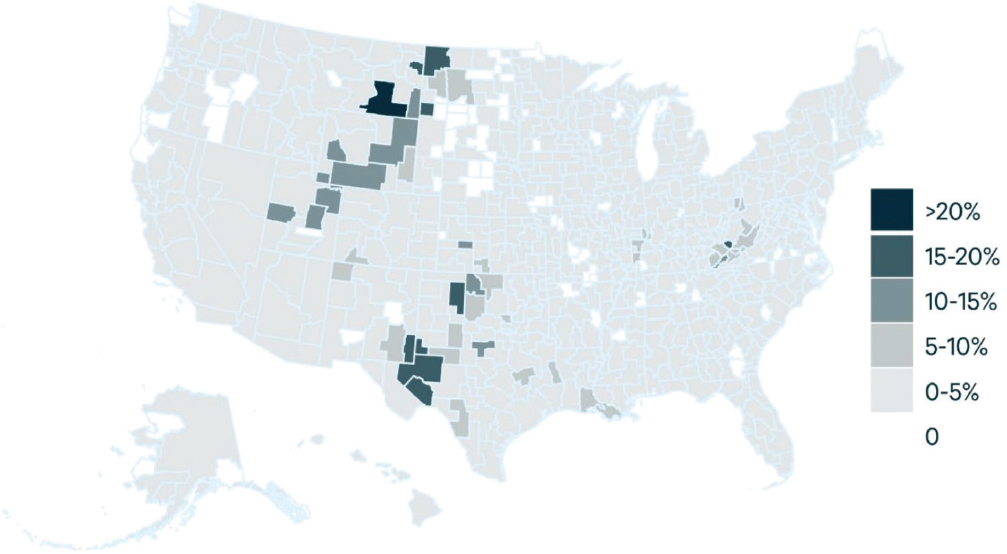
NOTE: A commuting zone uses a hierarchical cluster analysis and U.S. Census Bureau data to reflect where people live and work, combining the nation’s counties into 658 groupings.
SOURCE: Greenspon and Raimi (2022).
Illinois, Maryland, Massachusetts, Michigan, New Jersey, New York, Oregon, Pennsylvania, South Carolina, Vermont, Virginia, and Washington (National Conference of State Legislatures 2023).4 More recently, the robust response of DOE to meet the goals outlined in the Justice40 Initiative creates specific areas of interest through which action eventually can incentivize the continued development of CO2 utilization (E.O. 14008 2021; White House n.d.(b)). DOE identified eight policy priorities to guide the implementation of EJ across deployment of their programming (DOE n.d.(d)). Of those eight, the carbon management value chain and CO2 utilization infrastructure have the potential to impact and be impacted by the following:
- Decrease environmental exposure and burdens for disadvantaged communities.5 Low-income communities or communities of color are disproportionately impacted by air pollution and thus are more likely to experience adverse health effects (EPA n.d.(c)). Therefore, the potential for carbon capture equipment to directly address co-pollutants has drawn attention in the larger carbon management and EJ conversation. DOE’s Justice40-covered programs, if implemented as intended, may result in a larger build-out of carbon management infrastructure that can support CO2 utilization and decrease air pollution in affected communities (See Section 4.2.1.2.3.)
___________________
4 See NASEM (2023a, 2023e) for a discussion about current state and federal initiatives to advance the energy transition through holistic programs that seek multifaceted outcomes, including advancing EJ through risk-management planning for stormwater management (e.g., see LA SAFE 2019); applying prices to industrial pollution (e.g., see Cap-and-Invest n.d.); creating working groups to advise policy related to EJ communities (e.g., see IWG 2021 and New York State 2022); and evaluating policy impacts on disadvantaged communities (e.g., see DOE 2023).
5 Under Justice40, a “disadvantaged community” is a community that is marginalized, underserved, and overburdened by pollution (White House n.d.(b); see also Box 4-3 below).
- Increase clean energy enterprise creation and contracting in disadvantaged communities. Owing to the nature of the carbon management value chain and its economics, there are limited opportunities for smaller players, including minority-owned businesses, to partake in the build-out of this sector. The development of small minority and disadvantaged business enterprises has the potential to bring economic development to a disadvantaged community and diversify the carbon management value chain. In particular, the development of these enterprises can create diverse CO2 utilization opportunities.
- Increase clean energy jobs, job pipeline, and job training for individuals from disadvantaged communities. Both racial minorities and women are underrepresented in the U.S. clean energy sector, and racial minorities are less likely to hold executive or leadership roles (DOE-OEJ 2023; E2 et al. 2021; Lehmann et al. 2021). To support the carbon management sector, between 390,000 and 1.8 million jobs are projected to be created in raw materials, engineering and design, construction, and operation and maintenance (Suter et al. 2022). The expansion of the carbon management sector provides an opportunity to diversify the workforce with a focus on offering workforce development opportunities to underserved communities.
It has yet to be determined if Justice40 is a durable policy or if 40 percent of benefits is an achievable target for federal investment, but significant opportunity exists to prioritize these EJ goals to drive the build-out and implementation of the CO2 utilization sector, while ensuring its outcomes are multifaceted and more equitable. For example, carbon management falls largely under the climate change and clean energy topics of Justice40, but the administrative motivation to create a robust workforce and diversify supply chains also provides incentive to build up CO2 utilization opportunities in regions transitioning from oil and gas production. Policies that seek to enshrine EJ considerations into CO2 utilization investments can support the emerging sector in collecting and reporting the outcomes of investments for adaptive management (see Section 4.2.2.1) and by providing direct benefits to overburdened communities (see Section 4.4.3.3).
4.2.1.2.3 Health Co-Benefits from Carbon Management
Once emitted, greenhouse gases (GHGs) last up to thousands of years in the atmosphere and, in addition to climate change, contribute to adverse environmental effects, including air pollution, which leads to an estimated 53,200–355,000 premature deaths annually in the United States (EPA 2022; Mailloux et al. 2022; Vohra et al. 2021). Impacts of air pollution are disproportionately experienced across the nation. For example, near source pollution6 has been found to lead to higher exposures to air contaminants, negatively impacting public health in these areas (EPA n.d.(e)). Emissions mitigation approaches—including carbon capture, focus on reducing emissions, and removing GHGs from the atmosphere—are expected to benefit human and public health. (See Finding 4-3.) Furthermore, replacing processes and products that emit GHGs with low-carbon alternatives will prevent the continued release of GHGs into the atmosphere. Box 4-1 summarizes a study conducted to analyze the potential health benefits from deploying carbon capture technologies on certain facilities.
Providing quantitative data to affected communities and policy makers about how carbon capture technologies can reduce criteria air pollutant emissions, and consequently benefit human health, will further inform the dialogue that is necessary to deploy carbon management technologies (see Section 4.4.1). Furthermore, the results of future-looking reports describing expected health benefits from carbon management can support deployment of CO2 utilization technologies at the scale necessary to meet climate objectives. (See Recommendation 4-2.)
4.2.2 CO2 Utilization Policy Gaps
Climate change policies need to be stable and durable such that investments and incentives are maintained while also evolving with new information and changing conditions (NRC 2010). Policy uncertainty hinders investment and adoption of technologies and limits otherwise profitable investments (NASEM 2023d, Finding 5.3). However, because developing a net-zero or circular economy at the scale required to address climate change is a
___________________
6 Living near sources of air pollution, including major roadways, ports, rail yards, and industrial facilities.
BOX 4-1
Potential Health Benefits from Deploying Carbon Capture
Bennett et al. (2023) reviewed 54 facilities in seven industries—cement, coal power plants, ethanol, fertilizer and ammonia, iron and steel, natural-gas power plants, and petroleum refineries—to estimate regional air quality and health benefits that would result from carbon capture deployment. The study used the U.S. Environmental Protection Agency’s Co-Benefits Risk Assessment Health Impacts Screening and Mapping Tool (COBRA)—which predicts health outcomes on adult and infant mortality; nonfatal heart attacks; respiratory and cardiovascular-related hospital admissions; acute bronchitis; upper and lower respiratory symptoms; asthma exacerbations and emergency room visits; minor restricted activity days;a and work loss days—to identify the air quality and health benefits through the combined removal of CO2, NOx, SO2, and PM2.5 via carbon capture. Looking at different regions across the United States, carbon capture on mid-Atlantic facilities is projected to provide the highest reduction in asthma exacerbation and mortality (Bennett et al. 2023). COBRA also was used to find the economic value associated with the changes in health impacts—that is, the monetary value of health benefits from carbon capture. As shown in Figure 4-1-1, the largest monetary value of health benefits is estimated to come from deploying carbon capture on cement, coal, and petroleum refineries. This outcome can be used to inform priority carbon capture investments when the investment goal is to reduce adverse health impacts from emissions of CO2 and other pollutants. However, the study did not consider additional climate benefits from CO2 removal or additional economic benefits from installing and maintaining carbon capture technology, both of which could be additional drivers for carbon management.
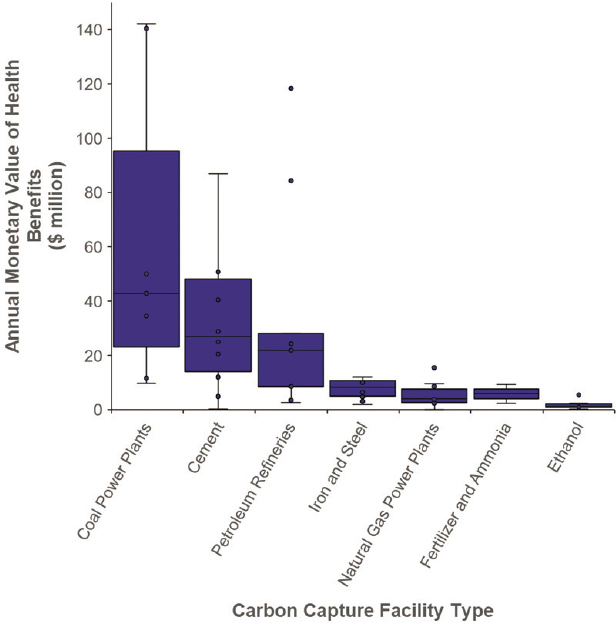
NOTE: The circles represent the total average value of health benefits calculated for each of the 54 facilities studied.
SOURCE: Based on data from Bennett et al. (2023).
__________________
a Defined as days on which usual daily activities are reduced, but without falling into work absenteeism.
novel task, there is limited ability to anticipate the ways in which this process can fail, which adds difficulty to policy design (NASEM 2023c). The lack of adaptable policy serves as barrier to the adoption of carbon management infrastructure and CO2 utilization by creating roadblocks to economic development. For example, there are legislative barriers to updating the 45Q tax credit to include a variety of eligible technology pathways, development, and deployment.
As it stands, the main policy mechanisms for the CO2 utilization sector are tax credits, permitting and regulatory frameworks, and large omnibus legislation—all of which under the current system are slow moving and difficult to modify, especially when bipartisan consensus is required. (See Finding 4-4.) Adaptable policies can serve the CO2 utilization sector by matching the pace of market and infrastructure development, and the science as it evolves. Adaptive management, an iterative learning process that produces improved understanding and management over time, is critical to the development of flexible policies (NASEM 2023c). Adaptive management can help identify and avoid unintended consequences like disincentivizing certain capture and removal pathways, while also leading to broader societal acceptance. For example, as more CO2 utilization technologies and products become commercially available, there will be more data about the direct and indirect impacts experienced by the general public and communities hosting infrastructure. Analysis of these data can be used to modify CO2 utilization policy to avoid unjust consequences to communities and the environment. The following section outlines how policy for CO2-derived products can be designed and implemented to support and adapt to an emerging market and identifies potential economic and noneconomic tools to address gaps and barriers. (See Recommendation 4-3.)
4.2.2.1 Economic Tools
As discussed above, the current policy portfolio incentivizes CO2 capture and production of CO2-derived products through tax credits such as 45Q and 45V that lower the cost of supply.7 However, it lacks demand incentives for CO2-derived product uses or markets, especially relative to other carbon abatement approaches. The lack of a sufficient cost benefit for use of CO2-derived products prevents uptake. For example, under current policies and prices, the use of SAF from captured CO2 is more expensive than continuing to use aviation fuel derived directly from fossil sources (Bose 2023). Without financial justification or specific policies incentivizing the use of CO2-derived products, there will be no economic rationale to drive market adoption. (See Finding 4-1 and Recommendation 4-1.)
Policy needs to create the conditions to both lower the costs and market frictions to produce CO2-derived products and decrease barriers to demand, at least initially so that a minimal industry can be established. The latter has an analogy in the rise in demand for carbon-free electricity, driven by state-level policies to achieve increasingly less carbon-intensive generation. The rise in demand is accelerated by increasing electrification of economic sectors, like transportation through incentives for and adoption of electric vehicles. The direct policy target for clean grids coupled with increased demand for electricity is creating an enormous demand for the build-out of generation sources like solar and wind energy (e.g., see Motyka et al. n.d. and Wilson and Zimmerman 2023). Economic tools for the consumption of products include policies that support cost parity for consumers between CO2-derived products and their carbon-intensive alternatives. This section outlines how economic tools can support CO2 utilization development, including tools that encourage product uptake.
4.2.2.1.1 Energy Mix Uncertainties
There is still significant need and opportunity to grow the zero-carbon electricity share; in 2023, 60 percent of electricity generated by utility-scale facilities in the United States was from fossil fuels (e.g., coal, natural gas, petroleum), while 21 percent was from renewable energy, and 17 percent was from nuclear energy (EIA n.d.). Without first decarbonizing the energy system, an emerging CO2 utilization sector using CO2 sourced from carbon capture or removal strategies could be reliant on fossil energy, preventing the desired impact on the nation’s climate goals from a life cycle assessment (LCA) perspective. The U.S. grid must continue to diversify while research and
___________________
7 The 45V tax credit for clean hydrogen production has a base rate of $0.60/kg of qualified clean hydrogen produced (H.R. 5376 Sec. 13204).
development (R&D) on low-carbon technologies seeks ways to reduce energy requirements. Both diversification of the U.S. energy portfolio and R&D will support a CO2 utilization sector that does not rely on fossil fuel combustion.
Recent U.S. legislative vehicles (e.g., the IIJA and the IRA) contain opportunities that encourage the build-out of renewable energy, including investment and production tax credits for installing solar and wind technologies, geothermal, tidal, and hydroelectric energy, and technology agnostic tax credits for clean energy production and investment (EPA n.d.(f)). Global projections show that renewable energy is becoming cost-competitive with fossil fuels, with around 187 gigawatts of all newly commissioned renewable capacity in 2022 having lower costs than fossil fuel–fired electricity (IRENA 2023). Nonetheless, a continual push to decarbonize the electricity mix is needed to develop an ethical and climate-impactful CO2 utilization market that is less reliant on fossil energy production, providing opportunities for lower-CI pathways.
Regardless of how the carbon capture, removal, and utilization value chain acquires energy and whether the energy is low-carbon, the cost of electricity may be high if facilities do not have access to a wholesale utility-regulated market. The committee’s first report discussed how uncertainty around the cost of electricity will influence CO2 utilization market growth by directly impacting the potential to develop a CO2 value chain (NASEM 2023d). It also identified that clustering energy supplies (i.e., hubs) could be more cost-effective for carbon capture, utilization, and storage (CCUS) processes and less likely to negatively impact other resources (NASEM 2023b).
4.2.2.1.2 Product Certification Processes and Reporting
Catalyzing CO2 utilization markets via federal procurement necessitates clear standards and regulation of use for these products. The programs and policies encouraging procurement of CO2-derived products do not yet have the transparency needed to advance procurement, including the creation of pilot programs or standardization guidelines. EPA has taken steps toward transparency with the Reducing Embodied Greenhouse Gas Emissions for Construction Materials and Products grant program, which helps businesses develop and verify Environmental Product Declarations (EPDs),8 and create user-friendly standardized labels for products (GSA n.d.(b)). Grants are awarded to projects that fall under five categories, including projects that develop robust, standardized product category standards and projects that support EPD reporting, availability, and verification; standardization of EPD systems; and EPD integration into construction design and procurement systems (GSA n.d.(b)). Grant awardees can help standardize the CO2-derived product industry by providing transparency on standardized data collection and analysis processes and developing tools and resources for EPD disclosures. However, further policy to support widespread adoption and standardization of CO2-derived products is necessary.
4.2.2.2 Noneconomic Tools
This section outlines the noneconomic policy tools that can support CO2 utilization development—namely, common carrier status, clarity regarding LCA standards, building materials standards, and workforce development.
4.2.2.2.1 Absence of Common Carrier Status Rules for CO2 Transportation
Robust siting frameworks will be needed as demand for CO2 transport infrastructure increases to support the sector. Historical trends for natural gas and electricity have shown that increased demand led to the development of regulatory frameworks for approving and evaluating infrastructure projects (Brown et al. 2023). State and federal agencies have been granted clear jurisdiction over siting gas pipelines and electricity transmission and have developed processes that are well defined, but not always streamlined. However, CO2 pipelines may pose greater permitting challenges than gas pipelines or electricity transmission (Brown et al. 2023). For CO2 midstream, there is uncertainty regarding common carrier rules and status9 for interstate transportation because common carrier
___________________
8 An EPD is an environmental report that provides that quantified environmental data using predetermined parameters and environmental information is consistent with ISO 14025:2006 (EPA n.d.(d)).
9 Common carrier status means that conveyance of CO2 for a fee is made open to the public by the operator, as opposed to private operation, where only specific actors may access such infrastructure.
status varies by state. It is unclear whether the entire pipeline is required to act as a common carrier when it passes through a state with common carrier requirement and a state without the requirement.
The lack of clear rules surrounding pipeline transportation of CO2 may not be an immediate constraint on market growth, but it will limit the unit economics and ongoing market maturity if not resolved as soon as possible. A significant challenge associated with common carrier status is that pipeline owners have concerns about the chemical composition and potential reactivity of what others may inject for transport in their infrastructure—especially given the many potential sources of CO2. Chemical impurities can lead to mechanical and metallurgical failures, which would be the responsibility of the pipeline owner. There is a space here for some type of policy or regulatory mechanism to certify CO2 streams in a common carrier system. However, currently no agreed-upon approach exists to common carrier status that allows certification to happen, and more intentional work is needed to address this.
4.2.2.2.2 Clarity Regarding Assessment Standards
Owing to the myriad pathways CO2 utilization can take, there is an ongoing discussion around monitoring, reporting, and verification (MRV) and how to standardize “best” practices. Because these practices could change with the development of new techniques and technologies, creating adaptable MRV frameworks is increasingly important.
As key aspects of MRV, LCAs for CO2 utilization processes need to be better defined and standardized. LCA requirements often lack widespread adoption or clarification outside of these frameworks for federal tax credits or funding opportunities. For example, after an open comment period, the Internal Revenue Service (IRS 2021) determined that an LCA of GHGs—consistent with ISO 14044:2006—has to be submitted in writing and “either performed or verified by a professionally-licensed independent third party,” along with the third party’s documented qualifications for 45Q tax credit applicants.10 Ultimately, the LCA needs to quantify the metric tonnes of qualified carbon oxide captured and permanently isolated from the atmosphere or displaced from being emitted into the atmosphere through use of eligible processes. Another example is DOE’s Carbon Utilization Program, which requires eligible entities to show significant reductions in life cycle GHG emissions for CO2-derived products compared to incumbent products using the National Energy Technology Laboratory’s (NETL’s) LCA Guidance Toolkit as a baseline (DOE n.d.(b); NETL n.d.(a); Skone et al. 2022). Creating standardized processes around LCA requirements and expectations is difficult, and nearly impossible if the purpose is not for a federal credit or funding opportunity.
There are also gaps in the use of social life cycle assessments (s-LCAs), which consider social impacts from a more quantitative perspective, as a part of federal frameworks or other standardized processes.11 s-LCAs, along with other ways to integrate equity and justice concerns, are not comprehensive or a replacement for community engagement. However, the results of the assessment may enable clear communication of social benefits or the pathway’s role in climate mitigation strategies in a way that a more traditional LCA may not. Therefore, these frameworks could play a role in addressing public acceptance issues while integrating social considerations into the traditionally high-level quantitative MRV discussion. Clarity around these systems and consistent regulatory and permitting processes will allow for more transparency among research entities, industry, government, and the public, while creating easier pathways for integrating CO2 utilization processes and products in our economic system. See Chapter 3 for more information about LCAs and s-LCAs.
4.2.2.2.3 Flexible Policy for CO2-Derived Building Materials
Strong demand signals exist to produce CO2-derived building materials—concrete, carbon black additives, and drywall—owing to incentives and requirements for low-embodied carbon in new buildings. These new materials
___________________
10 For these requirements, the IRS defined life cycle GHG emissions using the cradle-to-grave boundary, considering the entire product life cycle from raw material extraction until end of life (IRS 2021).
11 See Ashley et al. (2022) for a proposed equity assessment framework that provides sufficient quantitative information about the effects of federal legislation to inform federal processes.
seek to reduce carbon emissions and minimize adverse environmental impacts from the construction industry. The increasing number of patent applications for CO2 utilization technologies (a roughly 60 percent increase internationally between 2007 and 2017) reflects the interest from researchers and industries, with investment facilitating technologies to be developed at scale (Norhasyima and Mahlia 2018).12 The committee’s first report identified that CO2-derived construction materials would motivate the “testing and validation of the new materials, creation of new environmental product declarations, and adaptation of building codes and standards” to support the consumption of these products (NASEM 2023d, p. 64).
Innovative solutions are emerging to address these challenges from different perspectives, such as using renewable energy to produce clinkers for cement, applying alternative materials with lower carbon footprint, capturing CO2 produced from cement plants, and upcycling construction and demolition materials. (See Box 4-4 below for information about concerns expressed by construction professionals about CO2-derived materials.) In addition to supporting R&D for construction materials, future policy could incentivize the development of building codes and regulations that are flexible and adaptable as new CO2- and coal waste–derived materials are validated for use in buildings. For example, Bowles et at. (2022) provides sample language for building codes that could decrease the carbon impacts from the construction industry and support low-CI business models.
4.2.2.2.4 Workforce Development Considerations for Policy
As discussed above, there is an abundant workforce opportunity for carbon management infrastructure as the sector builds out and new prospects for career pathways develop. CO2 policy design could incorporate the following workforce development considerations:
- Facilitate localized development of workforce opportunities. Jobs are frequently cited as an economic benefit to bring communities on board with new projects and investment, position the United States as a leader in manufacturing, and reduce GHG emissions (e.g., see Larsen et al. 2021 and White House 2021). Developing workforce standards and requirements can create measurable benchmarks that can be strategized around. Furthermore, a dedicated commitment at a larger level of workforce development needs to occur simultaneously with a skill building framework implemented through local actors (i.e., providing classes and certifications, and facilitating job placements through a national public university, community college, or trade school) (Coleman 2023).
- Balance training the new workforce with upgrading the existing workforce. Skills development is integral to bringing new laborers into the workforce and supporting incumbent workers through the transition. Strategies that will reach both groups of workers include targeted outreach for occupation types and cross-industry partnerships and apprenticeships (Zabin 2020). Opportunities to grow the sector include targeting young people interested in the green economy, which can benefit youth in underserved communities to provide them with a variety of career trajectories. For example, future iterations of the American Climate Corps could include opportunities around carbon management (White House n.d.(a)). Reaching both groups of workers will take intentional and effective outreach to meet the specific needs of the present and future workforce.
4.3 MECHANISMS FOR BUSINESS DEVELOPMENT
Discovering, developing, and commercializing CO2 utilization processes and products are necessary as the nation transitions to a net-zero economy. This section highlights various considerations for business development, including market fit and access, available federal resources and programs, and potential workforce uncertainties.
___________________
12 See Chapter 2 for more about the market for cement and construction aggregates, Chapter 5 for more about CO2-derived building materials and the environmental impact of the processes to produce them, and Chapter 9 for more about coal waste–derived building materials.
4.3.1 Market Fit and Access for CO2-Derived Products
CO2-derived products have to be considered on a continuum with respect to market fit—the alignment between the specifications of the CO2-derived product and the needs and preferences of the purchasing consumers and market access—the ability of a product to enter and operate in a particular market successfully (i.e., in an economically sustainable manner) (Aaker and Moorman 2017). This section considers elements of market fit and access, including upstream and downstream partners and commodity gatekeepers.
4.3.1.1 Market Fit
Market fit in the context of CO2-derived products largely relies on the ability of products to satisfy the claims that they have lower CI than otherwise functionally identical products. For example, SAFs will not be chemically identical to current jet fuels but will have the same functionality and lower CI. Market fit becomes more complex in situations where product performance beyond CI is altered (e.g., concrete blocks that have been cured with CO2 and thus exhibit greater load-bearing characteristics). Such cases create a new submarket in which customers appropriately pay for functional performance that is greater—or less—than the baseline.
In strict replacement cases, the market fit of CO2-derived products mostly has been established already by the incumbent. Projections for the evolution of existing markets have to be considered to determine the long-term viability of the CO2-derived product. In cases where new products cannot be strictly considered replacements, product–market fit analysis has to be continually conducted to determine if—and at what point in time—a sufficiently sized demand signal will emerge to support the economic case of a CO2-derived product. It may take time for a unique and durable demand signal for new products to appear, as prospective customers need to accumulate knowledge and experience the product. For example, for CO2-cured concrete blocks, customers must determine if the price premium justifies a one-for-one replacement with existing markets; if new applications can be found that push out incumbent solutions; and if new products perform in the field as expected given standards tests. These considerations require time and experience on the parts of both customers and producers to make informed judgments about the product.
Co-piloting and partnerships are crucial for products to move up the adoption-readiness level ladder. Key upstream partners for CO2-derived product development include CO2 supply, specialized capital equipment providers, and specific co-input providers (e.g., providers of emissions-free electricity and clean hydrogen). While production volumes are currently small and uncertain for most CO2-derived products, key downstream partners are the direct customers that will help prove the commercialization and business case of the company producing the CO2-derived product. Such agreements are especially beneficial for commodity products where consistent, intentional effort will be required to make the CO2-derived product relatively cost-competitive with the incumbent that has decades of accumulated knowledge, resources, and market access (DOE n.d.(a)). At-volume, predictable demand over a long timeframe supported by a creditworthy off-taker creates the conditions for cost reductions and market adoption of CO2-derived products (e.g., see Saiyid 2023).
For the CO2 utilization company, a partnership agreement provides predictable demand over a long period, which could substantially support capital and operational planning, and a meaningful production/volume target that through accumulated learning effects, know-how, and value-engineering could reduce unit costs. In a sense, a downstream buyer’s contract could pave the way for cost reductions in a product, not only for the company with the contract but also for other customers. This, in turn, could create greater demand for products like SAFs (bolstered in part by the International Civil Aviation Organization’s emission targets), leading to wider market adoption. Continued engagement between upstream and downstream partners will support both the supply and demand for CO2-derived products, thus setting the foundation for a CO2 utilization market.
4.3.1.2 Market Access
Market access relates more to external factors and conditions beyond demand for product features, such as regulatory, legal, competitive, and economic factors that affect product entry into a market. Depending on the product and sector, businesses introducing CO2-derived materials will need to identify and address the relevant gatekeepers to different commodity markets to gain commercial traction (Ahn 2019). For example, adherence to
management requirements such as international quality management standards (e.g., see ASTM International n.d. and ISO 2015) and national chemical purity grading (e.g., see P.L. No. 94-469 1976 and Schieving 2018) assure customers of product reliability. Other gatekeepers for all CO2-derived products include:
- Price: In the absence of sufficient demand driven by incentives or strategic differentiation strategies, price will be the most salient factor affecting market access. Included in this is the concept of margin (price minus cost), which must be sufficient to keep suppliers economically motivated and allow for reinvestment in product improvements. CO2-derived products will need to have competitive prices, while maintaining adequate margins, to access commodity markets, which are differentiated (e.g., the price of fuels in California versus Texas may create an opportunity for CO2-derived fuels in the former).
- Volume: In commodity markets, volume and production volume certainty are other gating factors to market access. Downstream users of commodities generally optimize their processes around a guaranteed supply through multiple vendors to increase cost efficiency and capacity utilization. Producers of CO2-derived products will either need the ability to supply sufficient volumes at the onset of entering a market to satisfy procurement needs of customers or have a clear pathway to achieving such through a partnership with an offtaker.
- Quality: For a commodity product to be considered marketable, certain standards have to be achieved—typically, a combination of presence or absence criteria and/or tolerance bands with which the product has to comply. For example, the ASTM has several standards specifying, testing, and assessing the physical, mechanical, and chemical properties of plastics that CO2-derived products would be required to meet.
- Distribution channels: Depending on the product, distribution channels can take the form of commodity exchanges, wholesalers and distributors, brokers and agents, or government agencies. Each type is comprised of multiple actors with their own requirements for production volumes, price, insurance, hedging mechanisms, and quality audits. The factors affecting market access for new products are more complex, given the likely need for new submarket formation.
4.3.2 Resources for Emerging CO2 Utilization Businesses
4.3.2.1 Opportunities Through Federal Funding and Programs
CO2 utilization may use only a fraction of the total capturable CO2 otherwise destined for geologic sequestration, as discussed elsewhere in this report. Several funding opportunity announcements (FOAs) support carbon management interfacing with CO2 utilization, including those for the Regional Direct Air Capture Hubs (DOE-FECM n.d.(b)) and Carbon Capture Demonstration Projects Program (DOE-OCED n.d.). Despite being large in sum, these FOAs may not be the best source of funding for commercializing CO2 utilization because of focus and time lag to produce usable CO2. For example, the FOA for Carbon Management is positioned to help demonstrate conversion technologies, but the funding is more similar to R&D than commercial demonstration because it is spread across numerous pathways (DOE-FECM n.d.(c)). Moreover, this funding is unlikely to be sufficient for CO2 purchase for demonstration purposes.
The need for a demonstration project to claim the available tax credits incentivizes the development of CO2 utilization demonstration partners. The IIJA contains many funding opportunities to support the build-out of CO2 utilization infrastructure and R&D on CO2-derived products (see Table 4-1). For funding to be appropriately used, businesses will need to know the application and reporting criteria to secure funding. Additionally, to take advantage of multiple funding opportunities at once, multiple businesses develop partnerships and site facilities within the same region (i.e., hub design infrastructure). For example, program funding can be used to set up demonstration hubs centered close to ethanol production facilities, which would allow CO2 utilization to be demonstrated using carbon capture technology that is already commercially proven and available. The CO2 captured at these hubs would be eligible for the $60/tonne (or $130/tonne CO2 captured using direct air capture [DAC] technologies) tax credit through 45Q, and there is no requirement to geologically sequester. Given that the cost of CO2 capture from an ethanol facility is $0–$55/tonne (Bennett et al. 2023; GAO 2022; Hughes et al. 2022; Moniz et al. 2023;
National Petroleum Council 2019),13 a CO2 utilization demonstration hub centered close to ethanol production could offer the CO2 needed at zero cost. Developing demonstration partners and using hub designs when possible can stretch grant funds by eliminating operational costs from CO2 utilization unit economics. See Chapter 10 for more on CCUS infrastructure development opportunities.
4.3.2.2 Federal Programs for Building Knowledge About and Skills for CO2 Utilization
Federal agencies provide business leaders and stakeholders the opportunity to answer questions about proposed programs through various mechanisms like Requests for Information (RFIs) in order to alert the agency to gaps and opportunities in the sector. Frequently, RFIs are used to identify typically underrepresented stakeholders for collaboration, with the purpose of requesting feedback from a variety of stakeholders “all while considering environmental justice, energy transition, tribal, and other impacted communities” (DOE-FECM 2021, p. 3). Responses from small and disadvantaged CO2 utilization businesses, declaring the need for attention and collaboration, would likely result in additional opportunities in future funding processes.
Similarly, if businesses diversify their collaborations or aim to meet commitments, they improve their odds of success in the CO2 utilization market. Initiatives such as these create opportunities for businesses to access broader knowledge, perspectives, and skill sets, which can lead to further collaborative possibilities. (See Finding 4-5.) For example, the submission of Promoting Inclusive and Equitable Research Plans, which outline diversification tools such as engagement and collaboration with underserved populations, organizations, and institutions, and provision of professional and learning opportunities for underrepresented populations, such as Black, Indigenous, and other people of color (BIPOC) professionals with science and engineering expertise, are now required for some DOE FOAs (DOE n.d.(e)). These plans seek to advance the federal Small Business Innovation Research/Small Business Technology Transfer (SBIR/STTR) program goal to foster and encourage participation by socially or economically disadvantaged groups in innovation and entrepreneurship.
4.3.2.3 DOE Resources for Small Business Partners
In 2021, Sick et al. (2022) estimated that, of 160 developers active in CO2 capture and utilization, 39 were new start-ups that had emerged since 2016. Small businesses and start-ups can enter and thrive in the nascent field of CO2 utilization, and their participation is critical to the development and diversification of CO2-derived product markets. For example, within the design of hubs, small businesses would have to build their own niche based on what is needed in the system, which provides both a challenge and an opportunity. By securing a specialized role in a hub, small businesses can expect to develop an expanded role as the sector grows and more capacity is required.
The federal government has initiatives that target small businesses and encourage opportunities that will grow the CO2 utilization sector. For example, through cross-agency coordination, the General Services Administration (GSA) administers awards on behalf of clients in participating agencies and provides information on its website about how to undergo certification processes (GSA n.d.(a), n.d.(c)). The SBIR and STTR programs are another opportunity, and can help small businesses or start-ups initiate relationships with DOE. Projects are awarded in three distinct phases: Phases I and II provide R&D funding, and Phase III—during which federal agencies may award follow-on grants or contracts for products or processes that meet the mission needs of those agencies, or for further R&D—provides nonfederal capital to pursue commercial applications of that earlier R&D (SBIR n.d.). Small businesses experience various challenges to accessing these opportunities or being successful in this nascent sector, including limited awareness of relevant funding calls; limited ability to access facilities that could help their business development and/or result in meaningful partnerships to close gaps in their processes; and barriers in navigating available federal funding and required reporting. More support is needed for small businesses to overcome issues with accessing a broader market in addition to federal funding and resources.
DOE national laboratories provide a unique entry point for business leaders to engage with federal initiatives and programs while developing their business to better meet the needs of the sector. For example, Argonne National Laboratory’s Small Business Program provides business owners with technical assistance related to procurement and
___________________
13 Range includes first-of-a-kind and nth-of-a-kind facilities.
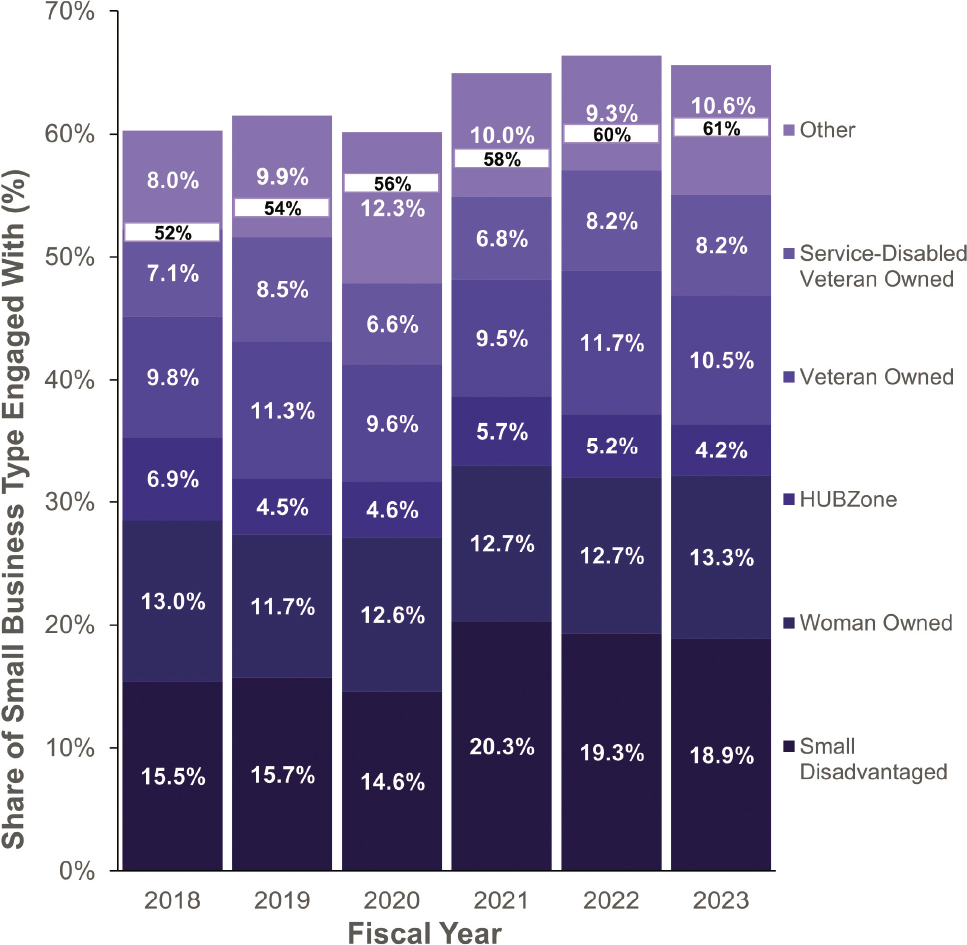
SOURCE: Based on data from SNL (n.d.).
development, and access to a streamlined registration and certification system (ANL n.d.). While no overarching organization provides cross-laboratory information for businesses, most national laboratories provide internal programming with collaboration opportunities. Sandia National Laboratories (SNL), for example, consistently exceeds its small business collaboration goals, reporting $1.1 billion in subcontracts to small and diverse businesses in FY 22, including small disadvantaged, woman-owned, veteran-owned, and service-disabled-veteran-owned businesses and businesses located in Historically Underutilized Business Zones (HUBZones)14 (Peery 2023; see Figure 4-3). These data are particularly encouraging representations of the opportunity that currently exists, and the potential trajectory for collaboration between national laboratories and small businesses, indicating that the Sandia model could perhaps be mapped successfully to other national laboratories across the country.
___________________
14 HUBZone businesses are part of the U.S. Small Business Administration’s program for small companies that operate and employ those in “Historically Under-Utilized Business Zones” (SBA n.d.).
DOE also works with third-party organizations to support the accelerated deployment of technologies. For example, ENERGYWERX, DOE’s first intermediary partner, works to increase joint activities between the agency and small business, higher-education institutions, and nontraditional partners to expand the deployment of clean energy solutions (DOE-OTT n.d.(b)). In growing the carbon management and CO2 utilization sectors, DOE can capitalize on the important role of national laboratories and third-party organizations in developing and commercializing new technologies and MRV methods. Box 4-2 highlights existing opportunities for small businesses to partner with national laboratories and third-party organizations for technology development and deployment support: the Gateway for Accelerated Innovation in Nuclear (GAIN) program and the Voucher Program. The best practices, beneficial components, and lessons learned from both of these programs can be applied to a program developed to aid businesses entering the CO2 utilization sector. (See Recommendation 4-4.)
BOX 4-2
Existing Opportunities for Commercialization Partnerships Through the Department of Energy
GAIN Program
The GAIN program, administered and led by Idaho National Laboratory in collaboration with Oak Ridge National Laboratory and Argonne National Laboratory, is a public–private partnership framework dedicated to rapid and cost-effective development of innovative nuclear energy technologies and market readiness. Its mission is to provide the nuclear energy industry with access to the technical, regulatory, and financial support needed to commercialize innovative nuclear energy technologies at an accelerated and cost-effective pace (GAIN n.d.(b)). Aside from communication and education programming, GAIN offers a host of valuable resources, including (1) physical access to unique experimental and testing capabilities housed within the national laboratory system; (2) computational and simulation tools; (3) data, information, and sample materials from previous research at national laboratories to inform future experiments; (4) use and site information for demonstration facilities; and (5) experts in nuclear science, engineering, materials science, licensing, and financing (DOE-NE n.d.). Access to these resources generally comes through the GAIN Nuclear Energy Voucher Program, which are not grants, but rather competitively awarded tokens that send funds directly to the national laboratory partner for laboratory time, materials, and equipment for the awardee. Since 2016, the GAIN program has awarded $34.2 million in vouchers to 57 different companies (GAIN n.d.(a)). While there are no size restrictions on applicant companies, special consideration is given to small companies.
DOE’s Voucher Program for Energy Technology Innovation
The DOE Voucher Program, overseen by the Office of Technology Transitions (OTT), Office of Clean Energy Demonstrations (OCED), FECM, and Office of Energy Efficiency and Renewable Energy (EERE), is funded by IIJA’s Technology Commercialization Fund (DOE-OTT 2023). The program will provide more than $32 million in commercialization support to businesses, including small businesses (DOE-OTT n.d.(a)). The support offered by the program includes (1) manufacturing or supply chain assessments, community benefits assessments, and other technoeconomic analyses; (2) third-party evaluation of technology performance under operating conditions that are certification-relevant; (3) considerations for technology benefits and challenges and siting and permitting best practices, and the development of streamlined processes for permitting and community engagement; (4) business plan, market research, and other commercialization strategy assistance; and (5) independent MRV practices and performance validation support (DOE-OTT 2023, n.d.(a)).
As part of the Voucher Program, businesses work directly with ENERGYWERX to connect with relevant third-party organizations, subject matter experts, and testing facilities. Lessons learned from this initial round of vouchers can guide future iterations of the programs and serve as a model for other commercialization programs.

SOURCES: Based on data from Jones et al. (2023) and O’Rear et al. (2023).
For emerging CO2 utilization businesses, especially small ones, the available DOE resources and funding need to be appropriately communicated so that diverse types of businesses can access them. Additionally, using programs for other energy-related technologies, like the GAIN and Voucher programs, as a model for CO2 utilization programs can support the entrance of small businesses into this space by connecting them with market and technology experts.
4.3.3 Workforce Uncertainties for CO2 Utilization Businesses
CCUS at scale has been estimated to support 177,000 to 295,000 jobs, while, for comparison, 3.1 million clean energy jobs are aligned with DOE’s net-zero definition15 (DOE-OEJ 2023; MacNair and Callihan 2019). However, regardless of the industry, there are not enough employees in the upstream labor force to support the infrastructure build-out that investors seek to fund. This is not owing to a lack of available jobs. The Bureau of Labor Statistics reported an average of 438,000 open construction jobs per month for November 2023 through January 2024 (BLS 2024). Despite the high number of job openings, contractors have reported difficulty finding willing and skilled workers in recent years (NASEM 2023g). For example, the Associated General Contractors of America and Autodesk Cloud Construction (2023) workforce survey found that 68 percent of firms surveyed had trouble filling openings because candidates lacked the skills to work in the industry. This employment trend will persist even without a transition to cleaner energy and products.
Figure 4-4 compares the upstream labor needs predicted for the DAC and SAF workforces. The Rhodium Group estimates that once a facility is built, DAC facilities will need 340 ongoing jobs, and SAF facilities will need 1440 ongoing jobs to support operations (Jones et al. 2023; O’Rear et al. 2023). Beyond the ongoing jobs related to maintenance, executive and business operations will comprise 11 percent of the ongoing employment for DAC facilities, and agricultural workers and managers will comprise 25 percent of the ongoing employment for SAF production (Jones et al. 2023; O’Rear et al. 2023). Small businesses aiming to participate in either field will need to match the skilled labor required to maintain facilities if they hope to compete with larger, more developed businesses.
___________________
15 DOE defines clean energy jobs aligned with a net-zero future as relating to “renewable energy; grid technologies and storage; traditional electricity transmission and distribution for electricity; nuclear energy; a subset of energy efficiency that does not involve fossil fuel burning equipment; biofuels; and plug-in hybrid, battery electric, and hydrogen fuel cell vehicles and components” (DOE-OEJ 2023, p. viii).
Very little research has been done to predict the workforce needs for CO2 utilization-specific businesses. However, the skill sets required for CO2 utilization projects are expected to translate from existing processes and skill sets for fossil fuel refining and chemical industries, as discussed in Section 4.2.1.2.1. Specialized training—which may be required for R&D-related workforces—will play a key role in workforce development for the growing sector, especially depending on its accessibility or lack thereof. Individuals with specialized skills tend to make more money while being a lower percentage of a sector’s workforce. For example, in oil and gas extraction in 2022, 1700 geoscientists (a specialized occupation in the field) were employed with an average annual salary of $145,660, compared to the 9340 wellhead pumpers employed with an average annual salary of $69,770 (BLS n.d.). This presents a challenge for small businesses because they likely will have to hire highly skilled employees at a high cost. Incentives are needed to encourage the development of a sustainable labor force for CO2 utilization that additionally support the access of small businesses to these skill sets. Special attention will need to be paid at federal and state levels to address the challenges and barriers and allow for the diversification of the CO2 utilization sector as it builds out.
4.4 SOCIETAL CONSIDERATIONS FOR THE EMERGING CO2 UTILIZATION SECTOR
Societal dimensions need to be considered and appropriately addressed in CO2 utilization policy, project design, and workforce development as the sector continues to build out. These considerations include the meaningful engagement of publics and communities, intentional focus on remediating and avoiding environmental harms, and equitable access to economic and workforce benefits of the emerging sector. Without these societal considerations, the CO2 utilization sector runs the risk of perpetuating past and current environmental and social injustices. This section defines relevant equity and justice terms, summarizes best practices for public and community engagement, elevates select principles of EJ, and identifies key economic considerations. Box 4-3, modified from the first report’s Box 5-1, includes definitions of key concepts of justice and equity discussed throughout this section.
BOX 4-3
Concepts of Justice and Equity
- Justice—Social arrangements that permit all (adult) members of society to interact with one another as peers (Nancy Fraser, quoted in Cochran and Denholm 2021). The principles of justice discussed in this section are: recognitional justice—understanding the historical and present bias regarding societal inequalities, especially about the treatment of communities (Cochran and Denholm 2021); procedural justice—the ability of people to be involved in fair decision-making processes (Cochran and Denholm 2021; Kosar and Suarez 2021); restorative justice—the act of repairing the impact of past injustices to restore communities and the environment to their original position (Hazrati and Heffron 2021); and distributive justice—equitable allocation of resources, risks, impacts, and benefits and burdens across society (Cochran and Denholm 2021; Kosar and Suarez 2021).
- Environmental justice—The just treatment and meaningful involvement of all people—regardless of income, race, color, national origin, Tribal affiliation, or disability—in decision-making activities related to climate change, the cumulative impacts of environmental and other burdens, and the legacy of racism or other structural or systemic barriers that disproportionately and adversely affect human health and the environment (EPA n.d.(b)).
- Social justice—A situation in which (1) benefits and burdens in society are dispersed with the allocation of a set of principles; (2) procedures and rules that govern decision making preserve the basic rights and entitlements of individuals and groups; and (3) individuals are treated with dignity and respect by authorities and other individuals (Jost and Kay 2010).
- Equity—Achieved results where advantage and disadvantage are not distributed based on social identities (Initiative for Energy Justice 2019). In this section, emphasis is placed on equitable access to a healthy, sustainable, and resilient environment in which to live, play, work, learn, grow, worship, and engage in cultural and subsistence practices.
- Disadvantaged community—A community that is marginalized by underinvestment and suffers the most from a combination of health, economic, and environmental burdens, including high unemployment, air and water pollution, and poverty (Kosar and Suarez 2021; White House n.d.(b)). Relatedly, marginalized/underrepresented communities are groups that experience societal barriers such as social, political, or economic exclusion or discrimination (Machado et al. 2021; Nakintu 2021). In this section, these terms are used interchangeably.
4.4.1 Public and Community Engagement Considerations
CO2 utilization is part of a suite of carbon management practices that are being designed to support the nation’s net-zero goals. In general, decarbonization pathways face a spectrum of responses from the public—from acceptance to opposition—which is common for emerging technologies (Boudet 2019; NASEM 2023f). Opposition to technologies can be broken into two dimensions: (1) concerns inherent to a technology (e.g., how will a project impact everyday life?); and (2) concerns related to the institutions that govern the technology (e.g., are the regulatory systems effective and competent and is a community being meaningfully consulted in deployment?) (NASEM 2023f, Table 8-1). Figure 4-5 illustrates the factors that affect public perceptions of and related responses
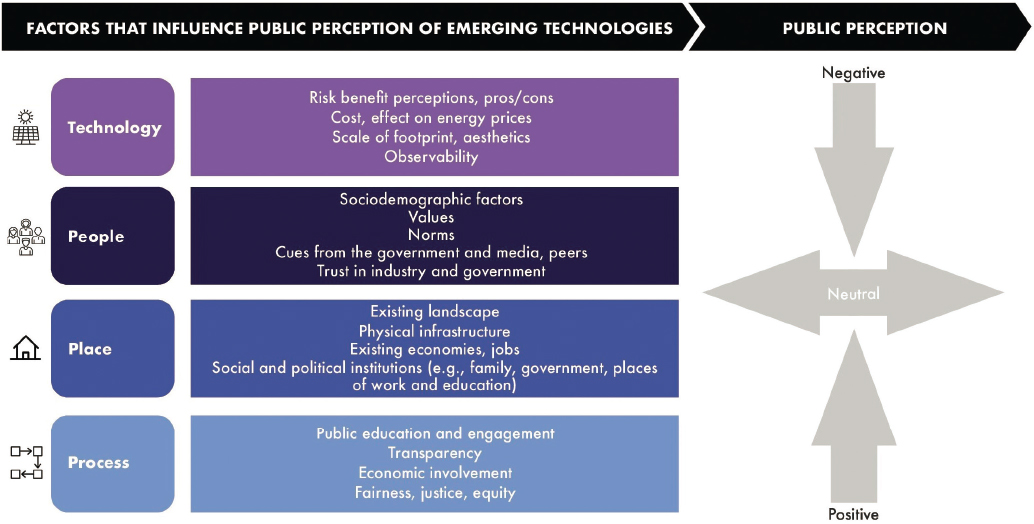
SOURCES: Modified from H.S. Boudet, 2019, “Public Perceptions of and Responses to New Energy Technologies,” Nature Energy 4:446–455, Springer Nature. Icons from the Noun Project, https://thenounproject.com. CC BY 3.0.
to new technologies.16 Studies show that providing the public with more information can lead to a shift in public support of new technologies (Stedman et al. 2016; Stoutenborough and Vedlitz 2016). However, the views of the media, peers, and trusted messengers (i.e., academics or social movement activists) also shape public responses to energy technologies (Boudet 2019).
Carbon management technologies and processes as a whole have been described as “false solutions”17 by EJ advocates (e.g., see Chemnick 2023a; Earthjustice and Clean Energy Program 2023; Just Transition Alliance 2020; New Energy Economy n.d.). Additionally, there is a public perception that investment in carbon management is outsized compared to the limited contribution that such technologies are expected to make to climate change mitigation (Jones et al. 2017). Skepticism that investment in CO2 utilization and its value chain is disproportionately large relative to its climate mitigation potential motivates negative public discourse. However, Seltzer (2021) found that 80 percent of the U.S. public either does not know of CCUS technology or cannot definitively recognize it. Transparency about how products are made, how widely used CO2-derived products are, and how R&D investments compare to the products’ GHG impacts can support the public’s understanding of CO2 utilization in relation to carbon management efforts. This section examines opportunities to use public and community engagement to (1) expand public understanding of CO2 utilization; (2) confront justice and equity questions that shape perceptions of the sector; and (3) communicate CO2-derived product pathways that align with public and community needs. (See Finding 4-7.)
4.4.1.1 Current Public Discourse Around Utilization
Most societal acceptance research about carbon management uses CCS to gauge an individual’s understanding before following up with questions on CO2 utilization, either because carbon capture is a source for CO2derived products or because CCS is more widely discussed. For example, Offermann-van Heek et al. (2018) used semistandardized interviews to identify the most important factors concerning trust and acceptance of CO2 utilization. The results of the qualitative study were incorporated in a quantitative online survey of 127 participants, which found that a lack of knowledge or awareness of CCS was owing to misconceptions, misleading information, or pseudo-opinions. When questions focused on CO2 utilization, Offermann-van Heek et al. (2018) found individual differences in preferences for end products (e.g., long-lasting cement versus fuels), skepticism about whether investment in CCS and CO2 utilization is worthwhile (e.g., preventing actual societal change, maintaining business as usual), and the acceptable amount of risk for health, sustainability, product quality, and the environment.
Offermann-van Heek et al. (2018) also found that customers have concerns about manufacturing considerations (e.g., the sustainability of production) and company considerations (e.g., company environmental management) for CO2-derived products. These concerns align with public considerations for conventional products, suggesting that customers do not view CO2-derived products differently. However, there are some challenges within the construction industry for using CO2-derived building materials (see Box 4-4).18 The concerns of both consumers and the construction industry can be addressed through low-stress testing projects, such as sidewalks and driveways (Derouin 2023). The transparency of testing products in public spaces can also support public communication of results.
Studies specific to CO2 utilization are sparse, and findings vary greatly. According to a meta-narrative review of 53 peer-reviewed publications by Nielsen et al. (2022), this variance of findings results from a lack of cohesive definitions—and therefore, a lack of cohesive metrics—for acceptance, community, and impacts. For example, a study that conceptualized acceptance as a lack of public resistance would frame their questions differently from
___________________
16 For examples of EJ concerns about decarbonization technologies, see Appendix E in NASEM (2023b).
17 The term false solutions is used to connote pathways that are viewed as continually extractive, leading to concentration of political and economic power, likely to continue poisoning or displacing communities, and reductive of the climate crisis to a solely carbon-based focus (Climate Justice Alliance 2019).
18 See Chapter 9, Section 9.3.5 for information about the safety of coal waste applications. See also Bhide and Sengupta (2024) for an overview of insurance sector considerations for the net-zero transition, including considerations about CO2 utilization technologies.
BOX 4-4
Discourse About CO2 Utilization Within the Construction Sector
A strong demand signals exist to produce CO2-derived building materials—concrete, carbon black additives, and drywall—owing to incentives and requirements for low-embodied carbon in new buildings. However, the construction industry is often risk-averse with regard to using new materials because “structural engineering or building infrastructure that impacts human health and safety is scrutinized” (Derouin 2023). Therefore, there exist challenges to adoption of these new CO2-derived building materials. For example, a mixed-method study used a survey and a series of interviews to identify economic, technical, practical, and cultural barriers to adopting building materials with lower embodied carbon from the perspective of 47 construction professionals (Giesekam et al. 2015). While respondents viewed the architect, client, or contractor as having the greatest influence over construction material selection, most felt that they had some influence on material selection (Giesekam et al. 2015). The perception held by construction professionals can shape the perception of the general public about these new materials.
Across different studies, key barriers to the adoption of CO2-derived building materials include
- Extensive training needed for engineers, builders, and contractors to develop skills needed to work with novel materials (Althoey et al. 2023).
- High costs of materials—such as fuels (i.e., cost to prepare fuels and cost of transporting fuels to facilities) and fly ash—needed to support utilization processes (Althoey et al. 2023; van Oss and Padovani 2003).
- Impact of local building codes, material regulations, and project specifications on types of materials used (Althoey et al. 2023; van Oss and Padovani 2003).
- Lack of communication with the public about safety considerations addressed by the sector (Althoey et al. 2023; Derouin 2023).
- Lengthy and expensive permitting processes (van Oss and Padovani 2003).
- Logistics regarding the physical movement of material (van Oss and Padovani 2003).
- Regional differences in resource availability (Althoey et al. 2023).
- Reliance on financial investment to establish and maintain novel technologies and processes, including during research and development efforts (Althoey et al. 2023).
- Risk averse stakeholders, including the construction sector itself (Althoey et al. 2023).
a study that conceptualized acceptance as consensus within a group (Nielsen et al. 2022). Figure 4-6 shows the major underlying dynamics of acceptance, community, and impacts, and the related conceptualization for each that influence public perception of CO2 utilization projects. Future studies on acceptance of CO2 utilization will have to consider not only the origins of the CO2 but also the impacts of the CO2 utilization sector itself, especially as they intersect with communities, to gain a better understanding of what characteristics are integral to defining public acceptance. (See Recommendation 4-6.)
4.4.1.2 Strengthening Public Understanding of CO2 Utilization Through Engagement
As the CO2 utilization sector continues to build out, meaningful public engagement can help to address public concerns about and strengthen public perception of CO2 utilization. NASEM 2023f found that generative dialogue—conversations that expand understanding through inclusive engagement—have the potential to facilitate early understanding of concerns and values of technologies and projects being proposed, make information more accessible and digestible, and allow the public to form their own views about a technology through interactions with experts. For example, a conjoint experiment-based study by Offermann-van Heek et al. (2020) found that carefully designed information allowed respondents without any technical knowledge about CO2 utilization to
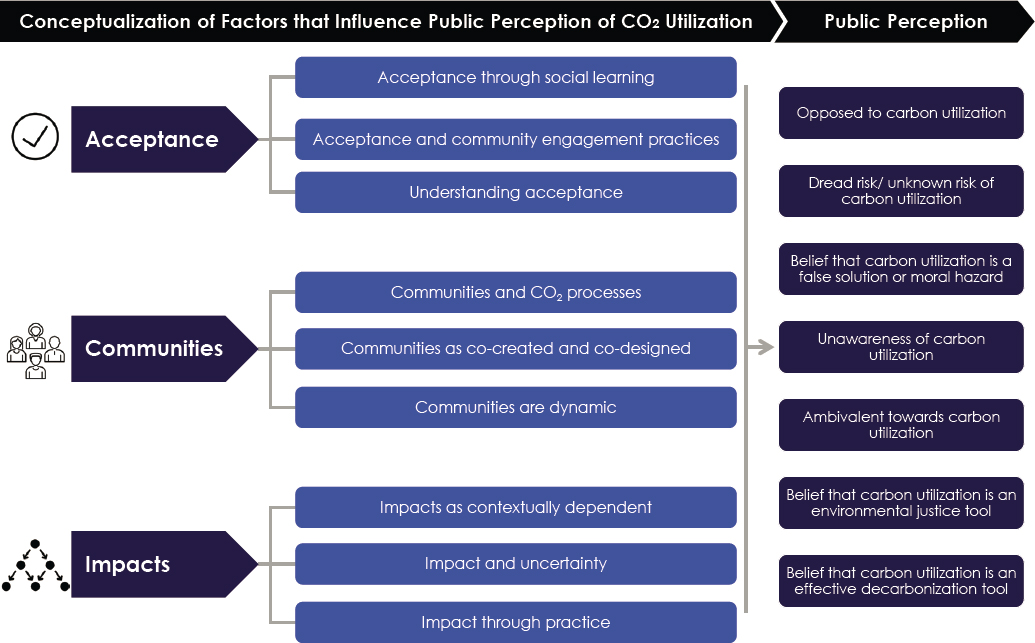
SOURCES: Modified from Nielsen et al. (2022), https://doi.org/10.1371/journal.pone.0272409. CC BY 4.0. Icons from the Noun Project, https://thenounproject.com. CC BY 3.0.
formulate informed decisions and update their preferences. However, the authors underscored that while people may update their preferences when presented with new, technically correct, comprehensible, and timely information, public perception is typically formed based on heuristics derived from deeply ingrained social preferences (Offermann-van Heek et al. 2020). Hence, perceptions and public acceptance need to be assessed early in the development cycle of new technologies to learn which decisions can be modified by providing new information.
In contrast, Buttorff et al. (2020) assessed public opinion and attitudes toward carbon management, support for carbon mitigation policies and R&D for decarbonization, and the willingness to pay for energy and products derived from carbon management. The online survey–based study did not provide CCS-based context and found support for the adoption of carbon management and its incentivization through governmental action and policy changes (Buttorff et al. 2020). The study also found that respondents were willing to pay higher prices—to the extent they are considered affordable and without internalizing the full cost of low-carbon alternatives—when presented with information on how carbon management technologies would impact the price they pay for electricity and other products like low-carbon fuels. Another study surveyed likely voters in Wyoming, Texas, Louisiana, and Colorado and found that most respondents supported turning captured CO2 into long-lived materials and were more skeptical of permanent underground storage (National Wildlife Federation 2024).
Effective and meaningful public engagement can ensure that relevant information is shared with the public, beyond the communities impacted by projects, including “How are the benefits of CO2 utilization market demand distributed?” and “What are the potential negative impacts and burdens of CO2 utilization?” However, engagement practices and strategies have to be location-specific and consider the history of and identities that exist in a region.
Such engagement, especially through public awareness and education efforts, can help empower people with the right technical information and help them form heuristics for decision making on new technologies incentivized by public money (Chailleux 2019; Offermann-van Heek et al. 2020). Furthermore, building public support through larger community education will develop trust, accountability, and transparency between project designers and developers and the general public and potential host communities (Meckling et al 2022). Holistic public engagement approaches that recognize a larger social movement to advance equity and justice across sectors—such as housing, education, and health care—facilitate a truly just cross-society transition and are foundational to any strategy. (See Finding 4-8 and Recommendation 4-6.)
4.4.1.3 Engagement of Affected Communities and Project Consent
A lack of engagement with affected communities, in particular, may result in reluctance to adopt or rejection and opposition to new low-carbon technologies, especially if there are perceived high costs and negative social impacts (NASEM 2023b). Meaningful community engagement, especially in the project development period, can provide on-the-ground knowledge that can shape projects to meet community needs, respect the rights and boundaries of underserved populations within those communities, and retool procedures that might pose barriers to overburdened communities (WHEJAC 2022a). Recommendations around community engagement emphasize accountability of federal agencies and project developers to the community—promises need to be delivered on if they are made, and the better a developer or government entity can track the dissemination of benefits, the more enfranchised community members can be (BW Research Partnership and Climate Equity Initiative 2023; WHEJAC 2022a). These recommended practices will not ensure that a project is selected by a community; instead, they can support community and public engagement during the design and build-out of projects, as appropriate.19 (See Recommendation 4-7.)
Within meaningful community engagement, consent—a collective decision made by those being engaged with—has to be sought from and granted or withheld by a community based on the unique relationship between elected officials and representatives within each community (FAO et al. 2016). Collective consent can be subject to change upon receiving new information about the project and can be given or withheld in phases of the project while also giving the community rights to govern what occurs after the decision is made (FAO et al. 2016; IHRB 2022). In support of consent, successful community engagement processes are designed to collect and address feedback. The outcome of the feedback process, which needs to continue into the implementation phase of a project, can be defined by how well project managers incorporate community concerns and solutions into the agreement (FAO et al. 2016). Both consent-seeking actions and feedback processes need to be place-based and flexible to match the needs of a community.
While no comprehensive list of “best” practices for community engagement exists, below are high-level themes and principles for meaningful public engagement. These practices are not formal guidance but promising engagement strategies. Elements can be incorporated into existing efforts by developers with federal funding for CO2 utilization projects and can provide the foundation for future projects seeking to expand the sector.
- Avoid past mistakes. Historically, disenfranchised communities have been forced to live with the impacts of decisions made without their input. To move forward and create space for a dialogue around CO2 utilization infrastructure, mistakes of past energy and technology transitions need to be avoided, especially mistakes specific to a potential host community. NASEM (2023f) identified two categories of failed communication strategies: (1) the “engineer’s myth”—the idea that technical modifications can alter the risk calculation and change public attitudes to a technology’s deployment—which has not been shown to be true; and (2) a lack of understanding or information rather than a lack of public trust. Early and frequent
___________________
19 Note that engagement, with the public or communities, is not appropriate for early technology readiness level (TRL) due to the uncertainty about what the impact of a process or project will be, what and where a project will be, and who will be impacted. For lower-TRL projects (e.g., those with small amounts of funding or compressed timelines), community engagement opportunities may not be meaningful and may act as a barrier to the project. For higher-TRL projects (e.g., those with extensive timelines), community engagement opportunities can be additive to the process. See Chapter 3, Section 3.4.2 for more about uses of s-LCA at different TRLs.
- engagement facilitates communication between developers and communities through which project intent and community benefits can be discussed and negotiated (see Section 4.4.2.3.2). Awareness of factors that lead to poor public engagement and focused efforts to improve engagement center principles of recognitional and procedural justice, allowing new projects to avoid failures of the past.
- Build trust and maintain relationships. Trust is fundamental to any type of community-based project and is especially necessary for the deployment of emerging technologies. To build trust, developers can (1) avoid using scientists, engineers, regulators, and policy makers who aggressively support the technology when engaging with potential host communities; (2) compare new technology to what communities are familiar with to support individual judgments about whether scientific knowledge is trustworthy; and (3) avoid the parachute method, in which developers drop into communities for the express purpose of developing a project and then disappear once the project is complete (NASEM 2023f). Outsiders, whether developers or scholars, need to avoid approaching the community with predetermined solutions or methodologies, and instead co-create strategies with the community (Deaton 2022). Often, trust-building results from developing long-standing relationships with reliable actors within the community.
-
Center enfranchising frameworks. Communities can be reticent to engage during development processes because they are often met with an approach focused on what they lack—whether information, infrastructure, or democratic power. Two frameworks that instead seek to enfranchise communities are
- Asset-Based Community Development (ABCD). The ABCD framework builds on a community’s assets through mobilized action from community members and local institutions (CNT n.d.). Fundamentally, ABCD highlights that communities can drive development processes by responding to and creating economic opportunities at a local level (CNT n.d.).
- Free, Prior, and Informed Consent (FPIC). The FPIC framework is centered on the fact that all people have the right to self-determination (FAO et al. 2016). FPIC, often discussed in the context of development on Tribal lands, allows a group to give consent to a project (see Section 4.4.2.3.2). While the process does not guarantee consent, it allows a group to conduct its own independent, collective decision making with project information that is continually provided and discussed (FOA et al. 2016).
- Provide resources for engagement. Communities, especially underserved populations, often do not have the bandwidth to engage on every single development issue they may face, while also confronting barriers to participation such as insufficient housing, employment and familial responsibilities, clothing, and food (Donnelly et al. 2015). As such, providing honorariums, transportation to and from events, food or vouchers at events, and wrap-around services like childcare for participating in engagement, acknowledges that engagement strategies do not exist in a vacuum and encourages them to reflect the complexity of the larger cultural ecosystem in which the project is operating (Barnes and Schmitz 2016; Donnelly et al. 2015; Langness et al. 2023). Additionally, providing access to mapping products, data, or community science frameworks may increase their ability to engage (Kimmell et al. 2021).
- Employ various ownership models. While the entire carbon management sector may not lend itself to ownership models similar to community solar or neighborhood cooperatives, it is worth considering how to transform traditionally corporate capitalist systems into more community-centered models with direct benefits. For example, a model in which local stakeholders own most of the project and define expected collective benefits can be adapted to CO2 utilization projects.
- Transparent reporting and information sharing for meeting metrics. Working alongside the community to develop metrics and goals to measure progress can provide clear benchmarks for project accountability. This could involve convening project-specific community advisory committees to identify potential impacts; preparing documents to communicate findings with community members; and using clear language to support understanding at varied levels of knowledge and reading proficiency (EJ IWG and NEPA Committee 2016). Goals and metrics have to be consistently revisited to ensure that they are being met, with the ability for community input to update and inform those outcomes.
Figure 4-7 illustrates how the outlined themes and principles can be integrated into a standard project cycle: project identification, project formulation, project selection, project implementation, and project closure.

4.4.2 Environmental Justice Considerations
The mainstream environmental movement has historically neglected social justice and equity issues (DeLuca 2007). For example, critics assert that early work in the environmental movement had “little regard to underlying social inequalities that drive differential exposures to pollution and did not incorporate voices of people of color and the working classes in solving them” (Mohai et al. 2009, p. 3). Even as it attempts to prioritize discussion on and address racial inequality, the scholarly EJ movement has often neglected to highlight well-established social scientific theories of race and racism or focused on race and class as dividing lines without acknowledging the context from which they emerged (Park and Pellow 2004). There is still scholarly and practical debate about how both environmental and social justice movements can and should work together to achieve common goals. As the CO2 utilization sector expands and considers EJ in the creation of environmental and industrial policy, it is imperative to recognize that EJ is inextricably linked to racism, in addition to other socioeconomic factors that lead to the marginalization of communities and groups.
EJ does not just apply to the creation of new infrastructure; part of the consideration of the movement is repairing historic harm, which includes existing and historic infrastructure. One example is mine remediation efforts, which thus far largely have focused on the technical aspects of clean-up but have important political, social, and cultural implications in addition to environmental ones (Beckett and Keeling 2019). Similar parallels may exist in the context of coal waste utilization as a method to commercialize carbon-based goods while also cleaning up existing mines. The value chain that supports CO2 utilization processes will also undoubtedly include sites that represent historical burdens in certain communities. Principles of justice, both historical and forward-looking, need to be continually applied as the CO2 utilization sector builds out to strive toward EJ as an outcome. This section discusses how to operationalize foundational principles of EJ, how to measure EJ in projects, and EJ considerations for project selection and siting.
4.4.2.1 Operationalizing Foundational Principles of EJ
A defining moment in the EJ movement with significant relevance to infrastructure development was the creation of the 17 Principles of Environmental Justice at the 1991 National People of Color Environmental Leadership Summit. The goals for the principles include to build a national and international movement to fight the destruction of land and communities; to respect and celebrate cultures and beliefs about the natural world; and to promote economic alternatives that contribute to the development of environmentally safe livelihoods (Madison et al. 1992). These principles are still considered foundational in the climate movement and can be used as guidelines to evaluate specific projects (e.g., see O’Laughlin 2021). Given the substantial opportunity for developing CO2 utilization and the accompanying capture and removal infrastructure, the sector has to develop in the most just way possible, not only to bolster public acceptance but also to do good for the public. Table 4-2 describes how Principles 3, 5, 6, 7, 8, 11, and 16 can be incorporated into considerations for the emerging CO2 utilization sector. (See Finding 4-9 and Recommendation 4-8.)
While the principles serve as a rubric through which communities can evaluate specific projects, the EJ movement has also served communities by enlarging the constituency through the incorporation of more disadvantaged communities; building community capacity through educational campaigns that draw direct connections between the EJ movement and the surrounding environment of many disadvantaged communities; and facilitating community empowerment through grassroots efforts (Faber and McCarthy 2001). These structures enfranchise communities as decision makers and reflect the nature of EJ as a dynamic movement, constantly pushing against antiquated and often exclusionary processes to ensure equity across all aspects of the project value chain.
4.4.2.2 Holistically Measuring EJ
Federal and state agencies designed and implemented policies and initiatives to advance EJ as early as 1994 (see Section 4.2.1.2.2). However, there is no standard way to measure elements of EJ or to locate communities impacted by environmental injustices. For example, CEQ’s new Climate and Economic Justice Screening Tool (CEJST; Version 1.0) is one of more than 30 EJ screening tools that exist across federal, state, and local agencies (Dean and Esling 2023).20 Assessment tools—such as CEJST and EPA’s EJScreen—can be beneficial for the process of deciding where infrastructure and retrofits are sited and can be used to track EJ outcomes (CEQ n.d.(b); DOE n.d.(d); EPA n.d.(a)). However, there are criticisms about how sufficiently these tools address certain factors, such as weighing race as a key demographic that indicates disproportionate impact or “disadvantaged” categorization (Sadasivam 2023; WHEJAC 2022b). Additionally, while environmental impact assessments are useful and integral to the siting process, they are better suited to address “potential harm and cumulative impacts of a proposed project, and supporting a decision to relocate, mitigate, or even stop a project” (Wang et al. 2023, p. 73). This results in the lack of ability to identify and address actual adverse outcomes of project and demonstrates that while these assessment tools have a place in the design and siting process, they alone are not comprehensive enough to be used without additional community considerations that often involve the history, racial makeup, and concentration of power in a community.21
While a lack of standardization makes quantitative measurement of EJ challenging, there exist foundational framings of holistic benefits that might flow into communities in response to direct investments in EJ-related projects. For example, Dr. Bunyan Bryant, a former University of Michigan School for Environment and Sustainability professor and noted EJ leader, stated that EJ is “supported by decent paying and safe jobs; quality schools and recreation; decent housing and adequate health care; democratic decision-making and personal empowerment; and communities free of violence, drugs, and poverty” (Bryant 1995, p. 6). Because communities are not monolithic, the specific benefits a community wants and experiences will differ from project to project. Federal agencies have recommended that programs work with stakeholders to define program and project benefits, specifically in the context of Justice40-covered programs (e.g., see WHEJAC 2021 and Young et al. 2021). These recommendations seek to avoid harm and maximize federal investments, including directing investments in geography and
___________________
20 For more information about how these screening tools intersect, see the Environmental Policy Innovation Center’s EJ Tools Map at https://epic-tech.shinyapps.io/ej-tools-beta, accessed August 5, 2024.
21 See Chapter 3 for more information about assessment tools.
TABLE 4-2 How to Operationalize the Principles of Environmental Justice in the CO2 Utilization Sector
| Principle | Description | Operationalization |
|---|---|---|
| 3. “Environmental Justice mandates the right to ethical, balanced, and responsible uses of land and renewable resources in the interest of a sustainable planet for humans and other living things.” | The most sustainable, climate-benefiting strategies can be applied across the carbon management value chain. This is especially crucial if infrastructure is located near overburdened communities. | Consider the long-term impact on the development of a circular economy, especially through meaningful consideration of the most appropriate uses of resources. |
| 5. “Environmental Justice affirms the fundamental right to political, economic, cultural, and environmental self-determination of all peoples.” | Community engagement, especially that of underserved populations, is an imperative factor and thus processes should be inclusive. And, as CO2 utilization remains novel, the education of stakeholders and decision makers is necessary. | Consider and prioritize self-determination of the community to create just precedents for infrastructure build out and informed understanding of CO2 utilization. |
| 6. “Environmental Justice demands the cessation of the production of all toxins hazardous wastes, and radioactive materials, and that all past and current producers be held strictly accountable to the people for detoxification and the containment at the point of production.” | Entities in the CO2 utilization sector that partner with fossil industry or infrastructure need to be aware that many EJ groups feel that reparative and recognitional justice are core to confronting the history of toxic industries to transform communities positively. | Strategize around waste products and pollutants that might arise from the creation of CO2-derived products or feedstocks, in addition to understanding the historical impact of certain industries on communities. |
| 7. “Environmental Justice demands the right to participate as equal partners at every level of decision making, including needs assessment, planning, implementation, enforcement, and evaluation.” | Communities feel their participation in all processes of development is necessary for a process to be considered just. Furthermore, engagement strategies will not be effective if only utilized at the beginning of a development process. | Consider ways to actively integrate community input and reflect that input through adaptations of a project plan throughout its lifetime. |
| 8. “Environmental Justice affirms the right of all workers to a safe and healthy work environment without being forced to choose between an unsafe livelihood and unemployment. It also affirms the right of those who work at home to be free from environmental hazards.” | The histories of industries have informed community desires to protect the health of the working class in these sectors, as well as prevent other environmental hazards from impacting the surrounding community. It is critical that working conditions in new infrastructure or businesses are conducive to healthy and safe work environments. | Ensure that workers and communities are provided with access to new job opportunities and related benefits of the sector, while prioritizing the health and well-being of the community and their employees. |
| 11. “Environmental Justice must recognize a special legal and natural relationship of Indigenous Nations to the U.S. government through treaties, agreements, compacts, and covenants affirming sovereignty and self-determination.” | The U.S. Indigenous community has its own relationship to the development of the energy industry, as well as sovereignty over its territories. Decision making and implementation processes need to acknowledge these relationships and authorities over respective territories. | Consider community approaches to decision making and implementation when engaging with Indigenous nations and communities that respect existing relationships with and authorities over respective territories. |
| 16. “Environmental Justice calls for the education of present and future generations which emphasizes social and environmental issues based on our experience and an appreciation of our diverse cultural perspectives.” | For communities to continually engage in project decision making and development it is imperative that education around technologies and their uses is accessible and further incorporates the values and perspectives of diverse groups and reflects a holistic historical perspective. | Consider education around CO2 utilization pathways and technologies and their deployment whether through academic institutions, community benefits plans, and/or apprenticeship opportunities that incorporates the lived experience of decision makers and their values. |
SOURCE: Based on data from Madison et al. (1992).
people, making indirect and direct investments in a community, and providing essential services to a community by external direct investments (WHEJAC 2021). Efforts to advance EJ can benefit from a core set of overarching benefit types from which projects can outline specific benefits to potential host communities.22 (See Finding 4-6 and Recommendation 4-5.)
___________________
22 For example, NASEM (2023b) recommended that federal legislation require the collection and reporting of standardized metrics for direct impacts on jobs, public health, and access to technologies and programs (see NASEM 2023a, Recommendation 2-1). For more about direct benefits from initiatives focused on equity and justice, see NASEM (2023a).
4.4.2.3 Considerations for Selecting Projects
When considering the role of EJ practices in societal and community acceptance of proposed projects, the mechanisms and processes producing inequities across various institutions, industries, and frameworks for deployment need to be evaluated, as do the interaction of rules, attitudes, and politics (Foster 1998). This section outlines factors that impact acceptance of projects, EJ considerations for resource consumption, and procedural justice in selection processes.
4.4.2.3.1 EJ Considerations for CO2 Utilization Resource Consumption
Avoiding adverse impacts of CO2 utilization infrastructure on communities requires consideration of the facilities’ resource consumption, especially for geographies where shared resources might be particularly scarce. The committee’s first report included discussion of the electricity, hydrogen, water, and energy storage needed to support CO2 utilization infrastructure (see NASEM 2023b, p. 96). While LCAs are adept at predicting resource consumption for a particular deployment scenario, the specific location where infrastructure might be sited also has to be studied during project design—for example, via an environmental impact assessment.23
Energy is one of the driving factors of GHG emissions and is therefore integral to the boundary considerations of the system (Terlouw et al. 2021). While the United States has advanced its commitments to deploy renewables, many underserved communities across the country still face substantial energy burdens and barriers to accessing zero-carbon energy infrastructure (DOE n.d.(c)). In these communities, energy justice—the goal of achieving equitable participation in the energy system while remediating the disproportionate social, economic, and health burdens of the current energy system—is integral for siting carbon management infrastructure, especially in cases where substantial energy requirements are necessary (DOE 2022b).24 In addition to the land used for electricity and fuel production itself, the environmental impacts from transporting and storing electricity and chemical feedstocks have to be considered when developing CO2 utilization projects. Similar to other renewable energy options (e.g., solar or wind), CO2 utilization is estimated to require a lot of land for facilities and transport infrastructure. For example, one study estimates that 68,000 miles of CO2 pipelines will be needed across the United States to meet the demand of a CO2 utilization sector (Larson et al. 2020; Thomley 2023b).25 While relying on a clean electricity grid can reduce the direct land transformation of a particular project, the externalities of this choice deserve acknowledgment, and co-locating electricity generation and storage facilities to minimize land use needs to be considered.
Water consumption for carbon management will vary across pathways, with biomass- and biochar-associated techniques typically resulting in intensive land use and water consumption (Rosa et al. 2021; Terlouw et al. 2021). Water as a resource has a long history in EJ communities, receiving more attention in recent years owing to events like the Flint, Michigan, water crisis, which led to contaminated drinking water and eroded trust of the local government, and the Jackson, Mississippi, water treatment facility failure, which left 150,00 residents without drinkable water (Denchak 2018; O’Neill 2023).26 Water is a highly scrutinized resource in many resource-scarce communities, with nearly 2.2 million Americans living in homes without running water or basic plumbing (O’Neill 2023).
For the carbon management sector, there are growing concerns about how the technologies will impact communities with scarce water resources. For example, the Central Valley—which has seen substantial oil, gas, and agricultural booms—is being considered for several DOE-funded DAC projects announced in fall 2023 (California Resources Corporation 2023). However, droughts in 2021 put “a massive strain on many households and farms in the area,” leading to losses of $1.7 billion and more than 14,000 jobs (Alonso and Ferrell 2023; DeLonge 2022) and creating competition for necessary resources like water and nonpolluted air (Cox 2020). Because recent analyses demonstrate that high water use hinders certain DAC approaches, trying to site facilities in drier regions is common (Küng et al. 2023). However, with existing burdens and competition of resources as a result of climate change in the Central Valley, any project development that could potentially increase resource insecurity in the region needs to be meaningfully considered (e.g., see Chemnick 2023b and Fernandez-Bou et al. 2023).
___________________
23 See Chapter 3 for more on LCAs and environmental impact assessments.
24 Although zero-carbon energy sources are favorable for carbon management infrastructure nationwide, these pathways come with their own resource costs on communities, such as the mining of critical minerals for lithium-ion batteries, or the potential air quality impacts resulting from the production of cement and steel needed for wind energy deployment (IEA 2021).
25 See Chapter 10 for more on pipeline development.
26 See also Tabuchi and Migliozzi (2023) for more about the impact fracking has made on water availability.
The committee’s first report identified that, while water requirements for CO2 utilization processes will not significantly increase water demand at a national level, local water impacts will vary based on geographical region (NASEM 2023b, Finding 4.14). Thus, DOE should work with its national laboratories to analyze the effect of CO2 utilization on local water demands and identify the regions where there are opportunities for water infrastructure to serve multiple projects while considering local and EJ impacts (NASEM 2023b, Recommendation 4.6).27 The committee still recommends that these analyses be conducted for CO2 utilization processes that require water, including waste mineralization, vacuum production, product rinsing, dilution, and distillation, and that the results are appropriately considered during the planning stage for CO2 utilization infrastructure.
4.4.2.3.2 Incorporating Procedural Justice in Project Selection
To address societal acceptance, several organizations outline engagement frameworks rooted in themes of justice and equity. For example, the Jemez Principles for Democratic Organizing feature agreements for organizing across diverse cultures, organizations, and politics (Solís 1997). These principles can help lay foundations for positive partnerships and engagement with communities that build trust and might, therefore, result in higher rates of acceptance of the CO2 utilization sector as it builds out. (See also the Just Transition Principles outlined by the Climate Justice Alliance 2019 and the Principles of Working Together adopted at the Second People of Color Environmental Leadership Summit [see Energy Justice Network n.d.].) Engagement processes with justice practices prioritized early can result in iterative learning processes and may prevent community rejection. However, if consent is not reached, the aspects of the project that the community rejects need to be identified and, where possible, updated and modified to address objections. Box 4-5 describes how a feedback process can be developed to approach a situation in which a community says “no.”
BOX 4-5
What Happens When a Community Says “No”?
The practice of EJ involves achieving environmental and socially just outcomes where there is development. It may be argued that neither of these outcomes can be achieved if the community is denied the right to refuse a “project deemed incompatible with their needs, even if a project comes with significant economic or labor benefits,” something with which preliminary polls of voters agree (Fraser 2023, p. 18). A community saying “no” to a particular project design has significant implications for developers to consider related to why exactly the community has refused the project. If a developer continues forward with a project despite community opposition—especially if the community is vulnerable owing to historic disenfranchisement—this action has the potential to set a negative tone for the carbon management and CO2 utilization sectors as they develop. Pushing a project forward despite community rejection may result in other unintended roadblocks, such as public outcry and even legal cases brought by the community, as demonstrated in this example:
When giant wind turbines were being planned on indigenous Saami reindeer herding lands in northern Sweden, the impacted communities argued that the project was in breach of Saami rights. In response, the Swedish government argued that renewable energy development had to be prioritised over the rights of the indigenous Saami. It is reported that the financier of the project, KfW IPEX-Bank, used the Swedish government’s statement to absolve itself of responsibility towards the Indigenous communities. The bank considered that Swedish law was sufficient to protect Saami rights. However, the Norwegian Supreme Court ruled that the wind project was illegal and it was to be discontinued. (IHRB 2022)
___________________
27 As noted in the committee’s first report, these analyses are being conducted for algal cultivation systems by Argonne National Laboratory, with support from DOE’s Bioenergy Technology Office and Office of Fossil Energy, and for different mineralization processes that take place under aqueous conditions. For more information about these analyses, see DOE-BETO (2021), Naraharisetti et al. (2017), and Xu et al. (2019).
Treating Tribal and underrepresented communities as “stakeholders” rather than “decision makers” or “rights-holders” who “[have] freedom and autonomy over their lives and their territories” can breed distrust between parties (IHRB 2022). When the government is also a primary decision maker, there may be times when a site is selected contrary to community desires. In this case, communities still need to be engaged throughout the process to ensure that their right to self-determination is preserved.
4.4.2.4 Just Practices for Permitting of CO2 Utilization Infrastructure
While widespread permitting gaps still exist and need to be prioritized for the development of the CO2 utilization sector, permitting may not result in the accountability communities seek from what is ultimately supposed to be a protective process. Permitting processes can be analyzed at both the federal and state level; some permitting will need federal guidance when infrastructure for carbon management, hydrogen, and utilization intersect with other sectors, with the understanding that states have significant knowledge of their own localities. Upon reviewing permitting processes for CO2 utilization in its first report, the committee recommended that these processes be coordinated by a single agency or entity that would also guide developers through the process of engaging with states and localities (NASEM 2023d, Recommendation 5.4).28 For technical information about CO2 utilization infrastructure, see Chapter 10.
To advance community voice in a permitting process, developers can share examples of the expected, place-based impact the CO2 infrastructure might have and allow time for community members to ask questions and express their concerns related to the information provided. The incorporation of just practices is a critical part of permitting, as these permits can ultimately determine impactful outcomes (Guana 2015). For example, employing the pillars of procedural justice—neutrality, respect, voice, and trustworthiness—can ensure that all necessary parties are respected and heard throughout the permitting process (Yale Law School n.d.). Procedural justice strategies in infrastructure planning, however, do not guarantee community endorsement or acceptance. NASEM (2023e) identified key siting features that could reduce conflict and delays in the permitting process and highlighted the necessary inclusion of stakeholders that otherwise would not be included in the process, the need to elevate Indigenous knowledge, and requirements for following federal guidance memos.29 Ultimately, for communities to build further trust with permitting entities, there has to be evidence of fair and equitably distributed outcomes alongside the integration of community perspective throughout the permitting process and its ongoing reassessment.
4.4.2.4.1 New and Existing Industrial Facilities
The procurement of CO2 is a good starting point when considering how to center justice practices in the CO2 utilization value chain. There are two categories in which this infrastructure can be placed: (1) existing infrastructure, such as industrial facilities that produce CO2 as a by-product, and (2) new infrastructure, such as the DAC and hydrogen (H2) hubs that, respectively, will remove atmospheric CO2 or capture CO2 from natural gas-based H2 production. While existing infrastructure still has opportunities to address long-standing EJ issues in the surrounding community and employ reparative and restorative justice principles, new infrastructure should be considered carefully throughout the design and project development stages to address community concerns and needs.
Existing facilities.
Studies have linked historical racist policies and practices to the fact that sources of air pollution are disproportionately located in and adversely impact communities of color (Bravo et al. 2016; Cushing et al. 2023; Lane et al. 2022; Liu et al. 2021; Ringquist 2005; Rothstein 2017; Tessum et al. 2019; Woodruff et al. 2023). In particular, racial zoning, redlining, and segregation have isolated racial and ethnic minorities within built environments with inadequate physical infrastructure (e.g., stormwater drainage, green space, and energy systems)
___________________
28 For more information, see Section 5.2.1 through Section 5.2.3 in NASEM (2023d).
29 Appendix G describes key features of effective siting and permitting processes from scholars and practitioners as outlined in NASEM (2023e).
(Bullard 2020; Hendricks and Van Zandt 2021) or near hazardous industrial facilities (Agyeman et al. 2002; GAO 1983; James et al. 2012; Linder et al. 2008; Mohai et al. 2009). These patterns of environmental injustice were “shaped by power and privilege” and created “areas of both prosperity and disadvantage” (Hendricks and Van Zandt 2021, p. 1). These historic inequities have laid the foundation for the industrial sector that persists to this day.
While an existing industrial facility’s location will not necessarily be revisited, retrofitting the facility with new technology can strive to incorporate EJ and democratic community organizing principles. An important first step is for the developers and advocates to familiarize themselves with the historical experience of the most disenfranchised in the immediately impacted community. Then, restorative justice can be considered; before new work can begin at an existing site where harm has taken place, especially if that harm is generational, the actors that have perpetuated harm accept responsibility and act to repair the harm done while reducing the likelihood of creating new injustices (Hazrati and Heffron 2021). Beyond just capturing CO2 from the facility, additional infrastructure in these locations can seek to alleviate existing burdens in the community where possible. For example, new infrastructure can pursue pollution reduction and include provisions for people’s science to conduct data MRV for the outcomes of retrofits.
New facilities.
While new developments featuring emerging technologies benefit from widespread site selection, they also face similar public acceptance challenges to other climate-mitigation technologies.30 In the case of DOE’s hub programs, developers are often encouraged to look at or partner with Opportunity Zones—economically distressed areas of the United States—with the goal of “[spurring] economic growth and job creation in low-income communities while providing tax benefits to investors” (IRS n.d.). While siting of new CO2-based infrastructure in Opportunity Zones may bring positive economic impacts, the fact that these communities are already economically depressed or overburdened indicates the presence of disenfranchised groups and potential structural inequities. Advocates and developers will need to center community history and EJ practices in site selection for hubs. The process of designing hubs is intricate and complex owing to the variety of potential industries, actors, and build-out involved, and could benefit from ongoing studies around social understanding and acceptance (Gough and Mander 2022; Upham et al. 2022). General pros and cons of clustered siting that could apply to DAC, H2, or CO2 facilities are listed in Table 4-3. See Chapter 10 for more discussion of infrastructure co-location.
TABLE 4-3 Pros and Cons of New Clustered Siting
| Pros | Cons |
|---|---|
|
|
SOURCES: Based on data from Gough and Mander (2022), Sovacool et al. (2023), and Upham et al. (2022).
___________________
30 For example, see NASEM (2022) for a summary of the societal challenges facing advanced nuclear.
New infrastructure does not necessarily connote good infrastructure. Practices that do not address the social and spatial impacts that remain within communities that have experienced adverse and extractive industry or infrastructure risk reproducing harms (Heck 2021). For example, in 2011, a St. Louis utility negotiated with EPA to reduce the cost of a redevelopment project for the St. Louis wastewater infrastructure. This negotiation resulted in a $1.3 million decrease in the project’s cost by eliminating the need to improve existing infrastructure, which resulted in a lack of benefits to marginalized communities directly impacted by failing sewer and stormwater infrastructure (Heck 2021). The siting of new infrastructure, especially on the scale of hubs, which will cross state lines and impact a variety of geographies, has to be considered in the context of “a progressive lens that views physical infrastructure as an extension of social circumstances,” thus reflecting historically racialized frameworks and policies that target disenfranchised groups (Hendricks and Van Zandt 2021, p. 1).
An example of a progressive lens is the social construction of technology framework, which states that technology and society are mutually constructed together (Bijker and Law 1994). This framework identifies the complex nature of projects in which the relevant social groups have different ideas about what a technology does; therefore, a project’s negotiation will have to acknowledge different technological frames—the goals, theories, and solutions that capture the interactions between social groups and the unique ideas about a proposed technology or project—before coming to consensus about a project (Sovacool et al. 2023). The complex relationship between social groups, technological frames, technology, solutions, and risks within a social construction of technology framework (see Figure 4-8) highlights that the design and implementation of net-zero megaprojects, such as CCUS hubs, have economic, political, and socioenvironmental dimensions that need to be identified and addressed throughout the project’s life cycle.

NOTES: The arrows depict how the social groups (shown in blue) interact with frames (shown in red) which also shape both technology (shown in black) and relevant solutions provided by technology (shown in green). The technologies in turn respond to or are impeded by risks (shown in purple).
SOURCE: Based on Sovacool et al. (2023), https://doi.org/10.1016/j.techfore.2023.122332. CC BY 4.0.
4.4.2.4.2 Pipelines
Pipelines are a critical part of energy infrastructure development and have controversial perceptions among the public, especially related to oil and gas development in the United States owing to the potential localized environmental and social impacts (e.g., land transformation and safety risks) (Jensen 2017). Responses to pipelines are often a result of factors such as technology (e.g., risks and benefits), process, place (e.g., physical infrastructure), and people (Boudet 2019; Janzwood 2023; see also Figure 4-5). Given that overburdened and disenfranchised communities are often impacted by harmful infrastructure, the intersection between pipeline infrastructure and environmental injustice has to be analyzed. The connection between pipelines and autonomy is especially pertinent in the case of Indigenous nations and communities who are vulnerable to and have limited capacity to mitigate pipeline-related incidents (Datta and Hurlbert 2020).
Concerns around pipelines—whether transporting oil, natural gas, or CO2—remain the same: impact on community resources (e.g., water and air); protection of culturally valuable sites (e.g., prayer and grave sites); impact on public and environmental safety and health; and adequate approval from local groups (Strube et al. 2021). The cancellation of the Mackenzie Valley Pipeline after the Berger Inquiry in 1974 is a notable example that voiced the concerns of Indigenous tribes. The proposed pipeline would have brought Canadian natural gas to U.S. markets, but a comprehensive social, environmental, and economic assessment recommended that no pipelines should be built in the Northern Yukon region inhabited by Tribes. More recently, Indigenous Tribes in the United States protested the Keystone XL and Dakota Access pipelines (Suls 2017). In the case of Dakota Access, protesters stated that the U.S. Army Corps of Engineers had failed to adequately consult Tribe members before approving the pipeline and had violated the National Historic Preservation Act (Herscher 2017).31 The general public reticence around CO2 pipelines is markedly similar. The cancellation of a 1300-mile CO2 pipeline across five Midwestern states in October 2023 was the outcome of public opposition and citations of a lack of certainty in the regulatory and permitting processes (Phillips 2023). Another Iowa-based CO2 pipeline project faces delays from comparable opposition and an unclear and difficult regulatory process (Tomich et al. 2023).32 There is also the overarching sentiment that pipelines are a part of the infrastructure that furthers the lifetime of fossil-based industries (e.g., see Earthjustice 2021).
Public health and safety are also important considerations when it comes to pipeline siting and practices. Public attention was drawn to safety and regulation of CO2 pipelines in February 2020 when a pipeline carrying CO2 and other chemicals ruptured in Satartia, Mississippi. While the failure was a consequence of natural force damage and did not result in any fatalities, the inadequate response by the pipeline operator led to an evacuation of 200 people and 45 hospitalizations. This event eroded public trust in CO2 pipelines and raised concerns about the safety and regulatory capabilities of the Pipeline and Hazardous Materials Safety Association (PHMSA). PHMSA’s official failure investigation report pointed to technical shortcomings—such as the failure of pipeline owner Denbury’s atmospheric models for emergencies to consider the locality of incident—and critical problems with the response to the incident (DOT-PHMSA 2022). Specifically, “[l]ocal emergency responders were not informed by Denbury of the rupture and the nature of the unique safety risks of the CO2 pipeline” (DOT-PHMSA 2022, p. 2). Because emergency responders were not trained to handle CO2 leaks, mitigation measures were not sufficient to prevent hospitalizations. This incident prompted PHMSA to improve its pipeline and emergency regulations.
While pipeline safety is left up to federal regulators, there are opportunities to learn from the Satartia incident to encourage community engagement and education on pipeline safety protocols, including what to do in the event of a rupture. Resources and funding for emergency training are possible preventative measures that might create “awareness of nearby CO2 pipeline and pipeline facilities and what to do if a CO2 release occurs” (DOT-PHMSA 2022, p. 2). Box 4-6 outlines lessons learned in Indigenous–Canadian communities from pipeline spills. These strategies, which have been recommended for Canadian government and Indigenous community interaction, could
___________________
31 Following the May 2021 announcement that the pipeline would remain in operation, another environmental impact statement was court-ordered. The Army Corps of Engineers received 200,000 comments during the open comment period of the trial, which ended in March 2024 without the presentation of closing arguments (Dalrymple 2024; Streurer and Dalrymple 2024). A final decision is expected in late 2024.
32 See Chapter 10 for more information about these proposed CO2 pipelines and recommended solutions to overcome the barriers public sentiment creates.
BOX 4-6
Government Interaction with Underrepresented Communities in Pipeline Siting
Pipeline siting is an opportunity to prioritize culturally relevant knowledge and practices to develop community-based solutions—a strategy that is often not employed. Effective processes for developing community-based solutions center a community’s worldview and consider their preferred research methodologies and frameworks (Datta and Hurlbert 2020). When addressing community concerns around resources and culturally significant sites, tools that seek to model a variety of scenarios while weighing both social and environmental impacts can be useful, especially when combined with a robust and transparent community procedural process (Shih et al. 2022). The development of community-based solutions requires robust community engagement. Recommendations for government interaction with Indigenous communities as developed by Datta and Hurlbert (2020) are listed below and can be applied to developer interactions with U.S. communities:
- Support community-based participatory action research. Community-led research initiatives can provide understanding of community perspectives from within and allow communities to invest in frameworks that support interventions relevant to the community while staying up to date with new science and protocols as they emerge. The outcome of community-led research can bridge gaps between outside advocates like scholars or nongovernmental organizations and the communities with whom they are working.
- Develop a database. Access to information is paramount for communities to advocate for themselves and understand the impacts of infrastructure on their health and resources, while further informing government agencies and other stakeholders.
- Consider community perspectives. To build projects in a community, the perspective of community groups needs to be centered and developed around the issues that impact them.
- Provide funding. It is critical to provide communities with resources to act in times of crisis, perform their own analyses and science, create action-based solutions, and educate the community before an emergency occurs.
- Develop community-led programs. Internal programs can work to maintain databases, perform outreach and education, report issues, and implement strategies to find and deploy effective community-centered solutions.
be a valuable addition to U.S. siting processes to ensure the incorporation of community perspectives in remedying pipeline hazards and developing pipeline safety plans. CO2 pipeline safety is discussed further in Chapter 10.
Federal review procedures conducted under the National Historic Preservation Act (NHPA) and the NEPA have been criticized for failing to adequately advance EJ or result in environmentally just outcomes, despite having EJ considerations built in. For example, there are concerns that the outcomes of the NHPA are based on the level of public engagement and thus will not ensure the preservation of culturally relevant or significant locations and that the NEPA has been implemented through guidance documents, not legally binding processes (Lockman 2023; Sassman 2021). Furthermore, these federal processes do not capture state-level nuances that need to be identified to achieve granular critiques of the siting and its impacts (e.g., the use of “Natural Resource for Public Purpose” or “Enhanced Oil Recovery for Public Purpose” in Idaho, Wyoming, and Colorado, or “Eminent Domain for Public Purpose” in North Dakota, Montana, or “Common Carriers” in Texas [Righetti 2017]).
Public transparency around pipeline protocols is imperative to ensure the health and safety of surrounding communities and increase their preparedness in the case of an incident. Models that evaluate technical, environmental, and social impacts can be used to expand accurate and transparent information about protocols. Studies have shown that “the optimal path is very sensitive to environmental and social impact considerations at even low weights, in that a small increase in pipeline length (and cost) significantly avoids large environmental and social impacts” (Shih et al. 2022, p. 1). With a procedurally just approach focusing on restorative principles, consensus
may be reached for the siting of a pipeline, especially if existing rights of way might be repurposed for CO2. However, consensus is not guaranteed just because certain practices are employed. Ultimately, when it comes to pipeline siting, developers need to consider the relationship of the pipeline to potential resources and culturally relevant sites. (See Finding 4-10 and Recommendation 4-9.)
The committee’s first report identified that special consideration is needed when selecting pipeline materials to ensure that appropriate mechanical properties are used to resist ductile and brittle propagating fractures (NASEM 2023b). The committee recommended, and still recommends, that DOE collaborate with national laboratories, university researchers, PHMSA (which is responsible for regulating liquid pipelines, including their design, construction, operation, corrosion control, and testing, maintenance, and reporting requirements), and industry to develop and test rigorous fluid-structure models (NASEM 2023b, Recommendation 4.3).
4.4.3 Just Economic Considerations
The CO2 utilization sector will have to consider how to equitably distribute economics in its planning. Otherwise, the potential capabilities for the nation’s workforce can become a missed opportunity, resulting in the loss of growth and productivity for the nation (Jacobs 2013). This section lays out how CO2-derived products contribute to a circular economy, what workforce considerations the sector needs to acknowledge, and how the economic benefits of the sector should be equitable distributed.
4.4.3.1 Product End Use and Contributing to a Circular Economy
Historically, underserved communities have hosted facilities that contribute to the linear economy, which is fundamentally based in extraction and waste, and then have been burdened with the climate impacts derived from these decisions (Berry et al. 2021; Schröder 2020). Aspects of these injustices can be addressed with a well-designed and inclusive circular economy (EPA n.d.(h)). Integral to creating a more just circular economy is considering the end-use impact of that CO2, in addition to the selection of which facilities go in what communities. For example, enhanced oil recovery, the primary current use of CO2 in industrial processes, is an economically useful and viable practice but does not create materials and products with a long lifetime, thus offering minimal contribution to a circular economy. See Chapter 2 for more about how CO2 utilization contributes to a circular economy.
Acceptance of CO2 utilization projects is likely to be determined by the level of trust that facilities will be run safely and the extent to which a project and its processes contribute to a more circular economy (Jones et al. 2017; Schröder 2020). Additionally, public acceptance will depend on policies and practices identifying the long-term consequences of the sector and how public investment aligns with the perceived rationale for CO2 utilization as it relates to climate mitigation strategies (Jones et al. 2017). As the transition to a circular economy is a response to climate change, further alignment of the CO2 utilization sector with goals the public understands is critical. These goals include sustainable practices that restore natural systems, design waste out, and choose biological or renewable materials over nonrenewable ones (Schröder 2020). Furthermore, a circular economy needs to include frameworks that incorporate principles of procedural and distributive justice for it to be just (Berry et al. 2021).
4.4.3.2 Workforce Considerations
Communities have shown particular concern that extractive industries and carbon management infrastructure will inflict ongoing harm on disenfranchised communities. Specifically, “concrete examples of environmental inequity leading directly to unequal health status can be found in occupational health literature and among . . . clinics which serve populations that include low wage workers and workers of color” (Friedman-Jiménez 1994, p. 605). To reform perceptions and experiences with the carbon management sector and set a more equitable tone for CO2 utilization, a breakdown of the jobs versus environment paradigm, which consistently pits the health and well-being of workers in potentially dangerous industrial jobs against their need for economic stability, needs to occur. This dichotomy has hindered the development of “efforts to build solidarity amongst local environmental justice goals on the one hand, and workers and union aspirations for secure, quality jobs on the other” (Evans and
Phelan 2016, p. 529). Providing workers with safe and healthy work environments needs to be prioritized in the build-out and siting of CO2 utilization projects.
An emerging CO2 utilization sector is also an opportunity to diversify the workforce, in terms of race and class, across the entire CO2 utilization value chain (Taylor 2011). Whether it is the skilled-labor force or positions that require higher education, there is room to further reflect the diversity of the U.S. population. The DOE Research Experience in Carbon Sequestration program, for example, promotes diversity and inclusion strategies like mentorship programs between program alumni and BIPOC graduates and early-career professionals, targeted recruitment strategies, intensive short courses, and internships (Cao and Tomski 2023). The intentional targeting of historically marginalized communities aims to overcome barriers to access to career pathways for unemployed adults, workers with low-wage jobs, and high-school-to-career transitions with significant data showing that “workforce development strategies can build pathways out of poverty” (Zabin 2020, p. 116). The inclusion of underserved and disenfranchised populations also can shape the future development of the CO2 utilization sector, encouraging an emphasis on a just economy moving forward.
Principles of developing a robust workforce that supports an inclusive economy include the following (Coleman 2023):
- Ground the workforce system. This requires both a more precise and a more expansive definition of individuals’ skills and needs based on the diverse needs of the population.
- Provide access to services and resources. To support adult learners who may face daily challenges that affect program participation and completion, workforce systems need to mitigate the personal and financial constraints that make training and education difficult to sustain.
- Coordinate cross-sector action. An effective workforce system—one that advances inclusive economic growth—engages with multiple institutions and sectors to meet the skill and transparency requirements necessary to produce economic mobility at scale.
While the CO2 utilization sector will vary by location, the preceding principles are important considerations for increasing access and cementing impactful workforce philosophies.
4.4.3.3 Working to Ensure Just Economic Outcomes
The distribution of infrastructure, benefits, and resources that come from building out the sector is another important consideration when selecting projects, especially given the U.S. history of toxic infrastructure disproportionately impacting underrepresented communities. Frameworks of distributive justice, a key principle of EJ, acting in cohesion with recognitional and procedural justice, have to be incorporated into processes that identify potential costs and benefits of proposed projects.
Increasing opportunities exist for businesses to incorporate social justice principles into their dealings, including through community benefits from the development and build-out of the CO2 utilization sector, which can include jobs and educational opportunities, preservation of natural resources, contributions to local trust funds, guarantees to pay workers local living wages, and reduction of toxic pollutants. Two types of community benefit frameworks that can be part of project negotiations are community benefits agreements (CBAs), which provide a transparent way for community members to work with developers to determine clear benefits the project will bring the community, and project labor agreements (PLAs),33 which are agreements between a developer and relevant labor unions to set terms for labor requirements on a project (Fraser 2023). There is evidence to suggest that voters across party lines, and especially those of color, support the use of these agreements in project design in their communities. In particular, Fraser (2023) found that support for CBAs is highest for Latino (86 percent) and
___________________
33 For example, the Memorandum of Understanding between the United Association of Union Plumbers and Pipefitters and Texas-based carbon capture company CapturePoint Solutions LLC created direct-entry career and technical education pathways for high schoolers to train in pipeline, plumbing, and steam-fitting industries, including providing updated facilities and workshops, student transportation, and instructors (Contractor 2023).
Black (77 percent) voters.34 These plans, when designed through a collaborative framework that is legally binding and adaptable, can serve as a pulse check on a project and can support distributive justice and equitable outcomes.
Community benefits frameworks also offer up obligations meant to diversify the value chain of a project, which can create and solidify inroads for underrepresented groups. For example, a small business developing partnerships with underserved groups might find it particularly beneficial to negotiate a PLA to ensure equitable access to employment opportunities. Additionally, as a start-up begins to develop its initial relationships across the supply chain, choices regarding company principles and workforce decisions have the potential to diversify the CO2 utilization supply chain and increase small business participation. However, the rights of people and communities need to be recognized and protected during a project’s selection process. Important considerations around these rights and just cross-sectoral distribution include “How are marginalized circular economy views and narratives, knowledge and values recognized and integrated into dominant narratives? How can competing development interests be resolved through participatory processes? And which institutions can guarantee recognition and protection of rights during the transition processes?” (Schröder 2020, p. 14).
The distributive implications of the CO2 utilization sector go beyond the U.S. domestic context, as the sector is globally connected across extensive supply chains. Sectors like textiles, chemicals, and waste management and recycling—in which CO2 utilization could play a key role as it develops—are intertwined globally. Holistic approaches and multistakeholder collaboration are required to create “decent, high value work throughout the value chain and with a focus on vulnerable communities and regions” affected by the transition to a more circular economy (Smith 2017, p. 18). Therefore, consideration of impacts from CO2 utilization will have a global element, of which the rights of countries and cultures will need to be protected.
4.5 CONCLUSIONS
The right combination of policy, regulatory, and engagement frameworks can supplement existing opportunities for the CO2 utilization sector to be economically viable and sustainable and to contribute to a circular economy. This chapter reviewed existing policy and regulatory mechanisms for the CO2 utilization sector. Passage of congressional legislation such as the IIJA and the IRA provided economic and noneconomic incentives to build out this sector. The IIJA alone appropriates about $20 billion to support R&D and commercialization for carbon management technologies, including CO2 utilization. Additionally, federal- and state-level efforts to incorporate EJ goals into policy can ensure that communities receive the public health (e.g., Justice40) and workforce benefits that may stem from investment in carbon management. In addition to developing more robust and adaptable policy mechanisms through which to incorporate EJ, opportunities also exist to develop more demand-side policy for CO2-derived products.
Because discovering, developing, and commercializing CO2 utilization processes and CO2-derived products will be necessary as the nation transitions to a net-zero economy, integrating business development opportunities into the expansion of the CO2 utilization sector is critical. The chapter identified key areas where policy can continue to support businesses—including small businesses—pursuing CO2 utilization. Additionally, programs that support partnerships among businesses, customers, and national laboratories will advance the market for CO2-derived products during R&D and commercialization phases. At the federal level, existing R&D programs, such as the GAIN Program and the Voucher Program, can serve as models for CO2-utilization-specific programs. Such a CO2-utilization-specific program could be especially beneficial for small businesses trying to find their niche in the emerging CO2 utilization sector.
The chapter identified an opportunity for project developers to address the lack of public awareness of CO2 utilization through public engagement and education practices that include meaningful engagement with impacted communities, which can provide substantial guidance on how to invest in communities holistically, regardless of
___________________
34 Columbia University’s Sabin Center for Climate Change Law compiled a database of publicly available CBAs and released a report with best practices for developing and implementing CBAs (Columbia University Sabin Center n.d.). Additionally, there is a wealth of scholarly literature around the efficacy of CBAs as a positive tool when implemented thoughtfully and as a drawback when actual community views are not reflected (e.g., see Been 2010; De Barbieri 2016; Fraser 2022, 2023; Marantz 2015; Wolf-Powers 2010).
infrastructure type (see Figure 4-7). The nascency of the CO2 utilization sector means that EJ principles can be meaningfully considered and appropriately incorporated into sector project and workforce development, as well as policy. Specifically, consideration of the 3rd, 5th, 6th, 7th, 8th, 11th, and 16th Principles of Environmental Justice can help ensure that the CO2 sector advances ethical and responsible uses of land and renewable resources; ensures all communities the right to self-determination; ameliorates waste products and potential pollutants; actively integrates community input into project design; provides workers and communities with access to new job opportunities and related benefits; incorporates community approaches into decision making and implementation; and provides education opportunities emphasizing social perspectives and histories on environmental issues. Furthermore, through the consideration of just economic outcomes, the emerging CO2 utilization sector can advance equitable access to the circular economy, new jobs associated with the emerging sector, and direct benefits to communities from projects.
This section enumerates the findings and recommendations related to the policy and regulatory frameworks needed for economically viable and sustainable CO2 utilization and concludes with the research agenda item associated with this chapter.
4.5.1 Findings and Recommendations
Finding 4-1: Demand incentives—Various supply-side economic incentives support carbon utilization, in contrast to minimal demand-side policy incentives. Multiple approaches to lower the carbon intensity (CI) of purchased commodities have been shown to be more cost effective than manufacture of CO2-derived products, given the current levels of decarbonization required by corporate goals in the private and public sectors. Adopting low-CI products produced from captured CO2 can support private and public sector decarbonization goals and also support the development of a CO2 market, especially as decarbonization targets become more stringent. Without the simultaneous incentivization of the demand for CO2-derived products or the imposition of low CI requirements for new products, CO2-derived products will remain costly compared to incumbents.
Recommendation 4-1: Targeted procurement standards—The General Services Administration (GSA) should implement and provide guidance to state and local procurement offices to ensure that programs are designed to motivate CO2-derived product demand. The GSA guidance should outline the benefits of procurement programs that either set product quotas or set a scoring system based on the prevalence of products procured through CO2 utilization processes, taking into consideration locally relevant conditions as appropriate, for state and local offices to consider. At least in the short term, these products may have higher costs and potentially higher carbon intensity (CI) than non-CO2derived products, but demonstrations are critical to obtain the necessary learnings to drive down costs through scaling. If the products continue to have higher CI, then a progressive CI target per carbon utilized that rachets down over time should be considered.
Finding 4-2: Workforce development—The workforce needed to support carbon utilization will be small in comparison with that for other clean energy jobs, but there are not enough employees in the upstream labor force to support the infrastructure build-out that investors seek to fund. To support the expansion of a market for CO2derived products, a sustainable workforce is needed for upstream labor for the deployment and maintenance of CO2 utilization facilities and technologies. Creating this workforce will require innovative approaches to make the labor force appealing and competitive to prospective employees. The development of a CO2 utilization workforce can use the existing oil and gas workforce that has transferable professional, technical, and labor skill sets, including project management, business development, pipeline construction, and manufacturing. The CO2 utilization sector can develop a diverse workforce by building on the awareness that opportunities in oil and gas are declining, offering more training focused on developing and using translatable skills that evolve with the industry, and ensuring emerging workforce opportunities are accessible to all.
Finding 4-3: Co-benefits—Preventing emissions of greenhouse gases and short-lived climate pollutants, including carbon dioxide, black carbon, and methane, is expected to have positive impacts on human and public health,
especially in communities and regions most adversely impacted by harmful emissions and air pollutants. Assessing and communicating the expected health impacts of carbon management technologies and developments will help inform project developers and potential host communities about what can be achieved and, in turn, will better inform decisions made during project selection and program implementation.
Recommendation 4-2: Disclosure of health impacts—The Department of Energy (DOE) should require the use of the U.S. Environmental Protection Agency’s Co-Benefits Risk Assessment Health Impacts Screening and Mapping Tool (COBRA) to analyze and communicate the projected health impacts of carbon capture, utilization, and sequestration technologies for DOE projects. The specificity of COBRA’s estimates will ensure that the maximum health benefits are achieved when siting and selecting carbon management projects.
Finding 4-4: Policy drivers—The main policy mechanisms for the CO2 utilization sector are tax credits, permitting and regulatory frameworks, and large omnibus legislation. These mechanisms largely incentivize the supply of CO2-utilization-derived materials and products and are difficult to modify as market conditions change. Both supply- and demand-side mechanisms need to be applied simultaneously to scale up CO2-derived products in a timely fashion and achieve meaningful market share. The absence of durable and adaptable policy serves as a barrier to successful market and infrastructure development for the CO2 utilization sector, because there is no clear and consistent direction for carbon management, which hinders the investment in CO2 utilization infrastructure or markets and the adoption of CO2 utilization technologies. The novel task of developing a circular economy at the scale required to meet the nation’s net-zero targets creates the opportunity to implement innovative policy that is flexible to meet targets and adaptable to course correct when relevant.
Recommendation 4-3: Policy flexibility—Congress and federal agencies that work on carbon management (e.g., the Department of Energy and the U.S. Environmental Protection Agency) should include a variety of directionally consistent policy mechanisms to support ongoing research, development, demonstration, and deployment; allow flexibility for updating and changing information used to shape incentives based on evolving market conditions; and develop financial mechanism alternatives to corporate tax credits to support adaptive policy development. These federal-level mechanisms should be further flexible to state- and local-level conditions for carbon management infrastructure to support decarbonization and/or economic development goals and enable a stable utilization market.
Finding 4-5: Emerging business support—There is an opportunity to diversify supply chains and types of small businesses that participate across the carbon management value chain as the market for CO2-derived products is created. Support through policy mechanisms or incentives for local, and veteran-, woman-, or minority-owned companies and start-ups to participate will allow new CO2 utilization opportunities to be more accessible than incumbent industries. Co-piloting and demonstration partnerships between key upstream and downstream partners of CO2 utilization will help prove the commercialization of emerging businesses of any kind. However, there is a lack of programs that connect emerging CO2 utilization businesses with the facilities and technologies needed to upscale.
Recommendation 4-4: Small business support—The General Services Administration, in collaboration with the Department of Energy (DOE), should develop opportunities for small businesses to upscale, modeled on the Gateway for Accelerated Innovation in Nuclear (GAIN) program run by the DOE national laboratories and DOE’s Voucher Program for energy technologies, to better support small businesses entering this field. The key components that should be adopted include:
- From the GAIN program: Access to testing capabilities; use of demonstration facilities; and connection to experts in material science, licensing, and finance. Like the GAIN program, a voucher program should be established to fund time and effort for the national laboratories to work with businesses. Vouchers for laboratory time and effort should be awarded on a competitive basis with meaningful consideration of how applicants can diversify the supply chain.
- From the Voucher Program: Predemonstration support to address key adoption risk areas; performance validation and certification support; commercialization support to access market research and business plan strategy assistance or to access independent monitoring, reporting, and verification technologies and practices. This support will enable small businesses to access information from subject-matter experts and opportunities through testing facilities that drive their businesses to the next level.
Finding 4-6: Host community impacts—The distribution of costs, benefits, and resources that stem from infrastructure need to be communicated to and considered by potential host communities of CO2 utilization infrastructure projects. Meaningful engagement and communication between a project’s developers and potential host community members is required to determine what aspects are considered costs or benefits. To supplement community engagement, assessment frameworks that quantify societal impacts—such as social life cycle assessments—can be used to communicate the societal benefits and risks of a project’s role in climate mitigation to the public. The combination of engagement and assessment can address barriers to public understanding of the emerging CO2 utilization sector.
Recommendation 4-5: Community impact tracking—The Department of Energy’s (DOE’s) Office of Energy Justice and Equity should work in partnership with community-centered councils and agencies like the White House Environmental Justice Advisory Council to develop robust pathways for defining, tracking, and measuring impacts of CO2 utilization projects and infrastructure to determine whether and how those impacts are being equitably distributed, while communicating expected outcomes to communities. These pathways should be incorporated into community benefit and project labor agreements and plans as relevant. If the impacts are determined to be benefits by the community, DOE should work on developing a framework to track how these project benefits also meet environmental justice metrics (e.g., taking into account the guidance issued by Office of Management of Budget on Justice40 implementation).
Finding 4-7: Community education—There is limited public knowledge about CO2 utilization compared with other technologies that will support a net-zero economy. Most of what the public understands is centered around limited familiarity with carbon management technologies, including opposition following similar concerns about other emerging technologies like hydrogen (now) and nuclear (decades ago). These concerns include how a project will impact everyday life in a community and if the required regulatory systems are effective and competent. Communities and consumers want to see connections between the contributions of CO2 utilization infrastructure and its products and climate mitigation, proving that the technology investment is yielding worthwhile results while prioritizing processes that value public engagement. Additionally, because the narrative around CO2 utilization is nascent, there are opportunities to confront justice-related challenges and shape a positive narrative by employing justice-centered practices.
Recommendation 4-6: Educational material development—Nongovernmental organizations and research-conducting entities—such as national laboratories, think tanks, and universities—should identify gaps in knowledge, sharing their data and findings about societal acceptance of or opposition to the CO2 utilization sector through the following actions:
- Nongovernmental organizations (including universities) and national laboratories should conduct targeted research to develop transparent resources to communicate findings and support improved education related to the direct impact of the CO2 utilization sector on climate change mitigation.
- Research-conducting entities should continue to conduct social analyses to determine what consumers and communities think about the CO2 utilization sector, both in relation to and separate from the carbon management value chain, filling the gaps in knowledge about societal acceptance and potential opposition, to better understand and address the concerns of the public. These data and conclusions of this research should be shared through a centralized and broadly accessible framework.
- Research-conducting entities should use analyses that combine techno-economic and life cycle assessment objectives to determine a levelized cost of CO2 abatement to be used to assess the desirability of projects as a function of CO2 source (fossil or biogenic point source, direct air capture, or direct ocean capture) and product durability. The results of these analyses and assessments should be communicated to the Department of Energy and other entities funding carbon utilization projects to inform them of factors that can influence community acceptance of projects and expected outcomes.
Finding 4-8: Public acceptance—To best support and fit into a circular economy, the CO2 utilization sector faces and must overcome barriers to public acceptance. Holistic approaches to public and community engagement that acknowledge the intersection of identities and priorities within a community and recognize environmental justice as a facet of a larger social movement facilitate a just, cross-society transition to a circular economy. In particular, meaningful engagement across the value chain can include opportunities for public education about the benefits and risks of the sector, diversifying the sector’s workforce and business types (e.g., small versus start-up versus private business), incorporating labor and community benefits agreements into project design, and consent-based siting and selecting practices. The application of these practices will be diverse, based on differences in project scale and scope, impacted and engaged community, and context within the project cycle.
Recommendation 4-7: Meaningful community engagement—The Department of Energy (DOE) should prioritize projects that can prove that meaningful community engagement frameworks were incorporated into their decision-making processes, as appropriate for the technology readiness level of the project. Additionally, to support DOE’s efforts:
- Private project designers that conduct life cycle assessments should communicate their findings transparently with community advocates as a part of planning and design processes. This protocol will ensure that a community is made aware of risks to shared resources such as energy, land, and water, and that any barriers are assessed before the project is selected so that place-based solutions can be developed.
- Project designers and funders, in both the public and private sector, should maintain transparency when co-developing projects and reporting emergency protocols to a community. This will ensure that public health and safety are prioritized during siting and emergency response processes. If the site includes infrastructure that might have potential safety impacts, developers should fund community engagement specifically targeting first responders to equip them with the necessary understanding of safety protocols in the event of an emergency.
- Project designers and funders, in both the public and private sector, should use diverse methods to incorporate community engagement into assessments to determine whether a project should move forward in a particular community. These methods include community benefits and project labor agreements (which are more robust if legally binding) and plans, and frameworks to employ elements of Free, Prior, and Informed Consent that incorporate vital community input into the decision-making process.
Finding 4-9: Environmental justice—It is critical for environmental justice considerations to be incorporated throughout the project process to ensure that the emerging CO2 utilization sector develops justly and does good for the public. Although project siting and selecting processes need to be place-based and adaptable to each community and project, a just utilization sector can rely on incorporating the Principles of Environmental Justice, adopted at the National People of Color Environmental Leadership Summit in 1991, into project design processes. Of the 17 principles, seven principles can be particularly useful as guidelines through which communities evaluate proposed carbon utilization projects: Principles 3, 5, 6, 7, 8, 11, and 16.
Recommendation 4-8: Principles of environmental justice—New CO2 utilization infrastructure development should apply justice principles and learn from other emerging technology pathways, while
seeking to deploy tangible benefits to surrounding communities beyond remediation of the climate, during the planning and design process. To support this, the Department of Energy should incorporate the Principles of Environmental Justice into the requirement for community benefit plans and the review of funding applications for CO2 utilization projects that require infrastructure development or changes. Specifically, the following principles should be incorporated to prioritize the just prior and ongoing development of the carbon utilization sector:
- Principle 3: Environmental Justice calls for the right to ethical, balanced, and responsible uses of land and renewable resources. Carbon management infrastructure, including for transport infrastructure to utilization facilities, should consider the most appropriate uses of energy, land, and related impacts through using this framework.
- Principle 5: Environmental Justice affirms the right to cultural, political, economic, and environmental self-determination of all. The self-determination of the community should be considered and prioritized by project planners and designers to create just precedents for infrastructure build-out.
- Principle 6: Environmental Justice calls for the end of hazardous wastes and radioactive materials production, while demanding past and current producers be held accountable to the public. The utilization sector should identify and plan to ameliorate waste products and potential pollutants from their facilities that might arise from the creation of CO2-derived products or feedstocks.
- Principle 7: Environmental Justice calls for the right to participate at every level of decision making as equal partners. The utilization sector should consider ways to actively integrate community input and reflect that input through adaptations of their project plans.
- Principle 8: Environmental Justice affirms the right of all workers to a safe and healthy work environment. The utilization sector should ensure that workers and communities are provided with access to new job opportunities, healthy working conditions, and related benefits of the sector.
- Principle 11: Environmental Justice must recognize a special legal and natural relationship of Indigenous nations to the U.S. government. The U.S. government should consider community approaches to decision making and implementation when engaging with Indigenous groups, as well as their authority over respective territories.
- Principle 16: Environmental Justice calls for the holistic education of present and future generations, including relevant social perspectives and histories on environmental issues. Prioritizing education through appropriate social lenses allows for the participation of underrepresented communities and supports the development of project frameworks that call for just outcomes.
Finding 4-10: Host community engagement as a part of project development—Project designers need to consider the benefits of available engagement models and select one that ensures just outcomes, including project co-benefits, for the potential host community. When addressing community concerns around resources and culturally significant sites, tools that seek to model a variety of scenarios while weighing both social and environmental impacts are critical for just planning and siting. However, processes dictated by the National Historic Preservation Act or the National Environmental Policy Act may not address appropriately state-level and hyper-local nuances, especially for projects that cross state boundaries. CO2 utilization developers can use lessons learned from infrastructure accidents (e.g., the 2020 pipeline rupture in Satartia, Mississippi) or failed siting processes (e.g., the terminated wind project in Sweden) to avoid past mistakes and apply successful models to CO2 utilization projects. Furthermore, legal frameworks, such as community benefits agreements or project labor agreements, have the potential to support transparent project development and provide direct workforce benefits to a community.
Recommendation 4-9: Using past experience to develop new projects—The Department of Energy should develop standards and guidelines for other federal projects to encourage the co-siting of infrastructure based on lessons learned from their direct air capture and hydrogen hubs. Furthermore, the lessons learned from these hubs should be made public. These exemplars can be used by the private
sector looking to develop clustered CO2 utilization infrastructure to ensure that specific considerations are made during siting processes and to minimize adverse impacts on communities. These considerations include the sharing of resources such as energy, land, and water; the development of pipelines; and synchronized construction periods.
4.5.2 Research Agenda for Policy and Regulatory Frameworks
The committee was tasked with (1) identifying and assessing the progress of technologies and approaches for carbon utilization that may play an important role in a circular carbon economy; (2) assessing and identifying gaps in research efforts to address barriers to commercialization of carbon utilization technologies; and (3) updating the 2019 National Academies’ report Gaseous Carbon Waste Streams Utilization: Status and Research Needs (NASEM 2019). Policy and regulatory considerations are considered enabling research items because they contribute to a net-zero future but are not research on CO2 utilization technologies or processes themselves; therefore, the research agenda item from this chapter contributes to task (2).
While about 80 percent of the U.S. public either does not know what CCUS technology is or cannot definitively recognize it, there are polarizing opinions about the carbon management sector (see Section 4.4.1.1). As the CO2 utilization sector emerges, there is an opportunity to invest in public engagement and education that contributes to an informed understanding of the technologies and the expected societal and environmental impacts of the processes. For example, there are opportunities to encourage public and community engagement and education around pipeline safety protocols through existing state-level initiatives. Table 4-4 describes the policy and regulatory
TABLE 4-4 Policy and Regulatory Frameworks Research Agenda
| Research, Development, and Demonstration Need | Funding Agencies or Other Actors | Basic, Applied, Demonstration, or Enabling | Research Area | Product Class | Long- or Short-Lived | Research Barrier Addressed | Source |
|---|---|---|---|---|---|---|---|
| 4-A. Knowledge gaps in public perception of carbon utilization technologies, and factors that influence community acceptance. | Nongovernmental organizations Universities National laboratories Other research-conducting entities Department of Energy | Enabling | Societal Impacts |
All | Long-lived Short-lived |
Environmental and societal considerations for CO2 and coal waste utilization technologies | Fin. 4-7 Rec. 4-6 |
Recommendation 4-6: Educational material development—Nongovernmental organizations and research-conducting entities—such as national laboratories, think tanks, and universities—should identify gaps in knowledge, sharing their data and findings about societal acceptance of or opposition to the CO2 utilization sector through the following actions:
|
|||||||
frameworks research agenda, including related research agenda recommendations. The table includes the relevant funding agencies or other actors; whether the need is basic research, applied research, technology demonstration, or enabling technologies and processes for CO2 utilization, the research theme that the research need falls into; the relevant research area and product class covered by the research need; whether the relevant products are long- or short-lived; and the source of the research need. The committee’s full research agenda can be found in Chapter 11.
4.6 REFERENCES
Aaker, D.A., and C. Moorman. 2017. Strategic Market Management. 11th Edition. John Wiley & Sons.
Agyeman, J., R.D. Bullard, and B. Evans. 2002. “Exploring the Nexus: Bringing Together Sustainability, Environmental Justice, and Equity.” Space and Polity 6(1):77–90. https://doi.org/10.1080/13562570220137907.
Ahn, D.P. 2019. Principles of Commodity Economics and Finance. The MIT Press.
Alonso, A., and J. Ferrell. 2023. “Carbon Removal in California: Striving Toward Environmental Justice in the Central Valley.” National Wildlife Federation: Environmental Justice (blog), November 2. https://blog.nwf.org/2023/11/carbon-removal-in-california.
Althoey, F., W.S. Ansari, M. Sufian, and A.F. Deifalla. 2023. “Advancements in Low-Carbon Concrete as a Construction Material for the Sustainable Built Environment.” Developments in the Built Environment 16(December):100284. https://doi.org/10.1016/j.dibe.2023.100284.
ANL (Argonne National Laboratory). n.d. “Small Business Resources.” https://www.anl.gov/partnerships/small-business-resources.
Ashley, S., G. Acs, S. Brown, M. Deich, G. MacDonald, D. Marron, R. Balu, et al. 2022. Scoring Federal Legislation for Equity: Definition, Framework, and Potential Application. Washington, DC: Urban Institute and PolicyLink. https://www.urban.org/sites/default/files/2022-06/Scoring%20Federal%20Legislation%20for%20Equity.pdf.
Associated General Contractors of America and Autodesk Cloud Construction. 2023. 2023 Workforce Survey Results: National Results. Associated General Contractors of America. https://www.agc.org/sites/default/files/Files/Communications/2023_Workforce_Survey_National_Final.pdf.
ASTM International. n.d. “Construction Standards.” https://www.astm.org/products-services/standards-and-publications/standards/construction-standards.html.
Barnes, M., and P. Schmitz. 2016. “Community Engagement Matters (Now More Than Ever).” Stanford Social Innovation Review 14(2):32–39. https://doi.org/10.48558/J83Z-0440.
Beckett, C., and A. Keeling. 2019. “Rethinking Remediation: Mine Reclamation, Environmental Justice, and Relations of Care.” Local Environment 24(3):216–230. https://doi.org/10.1080/13549839.2018.1557127.
Been, V. 2010. “Community Benefits Agreements: A New Local Government Tool or Another Variation on the Exactions Theme?” The University of Chicago Law Review 77(1):5–35. https://www.jstor.org/stable/40663024.
Bennett, J., R. Kammer, K. Eidno, M. Ford, S. Henao, N. Holwerda, E. Middleton, et al. 2023. “Carbon Capture Co-Benefits: Carbon Capture’s Role in Removing Pollutants and Reducing Health Impacts.” Great Plains Institute. https://carboncaptureready.betterenergy.org/carbon-capture-co-benefits.
Berry, B., B. Farber, F.C. Rios, M.A. Haedicke, S. Chakraborty, S.S. Lowden, M.M. Bilec, and C. Isenhour. 2021. “Just by Design: Exploring Justice as a Multidimensional Concept in US Circular Economy Discourse.” The International Journal of Justice and Sustainability 27(10–11):1225–1241. https://doi.org/10.1080/13549839.2021.1994535.
Bhide, P., and S. Sengupta. 2024. “Insuring the Net-Zero Transition: A Risk Management Strategy to Support Zurich North America’s Efforts to Accelerate the Adoption of Net-Zero Technologies.” University of Michigan School for Environment and Sustainability. https://dx.doi.org/10.7302/22618.
Bijker, W.E., and J. Law. 1992. “Shaping Technology/Building Society.” Bulletin of Science, Technology & Society 14(4):240–241. https://doi.org/10.1177/027046769401400468.
Biven, M.M., and L. Lindner. 2023. “The Future of Energy and Work in the United States: The American Oil and Gas Worker Survey.” True Transition. https://www.truetransition.org/_files/ugd/0ad80c_069ea867b3f044afba4dae2a1da8d737.pdf?index=true.
BLS (Bureau of Labor Statistics). 2024. “Table 1. Job Openings Levels and Rates by Industry and Region, Seasonally Adjusted.” In Economic News Release. https://www.bls.gov/news.release/jolts.t01.htm.
BLS. n.d. “Industries at a Glance: Oil and Gas Extraction: NAICS 211.” https://www.bls.gov/iag/tgs/iag211.htm.
Bose, S. 2023. “U.S. Sustainable Aviation Fuel Production Target Faces Cost, Margin Challenges.” Reuters, November 1. https://www.reuters.com/sustainability/us-sustainable-aviation-fuel-production-target-faces-cost-margin-challenges-2023-11-01.
Boston, W. 2021. “Green Steel Becomes a Hot Commodity for Big Auto Makers.” The Wall Street Journal, September 13. https://www.wsj.com/articles/green-steel-becomes-a-hot-commodity-for-big-auto-makers-11631525401.
Boudet, H.S. 2019. “Public Perceptions of and Responses to New Energy Technologies.” Nature Energy 4(2019):446–455. https://doi.org/10.1038/s41560-019-0399-x.
Bowles, W., K. Cheslak, and J. Edelson. 2022. “Lifecycle GHG Impacts in Building Codes.” New Buildings Institute. https://newbuildings.org/wp-content/uploads/2022/04/LifecycleGHGImpactsinBuildingCodes.pdf.
Bravo, M.A., R. Anthopolos, M.L. Bell, and M.L. Miranda. 2016. “Racial Isolation and Exposure to Airborne Particulate Matter and Ozone in Understudied US Populations: Environmental Justice Applications of Downscaled Numerical Model Output.” Environment International 92–93:247–255. https://doi.org/10.1016/j.envint.2016.04.008.
Brown, J.D., S.D. Comello, M. Jeong, M. Downey, and M.I. Cohen. 2023. “Turning CCS Projects in Heavy Industry and Power into Blue Chip Financial Investments.” Energy Futures Initiative. https://efifoundation.org/wp-content/uploads/sites/3/2023/02/20230212-CCS-Final_Full-copy.pdf.
Bryant, B., ed. 1995. “Environmental Justice: Issues, Policies, and Solutions.” Covelo, CA: Island Press.
Bullard, R.D. 2000. Dumping in Dixie: Race, Class, and Environmental Quality. Third edition. Routledge. https://doi.org/10.4324/9780429495274.
Buttorff, G., F. Cantu, R. Krishnamoorti, P. Pinti, A. Datta, and Y. Olapade. 2020. “Carbon Management: Changing Attitudes and an Opportunity for Action.” University of Houston. https://uh.edu/uh-energy/research/research-reports/carbon-management-report-2020.
BW Research Partnership and Climate Equity Initiative. 2023. “Perspectives from Environmental Justice Communities: A National Survey.” Clean Air Task Force. https://cdn.catf.us/wp-content/uploads/2023/07/11093912/perspectives-environmental-justice-communities-national-survey.pdf.
California Resources Corporation. 2023. “Carbon TerraVault’s California DAC Hub Consortium Selected for U.S. DOE Funding to Bring Direct Air Capture and Storage to the Golde State.” https://s202.q4cdn.com/682408967/files/doc_news/2023/Aug/california-dac-hub-award-press-release-final-8-11-2023-1015am.pdf.
Cao, X.E., and P. Tomski. 2023. “The Sustainability Workforce Shift: Building a Talent Pipeline and Career Network.” Matter 6:2471–2475. https://doi.org/10.1016/j.matt.2023.06.016.
Cap-and-Invest. n.d. “Reducing Pollution, Investing in Communities, Creating Jobs, and Preserving Competitiveness.” New York State. https://capandinvest.ny.gov.
CEQ (Council on Environmental Quality). 1997. “Environmental Justice: Guidance Under the National Environmental Policy Act.” https://www.energy.gov/nepa/articles/environmental-justice-guidance-under-nepa-ceq-1997.
CEQ. n.d.(a). “Net-Zero Emissions Procurement by 2050.” https://www.sustainability.gov/federalsustainabilityplan/procurement.html.
CEQ. n.d.(b). “Climate and Economic Justice Screening Tool: Frequently Asked Questions.” https://screeningtool.geoplatform.gov/en/frequently-asked-questions.
Chailleux, S. 2019. “Making the Subsurface Political: How Enhanced Oil Recovery Techniques Reshaped the Energy Transition.” Environment and Planning C: Politics and Space 38(4):773–750. https://doi.org/10.1177/2399654419884077.
Chemnick, J. 2023a. “‘False promise’: DOE’s Carbon Removal Plans Rankle Community Advocates.” E&E News by Politico: ClimateWire. https://www.eenews.net/articles/false-promise-does-carbon-removal-plans-rankle-community-advocates.
Chemnick, J. 2023b. “The Carbon Removal Project That Puts Communities in the Driver’s Seat.” E&E News. ClimateWire, October 26. https://www.eenews.net/articles/the-carbon-removal-project-that-puts-communities-in-the-drivers-seat.
Clean Air Task Force. 2021. “Carbon Management Provisions in the Infrastructure Investments and Jobs Act.” https://cdn.catf.us/wp-content/uploads/2021/12/13104556/carbon-management-provisions-iija-1.pdf.
Climate Justice Alliance. 2019. “Climate Justice Alliance: Just Transition Principles.” https://climatejusticealliance.org/wp-content/uploads/2019/11/CJA_JustTransition_highres.pdf.
CNT (Collaborative for Neighborhood Transformation). n.d. “What Is Asset Based Community Development (ABCD).” ABCD Toolkit. https://resources.depaul.edu/abcd-institute/resources/Documents/WhatisAssetBasedCommunityDevelopment.pdf.
Cochran, J., and P. Denholm, eds. 2021. LA100: The Los Angeles 100% Renewable Energy Study. NREL/TP-6A20-79444. Golden, CO: National Renewable Energy Laboratory. https://maps.nrel.gov/la100.
Coleman, K.M. 2023. “Modernizing Workforce Development for a Healthy and Inclusive Economy.” Harvard Advanced Leadership Initiative Social Impact Review. March 21. https://www.sir.advancedleadership.harvard.edu/articles/modernizing-workforce-development-for-healthy-inclusive-economy.
Comello, S.D., J. Reichelstein, and S. Reichelstein. 2023. “Corporate Carbon Reporting: Improving Transparency and Accountability.” One Earth 6(7):803–810. https://doi.org/10.1016/j.oneear.2023.06.002.
Contractor. 2023. “UA Signs Memorandum of Understanding to Establish the ‘Capturing Better Futures’ Initiative.” Contractor Training, June 22. https://www.contractormag.com/training/article/21268303/ua-signs-memorandum-of-understanding-to-establish-the-capturing-better-futures-initiative.
Cox, J. 2020. “Climate Change Report Forecasts Hard Time for Kern ag.” Bakersfield.com News, August 14. https://www.bakersfield.com/news/climate-change-report-forecasts-hard-times-for-kern-ag/article_a9b0f9e2-ddb3-11ea-b024-bbc9636fdb74.html.
Cushing, L.J., S. Li, B.B. Steiger, and J.A Casey. 2023. “Historical Red-Lining Is Associated with Fossil Fuel Power Plant Siting and Present-Day Inequalities in Air Pollutant Emissions.” Nature Energy 8:52–61. https://doi.org/10.1038/s41560-022-01162-y.
Dalrymple, A. 2024. “200,000 Comments Submitted on Dakota Access Pipeline Environmental Review.” South Dakota Searchlight, February 28. https://southdakotasearchlight.com/briefs/200000-comments-submitted-on-dakota-access-pipeline-environmental-review.
Datta, R., and M.A. Hurlbert. 2020. “Pipeline Spills and Indigenous Energy Justice.” Sustainability 12(47). http://dx.doi.org/10.3390/su12010047.
De Barbieri, E.W. 2016. Do Community Benefits Agreements Benefit Communities? Brookly Law School. Legal Studies Paper No. 462. http://ssrn.com/abstract=2802409.
Dean, B., and P. Esling. 2023. “CEJST Is a Simple Map, with Big Implications—and Attention to Cumulative Burdens Matters.” Intersections (blog). https://cnt.org/blog/cejst-is-a-simple-map-with-big-implications-and-attention-to-cumulative-burdens-matters.
Deaton, D. 2022. “Environmental Justice Practices and Resources for Rural Communities.” Aspen Institute Energy and Environment (blog), June 16. https://www.aspeninstitute.org/blog-posts/rural-environmental-justice.
DeLonge, M. 2022. “In California’s Central Valley, Drought Is a Growing Threat to Farms, Food, and People.” Union of Concerned Scientists (blog), March 15. https://blog.ucsusa.org/marcia-delonge/in-californias-central-valley-drought-is-a-growing-threat-to-farms-food-and-people.
DeLuca, K.M. 2007. “A Wilderness Environmentalism Manifesto: Contesting the Infinite Self-Absorption of Humans.” Pp. 27–56 in Environmental Justice and Environmentalism: The Social Justice Challenge to the Environmental Movement, Sandler, R., and P.C. Pezzullo, eds. Cambridge, MA: The MIT Press. https://doi.org/10.7551/mitpress/2781.003.0005.
Denchak, M. 2018. “Flint Water Crisis: Everything You Need to Know.” Natural Resources Defense Council, November 8. https://www.nrdc.org/stories/flint-water-crisis-everything-you-need-know#summary.
Derouin, S. 2023. “Is Low- to No-Carbon Cement the Future of Construction?” American Society of Civil Engineers, October 2. https://www.asce.org/publications-and-news/civil-engineering-source/civil-engineering-magazine/article/2023/10/is-low--to-no-carbon-cement-the-future-of-construction.
DOE (Department of Energy). 2022a. “DOE Announces $46 Million to Explore New Technologies That Convert Carbon and Waste into Clean Energy.” August 31. https://www.energy.gov/articles/doe-announces-46-million-explore-new-technologies-convert-carbon-and-waste-clean-energy.
DOE. 2022b. “How Energy Justice, Presidential Initiatives, and Executive Orders Shape Equity at DOE.” https://www.energy.gov/justice/articles/how-energy-justice-presidential-initiatives-and-executive-orders-shape-equity-doe.
DOE. 2023. “Office of Energy Justice Policy and Analysis.” https://www.energy.gov/diversity/office-energy-justice-policy-and-analysis.
DOE. n.d.(a). “Adoption Readiness Levels (ARL): A Complement to TRL.” https://www.energy.gov/technologytransitions/adoption-readiness-levels-arl-complement-trl.
DOE. n.d.(b). “Carbon Utilization Program.” https://www.energy.gov/fecm/carbon-utilization-program.
DOE. n.d.(c). “Energy Justice Dashboard (BETA).” https://www.energy.gov/diversity/energy-justice-dashboard-beta.
DOE. n.d.(d). “Justice40 Initiative.” https://www.energy.gov/diversity/justice40-initiative.
DOE. n.d.(e). “Promoting Inclusive and Equitable Research (PIER) Plan Guidance.” https://science.osti.gov/sbir/Applicant-Resources/PIER-Plan.
DOE-BETO (Bioenergy Technologies Office). 2021. “2021 Project Peer Review.” Washington, DC: Department of Energy. https://www.energy.gov/sites/default/files/2022-06/beto-00-2021-peer-review-report.pdf.
DOE-FECM (Office of Fossil Energy and Carbon Management). 2021. “Deployment and Demonstration Opportunities for Carbon Reduction and Removal Technologies.” DE-FOA-0002660. https://www.fedconnect.net/FedConnect/PublicPages/PublicSearch/Public_OpportunitySummary.aspx?ReturnUrl=%2ffedconnect%2f%3fdoc%3dDE-FOA-0002660%26agency%3dDOE&doc=DE-FOA-0002660&agency=DOE.
DOE-FECM. 2022. “The Infrastructure Investment and Jobs Act: Opportunities to Accelerate Deployment in Fossil Energy and Carbon Management Activities.” https://www.energy.gov/sites/default/files/2022-09/FECM%20IIJA%20BIL%20Factsheet_revised%20September%202022.pdf.
DOE-FECM. n.d.(a). “Carbon Conversion.” https://www.energy.gov/fecm/carbon-conversion.
DOE-FECM. n.d.(b). “Funding Notice: Bipartisan Infrastructure Law: Regional Direct Air Capture Hubs.” https://www.energy.gov/fecm/funding-notice-bipartisan-infrastructure-law-regional-direct-air-capture-hubs.
DOE-FECM. n.d.(c). “Funding Notice: Carbon Management.” https://www.energy.gov/fecm/funding-notice-carbon-management.
DOE-LPO (Loan Programs Office). n.d. “About LPO.” https://www.energy.gov/lpo/loan-programs-office.
DOE-NE (Office of Nuclear Energy). n.d. “Gateway for Accelerated Innovation in Nuclear (GAIN).” https://www.energy.gov/ne/gateway-accelerated-innovation-nuclear-gain.
DOE-OCED (Office of Clean Energy Demonstrations). n.d. “Funding Notice: Carbon Capture Demonstration Projects Program.” https://www.energy.gov/oced/funding-notice-carbon-capture-demonstration-projects-program.
DOE-OEJ (Office of Energy Jobs). 2023. “United States Energy and Employment Report 2023.” DOE/OP-0020. https://www.energy.gov/sites/default/files/2023-06/2023%20USEER%20REPORT-v2.pdf.
DOE-OTT (Office of Technology Transitions). 2023. “DOE Announces New $27.5M Voucher Program to Bring Innovative Energy Technologies to Market.” https://www.energy.gov/technologytransitions/articles/doe-announces-new-275m-voucher-program-bring-innovative-energy.
DOE-OTT. n.d.(a). “Bipartisan Infrastructure Law Technology Commercialization Fund.” https://www.energy.gov/technologytransitions/bipartisan-infrastructure-law-technology-commercialization-fund.
DOE-OTT. n.d.(b). “DOE Partnership Intermediary Agreement.” https://www.energy.gov/technologytransitions/doe-partnership-intermediary-agreement.
Donnelly, K., S. Doerge, J. Vandergrift, M. Jubinville-Stafford, G. Blinick, G. Keefe, D. Paris-Mackay, N. Drouin, B. Gilligan, and T. Corner. 2015. “Resident Honorarium—Guiding Principles and Promising Practices.” Community Development Framework. https://cdfcdc.ca/wp-content/uploads/2015/02/Honorarium-Guiding-Principles-and-Considerations-Final-July-2015.pdf.
DOT-PHMSA (Department of Transportation Pipeline and Hazardous Materials Safety Administration). 2022. “Failure Investigation Report—Denbury Gulf Coast Pipelines, LLC—Pipeline Rupture/Natural Force Damage.” Pipeline and Hazardous Materials Safety Administration—Office of Pipeline Safety. https://www.phmsa.dot.gov/sites/phmsa.dot.gov/files/2022-05/Failure%20Investigation%20Report%20-%20Denbury%20Gulf%20Coast%20Pipeline.pdf.
E2, Alliance to Save Energy, American Association of Blacks in Energy, Energy Efficiency for All, Black Owners of Solar Services, and BW Research Partnership. 2021. Help Wanted: Diversity in Clean Energy. E2R:21-07-F. https://e2.org/wp-content/uploads/2021/09/E2-ASE-AABE-EEFA-BOSS-Diversity-Report-2021.pdf.
Earthjustice. 2021. “Why Are Fossil Fuel Pipelines Bad for Our Climate and Communities?” July 14. https://earthjustice.org/feature/fighting-pipelines-fossil-fuels-oil-and-gas
Earthjustice and Clean Energy Program. 2023. “Carbon Capture: The Fossil Fuel Industry’s False Climate Solution.” EarthJustice. https://earthjustice.org/article/carbon-capture-the-fossil-fuel-industrys-false-climate-solution.
EIA (U.S. Energy Information Administration). n.d. “Frequently Asked Questions (FAQs): What Is U.S. Electricity Generation by Energy Source?” https://www.eia.gov/tools/faqs/faq.php?id=427&t=3.
EJ IWG (Federal Interagency Working Group on Environmental Justice) and NEPA (National Environmental Policy Act) Committee. 2016. “Promising Practices for EJ Methodologies in NEPA Reviews.” EPA 300B16001. https://www.epa.gov/sites/default/files/2016-08/documents/nepa_promising_practices_document_2016.pdf.
Energy Justice Network. n.d. “Principles of Working Together.” Presented at Second People of Color Leadership Summit. October 26. Washington, DC. https://www.ejnet.org/ej/workingtogether.pdf.
E.O. (Executive Order) 12898. 1994. “Federal Actions to Address Environmental Justice in Minority Populations and Low-Income Populations.”
E.O. 14008. 2021. “Tackling the Climate Crisis at Home and Abroad.”
EPA (U.S. Environmental Protection Agency). 2010. “EPA’s Action Development Process Interim Guidance on Considering Environmental Justice During the Development of an Action.” https://www.epa.gov/sites/default/files/2015-03/documents/considering-ej-in-rulemaking-guide-07-2010.pdf.
EPA. 2022. “Climate Change Indicators: Greenhouse Gases.” https://www.epa.gov/climate-indicators/greenhouse-gases https://www.epa.gov/climate-indicators/greenhouse-gases.
EPA. 2024. “Recommendations of Specifications, Standards, and Ecolabels for Federal Purchasing.” https://www.epa.gov/greenerproducts/recommendations-specifications-standards-and-ecolabels-federal-purchasing.
EPA. n.d.(a). “EJScreen: Environmental Justice Screening and Mapping Tool.” https://www.epa.gov/ejscreen.
EPA. n.d.(b). “Environmental Justice.” https://www.epa.gov/environmentaljustice.
EPA. n.d.(c). “EPA Research: Environmental Justice and Air Pollution.” https://www.epa.gov/ej-research/epa-research-environmental-justice-and-air-pollution.
EPA. n.d.(d). “Grant Program: Reducing Embodied Greenhouse Gas Emissions for Construction Materials and Products.” https://www.epa.gov/greenerproducts/grant-program-reducing-embodied-greenhouse-gas-emissions-construction-materials-and.
EPA. n.d.(e). “Research on Near Roadway and Other Near Source Air Pollution.” https://www.epa.gov/air-research/research-near-roadway-and-other-near-source-air-pollution.
EPA. n.d.(f). “Summary of Inflation Reduction Act Provisions Related to Renewable Energy.” https://www.epa.gov/green-power-markets/summary-inflation-reduction-act-provisions-related-renewable-energy.
EPA. n.d.(g). “Sustainable Marketplace: Greener Products and Services: About the Environmentally Preferable Purchasing Program.” https://www.epa.gov/greenerproducts/about-environmentally-preferable-purchasing-program.
EPA. n.d.(h). “What Is a Circular Economy? Why Is It Important?” https://www.epa.gov/circulareconomy/what-circular-economy.
EU (European Union). n.d. “Carbon Border Adjustment Mechanism.” https://taxation-customs.ec.europa.eu/carbon-border-adjustment-mechanism_en#cbam.
Evans, G., and L. Phelan. 2016. “Transition to a Post-Carbon Society: Linking Environmental Justice and Just Transition Discourses.” Energy Policy 99:329–339. https://doi.org/10.1016/j.enpol.2016.05.003.
Faber, D., and D. McCarthy. 2001. The Evolving Structure of the Environmental Justice Movement in the United States: New Models for Democratic Decision-Making. Social Justice Research 14:405–421. https://doi.org/10.1023/A:1014602729040.
Fan, Z., and J. Friedmann. 2021. “Low-Carbon Production of Iron and Steel: Technology Options, Economic Assessment, and Policy.” Joule 5(4):829–862. https://doi.org/10.1016/j.joule.2021.02.018.
FAO (Food and Agriculture Organization of the United Nations), Action Against Hunger, Action Aid, Deusche Gesellschaft für Internationale Zusammenarbeit, International Federation of Red Cross and Red Crescent Societies, Agencia Española de Cooperación Internacional para el Desarrollo, and World Vision International. 2016. “Free Prior and Informed Consent: An Indigenous Peoples’ Right and a Good Practice for Local Communities.” Food and Agriculture Organization of the United Nations. https://www.fao.org/3/i6190e/i6190e.pdf.
Fernandez-Bou, A.S., J.M. Rodriguez-Flores, A. Guzman, J.P. Ortiz-Partida, L.M. Classen-Rodriguez, P.A. SandchezPerez, J. Valero-Fandino, et al. 2023. “Water, Environment, and Socioeconomic Justice in California: A Multi-Benefit Cropland Repurposing Framework.” Science of the Total Environment 858(2023):159963. http://dx.doi.org/10.1016/j.scitotenv.2022.159963.
Foster, S. 1998. “Justice from the Ground Up: Distributive Inequities, Grassroots Resistance, and the Transformative Politics of the Environmental Justice Movement.” California Law Review 86(4):775–842. https://ir.lawnet.fordham.edu/faculty_scholarship/295.
Fraser, C. 2022. “Community Benefits Agreements Offer Meaningful Opportunities to Include Voter’s Voices in Development.” Data for Progress, July 6. https://www.dataforprogress.org/blog/2022/7/5/community-benefits-agreements-offer-meaningful-opportunities-to-include-voters-voices-in-development.
Fraser, C. 2023. “Community and Labor Benefits in Climate Infrastructure: Lessons for Equitable, Community-Centered Direct Air Capture Hub Development.” Data for Progress. https://www.filesforprogress.org/memos/community-and-labor-benefits-in-climate-infrastructure.pdf.
Friedman-Jiménez, G. 1994. “Achieving Environmental Justice: The Role of Occupational Health.” Fordham Urban Law Journal 21(3):605–632. https://ir.lawnet.fordham.edu/ulj/vol21/iss3/8.
GAIN (Gateway for Accelerated Innovation in Nuclear). n.d.(a). “NA Vouchers.” https://gain.inl.gov/SitePages/Nuclear%20Energy%20Vouchers.aspx.
GAIN. n.d.(b). “What Is GAIN?” https://gain.inl.gov/about.
GAO (U.S. Government Accountability Office). 1983. “Siting of Hazardous Waste Landfills and Their Correlation with Racial and Economic Status of Surrounding Communities.” GAO/RCED-83-168. Gaithersburg, MD: General Accounting Office.
GAO. 2022. Decarbonization: Status, Challenges, and Policy Options for Carbon Capture, Utilization, and Storage. Technology Assessment. GAO-22-105274. https://www.gao.gov/assets/730/723198.pdf.
Giesekam, J., J.R. Barrett, and P. Taylor. 2015. “Construction Sector Views on Low Carbon Building Materials.” Building Research and Information 44(4):423–444. https://doi.org/10.1080/09613218.2016.1086872.
Gough, C., and S. Mander. 2022. “CCS Industrial Clusters: Building a Social License to Operate.” International Journal of Greenhouse Gas Control 119(September):103713. https://doi.org/10.1016/j.ijggc.2022.103713.
Greenspon, J., and D. Raimi. 2022. Matching Geographies and Job Skills in the Energy Transition. Resources for the Future. WP 22-25. https://media.rff.org/documents/WP_22-25_PnkcURf.pdf.
GSA (General Services Administration). n.d.(a). “Certify as a Small Business.” https://www.gsa.gov/sell-to-government/step-2-compete-for-a-contract/certify-as-a-small-business?topnav=sell-to-government.
GSA. n.d.(b). “Environmental Product Declarations (EPDs).” https://sftool.gov/plan/402/environmental-product-declarations-epds.
GSA. n.d.(c). “Small Business Innovation Research (SBIR) and Small Business Technology Transfer (STTR) Programs.” https://www.gsa.gov/small-business/small-business-resources/small-business-innovation-research-sbir-and-small-business-technology-transfer-sttr-programs.
Guana, E. 2015. “Federal Environmental Justice Policy in Permitting.” Chapter 3 in Failed Promises: Evaluating the Federal Government’s Response to Environmental Justice, D.M. Konisky, ed. Cambridge, MA: The MIT Press. http://www.jstor.org/stable/j.ctt17kk8mr.
Hazrati, M., and R.J. Heffron. 2021. “Conceptualising Restorative Justice in the Energy Transition: Changing the Perspectives of Fossil Fuels.” Energy Research and Social Sciences 78:102115. https://doi.org/10.1016/j.erss.2021.102115.
Heck, S. 2021. “Greening the Color Line: Historicizing Water Infrastructure Redevelopment and Environmental Justice in the St. Louis Metropolitan Region.” Journal of Environmental Policy and Planning 23(5):565–580.
Hendricks, M.D., and S. Van Zandt. 2021. “Unequal Protection Revisited: Planning for Environmental Justice, Hazard Vulnerability, and Critical Infrastructure in Communities of Color.” Environmental Justice 14(2):87–97. https://doi.org/10.1089/env.2020.0054.
Herscher, R. 2017. “Key Moments in the Dakota Access Pipeline Fight.” The Two-Way, February 22. https://www.npr.org/sections/thetwo-way/2017/02/22/514988040/key-moments-in-the-dakota-access-pipeline-fight.
H.R. 3684. 2021. Infrastructure Investment and Jobs Act. 117th Congress (2021–2022). November 15. https://www.congress.gov/bill/117th-congress/house-bill/3684.
H.R. 5376. 2022. Inflation Reduction Act of 2022. 117th Congress (2021–2022). August 16. https://www.congress.gov/bill/117th-congress/house-bill/5376.
Hughes, S., A. Zoelle, M. Woods, S. Henry, S. Homsy, S. Pidaparti, N. Kuehn, et al. 2022. Cost of Capturing CO2 from Industrial Sources. Technical Report. DOE/NETL-2022/3319. National Energy Technology Laboratory. https://doi.org/10.2172/1887586.
ICAO (International Civil Aviation Organization) Environment. 2023. “CORSIA: Carbon Offsetting and Reduction Scheme for International Aviation Implementation Plan Brochure.” Montreal, QC, Canada: ICAO. https://www.icao.int/environmental-protection/CORSIA/Documents/CORSIA%20Brochure/2023%20Edition/CORSIA-Brochure2023-EN-WEB.pdf.
IEA (International Energy Agency). 2021. “Executive Summary.” In The Role of Critical Minerals in Clean Energy Transitions. World Energy Outlook Special Report. Paris: IEA. https://www.iea.org/reports/the-role-of-critical-minerals-in-clean-energy-transitions/executive-summary.
IHRB (Institute for Human Rights and Business). 2022. “What Is Free, Prior and Informed Consent (FPIC)?” Institute for Human Rights and Business Explainers, December 13. https://www.ihrb.org/explainers/what-is-free-prior-and-informed-consent-fpic.
Initiative for Energy Justice. 2019. The Energy Justice Workbook. Boston, MA. https://iejusa.org/wp-content/uploads/2019/12/The-Energy-Justice-Workbook-2019-web.pdf.
IRENA (International Renewable Energy Agency). 2021. “A Pathway to Decarbonise the Shipping Sector by 2050.” International Renewable Energy Agency. Abu Dhabi, United Arab Emirates. https://www.irena.org/-/media/Files/IRENA/Agency/Publication/2021/Oct/IRENA_Decarbonising_Shipping_2021.pdf?rev=b5dfda5f69e741a4970680a5ced1ac1e.
IRENA. 2023. “Renewables Competitiveness Accelerates, Despite Cost Inflation.” Press Release. https://www.irena.org/News/pressreleases/2023/Aug/Renewables-Competitiveness-Accelerates-Despite-Cost-Inflation.
IRS (Internal Revenue Service). 2021. “Credit for Carbon Oxide Sequestration.” Federal Register 86:4728. https://www.federalregister.gov/documents/2021/01/15/2021-00302/credit-for-carbon-oxide-sequestration.
IRS. n.d. “Business Credits and Deductions: Opportunity Zones.” https://www.irs.gov/credits-deductions/businesses/opportunity-zones.
ISO (International Organization for Standardization). 2015. Quality Management Systems—Requirements (ISO Standard No. 9001). https://www.iso.org/standard/62085.html.
IWG (Interagency Working Group on Coal and Power Plant Communities and Economic Revitalization). 2021. “Initial Report to the President on Empowering Workers Through Revitalizing Energy Communities.” https://netl.doe.gov/sites/default/files/2021-04/Initial%20Report%20on%20Energy%20Communities_Apr2021.pdf.
Jacobs, E. 2013. Principles for Reforming Workforce Development and Human Capital Policies in the United States. Washington, DC: The Brookings Institution Governance Studies. https://www.brookings.edu/wp-content/uploads/2016/06/FedRole-WorkforceDev.pdf.
James, W., C. Jia, and S. Kedia. 2012. “Uneven Magnitude of Disparities in Cancer Risks from Air Toxics.” International Journal of Environmental Research and Public Health 9(12):4365–4385.
Janzwood, A. 2023. “Pipeline Politics and the Future of Environmental Justice Struggles in North America.” Global Environmental Politics 23(3):120–126. https://doi.org/10.1162/glep_r_00731.
Jensen, N.M. 2017. “Eminent Domain and Oil Pipelines: A Slippery Path for Federal Regulation.” Fordham Environmental Law Review 29(2):320–348. https://ir.lawnet.fordham.edu/elr/vol29/iss2/6.
Jones, C.R., B. Olfe-Krautlein, H. Naims, and K. Armstrong. 2017. “The Social Acceptance of Carbon Dioxide Utilisation: A Review and Research Agenda.” Frontiers Energy Research 5(11). https://doi.org/10.3389/fenrg.2017.00011.
Jones, W., G. Hiltbrand, E.G. O’Rear, B. King, and N. Pastorek. 2023. “Direct Air Capture Workforce Development: Opportunities by Occupation.” Rhodium Group, October 12. https://rhg.com/research/direct-air-capture-workforce-development.
Jost, J.T., and A.C. Kay. 2010. “Social Justice: History, Theory, and Research.” Pp. 1122–1165 in Handbook of Social Psychology, S.T. Fiske, D.T. Gilbert, and G. Lindzey, eds. John Wiley & Sons, Inc. https://psycnet.apa.org/doi/10.1002/9780470561119.socpsy002030.
Just Transition Alliance. 2020. “False Solutions to Address Climate Change.” https://jtalliance.org/wp-content/uploads/2020/02/False-Solutions.pdf.
Kimmell, K., A. Boyle, Y. Si, and M. Sotolongo. 2021. “A User’s Guide to Environmental Justice: Theory, Policy, and Practice.” Northeastern University School of Public Policy and Urban Affairs. https://cssh.northeastern.edu/policyschool/wp-content/uploads/sites/2/2021/07/Users-Guide-to-Environmental-Justice-6.22.21-clean.pdf.
Kosar, U., and V. Suarez. 2021. “Removing Forward: Centering Equity and Justice in a Carbon-Removing Future.” Carbon180. https://static1.squarespace.com/static/5b9362d89d5abb8c51d474f8/t/6115485ae47e7f00829083e1/1628784739915/Carbon180+RemovingForward.pdf.
Küng, L., S. Aeschlimann, C. Charalambous, F. McIlwaine, J. Young, N. Shannon, K. Strassel, et al. 2023. “A Roadmap for Achieving Scalable, Safe, and Low-Cost Direct Air Carbon Capture and Storage.” Energy and Environmental Science 16:4280–4304. https://doi.org/10.1039/d3ee01008b.
LA SAFE (Louisiana’s Strategic Adaptations for Future Environments). 2019. “Regional and Parish Adaptation Strategies.” https://lasafe.la.gov.
Lane, H.M., R. Morello-Frosch, J.D. Marshall, and J.S. Apte. 2022. “Historical Redlining Is Associated with Present-Day Air Pollution Disparities in U.S. Cities.” Environmental Science and Technology Letters 9(4):345–350. https://doi.org/10.1021/acs.estlett.1c01012.
Langness, M., J.W. Morgan, S. Cedano, E. Falkenburger. 2023. Equitable Compensation for Community Engagement Guidebook. Urban Institute: Washington, DC. https://www.urban.org/sites/default/files/2023-08/Equitable%20Compensation%20for%20Community%20Engagement%20Guidebook.pdf.
Larsen, J., W. Herndon, G. Hiltbrand, and B. King. 2021. “The Economic Benefits of Carbon Capture: Investment and Employment Opportunities for the Contiguous United States. Phase III.” Rhodium Group. https://rhg.com/wp-content/uploads/2021/04/The-Economic-Benefits-of-Carbon-Capture-Investment-and-Employment-Opportunities_Phase-III.pdf.
Larson, E., C. Greig, J. Jenkins, E. Mayfield, A. Pascale, C. Zhang, J. Drossman, et al. 2020. Net-Zero America: Potential Pathways, Infrastructure, and Impacts. Interim Report. Princeton, NJ: Princeton University. https://netzeroamerica.princeton.edu/img/Princeton_NZA_Interim_Report_15_Dec_2020_FINAL.pdf.
Lehmann, S., N. Hunt, C. Frongillo, and P. Jordan. 2021. “Diversity in the U.S. Energy Workforce: Data Findings to Inform State Energy, Climate, and Workforce Development Policies and Programs.” BW Research Partnership. https://www.naseo.org/data/sites/1/documents/publications/Workforce%20Diversity%20Data%20Findings%20MASTER%20Final42.pdf.
Linder, S.H., D. Marko, and K. Sexton. 2008. “Cumulative Cancer Risk from Air Pollution in Houston: Disparities in Risk Burden and Social Disadvantage.” Environmental Science and Technology 42(12):4312–4322. https://doi.org/10.1021/es072042u.
Liu, J., L.P. Clark, M.J. Bechle, A. Hajat, S.-Y. Kim, A.L. Robinson, L. Sheppard, A.A. Szpiro, and J.D. Marshall. 2021. “Disparities in Air Pollution Exposure in the United States by Race/Ethnicity and Income, 1990–2010.” Environmental Health Perspectives 129(12):127005. https://ehp.niehs.nih.gov/doi/abs/10.1289/EHP8584.
Lockman, M. 2023. “Permitting CO2 Pipelines: Assessing the Landscape of Federal and State Regulation.” New York: Sabin Center for Climate Change Law. https://scholarship.law.columbia.edu/sabin_climate_change/207.
Machado, A.A., S.A. Edwards, M. Mueller, and V. Saini. 2021. “Effective Interventions to Increase Routine Childhood Immunization Coverage in Low Socioeconomic Status Communities in Developed Countries: A Systematic Review and Critical Appraisal of Peer-Reviewed Literature.” Vaccine 39(22):2938–2964.
MacNair, D., and R. Callihan. 2019. “Appendix D—ERM Memo: Economic Impacts of CCUS Deployment.” In Meeting the Dual Challenge: A Roadmap to At-Scale Deployment of Carbon Capture, Use, and Storage. November 20. https://www.energy.gov/sites/default/files/2022-10/CCUS-Appendix_D_Final.pdf.
Madison, I., V. Miller, and C. Lee. 1992. “The Principles of Environmental Justice: Formation and Meaning.” In The First National People of Color Environmental Leadership Summitt Proceedings. United Church of Christ Commission for Racial Justice. Washington, DC. http://rescarta.ucc.org/jsp/RcWebImageViewer.jsp?doc_id=32092eb9-294e-4f6e-a880-17b8bbe02d88/OhClUCC0/00000001/00000070&pg_seq=1&search_doc=.
Mailloux, N.A., D.W. Abel, T. Holloway, and J.A. Patz. 2022. “Nationwide and Regional PM2.5-Related Air Quality Health Benefits from the Removal of Energy-Related Emissions in the United States.” GeoHealth 6(5):e2022GH000603. https://doi.org/10.1029/2022gh000603.
Malinowski, M. 2023. “CALGreen Mandatory Measures for Embodied Carbon Reduction: Frequently Asked Questions.” Sacramento, CA: American Institute of Architects California. https://aiacalifornia.org/news/calgreen-mandatory-measures-for-embodied-carbon-reduction.
Marantz, N.J. 2015. “What Do Community Benefits Agreements Deliver? Evidence from Los Angeles.” Journal of the American Planning Association 81(4):251–267. https://doi.org/10.1080/01944363.2015.1092093.
Meckling, J., J.E. Aldy, M.J. Kotchen, S. Carley, D.C. Esty, P.A. Raymond, B. Tonkonogy, et al. 2022. “Busting the Myths Around Public Investment in Clean Energy.” Nature Energy 7(7):563–565.
Mohai, P., D. Pellow, and J.T. Roberts. 2009. “Environmental Justice.” Annual Review of Environment and Resources 34:405–430. https://doi.org/10.1146/annurev-environ-082508-094348.
Moniz, E.J., J.D. Brown, S.D. Comello, M. Jeong, M. Downey, and M.I Cohen. 2023. “Turning CCS Projects in Heavy Industry and Power into Blue Chip Financial Investments.” Energy Future Initiative. https://efifoundation.org/wp-content/uploads/sites/3/2023/02/20230212-CCS-Final_Full-copy.pdf.
Motyka, M., J. Thomson, K. Hardin, and C. Amon. n.d. “2024 Renewable Energy Industry Outlook.” Deloitte. https://www2.deloitte.com/us/en/insights/industry/renewable-energy/renewable-energy-industry-outlook.html.
Muslemani, H., F. Ascui K. Kaesehage, X. Liang, and J. Wilson. 2022. Steeling the Race: “Green Steel” as the New Clean Material in the Automotive Sector. The Oxford Institute for Energy Studies. https://www.oxfordenergy.org/wpcms/wp-content/uploads/2022/03/Green-steel-as-the-new-clean-material-in-the-automotive-sector-ET09.pdf.
Nakintu, S. 2021. “Diversity, Equity and Inclusion: Key Terms and Definitions.” National Association of Counties, November 29. https://www.naco.org/resources/featured/key-terms-definitions-diversity-equity-inclusion.
Naraharisetti, P.K., T.Y. Yeo, and J. Bu. 2017. “Factors Influencing CO2 and Energy Penalties of CO2 Mineralization Processes.” ChemPhysChem 18(22):3189–3202. https://doi.org/10.1002/cphc.201700565.
NASEM (National Academies of Sciences, Engineering, and Medicine). 2019. Gaseous Carbon Waste Streams Utilization: Status and Research Needs. Washington, DC: The National Academies Press. https://doi.org/10.17226/25232.
NASEM. 2023a. “Energy Justic and Equity.” Chapter 2 in Accelerating Decarbonization in the United States: Technology, Policy, and Societal Dimensions. Washington, DC: The National Academies Press. https://doi.org/10.17226/25931.
NASEM. 2023b. “Infrastructure Considerations for CO2 Utilization.” Chapter 4 in Carbon Dioxide Utilization Markets and Infrastructure: Status and Opportunities: A First Report. Washington, DC: The National Academies Press. https://doi.org/10.17226/26703.
NASEM. 2023c. “Introduction.” Chapter 1 in Accelerating Decarbonization in the United States: Technology, Policy, and Societal Dimensions. Washington, DC: The National Academies Press. https://doi.org/10.17226/25931.
NASEM. 2023d. “Policy, Regulatory, and Societal Considerations for CO2 Utilization Systems.” Chapter 5 in Carbon Dioxide Utilization Markets and Infrastructure: Status and Opportunities: A First Report. Washington, DC: The National Academies Press. https://doi.org/10.17226/26703.
NASEM. 2023e. “Public Engagement to Build a Strong Social Contract for Deep Decarbonization.” Chapter 5 in Accelerating Decarbonization in the United States: Technology, Policy, and Societal Dimensions. Washington, DC: The National Academies Press. https://doi.org/10.17226/25931.
NASEM. 2023f. “The Social Acceptance Challenge.” Chapter 8 in Laying the Foundation for New and Advanced Nuclear Reactors in the United States. Washington, DC: The National Academies Press. https://doi.org/10.17226/26630.
NASEM. 2023g. “Workforce Needs, Opportunities, and Support.” Chapter 4 in Accelerating Decarbonization in the United States: Technology, Policy, and Societal Dimensions. Washington, DC: The National Academies Press. https://doi.org/10.17226/25931.
National Conference of State Legislatures. 2023. “State and Federal Environmental Justice Efforts.” https://www.ncsl.org/environment-and-natural-resources/state-and-federal-environmental-justice-efforts.
National Petroleum Council. 2019. “Chapter Two—CCUS Supply Chains and Economics.” In Meeting the Dual Challenge: A Roadmap to At-Scale Deployment of Carbon Capture, Use, and Storage. https://dualchallenge.npc.org/files/CCUS-Chap_2-030521.pdf.
National Wildlife Federation. 2024. “Public Perceptions of Carbon Dioxide Removal in Wyoming, Texas, Louisiana, and Colorado.” https://www.nwf.org/-/media/Documents/PDFs/NWF-Reports/2024/Public-Perceptions-of-Carbon-Dioxide-Removal-WY-TX-LA-CO.pdf.
NETL (National Energy Technology Laboratory). n.d.(a). “NETL CO2U LCA Guidance Toolkit.” https://netl.doe.gov/LCA/co2u.
NETL. n.d.(b). “Utilization Procurement Grants (UPGrants).” https://www.netl.doe.gov/upgrants.
New Energy Economy. n.d. “Opposing False Solutions.” https://www.newenergyeconomy.org/opposing-false-solutions.
New York State. 2022. “Climate Justice Working Group.” New York’s Climate Leadership and Community Protection Act. https://climate.ny.gov/resources/climate-justice-working-group.
Nielsen, J.A.E., K. Stavrianakis, and Z. Morrison. 2022. “Community Acceptance and Social Impacts of Carbon Capture, Utilization and Storage Projects: A Systemic Meta-Narrative Literature Review.” PLoS ONE 17(8):e0272409. https://doi.org/10.1371/journal.pone.0272409.
Norhasyima, R.S., and T.M.I. Mahlia. 2018. “Advances in CO2 Utilization Technology: A Patent Landscape Review.” Journal of CO2 Utilization 26(July):323–335. https://doi.org/10.1016/j.jcou.2018.05.022.
NRC (National Research Council). 2010. “Policy Durability and Adaptability.” Chapter 8 in Limiting the Magnitude of Future Climate Change. Washington, DC: The National Academies Press. https://doi.org/10.17226/12785.
Offermann-van Heek, J., K. Arning, A. Linzechich, and M. Ziefle. 2018. “Trust and Distrust in Carbon Capture and Utilization Industry as Relevant Factors for the Acceptance of Carbon-Based Products.” Frontiers Energy Research 6(73). https://doi.org/10.3389/fenrg.2018.00073.
Offermann-van Heek, J., K. Arning, A. Sternberg, A. Bardow, and M. Ziefle. 2020. “Assessing Public Acceptance of the Life Cycle of CO2-Based Fuels: Does Information Make the Difference?” Energy Policy 143:111586.
Okoroafor, E.R., C.P. Offor, and E.I. Prince. 2022. “Mapping Relevant Petroleum Engineering Skillsets for the Transition to Renewable Energy and Sustainable Energy.” Presented at the SPE Nigeria Annual International Conference and Exhibition. Lagos, Nigeria. https://doi.org/10.2118/212040-MS.
O’Laughlin, T.T. 2021. “30 Years Ago, Leaders Declared the Principles of Environmental Justice. They’re Still Fighting to Make Them Heard.” Grist, November 5. https://grist.org/fix/justice/1991-national-people-of-color-environmental-leaderships-sum-declared-principles-environmental-justice.
O’Neill, R. 2023. “Addressing a Growing Water Crisis in the U.S.” CDC Foundation (blog), March 22. https://www.cdcfoundation.org/blog/addressing-growing-water-crisis-us.
Orange County Procurement Office. 2022. “Environmentally Preferable Purchasing Policy.” https://cpo.ocgov.com/sites/cpo/files/2022-05/EPP%20Policy%20Document%20upgrade%20040122.pdf.
O’Rear, E.G., W. Jones, G. Hiltbrand, M. Adeyemo, B. King, and N. Pastorek. 2023. “Sustainable Aviation Fuel Workforce Development: Opportunities by Occupation.” Rhodium Group, October 25. https://rhg.com/research/sustainable-aviation-fuel-workforce-development.
Park, L., and D.N. Pellow. 2004. “Racial Formation, Environmental Racism, and the Emergence of Silicon Valley.” Ethnicities 4(3):403–424. https://doi.org/10.1177/1468796804045241.
Peery, J.S. 2023. “Letter to Sandia National Laboratory.” https://www.sandia.gov/app/uploads/sites/113/2023/10/Commitment-to-Small-Business-Letter-2023.08.29.pdf.
Pett-Ridge, J., H.Z. Ammar, A. Aui, M. Ashton, S.E. Baker, B. Basso, M. Bradford, et al. 2023. “Chapter 9: Energy, Equity, and Environmental Justice Impacts.” In Roads to Removal: Options for Carbon Dioxide Removal in the United States. LLNL-TR-852901. Lawrence Livermore National Laboratory.
Phillips, A. 2023. “Major Carbon Pipeline Is Cancelled as Opposition Grows and Regulations Remain Elusive.” Environmental Integrity Project Oil and Gas Watch. October 25. https://news.oilandgaswatch.org/post/major-carbon-pipeline-is-cancelled-as-opposition-grows-and-regulations-remain-elusive.
P.L. No. (Public Law Number) 94-469. 1976. Toxic Substances Control Act. Amended December 27, 2022. https://www.govinfo.gov/content/pkg/COMPS-895/pdf/COMPS-895.pdf.
Righetti, T. K. 2017. “Siting Carbon Dioxide Pipelines.” Oil and Gas, Natural Resources and Energy Journal 3(4):907.
Ringquist, E.J. 2005. “Assessing Evidence of Environmental Inequities: A Meta-Analysis.” Journal of Policy Analysis and Management 24(2):223–247. https://doi.org/10.1002/pam.20088.
Rosa, L.D., L. Sanchez, and M. Mazzott. 2021. “Assessment of Carbon Dioxide Removal Potential via BECCS in a Carbon-Neutral Europe.” Energy and Environmental Science 14:3086–3097.
Rothstein, R. 2017. “The Color of Law: A Forgotten History of How Our Government Segregated America.” First edition. New York: Liveright Publishing Corporation, W.W. Norton.
Sabin Center (Columbia University School Sabin Center for Climate Change Law). n.d. “Community Benefits Agreements Database.” https://climate.law.columbia.edu/content/community-benefits-agreements-database.
Sadasivam, N. 2023. “Why the White House’s Environmental Justice Tool Is Still Disappointing Advocates.” Grist, February 27. https://grist.org/equity/white-house-environmental-justice-tool-cejst-update-race.
Saiyid, A.H. 2023. “Exclusive: United Inks Largest Deal for Clean Jet Fuel with Novel Method.” Cipher, September 13. https://ciphernews.com/articles/exclusive-united-inks-largest-deal-for-clean-jet-fuel-with-novel-method.
Sassman, W.G. 2021. “Community Empowerment in Decarbonization: NEPA’s Role.” Washington Law Review 96(4):1551–1566. https://digitalcommons.law.uw.edu/cgi/viewcontent.cgi?article=5196&context=wlr.
SBA (Small Business Administration). n.d. “HUBZone Program.” https://www.sba.gov/federal-contracting/contractingassistance-programs/hubzone-program.
SBIR (Small Business Innovation Research). n.d. “About: The SBIR and STTR Programs.” https://www.sbir.gov/about.
Schieving, A. 2018. “The Most Common Grades of Reagents and Chemicals. https://www.labmanager.com/the-seven-most-common-grades-for-chemicals-and-reagents-2655.
Schröder, P. 2020. Promoting a Just Transition to an Inclusive Circular Economy. London: Chatham House. https://www.chathamhouse.org/sites/default/files/2020-04-01-inclusive-circular-economy-schroder.pdf.
Seltzer, M. 2021. “Americans Are Unaware of Carbon Capture and Sequestration Technology, According to a New Study.” Princeton University Andlinger Center for Policy Research on Energy and the Environment. June 15. https://cpree.princeton.edu/news/2021/americans-are-unaware-carbon-capture-and-sequestration-technology-according-new-study.
Shih, J.-S., B. Chen, A. Krupnick, A. Thompson, D. Livingston, R. Pratt, and R. Pawar. 2022. Modeling Ecological Constraints on a CO2 Pipeline Network. Proceedings of the 16th Greenhouse Gas Control Technologies Conference (GHGT-16). https://dx.doi.org/10.2139/ssrn.4282306.
Sick, V., G. Stokes, F. Mason, Y.-S. Yu, A. Van Berkel, R. Daliah, O. Gamez, C. Gee, and M. Kaushik. 2022. “Implementing CO2 Capture and Utilization at Scale and Speed.” University of Michigan Global CO2Initiative. https://dx.doi.org/10.7302/5825.
Skone, T.J., M. Mutchek, M. Krynock, G. Cooney, S. Moni, S. Rai, J. Chou, et al. 2022. Carbon Dioxide Utilization Life Cycle Analysis Guidance for the U.S. DOE Office of Fossil Energy and Carbon Management Version 2.0. Pittsburgh, PA: National Energy Technology Laboratory. https://www.osti.gov/biblio/1845020.
Smith, S. 2017. Just Transition: A Report for the OECD. Just Transition Centre. https://www.oecd.org/environment/cc/g20-climate/collapsecontents/Just-Transition-Centre-report-just-transition.pdf.
SNL (Sandia National Laboratories). n.d. “Sandia’s Small Business Goals.” https://www.sandia.gov/working-with-sandia/prospective-suppliers/small-business/sandias-small-business-goals-2.
Solís, R. 1997. “Jemez Principles for Democratic Organization.” SouthWest Organizing Project. https://epa.illinois.gov/content/dam/soi/en/web/epa/documents/environmental-justice/jemez-principles.pdf.
Sovacool, B.K., M. Iskandarova, and F.W. Geels. 2023. “Bigger Than Government: Exploring the Social Construction and Contestation of Net-Zero Industrial Megaprojects in England.” Technological Forecasting and Social Change 188(March):122332. https://doi.org/10.1016/j.techfore.2023.122332.
Stedman, R.C., D. Evensen, S. O’Hara, and M. Humphrey. 2016. “Comparing the Relationship Between Knowledge and Support for Hydraulic Fracturing Between Residents of the United States and the United Kingdom.” Energy Research and Social Science 20(October):142–148. https://doi.org/10.1016/j.erss.2016.06.017.
Stoutenborough, J.W., and A. Vedlitz. 2016. “The Role of Scientific Knowledge in the Public’s Perceptions of Energy Technology Risks.” Energy Policy 96(September):206–216. https://doi.org/10.1016/j.enpol.2016.05.031.
Streurer, M., and A. Dalrymple. 2024. “Dakota Access Pipeline Protest Trial Ends, Ruling Still Months Out.” Source New Mexico, March 15. https://sourcenm.com/2024/03/15/dakota-access-pipeline-protest-trial-ends-ruling-still-months-out.
Strube, J., B. Thiede, and W. Auch. 2021. “Proposed Pipelines and Environmental Justice: Exploring the Association Between Race, Socioeconomic Status, and Pipeline Proposals in the United States.” Rural Sociology 86(4):647–672. https://doi.org/10.1111%2Fruso.12367.
Suls, R. 2017. “Public Divided Over Keystone XL, Dakota Pipelines; Democrats Turn Decisively Against Keystone.” Pew Research Center. February 21. https://www.pewresearch.org/short-reads/2017/02/21/public-divided-over-keystonexl-dakota-pipelines-democrats-turn-decisively-against-keystone.
Suter, J., B. Ramsey, T. Warner, R. Vactor, and C. Noack. 2022. Carbon Capture, Transport, and Storage: Supply Chain Deep Dive Assessment. Department of Energy. DOE/OP-0001. https://www.energy.gov/sites/default/files/2022-02/Carbon%20Capture%20Supply%20Chain%20Report%20-%20Final.pdf.
Tabuchi, H., and B. Migliozzi. 2023. “Uncharted Waters: ‘Monster Fracks’Are Getting Far Bigger. And Far Thirstier.” The New York Times, September 25. https://www.nytimes.com/interactive/2023/09/25/climate/fracking-oil-gas-wells-water.html.
Taylor, D.E. 2011. “Green Jobs and the Potential to Diversify the Environmental Workforce.” Utah Environmental Law Review 31(1):47–78. https://heinonline.org/HOL/Page?handle=hein.journals/lrel31&div=6&id=&page=&collection=journals.
Terlouw, T., K. Treyer, C. Bauer, and M. Mazzotti. 2021. “Life Cycle Assessment of Direct Air Carbon Capture and Storage with Low-Carbon Energy Sources.” Environmental Science and Technology 55(16):11397–11411. https://doi.org/10.1021/acs.est.1c03263.
Tessum, C.W., J.S. Apte, A.L. Goodkind, N.Z. Muller, K.A. Mullins, D.A. Paolella, S. Polasky, et al. 2019. “Inequity in Consumption of Goods and Services Adds to Racial–Ethnic Disparities in Air Pollution Exposure.” Proceedings of the National Academy of Sciences 116(13):6001–6006. https://doi.org/10.1073/pnas.1818859116.
Thomley, E. 2023b. “Carbon Dioxide Transport 101.” https://betterenergy.org/blog/carbon-dioxide-transport-101.
Tomer, A., J.W. Kane, and C. George. 2021. “How Renewable Energy Jobs Can Uplift Fossil Fuel Communities and Remake Climate Politics.” Brookings. February 23. https://www.brookings.edu/articles/how-renewable-energy-jobs-can-uplift-fossil-fuel-communities-and-remake-climate-politics.
Tomich, J., J. Plautz, and N.H. Farah. 2023. “Scuttled CO2 Pipeline Renews Debate About State Hurdles.” E&E News by Politico, October 23. https://www.eenews.net/articles/scuttled-co2-pipeline-renews-debate-about-state-hurdles.
Upham, P., B. Sovacool, and B. Ghosh. 2022. “Just Transitions for Industrial Decarbonisation: A Framework for Innovation, Participation, and Justice.” Renewable and Sustainable Energy Reviews 167:112699.
van Oss, H.G., and A.C. Padovani. 2003. “Cement Manufacture and the Environment: Part II: Environmental Challenges and Opportunities.” Journal of Industrial Ecology 7(1):93–126. https://onlinelibrary.wiley.com/doi/pdf/10.1162/108819803766729212.
Vohra, K., A. Vodonos, J. Schwartz, E.A. Marais, M.P. Sulprizio, and L.J. Mickley. 2021. “Global Mortality from Outdoor Fine Particle Pollution Generated by Fossil Fuel Combustion: Results from GEOS-Chem.” Environmental Research 195:110754. https://doi.org/10.1016/j.envres.2021.110754.
Wang, J., N. Ulibarri, T.A. Scott, and S.J. Davis. 2023. “Environmental Justice, Infrastructure Provisioning, and Environmental Impact Assessment: Evidence from the California Environmental Quality Act.” Environmental Science and Policy 146:66–75. https://doi.org/10.1016/j.envsci.2023.05.003.
WHEJAC (White House Environmental Justice Advisory Council). 2021. Final Recommendations: Justice40 Climate and Economic Justice Screening Tool and Executive Order 12898 Revisions. May 21. https://www.epa.gov/sites/default/files/2021-05/documents/whiteh2.pdf.
WHEJAC. 2022a. Justice40 Initiative Implementation: Phase 1 Recommendations. White House Environmental Justice Advisory Council. https://www.epa.gov/system/files/documents/2022-08/WHEJAC%20J40%20Implementation%20Recommendations%20Final%20Aug2022b.pdf.
WHEJAC. 2022b. “Recommendations for the Climate and Economic Justice Screening Tool.” Letter to Brenda Mallory, Council on Environmental Quality. August 16. https://www.epa.gov/system/files/documents/2022-08/CEJST%20Recommendations%20Letter%208_4_2022%20Final.pdf.
White House. 2021. “FACT SHEET: The American Jobs Plan.” Statements and Releases. March 31. https://www.whitehouse.gov/briefing-room/statements-releases/2021/03/31/fact-sheet-the-american-jobs-plan.
White House. 2023. Federal-state Buy Clean Partnership Principles. https://www.sustainability.gov/pdfs/federal-state-partnership-principles.pdf.
White House. n.d.(a). “American Climate Corps.” https://www.whitehouse.gov/climatecorps.
White House. n.d.(b). “Justice40.” https://www.whitehouse.gov/environmentaljustice/justice40.
Wilson, J.D., and Z. Zimmerman. 2023. “The Era of Flat Power Demand Is Over.” GridStrategies. https://gridstrategiesllc.com/wp-content/uploads/2023/12/National-Load-Growth-Report-2023.pdf.
Wolf-Powers, L. 2010. “Community Benefits Agreements and Local Government.” Journal of the American Planning Association 76(2):141–159. https://doi.org/10.1080/01944360903490923.
Woodruff, T.J., J.D. Parker, A.D. Kyle, and K.C. Schoendorf. 2003. “Disparities in Exposure to Air Pollution During Pregnancy.” Environmental Health Perspectives 111(7):942–946. https://doi.org/10.1289/ehp.5317.
Xu, H., U. Lee, A.M. Coleman, M.S. Wigmosta, and M. Wang. 2019. “Assessment of Algal Biofuel Resource Potential in the United States with Consideration of Regional Water Stress.” Algal Research 37(January):30–39. https://doi.org/10.1016/j.algal.2018.11.002.
Yale Law School. n.d. “Procedural Justice.” https://law.yale.edu/justice-collaboratory/procedural-justice.
Young, S.D., B. Mallory, and G. McCarthy. 2021. “Interim Implementation Guidance for the Justice40 Initiative.” Memorandum for the Heads of Departments and Agencies. M-21-28. Washington, DC: Office of Management and Budget, Executive Office of the President. https://www.whitehouse.gov/wp-content/uploads/2021/07/M-21-28.pdf.
Zabin, C. 2020. “Supply-Side Workforce Development Strategies: Preparing Workers for the Low-Carbon Transition.” Chapter 3 in Putting California on the High Road: A Jobs and Climate Action Plan for 2030. Berkeley, CA: California Workforce Development Board. https://laborcenter.berkeley.edu/wp-content/uploads/2020/08/Chapter-3-Supply-Side-Workforce-Development-Strategies-Putting-California-on-the-High-Road.pdf.


