Automated Applications for Infrastructure Owner-Operator Fleets (2024)
Chapter: 11 Automated Garbage Collection
CHAPTER 11
Automated Garbage Collection
11.1 Description of Semi-Automated Garbage Collection
A number of waste management agencies use human-operated garbage trucks with some automated features. For instance, many garbage trucks now have an automated side loading (ASL) arm that is used to raise and empty garbage or recycling bins (see Figure 11-1). The arm is usually controlled by the driver in the cab rather than being fully automated. The ASL arm avoids the need for workers to be exposed to traffic and other hazards associated with the traditional hands-on method of emptying bins. The system also reduces the need for personnel. Mount Airy, North Carolina, for instance, purchased a semi-automated garbage truck in 2021 at a price of $760,000. The state expects to offset this cost by eliminating garbage collector positions through attrition or personnel shifts (Joyce 2021).
One company has developed an autonomous refuse truck that uses a preprogrammed route, with the truck driving itself from one bin to another (Volvo 2017). The truck uses lidar to measure the distance to targets (Waste 360 2017) and continuously monitor the vehicle’s vicinity so that the truck stops when an obstacle appears in its path (Volvo 2017). Full implementation will require mapping a predetermined route. The truck has lower fuel consumption and emissions than conventional garbage trucks due to optimized gear changing, steering, and speed. The vehicle was first piloted in Sweden.
11.2 Examples of Applications for Automated Garbage Collection
Information about how agencies have utilized human-operated garbage trucks with ASL or automated features was gathered from a review of the literature and a survey of agencies.
11.2.1 Responses from the Survey
A survey was conducted to gather information about the automated processes that IOOs have implemented or are planning to implement, as described in Chapter 3. Agencies were asked about the automated processes that they have used or piloted and the processes that they thought could benefit from automation. None of the responding agencies reported using human-operated garbage trucks with ASL or automated features, and only 7% (n = 2) indicated that they planned to use or pilot the use of automated technology in the next 3 to 5 years. It should be noted that most DOTs are not responsible for garbage collection. The question was included in the survey because it was anticipated that responses from cities would also be obtained.
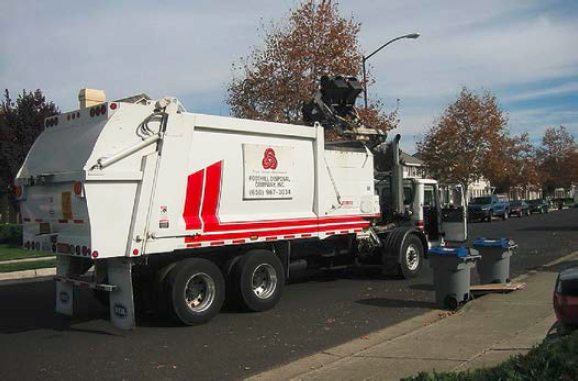
Figure 11-1. Semi-automated garbage truck with side loading arm.
11.2.2 Arizona
A major waste management company has introduced a fully electric semi-automated refuse truck for its operations in Phoenix. The company anticipates that half of its new truck purchases will consist of fully electric and semi-automated vehicles by 2028. Although the new vehicles will only be introduced in Phoenix at first, the company plans to introduce fully ASL EV garbage trucks in Portland, Oregon, and Santa Ana and Carlsbad, California, by 2024 (PR Newswire 2023).
11.2.3 California
In 2017, the city of Palo Alto and the city’s garbage management company introduced their first all-electric garbage trucks with ASL. These initial trucks were designed with a 76 mi range per 2 to 3 hours of charging. The trucks are projected to save $16,000 yearly due to their high-efficiency electric motors and controls, cost-efficient regenerative braking system, and overall lower maintenance costs due to the intelligent vehicle design (Ayre 2017).
Sacramento County, California, has added fully electric garbage trucks with ASL to its fleet. The county has received $2 million in grants to help pay for these trucks and intends to reach its zero-emissions goal by using all-electric garbage trucks for its sanitation operations (KCRA 2023).
11.2.4 Florida
In 2022, Miami-Dade County, Florida, introduced a fully electric garbage truck with ASL to its fleet. In addition to being completely emissions-free, the truck’s sustainability will be enhanced by charging using electricity generated from recycled waste at a sanitation facility in Miami-Dade County (FleetOwner 2022).
11.2.5 Massachusetts
The city of Cambridge, Massachusetts, in collaboration with the Massachusetts Institute of Technology’s Senseable City Lab, has introduced smart garbage trucks equipped with sensors such as air-quality sensors, infrared cameras, and accelerometers for collecting data on urban
issues such as air pollution, infrastructure decay, and traffic. The vehicles are capable of collecting and sending data via Wi-Fi hotspots to the Senseable City Lab. In the first trial, five garbage trucks were equipped with sensors to collect data as they navigated through designated routes in the city. By implementing this technology, the city aims to streamline its everyday urban maintenance by collecting real-time data during its daily maintenance work and managing its operations in a cost-efficient way (Rae 2017).
11.3 Summary of Applications for Automated Garbage Collection
Agencies in four states have tested or implemented human-operated garbage trucks with ASL or automated features for garbage collection.
11.3.1 Advantages
The main advantages of the use of garbage trucks with ASL or other automated features include:
- For ASL, workers do not have to manually load bins, which exposes them to traffic and other hazards.
- For automated trucks, the need for personnel is reduced.
11.3.2 Disadvantages
The main disadvantage to both automated and fully autonomous garbage trucks:
- Cost (automated garbage trucks are more expensive than their manually operated counterparts).
11.3.3 Costs
Several different types of automated features, such as ASL, have been used in human-operated garbage trucks, with costs varying by type of automation. One agency noted a price of $760,000 for the purchase of a new semi-automated garbage truck in 2021.
One source projected a savings of $16,000 per year through the use of all-electric human-driven garbage trucks equipped with ASL.
11.3.4 Status of Automated Garbage Collection
The use of human-operated garbage trucks equipped with ASL or other automated features is common in the United States.
Several agencies have piloted the use of autonomous garbage trucks, but such systems do not appear to be commercially available. No pilot evaluations in the United States were noted.


