For Ukrainian Researchers, Summer Institute Offers Rare Chance to Focus on Career Development During the War
Feature Story
By Molly Galvin
Last update August 28, 2023
In the 18 months since the war in Ukraine began, hundreds of scientists have fled the country, but hundreds more have stayed, carrying on their work under what are often difficult and unpredictable circumstances — including frequent power outages, difficulty getting to their laboratories or institutions, and interruptions or reductions in funding. For many of these scientists, daily life is frequently a struggle — let alone trying to stay connected with their colleagues or keep up with the latest developments in their fields.
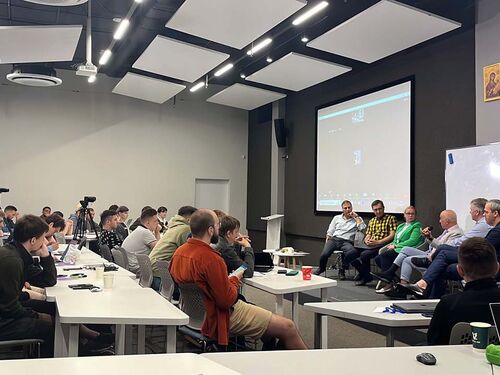
So when the U.S. National Academy of Sciences, the Simons Foundation, and the Ukrainian Catholic University teamed up recently to offer a weeklong summer institute on data science and applications in Lviv, many early career researchers jumped at the opportunity to attend. From a pool of more than 120 applications, 50 Ukrainian researchers in a wide range of fields — from astrophysics to the biological sciences to science policy — were selected to participate.
Several prominent U.S. data science experts traveled to Lviv to join their Ukrainian peers in leading the institute, including NAS member David Spergel, president of the Simons Foundation and founding director of the Center for Computational Astrophysics at the Flatiron Institute. During the week, Spergel and his colleagues delivered lectures ranging from statistical methods and machine learning in cosmology to data models for embryonic development to commercialization of research. The institute also featured panel discussions, breakout sessions, and mentoring opportunities.
“After the invasion, the Simons Foundation became an active supporter of Ukrainian scientists,” said Spergel. “In partnership with other foundations, federal funders, and European funding agencies, we hope to support the Ukrainians as they rebuild their scientific community.”
Spergel said that he and others have been particularly concerned about how isolated junior researchers in Ukraine were becoming since the war began. “For scientists to stay at the forefront of their field, they need to be continuing to learn new technical skills. One of the goals of the school was to introduce the researchers to some of the fast-developing areas like machine learning.”
For the Ukrainian researchers who attended, the summer institute provided a timely respite from the war to focus on learning, career development, and networking with experts and colleagues.
“Since the Russian invasion, the Lviv data science summer school was one of the first live international scientific events for me,” said Volodymyr Bezguba, senior research fellow at the Superconducting Quantum Electronics Lab at Kyiv Academic University, who explained that he has been feeling increasingly isolated as international travel has become essentially impossible for many inside the country. “People came not only from across Ukraine but also from the United States. It was very refreshing to get back to pre-war normality, and this school also helps us to be better integrated in modern scientific research — which nowadays is impossible without international collaborations.”
“Undoubtedly, warfare exerts a significantly negative impact on our lives, as we confront a multitude of issues such as compromised safety and pervasive insecurity about the future,” said Anastasiia Dmytriv, a second-year master student in biotechnology and bioengineering at the Lviv Polytechnic National University. Nevertheless, she said, “I resolved to explore novel avenues and undertake a challenging endeavor by enrolling in this program.”
Dmytriv said that even before the onset of the war, she had been disheartened by the isolation of the COVID-19 pandemic. “Our ability to refine practical skills was markedly curtailed, and the vibrancy of student life wanted for an extended span.” For her, she said, “the most significant aspect of [the summer institute] was the networking opportunities among individuals from diverse fields of study.”
Most Ukrainian scientists have faced significant personal challenges and career setbacks because of the war. For instance, despite receiving funding for postdoctoral work at an institution in Sweden, Anton Rudakovskyi, who works at the Bogolyubov Institute for Theoretical Physics in Kyiv, said he has been unable to leave Ukraine due to travel restrictions. However, he continues his research, and despite several challenges due to frequent Russian attacks of Kyiv, he managed to publish a paper in a top astronomy journal and is engaged in several ongoing astrophysical projects.
The summer institute came at a crucial time for him, he said. “My work is deeply related to data analysis. It was a great opportunity to hear top-level lectures as well as interact with leaders in the field.” He also presented his research findings in person for the first time since 2019. “The school was a remarkable event.”
The summer institute — which is being planned as an annual event — is one of many initiatives that the National Academies of Sciences, Engineering, and Medicine and their philanthropic and international partners are pursuing to support Ukrainian science and scientists. “Our aim is to help these researchers stay engaged with the international science community so that they are ready to help their country rebuild once the war ends,” said Vaughan Turekian, executive director of the National Academies’ Policy and Global Affairs Division, who also helped lead the institute in Lviv. “As the war continues on, it’s so important to keep providing opportunities like this at a time when these scientists really need it.”
“One of my takeaways from the visit is the importance of more deeply connecting the international scientific community with Ukrainian scientists,” added Spergel. “I want to encourage American scientists to engage with their Ukrainian colleagues and to support them by being collaborators and reviewers, and eventually also visit this inspirational and beautiful country.”
“Experiences like this school are especially valuable in current times, for people in Ukraine to not lose hope and not succumb to despair,” Bezguba said. “Despite all the troubles, Ukraine keeps standing and fighting back, but it’s of course getting exhausting with time. We need support from the world, including in science — so that we don’t lose our scientific potential and have a bright future after we win the war.”
Related Resources
More like this
Discover
Events
Right Now & Next Up
Stay in the loop with can’t-miss sessions, live events, and activities happening over the next two days.
NAS Building Guided Tours Available!
Participate in a one-hour guided tour of the historic National Academy of Sciences building, highlighting its distinctive architecture, renowned artwork, and the intersection of art, science, and culture.