Breastfeeding in the United States: Strategies to Support Families and Achieve National Goals (2025)
Chapter: 9 Exploring Research Needs and Future Implementation
9
Exploring Research Needs and Future Implementation
The committee identified throughout their report that conducting innovative breastfeeding and human milk research requires a range of investments to ensure high-quality, impactful studies. These investments span financial resources, infrastructure, workforce development, policy support, and technology integration. This chapter outlines the committee’s priorities for future research to better understand the efficacy of interventions that support breastfeeding initiation, duration, and exclusivity. It then describes implementation considerations, including opportunities to better integrate implementation research and cost-benefit analysis into evaluations of breastfeeding initiatives.
PRIORITIES FOR FUTURE RESEARCH
The means to improve breastfeeding outcomes in the United States, as reflected in the recommendations throughout the report, are multiple and intertwined, and they involve many actors. The committee’s consensus is that central and continuous leadership is necessary to make consistent progress in this area. In addition, to guide the development and implementation of a national breastfeeding strategy, the committee’s proposed strategy focuses on (a) strengthening national coordination efforts, (b) expanding effective community and public health interventions, (c) ensuring access to high-quality health care for all, (d) adopting and enacting breastfeeding-friendly policies to support paid leave and return to work and school, and (e) investing in research capacity and community-driven approaches.
The fifth and final theme is necessary for improving breastfeeding outcomes and rates, as investment in both research capacity and community-driven
approaches can address gaps in knowledge and differences across groups. For example, a robust research capacity enables the development, testing, and evaluation of policies and practices that support breastfeeding. In addition, programs that are co-designed with communities may improve their relevance, uptake, and sustainability, as well as continuity of support.
Based on its deliberations, the committee identified two recommendations for future research: expanding funding for breastfeeding and human milk research and developing an action plan to prioritize community, clinical, and translational breastfeeding and human milk research. This chapter’s recommendations do not have corresponding conclusions because they are not derived from a single body of evidence or a specific intervention. Instead, they reflect the committee’s overarching assessment that sustained investment in research infrastructure is essential to support and scale the full range of breastfeeding initiatives outlined throughout the report. These recommendations are structural and enabling in nature, intended to strengthen the national research system, guide future inquiry, and support strategic alignment across agencies and sectors. Rather than responding to a discrete finding, they set a forward-looking agenda to close persistent knowledge gaps, improve evaluation capacity, and ensure that effective interventions can be scaled and adapted across diverse settings. As such, they are synthesized from broad, cross-cutting themes that emerged across the committee’s deliberations and serve as foundational supports for the implementation of the report’s broader conclusions.
Recommendation 9-1: The National Institutes of Health, along with other federal and nonfederal agencies, should expand funding and prioritize key breastfeeding research and implementation questions geared toward scaling up supports to achieve the Healthy People 2030 infant feeding goals.
This may also include additional cost-benefit analysis research, which is critical for understanding how effective breastfeeding support interventions can be scaled and sustained across varied settings.
Recommendation 9-2: The National Institutes of Health should develop an action plan for prioritizing community, clinical, and translational breastfeeding research across its institutes and centers; this plan should build on existing initiatives.
For example, the National Institutes of Health could build on current efforts, such as the Breastmilk Ecology: Genesis of Infant Nutrition (BEGIN) Project. While BEGIN would be best complemented by additional clinical and community breastfeeding and lactation research, it provides an example relevant to this report and would support the emerging evidence base evaluating community-led breastfeeding programs. More research
could help identify some of the key features of these programs that influence positive breastfeeding outcomes, as well as structural limitations that prevent them from being more impactful (e.g., sustainability of funding, administrative burden of grant management, a lack of payment for services). Further research and evaluation of existing programs and organizations could also provide exemplar models of support and care across community contexts.
Ultimately, investment in research and community-driven approaches could create a feedback loop, in that research may inform policy and practice, and community-led programs may inform research by surfacing emergent needs or contextual nuance. Together, strategic investment can identify promising programs and approaches, which could be scaled and adapted for other families and communities.
In implementing Recommendations 9-1 and 9-2, the committee emphasizes specific research priorities related to breastfeeding and human milk; see Box 9-1. Such research can be guided by principles such as:
- Fund research that is focused on specific communities that experience ongoing differences in breastfeeding initiation, duration, and exclusivity rates and access to lactation care and support, and include increased sampling of groups most burdened by poor maternal and infant outcomes
- Fund community-led efforts and include resources for robust evaluation in partnership with community groups
- Fund studies that measure the cost and benefits of scaling up and sustaining effective interventions to support breastfeeding
- Measure a consistent range of metrics of success, including initiation, duration, and exclusivity, as well as meeting desired breastfeeding goals and mental, relational, and physical health of the breastfeeding dyad
IMPLEMENTATION CONSIDERATIONS
Additional research is needed to support effective implementation of interventions to support breastfeeding across all levels and sectors. Increased investments in the research and public health workforce are also needed (Eyler, 2020; McPake et al., 2023; Pérez-Escamilla, 2022; Pérez-Escamilla et al., 2023a). Sustained investments are needed to build capacity, reimagine and grow the workforce, and ensure that research institutions and public health agencies can effectively conduct high-quality, innovative, and ethical research studies. Meeting the research goals and priorities outlined in this chapter requires a research and public health workforce that is highly skilled, well trained, and representative of all the communities being served (Asiodu et al., 2021; Lett et al., 2022; Valantine & Collins, 2015).
BOX 9-1
Research Priorities for Improving Breastfeeding Rates, by Setting
The committee encourages funding breastfeeding research in multiple domains:
Community
- Identify funding needs of different community-led breastfeeding support programs, including an exploration of the sustainability of such initiatives.
- Further quantify the extent to which community-based breastfeeding support enables mothers to meet their infant feeding goals to better understand the unique needs of different communities.
- Evaluate the effectiveness of the Breastfeeding Family Friendly Community initiative to increase initiation and continuation of breastfeeding, improve maternal and infant health outcomes, and advance community well-being.
- Develop and validate a community-aligned, patient-centered breastfeeding experience measure.
- Study current differences in compensation in the lactation support workforce and impacts on historically underserved communities.
Marketing, Media, and Regulation
- Conduct additional research on how commercial milk formula (including infant formula) is manufactured, distributed, marketed, and paid for in the United States and how it is distributed through the U.S. Department of Agriculture’s Special Supplemental Nutrition Program for Women, Infants, and Children (WIC).
- Conduct rigorous evaluations of breastfeeding promotion support campaigns in the United States (e.g., Loving Support, WIC Breastfeeding Support, the National Breastfeeding Campaign).
- Explore opportunities and challenges related to compliance with the World Health Organization’s International Code of Marketing of Breast-Milk Substitutes.
- Design and conduct research on the role of social media and the current information and marketing environment on breastfeeding attitudes, beliefs, and behaviors.
- Rigorously evaluate current and future breastfeeding promotion and support media campaigns to inform future efforts and build a stronger evidence base.
- Measure the effects of commercial milk formula marketing on families’ breastfeeding journeys and the impact of interventions that address this influence.
Public Health
- Study the impact of the implementation of the Provisions of the Revisions in the WIC Food Packages Final Rule, including changes in participant rates of breastfeeding initiation, duration, and exclusivity, as well as the amount of commercial milk formula issued.
- Evaluate the cost savings of increased breastfeeding for WIC participants (both for the WIC program and for parents).
- Evaluate the extent to which local and state health department initiatives can protect, promote, and support breastfeeding.
- Evaluate the role of the public health workforce, including public health nurses, community health workers, and health educators, in initiating and sustaining breastfeeding and supporting infant feeding goals.
- Support research on best practices for disaster preparedness and responses related to infant and young child feeding in emergencies (IYCF-E), with a focus on breastfeeding practices, safe infant feeding, breastfeeding outcomes, and the role of breastfeeding in enhancing family resilience during disasters in the U.S. context.
Health Care
- Quantify the comparative effectiveness of state regulations, national accreditation standards, and Baby-Friendly USA certification to ensure that maternity hospitals fully implement and sustain to the World Health Organization Baby-Friendly Hospital Initiative’s Ten Steps for Successful Breastfeeding.
- Evaluate the comparative effectiveness of different models of lactation care within various settings (e.g., inpatient, outpatient, primary care).
- Test approaches to establishing a medical home for the breastfeeding dyad, such as co-locating care for mothers and infants in the “fourth trimester.”
- Measure the efficacy and comparative effectiveness of approaches to diagnose and treat common lactation and breastfeeding problems, including mastitis, breastfeeding-associated pain, insufficient glandular tissue, low milk production, insufficient milk transfer, infant latch difficulties, ankyloglossia, food protein–induced allergic proctocolitis, and dysphoric milk ejection reflex.
- Measure the distribution of and access to the lactation support workforce across the United States.
- Test the effectiveness of tuition support and other assistance programs for education and certification for lactation support providers.
- Develop a robust database that allows research into the association between breastfeeding and reduced infant mortality.
- Better evaluate and communicate the potential benefits and risks of maternal medications and impacts on human milk.
- Test the efficacy and effectiveness of strategies for supporting provision of donor human milk for sick and vulnerable infants (including critically ill infants).
Insurance and Payment
- Evaluate the effectiveness of options presented in the U.S. Breastfeeding Committee’s Payer Policy Guidance: Innovative Approaches to Coverage of Breastfeeding Support, Equipment, and Supplies.
- Develop and test Consumer Assessment of Healthcare Providers and Systems measures to quantify the accessibility, timeliness, and patient centeredness of lactation and breastfeeding care and coverage for support and supplies.
- Assess the cost(s) of implementing all levels (primary, secondary, tertiary) of breastfeeding care services that women need across their lactation journey.
Return to Work or School
- Quantify the effects of different family leave durations and payment levels on breastfeeding outcomes.
- Evaluate the costs of paid family leave mandates and their effects on small employers, including strategies for mitigating cost burden.
- Measure the impacts of the child tax credit, cash transfers, universal basic income, and other poverty-remediation measures on breastfeeding outcomes.
- Evaluate features of breastfeeding-friendly childcare and identify best practices for families returning to work or school (e.g., on-site childcare).
- Quantify the extent to which investments such as paid parental leave and flexible workplace accommodations affect long-term employment, workplace well-being, and productivity and health.
The sections below briefly discuss the need for research to better support the scaling up of effective programs, measuring the benefits and costs of effective interventions, and additional data needs to monitor outcomes and quality improvement opportunities.
Scaling Up Effective Programs
Scaling up effective programs and policies, such as those recommended throughout this report, requires implementation research to learn how to effectively adapt breastfeeding interventions to the local context
(Hernández-Cordero et al., 2022; Litwan et al., 2021), systematically taking the input from key actors into account (Litwan et al., 2023). Conducting pilot and feasibility trials prior to large-scale implementation may also be important for successful implementation and maintenance of breastfeeding support programs (World Health Organization & United Nations Children’s Fund, 2021).
For example, Pérez-Escamilla et al. (2023b) identified key components of national programs that had been successful at scaling up effective policies and programs in low- and middle-income countries. The review identified breastfeeding programs located in 28 countries in Africa, Latin America and the Caribbean, and Asia. The authors mapped a total of 22 enabling factors and 15 barriers into a scale-up framework that they then used to build a breastfeeding gear model (BFGM). According to Pérez-Escamilla et al. (2023b), the BFGM indicates the need for several key “gears” to be working in synchrony and coordination.
The BFGM visualizes national breastfeeding programs as a complex engine or system that requires eight gears or elements to function properly (Figure 9-1). Research and evidence-based guidance are needed to inform decision-making and implementation of policies that support interventions and programs to improve breastfeeding outcomes. Resources are also
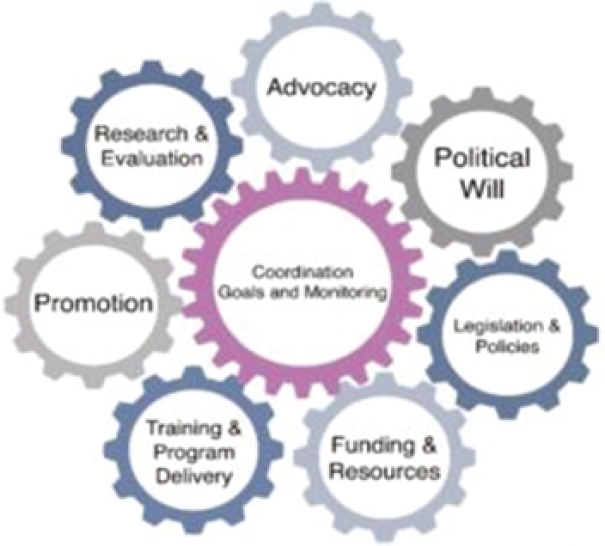
SOURCE: Pérez-Escamilla et al. (2012). Licensed under CC BY-ND 4.0.
needed for implementing behavior change communication campaigns and to conduct operational research on implementation and maintenance barriers and facilitators of the national program. At the center of the BFGM lies the master gear that is needed to coordinate goals, policies, and programs across the peripheral gears, using a multilevel management information system that facilitates decision-making from the local to the national levels. The model offers an opportunity to understand the strengths and weaknesses of each gear (Pérez-Escamilla et al., 2012).
Measuring the Benefits and Costs of Interventions to Support Breastfeeding
Adopting effective programs and interventions also requires an accurate assessment of the costs of implementation and maintenance of breastfeeding policies and programs and corresponding monitoring and evaluation systems (Carroll et al., 2020). Recent work has applied this approach for understanding the cost of expanding paid maternity leave duration among women working in the formal sector (Vilar-Compte et al., 2020) and for providing a cash transfer to women working in the informal economy, especially in lower-income countries (Carroll et al., 2022; Siregar et al., 2021; Ulep et al., 2021; Vilar-Compte et al., 2019). Likewise models that estimate the training cost for implementing the Baby Friendly Hospital Initiative have been applied to the United States and Mexico (Arslanian et al., 2022). This work is essential for providing cost-effectiveness estimates to inform breastfeeding investment decisions.
While the committee was not asked to provide in-depth regulatory impact or cost analyses for approaches to improving breastfeeding experiences and rates in the United States, it recognizes that it is useful to outline cost analyses that would provide well-informed, educated estimates for the costs of scaling up high-impact policies, programs, and investments that have made demonstrated improvements in breastfeeding measures. However, such data are largely unavailable in the U.S. context. As an example, analysis of scaling up of breastfeeding peer counseling in the Special Supplemental Nutrition Program for Women, Infants, and Children (WIC) requires data that are not currently available; this is especially true for detailed information on coverage rates and ratios of peer counselors to WIC participants. Scaling up includes providing services where they are not currently offered and achieving service levels at all sites that allow all WIC participants to access peer counseling. Data on the ratios of counselors to participants—and thus of this measure of access to services—are limited. It is also not known how many mothers who formula feed their infants might switch to breastfeeding if more peer counselors were available. Overall, the committee emphasizes the need for research studies to estimate the full set of benefits and costs of scaling up breastfeeding programs and interventions,
particularly for the Baby Friendly Hospital Initiative, WIC breastfeeding peer counseling, and paid family and medical leave. Such cost analyses of proven approaches would need to focus on measuring the entire population of mothers and infants, how far their breastfeeding experience falls short of meeting the standard of care, and the cost of improving care and outcomes.
Data Needs
Finally, implementing breastfeeding supports and interventions requires high-quality data and monitoring of outcomes. Chapter 4 discusses routine national monitoring systems that track breastfeeding outcomes and notes that additional data collection to capture the wide variety of public health supports for breastfeeding would be useful for identifying gaps and opportunities. It recommends that the U.S. Centers for Disease Control and Prevention continue to coordinate the surveillance of breastfeeding outcomes and expand the current data collection systems to ensure continuity, coordination, and collaboration across federal, state, territory, tribal, and local programs. By expanding the scope of data collection, strengthening current systems, and enhancing community-level data gathering, public health agencies can improve breastfeeding support services and address differences in rates among populations.
Improving breastfeeding outcomes in the United States will require sustained investment in research and community-driven solutions that are practical, effective, and grounded in real-world experiences. Strengthening research capacity across clinical, community, and public health settings will support the development, evaluation, and scaling of interventions that help families initiate and sustain breastfeeding. At the same time, partnering with communities ensures that programs are responsive to local needs and thus may be more likely to succeed. By expanding funding, prioritizing implementation science, measuring costs and benefits, and improving data systems, federal and nonfederal stakeholders can identify what works, support its adoption, and build a stronger foundation for infant feeding policy and practice nationwide.
REFERENCES
Arslanian, K. J., Vilar-Compte, M., Teruel, G., Lozano-Marrufo, A., Rhodes, E. C., Hromi-Fiedler, A., García, E., & Pérez-Escamilla, R. (2022). How much does it cost to implement the Baby-Friendly Hospital Initiative training step in the United States and Mexico? PLoS One, 17(9), e0273179. https://doi.org/10.1371/journal.pone.0273179
Asiodu, I. V., Bugg, K., & Palmquist, A. E. L. (2021). Achieving breastfeeding equity and justice in Black communities: Past, present, and future. Breastfeeding Medicine, 16(6), 447–451. https://doi.org/10.1089/bfm.2020.0314
Carroll G, Safon C, Buccini G, Vilar-Compte M, Teruel G, & Pérez-Escamilla R. (2020). A systematic review of costing studies for implementing and scaling-up breastfeeding interventions: What do we know and what are the gaps? Health Policy Plan, 35(4), 461–501. http://doi.org/10.1093/heapol/czaa005
Carroll, G., Vilar-Compte, M., Teruel, G., Moncada, M., Aban-Tamayo, D., Werneck, H., de Moraes, R. M., & Pérez-Escamilla, R. (2022). Estimating the costs for implementing a maternity leave cash transfer program for women employed in the informal sector in Brazil and Ghana. International Journal for Equity in Health, 21(1), 20. https://doi.org/10.1186/s12939-021-01606-z
Eyler, A. A. (2020). Research methods for public health. Springer Publishing Company.
Hernández-Cordero, S., Pérez-Escamilla, R., Zambrano, P., Michaud-Létourneau, I., Lara-Mejía, V., & Franco-Lares, B. (2022). Countries’ experiences scaling up national breastfeeding, protection, promotion and support programmes: Comparative case studies analysis. Maternal & Child Nutrition, 18(Suppl 3), e13358. https://doi.org/10.1111/mcn.13358
Lett, E., Asabor, E., Beltrán, S., Cannon, A. M., & Arah, O. A. (2022). Conceptualizing, contextualizing, and operationalizing race in quantitative health sciences research. Annals of Family Medicine, 20(2), 157–163. https://doi.org/10.1370/afm.2792
Litwan, K., Lara-Mejía, V., Chahine, T., Hernández-Cordero, S., Vilar-Compte, M., & Pérez-Escamilla R. (2023). An analysis of actors participating in the design and implementation of workplace breastfeeding interventions in Mexico using the NetMap analysis approach. Front Public Health, 11, 1192600. https://doi.org/10.3389/fpubh.2023.1192600
McPake, B., Dayal, P., Zimmermann, J., & Williams, G. A. (2023). What steps can improve and promote investment in the health and care workforce?: Enhancing efficiency of spending and rethinking domestic and international financing. European Observatory on Health Systems and Policies.
Pérez-Escamilla R. (2022). What will it take to improve breastfeeding outcomes in the United States without leaving anyone behind? American Journal of Public Health, 112(S8), S766–S769. https://doi.org/10.2105/AJPH.2022.307057
Pérez-Escamilla, R., Curry, L., Minhas, D., Taylor, L., & Bradley, E. (2012). Scaling up of breastfeeding promotion programs in low- and middle-income countries: The “breastfeeding gear” model. Advances in Nutrition, 3(6), 790–800. https://doi.org/10.3945/an.112.002873
Siregar, A. Y. M., Pitriyan, P., Hardiawan, D., Zambrano, P., Vilar-Compte, M., Belismelis, G. M. T., Moncada, M., Tamayo, D., Carroll, G., Perez-Escamilla, R., & Mathisen, R. (2021). The yearly financing need of providing paid maternity leave in the informal sector in Indonesia. International Breastfeeding Journal, 16(1), 17. https://doi.org/10.1186/s13006-021-00363-7
Ulep, V. G., Zambrano, P., Datu-Sanguyo, J., Vilar-Compte, M., Belismelis, G. M. T., Pérez-Escamilla, R., Carroll, G. J., & Mathisen, R. (2021). The financing need for expanding paid maternity leave to support breastfeeding in the informal sector in the Philippines. Maternal & Child Nutrition, 17(2), e13098. https://doi.org/10.1111/mcn.13098
Valantine, H. A., & Collins, F. S. (2015). National Institutes of Health addresses the science of diversity. Proceedings of the National Academy of Sciences of the United States of America, 112(40), 12240–12242. https://doi.org/10.1073/pnas.1515612112
Vilar-Compte, M., Teruel, G., Flores, D., Carroll, G. J., Buccini, G. S., & Pérez-Escamilla, R. (2019). Costing a maternity leave cash transfer to support breastfeeding among informally employed Mexican women. Food and Nutrition Bulletin, 40(2), 171–181. https://doi.org/10.1177/0379572119836582
Vilar-Compte, M., Teruel, G. M., Flores-Peregrina, D., Carroll, G. J., Buccini, G. S., & Pérez-Escamilla, R. (2020). Costs of maternity leave to support breastfeeding; Brazil, Ghana and Mexico. Bulletin of the World Health Organization, 98(6), 382–393. https://doi.org/10.2471/BLT.19.229898
World Health Organization & United Nations Children’s Fund. (2021). Implementation guidance on counselling women to improve breastfeeding practices. https://www.globalbreast-feedingcollective.org/media/1501/file/UNICEF-WHO-BF-Counseling-Guidance-2021.pdf


