Returning Human Spaceflight to the United States
Perspectives
By guest contributor Gwynne Shotwell
Last update November 16, 2020

NAE Perspectives offer practitioners, scholars, and policy leaders a platform to comment on developments and issues relating to engineering.
NAE member Gwynne Shotwell is president and chief operating officer of SpaceX.
In my nearly 20 years at SpaceX, I have experienced hundreds of Falcon launches and test firings. As such, my level of anxiety prior to these events had been waning until, of course, Saturday, May 30, 2020. On that day, and for days leading up to it, my heart was in my throat. Not for any known concern with the technology or the process we followed getting to this moment, but for fear of the unknown and the enormity of what was about to take place.
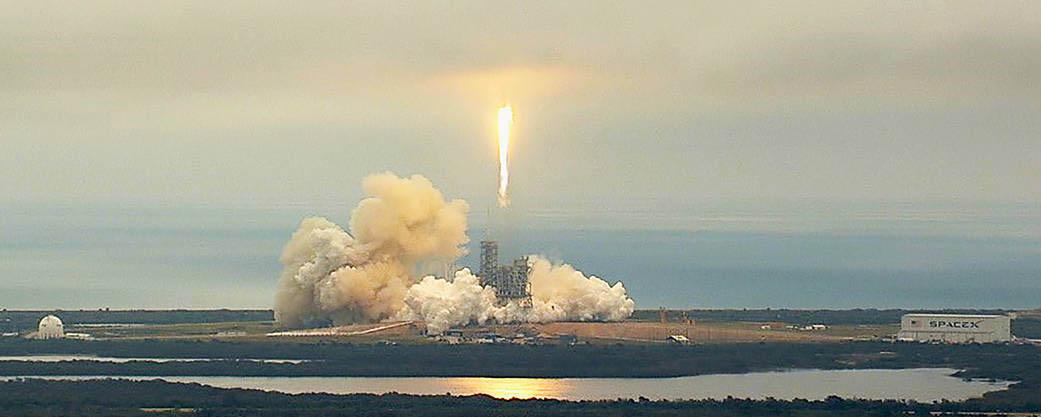
At 3:22 pm EDT, Falcon 9 and the Demo-2 Dragon spacecraft lifted off from Launch Complex 39A at Kennedy Space Center carrying SpaceX’s first human passengers, NASA astronauts Bob Behnken and Doug Hurley. We often refer to them as “the Dads,” a reflection of our responsibility not just to the astronauts but to their families as well.
Only three countries have launched humans into space: Russia, China, and the United States. SpaceX was about to become a member of a very elite club. We were launching from the same pad as Apollo 11 and the first and last Space Shuttles. The pad would now be the first to support a private company launching humans to space. I will never forget this day or all the engineering and teamwork that made it possible.
SpaceX was founded to launch humans to space and eventually the Moon and Mars. The early Dragon cargo vehicles had windows in anticipation of crew flights. We owe the success of launching Bob and Doug to our great SpaceX employees, but this success was enabled by the hard work of many, including NAE members and NASA staff, over the years to establish the engineering principles for spacecraft and launch vehicle design.
Innovations in Human Spaceflight
NASA’s commitment to innovation enabled SpaceX to propose new ways of doing things, moving beyond heritage designs and standards. This freedom allowed us to combine the best of historical design practices and knowledge with the best in modern design and manufacturing.
As an example, we chose to utilize a pusher abort system for Dragon. This was very a different design from the abort systems used in Mercury, Apollo, and Gemini, or the Russian and Chinese crew vehicles. In all of those cases, the abort system and its propellant are jettisoned and no longer available for future use. In a pusher system, the system and its propellant are available for the remainder of the mission.
The design of the pusher abort system for Dragon proved to be more challenging than anticipated. On April 20, 2019, during a static test firing of the abort system, the test vehicle was unexpectedly lost. We were using hypergolic propellants, design practices, and engineering principles that were all very common in the industry. The unique requirements of safely pushing the vehicle away from a malfunctioning rocket meant the pressures and velocities used for this system were much higher than for previous systems, but this difference was believed to be immaterial.
We learned that the hypergolic oxidizer, along with the titanium lines and fittings, could be flammable at these velocities and pressures with contamination that may be present in the system. This was a new finding—previously the materials were thought to be completely safe under these conditions. Working with NASA, we began to better understand how the oxidizer and titanium react under these new conditions—a great example of the government and private sector working together. This work will contribute to the body of knowledge available to all engineers and will result in safer systems. In the process of building an innovative abort system, we were able to contribute to better engineering design practices for everyone.
SpaceX has similarly added valuable state-of-the-art knowledge to industry practice through our parachute development. Parachutes might sound easy, or even antiquated, but the criticality of their reliability when returning humans from space is paramount. We tested our design across the entire deployment envelope, including stressing conditions for loss of drogues or main parachutes as well as in-flight abort conditions. Through this rigorous testing, we advanced the industry’s understanding of parachute reliability.
Data collected from an unexpected development test failure, also in April 2019, caused us and NASA to reexamine a decades-old industry assumption about load asymmetry in round parachutes. SpaceX used the data to more accurately predict structural margins, make targeted structural upgrades, and create a more reliable parachute system. The company completed nearly 100 tests and flights of Dragon’s parachute systems to ensure a safe landing back on Earth. And we would not have committed to flying Bob and Doug on Demo-2 without a comprehensive test campaign that convinced us that our system is reliable.
SpaceX was able to innovate on many other key systems. For example, the Dragon spacecraft leverages new, modern spacesuits that protect the crew in case of depressurization or evacuation, are relatively easy to don and doff, and provide the necessary reach and visibility to operate the spacecraft. In addition, the crew display system is very different from that of every other spacecraft system, with touch screens rather than the typical hand controllers. Finally, we designed Dragon as a primarily automated vehicle, with crew monitoring and override capability as needed.
Autonomous human spaceflight is revolutionizing human space transportation. Minimizing required crew interaction will facilitate the transportation of untrained or civilian passengers to space. This allows us to market our system to private citizens—we have sold two flights to customers other than NASA and the US government. This is the true dawn of a commercial market for human spaceflight, and might be as transformative to the industry as the launch of Crew Dragon itself. Exposing a broad community to spaceflight will accelerate ideas for yet unknown space enterprise, driving routine access to space and ultimately human missions to Mars.
Beginning of a New Era
We safely transported Bob and Doug to the International Space Station, where they assisted with maintenance, science, research, and battery repair. Dragon performed well, and we double-checked all systems in preparation for the crew’s return to Earth.
Return from space is as difficult as ascent. Energy used to place the spacecraft into orbit must be safely dissipated upon return. Dragon’s landing was the first human water recovery since Apollo, and we prepared carefully for it.
Unlike other spacecraft, Dragon is designed to be flown many times. After its return to Earth, Dragon was inspected and refurbished so that we could learn by inspecting the flight hardware and improve the vehicle design, making it safer.
Millions of hours have been invested in this system design and its operation, as this business requires precision and vigilance; small deviations in manufacturing, operations, and design can become major problems. Principles of engineering developed and documented by the community over the years are being leveraged and, critically, expanded every day at SpaceX. Improving industry practices and adopting new ones from other industries is critical to making better, safer designs.
The first crew launch from the United States in almost nine years was an amazing accomplishment, but that day was just the beginning. The dream of space as a place that everyone can visit, work in, and explore is becoming a reality. The world’s perception of what is possible can be changed by an engineering community that works together to ensure that lessons learned are not forgotten while relentlessly driving the state of the art. The NAE and its members are critical parts of that community. Ad astra!
Disclaimer
The views expressed in this perspective are those of the author and not necessarily of the author’s organizations, the National Academy of Engineering (NAE), or the National Academies of Sciences, Engineering, and Medicine (the National Academies). This perspective is intended to help inform and stimulate discussion. It is not a report of the NAE or the National Academies. Copyright by the National Academy of Sciences. All rights reserved.