Pathways to Discovery in Astronomy and Astrophysics for the 2020s: Highlights of a Decadal Survey (2023)
Chapter: Our Shared Quest
OUR SHARED
QUEST
We live in a time of extraordinary discovery and progress in astronomy and astrophysics.
What’s out there in the cosmos? Where did we come from? Are we alone?
These questions touch the very heart of human identity and curiosity. For millennia, they have motivated a shared quest to probe our surroundings, map the stars, and imagine what lies beyond the horizon.
The answers are closer than ever.
In the past few years, humanity has celebrated the first definitive detection of gravitational waves and imaged the shadow of a black hole. We have gleaned new insights into the birth of galaxies and discovered planets that may be capable of sustaining life. We have sent the world’s largest space telescope a million miles from Earth in a bold endeavor to observe what has previously been hidden and unknowable.
Our ability to grasp the mysteries of the universe has already far exceeded what our predecessors could have imagined. Now, we are poised to do much more. Technological innovations and emerging scientific methods are creating new tools to search for the signatures of life beyond Earth, investigate the origins and nature of our universe, and resolve the inner workings of galaxies.

Worlds and Suns in Context
Exoplanets—planets orbiting stars other than our Sun—have gone from something we could only imagine to something we routinely observe. This transformation has happened in a stunningly short period of time, opening new opportunities to study how planets form, their connections to their parent stars, and what other secrets they may harbor.
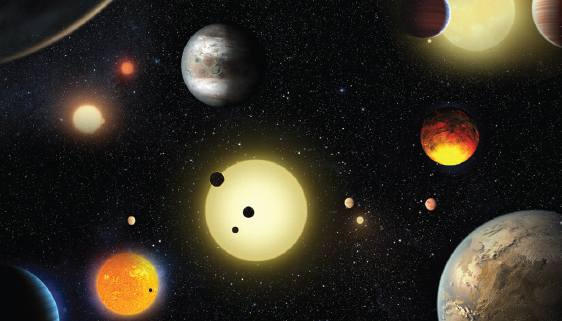
A Universe Teeming with Worlds
Scientists long speculated that planets exist outside of our solar system but did not confirm this until just a few decades ago. When the first exoplanet was documented in 1992, researchers debated how many such planets might be out there. Were they rare, making our solar system unique with its bounty of eight planets? Or did most stars host their own planetary systems, spinning in countless intricate dances across the universe?
Recent decades have answered that question with an explosion of exoplanet observations. To date, scientists have documented more than 5,000 planets, with new ones now being discovered every few days. These discoveries suggest that there are likely many more planets than stars in the universe.
Searching for Signs of Life
What wonders might each world hold? Perhaps the most intriguing possibility is life. Scientists have already found about 20 Earth-sized planets that are in the “habitable zone”—at a distance from their parent star that makes them neither too hot nor too cold to allow for liquid water. Measurements suggest that around 30 percent of stars host at least one habitable-zone planet.
While much about these planets remains mysterious, new tools are allowing us to learn more about their makeup, origins, orbits, and atmospheres. Spectroscopic measurements, for example, are particularly useful because they offer information about the chemical composition of a planet’s atmosphere—data that can help us find habitable planets and even provide evidence of active life.
The coming decades will set humanity down a path to determine if we are alone.
Unraveling the many cosmological mysteries will require a particularly close interplay among theory, simulation, observations, and laboratory experiments.
New Messengers and New Physics
Astrophysics teaches us to expect the unexpected—to embrace surprises as a way to refine or fundamentally reconsider how we view the universe. As we expand our capacity to observe, simulate, and experiment with fundamental physical processes, we unlock new opportunities to test and reshape our theories about how the universe works.
Going the Distance
Emerging observational capabilities allow us to tap signals from the extreme reaches of space and time. Many of these signals or “messengers” have traveled billions of years before encountering our instruments, carrying with them the traces of ancient events.
For example, observations using the full electromagnetic spectrum allow us to detect ever fainter sources of light, effectively peering into the distant past for a view of the young universe. At the same time, innovative methods to overcome distortion offer views of distant phenomena with unprecedented clarity. Observing the sky repeatedly over time, over multiple wavelengths and messengers, provides a powerful window into cosmic dynamics.
New Ways of Seeing
To augment and amplify the wide range of light-based observations, researchers can now tap into entirely new types of messengers such as particles, gravitational waves, and neutrinos. For example, in the mid-2010s,

complementary observations of gravitational waves and light revealed a new picture of a pair of merging neutron stars. Just as we combine sight, sound, taste, smell, and touch to sense our everyday surroundings, combining multiple types of observations provides a deeper understanding of our universe.
These developments have greatly enriched the intellectual feedbacks between astronomy and physics. They also bring us closer to thrilling new insights into many longstanding mysteries, including the nature of dark matter and dark energy, the origins of the elements that comprise our bodies and our planet, the makeup of the gas between galaxies, and the processes that formed the universe.
Cosmic Ecosystems
Galaxies enchant us with their explosive abundance of cosmic bodies, often standing out as swirling hives of activity against the dark emptiness of space. While it is tempting to view galaxies as independent and self-contained, in truth they are intricately connected with each other and the broader space environment in ways that we are only beginning to grasp.
Finding Feedbacks
On Earth, feedbacks are integral to ecosystems—from forests to coral reefs. Similarly, scientists are learning that feedbacks are an essential part of the workings of the cosmos, with different components moving, using, and recycling matter and energy in a complex interconnected web.
This means that even small-scale processes can have surprising impacts on large-scale systems. For example, it is thought that ionizing radiation produced by some of the first stars and black holes—relatively small bodies in the scheme of things—propagated across the cosmos and contributed to the conversion of most of the hydrogen in the universe from a neutral to an ionized state, a phase transition with massive implications for the evolution of the young universe.
Synthesizing Across Scales
The flow of matter and energy throughout the cosmic ecosystem—combined with the effects of gravity and feedbacks—likely explains many of the similarities and differences between galaxies, as well as the internal
We stand on the threshold of new endeavors that will transform not only our understanding of the universe and the processes and physical paradigms that govern it but also humanity’s place in it.
dynamics that produce the stars and planets within galaxies. But the details of this process have been elusive. How do these flows disburse heavy elements, from the carbon in our bones to the rare-Earth metals in our phones? How do they determine the distribution of gas between stars and between galaxies? How do some galaxies get fuel to keep forming stars, and what causes others to become quiescent?
Answering these questions requires studies at an enormous range of length and time scales. Knitting together observations of processes often spanning 10 or more orders of magnitude pushes the limits of our scientific capabilities. A confluence of advances in theory, computational modeling, and new observational capabilities is opening new opportunities to investigate stars, black holes, supernovae, and other structures within galaxies; the interactions between galaxies and the broader cosmic ecosystem; and what these relationships may reveal about how galaxies form.




