Advancing Vineyard Health: Insights and Innovations for Combating Grapevine Red Blotch and Leafroll Diseases (2025)
Chapter: 6 Considerations for Future Research on Grapevine Viruses and Diseases
6
Considerations for Future Research on Grapevine Viruses and Diseases
This final chapter discusses future considerations for the California Department of Food and Agriculture (CDFA) Pierce’s Disease/Glassy-Winged Sharpshooter (PD/GWSS) Board as it continues to support research to develop viable solutions to virus diseases that threaten vineyard health and the sustainability of the California wine grape industry. The following sections include discussions of genetic pest management strategies; relevant insights and additional research directions from other pathosystems; and approaches to engage a wider range of investigators in grapevine virus research, address immediate research needs, and facilitate knowledge sharing and collaboration among researchers, extension agents, growers, and other constituents of the wine grape industry.
While the committee believes that all the recommendations in this chapter are important, it is also cognizant of the fact that research funds are limited. Therefore, the committee identified research areas it considers high priority (labeled HP) and medium priority (labeled MP). These research areas are also presented in Table 6-1, at the end of this chapter.
GENETIC PEST MANAGEMENT STRATEGIES
Genetic pest management is an approach to pest control that involves “releasing modified versions of a pest species to mate with wild pests in the target area” (Leftwich et al., 2021). The two main strategies for genetic pest management are suppression and replacement. For suppression, sterile males are released into the environment where they compete with wild type males for mating, reducing each female’s chance of successful
reproduction and ultimately reducing the size of the population (Abraham et al., 2007). A population suppression approach using genetically modified male Aedes aegypti mosquitoes has proven to be successful in reducing vector populations and the prevalence of the mosquito-borne dengue virus (Carvalho et al., 2015; de Castro Poncio et al., 2023; Oxitec, 2024). A variation of the suppression strategy is precision guided sterile insect technique (pgSIT). With this technique, genetically modified, laboratory-reared males are released into the environment to mate with wild females and propagate genes that result in sterility among male offspring and death among female offspring. This method ensures that only sterile males survive, and genetically modified males can be introduced into the population at any life stage to effectively suppress insect populations (Kandul et al., 2019; Li et al., 2021). The success of this strategy requires a sex that does not cause harm (for example, male mosquitoes feed on nectar only and therefore do not transmit dengue virus), the ability to rear genetically modified individuals successfully in controlled conditions, and genetic modifications that do not reduce mating fitness. For replacement, individuals that have been genetically modified to be incapable of transmitting pathogens are released into the environment where they reproduce freely, propagating the genetic modification and reducing the population’s overall ability to carry disease (Shaw and Catteruccia, 2019). Clustered regularly interspaced short palindromic repeats (CRISPR)-based genome editing has transformed the ability to perform precise genome manipulations that spread target genes rapidly through a population.
The importance of vine mealybug as a vector of grapevine leafroll-associated virus 3 (GLRaV-3) and the invasive nature of this insect (Daane et al., 2018) make this species a good candidate for consideration for genetic pest management and feasibility studies for genome editing. Male mealybugs may be good targets for the pgSIT approach because they do not feed on grapevines or transmit viruses, but additional knowledge of their genomes, reproductive biology, seasonal dynamics, laboratory rearing procedures, and molecular transmission mechanisms is needed to begin investigating this approach for vector control. Some factors that may impact the success of a genetic pest management approach that would need to be included in models are the short lifespan of male mealybugs, their dispersal capability, and their sensitivity to environmental conditions. Preliminary modeling studies may prove useful in predicting whether genetic pest management methods would be effective in controlling these pests as a component of integrated pest management (IPM) programs (Barclay, 2021). One benefit of this approach is that it relies on modification of the insect rather than the plant and thus does not involve modification of products intended for human consumption.
To implement potential genetic pest management, additional research is needed to further characterize the primary vectors of GLRaV-3, the vine
mealybug and grape mealybug. This includes addressing the knowledge gaps identified in Chapters 4 and 5, as well as research to gain insights into the genomes of these vectors and bioengineering approaches that might be appropriate for them. Interdisciplinary research teams that include molecular biologists, entomologists, modelers, field biologists, and extension specialists are key for developing strategies and predicting real-world implications. It is also important to study sociological aspects and consumer acceptance to understand how biotechnology-based strategies may be perceived and adopted and anticipate potential downsides or barriers to adoption.
The replacement strategy, which targets the molecular determinants of vector competence or expression of genes to reduce vector competence (Buchman et al., 2020; Dong et al., 2020; Carballar-Lejarazú et al., 2023), also represents a potentially viable option for grapevine leafroll disease (GLD) and/or grapevine red blotch disease (GRBD) management. For GLRaV-3, which is transmitted in a semi-persistent manner, this would likely involve targeting molecules on the surface of the vector foregut, the proposed site of virus retention. In contrast, grapevine red blotch virus (GRBV) is transmitted in a persistent manner and likely is transcytosed (i.e., transported across a biological barrier) through the treehopper gut cells to the hemolymph after initial interactions with specific molecules in the gut. For both pathosystems, virus receptors in the insects have not been identified; a multidisciplinary approach to defining receptors could enable research to develop incompetent vectors. However, due to the importance of mealybugs as direct pests in addition to disease vectors, a population suppression approach may be more desirable and might eventually be part of an IPM approach alongside the use of pheromones, biological controls, and insecticides.
Conclusion 6-1: Genetic pest management strategies, in which the insect vector is modified rather than the plant, offer opportunities to curb the spread of disease by reducing vector populations or their ability to transmit viruses. The biology of mealybug vectors makes them good targets for genetic pest management.
Conclusion 6-2: Multidisciplinary research teams composed of molecular biologists, entomologists, modelers, and field biologists or extension researchers are needed to develop genetic pest management strategies and to predict their real-world implications.
Conclusion 6-3: Sociological aspects and consumer acceptance are important considerations when developing genetic pest management strategies.
Recommendation 6-1: Support basic research to enable genetic pest management strategies for GLD and GRBD vectors and support modeling and sociological research to predict whether these strategies will be effective in the field and be accepted by the public.
INSIGHTS AND ADDITIONAL RESEARCH DIRECTIONS FROM OTHER PATHOSYSTEMS
Tactics for Controlling Insect Vectors
This section discusses approaches or tools used to control vectors of pathogens that infect other economically important crops, which may be applicable to insect vector management in grapevines.
RNA Interference (RNAi)
RNAi is a conserved cellular defense mechanism in eukaryotes targeting double-stranded RNA (dsRNA) that can be harnessed for insect control. To use this approach, dsRNA molecules with a sequence complementary to that of the single-stranded messenger RNA (mRNA) of an essential insect gene are introduced into the insects via feeding, injection, or other methods. The insect’s cells perceive the dsRNA as a pathogen-associated molecular pattern, a sign of invasion by a foreign entity or an unnatural phenomenon. This in turn triggers the RNAi response, resulting in degradation of the target mRNA. The functionality of the essential (i.e., target) gene in the insect is thereby reduced by this knockdown of mRNA abundance, resulting in developmentally challenged individuals or even the death of the insect.
Several research groups have explored the application of RNAi for insect control (Gordon and Waterhouse, 2007; Vogel et al., 2019; Christiaens et al., 2020; Zhu and Palli, 2020). For example, this approach is gaining considerable interest in Huanglongbing (HLB) research as insecticides have become less effective in controlling the vector of this disease, Asian citrus psyllid (ACP; Diaphorina citri). Studies of RNAi knockdown in the ACP across all life stages have been reviewed by Yu and Killiny (2020); an RNAi approach developed for controlling ACP and for disrupting essential genes of the glassy-winged sharpshooter have been shown to be effective and species-specific (Hunter et al., 2012, 2019, 2020; El-Shesheny et al., 2013; Killiny et al., 2014; Andrade and Hunter, 2016, 2017; Taning et al., 2016; Ghosh et al., 2018; Kishk et al., 2017; Hunter and Sinisterra-Hunter, 2018; Tian et al., 2018; Yu and Killiny, 2018; Liu et al., 2020). As further illustrated in studies using exogenous RNAi to significantly reduce insect vectors, including reports of gene target suppression after ingestion of dsRNA by plant-feeding hemipterans (examples and references in Li et al., 2013,
2015; Christiaens and Smagghe, 2014; Adeyinka et al., 2020; Fletcher et al., 2020; Jain et al., 2020), the strong response to dsRNA triggers shows that RNAi has the potential for managing insect vectors and pests. However, caution is needed when designing an RNAi for a targeted insect in order to avoid harming beneficial insects or other non-target species.
Another promising aspect of this approach is that two products with RNAi-based modes of action were approved by the U.S. Environmental Protection Agency and commercially released in 2024 (Yan et al., 2024); one is a sprayable formulation that targets the Colorado potato beetle (CPB; Leptinotarsa decemlineata) (Zhu et al., 2011; San Miguel and Scott, 2016; Máximo et al., 2020; Mehlhorn et al., 2020; Petek et al., 2020; Doğan et al., 2021), and one is a transgenic crop that expresses dsRNA to target the western corn rootworm (WCR; Diabrotica virgifera virgifera LeConte) (Bolognesi et al., 2012; Ramaseshadri et al., 2013; Bachman et al., 2016; Head et al., 2017). The first sprayable dsRNA biopesticide, Calantha™ (active ingredient ledprona), triggers RNAi to silence expression of an enzyme, which leads to death of CPB (Rodrigues et al., 2021). To manage WCR, RNAi is triggered after root-feeding larvae ingest dsRNAs from corn plants genetically engineered to express them. These new products provide novel modes of action for pest management, and it is worth investigating the potential use of similar approaches in vector management for GLD and GRBD.
Conclusion 6-4: RNAi has the potential for use in managing viruses, their insect vectors, and potential other grapevine pests. Applied RNAi biopesticides should have narrow activity based on target-specific dsRNA that will trigger RNAi suppression only in the targeted organism and no activity in other beneficial insects. Genetically engineered plants expressing dsRNA may more effectively manage mealybugs and other insects that reside under bark where it is hard to contact them with insecticide sprays.
Recommendation 6-2 (MP): Consider supporting interdisciplinary research teams to advance RNAi research for the suppression of vectors in vineyards.
Nanobodies
Nanobodies, or single-domain antibodies, have emerged as promising tools for managing grapevine fanleaf virus (GFLV) (Hemmer et al., 2018). These small antibody fragments, derived from camelid species, have high affinity and specificity for their target antigens, including GFLV proteins (Hemmer et al., 2018). Although GFLV can overcome resistance conferred
by the Nb23 nanobody, researchers have developed Nb75, which provides dual resistance to GFLV and arabis mosaic virus, and are exploring the combination of different nanobodies for more durable resistance (Hemmer et al., 2018; Orlov et al., 2020). Other studies have shown that nanobodies can effectively inhibit viral infection, replication, and disease symptoms in plants (Ghannam et al., 2015; Ingram et al., 2018). Transgenic expression of nanobodies in plants also offers a promising approach to control viral infections like GLRaV-3 and GRBV, potentially neutralizing viruses and preventing their spread. However, challenges such as the scalability and cost-effectiveness of nanobody production need to be addressed for practical field application. A U.S. Department of Agriculture (USDA) team, in collaboration with AgroSource, Inc., recently demonstrated that nanobodies can be produced in a plant system and could have agricultural and public health applications. As a proof-of-concept, this team demonstrated the production of functional nanobodies targeting severe acute respiratory syndrome coronavirus 2 (SARS-CoV-2), showcasing their potential for various uses beyond agriculture (USDA-ARS, 2022). Their recent efforts are focused on testing the plant-based delivery system, which they are calling Symbiont technology, to prevent and treat citrus greening disease using nanobodies (USDA-ARS, 2024). Field trials and risk assessments are needed to evaluate the long-term stability and effectiveness of nanobodies under field conditions.
Conclusion 6-5: Nanobodies present a promising strategy for managing grapevine viruses like GLRaV-3 and GRBV, given their high specificity and efficacy in targeting viral proteins. However, successful application in vineyards depends on overcoming challenges related to scalable production, cost-effectiveness, and long-term stability under field conditions.
Recommendation 6-3: Consider supporting research to advance the development of nanobodies for the control of GLRaV-3 and GRBV through transgenic or exogenous approaches. This could include monitoring and funding multidisciplinary, collaborative efforts to refine nanobody production methods to improve scalability and affordability, as well as supporting field trials to rigorously assess the performance and durability of nanobodies in diverse vineyard environments to ensure they are a practical and sustainable solution for virus management.
Trunk Injection of Systemic Pesticides
Trunk injection of systemic pesticides is often used to treat vascular bacterial, fungal, or nematode diseases of forest trees and has been applied to various tree crops. For example, trunk injection of oxytetracycline (OTC)
has been shown to manage HLB in citrus, almond leaf scorch (Xylella fastidiosa) in almonds, mycoplasma infections in apricots, and phytoplasma infections causing lethal bronzing of palms (Brooks et al., 1994; Takai et al., 2000; Koch et al., 2010; Archer et al., 2023). Studies investigating the efficacy of antibiotics, brassinosteroids, plant growth regulators, RNAi, insecticides, systemic acquired resistance inducers, endophytes, and other agents by trunk injection show positive results in citrus (Shwarz et al., 1972; Boina and Bloomquist, 2015; Hu and Wang, 2016; Hu et al., 2017; Archer et al., 2022a,b, 2023). Much of this work has been focused around the management of HLB, which has brought Florida’s iconic citrus industry to the brink of collapse and is spreading in other major citrus production areas in Texas and California (Halbert and Manjunath, 2004; Bové, 2006; Gottwald, 2010; Grafton-Cardwell et al., 2013; Hall et al., 2013; McCollum and Baldwin, 2016; Graham et al., 2020). While the vascular nature of HLB renders therapies that are applied via foliar sprays, such as bactericides, ineffective (Killiny et al., 2020), trunk injection methods can overcome these obstacles. In Florida, trunk injections of OTC have been found to reduce Candidatus Liberibacter asiaticus titer levels, improve fruit and juice quality, and prevent HLB-induced decline (Archer and Albrecht, 2023; Archer et al., 2023).
The effectiveness of trunk injection methods in controlling vasculature diseases and insect pests in other tree crops suggests that the approach could be applicable to the grapevine industry in California. Studies conducted in European vineyards have demonstrated the potential to control esca disease complex by injecting fungicides and chemicals into the grapevine trunk (Di Marco et al., 2000; Calzarano et al., 2004; Dula et al., 2007; Del Frari et al., 2018). Using trunk injection as a way of managing woody plant pathogens and pests offers several distinct advantages relative to foliar sprays. First, they can eliminate chemical loss due to spray drift (Berger and Laurent, 2019). Second, they offer precise delivery and allow for a higher concentration in the plant tissue, thus requiring fewer applications (Vincent et al., 2022). Additionally, they can reduce risks for non-target organisms and worker contact with materials, thus causing less concern for human health and the environment. Finally, therapeutics administered directly into plant tissue are less likely to be removed by rain or degraded by sunlight, resulting in greater stability and extended residual activity of the therapeutics (reviewed in Batuman et al., 2024).
Conclusion 6-6: Trunk injection has been used for delivering pesticides directly to the plant vasculature to control diseases in citrus, almond, apricot, and palm trees. This delivery method, which is more precise and has a lower risk of non-target effects, may be applicable in controlling phloem-limited pathogens as well as phloem-feeding insects in vineyards.
Recommendation 6-4 (MP): Consider supporting research to investigate the potential utility of trunk injection to control vectors and viruses with various pesticides (including new approaches such as RNAi and nanobodies) in grapevines.
Prediction Models and Risk Indexes as Management Tools
Various models and risk indexes have been developed to help predict timing of insect infestations into crops, insect development, and the risk of disease spread into crops. Incorporating elements such as degree-day models of insects and/or crops, crop phenological models, models of pathogen spread, and information about factors that promote or suppress crop injury or disease spread, these tools help stakeholders identify critical periods and geographic areas for management by shedding light on site-specific risk based on seasonality, location, and production practices. Further development of these tools may help growers better predict insect population dynamics to improve scouting and timing of management activities. To advance this work and improve prediction accuracy requires multiyear and multi-location data to accurately identify factors driving insect and pathogen dynamics, validation after development, and ongoing evaluation to ensure models are kept current based on changing production practices and improved knowledge. The University of California Statewide IPM program currently hosts a variety of insect degree-day and crop phenology models;1 if developed, models specific to GLRaV-3 and GRBV could be housed there for public use.
Tomato Spotted Wilt Virus Field Risk Index and Thrips Projections
Several region-specific tools have been developed to help manage infestations of tobacco thrips (Frankliniella fusca Hinds) and the spread of tomato spotted wilt virus (TSWV). In California, a dedicated webpage2 has been established that provides predictions of western flower thrips (Frankliniella occidentalis Pergande) population development and alerts growers and pest control advisers when they may consider implementing thrips control measures in tomato fields (Batuman et al., 2020). The website also provides a TSWV field risk index that growers can use to predict the potential for disease outbreaks in a given field. These resources are updated regularly to provide grower updates and alerts before, during, and after the growing season (Batuman et al., 2015).
___________________
1 See https://ipm.ucanr.edu/WEATHER/index.html#PESTPLANTMODELS.
Thrips Infestation Predictor for Cotton
The Thrips Infestation Predictor (Chappell et al., 2020a) provides an online tool3 that cotton growers in the Southeast and Mid-South can use to learn when adult thrips will be present to infest seedling crops and how the risk of cotton injury is likely to vary depending on planting date. As its data source, the tool uses a degree-day model that captures landscape-level dynamics and can be used to determine when infestations will occur for any crop that is infested with thrips. The Thrips Infestation Predictor is specific to cotton and models how seedling cotton growth interacts with periods of insect flights to identify windows of susceptibility when pesticide applications are needed. To use the online tool, growers select their location on a map and enter their planting date. Based on these inputs, the model uses publicly available weather data to provide forecasts of insect dispersal into fields and crop injury risk and provides graphical outputs and explanations. Growers can use this tool to adjust planting dates or identify priority fields for management based on the planting date used. Because cotton growth and thrips population dynamics are seasonally predictable, information in this tool does not need to be updated annually unless cotton growth parameters or responses of insect population dynamics to the environment change.
Peanut Rx
Peanut Rx is a disease index developed to help U.S. peanut growers identify the risk of diseases including TSWV, leaf spot, white mold, and root-knot nematode in peanut fields (Kemerait et al., 2004; Chappell et al., 2020b). Risk points are assigned based on factors known to increase or decrease incidence of specific diseases in the crop. Factors included in the model include peanut variety, planting date, plant population, at-plant insecticide, row pattern, tillage, herbicide, crop rotation, field history, and irrigation. The tool helps growers identify production practices that lower their risk of specific pathogens to prevent yield loss. Peanut Rx is available online4 and is updated during the annual meeting of the Land Grant University peanut breeders, agronomists, entomologists, and plant pathologists in the southeastern United States, who discuss any changes occurring in ongoing disease pressure, efficacy of management tools, production practices, and varieties.
___________________
3 See https://products.climate.ncsu.edu/ag/cottontip/.
4 See https://peanutrx.org/.
Conclusion 6-7: Models have been valuable tools for stakeholders to understand pest risk, apply practices that mitigate risk, and know critical windows of time for scouting and management activities.
Recommendation 6-5 (HP): Fund research that will lead to the development of publicly available, regionally relevant insect population models and disease risk models that can be used to guide local and areawide management activities for GLD and GRBD.
ENGAGING A WIDER RANGE OF RESEARCHERS IN ADDRESSING RESEARCH NEEDS
The CDFA PD/GWSS Board and its Requests for Proposals (RFPs)5 focus on Pierce’s disease and its vector, the glassy-winged sharpshooter, which continues to pose an important economic threat to California wine grape production. However, researchers who work on other pathosystems and are not familiar with the PD/GWSS Board research and outreach grant program may not realize that the program also supports research on other grapevine viruses and pests, such as GLRaVs and GRBV and their vectors. It is important for the broader research community (domestic and international) to be aware of the scope of research that is supported by the PD/GWSS Board.
One way to increase the pool of researchers who engage with this grant program is to allocate funding specifically for early- and mid-career researchers. This approach can also help to build a new network of scientists to address long-term questions.
Conclusion 6-8: Researchers who are not familiar with the PD/GWSS Board research and outreach grant program may not be aware that this program also funds research on other grapevine viruses and pests, such as GLRaVs and GRBV and their vectors. Allocating funding specifically for early- and mid-career scientists may help expand the pool of researchers working on grapevine virus diseases.
Recommendation 6-6 (HP): To draw in diverse researchers, consider changing the name of the PD/GWSS Board research and outreach grants to accurately reflect the scope of its RFPs, which include multiple grapevine virus diseases and their insect vectors.
Recommendation 6-7: To increase awareness of the work of the PD/GWSS Board and bring in new scientists to address grapevine vector-borne diseases of national and global significance, expand efforts to
___________________
promote the funding portfolio and RFPs to more diverse research communities via social media, professional societies, and other mechanisms.
Recommendation 6-8 (MP): Consider offering specific funding for early- and mid-career researchers to encourage engagement in grapevine virus diseases research and build a network of scientists to address long-term questions.
Inviting specific researchers or research groups to address particular knowledge gaps or research needs may also increase the pool of interested researchers. For example, the Citrus Research and Development Foundation occasionally issues invitations for a “Directed Research” proposal to conduct immediate studies on specific topics outside of the RFP process. The foundation also accepts off-cycle proposals to work on projects that have potential to generate results that can significantly improve the health or yield of citrus trees infected with citrus greening;6 success in these projects can lead to longer-term projects in subsequent funding cycles. As another example, Bayer Crop Science develops RFPs directed at specific research needs (e.g., for developing innovative solutions for real-time, remote monitoring of greenhouse spaces and for developing next-generation genomic tools in agriculture).7,8
Conclusion 6-9: In addition to traditional RFP cycles, research may be funded through other mechanisms, such as inviting researchers to address specific topics.
Recommendation 6-9 (HP): Consider developing additional funding mechanisms to address particular needs for GLD or GRBD research, such as through inviting specific researchers to address particular knowledge gaps or accepting off-cycle proposals for projects that have potential to generate information for dramatically improving GLD and GRBD management.
___________________
6 See https://citrusrdf.org/apply-for-funding/.
7 See https://www.halo.science/research/agriculture/greenhouse-level-image-monitoring?utm_campaign=n-2784899&utm_source=notification-campaigns&utm_medium=email&_luid=2453&_nid=2784899).
8 See https://www.bayer.com/media/en-us/bayers-grants4ag-program-awards-21-crop-science-research-grants-for-2023/.
ADDRESSING THE NEED FOR LONGER-TERM STUDIES AND REPLICABILITY
The study of vector-borne diseases requires extensive coordination and organization among diverse scientists and constituents, and the added complexity of the perennial cropping system necessitates long-term studies to accurately describe disease biology and make recommendations for disease or vector management. As a result, some research projects would benefit from longer funding periods than the current three-year maximum.
For some studies, a five-year funding period may enable researchers to make significant new discoveries on the biology and ecology of GLD and GRBD. To provide checkpoints along the way and ensure continued progress, projects with this extended period of funding would need to demonstrate significant progress each year in order to justify receiving the next year of funding. This extended period of funding may be particularly valuable for multidisciplinary studies that advance control recommendations, translational research, and projects that integrate economic and societal impacts.
To support replicability (which is defined as obtaining consistent results across studies that address the same scientific questions and have generated their own data; NASEM, 2019) and confirm emerging findings, the PD/GWSS Board may also consider supporting studies to replicate experiments that address the same research questions in different locations and/or grape growing regions. This may be particularly important for advancing knowledge about GRBV because many questions remain unanswered about basic virus biology and transmission by vectors. For example, the PD/GWSS Board could choose to support research projects in more locations, encourage collaboration among researchers in different locations, and design new funding mechanisms for collaborative proposals to support these larger efforts. One approach could be to employ the National Science Foundation’s strategy for funding collaborative proposals, in which projects are submitted “as a single proposal, in which a single award is being requested (with subawards administered by the lead organization); or by simultaneous submission of proposals from different organizations, with each organization requesting a separate award” (NSF, n.d.). In some cases, these collaborations may also benefit from researchers with an international perspective, such as those working in places where new disease control strategies have been developed or implemented.
Conclusion 6-10: The study of complex systems such as vector-borne diseases in perennial crops may take longer than three years and require more funding to accurately describe disease biology and make recommendations for disease or vector management.
Conclusion 6-11: Replicability of results is an important issue, especially with GRBV because of knowledge gaps in virus biology and vector transmission.
Conclusion 6-12: Collaborative research proposals provide a mechanism to support multiple research teams addressing the same research questions.
Recommendation 6-10 (HP): Consider funding longer-term projects (lasting more than three years), such as studies that advance control recommendations, translational research, and projects that integrate economic and societal impacts.
Recommendation 6-11 (HP): Consider funding research to replicate experimental results in more than one location and with different research teams to obtain more robust and reliable insights.
Recommendation 6-12: Consider new ways to leverage available funds using different proposal and award structures to encourage collaboration.
KNOWLEDGE SHARING AND COLLABORATIVE RESEARCH
Interdisciplinary Approach to Vector-Borne Disease Research
The study of plant diseases requires a multi-faceted, interdisciplinary approach to understand the complex interactions within a given pathosystem (Jeger et al., 2021). This approach has been employed and works well in the study of soil-borne diseases involving interactions of multiple biotic agents (e.g., fungi and nematodes) (Zhang et al., 2020) and in the study of vector-borne plant diseases in which vector control is utilized for disease management (Jeger et al., 2021). While the PD/GWSS Board encourages multidisciplinary teams in its RFPs, more effort is needed to improve collaboration and communication among researchers from various disciplines, institutions, and wine grape producing regions in order to gain a more holistic understanding of GLD and GRBD and inform the development of more effective control strategies.
Moving from a framework of multidisciplinary to interdisciplinary research could facilitate this goal. In multidisciplinary research, a common topic is addressed by experts using different disciplinary perspectives, but the findings are not integrated in the end (Van den Besselaar and Heimeriks, 2001). In contrast, interdisciplinary research entails the integration of knowledge generated by experts from various disciplines.
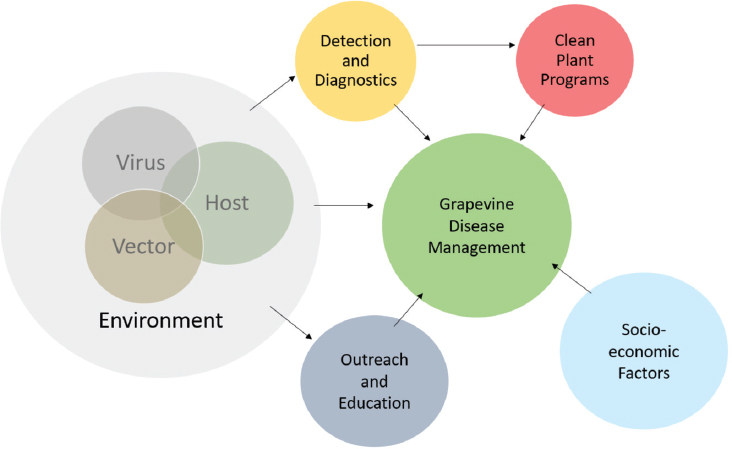
Interdisciplinary research has been defined as “a mode of research by teams or individuals that integrates information, data, techniques, tools, perspectives, concepts, and/or theories from two or more disciplines or bodies of specialized knowledge to advance fundamental understanding or to solve problems whose solutions are beyond the scope of a single discipline or area of research practice” (IOM, 2005). The integration of knowledge is crucial to the “systems thinking” approach needed to solve complex problems like vector-borne diseases. Effective management of vector-borne diseases requires research to understand the virus(es), vector(s), hosts, and their interactions, as well as the influence of environmental factors on the pathosystem. Knowledge of the pathosystem is needed for developing detection and diagnostic tools and methods for use in clean plant programs and in monitoring and early detection of GLRaVs and GRBV in vineyards. In addition, knowledge of socioeconomic factors that may prevent growers from adopting disease management strategies or participating in areawide pest management is also crucial, as is finding and implementing the most effective educational and outreach strategies (see Figure 6-1).
Conclusion 6-13: GLD and GRBD research would benefit from an interdisciplinary approach, wherein findings and perspectives of experts from various disciplines and growers are integrated to gain a holistic understanding of a complex problem.
Recommendation 6-13: Consider allocating funding specifically for research projects that employ an interdisciplinary approach.
Fostering Information Sharing, Interactions, and Collaboration
In the past, the PD/GWSS Board sponsored an annual symposium that facilitated information sharing and interactions among funded researchers. With the COVID-19 pandemic, this symposium was moved online and then canceled in most recent years. Although holding an annual in-person symposium can be costly, it is important for researchers studying GLD and GRBD (in California or elsewhere in the United States and the world) to interact and share information in a timely manner, and to have some mechanism for integrating information generated by research teams and forming synergistic collaborations. PD/GWSS project progress reports are available online9 and shared among researchers and stakeholders; however, additional efforts are required to integrate the information on GLD and GRBD generated to date. Greater sharing and integration of research findings could be facilitated by the establishment of a dedicated working group
___________________
hat includes all or most researchers who study GLD and GRBD, and/or through expanded opportunities for U.S. and international researchers to interact and share ideas at in-person meetings.
Engagement with a USDA-sponsored Multistate Research Coordinating Committee and Information Exchange Group represents one model. One such exchange group is the WERA20,10 which meets annually and facilitates the exchange of information and ideas related to fruit crops, including grapevines. WERA20 focuses on a wide range of diseases caused by graft-transmissible pathogens, such as viruses, viroids, phytoplasmas, and systemic bacterial pathogens (Fuchs et al., 2021). It includes official representatives from various states, although multiple representatives from the same state attend annual meetings, which are held in states with significant fruit crop industries, such as California, Washington, New York, and Michigan.11 Annual meetings typically consist of two days of state reports and research presentations followed by a half-day tour of the local fruit
___________________
crop industries. WERA20 already includes strong representation by researchers involved in grapevine virus research, including researchers funded by the PD/GWSS Board. Increasing the formal presence of the PD/GWSS Board at this annual meeting by sponsoring a mini workshop on topics of interest to the CDFA could represent a relatively low-cost substitute for a yearly research symposium. The opportunity for researchers studying GLD and GRBD to interact with researchers studying other fruit crops such as stone fruits, citrus, and berries would offer the additional advantage of facilitating a broader exchange of ideas and research breakthroughs.
Coordinating with other existing organizations and events could provide additional venues for GLD and GRBD researchers to share research and exchange ideas. For example, it may be possible for the PD/GWSS Board to organize sessions within the annual conference of the American Society for Enology and Viticulture or the annual Unified Wine and Grape Symposium.12 To facilitate further collaboration among researchers across states, California’s wine grape industry could also advocate for the creation of a multistate research or exchange project under the Hatch Multistate Research Fund, which is administered by the USDA National Institute of Food and Agriculture and supports agricultural research to address problems across multiple states.13
The Emerging Viruses in Cucurbits Working Group (EVCWG) offers another potential model for facilitating collaboration on GLD and GRBD issues. The EVCWG was established in 2022 through the initiative of cucurbit researchers with support from the U.S. cucurbit industry and funding from the Southern IPM Center (see Box 6-1).14 It is composed of members from all sectors (research, production, extension/outreach, and regulation) of the U.S. cucurbit industry. Establishing a working group under a similar model for grapevine viruses could facilitate communication and dissemination of resources and findings among researchers, extension agents, growers, and other members of the wine grape industry. Additionally, such a group can be useful for facilitating sharing of prepublication data related to pathogen sequences and biology, which has enabled faster responses to emerging diseases (Hadfield et al., 2018; Dhami et al., 2022;
___________________
12 See https://www.unifiedsymposium.org/.
13 See https://www.nifa.usda.gov/grants/programs/capacity-grants/hatch-act-1887-multistateresearch-fund.
14 The Southern IPM Center is funded by the USDA National Institute of Food and Agriculture to promote IPM. It is the hub of a multi-state partnership and communication network for connecting researchers, growers, extension educators, commodity organizations, environmental groups, pest control professionals, government agencies, and others. The Western Region IPM Center, headquartered at the University of California, Davis (https://westernipm.org/), is the western counterpart to the Southern IPM Center.
BOX 6-1
The Emerging Viruses in Cucurbits Working Group
The creation, mission, and accomplishments of the Emerging Viruses in Cucurbits Working Group (EVCWG) provide an illustrative example of academic-industry collaboration that could help to guide similar efforts to facilitate information exchange on grapevine virus diseases.
During the 2021 annual Plant Health meeting of the American Phytopathological Society, Bill Wintermantel of the USDA Agricultural Research Service and Rebecca Melanson of Mississippi State University Extension led a discussion of cucurbit-infecting viruses among interested researchers. A follow-up discussion with participants from the cucurbit industry was held two months later. During these discussions, participants identified critical needs for the cucurbit industry to better address the challenges of cucurbit-infecting viruses, including increased knowledge of current and potential virus threats and improved educational resources on virus threats for a variety of industry stakeholders. To address these challenges and facilitate coordination and knowledge sharing among scientists and industry members across multiple sectors of the cucurbit industry, the EVCWG was established in 2022 through the initiative of academic researchers with support from the U.S. cucurbit industry and funding from the Southern IPM Center.
The EVCWG is composed of 27 members representing various sectors (research, production, extension/outreach, and regulation) of the U.S. cucurbit industry and a few members from other countries. It is led by two co-chairs and has nine steering committee members (two from industry, three from government research organizations, and four from university research or extension organizations).
The mission of the EVCWG is to improve knowledge of and communication about viruses and their spread across the industry, promote strategies to identify and mitigate virus threats to cucurbit production, and educate stakeholders on emerging viruses of cucurbits and the mission and initiatives of the EVCWG both in the United States and internationally. To achieve its mission, the EVCWG holds quarterly meetings; maintains a websitea to share and communicate EVCWG initiatives, activities, and educational resources; develops educational webcasts, videos, recorded presentations, and fact sheets on virus threats to cucurbit production; and delivers educational presentations to stakeholders on emerging viruses and their management. Work group members have given talks and hosted outreach events on cucurbit virus threats and the EVCWG at industry, trade, and scientific meetings across several states. Together, these activities have fostered closer cooperation among scientists in academia, government, and industry to address a common interest of tackling viruses in cucurbit production systems.
__________________
Open Wheat Blast).15 Greater collaboration and data sharing can also enable rapid response to changes in virus populations (for example, by modifying molecular detection methods to better detect viruses in the field; Thompson et al., 2019) and build a network of scientists ready to respond as virus diseases of grapevine evolve and emerge.
Conclusion 6-14: Sharing of information and collaboration among researchers is essential to interdisciplinary research and to facilitating a “systems thinking” approach for solving complex problems.
Conclusion 6-15: Groups such as WERA20 and EVCWG have effectively facilitated the dissemination of information and the exchange of ideas about virus diseases in crops among researchers, extension agents, growers, and other stakeholders.
Recommendation 6-14 (MP): As an alternative to the annual Pierce’s disease symposium, consider coordinating with other organizations to hold sessions on GLD and GRBD at events such as the annual conference of the American Society for Enology and Viticulture and the Unified Wine and Grape Symposium. These sessions could also serve as a platform to facilitate new collaborations involving scientists working on other grape diseases or working in other wine grape producing regions.
Recommendation 6-15: Consider enhancing PD/GWSS Board participation in WERA20 annual meetings through sponsorship of workshops to build synergies and facilitate cross-pollination of strategies and technologies across specialty crops.
Recommendation 6-16 (HP): Explore the feasibility of creating a working group, supported by the wine grape industry and funded by another entity, that can facilitate information sharing and foster collaboration among GLD and GRBD researchers.
EDUCATION AND OUTREACH
Information Dissemination
As understanding of GLD and GRBD continues to advance, it is critical to make the expanding body of knowledge available to wine industry stakeholders, including grape growers, crop consultants, and wineries,
___________________
to help with disease management decision making. Many solutions for insect-vectored virus diseases in grapevines that are relatively simple to implement have not been widely adopted, a gap that has been attributed to a lack of effective communication with and knowledge dissemination to decision makers (Fuchs, 2020). Hobbs et al. (2022) identified growers’ lack of knowledge regarding the cause of GLD as an important barrier to the adoption of control tactics, in addition to the economic costs of implementation. Similarly, the adoption of current GRBD management practices has likely been hampered by a lack of information and education (Hobbs et al., 2022). Innovative strategies in education and outreach that utilize dynamic information technologies would help provide greater connectivity between those with scientific knowledge and those who can use it to maintain the health and productivity of their vineyards. Having open communication with growers across the California wine grape production areas could also help with aligning what growers consider as priority issues and what researchers perceive as priority research needs. Efforts in regional education and outreach like the Lodi Winegrape Commission16 and the Napa County Vine Mealybug Management Program17 provide models for other wine grape regions in California.
Conclusion 6-16: Gaps in communication and knowledge dissemination contribute to the underutilization of GLD and GRBD management practices, underscoring the importance of having more effective educational and outreach strategies as knowledge of GLD and GRBD advances.
Recommendation 6-17: Consider allocating funds for projects to advance innovative educational and outreach strategies to help improve grower and extension educator knowledge of GLD and GRBD and strategies for their control.
Recommendation 6-18 (HP): Provide opportunities for funded researchers to share findings and recommendations regarding grapevine viruses via a dedicated website or a virtual town hall that facilitates interactive discussions about GLD and GRBD among researchers, extension agents, and growers.
___________________
Grower Adoption of Disease Control Strategies
Science and technology alone do not solve problems—people do, and very little about their behavior is predictable or even rational (Kahneman, 2011). If it is challenging for people to adopt changes with proven benefits such as boiling water to make it safe for drinking (Rogers, 1962) or putting wheels on suitcases (Marçal, 2021), it is understandable that agricultural systems will face challenges in grappling with complex decisions around infectious disease. Fortunately, the social sciences have advanced significantly since Ryan and Gross (1943) investigated why some farmers in Iowa adopted hybrid seed corn and why some did not and identified the stages in the innovation adoption process (Rogers, 1995). That early work gave rise to the diffusion of innovations paradigm, later expanded on in Diffusion of Innovations (Rogers, 1962), which provides insights about how an idea or product (i.e., innovation) spreads through a social system (LaMorte, 2022). In the context of agriculture, there is growing awareness of the effects of human actors in addition to the host, vectors, and pathogens in the epidemiology of plant diseases. Garcia-Figuera et al. (2024) point out “a need to better characterize how attributes of epidemics determine the usefulness of collective management, what influences actors’ decisions to participate, what governance systems fit different plant health threats, and how these subsystems interact to lead to plant health outcomes.” These are researchable topics of equal significance to other dimensions of the effort to mitigate the damage of GLRaVs and GRBV. For example, the careful use of well-designed surveys and appropriate statistical analyses can reveal distinct producer “archetypes” and their unique priorities and help map the network of information flow through stakeholders. These studies are especially significant when collective action is required for success of a disease intervention (Lowder et al., 2024a,b).
Regardless of the science that supports any pest management recommendation, there will still be a high degree of uncertainty with regard to adoption of control tactics by growers. Adoption is most critical and apparent with respect to practices that depend on areawide implementation for success. Because an infectious disease knows no boundaries, a few growers who do not opt into a best practice for vector control could undermine the effectiveness of control across a larger region. This is known as a “weakest link public good problem.” It is, therefore, of utmost importance that growers and researchers become collaborators in the search for practical solutions and that information flows freely and frequently in both directions. It is also important to convey information via growers’ social networks, which is linked to practice adoption (Lubell, 2024).
Conclusion 6-17: Successful control of vector-borne diseases relies not only on understanding the pathosystem and devising strategies to control the pathogen or its vector, but also on what growers decide to do, known as “willingness to adopt” (e.g., to participate in areawide pest management programs or not).
Conclusion 6-18: Social science research has shown that social networks play an important role in social learning (learning by observing others) and subsequently, in the adoption of innovations (e.g., pest management practices).
Recommendation 6-19 (HP): Support research to better understand the sociological aspects of managing vector-borne diseases through collective action (i.e., areawide pest management) and find ways to increase grower participation in areawide pest management programs.
Recommendation 6-20 (HP): Support research on understanding and improving the flow of information across grower social networks and on outreach efforts to understand the drivers and barriers to successful adoption of GLD and GBRD management practices.
RESEARCH PRIORITIZATION
High- and medium-priority research areas and actions (with the recommendation number) are summarized in Table 6-1 for quick reference.
TABLE 6-1 Future Considerations Prioritization
| High-Priority Research Areas |
|---|
| Research that will lead to the development of publicly available, regionally relevant insect population models and disease risk models that can be used to guide local and areawide management activities for GLD and GRBD (Recommendation 6-5) |
| Research to better understand the sociological aspects of managing vector-borne diseases through collective action (i.e., areawide pest management) and find ways to increase grower participation in areawide pest management programs (Recommendation 6-19) |
| Research on understanding and improving the flow of information across grower social networks and on outreach efforts to understand the drivers and barriers to successful adoption of GLD and GBRD management practices (Recommendation 6-20) |
| Medium-Priority Research Areas |
| Research to investigate the potential utility of trunk injection to control vectors and viruses with various pesticides (including new approaches such as RNAi and nanobodies) in grapevines (Recommendation 6-4) |
| High-Priority Actions |
| Changing the name of the PD/GWSS Board research and outreach grants to accurately reflect the scope of its RFPs, which include multiple grapevine virus diseases and their insect vectors (Recommendation 6-6) |
| Developing additional funding mechanisms to address particular needs for GLD or GRBD research, such as through inviting specific researchers to address particular knowledge gaps or accepting off-cycle proposals (Recommendation 6-9) |
| Funding longer-term projects such as studies that advance control recommendations, translational research, and projects that integrate economic and societal impacts (Recommendation 6-10) |
| Funding research to replicate experimental results in more than one location and with different research teams to obtain more robust and reliable insights (Recommendation 6-11) |
| Creating a working group, supported by the wine grape industry and funded by another entity, that can facilitate information sharing and foster collaboration among GLD and GRBD researchers (Recommendation 6-16) |
| Providing opportunities for funded researchers to share findings and recommendations regarding grapevine viruses via a dedicated website or a virtual town hall (Recommendation 6-18) |
| Medium-Priority Actions |
| Supporting interdisciplinary research teams to advance RNAi research for the suppression of vectors in vineyards (Recommendation 6-2) |
| Offering specific funding for early- and mid-career researchers to encourage engagement in grapevine virus diseases (Recommendation 6-8) |
| As an alternative to the annual Pierce’s disease symposium, coordinating with other organizations to hold sessions on GLD and GRBD at events such as the annual conference of the American Society for Enology and Viticulture and the Unified Wine and Grape Symposium (Recommendation 6-14) |
REFERENCES
Abraham, E. G., S. J. Cha, and M. Jacobs-Lorena. 2007. Towards the genetic control of insect vectors: An overview. Entomological Research 37(4):213-220.
Adeyinka, O. S., S. Riaz, N. Toufiq, I. Yousaf, M. U. Bhatti, A. Batcho, A. A. Olajide, I. A. Nasir, and B. Tabassum. 2020. Advances in exogenous RNA delivery techniques for RNAi-mediated pest control. Molecular Biology Reports 47:6309-6319.
Andrade, E. C., and W. B. Hunter. 2016. RNA interference—Natural gene-based technology for highly specific pest control (HiSPeC). In RNA interference, edited by I. Y. Abdurakhmonov. Rijeka, Croatia: InTech. Pp. 391-409.
Andrade, E. A., and W. B. Hunter. 2017. RNAi feeding bioassay: Development of a nontransgenic approach to control Asian citrus psyllid and other hemipterans. Entomologia Experimentalis et Applicata 162:389-396.
Archer, L., J. H. Crane, and U. Albrecht. 2022a. Trunk injection as a tool to deliver plant protection materials—an overview of basic principles and practical considerations. Horticulturae 8(6):552, https://doi.org/10.3390/horticulturae8060552 (accessed August 20, 2024).
Archer, L., J. Qureshi, and U. Albrecht. 2022b. Efficacy of trunk injected Imidacloprid and oxytetracycline in managing Huanglongbing and Asian citrus psyllid in infected sweet orange (Citrus sinensis) trees. Agriculture 12:1-24. https://doi.org/10.3390/agriculture12101592 (accessed August 20, 2024).
Archer, L., and U. Albrecht. 2023. Evaluation of trunk injection techniques for systemic delivery of Huanglongbing therapies in citrus. HortScience 58(7):768-778. https://doi.org/10.21273/HORTSCI17172-23 (accessed August 20, 2024).
Archer, L., S. Kunwar, F. Alferez, O. Batuman, and U. Albrecht. 2023. Trunk injection of oxytetracycline for Huanglongbing management in mature grapefruit and sweet orange trees. Phytopathology https://doi.org/10.1094/PHYTO-09-22-0330-R (accessed August 20, 2024).
Bachman, P. M., K. M. Huizinga, P. D. Jensen, G. Mueller, J. Tan, J. P. Uffman, and S. L. Levine. 2016. Ecological risk assessment for DvSnf7 RNA: A plant-incorporated protectant with targeted activity against western corn rootworm. Regulatory Toxicology and Pharmacology 81:77-88, https://doi.org/10.1016/j.yrtph.2016.08.001 (accessed August 19, 2024).
Barclay, H. J. 2021. Mathematical models for using sterile insects. In Sterile insect technique, edited by V. A. Dyck, J. Hendrichs, and A. S. Robinson. Boca Raton, FL: CRC Press. Pp. 201-244. http://dx.doi.org/10.1201/9781003035572-7 (accessed August 20, 2024).
Batuman, O., A. J. Campbell, D. E. Ullman, R. L. Gilbertson, N. McRoberts, and L. Coop. 2015. Using a degree day insect development model to guide strategic management of western flower thrips and tomato spotted wilt virus (Family Bunyaviridae, Genus Tospovirus) on processing tomato in the Central Valley of California. ISHS Acta Horticulturae 1069:309-314.
Batuman, O., T. A. Turini, M. LeStrange, S. Stoddard, G. Miyao, B. J. Aegerter, L.-F. Chen, N. McRoberts, D. E. Ullman, and R. L. Gilbertson. 2020. Development of an IPM strategy for thrips and tomato spotted wilt virus in processing tomatoes in the Central Valley of California. Pathogens 9(8):636. https://doi.org/10.3390/pathogens9080636 (accessed August 20, 2024).
Batuman, O., K. Britt-Ugartemendia, S. Kunwar, S. Yilmaz, L. Fessler, A. Redondo, K. Chumachenko, S. Chakravarty, and T. Wade. 2024. The use and impact of antibiotics in plant agriculture: A review. Phytopathology 114(5):885-909. https://doi.org/10.1094/PHYTO-10-23-0357-IA (accessed August 20, 2024).
Berger, C., and F. Laurent. 2019. Trunk injection of plant protection products to protect trees from pests and diseases. Crop Protection 124:104831. https://doi.org/10.1016/j.cropro.2019.05.025 (accessed August 20, 2024).
Boina, D. R., and J. R. Bloomquist. 2015. Chemical control of the Asian citrus psyllid and of Huanglongbing disease in citrus. Pest Management Science 71(6):808-823. https://doi.org/10.1002/ps.3957 (accessed August 20, 2024).
Bolognesi, R., P. Ramaseshadri, J. Anderson, P. Bachman, W. Clinton, R. Flannagan, O. Ilagan, C. Lawrence, S. Levine, W. Moar, G. Mueller, J. Tan, J. Uffman, E. Wiggins, G Heck, and G. Segers. 2012. Characterizing the mechanism of action of double-stranded RNA activity against western corn rootworm (Diabrotica virgifera virgifera LeConte). PLoS ONE 7(10):e47534._https://doi.org/10.1371/journal.pone.0047534 (accessed August 19, 2024).
Bové, J. M. 2006. Huanglongbing: a destructive, newly-emerging, century-old disease of citrus. Journal of Plant Pathology 88:7-37. https://www.jstor.org/stable/41998278 (accessed August 20, 2024).
Brooks, D. S., C. F. Gonzalez, D. N. Appel, and T. H. Filer. 1994. Evaluation of endophytic bacteria as potential biological control agent for oak wilt. Biological Control 4:373-381.
Buchman, A., S. Gamez, M. Li, I. Antoshechkin, H. H. Li, H.-W. Wang, C.-H. Chen, M. J. Klein, J.-B. Duchemin, J. E. Crowe Jr., P. N. Paradkar, and O. S. Akbari. 2020. Correction: Broad dengue neutralization in mosquitoes expressing an engineered antibody. PLOS Pathogens 16(4): e1008545. https://doi.org/10.1371/ (accessed August 10, 2024).
Calzarano, F., S. Di Marco, and A. Cesari. 2004. Benefit of fungicide treatment after trunk renewal of vines with different types of esca necrosis. Phytopathologia Mediterranea 43:116-124.
Carballar-Lejarazú, R., Y. Dong, T. B. Pham, T. Tushar, R. M. Corder, A. Mondal, H. M. Sánchez C., H. F. Lee, J. M. Marshall, G. Dimopoulos, and A. A. James. 2023. Dual effector population modification gene-drive strains of the African malaria mosquitoes, Anopheles gambiae and Anopheles coluzzii. Proceedings of the National Academy of Sciences 120(29):e2221118120.
Carvalho, D. O., A. R. McKemey, L. Garziera, R. Lacroix, C. A. Donnelly, L. Alphey, A. Malavasi, and M. L. Capurro. 2015. Suppression of a field population of Aedes aegypti in Brazil by sustained release of transgenic male mosquitoes. PLOS Neglected Tropical Diseases 9(7):e0003864. https://doi.org/10.1371/journal.pntd.0003864. (accessed September 3, 2024).
Chappell, T. M., C. B. Codod, B. W. Williams, R. C. Kemerait, A. K. Culbreath, and G. G. Kennedy. 2020a. Adding epidemiologically important meteorological data to Peanut Rx, the risk assessment framework for spotted wilt of peanut. Phytopathology 110:1199-1207.
Chappell, T. M., R. V. Ward, K. T. DePolt, P. M. Roberts, J. K. Greene, and G. G. Kennedy. 2020b. Cotton thrips infestation predictor: a practical tool for predicting tobacco thrips (Frankliniella fusca) infestation of cotton seedlings in the southeastern United States. Pest Management Science 76:4018-4028. https://doi.org/10.1002/ps.5954.
Christiaens, O., and G. Smagghe. 2014. The challenge of RNAi-mediated control of hemipterans. Current Opinion in Insect Science 6:15-21.
Christiaens, O., J. Niu, and C. Nji Tizi Taning. 2020. RNAi in insects: A revolution in fundamental research and pest control applications. Insects 11(7):415.
Daane, K. M., C. Vincent, R. Isaacs, and C. Loriatti. 2018. Entomological opportunities and challenges for sustainable viticulture in a global market. Annual Review of Entomology 63:193-214.
de Castro Poncio, L., F. A. dos Anjos, D. A. de Oliveira, A. de Oliveira da Rosa, B. P. Silva, D. Rebechi, J. M. Pedrosa, D. A. da Costa Franciscato, C. de Souza, and N. Paldi. 2023. Prevention of a dengue outbreak via the large-scale deployment of Sterile Insect Technology in a Brazilian city: A prospective study. The Lancet Regional Health – Americas 21:100498.
Del Frari, G., J. Costa, H. Oliveira, and R. Boavida Ferreira. 2018. Endotherapy of infected grapevine cuttings for the control of Phaeomoniella chlamydospora and Phaeoacremonium minimum. Phytopathologia Mediterranea 57:239-448.
Dhami, S., D. Thompson, M. El Akoum, D. W. Bates, R. Bertollini, and A. Sheik. 2022. Data-enabled responses to pandemics: Policy lessons from COVID-19. Nature Medicine 28:2243-2246, https://doi.org/10.1038/s41591-022-02054-0 (accessed August 10, 2024)
Di Marco, S., A. Mazzullo, F. Calzarano, and A. Cesari. 2000. The control of esca: Status and perspectives. Phytopathologia Mediterranea 39:232-240.
Doğan, C., S. Hänniger, D. G. Heckel, C. Coutu, D. D. Hegedus, L. Crubaugh, R. L. Groves, D. A. Mutlu, Z. Suludere, Ş. Bayram, and U. Toprak. 2021. Characterization of calcium signaling proteins from the fat body of the Colorado Potato Beetle, Leptinotarsa decemlineata (Coleoptera: Chrysomelidae): Implications for diapause and lipid metabolism. Insect Biochemistry and Molecular Biology 133:103549.
Dong, Y., M. L. Simões, and G. Dimopoulos. 2020. Versatile transgenic multistage effector-gene combinations for Plasmodium falciparum suppression in Anopheles. Science Advances 6(20):eaay5898. https://www.ncbi.nlm.nih.gov/pmc/articles/PMC7220273/ (accessed August 29, 2024).
Dula, T., E. M. Kappes, A. Horvath, and A. Rabai. 2007. Preliminary trials on treatment of esca-infected grapevines with trunk injection of fungicides. Phytopathologia Mediterranea 46:91-95.
El-Shesheny, I., S. Hajeri, I. El-Hawary, S. Gowda, and N. Killiny. 2013. Silencing abnormal wing disc gene of the Asian citrus psyllid, Diaphorina citri disrupts adult wing development and increases nymph mortality. PLoS ONE 8:e65392. https://doi.org/10.1371/journal.pone.0065392 (accessed August 12, 2024).
Fletcher, S. J., P. T. Reeves, B. T. Hoang, and N. A. Mitter. 2020. A perspective on RNAi-based biopesticides. Frontiers in Plant Science 11. https://doi.org/10.3389/fpls.2020.00051/full (accessed August 14, 2024).
Fuchs, M. 2020. Grapevine viruses: A multitude of diverse species with simple but overall poorly adopted management solutions in the vineyard. Journal of Plant Pathology 102(3):643-653.
Fuchs, M., C. V. Almeyda, M. Al Rwahnih, S. S. Atallah, E. J. Cieniewicz, K. Farrar, W. R. Foote, D. A. Golino, M. I. Gómez, S. J. Harper, M. K. Kelly, R. R. Martin, T. Martinson, F. M. Osman, K. Park, V. Scharlau, R. Smith, I. E. Tzanetakis, G. Vidalakis, and R. Welliverhttps. 2021. Economic studies reinforce efforts to safeguard specialty crops in the United States. Plant Disease 105(1):14-26. https://doi.org/10.1094/PDIS-05-20-1061-FE (accessed September 4, 2024).
Garcia-Figuera, S., S. R. Lowder, M. N. Lubell, and W. F. Mahaffee. 2024. Free-riding in plant health: A social-ecological systems approach to collective action. Annual Review of Phytopathology 62:4.1-4.28.
Ghannam, A., S. Kumari, S. Muyldermans, and A. Q. Abbady. 2015. Camelid nanobodies with high affinity for broad bean mottle virus: A possible promising tool to immunomodulate plant resistance against viruses. Plant Molecular Biology 87:355-369.
Ghosh, S. K., D. E. Gundersen-Rindal, A. L. Park, and W. B. Hunter. 2018. Double-stranded RNA oral delivery methods to induce RNA interference in phloem and plant-sap-feeding hemipteran insects. Journal of Visualized Experiments 135:e57390.
Gottwald, T. R. 2010. Current epidemiological understanding of citrus Huanglongbing. Annual Review of Phytopathology 48:119-139. https://doi.org/10.1146/annurev-phyto-073009-114418 (accessed August 20, 2024).
Grafton-Cardwell, E. E., L. L. Stelinski, and P. A. Stansly. 2013. Biology and management of Asian citrus psyllid, vector of the Huanglongbing pathogens. Annual Review of Entomology 58:413-432, https://doi.org/10.1146/annurev-ento-120811-153542 (accessed August 20, 2024).
Graham, J., T. R. Gottwald, and M. Setamou. 2020. Status of Huanglongbing (HLB) outbreaks in Florida, California and Texas. Tropical Plant Pathology 45:265-278.
Gordon, K., and P. Waterhouse. 2007. RNAi for insect-proof plants. Nature Biotechnology 25:1231-1232.
Hadfield, J., C. Megill, S. M. Bell, J. Huddleston, B. Potter, C. Callender, P. Sagulenko, T. Bedford, and R. A. Neher. 2018. Nextstrain: Real-time tracking of pathogen evolution. Bioinformatics 34(23):4121-4123
Halbert, S. E., and K. L. Manjunath. 2004. Asian citrus psyllids (Sternorrhyncha: Psyllidae) and greening disease of citrus: A literature review and assessment of risk in Florida. Florida Entomologist 87:330-353. https://doi.org/10.1653/0015-4040(2004)087[0330:ACPSPA]2.0.CO;2 (accessed August 20, 2024).
Hall, D. G., M. L. Richardson, E. D. Ammar, and S. E. Halbert. 2013. Asian citrus psyllid, Diaphorina citri, vector of citrus Huanglongbing disease. Entomologia Experimentalis et Applicata 146(2):207-223. https://doi.org/10.1111/eea.12025 (accessed August 20, 2024).
Head, G. P., M. Carroll, S. Evans, D. M. Rule, A. Willse, T. Clark, N. Storer, R. Flannagan, L. Samuel, and L. Meinke. 2017. Evaluation of SmartStax and SmartStax PRO Maize against western corn rootworm and northern corn rootworm: Efficacy and resistance management. Pest Management Science 73(9):1883-1899.
Hemmer, C., S. Djennane, L. Ackerer, K. Hleibieh, A. Marmonier, S. Gersch, S. Garcia, E. Vigne, V. Komar, M. Perrin, and C. Gertz. 2018. Nanobody-mediated resistance to grapevine fanleaf virus in plants. Plant Biotechnology Journal 16(2):660-671.
Hobbs, M. B., S. M. Vengco, S. L. Bolton, L. J. Bettiga, M. M. Moyer, and M. L. Cooper. 2022. Adoption of best management practices for grapevine leafroll and red blotch diseases: A survey of West Coast growers. PhytoFrontiers 2:181-191.
Hu, J., and N. Wang. 2016. Evaluation of the spatiotemporal dynamics of oxytetracycline and its control effect against citrus Huanglongbing via trunk injection. Phytopathology 106(12):1495-1503, https://doi.org/10.1094/PHYTO-02-16-0114-R (accessed August 20, 2024).
Hu, J., J. Jiang, and N. Wang. 2017. Control of citrus Huanglongbing via trunk injection of plant defense activators and antibiotics. Phytopathology 108(2):186-195. https://doi.org/10.1094/PHYTO-05-17-0175-R (accessed August 20, 2024).
Hunter, W. B., and X. Sinisterra-Hunter. 2018. Emerging RNA suppression technologies to protect citrus trees from citrus greening disease bacteria. Advances in Insect Physiology 55:163-199.
Hunter, W. B., E. Glick, N. Paldi, and B. R. Bextine. 2012. Advances in RNA interference: dsRNA treatment in trees and grapevines for insect pest population suppression. Southwestern Entomologist 37:85-87.
Hunter, W. B., T. M. Gonzalez, and A. Andrade. 2019. Double stranded RNA compositions for reducing Asian citrus psyllid infestation and methods of use. U.S. Patent 10,344,291 B2, 7 September 2019.
Hunter, W. B., S.-K.V. Clarke, A. F. S. Mojica, T. M. Paris, G. Miles, J. L. Metz, C. S. Holland, G. McCollum, J. A. Qureshi, J. M. Tomich, M. J. Boyle, L. Cano, S. Altman, and K. S. Pelz-Stelinski. 2020. Advances in RNA suppression of the Asian citrus psyllid vector of bacteria (Huanglongbing pathosystem). In Asian citrus psyllid. biology, ecology and management of the Huanglongbing vector, edited by P. Stansly and J. Qureshi. Wallingford, Oxfordshire, UK: Commonwealth Agricultural Bureau International (CABI Press). Pp. 258-283.
Ingram, J. R., F. I. Schmidt, and H. L. Ploegh. 2018. Exploiting nanobodies’ singular traits. Annual Review of Immunology 36(1):695-715.
IOM (Institute of Medicine). 2005. Facilitating interdisciplinary research. Washington, DC: The National Academies Press. https://doi.org/10.17226/11153.
Jain, R. G., K. E. Robinson, S. J. Fletcher, and N. Mitter. 2020. RNAi-based functional genomics in Hemiptera. Insects 11:557.
Jeger, M., R. Beresford, C. Bock, N. Brown, A. Fox, A. Newton, A. Vicent, X. Xu, and J. Yuen. 2021. Global challenges facing plant pathology: Multidisciplinary approaches to meet the food security and environmental challenges in the mid-twenty-first century. CABI Agriculture and Bioscience 2(1):1-18.
Kahneman, D. 2011. Thinking, fast and slow. United States: Farrar, Straus, and Giroux.
Kandul, N. P., J. Liu, H. M. Sánchez C., S. L. Wu, J. M. Marshall, and O. S. Akbari. 2019. Transforming insect population control with precision guided sterile males with demonstration in flies. Nature Communications 10:84. https://doi.org/10.1038/s41467-018-07964-7 (accessed August 9, 2024).
Kemerait, R. C., T. B. Brenneman, and A. C. Culbreath. 2004. A risk index for leaf spot and soilborne diseases of peanut in Georgia. In 2003 Georgia peanut research and extension report, edited by T. B. Brenneman and C. L. Butts. Univ. Ga. Coop. Ext. Serv. and U.S. Dep. Agric., Tifton, Ga. Pp. 83-90.
Killiny, N., S. Hajeri, S. Tiwari, S. Gowda, and L. L. Stelinski. 2014. Double-stranded RNA uptake through topical application, mediates silencing of five CYP4 genes and suppresses insecticide resistance in Diaphorina citri. PLoS ONE 9:e0110536.
Killiny, N., F. Hijaz, P. Gonzalez-Blanco, S. E. Jones, M. O. Pierre, and C. I. Vincent. 2020. Effect of adjuvants on oxytetracycline uptake upon foliar application in citrus. Antibiotics 9(10):677. https://doi.org/10.3390/antibiotics9100677 (accessed August 20, 2024).
Kishk, A., H. A. I. Anber, T. K. Abdel-Raof, A.-H. D. El-Sherbeni, S. Hamed, S. Gowda, and N. Killiny. 2017. RNA interference of carboxylesterases causes nymph mortality in the Asian citrus psyllid, Diaphorina citri. Archives of Insect Biochemistry and Physiology 94:e21377.
Koch, K. A., G. L. Quiram, and R. C. Venette. 2010. A review of oak wilt management: A summary of treatment options and their efficacy. Urban Forestry & Urban Greening 9(1):1-8. https://doi.org/10.1016/j.ufug.2009.11.004 (accessed August 20, 2024).
LaMorte, W. W. 2022. Diffusion of innovation theory. https://sphweb.bumc.bu.edu/otlt/MPH-Modules/SB/BehavioralChangeTheories/BehavioralChangeTheories4.html (accessed November 14, 2024).
Leftwich, P. T., L. G. Spurgin, T. Harvey-Samuel, C. J. E. Thomas, L. C. Paladino, M. P. Edgington, and L. Alphey. 2021. Genetic pest management and the background genetics of release strains. Philosophical Transactions of the Royal Society B: Biological Sciences 376(1818):20190805.
Li, H., R. Guan, H. Guo, and X. Miao. 2015. New insights into an RNAi approach for plant defence against piercing-sucking and stem-borer insect pests. Plant, Cell & Environment 38:2277-2285.
Li, J., X. P. Wang, M. Q. Wang, W. H. Ma, and H. X. Hua. 2013. Advances in the use of the RNA interference technique in Hemiptera. Insect Science 20:31-39.
Li, M., T. Yang, M. Bui, S. Gamez, T. Wise, N. P. Kandul, J. Liu, L. Alcantara, H. Lee, J. R. Edula, R. Raban, Y. Zhan, Y. Wang, N. DeBeaubien, J. Chen, H. M. Sánchez C., J. B. Bennett, I. Antoshechkin, C. Montell, J. M. Marshall, and O. S. Akbari. 2021. Suppressing mosquito populations with precision guided sterile males. Nature Communications 12:5374, https://doi.org/10.1038/s41467-021-25421-w (accessed August 19, 2024).
Liu, X., Z. Zou, C. Zhang, X. Liu, J. Wang, T. Xin, and B. Xia. 2020. Knockdown of the trehalose-6-phosphate synthase gene using RNA interference inhibits synthesis of trehalose and increases lethality rate in Asian citrus psyllid, Diaphorina citri (Hemiptera: Psyllidae). Insects 11:605.
Lowder, S. R., M. M. Moyer, M. L. Cooper, J. W. Pscheidt, and W. F. Mahaffee. 2024a. Information transfer among grape producers in the western United States on pest and disease management. PhytoFrontiers, https://doi.org/10.1094/PHYTOFR-07-23-0081-R (accessed October 29, 2024).
Lowder, S. R., M. M. Moyer, M. L. Cooper, J. Pscheidt, and W. F. Mahaffee. 2024b. Perspectives towards collective action for pest and disease management in vineyards in the western United States. PhytoFrontiers, https://doi.org/10.1094/PHYTOFR-07-23-0082-R (accessed October 29, 2024).
Lubell, M. 2024. Perspectives on agricultural decision-making for environmental practices. Presentation at the National Academies of Sciences, Engineering, and Medicine Open Session, May 2024.
Marçal, K., 2021. Mother of invention: How good ideas get ignored in an economy built for men. New York, NY: Abrams Press. 296 pp.
Máximo, W. P., J. L. Howell, K. Mogilicherla, M. Basij, S. C. Chereddy, and S. R. Palli. 2020. Inhibitor of apoptosis is an effective target gene for RNAi-mediated control of Colorado potato beetle, Leptinotarsa decemlineata. Archives of Insect Biochemistry and Physiology 104(4):e21685.
McCollum, G., and E. Baldwin. 2016. Chapter 7, Huanglongbing: Devastating disease of citrus. In Horticultural reviews volume 44, edited by J. Janick. Hoboken, New Jersey: Wiley-Blackwell. Pp. 315-361.
Mehlhorn, S. G., S. Geibel, G. Bucher, and R. Nauen. 2020. Profiling of RNAi sensitivity after foliar dsRNA exposure in different European populations of Colorado potato beetle reveals a robust response with minor variability. Pesticide Biochemistry and Physiology 166:104569.
NASEM (National Academies of Sciences, Engineering, and Medicine). 2019. Reproducibility and Replicability in Science. Washington, DC: The National Academies Press. https://doi.org/10.17226/25303.
NSF (US National Science Foundation), n.d. Chapter II: Proposal Preparation Instructions. https://new.nsf.gov/policies/pappg/23-1/ch-2-proposal-preparation#2E3 (accessed August 19, 2024).
Orlov, I., C. Hemmer, L. Ackerer, B. Lorber, A. Ghannam, V. Poignavent, K. Hleibieh, C. Sauter, C. Schmitt-Keichinger, L. Belval, and J. M. Hily. 2020. Structural basis of nanobody recognition of grapevine fanleaf virus and of virus resistance loss. Proceedings of the National Academy of Sciences 117(20):10848-10855.
Oxitec. 2024. The City of Congonhas, Brazil, deploying Oxitec’s Friendly™ Aedes aegypti solution, reports curtailed dengue spike and suppression of dengue-spreading mosquitoes. https://www.oxitec.com/en/news/congonhas (accessed September 3, 2024).
Petek, M., A. Coll, R. Ferenc, J. Razinger, and K. Gruden. 2020. Validating the potential of double-stranded RNA targeting Colorado potato beetle mesh gene in laboratory and field trials. Frontiers in Plant Science 11:1250.
Ramaseshadri, P., G. Segers, R. Flannagan, E. Wiggins, W. Clinton, O. Ilagan, B. McNulty, T. Clark, and R. Bolognesi. 2013. Physiological and cellular responses caused by RNAi-mediated suppression of Snf7 orthologue in western corn rootworm (Diabrotica virgifera virgifera) larvae. PLoS ONE 8(1):e54270. https://doi.org/10.1371/journal.pone.0054270 (accessed August 19, 2024).
Rodrigues, T. B., S. K. Mishra, K. Sridharan, E. R. Barnes, A. Alyokhin, R. Tuttle, W. Kokulapalan, D. Garby, N. J. Skizim, Y.-W. Tang, B. Manley, L. Aulisa, R. D. Flannagan, C. Cobb, and K. E. Narva. 2021. First sprayable double-stranded RNA-based biopesticide product targets proteasome subunit beta type-5 in Colorado potato beetle (Leptinotarsa decemlineata). Frontiers in Plant Science 12. https://doi.org/10.3389/fpls.2021.728652 (accessed August 20, 2024).
Rogers, E. M. 1962. Diffusion of innovations. New York: Free Press.
Rogers, E. M. 1995. Diffusion of innovations, 4th ed. New York: Free Press.
Ryan, B., and N. C. Gross. 1943. The diffusion of hybrid seed corn in two Iowa communities. Rural Sociology 8(1):15.
San Miguel, K., and J. G. Scott. 2016. The next generation of insecticides: dsRNA is stable as a foliar-applied insecticide. Pest Management Science 72(4):801-809.
Shaw, W. R., and F. Catteruccia. 2019. Vector biology meets disease control: Using basic research to fight vector-borne diseases. Nature Microbiology 4(1):20-34.
Shwarz, R. E., J. N. Moll, and S. P. van Vuuren. 1972. Control of citrus greening and its psylla vector by trunk injection of tetracyclines and insecticides. International Organization of Citrus Virologists Conference Proceedings (1957-2010) 6(6). https://doi.org/10.5070/C56189m3pk (accessed August 20, 2024).
Takai, K., T. Soejima, T. Suzuki, and K. Kawazu. 2000. Emamectin benzoate as a candidate for a trunk-injection agent against the pine wood nematode, Bursaphelenchus xylophilus. Pest Management Science 56:937-941.
Taning, C. N. T., E. C. Andrade, W. B. Hunter, O. Christiaens, and G. Smagghe. 2016. Asian citrus psyllid RNAi pathway—RNAi evidence. Scientific Reports 6:38082. https://www.nature.com/articles/srep38082 (accessed August 20, 2024).
Thompson, B. D., J. Dahan, J. Lee, R. R. Martin, and A. V. Karasev. 2019. A novel genetic variant of grapevine leafroll-associated virus-3 (GLRaV-3) from Idaho grapevines. Plant Disease 103(3):509-518.
Tian, F., C. Li, Z. Wang, J. Liu, and X. Zeng. 2018. Identification of detoxification genes in imidacloprid-resistant Asian citrus psyllid (Hemiptera: Liviidae) and their expression patterns under stress of eight insecticides. Pest Management Science 75:1400-1410.
USDA-ARS (US Department of Agriculture-Agricultural Research Service). 2022. USDA scientists produce nanobodies in plant cells that block emerging pathogens. https://www.ars.usda.gov/news-events/news/research-news/2022/usda-scientists-produce-nanobodies-in-plant-cells-that-block-emerging-pathogens/ (accessed August 20, 2024).
USDA-ARS. 2024. Research project: Grove evaluation of symbiont technology. https://www.ars.usda.gov/research/project/?accnNo=445321 (accessed August 20, 2024).
Van den Besselaar, P., and G. Heimeriks. 2001. Disciplinary, multidisciplinary, interdisciplinary: Concepts and indicators. In 8th International conference on scientometrics and informetrics, Vols. 1 and 2, edited by M. Davis and C. S. Wilson. University of New South Wales. Pp. 705-716.
Vincent, C. I., F. Hijaz, M. Pierre, and N. Killiny. 2022. Systemic uptake of oxytetracycline and streptomycin in Huanglongbing-affected citrus groves after foliar application and trunk injection. Antibiotics 11(8):1092. https://doi.org/10.3390/antibiotics11081092 (accessed August 20, 2024).
Vogel, E., D. Santos, L. Mingels, T.-W. Verdonckt, and J. V. Broeck. 2019. RNA interference in insects: Protecting beneficials and controlling pests. Frontiers in Physiology 9:1912.
Yan, J., R. Nauen, S. Reitz, A. Alyokhin, J. Zhang, D. Mota-Sanchez, Y. Kim, S. R. Palli, S. I. Rondon, B. A. Nault, J. L. Jurat-Fuentes, M. S. Crossley, W. E. Snyder, A. M. R. Gatehouse, M. P. Zalucki, B. E. Tabashnik, and Y. Gao. 2024. The new kid on the block in insect pest management: Sprayable RNAi goes commercial. Science China Life Sciences 67:1766-1768.
Yu, X., and N. Killiny. 2018. RNA interference of two glutathione S-transferase genes, Diaphorina citri DcGSTe2 and DcGSTd1, increases the susceptibility of Asian citrus psyllid (Hemiptera: Liviidae) to the pesticides fenpropathrin and hiamethoxam. Pest Management Science 74:638-647.
Yu, X., and N. Killiny. 2020. RNA interference-mediated control of Asian citrus psyllid, the vector of the Huanglongbing bacterial pathogen. Tropical Plant Pathology 45:298-305.
Zhang, Y., S. Li, H. Li, R. Wang, K,-Q. Zhang, and J. Xu. 2020. Fungi–nematode interactions: Diversity, ecology, and biocontrol prospects in agriculture. Journal of Fungi 6:206.
Zhu, F., J. Xu, R. Palli, J. Ferguson, and S. R. Palli. 2011. Ingested RNA interference for managing the populations of the Colorado potato beetle, Leptinotarsa decemlineata. Pest Management Science 67(2):175-182.
Zhu, K. Y., and S. R. Palli. 2020. Mechanisms, applications, and challenges of insect RNA interference. Annual Review of Entomology 65:293-311.


