Advancing Vineyard Health: Insights and Innovations for Combating Grapevine Red Blotch and Leafroll Diseases (2025)
Chapter: 1 Introduction
1
Introduction
Grapevine (Vitis spp.) is one of the most widely cultivated crops in the world; Vitis species are grown for wine, fresh fruit, raisin, and juice. Grapes (table, raisin, and wine) rank second among California’s top 10 agricultural commodities, valued at $5.54 billion for the 2022 crop year (California Department of Food and Agriculture [CDFA], 2024). California is the number one wine-producing state in the United States; in 2022, California accounted for about 80% (599,557,535 gallons) of the total U.S. wine production (752,077,206) (Wine Institute, n.d.). Annually, the California wine and wine grape sector and allied businesses contribute $73 billion to the state’s economy and $170.5 billion to the U.S. economy (Wine Institute, 2022).
There are 904,000 grape-bearing acres (365,836 hectares) in the United States that produce grapes at an average of 6.69 tons/acre (16.53 tons/ha) (Agricultural Marketing Resource Center, 2023). In California, where most of the U.S. grape production occurs, the total grape acreage in 2021 was 881,000 acres (356,528 ha), of which 615,000 acres (248,882 ha) produced wine-type grapes, 127,000 acres (51,396 ha) produced table-type grapes, and 138,000 acres (55,847 ha) produced raisin-type grapes (CDFA, 2022). Among the grape-growing regions of California (Figure 1-1), the North Coast, Central Coast, North San Joaquin Valley, and South San Joaquin Valley are the major wine grape producing areas (based on data from CDFA, 2023).1 Table and raisin grape production is concentrated in the southern
___________________
1 This sentence and Figure 1-1 were revised after the release of the report to clarify the major grape-growing regions of California.
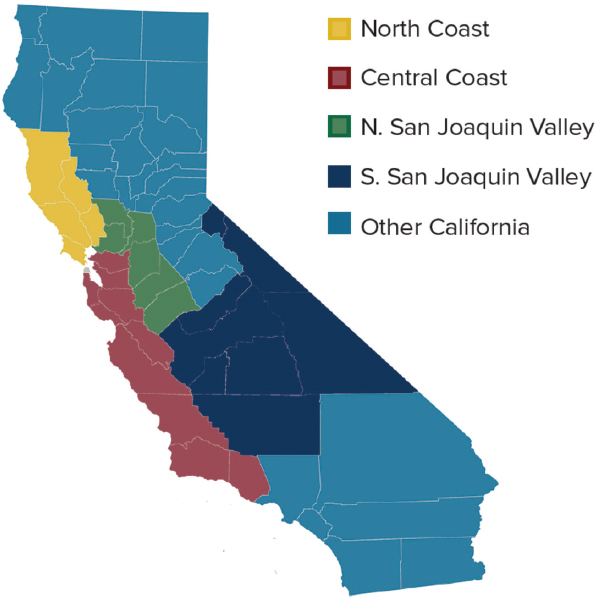
SOURCE: Alston et al. (2020).
San Joaquin Valley (Alston et al., 2020). Census data indicate that there were 11,812 grape-growing farms in California as of 2017 (U.S. Department of Agriculture National Agricultural Statistics Service [USDA/NASS], 2017) with larger farms (average of 140 acres or 56.7 ha) located in the San Joaquin Valley and smaller farms (average of 36 acres or 14.6 ha) located in the coastal regions (Alston et al., 2020). California wine grape growing regions vary in terms of climate, terrain, soil types, mixture of grape varieties grown, and the quantity and quality of grapes and wine produced (Alston et al., 2020). Vineyards across these regions also differ in age and employ different management practices.
GRAPEVINE VIRUSES AND DISEASES
Among all cultivated woody perennials, grapevines are known to be infected with the largest number of viruses (Naidu et al., 2014; Xiao et al., 2018). To date, more than 100 viruses belonging to 21 different families or
having similarity to unclassified plant satellite viruses have been reported on Vitis germplasm worldwide (Fuchs, 2023, and cited references). Viruses of grapevines have been grouped into four categories based on the disease they cause or symptoms they are associated with: 1) degeneration or decline disease complex; 2) leafroll disease complex; 3) rugose wood complex; and 4) fleck disease complex (Naidu et al., 2014).
Grapevine Leafroll Disease
Grapevine leafroll disease (GLD) occurs in all grape-growing regions in the world and causes the most economic damage among all virus and virus-like diseases of grapevine (Martelli, 2000; Freeborough and Burger, 2006; Nimmo-Bell, 2006; Naidu et al., 2008). Several viruses are associated with GLD, and they are collectively referred to as grapevine leafroll-associated viruses or GLRaVs. Among the GLRaVs, grapevine leafroll-associated virus 3 (GLRaV-3) is considered the primary causal agent of GLD (Maree et al., 2013). In 1992, using serological testing techniques, GLRaVs were detected for the first time in previously healthy vines at the Foundation Plant Services vineyard of the University of California, Davis (Rowhani and Golino, 1995). Symptoms of GLD vary between grape cultivars and within the same cultivars. Leaves of infected red or black-fruited cultivars have red or reddish-purple discolorations in the interveinal areas, while tissue on either side of the veins appears green. Leaves of infected white-fruited cultivars exhibit mild yellowing or chlorotic mottling in the interveinal areas, but these symptoms are not pronounced and may not be apparent in many white-fruited cultivars (Naidu et al., 2014). In both the red or black- and white-fruited cultivars, disease symptoms may become apparent in early to mid-summer (i.e., during post-veraison) and leaf margins of symptomatic leaves usually roll downward toward the end of the season (Martelli et al., 2014; Naidu et al., 2014).
Grapevine Red Blotch Disease
In 2008, disease symptoms that somewhat resembled GLD were observed in a Cabernet Sauvignon vineyard in a research station in Oakville, California (Calvi, 2011). Disease symptoms suggestive of GLD were also observed in a Cabernet franc vineyard in New York, and the viral nature of this disease was determined in 2011. In 2012, research groups in California and New York proposed to call the virus associated with this disease (referred to as grapevine red blotch disease, or GRBD) as grapevine red blotch-associated virus, and eventually grapevine red blotch virus (GRBV) (Sudarshana et al., 2015; Yepes et al., 2018). GRBD causes delayed fruit ripening, reduced fruit quality and yield, and effects on wine composition
(Blanco-Ulate et al., 2017; Cieniewicz et al., 2017; Martínez-Lüscher et al., 2019; Cauduro Girardello et al., 2020; Rumbaugh et al., 2021). Since the discovery of GRBV in North America, the virus has been detected in grapevines in other countries, including South Korea (Lim et al., 2016), Switzerland (Reynard et al., 2018), India (Marwal et al., 2019), Argentina (Luna et al., 2019), Italy (Bertazzon et al., 2021), France (Reynard et al., 2022), Australia (Kaur et al., 2023), and Iran (Gholampour et al., 2024).
CDFA SUPPORT FOR GRAPEVINE DISEASES AND PESTS RESEARCH
In 2001, an annual Pierce’s disease (PD) wine grape assessment was established to fund research and other related activities on PD and its vector, the glassy-winged sharpshooter (GWSS). The CDFA Pierce’s Disease/Glassy-Winged Sharpshooter (PD/GWSS) Board, which is composed of representatives from the California wine grape industry, was also established in that year and since then has been providing recommendations to the CDFA Secretary on the use of funds collected under the PD/GWSS wine grape assessment. The annual assessment rate, which is set by the PD/GWSS Board, has averaged $1.35 per $1,000 of value since 2001 and the assessment has collected $83.1 million in total since 2001, (California Ag Network, 2023; Kaiser, 2023). The rate for the 2024 harvest is $1.25 (CDFA, 2024). Every five years, the PD/GWSS Board and the wine grape assessment are subject to a referendum of growers who pay the assessment (M. Kaiser, personal communication, October 4, 2024). The PD/GWSS Board Research and Outreach Program issues a Request for Proposals (RFP) and accepts proposals each year between December 1 and January 31.2 The process by which CDFA selects proposals to fund is illustrated in Figure 1-2.
A total of $43.5 million has been allocated for PD and GWSS research and outreach activities since 2001, while a total of $14.2 million has been allocated for research and outreach activities on other grapevine pests and diseases (e.g., European grapevine moth, brown marmorated stink bug, GRBV, GLRaV, and mealybugs) since 2010.3 From July 2015 through July 2023, the CDFA PD/GWSS Board funded a total of 60 grants: 28 on GRBV; 13 on GLRaV; 10 on vine mealybug Planococcus ficus Signoret, which is a vector of GLRaV-3; and nine on multiple viruses. Several GLRV projects include mealybugs and one GRBV project included PD (Kaiser, 2023). To date, CDFA has funded a total of 72 grants on grapevine viruses and their
___________________
2 The RFP is issued via https://www.cdfa.ca.gov/pdcp/grants/.
3 Information obtained from Funding Research to Safeguard California Winegrapes PD/GWSS Board Fact Sheet, available at https://www.cdfa.ca.gov/pdcp/documents/GWSS_Board_fact_sheet.pdf.
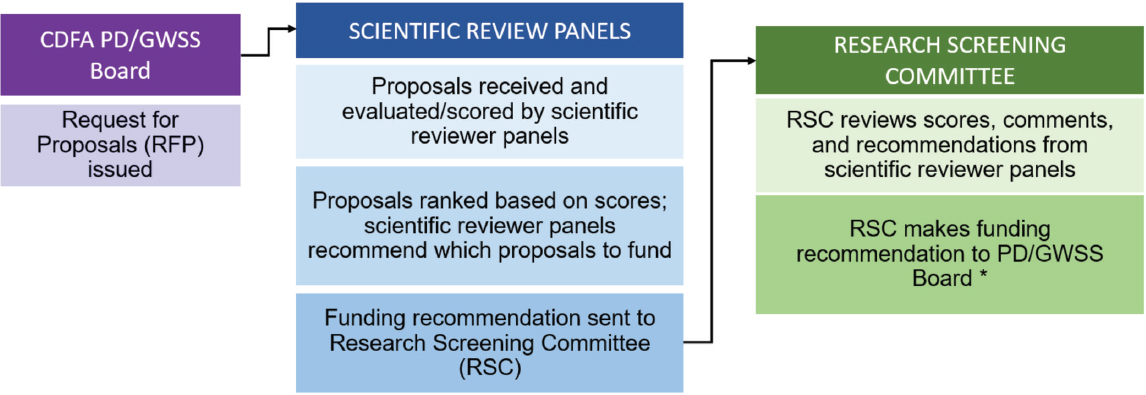
NOTE: *Factors considered by the RSC when making a recommendation to the PD/GWSS Board include scores, reviewer comments, industry and research priorities, program history, history of the project and researchers who submitted the project proposal, and the amount of funding being recommended in relation to the PD/GWSS Board’s overall budget.
SOURCE: Created with information provided by CDFA representatives (M. Kaiser and K. Lowe, personal communication, July 21, 2023).
vectors (M. Kaiser, personal communication, August 12, 2024). Information about CDFA-funded research projects, project summaries, and year-end progress reports are available at the CDFA website.4
STUDY ORIGIN
In 2022, CDFA requested the National Academies of Sciences, Engineering, and Medicine to provide guidance to the CDFA PD/GWSS Board on grapevine viruses and grapevine diseases research by convening an ad hoc committee that would conduct a study with three interrelated activities that address research on GLRaV-3 and GRBV, the diseases they are associated with, and their insect vectors. The committee’s charge is provided in Box 1-1. Activities 1 and 2 were conducted from April to June 2023; the Report to the California Department of Food and Agriculture Pierce’s Disease/Glassy-Winged Sharpshooter Board on the Review of Research Proposals on Grapevine Virus Diseases and their Vectors5 was released on May 4, 2023 and A Critique of the California Department of Food and Agriculture Pierce’s Disease/Glassy-Winged Sharpshooter Board’s Request for Proposals was released on July 5, 2023.6 This report addresses Activity 3 (Review of Current Knowledge on Grapevine Viruses, GRBV and GLRaV-3 Research Outcomes/Gaps and Future Research Approach) in the Statement of Task.
COMMITTEE’S APPROACH TO ITS CHARGE
To address its charge under Activity 3, the committee gathered information and deliberated from June 30, 2023, to August 12, 2024, holding a total of 14 closed meetings and six public meetings. The committee held a virtual public meeting with CDFA representatives on June 30, 2023, to clarify the committee’s task and CDFA’s expectations from the study’s Activity 3. On October 12-13, 2023, the committee convened in Prosser, Washington, to visit a grapevine nursery, the Washington State University Irrigated Agriculture Research and Extension Center, commercial vineyards infected with GLD and GRBD, a winery, and the Ste. Michelle Wine Estates Washington State University Wine Science Center. The committee also met with the Wine Research Advisory Committee of the Washington State Wine Commission
___________________
4 See https://www.cdfa.ca.gov/pdcp/research.html.
5 Available at https://nap.nationalacademies.org/catalog/27145/a-critique-of-the-california-department-of-food-and-agriculture-pierces-diseaseglassy-winged-sharpshooter-boards-request-for-proposals.
6 Available at https://nap.nationalacademies.org/catalog/27145/a-critique-of-the-california-department-of-food-and-agriculture-pierces-diseaseglassy-winged-sharpshooter-boards-request-for-proposals.
BOX 1-1
Statement of Task
At the request of the California Department of Food and Agriculture (CDFA), the National Academies of Sciences, Engineering, and Medicine will convene an ad hoc committee to provide guidance on grapevine disease research to the CDFA Pierce’s Disease/Glassy-Winged Sharpshooter (PD/GWSS) Board. The committee will carry out three interrelated activities.
Activity 1: Review of Proposals Submitted to the CDFA PD/GWSS Board
The committee will evaluate research proposals submitted to the PD/GWSS Board in response to a Request for Proposals (RFP). Specifically, the committee will evaluate research proposals on the grapevine red blotch virus (GRBV) and the grapevine leafroll associated virus type-3 (GLRaV-3), their insect vectors, and the diseases they are associated with, using the proposal evaluation and selection criteria developed by the PD/GWSS. The committee will prepare a brief document that describes the proposal evaluation process and a list of projects recommended by the committee for funding, for the board’s consideration. A nonpublic appendix will contain detailed evaluations of individual proposals.
Activity 2: Critique of CDFA PD/GWSS Board’s Request for Proposals (RFP) and Proposal Selection Process
The committee will provide a review of and recommendations for improving the PD/GWSS Board’s RFP and its proposal evaluation and selection process.
Activity 3: Review of Current Knowledge on Grapevine Viruses, GRBV and GLRaV-3 Research Outcomes/Gaps and Future Research Approach
The committee will review the state of knowledge about the grapevine red blotch virus (GRBV) and grapevine leafroll-associated virus type 3 (GLRaV-3) and the management of diseases they are associated with and develop guidance to the PD/GWSS Board in its efforts to support research that leads to a reduction in the spread of GRBV- and GLRaV-3-associated diseases and their economic impacts.
The committee will examine the scientific literature and gather information from experts, plant health practitioners, and grape growers. The committee will explore recent and current research activities on GRBV and GLRaV3 and their insect vectors that are funded by the CDFA PD/GWSS Board.
In its review, the committee will identify the following as they relate to GRBV and GLRaV-3:
- The most significant knowledge gaps in the current understanding of grapevine red blotch disease and grapevine leafroll disease epidemiology;
- Research areas where significant progress has been/has not been achieved;
- Research areas that may yield the most promising short- and long-term management solutions;
- New genetic tools and research platforms that could be used to study grapevine viruses;
- Opportunities for collaborative research that could accelerate progress in finding grapevine disease management solutions;
- Other viral pathogen systems (animal and human) that could provide insights or additional research directions; and
- Opportunities to improve the current CDFA PD/GWSS Board’s research review and funding process, and opportunities to draw from a wider range of researchers across various disciplines and fund a wider range of national researchers.
The committee will prepare a consensus report with conclusions from its review, describing what is currently known about GRBV and GLRaV-3; what knowledge is needed to improve management of the diseases caused by these viruses; and the committee’s recommendations with respect to a viable approach for supporting research on grapevine viruses.
to hear their perspective on GLD and GRBD.7 The committee held a hybrid public meeting on March 4-5, 2024, in Davis, California, and visited the University of California, Davis Foundation Plant Services diagnostic laboratory, meristem-tip culture laboratory, greenhouse, and nursery areas. On May 8-9, 2024, the committee held an in-person meeting in Washington, D.C. Information-gathering activities during the public meetings featured presentations and question-and-answer sessions with invited speakers; discussions with CDFA PD/GWSS Board members, wine grape growers, pest control advisors, farm and integrated pest management advisors, and nursery operators; and virtual question-and-answer sessions based on pre-recorded presentations from invited speakers. All open sessions were livestreamed8 on the study website.9 Open session agendas, recordings, and some materials presented by invited speakers are available at the study website. All open session agendas are also provided in Appendix B of this report.
___________________
7 This meeting was an open session but was not livestreamed because no members of the public registered to attend remotely.
8 Except for open sessions where no members of the public registered to attend remotely or attended in person.
9 Available at https://www.nationalacademies.org/our-work/assistance-to-the-california-department-of-food-and-agriculture-pierces-diseaseglassy-winged-sharp-shooter-board-on-grapevine-viruses-and-grapevine-disease-research.
The committee’s review of current knowledge, research outcomes, knowledge gaps, and future research approaches relevant to GLRaV-3 and GRBV was conducted using information from many sources, including published papers, presentations at open sessions and webinars, pre-recorded presentations, question-and-answer session discussions, and documents provided by CDFA10 and members of the public. All documents received from third parties were added to the study’s public access file, which is available on request from the National Academies’ Public Access Records Office.11
SCOPE AND ORGANIZATION OF THE REPORT
Over the course of several months, the committee drafted a report in response to the statement of task. This report comprises six chapters. This chapter (Chapter 1) provides the general background for the study and the committee’s statement of task and explains how the committee approached its charge. Chapters 2 and 3 provide information on the current state of knowledge on GRBD and GLD, respectively. These two chapters provide general information about GRBD and GLD symptoms, the viruses associated with these diseases and their vectors, and currently available diagnostic methods. These chapters also provide an overview of how each disease is managed, although they are not meant to provide a comprehensive discussion of disease management tactics. Chapter 4 discusses the significant knowledge gaps surrounding GLD and GRBD. Chapter 5 identifies actions and research strategies that could yield promising management solutions, and Chapter 6 discusses new tools and research approaches, as well as insights to help improve the PD/GWSS Board’s research program on GLD and GRBD. Although the committee touched on and emphasized the importance of virus-free planting materials, this report does not include an in-depth review of the California certification program, as this was not part of the committee’s charge.
REFERENCES
Agricultural Marketing Resource Center. 2023. Grapes. https://www.agmrc.org/commodities-products/fruits/grapes (accessed November 8, 2024).
Alston, J. M., J. T. Lapsley, and O. Sambucci. 2020. Grape and wine production in California. In California agriculture: Dimensions and Issues, edited by P. Martin, R. Goodhue, and B. Wright. Berkley, CA: Giannini Foundation. Pp. 181-206, https://s.giannini.ucop.edu/uploads/pub/2021/01/21/chapter_8_grapewine_production_2020_cRMPBgj.pdf (accessed April 3, 2024).
___________________
10 A list of CDFA-funded projects since 2015 and progress from project principal investigators.
11 Requests can be directed to PARO@nas.edu.
Bertazzon, N., D. Migliaro, A. Rossa, L. Filippin, S. Casarin, M. Giust, L. Brancadoro, M. Crespan, and E. Angelini. 2021. Grapevine red blotch virus is sporadically present in a germplasm collection in Northern Italy. Journal of Plant Diseases and Protection 128:1115-1119.
Blanco-Ulate, B., H. Hopfer, R. Figueroa-Balderas, Z. Ye, R. M. Rivero, A. Albacete, F. Pérez-Alfocea, R. Koyama, M. M. Anderson, R. J. Smith, S. E. Ebeler, and D. Cantu. 2017. Red blotch disease alters grape berry development and metabolism by interfering with the transcriptional and hormonal regulation of ripening. Journal of Experimental Botany 68:1225-1238.
California Ag Network. 2023. PD/GWSS winegrape assessment set at $1.25 for 2023 harvest. https://californiaagnet.com/2023/07/14/pd-gwss-winegrape-assessment-set-at-1-25-for2023-harvest/ (accessed October 4, 2024).
Calvi, B. L. 2011. Effects of red-leaf disease on Cabernet Sauvignon at the Oakville experimental vineyard and mitigation by harvest delay and crop adjustment. University of California, Davis. p. 77.
Cauduro Girardello, R., V. Rich, R. J. Smith, C. Brenneman, H. Heymann, and A. Oberholster. 2020. The impact of grapevine red blotch disease on Vitis vinifera L. Chardonnay grape and wine composition and sensory attributes over three seasons. Journal of the Science of Food and Agriculture 100:1436-1447.
CDFA. 2022. California grape acreage report, 2021 summary https://www.nass.usda.gov/Statistics_by_State/California/Publications/Specialty_and_Other_Releases/Grapes/Acreage/2022/grpacSUMMARY2021Crop.pdf (accessed April 2, 2024).
CDFA (California Department of Food and Agriculture). 2023. California grape crush final report. https://www.nass.usda.gov/Statistics_by_State/California/Publications/Specialty_and_Other_Releases/Grapes/Crush/Final/2023/2023_Final_Grape_Crush_Report.pdf (accessed December 18, 2024).
CDFA. 2024. California agricultural production statistics. https://www.cdfa.ca.gov/Statistics/ (accessed April 2, 2024).
Cieniewicz, E. J., S. J. Pethybridge, G. Loeb, K. Perry, and M. Fuchs. 2017. Insights into the ecology of grapevine red blotch virus in a diseased vineyard. Phytopathology 108:94-102.
Freeborough, M.-J., and J. T. Burger. 2008. Rolblaar: Ekonomiese implikasies. Wynland Tydskrif, December 2008:107-111.
Fuchs, M. 2023.Grapevine virology highlights: 2018–2023. In Proceedings of the 20th Meeting of the International Council for the Study of Viruses and Virus Diseases of the Grapevine (ICVG), Thessaloniki, Greece.
Gholamphour, Z., M. Zakiaghi, E. Asquini, M. Moser, A. Gualandri, M. Mehrvar, and A. Si-Ammour. 2024. Application of high-throughput sequencing for comprehensive virome profiling in grapevine shows yellows in Iran. Viruses 16:204.
Kaiser, M. 2023. CDFA PD/GWSS Board overview. Presentation at the National Academies of Sciences, Engineering, and Medicine Committee on Assistance to the California Department of Food and Agriculture Pierce’s Disease/Glassy-Winged Sharpshooter Board on Grapevine Viruses and Grapevine Disease Research Open Session, June 30, 2023.
Kaur, K., A. Rinaldo, D. Lovelock, M. Kehoe, T. Kinene, A. Clarke, I. Dry, B. Rodoni, and F. Constable. 2023. The prevalence of grapevine red blotch virus (GRBV) in a historical germplasm collection in Australia. In Proceedings of the 20th Congress of the International Council for the Study of Virus and Virus-like Diseases of the Grapevine, Thessaloniki, Greece, Sept. 25-29. Pp. 41-42, https://icvg.org/data/ICVG20Abstracts.pdf (accessed September 24, 2024).
Lim, S., D. Igori, F. Zhao, J. S. Moon, I. S. Cho, and G. S. Choi. 2016. First report of grapevine red blotch-associated virus on grapevine in Korea. Plant Disease 100(9):1957-1957.
Luna, F., H. Debat, S. Moyano, D. Zavallo, S. Asurmendi, and S. Gomez-Talquenca. 2019. First report of grapevine red blotch virus infecting grapevine in Argentina. Journal of Plant Pathology 101:1239-1239.
Maree, H. J., R. P. Almeida, R. Bester, K. M. Chooi, D. Cohen, V. V. Dolja, M. F. Fuchs, D. A. Golino, A. E. Jooste, G. P. Martelli, and R. A. Naidu. 2013. Grapevine leafroll-associated virus 3. Frontiers in Microbiology 4:82, https://www.frontiersin.org/articles/10.3389/fmicb.2013.00082/full (accessed August 28, 2024).
Martelli, G. P. 2000. Major graft-transmissible diseases of grapevines: Nature, diagnosis, and sanitation. In Proc. 50th Anniv. Annu. Meeting ASEV, Seattle. Pp. 231-236.
Martelli, G. P. 2014. Directory of virus and virus-like diseases of the grapevine and their agents. Journal of Plant Pathology 96 (suppl. 1):1-136.
Martínez-Lüscher, J., C. M. Plank, L. Brillante, M. L. Cooper, R. J. Smith, M. Al-Rwahnih, R. Yu, A. Oberholster, R. Girardello, and S. K. Kurtural. 2019. Grapevine red blotch virus may reduce carbon translocation leading to impaired grape berry ripening. Journal of Agricultural and Food Chemistry 67:2437-2448.
Marwal, A., R. Kumar, S. M. Paul Khurana, and R. K. Gaur. 2019. Complete nucleotide sequence of a new geminivirus isolated from Vitis vinifera in India: A symptomless host of grapevine red blotch virus. Virus Disease 30:106-111.
Naidu, R. A., S. O’Neil, and D. Walsh. 2008. Grapevine leafroll disease. WSU Extension Bulletin EB2027E. https://pubs.extension.wsu.edu/grapevine-leafroll-disease.
Naidu, R., A. Rowhani, M. Fuchs, D. Golino, and G. P. Martelli. 2014. Grapevine leafroll: A complex viral disease affecting a high-value fruit crop. Plant Disease 98(9):1172-1185.
Nimmo-Bell. 2006. The economic effects and financial impact of GLRaV-3. Wellington, NZ: Nimmo-Bell and Company.
Reynard, J. S., J. Brodard, N. Dubuis, V. Zufferey, O. Schumpp, S. Schaerer, and P. Gugerli. 2018. Grapevine red blotch virus: Absence in Swiss vineyards and analysis of potential detrimental effect on viticultural performance. Plant Disease 102:651-655.
Reynard, J. S., J. Brodard, N. Dubuis, I. Kellenberger, A. S. Spilmont, D. Roquis, V. Maliogka, C. Marchal, S. Dedet, O. Gning, D. Croll, K. Gindro, O. Schumpp, J. L. Spring, and T. Lacombe. 2022. Screening of grapevine red blotch virus in two European ampelographic collections. Journal of Plant Pathology 104:9-15.
Rowhani, A., and D. Golino. 1995. ELISA test reveals new information about leafroll disease. Cal Ag. 49(1):26-9.
Rumbaugh, A. C., R. C. Girardello, M. L. Cooper, C. Plank, S. K. Kurtural, and A. Oberholster. 2021. Impact of rootstock and season on red blotch disease expression in Cabernet Sauvignon (V. vinifera). Plants 10:1583.
Sudarshana, M. R., K. L. Perry, and M. F. Fuchs. 2015. Grapevine red blotch-associated virus, an emerging threat to the grapevine industry. Phytopathology 105(7):1026-1032.
USDA NASS (United States Department of Agriculture National Agricultural Statistics Service). 2017. United States Department of Agriculture Census of Agriculture. Volume 1, Chapter 2. https://bit.ly/2HaSn9z. https://www.nass.usda.gov/Publications/AgCensus/2017/Full_Report/Volume_1, Chapter_2_County_Level/California/st06_2_0031_0031.pdf. (accessed April 3, 2024).
Wine Institute. n.d. California and U.S. wine production. https://wineinstitute.org/our-industry/statistics/california-us-wine-production (accessed April 2, 2024).
Wine Institute. 2022. California wines pour jobs and dollars into economy. https://wineinstitute.org/press-releases/california-wines-pour-jobs-and-dollars-into-economy/ (accessed April 5, 2024).
Xiao H., M. Shabanian, C. Moore, C. Li, and B. Meng. 2018. Survey for major viruses in commercial Vitis vinifera wine grapes in Ontario. Virology Journal 15(1):127. doi: 10.1186/s12985-018-1036-1, https://www.ncbi.nlm.nih.gov/pmc/articles/PMC6090770/#CR7 (accessed August 28, 2024).
Yepes, L. M., E. J. Cieniewicz, B. Krenz, H. McLane, J. R. Thompson, K. L. Perry, and M. Fuchs. 2018. Causative role of grapevine red blotch virus in red blotch disease. Phytopathology 108:902-909.


