Assessing Climate Change Vulnerability at Airports: A Primer (2024)
Chapter: Appendix A: Case Studies
Appendix A. Case Studies
A-1. Tampa International Airport Case Study
Introduction
Tampa International Airport (TPA) is a publicly owned airport that covers 3,300 acres six miles west of downtown Tampa. TPA is immediately adjacent to Tampa Bay and sits only 26 feet above sea level, putting it at risk of the negative effects of climate change, such as flooding exacerbated by sea level rise. Recent storms have underscored this threat and intensified the airport’s focus on resiliency actions.
The airport’s 2014 Sustainable Management Plan highlighted the need for a climate vulnerability assessment to identify climate change-induced risks and vulnerabilities to airport assets and operations. In response, the Hillsborough County Aviation Authority (HCAA) completed a climate change resilience assessment in 2019.
The resilience assessment estimated risk and vulnerability for more than 1,000 unique combinations of climate change impacts and assets or operations for the years 2050 and 2100. Of those unique combinations assessed for 2050, approximately 3% of asset impacts were found to be highly vulnerable, while 25% of operations impacts were found to be highly vulnerable for the 2050 time period.
Outcomes of the Vulnerability Assessment Process
The vulnerability assessment increased awareness of TPA’s vulnerability among airport leadership and across the airport’s primary departments. This awareness has led to support for the accompanying 2019 Initial Action Plan consisting of several interrelated adaptive management initiatives, such as a more in-depth analysis of vulnerability to storm surge scenarios (considering a changing climate) and the development of resilience concepts to protect the airport from storm surge flooding.
The assessment informed implementation of the airport’s Phase 2 and 3 Master Plan projects that commenced in 2019 and is ongoing, which included elevation and storm hardening for critical assets and infrastructure. The availability of replacement equipment and parts that could be adversely impacted by extreme weather is raising awareness on changes to inventory management approaches. Findings of the resilience assessment are being considered as the airport develops its Master Plan update for the next 20 years as well as its 2024 Sustainability Management Plan update.
Resilience Efforts Based on Resilience Assessment Findings
- Analysis of vulnerability to storm surge scenarios and development of resilience concepts to protect the airport from storm surge flooding
- Critical electrical infrastructure assessment
- Analysis of terminal stormwater infrastructure resilience under climate change
- Assessment of future heat stresses for airport workers
- Coordination with regional entities to improve resilience
Actions taken as a result of the climate change resilience assessment have been instrumental in TPA’s strategy, mobilization, and recovery from Hurricane Ian in 2022 and Hurricane Idalia in 2023. Such actions include a Hurricane Surge Analysis and a detailed evaluation of critical asset vulnerability to storm surge scenarios.
A-2. Philadelphia International Airport Case Study
Introduction
Philadelphia International Airport (PHL) is a publicly owned airport that covers 2,598 acres seven miles from downtown Philadelphia. PHL is north of, and immediately adjacent to, the Delaware River, which is tidally influenced and is predicted to increase in elevation with future sea level rise. PHL is at risk from the negative effects of climate change, such as flooding from intense rain events exacerbated by sea level rise, heat, and high winds. Recent storms have underscored this threat and intensified the airport’s focus on resiliency actions.
The Vulnerability Assessment Process
The airport’s assessment followed the ACRP Report 147 process, supplementing the Airport Climate Risk Operational Screening (ACROS) tool outputs with local available climate projection information, including a site-specific hydrologic and hydraulics (H&H) study. Informed by the climate hazards projections for the area, the airport assigned the importance or criticality to every asset and operation and then assessed the vulnerability and risk of each to the climate hazards.
The vulnerability assessment process was guided by an airport steering committee (i.e., Climate Resilience Steering Committee) consisting of a multidisciplinary team including executives, managers, and operators. Outcomes from the five facilitated workshops, a series of one-on-one interviews, feedback from the airport’s insurance provider, and various city and community contributors shaped the goals and prioritization of future actions.
Outcomes of the Vulnerability Assessment Process
The vulnerability assessment culminated in a Climate Adaptation and Resiliency Plan (CARP) for PHL. This CARP is integrated into the airport’s Sustainability Management Plan, is referenced in the Master Plan Update, and is part of ongoing capital planning. For example, one of the first CARP adaptation measures applied integrates future climate conditions into the PHL Architectural and Engineering Standards.
Vulnerability Ranking
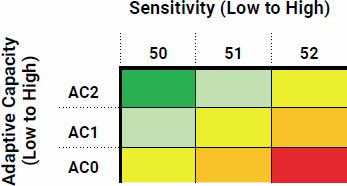
During a series of stakeholder engagement workshops, a vulnerability ranking of each asset and operation was determined based on the sensitivity, or the degree of impact due to climate change, and the adaptive capacity, or ability to respond to and recover from such impacts. The assets and operations that were ranked as high and medium-high vulnerability to climate hazards were prioritized for the action plan.
Vulnerability Ranking
 Potential Opportunity
 Low Vulnerability
 Medium-Low Vulnerability
 Medium-Hight Vulnerability
 High Vulnerability