Assessing Climate Change Vulnerability at Airports: A Primer (2024)
Chapter: 5 Look Ahead to Resilience Planning
5. Look Ahead to Resilience Planning
Although this primer focuses on evaluating vulnerabilities to changing climate conditions, a natural next step is strategizing how to minimize those vulnerabilities. Resilience planning (also referred to as adaptation planning) sets a path forward to proactively prepare for future climate conditions, which is different from business-as-usual at your airport.
5.1 Resilience Planning Resources
A number of resources are available to guide airport resilience planning. These resources provide different ways to manage your airport’s vulnerabilities to changing climate conditions proactively, and not all solutions involve costly changes to existing infrastructure. Understanding how the future may change enables you to make cost-effective decisions about adjusting infrastructure design, adjusting operations to better accommodate extreme weather events, and improving maintenance and repair practices. Planning for climate change is an opportunity to make smart, long-term decisions now that will save money later, minimize service disruption, and keep your employees, passengers, and community safe.
The following resources are a starting place for your resilience plan.
5.1.1 ACRP Report 188: Using Existing Airport Management Systems to Manage Climate Risk
Resilience planning is most successful if it is integrated into existing activities at your airport and is regularly revisited and updated. ACRP Report 188: Using Existing Airport Management Systems to Manage Climate Risk addresses how to integrate climate change risks into common decision-making processes at airports.
Upon completing a self-assessment following the user worksheets, this resource guides you to select a management system you regularly execute at your airport to also manage your identified climate risks. The management systems addressed in this guidance are listed in Figure 5-1. Finally, the case studies provided in the appendix offer examples of airports that have undertaken adaptation or resilience planning processes.
Once you start the planning process for a selected management system, Report 188 will prompt your airport where and how to integrate actions to address climate risks as you complete the plan-do-check-act steps of your management system. The vulnerability assessment you completed in Section 4 of this primer will inform the specific actions you may choose to evaluate and
Addressing Climate Risks Using Business-as-Usual Processes
Some business-as-usual processes, such as annual engineering assessments, can help you stay on top of trends and impacts as they occur. This adaptive management approach is best suited to manage gradually changing risks over time. When climate change poses immediate threats, adaptive management may not be sufficient. ACRP Report 188 will help you identify opportunities to proactively address impacts.

the solutions you select, as you progress through the management system. The recurring planning cycle of your management systems will ensure updated climate science and airport operational data are integrated and climate risks are regularly addressed.
5.1.2 California Adaptation Planning Guide
The widely used California Adaptation Planning Guide for local governments presents best practices in a flexible step-by-step process airports can use to plan for climate change. For your airport’s plan development, consider starting with Phase 3 of this guide, illustrated in Figure 5-2, as it defines a framework for adaptation (resilience) planning with strategies that build on the results of your vulnerability assessment. The resilience strategies developed following the California Adaptation Planning Guide’s process will be the airport’s response to the vulnerability assessment—that is, how the airport will address the potential for harm identified in the vulnerability assessment, given the airport’s resources, goals, values, needs, and regional context.


5.1.3 ACRP Report 199: Climate Resilience and Benefit-Cost Analysis; A Handbook for Airports
ACRP Report 199: Climate Resilience and Benefit-Cost Analysis; A Handbook for Airports describes how to apply benefit-cost analysis tools and techniques to improve climate resilience decision-making related to airport infrastructure projects. An explanation of the difference between a project benefit-cost analysis that accounts for all aviation stakeholders, including the adjacent community, versus a financial feasibility analysis that focuses on whether a project can be paid for using available sources of funds, is included in the guidance. Based on available data, a detailed analytical methodology for assessing risk and uncertainty of an airport experiencing extreme flooding from sea level rise and storm surge is included. In addition, there is a detailed analytical methodology for assessing the impact of rising temperatures that may require weight restrictions on aircraft takeoffs.
The guidance is technically focused and includes resources for communicating with executive management as well as a Microsoft Excel workbook to guide calculations.
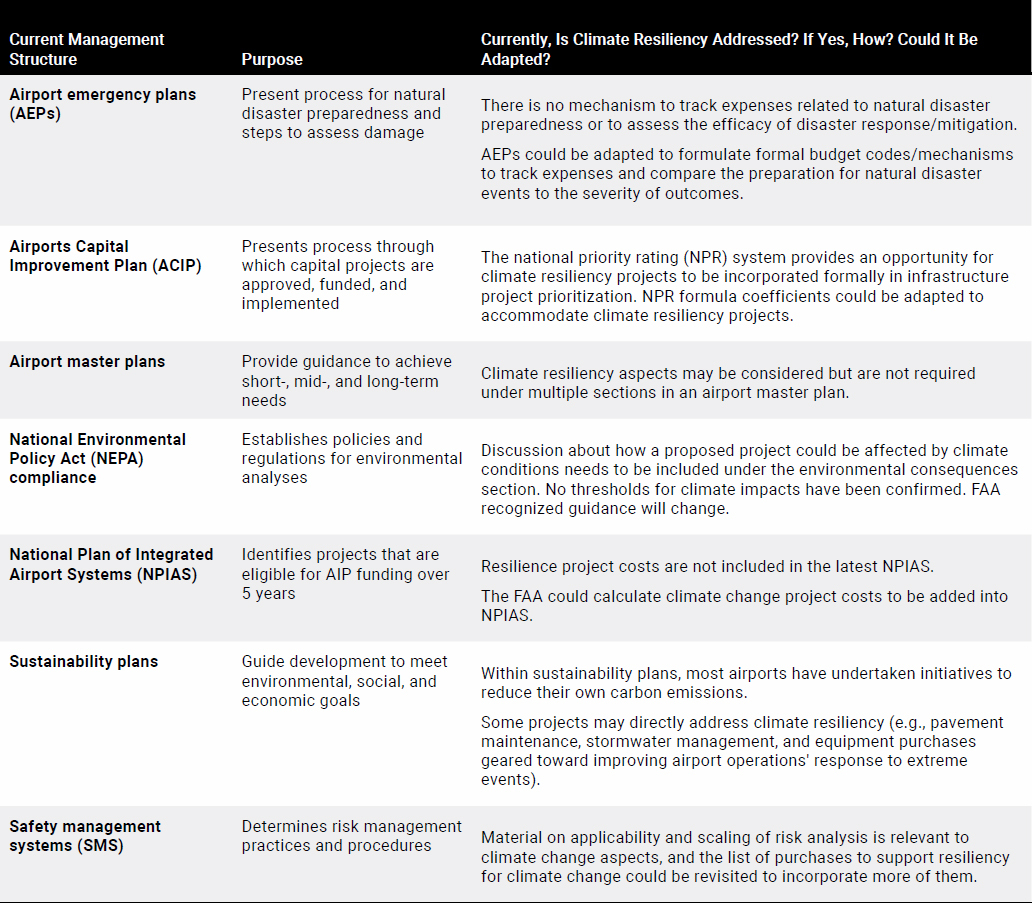
Recognizing that many airports seek financing for existing planning initiatives to comply with FAA requirements, this guidance provides a summary of current FAA funding options and identifies how they are or could be used by airports to address climate resilience projects. Figure 5-3 presents the FAA funding management structure and climate resilience applicability.
5.2 Incorporating Equity and Environmental Justice into Resilience Planning
Airports are economic hubs with many connections to the regional and local communities they serve. As employers, purchasers of goods and services, and consumers of resources, your airport is positioned to incorporate equity and environmental justice into climate risk management that is mutually beneficial to your airport and your adjacent communities, while also at a scale that is impactful. By engaging with stakeholders, you can gain insight into challenges and potential opportunities for strengthening climate resilience planning. The following steps describe how this might look in practice.
5.2.1 Determining Who Is Affected by Climate Change
To start, determine who is anticipated to be affected by your airport’s climate risk management approach and thus who to engage with during the planning process. Some key stakeholders are common to most airports, such as airport employees, contractors, customers, visitors, and adjacent communities. You may also wish to engage other stakeholders specific to your airport.
Airport Employees and Contractors
who work outdoors (e.g., ground crew, transportation attendants, construction workers) may have increased health risks from extreme heat. Specifically, occupational exposure to heat puts workers at increased risk for heat stress, traumatic injury, sick building syndrome, and even death.
Mitigation measures such as an airport policy requiring a minimum number of breaks per hour in a cooling shelter or vehicle is an example operational climate adaption strategy.
Now that you have determined who to involve, it is time to reach out to stakeholders and build engagement by using the following strategies:
Case Study
San Diego International Airport (SAN) developed a Climate Resilience Plan in 2020. As part of this effort, SAN identified internal and external stakeholders and engaged with them at multiple touchpoints. External stakeholders included industry organizations, surrounding communities, regional agencies, business partners, and the traveling public.
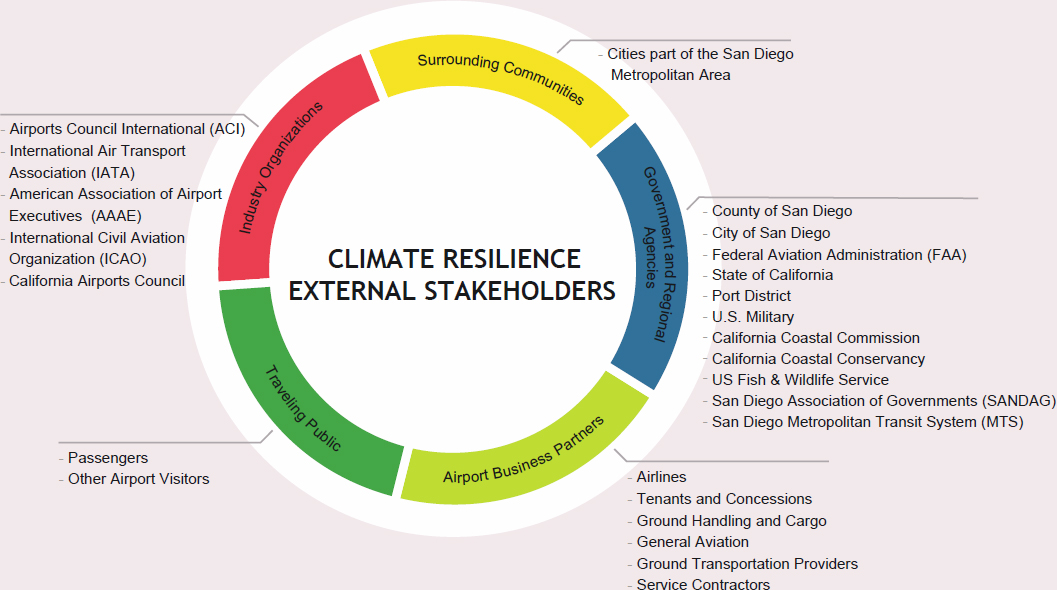
After adopting the Climate Resilience Plan, SAN is regularly engaging with the San Diego Regional Climate Collaborative to contribute to identifying and implementing regional solutions, per the Plan.
- Proactively consult with your airport stakeholders early and often to allow time to build trust, identify and understand climate hazard impacts, and co-develop goals to inform the climate resilience planning process.
- For those frontline communities where you do not have an established relationship and may struggle with finding the best point of contact, reach out to state and local human resource agencies, community leaders, and/or tribal governments to assist with initial outreach as identified in FAA’s Environmental Desk Reference, Chapter 10: Environmental Justice.
- Communicate with each audience using tailored messaging. When identifying communities in outreach efforts, provide clear and specific descriptions, so that communication collateral and engagement tactics are tailored to the audience. For example, refer to “Spanish-speaking community” rather than “non-English language speakers” or “Black, Indigenous, and People of Color (BIPOC) community” in lieu of “communities of color.” Naming specific communities also allows an airport to recognize the legacy impacts of some historical policies (e.g., historical zoning policies, immigration patterns, land use).
- Following significant decisions, summarize important issues, changes, and actions in non-English languages common to the affected parties. Doing so can help to increase linguistic accessibility and facilitate communication.
- Since some adjacent communities may be overburdened, intentional strategies (e.g., participatory workshops, focus groups) deployed by your airport for fostering a partnership during the climate resilience plan development and implementation will likely be needed. This may involve providing compensation for external stakeholders or having a designated liaison from the airport who can take time to meet with community members when their schedules permit instead of a single standing meeting during the day.
5.2.2 Understand How Airport Climate Resilience Planning Can Strengthen the Local Community
Increasing your airport’s resilience to climate hazards in coordination with your local community can efficiently identify and mitigate shared vulnerabilities. For example, if the airport and adjacent community are vulnerable to sea level rise and associated flood inundation, a coordinated response developed during an airport’s resilience planning process may build goodwill, strengthen relationships, and lead to a shared engineering solution.
From a different angle, collaborating with frontline communities to co-create plans to respond to climate-related disasters or climate-health emergencies can improve access to safety and emergency resources during and following an event. This approach further strengthens the relationship between an airport and an adjacent community and establishes a plan before a crisis. Clearly showing the co-benefits of a strategy is effective for communicating to stakeholders—and decision-makers—the value of undertaking climate resilience planning, mainly when actions provide multiple benefits. Co-benefits can be linked to other community planning goals and thus support the principle of integrating climate resilience across all community plans and policies.
During the planning process, assessing strategies holistically for your airport and adjacent communities will decrease the chance of unintended consequences of maladaptation where resilience strategies implemented are harmful to the adjacent community, as shown in the California Adaptation Planning Guide.
Case Study
The Port of Seattle—which includes Seattle-Tacoma International Airport—has deployed an Office of Equity, Diversity, and Inclusion (OEDI), which allows the district to deepen efforts toward equity across its operations and services. The OEDI 2023-2024 Strategic Plan documents three strategies to enhance and further DEI goals.
One goal is focused on external and public facing opportunities, “Support the Port of Seattle to create meaningful engagement with near-Port communities and provide equitable and tangible benefits to impacted communities of color, immigrant and refugee and low-income communities.”
Additionally, OEDI developed an “Equity Index” tool, which is an interactive map displaying a visual representation of social and Environmental disparities in King County. Using 21 indicators across four categories, the Equity Index illustrates the degree to which different communities experience pollution burdens and social inequities. The district aims to utilize this Equity Index to inform future operational and capital projects.
5.2.3 Incorporate Environmental Justice into Climate Resilience Planning
Airport operations impact adjacent communities in a variety of ways ranging from transportation network congestion, air quality, stormwater runoff, lights and noise from aircraft and equipment, or movement of goods. Related, airport adjacent communities may also use airport infrastructure for access such as by roadway, pedestrian walkways, or rail; recreational use such as for fishing or hiking; or meeting space in designated buildings on airport property. Historically, there has been a distributional burden of climate hazards in airport adjacent communities. As such, there are strategies you may undertake to incorporate environmental justice into climate resilience planning to account for your airport adjacent communities, such as:
- Expand asset/operation vulnerabilities to include human health and safety risks along with risks to airport infrastructure and operations. Include frequent and explicit considerations of impacts on people, in addition to those already outlined for infrastructure and operations.
- Identify and consider the impacts of development on minority or low-income populations that are already vulnerable to the effects of climate change, including the development of new airports; airfield/landside expansion; and land acquisition for aviation-related use, new or moved access roadways, parking lots, and construction activity.
- Consider affected resources and services of capital projects, such as impacts to stormwater drainage management and the ability to mitigate flooding, air quality measures including smoke from local and regional wildfires, tree coverage and the increase or decrease of the local heat island, community cohesion and the ability to respond to a climate change hazard event, and traffic management in and around the airport and adjacent communities.
- Consider local overburdened communities with respect to changes to land use, zoning, development policies, or mutual aid agreements, and changes to emergency management procedures. This may also involve social costs and inequities for proposed changes to airport infrastructure to airport adjacent communities.
- Assess current infrastructure’s capacity to address current and projected climate impacts and contextualizing those results through a public health lens.
Case Study
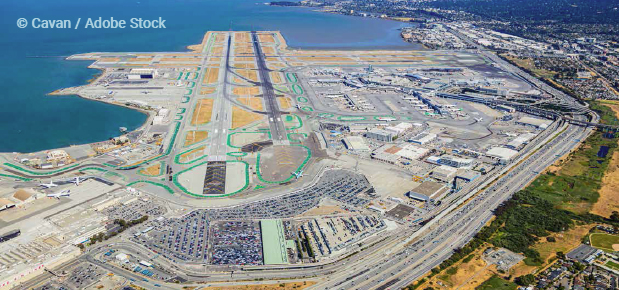
San Francisco International Airport (SFO) developed a Sustainability and Social Equity Plan with guidance on how to manage climate and compliance risks and optimize natural systems from climate impacts such as flooding and sea level rise. One of the strategies emphasizes the need to “create a capital planning guide to help secure funding for hazard-appropriate adaptation enhancements...and provide support for adjacent communities to do the same.” Additionally, the airport indicated the need to build awareness on climate resilience. Strategies to build awareness include first identifying knowledge gaps and then fostering relationships with community-based organizations to collectively work together to address those gaps.
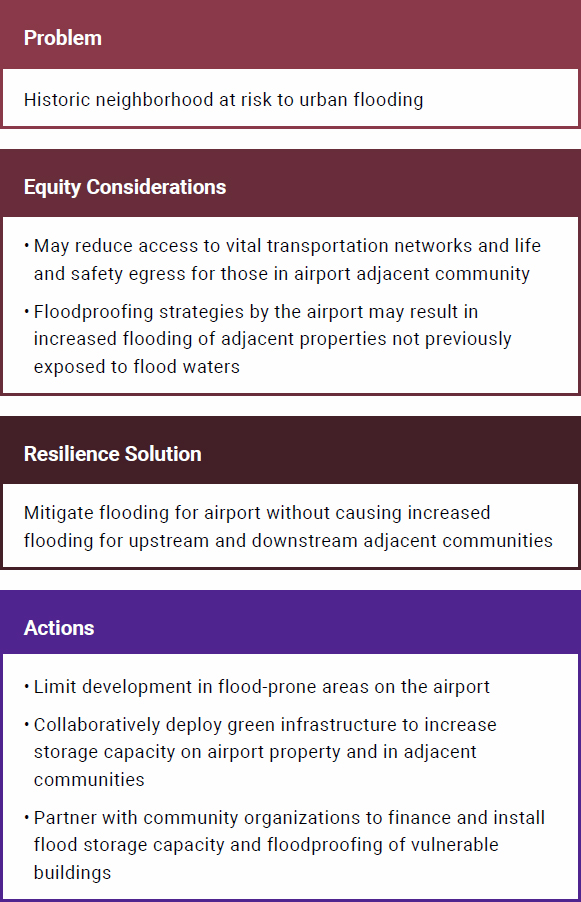
Adapted from Guide to Equitable Community-Driven Climate Preparedness Planning, prepared for Urban Sustainability Directors Network
5.3 Planning for Continuous Improvement
A climate vulnerability assessment provides valuable information for making risk-informed decisions, but it only provides a snapshot in time. An airport should plan to update its vulnerability assessment and associated planning document(s) periodically. Every four years is a common planning interval, as it allows for the incorporation of new assets, updated datasets including climate projections, evaluation of the effectiveness of climate actions and responses since the last vulnerability assessment, and any new refinements to the process. Additional resources are under development to support airports to better understand climate risk and continuously improve how to manage risk. For example, one of these key resources that is not yet available at time of publication is the FAA Airport Resilience Analysis Framework tool. As best practices continue to evolve, airports will be able to streamline this process and identify new opportunities to further increase airport resilience.