Pathways for New Nuclear Development: Proceedings of a Workshop (2025)
Chapter: Overview
Overview
Recent years have brought a renewed focus on the potential for nuclear energy to help meet the United States’ growing demands for abundant, reliable, low-carbon energy. Trends such as the increased electrification of transportation and industrial processes, along with the rapid expansion of data centers over the past decade, have accelerated and amplified these demands. Advances in nuclear energy technologies, along with the recent completion of Plant Vogtle—the largest nuclear power plant in the United States comprised of four reactor units—are opening new opportunities to build next-generation nuclear reactors and sparking interest and dialogue among utilities, investors, policymakers, and communities. However, significant barriers to nuclear power deployment include technical challenges, regulatory hurdles, and investment risks that complicate decision-making timelines.
To explore pathways for new nuclear power development in the United States, the National Academies of Sciences, Engineering, and Medicine hosted the workshop Pathways for New Nuclear Development on January 29–30, 2025, in Washington, DC. Building on recommendations from the National Academies’ report Laying the Foundation for New and Advanced Nuclear Reactors in the United States,1 the event facilitated in-depth discussions among policymakers, regulators, community leaders, and technical experts from industry, national laboratories, and academia.
___________________
1National Academies of Sciences, Engineering, and Medicine, 2023, Laying the Foundation for New and Advanced Nuclear Reactors in the United States, National Academies Press, https://doi.org/10.17226/26630.
Participants examined the challenges of deploying more nuclear power and discussed potential opportunities to overcome some of those challenges, including strategies to facilitate decision making, public engagement, workforce development, financing, regulatory improvement, and construction. Attendees shared their experiences and perspectives regarding the real and perceived risks of new nuclear projects and projected timelines, the opportunities of co-locating nuclear plants with other facilities or in non-traditional locations, and the role different reactor designs could play in meeting growing electricity demand.
Richard A. Meserve, Covington & Burling LLP, provided context on the findings and recommendations from Laying the Foundation along with reflections on the ways the nuclear energy landscape has changed since the report’s publication in 2023. Among other developments, he highlighted how rapidly rising energy demands from data centers, coupled with increasingly positive public perceptions of nuclear energy, have helped to fuel a surge of interest in nuclear energy development. A key change since the 2023 report has been the renewed interest in gigawatt-scale units, in addition to small modular reactors (SMRs). In the regulatory sphere, he noted that a key step has been the passage of the Accelerating Deployment of Versatile, Advanced Nuclear for Clean Energy (ADVANCE) Act of 2024 (P.L. 118-67), which requires the U.S. Nuclear Regulatory Commission (NRC) to streamline the process of approving new reactors and fuels while maintaining core safety and security standards.2
In panel discussions, participants examined technical challenges to deployment, construction timelines, end user timelines and decision making, financing timelines, host community perspectives, workforce development considerations, and the elements of regulatory risk. Over the course of the workshop, participants discussed the readiness of new nuclear designs and of the overall ecosystem to support new deployment at scale. They considered challenges surrounding the construction of new plants, pathways to create resilient and agile supply chains and a robust workforce, drivers of end user needs and expectations, options for sustained financial backing, and how host communities can—and in some cases already do—support nuclear projects through partnerships that drive alignment, address risks, and support shared benefits. Members of the workshop planning committee, who served as moderators for the panel discussions, closed the event with reflections on the key challenges and possible solutions raised during the discussions (see Figure O-1).
___________________
2U.S. Nuclear Regulatory Commission, “Effectiveness, Efficiency, and Timeliness Initiatives That Support Unleashing American Energy,” https://www.nrc.gov/about-nrc/governing-laws/advance-act.html, accessed April 14, 2025.
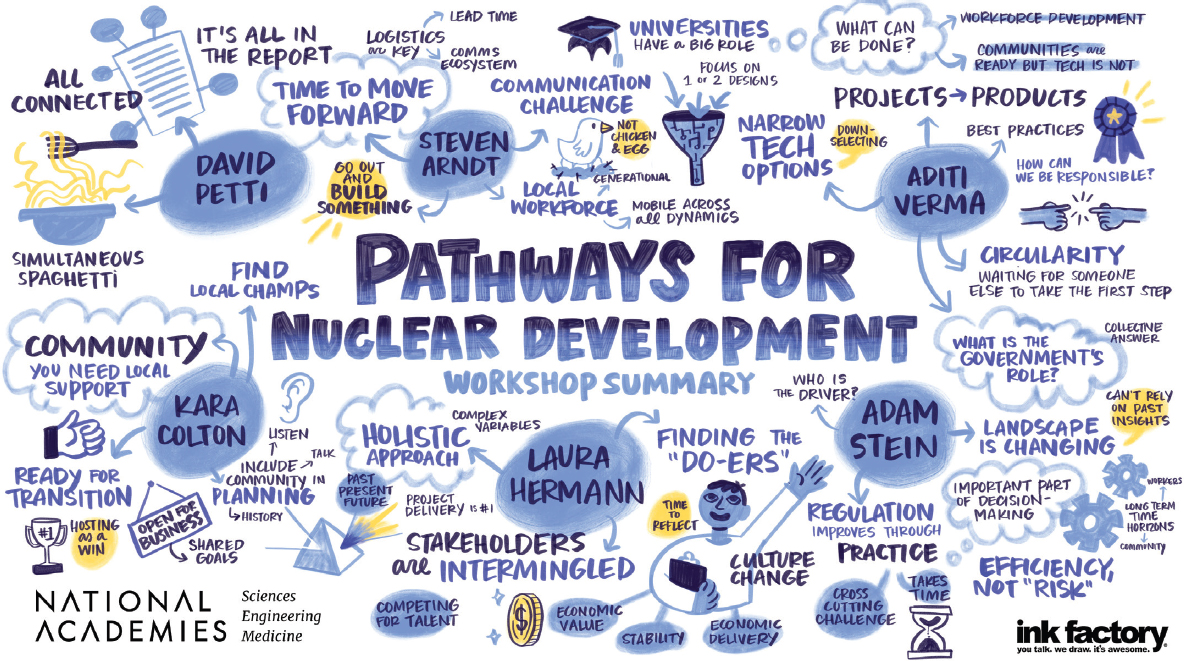
SOURCE: Created by Alison Vellas and visualized by the Ink Factory, inkfactorystudio.com.
SCALING NEW NUCLEAR DEPLOYMENTS
Deploying nuclear energy at scale would not only bring more energy generation online to help meet growing demands but also make future nuclear energy development more feasible by shortening deployment timelines and bringing down costs. In the session she moderated on construction timelines, Aditi Verma, University of Michigan, noted that a common theme was the notion of shifting from projects to products—that is, moving away from a focus on building individual nuclear plants and toward a mode of standardized, repeatable reactor manufacturing and repeatable construction to deploy a nuclear energy fleet across the United States. Repeatable manufacturing and construction approaches have the potential to lower the cost of each deployment by taking advantage of economies of scale, establishing reliable supply chains, allowing managers and workers to benefit from experience and lessons learned, and creating proven pathways for navigating community engagement and regulatory approvals.
To make this vision possible, multiple panelists underscored the need to down-select from the currently crowded field of candidate technologies and focus on further developing the technology, fuels, construction strategies, and supply chains for a few promising options. Ultimately, rather than a one-size-fits-all approach, several participants suggested that a nationwide fleet that includes a combination of large reactors, SMRs, and microreactors will best fit the diverse needs of end users, which range from individual data centers to large electric utility service areas and industrial facilities requiring high-temperature heat or steam. Some participants also noted that many considerations play into the question of whether it is more economical to build one large reactor or many smaller ones (a concept known as economies of scale versus economies of multiples), positing that this will remain an open question until more demonstration plants are built and the total costs of each approach can be better understood. Many participants emphasized that moving from first-of-a-kind deployments to a more efficient fleet approach requires focusing on a narrow group of technologies. Several panelists suggested that the Westinghouse Advanced Passive 1000 reactor, having been successfully approved, built, and brought online, is now well positioned for further deployments. Participants also highlighted both opportunities and areas of uncertainty around various technologies for SMRs and microreactors and suggested that a milestone-based approach could be used to advance the development of a few candidate technologies while avoiding over-investing in those that are less likely to succeed.
Another key theme was the importance of effective collaboration and project management among those responsible for driving nuclear
projects forward. Constructing a nuclear facility is an incredibly complex undertaking with an enormous array of logistical, safety, security, and regulatory demands to navigate. To anticipate and overcome hurdles, participants pointed to the value of early and close collaboration among planners, managers, and regulators, as well as the value of mock-ups, digital twins, and testing. Based on his experience delivering nuclear energy hardware, for example, Erik Nygaard, BWXT Advanced Technologies, LLC, noted the importance of balancing needs and priorities among project managers, business leaders, and technical leaders. Several speakers underscored the critical need to align incentives across all stakeholders such that those who contribute investments, take risks, and reap rewards are appropriately incentivized to collaborate effectively, minimize costs, solve problems, and deliver results.
POLICIES TO SPUR PROGRESS
While enthusiasm for new nuclear energy development is clearly growing, Verma and others noted that the high costs and uncertainties of nuclear projects have meant that many of those who are in a position to drive progress toward meaningfully ramping up deployment are waiting for someone else to take the first step (and shoulder the greatest risk). Given that larger nuclear plants in particular are an extremely long-term investment with a years-long construction timeline and decades-long operational lifespan, it is important to recognize the uncertainties inherent in predicting energy demands, fuel costs, and alternative energy sources far into the future, and how these uncertainties affect cost-benefit projections and financing decisions for nuclear plants. For example, Chris Nolan, Duke Energy, which operates the country’s largest regulated nuclear energy fleet, said that utilities, which typically take on much of the risk associated with nuclear energy builds, need financial incentives along with a reasonable expectation that they will be able to recover the costs they incur, before it makes economic sense to move forward with new nuclear energy projects.
One option to overcome these barriers, raised by several participants, is to form stakeholder consortia through which multiple parties could collaborate to secure financing and share the risks and rewards according to the level of investment and risk each party takes on. The discussions also highlighted the critical role of the federal government in helping to incentivize investments in early nuclear energy projects and reduce the amount of risk that investors must shoulder through tax credits, loan guarantees, construction cost overrun insurance, or other forms of support. For example, multiple participants pointed to the provisions of the Inflation Reduction Act of 2022 (P.L. 117-169) as instrumental in
generating movement toward nuclear energy development. To build on the current momentum and avoid stalling progress, several participants emphasized that it will be important for those incentives to remain in place.
Streamlining construction and operational licensing, environmental reviews, and other regulatory approval processes can also help to reduce barriers and spur progress. Participants described several ways the ADVANCE Act has helped to improve these processes, such as by reducing unnecessary or redundant hearings and requirements and improving channels of communication between regulators and project stakeholders. Speakers also pointed to additional opportunities for the government to advance nuclear energy while protecting the public and the environment. Reflecting on the discussion of regulatory considerations that he moderated, Adam Stein, Breakthrough Institute, pointed out that both the NRC and industry have important roles to play in refining processes, incorporating lessons learned, improving communication and collaboration, and creating clear, effective, and flexible regulatory frameworks. Rather than seeing regulations as merely barriers, Stein said that everyone benefits when developers work together with regulators to minimize delays, keep projects on track and on budget, and earn community trust.
ALIGNING INTERESTS
David A. Petti, Idaho National Laboratory (retired), reflected that one theme noted throughout the workshop was the interconnected nature of the nuclear energy ecosystem. While elements such as workforce, financing, technologies, and end users may appear separate, they are heavily intertwined. Building on this point, Laura Hermann, Potentiary, said that the workshop crystallized the need for an integrated ecosystem collaborating toward a holistic, realistic, and future-forward approach to nuclear energy while acknowledging the uncertainties and changes that the future may hold. She added that a more cohesive approach to determining the true economic value of nuclear energy can help stakeholders see the industry as stable and capable of delivering on its promises.
Stein and others highlighted the value of focusing on the end goals. Construction takes time, and the priorities and concerns of communities and decision makers may evolve, but when nuclear plants can be successfully deployed, the end result can bring decades-long benefits in the form of clean, firm energy and good jobs for host communities. He added that nuclear energy is also important for national security, which may not be the primary goal for all stakeholders but is of critical importance to the federal government. Noting that nuclear projects need local and state support to move forward, Kara Colton, Kaco Group, LLC, highlighted current
trends toward increasing support for nuclear energy, both among the public broadly and in communities that are actively exploring opportunities to host nuclear sites or convert coal-fired plants to nuclear facilities. “If we can create an environment where these communities see hosting a facility like this as a win, we have a lot more momentum to see these things actually come to fruition,” Colton said.
In successful projects, all stakeholders—communities, developers, government agencies, vendors, and utilities—share the goals of affordable, reliable, clean energy and economic opportunity. For this reason, Colton said that community engagement, done early, often, and thoughtfully, is just as important as planning, licensing, construction, and deployment. Several participants emphasized the importance of recognizing a community’s history and culture and shared examples of successful approaches developers can use to actively listen to communities to understand their specific concerns, needs, and priorities. For example, Richard Arnold, Consolidated Group of Tribes and Organizations, urged a mindset of doing “science with a conscience” and enabling authentic, inclusive community conversations with those who are affected by new or existing nuclear developments.
Colton noted that fears of nuclear power do not have to mean the end of the conversation; meeting people where they are with respectful, informative exchanges can lead to a deeper and more nuanced understanding of the realities of nuclear energy today. In addition, she said that creating partnerships with universities, vocational schools, unions, and local champions is also important to earn community trust and acceptance. Connecting the importance of incorporating community perspectives to the broader goals of nuclear energy development, Verma added, “We’re not developing nuclear technologies and nuclear energy as an end in and of itself. It’s the means to an end—to cleaner, more reliable energy, jobs, powering the economy, industry. [The question is] how can we—as engineers, as practitioners, as policymakers, as educators—do this work more responsibly?”
PREPARING THE WORKFORCE
The nuclear industry has unique workforce needs that present both challenges and opportunities. The construction of a nuclear plant brings many thousands of jobs, often requiring the recruitment of many new workers into remote communities. Once construction is complete, a broad array of workers is needed to operate the plant. In both the construction and operational phases, participants emphasized that the greatest workforce need is for skilled tradespeople—not PhD-level nuclear engineers; although university graduates in nuclear engineering and the research
and development centers that are needed to support them are critical, the more challenging aspects of the workforce development are found in broader areas. Throughout the workshop and in a session moderated by Steven Arndt, University of Tennessee, participants discussed how unions, apprenticeships, and community colleges can contribute to training this workforce and identified strategies for attracting people to the field, ranging from K–12 level engagement to worker retraining programs. Verma also highlighted the role of universities in advancing research, community engagement, and workforce development across the nuclear ecosystem. In addition to technical skills and expertise, Verma added that the nuclear energy workforce will benefit from people who can effectively collaborate, share expertise, and apply lessons learned to solve problems and build reactors more efficiently.
Arndt emphasized that the nuclear ecosystem can continue to move forward by incorporating lessons from past projects, starting workforce development as early as possible, supporting more pathways to local and long-term nuclear jobs, improving communication among stakeholders, and sharing benefits with host communities. He also emphasized the need to be more proactive and less siloed, both in accelerating projects and addressing the industry’s workforce needs. Pursuing workforce development in the absence of a project will lead to the developed workforce having nothing to do. Arndt said that, ultimately, building the nuclear energy workforce will come down to building nuclear energy plants. Positing that the time has come to move forward, he said, “It all starts with getting out of the mentality of this as a chicken and egg kind of challenge we have right now, because it’s not. It’s a let’s go out and build something.… We just need to be more proactive.”


