The Waste Isolation Pilot Plant: A Potential Solution for the Disposal of Transuranic Waste (1996)
Chapter: EXECUTIVE SUMMARY
Executive Summary
The Waste Isolation Pilot Plant (WIPP) is a network of underground excavations at a depth of approximately 658 m (2,160 ft), in bedded salt formations near Carlsbad, New Mexico, in the southeastern corner of the state (Figure ES.1). WIPP is intended to serve as a permanent repository for transuranic (TRU) waste, which consists of a wide variety of materials (such as protective clothing, laboratory equipment, and machine parts) that have become contaminated with radioactive transuranic elements1 during use in defense-related activities. These materials, from U.S. Department of Energy (DOE) facilities, currently are stored at several DOE locations around the country and are classified as either CH (contact handled) or RH (remote handled) waste.
DOE has been investigating the suitability of WIPP as a TRU waste repository since the 1970s and plans to submit an application to the U.S. Environmental Protection Agency (EPA) in the fall of 1996 for a certificate of compliance to open and operate the facility. To obtain the certificate of compliance, DOE must demonstrate that the WIPP facility will comply with relevant U.S. federal regulations—chiefly, the EPA's 40 CFR 191 and 40 CFR 194.
The National Research Council (NRC) Committee on the Waste Isolation Pilot Plant was formed in 1978 at the request of DOE to provide scientific and technical evaluations of DOE investigations at WIPP. The committee's statement of task charges it to report on the current state and progress of the scientific and technical issues that form the core of a submission by DOE to EPA for certification of the WIPP facility.
Because DOE's compliance certification application to the EPA consists largely of conclusions drawn from DOE investigations, it is timely to comment on results of committee evaluations and their implications with regard to the overall suitability of WIPP as a repository for TRU waste (Box ES.1). This report presents these findings.
|
BOX ES.1 Uncertainty in Repository Performance Assessing the performance of a radioactive waste repository over the long time periods of interest necessarily includes significant uncertainties. This is recognized by EPA in the standards for the disposal of TRU and high-level waste and spent nuclear fuel. Regarding the required degree of proof, EPA notes: Performance assessments need not provide complete assurance that the requirements of Part 191.13(a) [i.e., the containment requirements] will be met. Because of the long time period involved and the nature of the events and processes of interest, there will inevitably be substantial uncertainties in projecting disposal system performance. Proof of the future performance of a disposal system is not to be had in the ordinary sense of the word in situations that deal with much shorter time frames. Instead, what is required is a reasonable expectation, on the basis of the record before the implementing agency, that compliance with Part 191.13(a) will be achieved. (40 CFR Part 194.13(b)) This review of WIPP should be read with this limitation in mind; the findings and judgments reached in this report could not be achieved with absolute certainty, but instead reflect a reasonable expectation for WIPP performance based on the available evidence. |
Several general committee findings regarding TRU waste disposal at WIPP are worth noting. These findings are based on the characteristics of the waste and the salt medium and from scientific and technical studies at WIPP and at potential salt repositories in other countries.
- Although TRU waste contains long-lived radionuclides that require geologic isolation, the overall
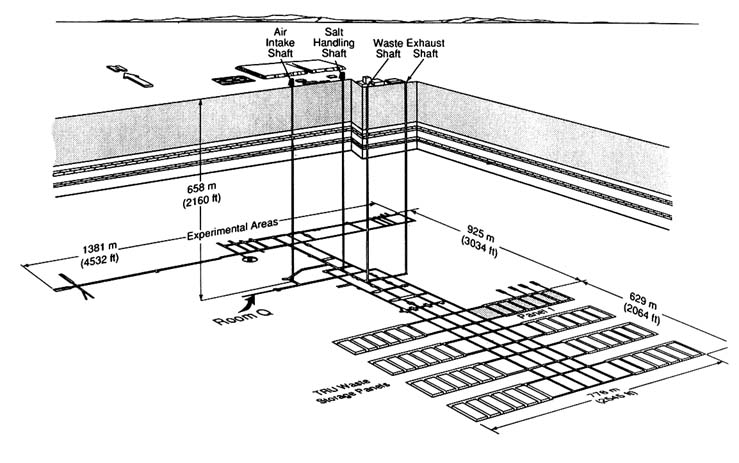
FIGURE ES.1 Three-dimensional view of the Waste Isolation Pilot Plant. The WIPP facility includes surface support buildings, a waste-handling building, four shafts, and the mined underground operations area. The repository is located approximately 658 m (2,160 ft) below the surface, within the Salado Formation, a Permian sequence of bedded salt with minor amounts of anhydrite and clay. The excavations are accessible from the surface by four vertical shafts. Only one of the planned eight panels, labeled Panel 1 in the diagram, has been excavated to date. Each panel consists of seven rectangular rooms, 10 m wide and 91 m long, separated by 30.5-m-wide pillars. Room Q, also labeled, is the site of a series of experiments on brine inflow into a 2.9-m-diameter, 109-m-long bored cylindrical tunnel. (Note: 1 meter [m] is approximately 3.28 feet [ft].) Source: Jensen et al. (1993), modified from their Figure 3-1.
- level of radioactivity is much lower than that of high-level radioactive waste.2
- The early recognition of salt as an attractive medium for geological isolation (e.g., NRC, 1957) of radioactive waste has been confirmed by subsequent studies.
- Provided it is sealed effectively and remains undisturbed by human activity, the committee finds that the WIPP repository has the ability to isolate TRU waste for more than 10,000 years. The geologic stability and isolation capability of the Salado Formation, which consists of bedded salt, are the primary factors leading to this finding.
- The only known possibilities of serious release of radionuclides appear to be from poor seals or some form of future human activity that results in intrusion into the repository. The committee anticipates that the consequences of such human intrusion can be reduced based on available engineering design options and on improved understanding to be obtained from ongoing scientific studies.
- EPA's regulations (i.e., 40 CFR 191, as specified for WIPP in 40 CFR 194) relating to human intrusion do not take into account that if radionuclide releases to the environment via ground-water pathways at WIPP occur, they will be predominantly in non-potable water. This greatly reduces the risk of human exposure compared to a similar release in potable water.
General Conclusions And Recommendations
The combination of general considerations, such as those outlined above, and detailed studies described later in this report, lead to the following conclusions and recommendations.
Based on available scientific evidence, the only probable threat to satisfactory isolation performance of the repository is the possibility of disturbance by human activity, deliberate or unintentional, that could compromise the integrity of the repository. Engineering methods are available, if needed, to reduce the consequences of human intrusion to acceptable levels.
Conclusion: Human exposure to radionuclide releases from transuranic waste disposed in WIPP is likely to be low compared to U.S. and international standards.
Consideration of the consequences of future activities that could violate the natural, or undisturbed, integrity of the repository is valuable for assessing the relative vulnerability of the repository to such activities and in identifying ways to reduce this vulnerability, but assessing human technologies thousands of years hence is highly conjectural and lacks a sound scientific foundation.3
Recommendation: Speculative scenarios of human intrusion should not be used as the sole or primary basis on which to judge the acceptability of WIPP (and, by extension, any geological repository).
Findings, Conclusions, and Recommendations on DOE Studies
DOE has concentrated on studies and calculations intended to determine compliance with federal regulations for WIPP in the event of human intrusion. Although the committee has not so restricted its studies, the following comments relate specifically to the DOE compliance activities. Most of the issues discussed below are significant only in the event of human intrusion.
-
The role of Performance Assessment: Performance assessment (PA) examines the combined effect of each component of the total system to assess the overall ability of the repository to isolate radionuclides from the biosphere. As used by DOE, PA responds to the question, ''Is WIPP in compliance with federal regulations?"
Although PA has made important contributions to the WIPP project, in retrospect, it is clear that the potential of PA is higher, and important opportunities
|
2 |
The level of radioactivity per unit volume of WIPP TRU waste is of the order of 0.1 percent of the corresponding level for U.S. spent fuel [see Chapter 1 Table 1.1]. |
|
3 |
Federal regulations (40 CFR 191, 40 CFR 194) require stylized calculations on releases due to human intrusion. The level of proof required is a "reasonable expectation." See Box ES.1. The weight to be given to human intrusion possibilities is also discussed in Technical Basis for Yucca Mountain Standards (NRC, 1995; see especially, pp. 11, 107-111,115). |
- to put PA to good use have been missed. PA is valuable at all stages of the repository evaluation process. It can identify the most critical components of the system, assess the significance of engineered supplements to the natural geological barriers, and serve as an aid to planning and management decisions on the most effective allocation of staff and project resources.
-
Conservatism of performance assessment models: The PA models currently used by DOE are too conservative in some respects. Such conservatism masks the potential for identifying and assessing the benefits of relatively simple engineering design procedures in reducing the consequences of human intrusion.
The assumption that the Disturbed Rock Zone (DRZ) bordering the room excavations remains a relatively high-permeability region throughout the first 10,000 years of the repository appears overly conservative. This is in marked contrast to the assumption (see Chapter 4) that the DRZ around the shaft will heal, achieving a permeability of between 10-16 m2 and 10-18 m2 within 50 to 100 years and approaching the essentially impermeable condition of intact salt within a small fraction of 10,000 years. Such a conservative assumption with respect to the DRZ in the PA models may prevent a realistic evaluation of the major benefits of compartmentation of the waste by room and panel seals in reducing the consequences of repository disturbance by intrusion. -
Complexity of performance assessment models: DOE's PA modeling of radionuclide releases from WIPP involves complex combinations of many variables such that, to the non-specialist, it is not clear how the predicted releases depend on the component features, events, and processes in the geological isolation system.
The committee recommends that DOE develop, in parallel with the complex PA models, simpler versions that provide a more transparent, traceable path from the model inputs to the predicted releases. The insights gained from the simpler model as to which components of the isolation system are most critical to improved repository performance would serve a very useful role in decision making and in resource allocation for WIPP. It is essential, of course, that the simpler PA models still identify correctly the key features, events, and processes upon which repository performance depends.
To illustrate this recommendation: because plutonium (Pu) is the dominant radioactive element of concern in the WIPP inventory, a simpler model could focus on Pu in the source term to the exclusion of other radioactive elements. However, understanding and predicting the behavior of Pu in the WIPP system is challenging, and experimental work with other actinides is necessary to develop the parameters for Pu required for the PA models, for both the full model and any simpler version. While studies of other actinides are necessary to support the chemical model developed for Pu, a simpler PA of the kind proposed here would consider only Pu isotopes as a source term, and only the dominant pathway(s) for environmental releases, with no more complexity than needed for an adequate representation. - Waste characterization: The waste characterization program being considered by DOE does not appear to be based on the needs for information important to an assessment of the long-term performance of the facility. Ideally, the PA should be used to determine what characterization is required.
- Nonradioactive constituents of TRU waste: Nonradioactive hazardous constituents of TRU waste are considered to pose negligible long-term hazards compared to the radioactive constituents of WIPP waste (see Box 2.1 and discussion on 40 CFR 268 in Chapter 2).
- Behavior of salt at the WIPP site: Time-dependent deformation of the salt and associated stratigraphic layers at WIPP is now understood well enough to allow reliable long-term calculations of salt deformation behavior as it relates to repository performance.
- Salado brine: Small quantities of brine seep from the disturbed rock zone in the immediate vicinity of any excavation in the Salado Formation. The amount of brine accumulation is not sufficient to be a credible cause for significant escape of radionuclides from the sealed repository.
- Non-Salado brine: Apart from possible effects of deep–well fluid injection in adjacent areas, brine flooding is only likely if, after loss of administrative controls, an intrusion borehole connects the repository with a deeper source of pressurized brine, such as has
- been encountered by some deep boreholes in the vicinity of the repository.
- Gas generation in the repository: Gas generation will be minimal in a dry or nearly dry repository such as WIPP because both chemical and biological gas-generating processes (e.g., metal corrosion and bacterial action on organic matter) require a liquid phase for mass transport of the reactants and products that are involved in gas formation.
- Treatment of waste: Sophisticated treatment (e.g., incineration) of the TRU waste to be placed in a well-engineered WIPP repository is unwarranted to further improve repository performance, because gas generation is not a serious concern (see Chapter 3).
- Backfilling and compartmentation: Simple repository engineering measures, such as backfilling of the rooms and tunnels in which the waste is emplaced, can be valuable and cost-effective methods of reducing the consequences of human intrusion and any associated brine flooding. Room and panel seals via backfill are relatively well-defined engineering procedures for improving the isolation process. In this regard, compartmentation is recommended by the committee to provide effective seals to eliminate hydrological communication between the waste-filled rooms.
- Non-Salado hydrology: A more comprehensive understanding of the non-Salado hydrology is needed before a reasonable judgment can be made as to the role of the Rustler and adjacent formations in delaying radionuclide releases in the event of human intrusion. To date, studies have been overly focused on a two-dimensional analysis of the Culebra Dolomite. They have not sufficiently considered other possible hydrogeologic release pathways for radionuclides or interconnections between the Culebra and other formations. Potential releases to the Dewey Lake Red Beds, which are less conductive than the Culebra, but contain some potable water, are recommended for further study.
- Potash mining: The consequences to the non-Salado hydrology of subsidence damage due to possible future mining of potash resources above the repository have not yet been evaluated by DOE. If the potential consequences are found to be seriously adverse, it is technically feasible to extract these resources preemptively, in a way that avoids subsidence and associated effects and that reduces the potential for human intrusion by drilling.
- Deep well fluid injection: The requirement to consider the effects on the repository of fluid injection activities was a relatively new addition to the final version of EPA criteria for certification (40 CFR part 194.32(c)). Neither the probability nor the effects on the repository from nearby injection of water or brine have been evaluated in detail by the committee, nor has DOE published an analysis of this issue. A comprehensive analysis of the risks and consequences of this scenario should be completed and documented.
- Waste solubility and transport: The PA completed by DOE in 1992, and all subsequent analyses, consistently have identified a set of issues that will have the greatest impact on the compliance of WIPP in the event of human intrusion and associated brine flooding of the repository. Prominent among these issues are
- actinide solubilities in brine,
- formation and transport of colloids containing radionuclides, and
- retardation of radionuclides during transport through the Culebra.
- The EPA also has identified these issues as critical to its evaluation of the compliance certification application.
- At the time of the writing of this report, the data and models to be used to represent these three issues in the next version of the PA (to support the compliance certification application) were not available for review.
- Continuation of experiments and analyses: Continuation of analyses and experiments recently initiated in the WIPP program to address concerns raised in issues 12, 14, and 15 is recommended by the committee, even though the results may not be available in time to be used in the compliance submission. Results of such testing could reduce uncertainties in the long-term performance of WIPP, eliminate concern over other issues, and be useful in judging the cost effectiveness of various waste isolation procedures at WIPP and other repositories.
Summary
- Provided the WIPP repository is sealed effectively and undisturbed by human activity, the committee knows of no credible or probable scenario for release of radionuclides.
- For the WIPP repository disturbed by future human activity, the committee has noted three ways in which confidence in the performance of the repository could be increased:
- Re-evaluation of the probability and/or consequences assigned to highly speculative scenarios of future human activities may reduce the estimated risk of radionuclide release.
- Experimental and field programs in progress or planned may show that key parameters (e.g., actinide transport) are well within the range required to reduce the impacts of human activities on radionuclide releases substantially.
- The implementation of available engineering options (e.g., compartmentation, treated backfill), which have not been considered in published DOE analyses, could reduce the consequences of human intrusion. The cost effectiveness of these options will depend on the outcome of (1) and (2) above.
The committee believes that some combination of the above three considerations will very probably be sufficient to allow DOE to demonstrate that a WIPP repository will keep radionuclide release within acceptable levels for the disturbed case.


