Is human-driven climate change causing the sea levels to rise?
Based on Science
Global average sea level is increasing due to melting land ice and expansion of warming seawater, both caused by global warming.
Last update March 11, 2026
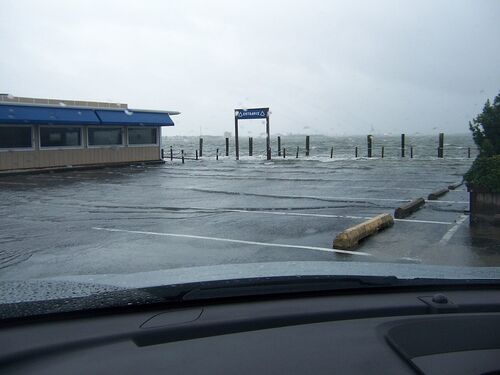
Global average sea level is rising.
Sea level has been measured regularly since the 19th century using systems of coastal tide gauges. Over the past 100 years, global average sea level has risen about 6 inches. Now, satellites are used to measure sea level very precisely.
Sea level is rising more than twice as fast in recent decades than it did earlier in the 20th century. Satellite data collected since 1993 show that global sea level has risen about 3.8 inches in that time.
Increasing temperatures change sea level in two ways.
Rising sea levels are due to two main factors. The first factor is the melting of land ice, that is, ice sheets and mountain glaciers. (Melting sea ice has little impact on sea level rise because it is already floating in the ocean.) As the ice sheets and glaciers melt, they add liquid water to the oceans. The ice sheets on Greenland and West Antarctica are both melting at increasing rates and are pushing sea level higher.
The second factor is that water expands as it gets warmer. Measurements show that this thermal expansion currently accounts for about 40 percent of observed sea level rise to date.
Such changes are certain to continue. The oceans have absorbed a massive amount of the extra heat trapped by greenhouse gases in Earth’s atmosphere. Greenhouse gas emissions have increased because of human activities. Even if we stopped greenhouse gas emissions today, the sea level would continue to rise. But it will rise faster the more quickly the world warms.
How much—and how fast—sea level rises will depend on the choices people make this century.
The amount of heat-trapping gases in Earth’s atmosphere will affect how much and how fast sea level rises in the next century and beyond. If the rate at which we produce heat-trapping gases continues to grow, current models project that sea levels will likely rise 2–4 feet by 2100 relative to average sea level during 1986–2005, though the polar ice sheets could be less stable than currently expected and lead to significantly larger sea level rise. If instead we aggressively reduce our emission of heat-trapping gases, sea level rise is expected to be closer to about 1–2 feet by the end of the century.
Rising sea levels are already affecting U.S. communities, with bigger changes to come.
According to the Census Bureau, almost 40 percent of the U.S. population lived in coastal shoreline counties in 2020. That's 129 million people. Those same counties produce $10 trillion worth of goods and services per year. Over time, such flooding will damage roads, bridges, buildings, and other infrastructure and will lower property values.
Many coastal communities are already seeing effects of rising seas. The online Climate Explorer tool shows how often high-tide flooding is projected to occur each year at about 90 sites along the U.S. coasts. Minor flooding that used to occur once every few years now occurs multiple times per year. Models using current patterns of sea level rise predict that such flooding will rise sharply over the next 30 years along the coasts.
In addition, what once seemed extreme may become frequent. By 2100, what today would be called a “100-year” flood—that is, a flood resulting in such high levels of water that it only has a 1% chance of happening in a year—will occur every year in many coastal regions. Without significant adaptation efforts, annual coastal flood damages are projected to increase by 100- to 1,000-fold by the end of this century.
ADDITIONAL RESOURCES
National Academy of Sciences and The Royal Society – Climate Change: Evidence & Causes (2020)
U.S. Global Change Research Program – Fourth National Climate Assessment, Volume 2 (2018)
Intergovernmental Panel on Climate Change – Special Report: Global Warming of 1.5°C (2018)
National Academies of Sciences, Engineering, and Medicine – Earth Sciences | Topic
Global and Regional Sea Level Rise Scenarios for the United States (2022)
Intergovernmental Panel on Climate Change – Climate Change 2021: The Physical Science Basis (2021)