Would solar geoengineering help slow global warming?
Based on Science
The potential role of solar geoengineering strategies in addressing global warming is a matter of current scientific and societal debate. Some strategies could reduce the surface temperature of Earth, but there are many unknowns about the impacts solar geoengineering would have on ecosystems, human health, and political and economic systems.
Last update June 15, 2023
What is solar geoengineering?
Solar geoengineering is the idea that we could slow global warming by increasing the amount of sunlight reflected back to space or by allowing more heat to escape Earth’s atmosphere.
Global warming is caused by a buildup of carbon dioxide and other greenhouse gases that trap heat from the Sun within Earth’s atmosphere. Reducing the amount of sunlight that reaches Earth, or allowing more heat to escape the atmosphere, could help to cool Earth’s surface.
Scientists researching solar geoengineering are studying three main ideas:
Stratospheric aerosol injection. This idea is to add liquid or solid particles to the air about 10-15 miles (16-25 kilometers) above Earth’s surface to reflect sunlight. This type of injection happens naturally with some large volcanic eruptions. For example, the aerosols injected into the stratosphere by the 1991 eruption of Mt. Pinatubo reflected enough sunlight to cool Earth’s surface for the next 2 years. Injecting particles on purpose and continually could similarly result in cooler surface temperatures.
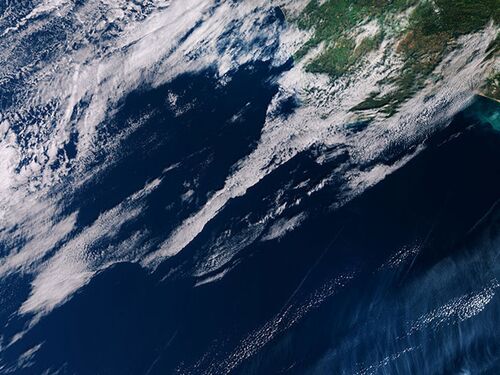
Marine cloud brightening. This idea involves adding particles to low-lying clouds over the ocean to cause the clouds to reflect more sunlight. Low clouds, particularly over dark ocean surfaces, scatter sunlight back to space that would otherwise reach and warm Earth’s surface. Adding particles could increase the surface area, lifetime, or reflective power of low-lying clouds, bouncing more sunlight back into space.
Cirrus cloud thinning. This idea seeks to reduce the thickness of ice clouds 4-8 miles (6-13 kilometers) above Earth’s surface. Cirrus clouds tend to trap more heat in the atmosphere than they reflect back to space. Thinning these clouds could allow more heat to escape from Earth’s atmosphere, producing a cooling effect.

Solar geoengineering could theoretically help cool Earth, but it raises a lot of questions.
Based on the evidence available to date, solar geoengineering has the potential to lower Earth’s surface temperature quickly. To be effective on a global scale, the strategies described above would have to be used continuously for long periods of time.
Solar geoengineering could have unintended negative consequences. For example, stratospheric aerosol injection could change critical atmospheric processes by reducing ozone, a gas in the stratosphere. The ozone layer prevents too much of the Sun’s ultraviolet radiation from reaching Earth’s surface. Models also show that stratospheric aerosol injection could affect regional climates, such as by weakening seasonal monsoons in the tropics. Additionally, it is not possible to quantify or even identify other environmental, social, political, legal, and economic risks, given the current state of knowledge.
There are steps we can take right now to slow global warming.
Greenhouse gas (GHG) emissions from burning of fossil fuels and other human activities are the main driver of global warming. Solar geoengineering would not reduce the production of GHG emissions or their impacts on ecosystems and human health and well-being. For example, using solar geoengineering approaches to cool Earth would not address the acidification of the world’s oceans and other consequences of emitting greenhouse gases to the atmosphere.
Changing how we produce and use energy can greatly reduce GHG emissions. Some ways to reduce emissions are to:
Generate electricity without emissions by using wind, solar, nuclear, and hydro power.
Power vehicles and heat buildings with electricity generated from these non GHG-emitting sources.
Use energy more efficiently.
Whether or not solar geoengineering projects move forward, it is critical to decrease the concentration of greenhouse gases in Earth’s atmosphere. Solar engineering is not a substitute for reductions in GHG emissions or for approaches that remove carbon from the atmosphere. At the same time, adaptation efforts are needed to help people and nature cope with the negative consequences of climate change that have already occurred and will occur in the future.
ADDITIONAL RESOURCES
Climate Conversations: Solar Geoengineering – National Academies of Sciences, Engineering, and Medicine
Climate Intervention: Reflecting Sunlight to Cool Earth – National Academies of Sciences, Engineering, and Medicine (2015)
National Academies of Sciences, Engineering, and Medicine – Earth Sciences | Topic
National Academies of Sciences, Engineering, and Medicine – Energy and Energy Conservation | Topic
Workshop Report on Marine Cloud Brightening – U.S. Department of Energy and National Oceanic and Atmospheric Administration (2022)
More like this



Discover
Events
Right Now & Next Up
Stay in the loop with can’t-miss sessions, live events, and activities happening over the next two days.
NAS Building Guided Tours Available!
Participate in a one-hour guided tour of the historic National Academy of Sciences building, highlighting its distinctive architecture, renowned artwork, and the intersection of art, science, and culture.