Exploring Relevant Policy Domains: Tax Policy and Population Health: Proceedings of a Workshop—in Brief (2026)
Chapter: Exploring Relevant Policy Domains: Tax Policy and Population Health: Proceedings of a Workshop - in Brief
 |
Proceedings of a Workshop—in Brief |
Convened September 29, 2025
Exploring Relevant Policy Domains: Tax Policy and Population Health
Proceedings of a Workshop—in Brief
OPENING REMARKS
Ana Diez Roux (Drexel University), cochair of the Roundtable on Population Health Improvement, welcomed participants to the second installment of the workshop series on Structural Drivers of Health: Exploring Relevant Policy Domains.1
Diez Roux noted that the roundtable set out in 2025 to explore three policy domains relevant to health, health equity, and well-being: labor and employment, taxation, and housing. The workshop summarized here, held on September 29, 2025, examined how tax policy decisions at the local, state, and federal levels influence opportunities for health across the lifespan, with attention focused on the design and distributional effects of tax systems. Diez Roux emphasized that the workshop would not include discussion of excise taxes, including “sin” taxes, which were a focus of the Roundtable’s 2017 workshop on Exploring Tax Policy to Advance Population Health, Health Equity, and Economic Prosperity.2
INTRODUCTION TO TAX POLICY
Roundtable and planning committee member Philip Alberti (AAMC Center for Health Justice) explained the goal of the workshop was for population health scientists, practitioners, and advocates to view tax policy as a largely untapped opportunity and a potential lever for improving the health and well-being of all populations in the United States. He said the workshop would be successful if participants left with new ideas about how their research, expertise, and practice could inform the development and implementation of tax policies that affect population health outcomes.
The event began with a panel that set the stage by defining tax policy, explaining what constitutes population health, and describing how the two are connected. The remainder of the workshop was organized around a life course perspective, with three panels examining the impact of tax policies designed with specific populations in mind: children, working-age adults, and older adults. Alberti noted that speakers were asked to focus on three key aspects of each policy: its origin, intent, and impacts.
Jason Fichtner (Alliance for Lifetime Income) stated that the most basic goal of tax policy is to raise enough revenue to meet government spending requirements with the least impact on market behavior. He added that tax policy is also used for social policy purposes, such as encouraging retirement savings or smoking cessation. He listed common taxes, including federal, state, and local income taxes; inheritance taxes; property taxes; payroll taxes
__________________
1 https://www.nationalacademies.org/our-work/exploring-relevant-policy-domains-tax-policy-and-population-health-a-workshop (accessed November 5, 2025).
2 https://www.nationalacademies.org/our-work/exploring-tax-policy-to-advance-population-health-health-equity-and-economic-prosperity-a-workshop (accessed November 5, 2025).
that fund Social Security and Medicare; sales taxes; and customs duties. He defined “tax expenditures” as policies that resemble spending but operate through the tax code, such as exclusions, deferrals, deductions, and credits, and noted examples, including deductions for state and local taxes, mortgage interest, and certain medical expenses. He said tax policy touches many areas, such as housing, energy, transportation, health care, and travel.
Fichtner described four criteria that economists use to evaluate tax policy: simplicity, equity, efficiency, and predictability. On simplicity, he said complexity makes compliance difficult and costly and can undermine policy intent if people cannot understand or use a provision. On equity or fairness, he distinguished three dimensions: horizontal, vertical, and generational. Horizontal equity, he explained, means that taxpayers with comparable incomes, housing, and family structures should pay around the same amount in taxes. Vertical equity refers to a progressive design where those with higher incomes pay more, while generational equity relates to the distribution of tax burdens and benefits across age cohorts, ensuring one generation does not bear a disproportionate share of the costs for programs that primarily benefit another. Fichtner added that while access to tax-advantaged programs such as retirement plans is one measure of fairness, it does not ensure equitable outcomes. On efficiency, Fichtner said taxes affect behavior, and an efficient system raises needed revenue while minimizing unintended behavioral changes. He illustrated how narrow tax bases invite avoidance and said broader bases reduce behavioral shifts. On predictability, he said people are less likely to invest or change behavior if policies are not stable or permanent, pointing to recent uncertainty around tariffs to show why predictability matters.
Fichtner asked participants to keep several additional concepts in mind, such as paying attention to the original intent of a tax policy and whether that purpose still fits current economic and social conditions. He also emphasized the importance of unintended consequences, using cigarette taxes to illustrate how high rates can encourage avoidance or evasion. He discussed tax incidence, distinguishing statutory incidence, or who remits the tax, from economic incidence, or who bears the burden. He used sales taxes to show that merchants remit the tax while consumers bear the cost. He defined direct taxes as those where statutory and economic incidence align, such as the individual income tax, and indirect taxes as those where they differ, such as sales taxes and tariffs. He said corporate income taxes are ultimately paid by people as consumers, workers, or shareholders. He summarized this point with the principle that “only people pay taxes.”
Fichtner then provided four policy examples showcasing their origin, intent, and impact. On retirement saving, he said employer plans and pre-tax or Roth options were intended to increase retirement saving and wealth building but tying participation to employers and the larger benefits for higher-income households created unintended consequences, including upside down advantages and potential effects on wealth inequality. On employer-provided health insurance, he described the World War II era origins in wage and price controls, the exclusion of employer contributions from employee taxable income, and the deduction for employers. He said the intent was to expand coverage but noted unintended consequences, including less visibility into the true cost of care for employees and distributional differences based on benefit generosity. On the home mortgage interest deduction, he said the intent was to make homeownership more affordable and to promote wealth-building and community engagement. He said the provision did not significantly increase homeownership among those who could not already afford it, functioned more as a subsidy for those who could, and contrasted deductions with credits in terms of potential effectiveness. On municipal bonds, he said the intent was to lower borrowing costs for local projects by offering interest that is not taxed to investors, which can make after-tax returns attractive. He said unintended consequences include the risk that some localities become overleveraged, up to bankruptcy in some cases, and that the tax benefit accrues more to higher-income investors.
Fichtner concluded by reiterating that these concepts form a basic framework for how economists analyze taxes across social policy areas, including health care and population health, and by restating that only people pay taxes.
Cierra Bryant (The Rippel Foundation) explained that, as an evaluator, she examines an intervention either retrospectively—after it has been implemented—or prospec-
tively, before it begins. She said this same approach can be applied to tax policy by considering its intended and unintended consequences in advance. Bryant introduced the Vital Conditions for Health and Well-Being (Vital Conditions Framework)3 (Figure 1), as a tool for assessing how a tax policy may move society closer or further away from a future in which all people and places thrive together. She described the framework as encompassing the properties of places and institutions that shape everyone’s potential to thrive over time.
Bryant explained that the Vital Conditions Framework builds on and extends the social determinants of health, offering a clearer and more action-oriented approach that has gained use at national and regional levels. She said that using the framework to evaluate tax policy helps to identify both benefits and disadvantages by asking which people and places are helped or harmed and how those effects influence the vital conditions. To illustrate the approach, she used two examples.
The first was the home mortgage interest deduction, which allows homeowners to deduct interest paid on home loans (during a given year) from taxable income. Bryant said the policy can reduce income taxes for a given year and support humane housing, meaningful work, and wealth by increasing disposable income and promoting homeownership. However, she noted that it primarily benefits existing homeowners, can widen the wealth gap, and reflects inequities in access to home loans, potentially contributing to gentrification. Her second example was the preferential tax treatment for municipal bonds, which enables investors to lend money to governments for public projects and receive tax-exempt interest income. She said the policy helps municipalities fund infrastructure and public services while supporting wealth-building for investors. Using the Vital Conditions Framework, she observed that such investments can positively affect all seven vital conditions—such as reliable transportation, lifelong learning, humane housing, and belonging and civic muscle—yet also disproportionately benefit higher-income individuals, furthering wealth inequality.
Bryant concluded that the Vital Conditions Framework equips policy makers and the public with a structured way to consider shared values, the people and places most affected by policy, the design and direction of effects, and the accessibility of participation in policy design. She emphasized that understanding tax policy impacts does not require technical expertise and encouraged participants to reflect throughout the workshop on how the framework can be used to assess tax policy.
Alberti opened the Q&A by asking the panelists how economists, policy experts, and population health experts might collaborate prospectively to anticipate the health impacts of tax policies. Fichtner said effective design requires “everyone in the room,” including policy staff
__________________
3 See https://rippel.org/vital-conditions/ (accessed November 5, 2025).
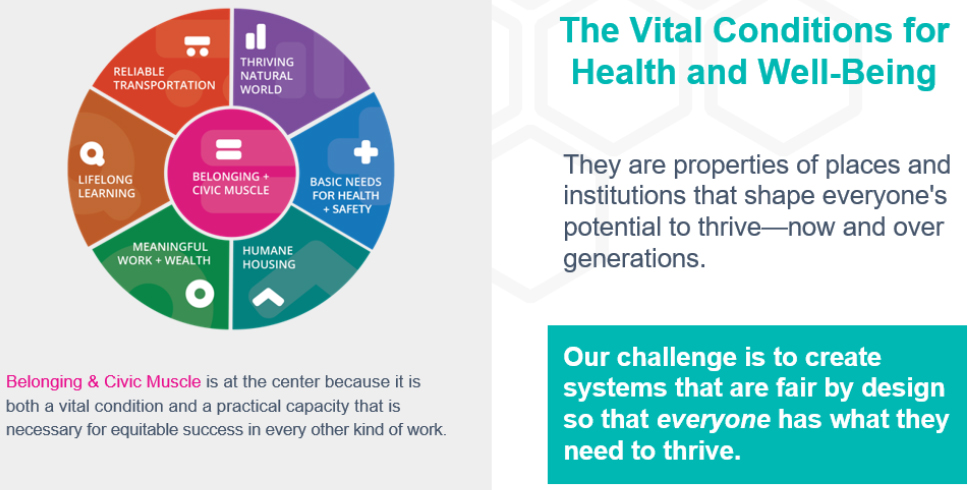
SOURCE: Presented by Cierra Bryant on September 29, 2025.
and lawyers, because taxes are one tool among many and must be considered alongside regulatory and supply constraints. Bryant said the Vital Conditions Framework can organize such collaboration by bringing in people who can speak to each vital condition and lived experience.
Responding to an audience question about Fichtner’s earlier remark that “only people pay taxes,” he explained statutory versus economic incidence, noting that for-profit hospitals remit taxes, but people ultimately bear the costs as consumers, workers, or shareholders. He used estate taxes to show that executors remit payment while beneficiaries bear the burden.
Alberti asked about the importance of community perspective on tax policies before they go into effect. Bryant emphasized listening sessions and other methods to hear from those most affected before policies take effect. Fichtner said local engagement can improve policy, citing bond and development decisions in the Washington, DC, region and noting that participation can still involve tradeoffs.
In response to an audience question about local public health levies and creating special districts, Fichtner said special districts and targeted tax preferences can incentivize investment in underserved areas and that public support is stronger when revenue sources are visibly linked to uses. Bryant added that place specificity matters and suggested directing benefits to those with the most to gain. A participant asked a related question about long-term public health financing strategies drawn from other sectors. Fichtner said broad, low-rate revenue sources that minimally affect behavior could be dedicated to public health investments.
In closing, Bryant encouraged weighing pros and cons to support equitable tax policy design by asking what groups and communities benefit or are disadvantaged. Fichtner urged a holistic approach that integrates tax design with regulatory, supply, and infrastructure considerations and involves diverse expertise. Alberti concluded this session by underscoring a focus on people and places and the value of cross-sector collaboration.
TAX TOOLS FOR CHILDREN’S WELL-BEING
Indivar Dutta-Gupta (National Academy of Social Insurance) discussed how tax policies shape access to and the quality of child care. He explained that the Child and Dependent Care Tax Credit originated in 1954 as a limited deduction for child care expenses, based on the idea that such costs should be treated like business expenses necessary for employment. The modern version was established in 1976 as more mothers entered the workforce, and many states later developed similar policies. The intent of the credit is to offset some child care costs and encourage labor force participation by making work more financially viable for parents. In practice, Dutta-Gupta noted, the effects have been uneven because the federal credit is nonrefundable. Low- and moderate-income families with little or no federal income tax liability often cannot benefit, while middle- and higher-income families receive partial reimbursement. As a result, he said, the credit disproportionately benefits those with higher incomes and does less for families most in need of assistance.
Dutta-Gupta described Dependent Care Assistance Programs, also known as dependent care flexible spending accounts, which emerged in the late 1970s and early 1980s as part of employer spending plans. The intent was to help working families manage expenses and encourage employers to offer pre-tax dependent care benefits. He said these programs largely reward higher-income workers who have access to employer-sponsored plans and the means to set aside funds in advance. In effect, he continued, the programs do little to improve child care quality or strengthen the workforce, since benefits accrue to families rather than directly to providers or the broader system of care.
In 2001, the Employer-Provided Child Care Tax Credit was established to incentivize businesses to offer or help arrange child care for their employees, said Dutta-Gupta. The intent was to encourage employers to invest in child care facilities or referral services by providing a nonrefundable credit against corporate income tax. He said the credit applies only to for-profit companies that owe federal corporate income tax and is typically used by larger, financially stable employers capable of making long-term investments. He noted that the uptake has been limited, and research shows little evidence that the policy has expanded access to or improved the quality of child care.
He also referenced other tax policies that influence child care indirectly, including the Earned Income Tax Credit and the Child Tax Credit, which affect household resources even though they are not tied to specific child care expenditures. At the state level, he highlighted Louisiana’s “school readiness” tax credits, which include refundable credits for credentialed child care workers and for programs that meet quality standards. He said these credits represent an effort to use the tax code to address workforce and quality challenges more directly than federal policies typically do.
Dutta-Gupta concluded that a comprehensive view is needed to determine when tax mechanisms are the right tool, when direct spending may be more effective, and how to modify existing policies to ensure that support reaches the families and providers most affected by child care costs.
Steven Dean (Boston University School of Law) described the Earned Income Tax Credit (EITC) as one of the most “significant and complex” tax policies in the United States, serving as the largest cash transfer program for low-income workers with children. Dean explained that the EITC’s origin traces back to economist Milton Friedman’s 1962 book Capitalism and Freedom, which proposed a “negative income tax” to replace other forms of social spending. The idea was to provide income support in a way that encouraged work rather than discouraging it. Although Friedman intended his proposal as an alternative to traditional welfare programs, the concept ultimately became a supplement. The EITC was first enacted in 1975, providing credits to 6.2 million recipients and distributing $1.25 billion in benefits.4
Dean said the EITC was designed as a wage subsidy for low-income workers to offset the burden of payroll taxes and to encourage participation in the labor force. He noted that the credit expanded significantly in the 1990s, transforming into a strong support mechanism for working families. Research, he said, has found that the EITC improves health and educational outcomes, including higher birth weights, improved reading and math scores, and an increased likelihood that children in recipient households attend college (Courtin et al., 2020).
Dean discussed both positive and unintended outcomes. He cited research showing that recipients view the EITC favorably and prefer it to traditional welfare programs because it is tied to work and delivered through the tax system. Many recipients report that receiving the credit gives them pride and motivation, viewing it as a reward for employment rather than a form of assistance (Greene, 2013). However, Dean said the credit is typically delivered as an annual refund, and it may not align with the financial realities of low-wage workers who need more regular support. He noted that efforts to distribute payments more frequently have been limited. Dean also pointed to disparities in tax enforcement, referencing a study showing that Black taxpayers are three- to five-times more likely to be audited than other taxpayers, largely driven by audit selection within EITC audits that overrepresented Black taxpayers (Elzayn et al., 2023). He said this raises concerns about fairness in the administration of tax benefits and illustrates how the design of tax enforcement systems can produce unintended harm.
In closing, Dean emphasized that the EITC demonstrates both the promise and the challenges of using the tax system to deliver social policy. It effectively supports low-income working families and yields measurable benefits for children’s well-being, but its current structure reveals ongoing issues of timing, fairness, and enforcement that warrant continued attention.
Jacob Bastian (Rutgers University) focused on the Child Tax Credit (CTC), noting that it began in 1997 as a nonrefundable credit of up to $500 per child, which was intended to provide tax relief to middle- and upper-middle-income working families. He said the credit was expanded several times, most recently in 2021 when the American Rescue Plan temporarily made it fully refundable, with monthly payments of $3,000 to $3,600 per child. He said 2021 was the year the credit substantially helped lower income families, citing declines in child poverty to 5.2 percent and reductions in food insecurity during that year.5 He added that families can currently claim up to $2,200 per child, most of which is refundable, and the program costs roughly $120 billion annually.6 He emphasized that design details determine
__________________
4 See https://www.irs.gov/pub/irs-soi/04status.pdf (accessed November 5, 2025).
5 See https://www.census.gov/library/stories/2022/09/record-drop-in-child-poverty.html (accessed November 5, 2025).
6 See https://www.irs.gov/credits-deductions/individuals/child-tax-credit (accessed November 5, 2025).
who benefits, including phase-in rates, income thresholds, and refundability, and contrasted the CTC’s slower phase-in and broad eligibility at higher incomes with the EITC’s faster phase-in and focus on lower incomes. In 2023, Bastian said, about 70 percent of CTC dollars went to families earning more than $50,000, and families earning less than $30,000 received less than 10 percent of benefits, which means the credit is more costly and less effective at reducing poverty than the EITC. He said this structure disproportionately excludes Black and Hispanic children and has implications for rural areas where incomes are lower (Bastian, 2023).
Bastian cited examples from states such as Colorado, Minnesota, New Mexico, and California, where evidence shows that state child tax credits can reduce child poverty, improve family stability, and relieve financial stress—with minimal effects on work incentives. He discussed the EITC, noting that more than 30 states and DC supplement the federal program, usually as a percentage of the federal benefit. He highlighted DC’s policy, which currently matches 70 percent of the federal credit and is scheduled to reach 100 percent in 2026.7 He explained that a low-income family with three children could receive an $8,000 federal refund that doubles to $16,000 in DC. He noted that some recipients value the lump sum as a form of forced savings, while others may prefer regular payment over time.
Similar to the EITC, he said, studies also link the CTC to improved maternal health, higher birth weights, better test scores, greater high school completion, and greater college attendance, with longer-term findings that children exposed to the credits work more, earn more, and report better health as adults (Vasan et al., 2025). He mentioned the Low-Income Housing Tax Credit (LIHTC), describing it as a primary tool for building and preserving affordable rental housing and emphasizing that the location of units matters for children’s outcomes. He stated that the design and distribution of tax credits determine how resources flow to families and places and that by “addressing income and housing needs, tax policy can enhance community capacity to support health across generations.”
Alberti asked the panel to identify design features that make tax policies for children and families more or less successful. Dutta-Gupta emphasized refundability and the practical barriers to accessing benefits, noting that nonrefundable credits exclude many low- and moderate-income families and that outreach and filing assistance affect uptake, even among those with eligibility. Bastian agreed that refundability is central and added that state and local tax systems are often less progressive than the federal system, so design details at those levels matter for reaching lower-income families. Dean highlighted administrative complexity, especially for the EITC, observing that annual lump-sum delivery does not always match household needs and that prior government attempts at more frequent payments faced reluctance from recipients who feared year-end repayments.
Bobby Milstein (The Rippel Foundation) asked about obstacles to broader adoption of credits like the CTC and EITC. Bastian said tax credits should accomplish two things—encourage work and provide a minimum standard of living. He said an effective pairing would be a pro-work EITC alongside a broadly available child benefit similar to the 2021 Child Tax Credit, arguing that careful design can support work while also setting a baseline for families who cannot work. Responding to Alberti’s question about narrative and framing for tax policies that support families and children, Dean expressed concerns about perceived work disincentives and encouraged getting support to children with as few strings as possible. Dutta-Gupta added that large sums already flow through the tax code and that “upside down” designs deliver fewer returns when benefits skew to higher incomes, which may reduce resources available for other needs; he suggested elevating the social value of raising children. Bastian said that benefits to higher-income households are less cost-effective and that reallocating toward lower-income families could reduce deficits or increase impact.
Samantha Jacoby (Center on Budget and Policy Priorities) asked panelists to compare the United States to peer countries on child benefits and health outcomes. Dutta-Gupta referenced Jane Waldfogel’s 2025 book Child Benefits, saying the United States briefly approached peer nations’ practices during the 2021 expansion but has since reverted to policies that are less generous than
__________________
7 See https://www.dcfpi.org/all/mayors-proposed-fy25-budget-would-set-back-progress/ (accessed November 5, 2025).
common child allowances abroad. He noted that paid family and medical leave interacts with child benefits to improve financial and health outcomes. Bastian described child allowances used in many high-income countries, such as Canada, as a straightforward recognition of the costs of raising children and said the 2021 Child Tax Credit resembled that approach.
A participant asked about the interplay of state and federal policy, referring to New Mexico’s policy supporting universal child care. Bastian pointed to evidence from universal prekindergarten and child care expansions that increase parental employment and produce positive spillovers for extended family members who can also enter the labor market, with broader economic and health equity effects (Jackson et al., 2025).
Sheri Johnson (University of Wisconsin) asked whether racialized tensions within a society influence the likelihood that child allowances or similar family benefits are implemented. Dutta-Gupta cited research showing that attitudes about race and immigration influence willingness to redistribute and noted that similar patterns appear in state-level programs. He pointed to the Temporary Assistance for Needy Families (TANF) program as an example of a direct spending policy that can function like a child benefit or cash allowance but is administered differently across states, with research showing that states with larger Black populations tend to provide lower benefits and impose higher sanction rates. He also highlighted the U.S. preference for in-kind programs such as the Supplemental Nutrition Assistance Program (SNAP) over cash benefits. Dean noted similar issues abroad, citing the Dutch child benefits scandal to illustrate how administrative systems can produce disparate harms. Bastian added that policies appearing to be race-neutral can produce racially disparate effects in practice, using the mortgage interest tax deduction as an example of a provision that primarily benefits higher-income white homeowners. Dean noted similar disparities in access to 401k plans, explaining that workers in blue-collar jobs are less likely to have access to such benefits, even at comparable income levels, and referenced Dorothy Brown’s 2021 book The Whiteness of Wealth to illustrate how the tax system can reinforce unfairness.
Alberti asked how to reduce filing barriers so eligible families actually receive benefits. Dean described automated tax filing systems, noting prefilled or ready-to-file returns as a proven approach in some jurisdictions and said industry opposition has impeded wider adoption in the United States; he added that complexity tied to delivering social policy through the tax code also limits simplification. Dutta-Gupta called for more outreach, free public filing options that safely prepopulate data, and clearer rules, noting that complex family circumstances such as shared custody often collide with rigid eligibility criteria.
Alberti welcomed the panelists to provide any closing statements. Dutta-Gupta said delivering supports through the tax system can reduce stigma and be administratively efficient when designed well, but it is not inherently suited to all goals. Dean underscored both the power and the risks of tax delivery, noting evidence that Black taxpayers are audited at higher rates in part due to EITC audit selection, which raises concerns about fairness, even when program impacts are strong.
TAX POLICY FOR WORKING ADULTS
Alberti introduced the next panel of speakers, who discussed how tax policies impact working age adults: Kimberly Clausing, UCLA School of Law; Benjamin Harris, The Brookings Institution; and Suyapa Miranda, Prepare + Prosper. Clausing opened by speaking about climate change and its connection to tax policy. She explained that the continued rise in fossil fuel emissions is a pressing concern and noted that the United States is falling behind its 2030 reduction targets. Carbon fees, in which industries emitting large amounts of carbon are charged a fee, are one option to make progress toward reducing emissions, Clausing said. She shared her recent paper, which showed that, on average, climate change costs a United States’ household $900 per year (BPEA, 2025; Clausing et al., 2025). Clausing explained that the cost to households stems from two main factors: (1) increased home insurance costs due to a higher number of natural disasters and (2) mortality and health costs, especially from the health effects of exposure to particulate matter in wildfire smoke. The costs have a higher burden on low-income households, which must spend a larger
share of their income on expenses such as insurance, she noted.
Discussing the role of tax policy, Clausing said the repeal of energy tax credits has increased energy costs for households, placing an emphasis on the importance of a carbon fee. She said an effective carbon fee could reduce household costs through utility rebates and gas exemption and could be coupled with tax reform and tax cuts for low-income households. A carbon fee, Clausing explained, would also raise money for the government, which could be put toward initiatives such as health insurance affordability or expansions of the CTC and EITC. Clausing recognized that, together, the G20 countries account for 80 percent of global carbon emissions, and currently, 17 of these countries have implemented a carbon pricing system. The United States, she noted, is one that has not. A carbon tax could be effective in both lowering household costs associated with climate change and positively contributing toward a global solution, she stated.
Harris spoke next about housing and retirement saving tax expenditures. He noted three main housing tax expenditures: capital gains exclusion on principal residences, deduction of mortgage interest on owner-occupied homes, and Low-Income Housing Tax Credit. Elaborating on intent, he said the capital gains exclusion on principal residences was designed to increase homeowners’ mobility by reducing tax costs of “involuntary transfers,” such as relocating for work, and to ease compliance burden. The intent of the deduction of mortgage interest was initially justified as a pro-homeownership tax incentive, but real intent was never established, he continued. Harris noted that the economic impact has been incentivizing debt and pushing people into larger and more expensive homes, although it has not increased homeownership overall. For the Low-Income Housing Tax Credit, Harris said the intent was to increase affordability of housing by inducing more private capital toward construction and rehabilitation of housing for low-income families.
Retirement saving tax expenditures, he said, include retirement plans for sole proprietorships, defined benefit plans (e.g. pensions), defined contribution plans (e.g. 401ks), traditional and Roth individual retirement accounts (IRAs), and the Saver’s Match. Regarding intent, Harris explained that these retirement tax incentives are aimed at creating financial stability in retirement and less dependence on social support, capital formation (theoretically boosting aggregate saving), and limiting “double taxation” of business profits. He shared impacts of these plans, including that the worker does not bear the investment, longevity, or inflation risk. Additionally, Harris noted that low-income taxpayers tend to put a relatively small amount in 401ks, and the plans contribute minimally to net increased savings.
Miranda provided background on Prepare + Prosper, the largest free tax clinic in Minnesota. She shared that the organization serves about 13,000 people (many Spanish-speaking) and annually facilitates over $24 million back to individuals and families. Minnesota is currently one of the largest recipients of the Child Tax Credit in the United States, Miranda continued. She noted that, for many people, there is a fear associated with filing taxes and that Prepare + Prosper provides support and relationship-building to support communities through the process, including helping people get back on track after falling behind on filing.
Transitioning to questions, Alberti asked the panelists how to achieve more balance in the tax system and ensure that households benefit. Clausing said one key feature in tax reform over the last few decades is that the tax rate on capital income has decreased significantly. She also noted how, at times, there have been expansions of the CTC and EITC. One challenge moving forward is determining how to raise revenue that adequately funds the government without burdening those struggling financially, Clausing continued. A tax system that is more generous to those at the bottom, she said, could be funded by increased taxes on capital and corporate income. She explained that it is important to have both a light tax burden on low-income households and to have well-funded state services to avoid financial distress for low-income households. Harris responded that, in general, it would be helpful to direct tax incentives toward households and expand supply, especially of low-income housing. He also said a tradeoff could limit tax benefits for high-income individuals and put money toward the
Saver’s Match, which would benefit low- and middle-income workers.
Alberti asked the speakers to discuss the importance of tax administration and collecting the tax that is due to ensure taxpayers’ return on investment. Clausing noted some main effects on households of collecting less tax than is due. First, either tax is collected elsewhere on the taxpayer, government services are cut, or big deficits are created. If government services are cut, she said support for filing taxes is unavailable and refunds might be delayed. Other effects on households are that IRS audits are poorly targeted due to lack of updated computer and artificial intelligence (AI) technology; and there are issues around tax morale, with people feeling that the tax system is unfair and that not everyone is paying their share, Clausing continued. Harris said that having a tax administrator that collects all owed taxes would decrease the number of industries and individuals that evade taxes.
Next, Alberti asked Miranda about tax-related fears that her organization encounters and how to make the tax filing process more equitable. Miranda said many people fear anything associated with the government and are afraid of owing money. She noted that her organization values education and information-sharing with communities and helps people create payment structures. Miranda also explained that due to a lack of information, many people end up paying more in taxes than necessary.
Jacoby asked how the federal government has used tax policy to help households during recessions. Clausing said that “automatic stabilizers,” such as unemployment insurance, play an important role and that additional automatic policies and features would be beneficial. Harris agreed and stated it would be helpful to have more sophisticated and flexible tax policies that do not rely on Congressional action.
Alberti noted that the benefits of public health policies can be difficult for policy makers to see, compared to other public policies, and asked speakers how to effectively communicate the future economic gains of current investment in public health infrastructure through tax policy. Harris said that evaluation of tax expenditures to examine whether they have the intended effects is lacking and would be an important step. Alberti acknowledged that focusing on evaluation relates to Bryant’s earlier remarks regarding the relationship between tax policy and the vital conditions for health and said that evaluation can be done both retroactively and prospectively. Clausing added that communicating more directly with the public about how various taxes impact their future could be beneficial and prevent taxes from being thought of in isolation. For example, she said, policy makers could make effects more visible by noting how taxes could provide support during a recession or public health emergency or make retirement more secure.
Lastly, Alberti asked Miranda, given her experience working with people, what she would tell state and federal policy makers about the top effects of tax policies on people. Miranda said that walking in the shoes of community members would be eye-opening and aid in understanding that some people live with circumstances that make it necessary to stretch their income to last as long as possible. Offering final thoughts, Clausing said it is important to reflect on the sustainability of the tax system as a whole and the fiscal future in the United States, and she noted that the tax burden is rising for low- and middle-income people and falling for those at the top. Harris added that when considering tax policy changes, it is important to think within the realm of what changes are plausible and do not require redesigning an entire system from scratch.
SECURING HEALTH AND WEALTH IN LATER LIFE
The final panel focused on health and wealth in later life and on tax policy in the context of retirement age. Alberti introduced the three panelists: Surya Kolluri, TIAA Institute (TIAA); Teresa Ghilarducci, The New School; and Ben Veghte, WA Cares Fund. Ghilarducci began by recognizing the uniqueness of the administration of social insurance policies in the United States through the tax code (e.g. retirement, health, Social Security) and noted how these policies also act as automatic stabilizers. However, she said the administration of retirement policies has gotten more expensive. Ghilarducci stated that deductions for 401ks, 403bs, defined benefit plans, and IRAs, amounts to approximately 1.5 percent of gross domestic product (GDP) which she said is about $250-$400 billion per year. Speaking about the origins of retirement accounts,
Ghilarducci explained that they began when the income tax was implemented and Congress gave tax breaks for employee contribution to retirement accounts. In the 1940s, nondiscrimination rules were put in place that required employers to prove that a certain percentage of their low-income workers were covered by this tax break, she continued. Ghilarducci said that the intent of the plans was “to be fair,” promote retirement security, and help high-income and non-union workers save.
She explained that in 1978, a section of the tax code called 401(k) was created, which was intended to allow high-income executives to save in their retirement accounts tax-free, and it had the unintended consequence of most retirement accounts in the United States being shifted to that type. Ghilarducci said there was an expectation that the use of 401(k)s would be universally adopted by all employers but that, in fact, only about 50 percent of the U.S. workforce is currently covered by them, limiting many people’s ability to regularly save for retirement. She emphasized that this system favors those with steady, long-term jobs and those whose income increases over time. Additionally, she noted that these accounts are used more often as emergency savings accounts rather than retirement accounts.
Ghilarducci said that creating a universal pension system requires bold action. She highlighted a paper she wrote with colleague Kevin Hassett in 2021, which explored the effectiveness of the thrift savings plan for federal workers and examined how its design elements (e.g. employer matched and automatic enrollment) could be applied more broadly to increase all workers’ retirement savings.8 This idea was transformed into a bill called the Retirement Savings for Americans Act9 (currently in Congress), which is intended to be a universal retirement account for all workers, Ghilarducci continued. She said with this policy, people would be automatically enrolled and those whose income is below $50,000 would receive a 1 to 5 percent match by the federal government, depending on how much they contribute.10 This universal plan would help workers build wealth and allow low-wage workers to have retirement security, Ghilarducci stated.
Kolluri spoke next about longevity risk and longevity literacy. He said that longevity risk is the possibility that a person lives longer than they expect and run short on money as a result. Longevity literacy concerns a person’s understanding of how long individuals tend to live in retirement, which strongly influences their expectations (and preparations) for their own lifespan. Regarding the connections between health and wealth, Kolluri said individuals should plan and take actions to ensure that a longer life means more healthy years and that they are financially prepared to enjoy such a longer, healthier life. He mentioned two policy areas related to increasing longevity that are a particular focus for the TIAA Institute: caregiving and lifetime income.
Kolluri explained the Lowering Costs for Caregivers Act,11 also currently in Congress, would allow caregivers to use their health savings accounts and flexible spending accounts to cover caregiving costs. The effects would be impactful, he said, because informal caregiving costs are about $7,000 annually per person (if the person does not have a disability). Kolluri added that during the COVID19 pandemic, research at TIAA found that many people withdrew money from their 401k accounts for caregiving reasons. Regarding lifetime income, he stated that TIAA is examining how to provide lifetime income to prevent people from incurring longevity risk. Specifically, he said, they are exploring the transformation of defined contribution plans from a focus on accumulation to a more comprehensive retirement security focus, which TIAA refers to as the Retirement Bill of Rights12 (including low-income solutions and access to education, such as longevity literacy). Kolluri shared that through his research, he has found that increased longevity literacy results in a person being more likely to make financial decisions that are in their best interest.
__________________
8 For more information on Ghilarducci and Hassett’s proposal, see https://eig.org/bipartisan-pair-of-economists-propose-bold-new-wealth-building-program-for-the-bottom-50-percent-of-american-workers/ (accessed October 24, 2025).
9 For more information, see https://smucker.house.gov/sites/evo-subsites/smucker.house.gov/files/evo-media-document/rsaa-one-pager_119.pdf and https://smucker.house.gov/media/press-releases/smucker-sewell-tillis-and-hickenlooper-reintroduce-retirement-savings (accessed October 24, 2025).
10 The Retirement Savings for Americans Act eligibility relates to the applicable median income which may differ by year. For more information see https://www.congress.gov/bill/117th-congress/senate-bill/5271 (accessed December 17, 2025).
11 For more information, see https://www.rosen.senate.gov/2025/05/01/rosen-cassidy-introduce-bipartisan-bill-to-lower-costs-for-caregivers/ (accessed October 24, 2025).
12 For more information, see https://www.tiaa.org/public/pdf/t/tny-tiaa-rbor-digital-vertical-pgr-srgb.pdf (accessed October 24, 2025).
Veghte spoke about the WA Cares Fund13, a universal public long-term care insurance program in Washington State. The program works like Medicare Hospital Insurance: workers contribute mandatorily from their first paycheck to their last and thereby earn access to insurance benefits when they need them. He noted that seven out of ten people in the United States need long-term care as they age, and this care is not covered by Medicare or other health insurance, or Medicaid (unless the person has spent down their life savings to less than $2,000). Most people (83 percent in the state of Washington) approach retirement without adequate savings to pay for long-term care, Veghte continued, and he emphasized that over the coming decades, the number of people aged 80 or older is rising fast, while the subsequent generations are stagnant. As a result, while there were seven people of prime caregiving age (45-64) for every person likely to need care (80 or older in 2010), that ratio will decline to 3:1 by 2050.
Veghte explained that the WA Cares Fund provides a mechanism by which all workers can set money aside during their working years to prepare for the risk of needing long-term care in later years, allowing them to age with more dignity and independence. The premium of this program, he noted, is 0.58 percent of a worker’s wages. Veghte shared that he thinks it is important to refer to initiatives like this as “programs” and not just as a “benefit” or “tax” so that they are understood more holistically. In WA Cares, he said that a worker earning the median covered wage of $59,000 contributes about $29 per month (roughly, $10,000 over 30 years) and thereby earns a lifetime benefit of $36,500 (growing automatically with inflation). Veghte shared that one interesting effect of the WA Cares Fund is that it created space for a supplemental, private, long-term care insurance market. The Washington legislature enacted the statutory framework for this market in 2025, and carriers are currently working on policies to launch in the next year or two. These policies would offer workers more coverage on top of the WA Cares benefit, he continued.
Veghte closed by speaking about the benefits of universal coverage, or a mandatory payroll tax. He said it mitigates three “profound inequities” in the current long-term care system: access to care, the burden on family caregivers, and low-wage caregiving jobs that lack benefits. The result of universal coverage, he said, would be increased access to long-term care, family caregiving burden spread evenly across the workforce because everyone would pay into the benefit fund, and increased funds for the caregiving workforce, which would improve job quality and increase wages. Veghte also said that over time, universal coverage could create a constituency that advocates for improvements in the quality and affordability of the long-term care delivery system as well.
Transitioning to discussion, Alberti asked the panelists whether they have examined the real and/or potential health impacts of the policies presented (e.g. Retirement Savings for Americans Act, Retirement Bill of Rights, and WA Cares). Ghilarducci noted that with Medicare and Social Security, it was not Medicare that resulted in increased longevity and less morbidity, but rather both outcomes came from the growing Social Security benefits. This would suggest, she said, that universal coverage would improve health due to positive effects of increased income. She also mentioned research on the potential links between financial and job insecurity over the life course, as well as increased cortisol and stress levels, which negatively impact health during retirement age. Kolluri said the TIAA Institute is working to understand the behavioral economic impact of solutions because it is important to both help people understand the retirement planning resources available and offer behavioral finance interventions to help them succeed. Veghte added that having financial resources in older age due to social insurance can increase people’s choices, which otherwise are typically limited at this vulnerable age. He pointed to research in the Netherlands that showed early access to home care improves health and well-being and reduces the use of long-term care. This results in less money spent on nursing homes and end-of-life medical interventions, he continued. Veghte emphasized that, moving forward, it is important to have a national dialogue about what Americans want to prioritize with regard to public supports in the final decade of life. Currently, he said, the United States spends much more than other countries on end-of-life medical interventions that may extend life by
__________________
13 For more information, see https://wacaresfund.wa.gov/ (accessed October 21, 2025).
only a few months or a year, while spending much less on supporting aging in place, which can support greater quality of life in one’s final years. Redirecting some resources to quality retirement and assisted living communities or independent living with supportive services could help many people afford these options and improve their quality of life and happiness.
Reflecting on the research in other countries, Alberti asked speakers about the differences between individualism and collectivism and the impact on how the retirement system in the United States compares to that in other countries. Kolluri said the TIAA Institute has examined approximately 14 countries and grouped them into collective choice and individual choice and analyzed whether each group adequately generates enough money for retirees. He highlighted that countries like the Netherlands, which have historically ranked high in terms of collectivism and adequacy, are reforming to incorporate aspects of individualism because their system is no longer sustainable. Similarly, Kolluri noted how individualistic countries like the United States are now considering collective approaches such as guaranteed income. Therefore, he said, a hybrid system is likely to emerge and become more common in the coming years.
Veghte shared that based on his experience working in Washington, he thinks that a social insurance program for long-term care is consistent with American political culture. He found that voters are open to expanding the social contract to make life more affordable.. This includes finding ways to support families in affording long-term care. A universal social insurance program for long-term care, like WA Cares, also reduces economic inequality as well as gender and racial inequities in old age, Veghte said. Ghilarducci agreed with Veghte that addressing the retirement tax policy landscape through a class, race, and gender equity lens is important because 401ks still primarily benefit those who are white, men, and high-income. Kolluri noted the need to close the gap between lifespan, health span, and wealth span, so people can live longer lives that are more fulfilling and healthier. Veghte added the importance of increasing investment in the later decades of life to improve health outcomes after age 80 and said the United States could learn from other countries with a universal social insurance program for long-term care.
CLOSING REMARKS
Diez Roux closed by highlighting five themes that arose throughout the workshop. First, she noted that tax policy is a “major force” impacting population health, with implications over the life course. Taxes affect health through several processes, she continued, such as by delivering social insurance or through environmental impacts of carbon taxes. Second, Diez Roux said that even a narrowly defined tax can have widespread positive and negative effects, whether intended or not, and she highlighted Bryant’s example of how a single tax policy can affect multiple vital conditions due to complex social systems. The third theme, she continued, is that tax policy impacts health equity, both in terms of its design features and outcomes. Fourth, Diez Roux noted the opportunity for and importance of health impact assessment of taxes to assess and predict the health impacts of a particular policy and to identify ways to prevent adverse effects. Lastly, she highlighted the importance of narrative framing, community engagement, and the connections between tax policies and societal values. Diez Roux shared that, looking forward, she hopes the population health field will more sufficiently understand and emphasize the power of tax policy.
Roundtable member Bobby Milstein (ReThink Health and The Rippel Foundation) elevated a point made earlier about taxes being “positive freedoms” rather than burdens and said that perspective is aligned well with the vital conditions, which he explained are intended to be expressions of freedoms. He also emphasized the point Diez Roux made about the importance of examining in combination the design and effects of tax policies that have been in effect for many years.
Roundtable member Lorna Thorpe (NYU Grossman School of Medicine) reflected on how struck she was by the last panel on health and wealth in later life because of the significant gaps in access to retirement savings and long-term care in the United States. Veghte responded that the United States is at an inflection point, especially with many working people feeling left behind, and it is important now to reimagine new possibilities in designing tax policies.
REFERENCES
Bastian, J. 2023. Designing a better child tax credit: Accounting for effects on poverty, parental employment and government budgets. https://www.rstreet.org/wp-content/uploads/2023/02/Final-Study-No.-276.pdf (accessed October 24, 2025).
Clausing, K. A., C. R. Knittel, and C. Wolfram. 2025. Who bears the burden of climate inaction? Brookings Papers on Economic Activity, Brookings Institute, September. https://www.brookings.edu/articles/who-bears-the-burden-of-climate-inaction/ (accessed October 24, 2025).
Courtin, E., K. Aloisi, C. Miller, H. L. Allen, L. F. Katz, and P. Muennig. 2020. The health effects of expanding the Earned Income Tax Credit: Results from New York City. Health Affairs (Millwood). Jul;39(7):1149-1156. https://doi.org/10.1377/hlthaff.2019.01556.
Elzayn, H., E. Smith, T. Hertz, A. Ramesh, R. Fisher, D. E. Ho, and J. Goldin. 2023. Measuring and mitigating racial disparities in tax audits. January. https://siepr.stanford.edu/publications/working-paper/measuring-and-mitigating-racial-disparities-tax-audits (accessed October 24, 2025).
Greene, S. S. 2013. The broken safety net: A study of Earned Income Tax Credit recipients and a proposal for repair. N.Y.U. Law Review 88:515-522.
Jackson, C. K., J. A. Turner, and J. Bastian. 2025. Universal Pre-K as economic stimulus: Evidence from nine states and large cities in the U.S. National Bureau of Economic Research. https://www.nber.org/papers/w33767#:~:text=While%20Universal%20Pre%2DKindergarten%20(UPK,revenues%20might%20fully%20cover%20costs.
Vasan, A., J. I. Wood, X. Luan, C. C. Kenyon, and M. Matone. 2025. Expanded child tax credit payments during pregnancy were associated with decreased odds of adverse birth outcomes. Health Affairs 44(10):1298-1306. https://doi.org/10.1377/hlthaff.2024.01641.
DISCLAIMER This Proceedings of a Workshop—in Brief was prepared by Alexandra Andrada Silver and Stephanie Puwalski as a factual summary of what occurred at the workshop. The statements made are those of the rapporteurs or individual workshop participants and do not necessarily represent the views of all workshop participants; the planning committee; or the National Academies of Sciences, Engineering, and Medicine.
PLANNING COMMITTEE Philip Alberti (Chair), Association of American Medical Colleges; Veronique de Rugy, George Mason University; Ana Diez Roux, Drexel University; Jason Fichtner, Alliance for Lifetime Income; Samantha Jacoby, Center on Budget and Policy Priorities; Bobby Milstein, ReThink Health; Diane Schanzenbach, Georgetown University. The National Academies’ planning committees are solely responsible for organizing the workshop, identifying topics, and choosing speakers. Responsibility for the final content rests entirely with the rapporteurs and the National Academies.
REVIEWERS To ensure that it meets institutional standards for quality and objectivity, this Proceedings of a Workshop—in Brief was reviewed by Samantha Jacoby, Center on Budget and Policy Priorities; Elaine Maag, Urban Institute; and Jason Orr, University of Minnesota. Leslie Sim, National Academies of Sciences, Engineering, and Medicine, served as the review coordinator.
SPONSORS This workshop was partially supported by Association of American Medical Colleges, Blue Shield of California Foundation, Fannie E. Rippel Foundation, Nemours, NYU Langone Health, Robert Wood Johnson Foundation, The Kresge Foundation, and Thomas Jefferson University. Any opinions, findings, conclusions, or recommendations expressed in this publication do not necessarily reflect the views of any organization or agency that provided support for the project.
STAFF Maggie Anderson, Research Assistant; Alexandra Andrada Silver, Program Officer; Alina Baciu, Roundtable Director; and Stephanie Puwalski, Research Associate.
SUGGESTED CITATION National Academies of Sciences, Engineering, and Medicine. 2025. Exploring Relevant Policy Domains: Tax Policy and Population Health: Proceedings of a Workshop—in Brief. Washington, DC: National Academies Press. https://doi.org/10.17226/29361.
For additional information regarding the workshop, visit https://www.nationalacademies.org/event/45453_09-2025_exploring-relevant-policy-domains-tax-policy-and-population-health-a-workshop.
|
Copyright 2026 by the National Academy of Sciences. All rights reserved. |
 |


